



Abstract
Advanced economies lack mechanisms for spotlighting lifelong learning needs and helping higher education institutions provide programs and activities which serve these. This paper presents research underway in Singapore since 2019 which has sought ways to help institutions to identify and meet opportunities to deliver lifelong learning. The paper sets out the policy context, articulates a validated indicator framework, discusses prospects for deployment, and touches on implications for Asia and beyond. The analysis sheds light on this important Singapore context and is immediately relevant to all high-participation higher education systems and advanced economies across Asia around the world. The paper makes a policy contribution and contributes to a growing body of research focused on higher education and lifelong learning.
Reframing lifelong learning
In recent decades, higher education has expanded substantially in many countries, opening opportunities for hundreds of millions more people to obtain degrees and engage in professional work. Expansion interests have tended to focus initially on expanding bachelor- then master-level qualifications for school leavers. In the last decade, attention has broadened to consider the expansion of opportunities for adult and lifelong learners. In countries which built high-participation tertiary education systems since the 1990s, including advanced knowledge economies in Europe, Asia Pacific and the Americas, there is pressing and widescale interest in finding ways to make higher education available to mature age students and either up- or reskill workers who received initial qualifications typically many decades before. It is apparent, however, that advanced economies lack mechanisms for spotlighting lifelong learning needs and helping higher education institutions provide programs and activities which serve these. This fuels a need for education research which can underpin policy innovation.
To this end, this paper presents research underway in Singapore since 2019 which has sought ways to help institutions to identify and meet opportunities to deliver lifelong learning. Following this introductory section, the paper sets out the policy context, articulates a validated indicator framework, discusses prospects for deployment, and touches on implications for Asia and beyond. The analysis sheds light on the important Singapore context and, as we clarify in conclusion, is immediately relevant to all high-participation higher education systems and advanced economies around the world. Hence, the paper makes a policy contribution and contributes to a growing body of research focused on the evolving role of higher education and lifelong learning.
The need for greater clarity in this area is driven by an evolving set of education and skills sector rationales, and by broader economic circumstances. Sketching changing demands for higher education helps to understand the need for different forms of supply.
Demand for lifelong learning is buoyed by an accumulation of factors. Most broadly, higher education institutions in Singapore have been subject to the development of three macro-level policies. The first is the Smart Nation Policy which was launched in 2014 with the aim of placing technology at the heart of the economy, government and society (Ng, 2019). The second is the SkillsFuture policy which focuses on workforce capability with a particular reference to lifelong learning. The third is the diversification of higher education provision, moving from a relatively small number of higher education institutions (up until 20 years ago) to a variety of current higher learning providers, including technology-focused universities, colleges of arts and foreign institutions specialising in management and law (Gleason, 2018).
At the occupational level, economic advance also spurs an ongoing swing towards professional roles which require higher education. This generates demand for provision of bachelor and master’s degrees to post-school learners. Universal participation rates in higher education over recent decades have led to high levels of degree attainment and stimulated larger demand for continuous reskilling. Such demand has been amplified as professionals work for longer and need career-long reskilling to service more mobile careers. Pandemic-related disruptions have fuelled demand further. While the specifics of such demand are nuanced by particular circumstances, it is clear that in decades to come, demand for post-secondary education will look different than it did at the turn of the century. As this brief summary conveys, an important facet of this difference is the much larger and more diverse market for what we refer to as ‘lifelong learning’.
‘Lifelong learning’ is a difficult term to corral. Building on earlier conceptual and definitional work (James, 2020), for the purposes of this paper and the research it discusses, the term includes a broad array of post-compulsory education activities. Certainly, we embrace various forms of higher level ‘adult learning’. We include but largely look beyond graduate qualifications which people take directly after undergraduate studies and prior to full-time entry into the workforce. We include professional and executive education, irrespective of whether it is credit or non–credit-bearing, vocationally compulsory or completely voluntary. Clearly, this attempt at definition almost provokes more questions than it answers, which itself conveys much about the inherent diversity of this growing area of higher education. To sustain broad scope and relevance, therefore, this research deliberately did not attempt to artificially reduce or articulate the activities or programs under consideration. In addition, as explained later, lifelong learning under the SkillsFuture policy includes emphasis on learners returning to learning after leaving formal education, the concept of ‘skills mastery’ (deep learning that is based on personal ‘passion’) and career development (Shanmugaratnam, 2014).
Higher education institutions have not waited to clarify definitions, of course, and substantial investments are being made to serve this surging demand. Traditionally, adult and lifelong learning has been somewhat marginalised in universities, relegated to small units or to units with no clear strategic role. But this is changing swiftly. Universities have been investing in online and hybrid learning, alternative credentials, redesigned learning resources and embracing an array of partnerships (Coates, 2020). Such initiatives have been constructed in response to the demand dynamics identified above, to tap into new sources of funding and to counter new commercial players entering the global institutional marketplace (Yang et al., 2015). Higher education institutions are manoeuvring to become regionally or globally positioned, and expand their engagement with employers to improve students’ employability.
While institution-, discipline- and profession-specific efforts are important, it is hard to ‘add up’ such initiatives in ways which help understand, design, incentivise and regulate these new markets. Indeed, unleashing a swarm of freemium or priced non-credit or credit-bearing online resources, even with ‘stacking potential’, badges or microcredits, is likely to multiply complexity and confusion, and hinder clarity and progress where it is needed most. Established university evaluations and regulations do little to articulate the environment and have in fact shifted attention away from lifelong learning into degrees and research. Even and especially if the market for lifelong education is likely to be largely commercial and private in nature, there is a need to clarify what is going on, how institutions can contribute and how to make it worthwhile for them to bother. Finding policy and educational coherence is important for future growth and contribution (Tamez, 2014; Lauder, 2020).
This milieu spurs the need to for a raft of new far-reaching education arrangements which, broadly, work to engage and facilitate the engagement of higher education institutions in lifelong learning. Hence, there is the need to establish policy infrastructure, for new policy-relevant information and discourse, and for revised funding and regulatory arrangements. The balance of this paper reveals design and development work on each of these fronts, starting with discussion of the establishment of policy infrastructure.
Policy infrastructure: Skills future Singapore
The research reported in this paper is framed by what appears to be one of the world’s leading policies regarding lifelong learning, SkillsFuture. Around the world, the SkillsFuture program is being highlighted as an example of a comprehensive lifelong learning program (Head, 2019; Oosi et al., 2019; Ra et al., 2019). SkillsFuture has garnered attention because unlike past efforts that focus on training workers through ad-hoc programmes on a vocationally specific and productivity-related budget, the SkillsFuture movement is an ambitious and nation-wide initiative, sometimes described as a ‘movement’, reflecting the inclusive intention of the policy (Tan, 2017).
Prior to the launch of SkillsFuture, Singapore had various continuing education and training initiatives such as the Workforce Skills Qualifications (WSQ), a national credential system, that offers varying levels of certifications to workers based on industry-recognised competencies (Oosi et al., 2019). With the launch of Skillsfuture in 2015, the array of continuing education and training programmes were consolidated as a ‘national movement to provide Singaporeans with the opportunities to develop their fullest potential throughout life, regardless of their starting points’ (Ministry of Manpower, 2018, para. (1). SkillsFuture comprises initiatives for all Singaporeans, including students, employees, employers, training providers and adult educators. The initiatives have the following four basic thrusts: ‘(1) help individuals make well-informed choices in education, training and careers, (2) develop an integrated high-quality system of education and training that responds to constantly evolving needs, (3) promote employer recognition and career development based on skills and mastery and (4) foster a culture that supports and celebrates lifelong learning’ (Ministry of Manpower, 2014, para. (3); Skillsfuture, 2021, para. (4). For example, as one among a variety of funding supports, SkillsFuture Credit is one initiative by which each Singaporean 25 years and above is given an individual learning account with S$500 to pay for courses offered by many training course providers. In 2020, a S$500 top-up was announced for Singaporeans 25 years and above, and an additional S$500 credit was given to Singaporeans aged 40 to 60 (Co, 2020a). In principle, SkillsFuture Credit will be continually ‘toped-up’, depending on the rate of utilisation.
As a training-specific statutory board under the Ministry of Education, SkillsFuture Singapore has ownership of the SkillsFuture policy. It can connect closely with the strengths of higher education institutions as well as private training providers to drive SkillsFuture’s endeavours towards lifelong learning (Oosi et al., 2019). In a policy analysis, Woo (2018) found that there was significant synergy between SkillsFuture’s policy goals and Singapore’s higher education system. The synergy is strengthened by ongoing efforts at integrating SkillsFuture initiatives with various aspects of Singapore’s higher education system (Woo, 2018). One example initiative is the SkillsFuture work-study programs that provide opportunities ranging from diploma, degree and postgraduate levels as offered by institutes of higher learning, private providers and industry partners appointed by SkillsFuture. For example, the Work-Study Degree Programme (WSDeg) is offered by various universities such as Singapore Institute of Technology (SIT), Singapore University of Social Sciences, National University of Singapore (NUS) and Nanyang Technological University (NTU). As of August 2020, more than 5600 individuals and over 1600 companies have engaged in work-study programmes since its launch in 2015 (Co, 2020b).
One of the main objectives of SkillsFuture is to promote recognition and career development based on skills and mastery. Since the launch of SkillsFuture, it has been reiterated that having qualifications and being competent at a current job are no longer sufficient to keep pace with the needs of fast-evolving economies. It is skills which now carry a premium and need to be honed throughout individuals’ lifetimes (Toh, 2017). Given that the development of skills through continuing education and training had not been the primary remit of higher education institutions, as part of the SkillsFuture movement, all public universities set up a lifelong learning unit in 2016 to deliver shorter courses geared towards mid-career adults (Basu, 2016). For instance, at NUS, the lifelong learning unit, called the School of Continuing and Lifelong Education, offers a variety of programs including certificate courses, undergraduate and postgraduate degrees as well as continuing and education training (CET) courses. One CET course is the SGUnited Skills program which is targeted for working professionals affected by COVID-19. The program seeks to help job seekers obtain industry-relevant skills to improve employability. The SGUnited Skills program, introduced by SkillsFuture, is part of a range of initiatives within the Singapore Government’s SGUnited Jobs and Skills package which was launched in 2020 in response to the Covid-19 pandemic. As of July 2021, almost 44,000 job seekers have found jobs through career matching services under this program (Lim, 2021).
In summary, it is imperative to stress that SkillsFuture is not just a revamping and reorganisation of existing continuing education and training initiatives (Sung & Freebody, 2017). SkillsFuture embraces lifelong learning with the aim of empowering ‘each Singaporean to chart their own journey in life, and gain fulfilment at work and even in their senior years’ (Shanmugaratnam, 2014) and promotes lifelong learning for economic development as well as for developing the fullest potential of Singaporeans (Woo, 2018). There has been a great deal of effort to incorporate SkillsFuture lifelong learning into higher education in Singapore by integrating policies so that the goals of SkillsFuture and institutes of higher learning are aligned (Woo, 2018). In reforming higher education, Ong, the Minister of Education for Higher Education and Skills in 2018, envisioned that the impact of higher education is no longer just for education and changing the lives of students. Instead, higher learning institutions in Singapore should play a wide-ranging role from promoting lifelong learning to driving innovation and enterprise, and from guiding future entrepreneurs to keeping industries at the forefront (Ong, 2018). The Minister noted that an important challenge was finding a means to measure and benchmark the impact of higher education on society and the economy.
Framework design and prototyping
The preceding background has showcased the foresight, nature and perspective of SkillsFuture. It has articulated SkillsFuture as a policy mechanism for enacting the kind of educational change outlined at the outset of this paper. As the statistics convey, it has already captured and spurred many intended reforms. One missing link, however, is a mechanism to incentivise higher education institutions to engage. As Ong’s remarks convey, soon after the establishment of SkillsFuture, it was foreseen that different information, hence, indicators were needed to undergird emerging governmental and institutional settings.
With this setting and momentum in mind, planning was conducted in late 2018 to clarify the kind of research and development required. While there is already a body of exploratory and investigative research on lifelong learning in the context of higher education, clearly insights and recommendations from researchers, policymakers and advisors were failing to spur the kind of momentum and direction required (Yang et al., 2015; Sung & Freebody, 2017). It was determined, accordingly, to construct a generalisable set of metrics which could inform people across the higher education sector, in particular institution and government leaders.
The current research was launched, therefore, with an aim to design a framework with indicators to propel higher education institutions to engage in higher lifelong learning. Ultimately, this comparison instrument sought to make available information on the suitability and capacity of institutions to provide more varied forms of education to people across a much larger and diverse range of demographics. While designed in Singapore, it was foreseen that the evaluation tool should be regional and even global in vision given growing worldwide interest in lifelong learning. The research started with a broad canvas and was framed in response to a single large research question. What information would help to evaluate and promote the multi-faceted and lifelong impact of higher education institutions?
A year of consultation and planning was conducted in 2019 to clarify and specify the research focus and goals. The research started in early 2020. A design processes was initiated to specify the framework and indicators. Such processes are essentially creative and embrace a range of research methods including idea generation, stakeholder consultation, research synthesis, expert review, a suite of commissioned background papers, pilot testing with Singaporean and international universities, empirical validation, policy analysis and various forms of formal and informal reporting. With consideration of the Singapore system and international settings, care was taken to consult a sufficient number and variety of advisors, experts and stakeholders. The innovation was overseen by a Singapore-based Steering Committee included delegates from SkillsFuture, Singapore’s Ministry of Education, UNESCO and three Singaporean universities. The geographically and professionally diverse international Expert Group included people with background in learning cities, lifelong learning, institutional classification, indicator development, vocational and professional training, workforce development, university governance and university profiling. Stakeholders included representatives at higher education institutions in Singapore and several other countries who were interviewed and engaged in collecting data, as well as several Singapore-based academics with expertise in language, management and technical operations.
Lifelong learning framework and indicators.
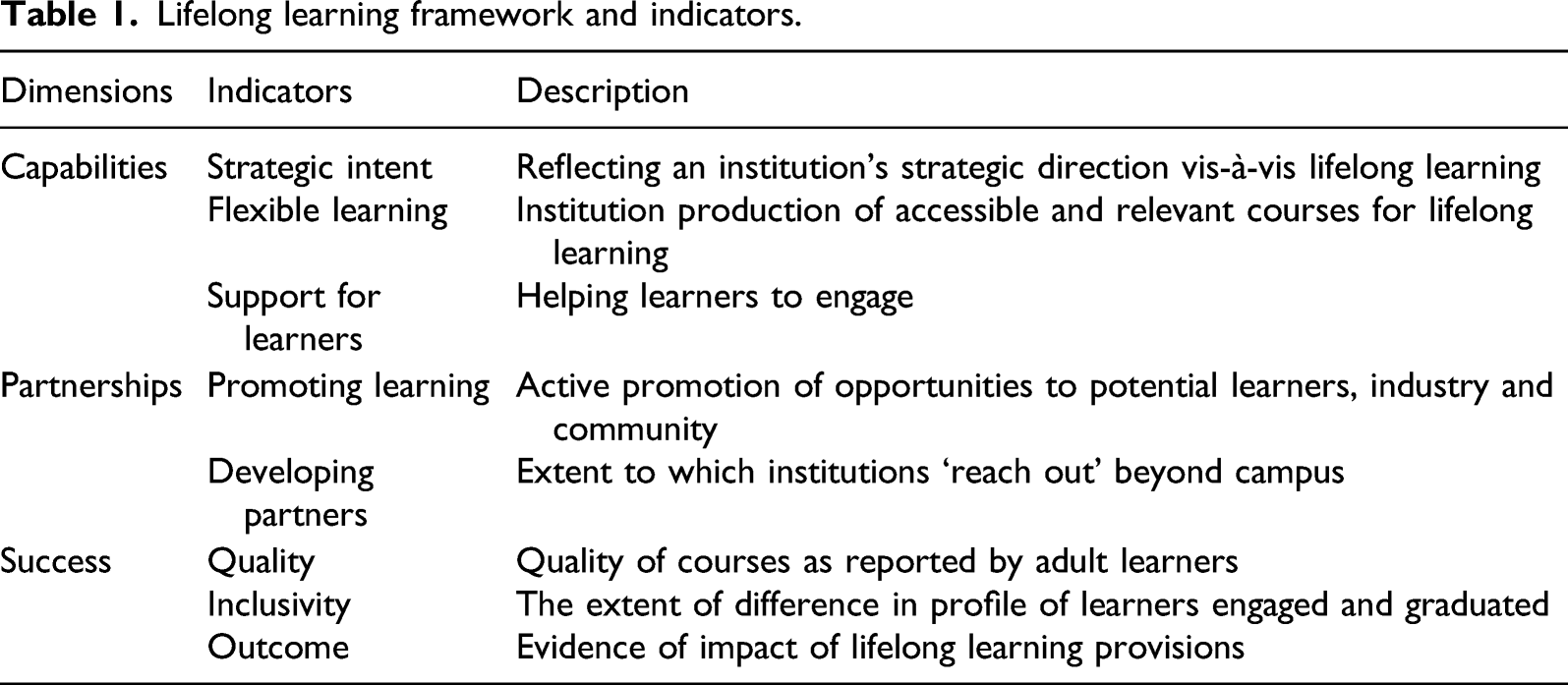
While focused instrumentally on impelling institutions to engage in lifelong learning, these dimensions were framed to reflect how higher education forms a key part of the SkillsFuture policy in Singapore. Figure 1 signposts this relationship, locating the evaluation framework dimensions alongside key policies and contexts. This diagram clarifies the dual and not always aligned interests of higher education institutions and industry/community. The dimensions, indicators and questions were designed to generate information that would build mutually beneficial insight and understanding about opportunities and challenges and help co-create shared outcomes. This is easier to plan than achieve, however, and ultimately it will take time to realise a platform of value to all parties. As well, while designed in the Singaporean context, which is the most immediate for the evaluation, the platform will needs further development to facilitate broader international application. How the evaluation relates to policy and broader contexts in other higher education systems, even in a normative way, is a much more complex matter as other evaluation and broader ranking systems have revealed (Hazelkorn et al., 2018; Hazelkorn & Mihut, 2022). Link between lifelong learning framework and SkillsFuture.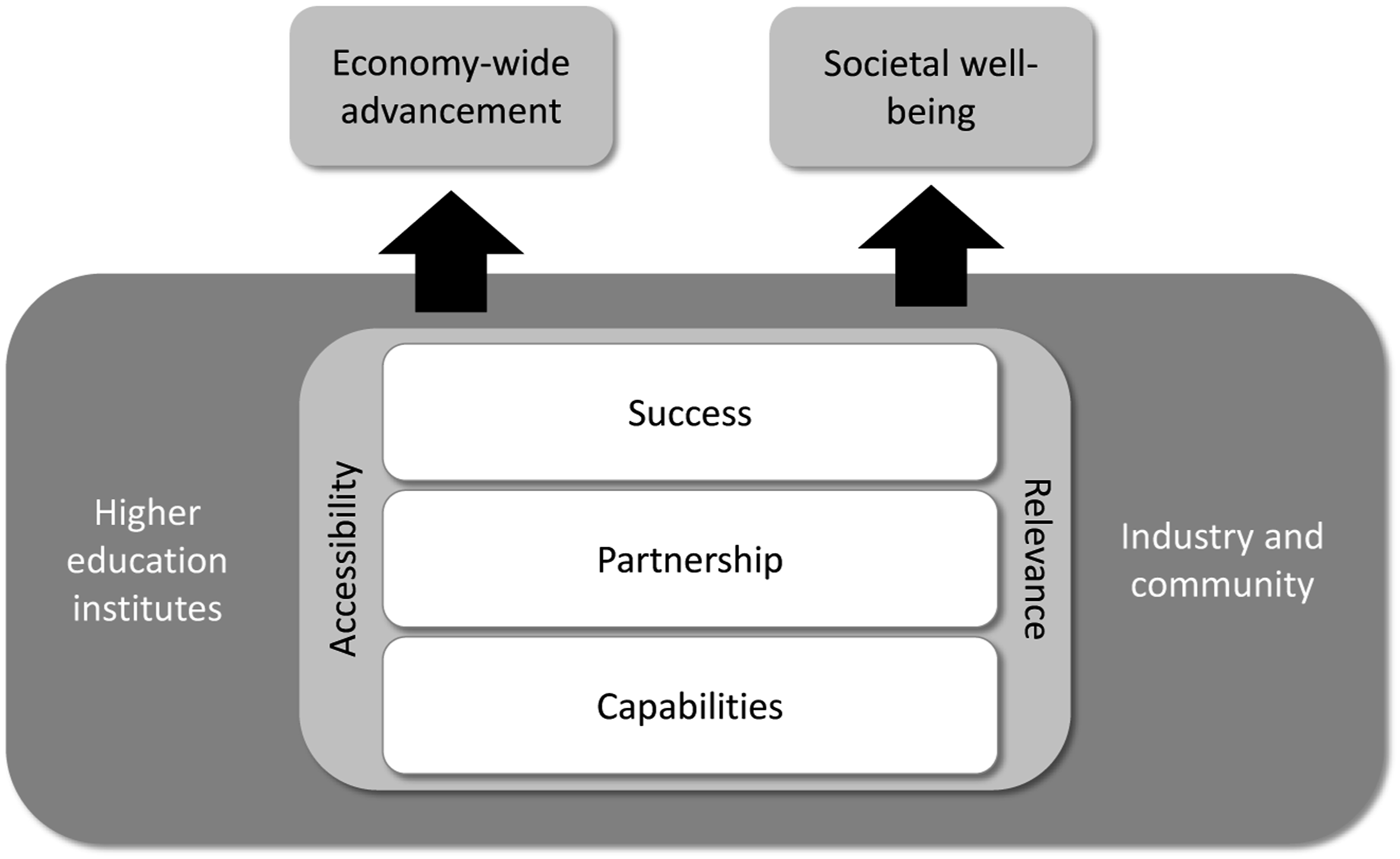
Question labels associated with each indicator.
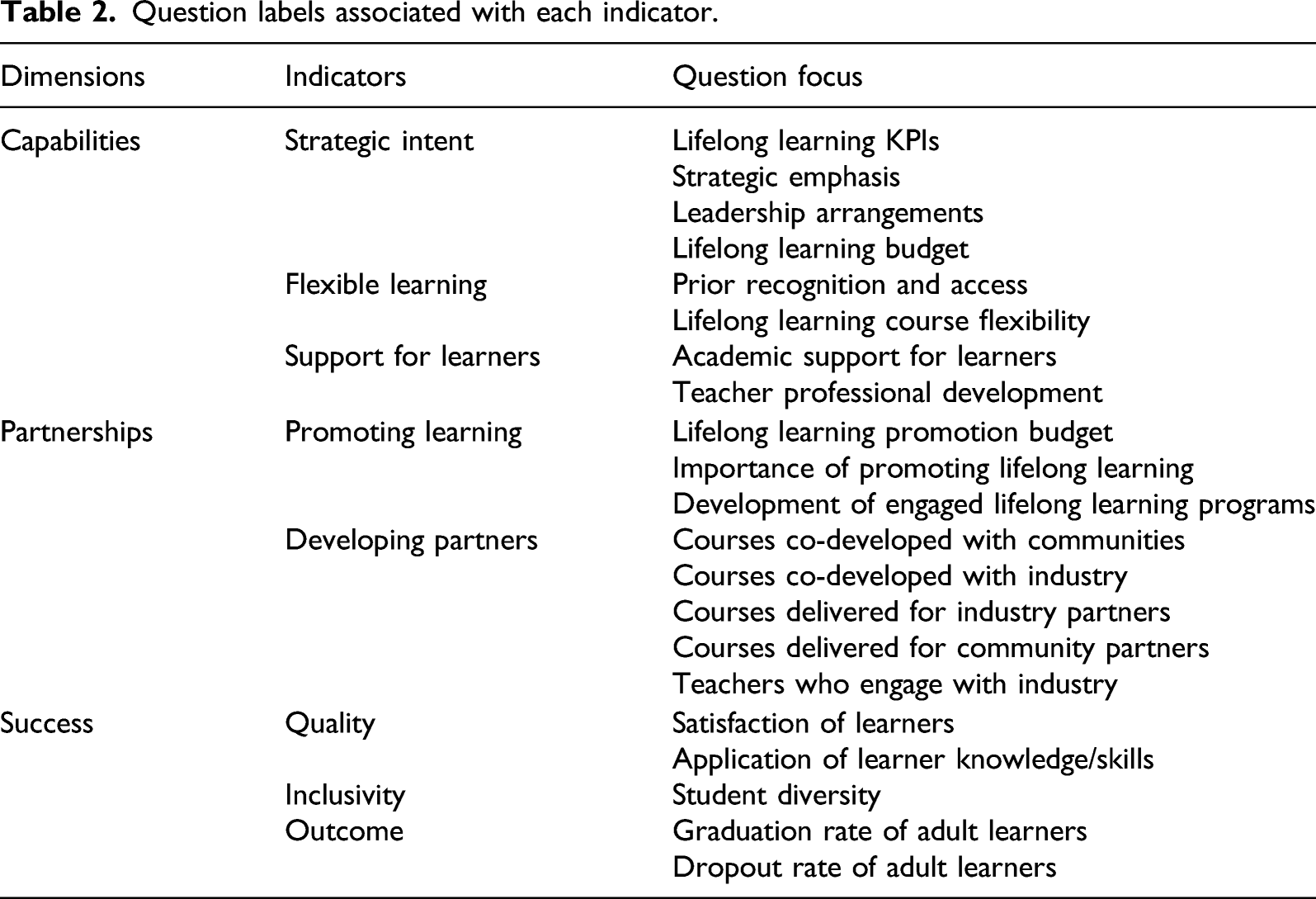
Two stages of empirical validation were conducted. First, a pilot data collection was carried out between February and June. This pilot sought to ensure that higher education institutions could answer the questions, that the questions were clear and responses could be interpreted and that there was variation across institutions. Invitations to complete the online instrument were sent to nine higher education institutions in Australia, Canada, China, Italy, Russia, Singapore and the United Kingdom. Four institutions in Australia, China, Russia and Singapore provided responses. Interviews were also conducted with staff at two institutions in Singapore which helped to delve deeper into the process of compiling institutional responses. The primary finding from the pilot study was that the instrument required detailed information on how staff in institutions should procure the relevant information. A number of more detailed indicator- and question-specific improvements were recorded. Insights from the pilot helped simplify and reduce the instrument. Second, this refined instrument was deployed in a larger and more in-depth validation study in Singapore. This study engaged 12 institutions of higher learning (IHLs) in Singapore, including six universities, five polytechnics and one institute of technical education. Responses from these 12 IHL helped delve deeper into question refinement, the compilation of data within complex institutions, challenges of establishing data commonality across institutions, and related consequences for reporting and interpretation. This in-depth validation study revealed the need for ongoing discussion and support during data collection, not least to ensure that an ‘institution-wide perspective’ rather than ‘lifelong learning unit’ perspective was delivered.
This necessarily methodological and normative articulation of the development foundations is not intended to mask the challenges experienced during the project. There were many and a few are noted here. Most notably, the diffuse nature of ‘lifelong education’ in higher education made it difficult to know how to demarcate and capture the phenomenon under analysis. Juggling was required to mediate between established research on adult or lifelong education written when such fields were often peripheral, and emerging environments in which such fields have become mainstream. As with the synthesis of prior research, the experts and stakeholders involved in the research held a diverse array of perspectives. Mapping the ideas onto institutional structures and practices was difficult given the varying and often informal ways in which lifelong education is designed and delivered. Identifying the indicators and the specific questions came with unique challenges given the dynamic matters under review, the need to jointly optimise educational/institutional relevance and policy generalisability, and look beyond prevailing metrics and those used in other evaluations. For instance, searching for indicators to reflect ‘success’ required substantial discussion of what success looked like in this context, how to narrow down various perspectives and how to seize an area of broad applicability which was relevant to institutions and communities and could be linked with data. Similar analyses of other dimensions and indicators revealed the immature nature of this field and need for the research contribution. While the Singapore context provided an important prompt and frame for this research, the small size of the sector provided challenges for validation and piloting. Conversely, the intensely international nature of Singapore meant that the research was infused with this outlook from the outset.
Much has been achieved to establish these dimensions, indicators and questions. On face value, they seem straightforward. Yet, they reflect a delicate balance to the lifelong and higher education worlds which they attempt to unite, between global generalisability and institutional relevance, between ideas and technical or operational practicalities, and between research, policy and practice. In our exercise, we found that while higher education institutions have a lot of data, this data is shaped by external reporting purposes and needed to be augmented and modified to reflect the nature and level of lifelong learning. Much has been achieved, yet clearly, this evaluation platform is in the foundation stages and much more is to be done.
Advancing lifelong learning
This paper closes by examining steps ahead for development of the evaluation mechanism and its contribution to lifelong learning both in Singapore and also other comparable systems. It looks at work required with regards to further technical development, engaging institutions, shaping institutional plans and practices, and broader international initiatives.
Further technical development of the inventory is one obvious next step, and this requires simultaneous consultation and statistical validation. The consultation will arise through expanding institutional participation, sector discussions and policy analysis. Technical validation requires much larger volumes of institution data in order to deploy a raft of exploratory and confirmatory analyses which will help refine, augment and validate the mechanism. This requires ongoing work to engage universities, or faculties within universities, in the research and validation activities.
Beyond validation, there is the broader task of engaging universities in the broader and ongoing evaluation. This generally happens in two ways, via top-down regulation from government or through institution-driven engagement. The platform being developed requires active institutional engagement and data provision, and even as part of a regulatory mandate, a clear institutional value-proposition will be required. Specifically, the benefit derived from opening new markets segments in lifelong learning and quality-enhancing benchmarking will have to clearly outweigh the cost of collating and reporting data and potential reputational implications. There is no uniform or straightforward means of specifying and operationalising this value-proposition given variations in national, sectoral and institutional contexts. But engaging universities in the evaluation of lifelong learning is clearly an important step ahead.
The most profound and effective means for engaging universities in validation and ongoing data collection are of course to make the platform easy and useful. This goes beyond universities and also embraces active and potential learners, business and industry, government and other system-level actors, and international communities. Conceptually, this is not difficult to realise given the importance of lifelong learning in advanced economies and the lack of existing metrics and data. Practically, it means moving beyond pilots and prototypes and positioning the exercise within the tapestry of institutional life. Such embedding typically takes at least three to five years. Such chance is challenging given the need to re-balance the strategic provision of lifelong learning in universities. Universities have become deeply engaged with international rankings that focus on research. This means that strategies and activities are geared towards publications at the expense of evolving their teaching and learning provision with lifelong learning needs. While public policy often incentivises lifelong learning provision in universities, as in the case of SkillsFuture, many if not all universities treat lifelong learning as an extra that can be carried out without re-examining, re-integrating and re-balancing the overall education offer.
As this paper’s opening remarks convey, there is a growing international need for this kind of research and policy innovation. Most evaluative activities in higher education happen within discrete national or provincial systems, but such boundaries impose artificial constraints which hinder policy and practice relevance. For instance, teaching and research evaluations in the United Kingdom which are nationally framed yet internationally reported are complex to interpret and use (Ashwin, 2021). There is a clear need for generalisable evaluation of lifelong learning across Asia, and even beyond. This is reflected in the proliferation of lifelong learning initiatives. This paper discusses formative research shaped by Singapore’s SkillsFuture. Tsinghua University (Tsinghua University, 2020), meanwhile, has merged continuous education and online education offices. Korea’s Academic Credit Bank System (Park, Choi, Kim and Hwang, 2019) is pioneering new forms of recognising diverse formal and non-formal learning experiences. In the United States, Stanford University is promulgating its Open Loop University model (Stanford, 2020), Georgia Tech is building Lifetime Education (Georgia Tech, 2018) and researchers are clarifying the ‘sixty-year curriculum (60 YC)’ (Dede, 2018). UNESCO have mapped many other lifelong learning initiatives (Martin and Godonoga, 2020). Instead of people being sorted by capability into a small number of formal post-secondary qualifications before embarking on a lifetime of work, these initiatives signal people’s engagement in a career-long programs of learning and upskilling. Rather than providing formal foundations which are augmented through work and informal learning, education itself plays an ongoing role in co-creating innovation frontiers.
Throughout this paper, we have touched on various contributions to research, and it is helpful to clarify these by way of conclusion. Obviously, the paper contributes to research on higher education evaluation and rankings for lifelong learning (i.e. Hazelkorn, et al., 2018; Hazelkorn & Mihut, 2022). Specifically, it goes well beyond existing evaluation systems and rankings platforms which focus mainly on research and on very limited facets of education, most of which assume convention campus-based provision to school-leaver student cohorts, to establish information which engages higher education institutions in hitherto uncharted facets of lifelong learning. In the main, institutions have yet to be evaluated or ranked with respect to such provision, reinforcing the pioneering contribution of the current research. Accordingly, the paper contributes to research on lifelong learning and higher education (i.e. Askling & Foss-Fridlizius, 2000; Jakobi & Rusconi, 2009; Yang, et al., 2015). It moves discussion beyond much prevailing study which has focused on access, opportunity, disadvantage and social mobility. Instead, it shines renewed institutional, policy and community light on the core socioeconomic implications of institution engagement in lifelong learning. It contributes to research on education policy in Asia (Zhong et al., 2020). As the analysis in this paper itself conveys, much existing research has stemmed from Europe and North America. It is important to spotlight this Asia-based education and skills policy innovation, and document its potential for broad application across the large region and beyond. It contributes to broader public policy analysis about the changing role of higher education in the world (i.e. Chiţiba, 2012; Comyn, 2018; Hong et al., 2021). As conveyed at the start of this paper, higher education systems and institutions across the world are being called to make much more community- and industry-engaged contributions. Singapore is a very globally engaged country and serves as a compelling case study for Asia and beyond.
This analysis loops back to the discussion at the start of this paper, which identified the need to build mechanisms which unite universities and the world of work in ways which help people engage in higher learning throughout their lives. All advanced economies with established professional workforces and developed higher education systems are confronting this need. This is currently a challenge given the limited policy and information infrastructure to guide individual and institutional engagement. As the research in this paper advances, it seeks to turn such challenge into opportunity.
Footnotes
Acknowledgements
The authors acknowledge funding support from SkillsFuture Singapore and the feedback of the Steering Committee and the international experts regarding the lifelong learning framework.
Declaration of conflicting interests
The author(s) declared no potential conflicts of interest with respect to the research, authorship, and/or publication of this article.
Funding
The author(s) received financial support from the SkillsFuture Singapore for this research.