



Abstract
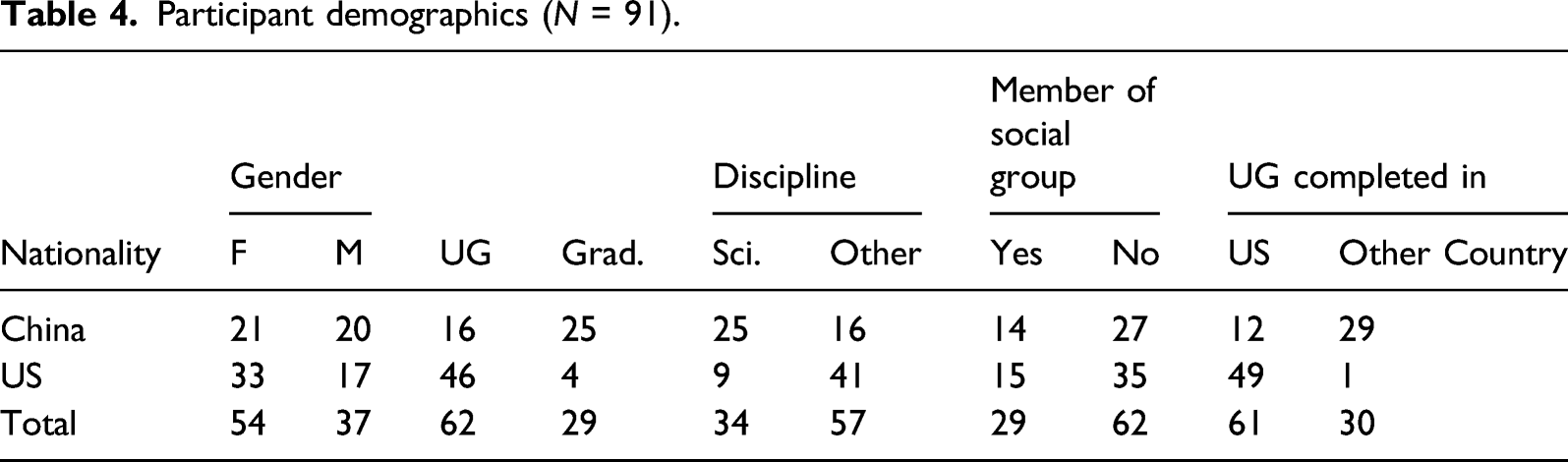
This quantitative research study compared the critical thinking dispositions of 91 college students studying in a public university in South East Florida. Forty-one students identified as Chinese and 50 students identified as American. The California Critical Thinking Disposition Inventory (CCTDI) measured these students’ critical thinking dispositions. There were differences between students on the scale of open-mindedness and gender. A dis-ordinal interaction occurred. American males scored lower than American females on the CCTDI scale of open-mindedness. However, the opposite occurred for the Chinese students. Chinese males received a higher score on the CCTDI scale of open-mindedness than Chinese females. These findings are significant for educators and organizations when designing curriculum and workplace training development for leaders. Being open-minded feeds into decision-making and problem-solving are skills which are necessary for leadership. It is helpful to understand which variables impact individual’s disposition to critical thinking so that leadership skills can be developed.
Introduction
Institutions of higher education as well as other private and public organizations strive to develop strong adults and leaders who possess good decision-making and problem-solving skills. It is important to consider the variables that may impact a person’s disposition to critical thinking so that educational institutions and organizations can develop these skills and incorporate them into curricula. Good leadership includes being open-minded to new ideas and understanding how to deal with the unpredictable (Tiffan, 2010). Leone et al., (2005) state that people who are open-minded are open to new experiences, as well as being innovative and divergent thinkers. McCrae and Costa (1987) agree and believe that open-minded individuals are creative. These are strong traits that are important in transformational leadership (De Hoogh et al., 2005). “Critical thinking helps with decision-making. Rather than picking an answer because it feels right, leaders use critical thinking techniques to peel back the layers and to delve into the problem. They use the tools to help eliminate everything except from reliable and useful information” (Dennett, 2018, p.42).
It is important therefore to delve into the factors that impact critical thinking skills, particularly a disposition to open-mindedness. In this study, there was interest in learning whether there were variables that influenced dispositions to critical thinking between different cultural groups of college students. According to Facione and Facione (1997), there is little research on the differences of critical thinking dispositions between cultural groups. Understanding these variables may help when developing young adults at higher educational institutions and developing leaders to assume leadership tasks and roles, in particular for making decisions and in solving problems. Specifically, in higher education, curriculum can be designed to develop problem-solving skills in order to foster and cultivate the development of students’ critical thinking skills so that students are prepared to enter the workplace. As a result of this current study, interest may occur, resulting in future studies. Additionally, higher educational institutions assessment leaders may be interested in the use of the CCTDI for assessment of critical thinking dispositions. When faced with problems, a person with a weak critical thinking disposition may conduct a poor analysis of a problem resulting in a costly mistake (Insight Assessment, 2013). Profetto et al. (2003) conducted a study of 141 nurses using the CCTDI. Findings showed a positive correlation between the nurses actual critical thinking that they demonstrated on the job and their score on the CCTDI. If higher educational institutions provide opportunities for students to develop their dispositions to critical thinking, then students will have a strong foundation to analyze problems, as well as considering alternatives with an open mind later in life. Higher educational institutions in the United States tend to offer an environment where students can use their initiative during class and ask questions and challenge assumptions. However, students from other countries may feel uncomfortable to challenge the teacher and they may wait for direction (Dennett, 2013). One of the authors in this current study noticed students from China waiting for instructions before embarking on a college class activity. They did not ask questions in class. It is important that educators recognize these differences so that they may adapt teaching methods. The authors wanted to learn more about the differences in critical thinking dispositions between Chinese and American students. Even though research has been conducted on critical thinking skills, there is limited research on the differences between cultures and specifically students from China. One study found that university students from America, Hong Kong and mainland China had varying thinking styles (Zhang & Sternberg, 2001). Tiwari et al., (2003) found significant differences between the critical thinking dispositions of college students from Hong Kong and Australia.
Today, global leaders face difficult situations and experience different problems to solve than decades ago. There is literature that focuses on the level of critical thinking skills that leaders must apply both to their professional and personal lives (Riddell, 2007; Werner & Bleich, 2017). Werner and Bleich (2017) continue to state that skilled critical thinking leaders make stronger decisions than those with weak critical thinking skills. Insight Assessment (2013) reported that people can have specific dispositions to encourage critical thinking skills. There is agreement (61%) that dispositions of inquisitiveness, self-confidence, open-mindedness, recognizing one’s own biases, and flexibility were important to develop strong skills in critical thinking.
To fully comprehend critical thinking and the different facets of critical thinking, a conceptual framework of critical thinking is important. According to Paul and Elder (1996), when measuring critical thinking skills, there are various factors to consider: “question at issue, assumptions, inferences, implications, point of view, concept and evidence” (p. 1). There are three components to the Paul–Elder Framework: Elements of thought (reasoning), intellectual standards, and intellectual traits. When students demonstrate reasoning skills, Paul and Elder (1996) posit that it is possible to determine the level of reasoning being used. Each intellectual standard can be compared to the level of reasoning. These standards include clarity, accuracy, precision, relevance, depth, breadth, logic, significance, and fairness. When applying the standards to reasoning, the following intellectual traits are developed: Humility, courage, empathy, autonomy, integrity, perseverance, confidence in reason, and fair-mindedness. The consistent use of these intellectual traits supports the development of a solid critical thinker.
One of the researchers in this present study experienced many international students, particularly students from China and she wanted to ensure these students experienced opportunities to develop their critical thinking dispositions because they were learning to be global leaders. The literature supports the importance of certain dispositions that encourage critical thinking. The researcher wanted to measure the levels of these dispositions in students to contribute to the limited literature, as well as use the findings to support the development of students’ critical thinking skills, in high school, higher educational institutions, and organizations. Furthermore, it was important to recognize the void if students lacked critical thinking dispositions. More opportunities to develop critical thinking could be incorporated into the curricula and course activities both in America and China. China has focused significantly on education in the recent years and has acknowledged the Western educational methods after years of rote learning (Jackson & Bak, 1998). The findings of this present study would be of interest to educational institutions both in China and other countries to further their development of teaching methods.
California Critical Thinking Disposition Inventory Scale descriptions.
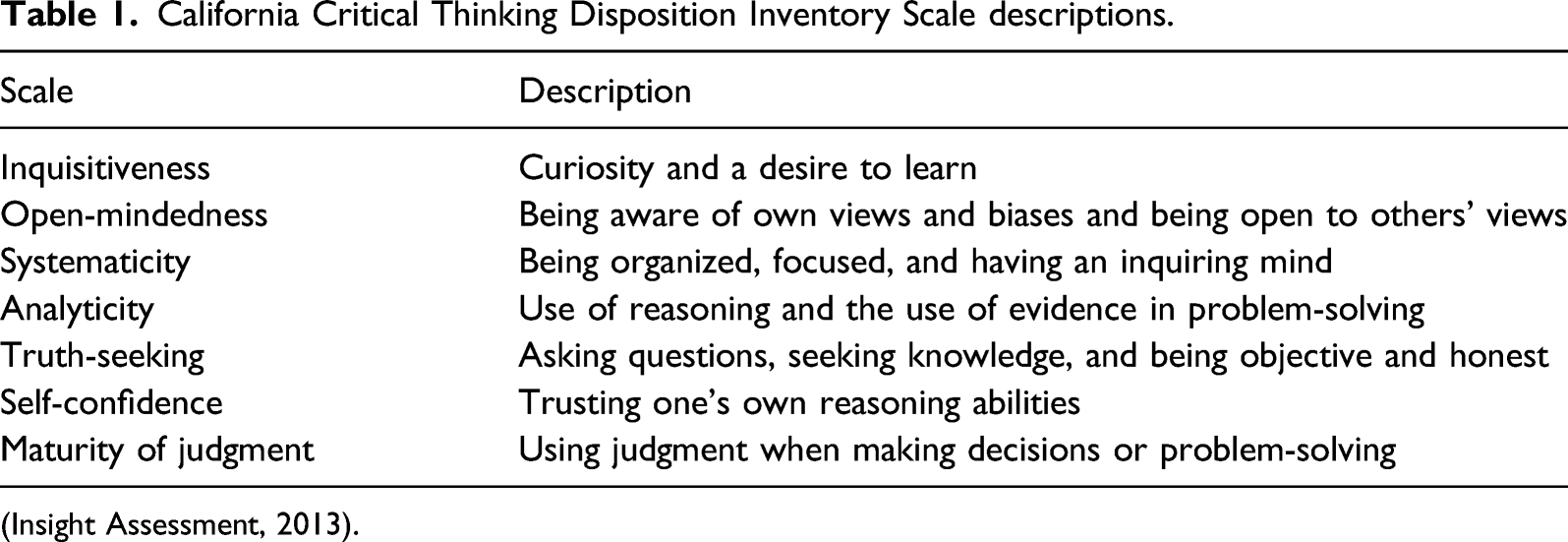
Critical thinking skills are important for students who develop into adults and leaders; they must articulate and communicate their vision to others (De Hoogh et al., 2005). Leaders with a disposition toward open-mindedness no doubt will explore avenues and consider innovative ideas to meet the organization’s strategic plan. As Insight Assessment (2013) points out, problem-solving and decision-making both require skills in critical thinking. As leaders continue to lead in this global environment and leaders work with colleagues from different cultures, critical thinking, particularly open-mindedness, becomes extremely important. Leaders with weak critical thinking skills risk making poor decisions without the tools necessary to analyze situations and problem solve. Weak critical thinking skills have implications for both educational settings and business settings (Insight Assessment, 2013).
Literature review
Critical thinking and open-mindedness
There are a number of definitions for critical thinking. According to Brookfield (2005), critical thinking involves the exploration of assumptions and actions, while Paul and Elder (2005) explain that there is a process involved that concludes with an improvement after analyzing one’s own thinking. Ennis (1991) defines critical thinking as “reasonable reflective thinking that is focused on deciding what to believe and do” (p. 8). Paul and Elder’s definition of critical thinking was used in this present research study. “The consistent internal motivation to engage problems and make decisions by using thinking” defines a critical thinking disposition (Giancarlo & Facione, 2001, p. 31).
As Yost et al., (2000) stated, open-mindedness is having the ability and desire to listen to a number of different viewpoints. The CCTDI describes open-mindedness as having the disposition to be open to the views of others and to be aware of one’s own views (Insight Assessment, 2013). According to Daresh and Playko (1995), it is vital for successful leadership development to create opportunities for leaders to experience ways to develop their open-mindedness. An environment that encourages open-mindedness provides a forum for innovation and creative ideas (Conger & Toegel, 2002). Communication and decision-making can be improved by being more open-minded and considering other people’s viewpoints (De Hoogh & Den Hartog, 2008). Clifford et al. (2004), Sa et al. (1999), and West et al. (2008) agree that open-mindedness connects positively to cognitive abilities. Sa et al. (1999) noted a 2.8% and 8.6% unique variance on performance when subjects worked on reasoning and evaluation tasks. During one’s approach to learning, adults with a higher critical thinking disposition will have a solid toolbox full of tools to help them to succeed in learning (Dennett, 2013). Paul and Elder (2005) state that learners need to take the reins to steer themselves toward learning rather than be a complacent follower. Rather than following a leader blindly, followers need to hone their critical thinking skills to carefully assess and evaluate what they are doing. By having a solid foundation in critical thinking skills, adults will be less rigid in their thinking going forward.
California Critical Thinking Disposition Inventory
The California Critical Thinking Disposition Inventory (CCTDI) was used to measure critical thinking dispositions in this study. Drs Peter and Noreen Facione developed the CCTDI in early 1990. The CCTDI is based on the American Philosophical Association (APA) Delphi Report’s agreement of critical thinking with its theoretical foundation to calculate dispositions in critical thinking. In order to formulate the seven scales of critical thinking disposition, both factor analysis and item analysis were used. The CCTDI was used extensively in studies and in a wide range of international settings, including hospitals, higher education institutions, schools and businesses (Bers et al., 1996; Biber et al., 2013; Domenech & Watkins, 2015; Du et al., 2013; Facione & Facione, 1997; Kırbaşlar & Özsoy-Güneş, 2015), resulting in published reports and a high predictive value. Dissertation research, as well as other published research documented the criterion validity (Insight Assessment, 2013). When tested for reliability, Cronbach’s alpha was overall .90 and .71–.80 for all of the scales within the CCTDI during the study of 1019 college students (Facione & Facione, 1996). For the individual disposition scales, the values ranged from .60 to .78 consistently and a value of .90 and higher for the total measures (Insight Assessment, 2013). This instrument was also validated in various studies (Biber et al., 2013; Facione et al., 1995; Yan et al., 2012). Kwon et al., (2007) found that confidence and systematicity predicted anxiety between librarians. Educators administering the instrument reported content validity (Insight Assessment, 2013). The CCTDI’s construct validity was measured and a study includes the comparison of 200 students’ personality traits. Correlations between open-mindedness, inquisitiveness, and truth-seeking were significant (r = .27, P <. 001), open-mindedness (r = .33, P < .001) and inquisitiveness (r = .37, P < .001).
Other instruments to measure critical thinking skills were considered for the present study: The Watson-Glaser Critical Thinking Appraisal, and another critical thinking measurement by Paul and Elder (1996). However, these did not measure critical thinking dispositions. In an investigation by the US Department of Education (DOE) on instruments that measured student critical thinking dispositions, they reported that although there were some instruments that measured critical thinking, there was only one instrument that had been created specifically to measure the dispositions to think critically: The CCTDI. They reported it had the ability to measure how much an individual actually had the propensity to think critically (Iskifoglu, 2014). As a result, the CCTDI was selected because of its validity and reliability and its ability to measure critical thinking dispositions. Insight Assessment (2013) states that “A minimum Alpha of 0.80 for attributes measures and a minimum KR-20 of .72 for skills measures” (Insight Assessment, 2013, p. 50). Cronbach’s alpha reliability coefficient reported a range of .80 and .98.
Culture, critical thinking, and teaching
In order to invite students to take a deeper dive into material and context, instructors must recognize any barriers that prevent critical thinking, and make every effort to remove these barriers (Dennett, 2013). A barrier to critical thinking could include a number of variables, including culture. Culture indeed was a factor; there was a difference in critical thinking, particularly open-mindedness between two cultures. Culture, according to Fan (2000) is defined as individual characteristic traits of one group as opposed to another group. Rokeach (1973) enhances this definition by adding that attitudes and beliefs guide a person’s behavior. So, if one asks the question whether culture is a barrier in creating a critical thinking mindset, does that mean we might conclude that culture might play a negative part in developing leaders? An important question since one lives in a global environment where college students and leaders are from different cultures (Dennett, 2013). However, Tiwari et al. (2003) provide a positive outlook when they state that in these particular cases, there are ways to develop a disposition to open-mindedness, and alternatives may be sought when going through decision-making. By understanding some of the barriers students face, instructors might incorporate a diverse range of teaching methods to encourage critical thinking and open-mindedness, skills that students can then transfer into their world of work and lifelong habits. As Whitson and Amstutz (1977) clearly state, these are significant skills needed in the workplace in order to make decisions regarding the credibility of various information. In US classrooms, students tend to ask questions and attempt to think critically; however, it was noticed that some students from other cultures did not ask questions and they waited to be guided before beginning a project (Dennett, 2013). Rather than singling out the differences, instructors can recognize and appreciate the differences between cultures and adapt accordingly.
In a study by Ku and Ho (2010), they studied 487 Chinese undergraduate students located in Hong Kong studying at two different universities. Ku and Ho specifically looked at the critical thinking skills of the participants and used the NEO Five Factor Inventory to assess whether participants who had a high critical thinking disposition had critical thinking skills in the Chinese environment. Findings concluded that cognitive ability did impact critical thinking performance.
Gender
Bers et al. (1996) used the CCTDI in a study and found that gender was a factor when analyzing critical thinking dispositions between 224 male and female college students from two different universities. Females scored higher on the overall total CCTDI scores than males. Gender also was a factor when Walsh and Hardy (1999) conducted their comparison study of critical thinking dispositions using the CCTDI. The sample of 334 male and female undergraduate students enrolled in various disciplines in a public university in the mid-Atlantic region. In the scales of open-mindedness and maturity of judgment, females scored higher than males. However, Ozcan and Elkoca (2019) found the opposite in their study, noting that female students scored lower than male students in open-mindedness. In a study by Biber et al. (2013), they found no difference between the critical thinking skills between males and females. There was a population of 99 mathematics teacher candidates. The study was based at a university in Turkey. Similar to the current study, the CCTDI was used to measure the critical thinking dispositions. In another randomized cross-sectional research study in China during 2009, using a population of 256 college students, researchers found that there was a small difference between gender. Females scored higher than males in open-mindedness and inquisitiveness on the CCTDI (Du et al., 2013). A similar finding occurred when Kırbaşlar and Özsoy-Güneş (2015) conducted their study of 548 teachers. They used the CCTDI and found that females scored higher than males. However, the opposite was true in a study of 309 male and female teacher students. Males scored higher in systematicity and inquisitiveness than females. There was no significant difference in open-mindedness (Demirhan & Köklükaya, 2014).
There is a large body of research evidence that concludes that critical thinking skills are essential for leaders leading in the future. It is therefore important that leaders are prepared early. Early may mean during higher education or at the very latest during early stages of a person’s career. There are ways that higher educational institutions and organizations can assist in preparing adults and leaders. One practice to develop these skills might involve encouraging people to consider alternatives and to be open-minded when charged with decision-making (Tiwari et al., 2003). Another recommendation is to measure college students and employees’ dispositions to critical thinking and provide educational opportunities to develop lacking areas. For example, if employees’ lack strong dispositions to open-mindedness, employers may provide project or shadowing opportunities to strengthen open-mindedness.
Methodology
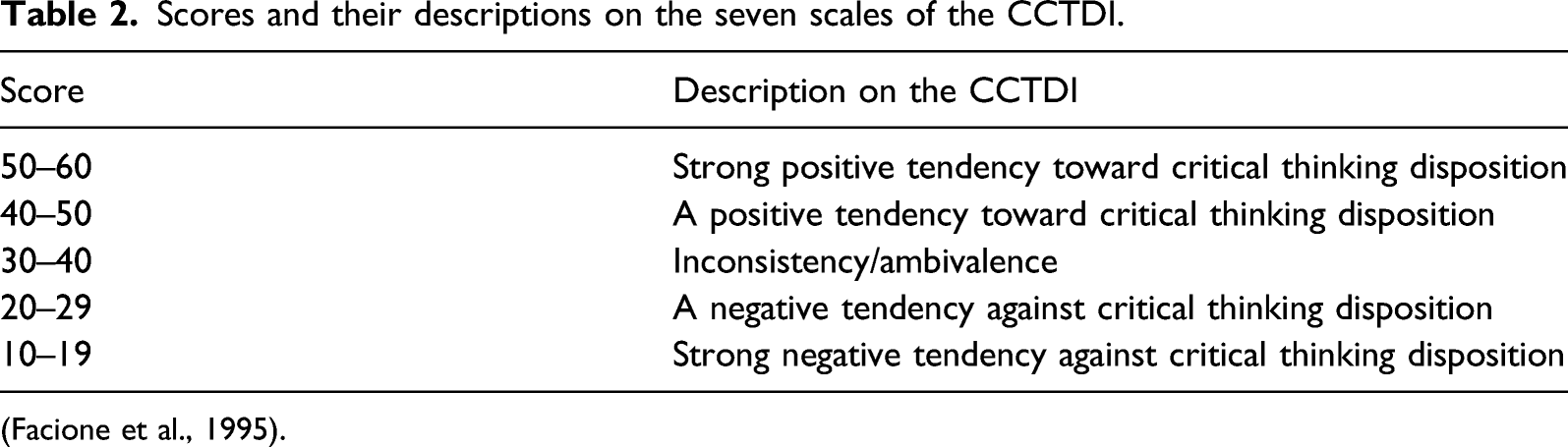
Scores and their descriptions on the seven scales of the CCTDI.
Results
Correlations between CCTDI dispositions.
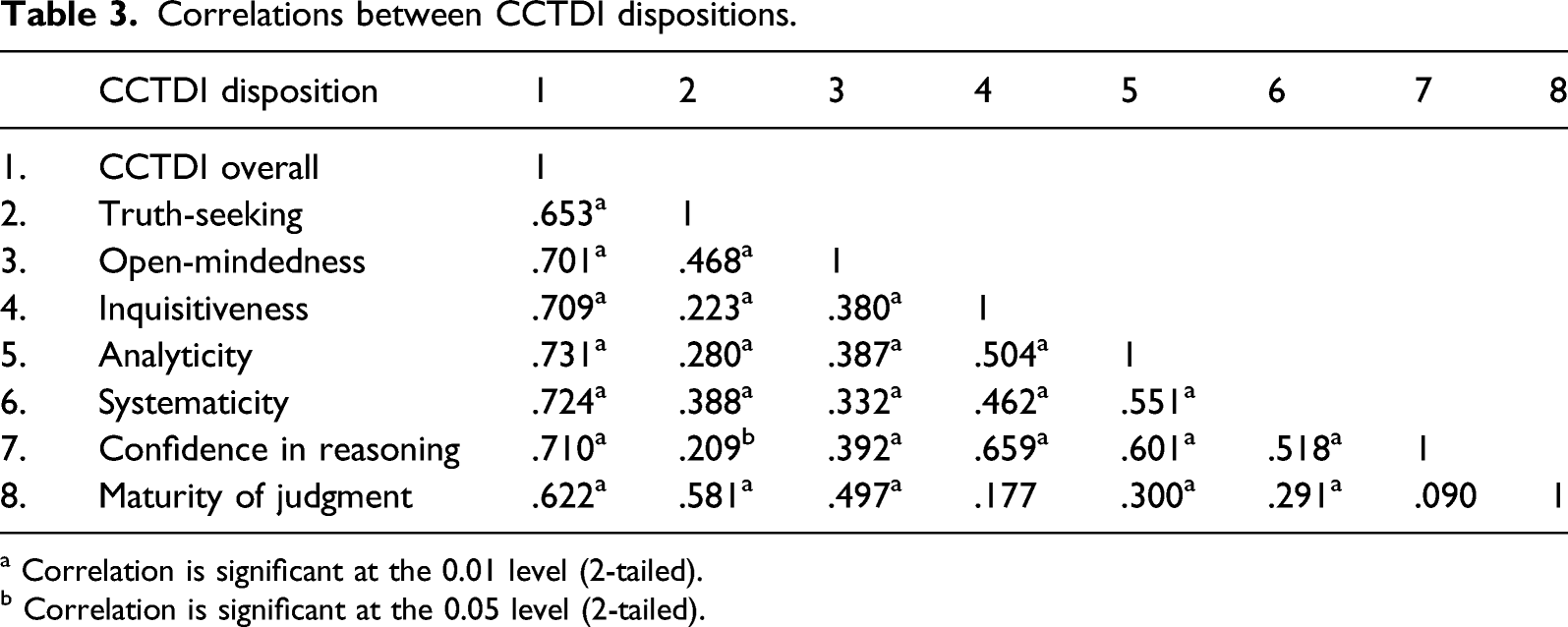
a Correlation is significant at the 0.01 level (2-tailed).
b Correlation is significant at the 0.05 level (2-tailed).
Primary research question
The research question was: What are the differences between Chinese and American students’ scores on the individual seven scales of the CCTDI? The study helped to answer this question along with the following secondary question. What are the differences between male and female students’ scores on the CCTDI?
Participant demographics (N = 91).
Analysis of research questions
The data were analyzed using SPSS version 20.0. An independent sample t-test was conducted to answer the main research question. Each of the seven scales on the CCTDI was analyzed: truth-seeking, open-mindedness, inquisitiveness, analyticity, systematicity, confidence in reasoning, and maturity of judgment. In order to answer the moderator questions, a factorial analysis of variance was conducted.
Primary Research Question: What are the differences between Chinese and American students’ scores on the individual seven scales of the CCTDI?
In order to answer the research questions based on the total score of the CCTDI and on the sub-scales: truth-seeking, open-mindedness, inquisitiveness, analyticity, systematicity, confidence in reasoning, and maturing of judgment, an independent t-test was performed. Upon further analysis, Levene’s test P = .961 was not-significant. There was a failure to reject the null, t (89) = .54, P > .05 once the equal variance t-test was run. Therefore, no differences between Chinese and American students’ total score on the CCTDI were found.
Secondary questions: This study also asked: What are the differences between male and female students’ scores on the CCTDI?
Levene’s test of equality of error variances for open-mindedness scale.

Tests of between-participants effects for open-mindedness scale.
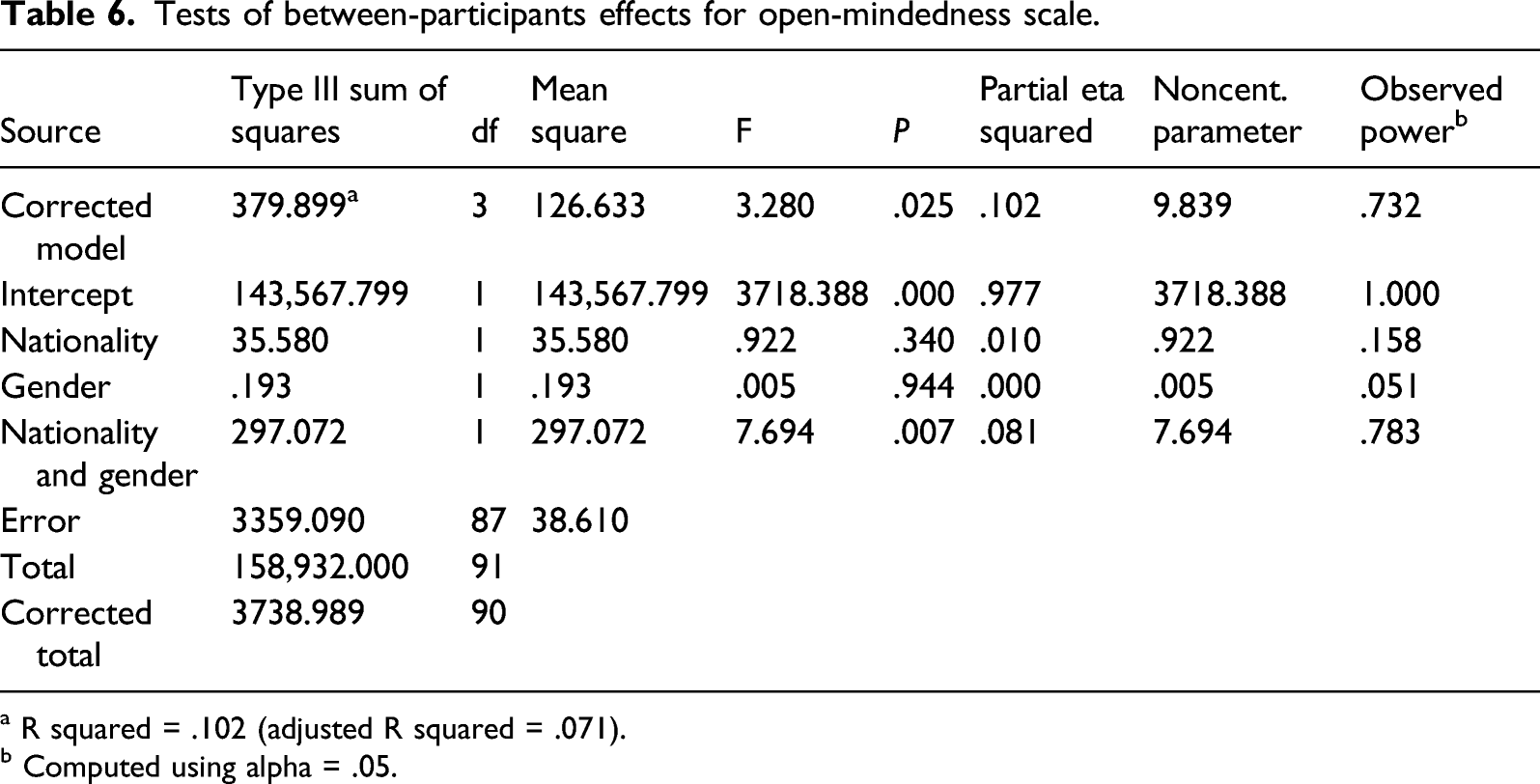
a R squared = .102 (adjusted R squared = .071).
b Computed using alpha = .05.
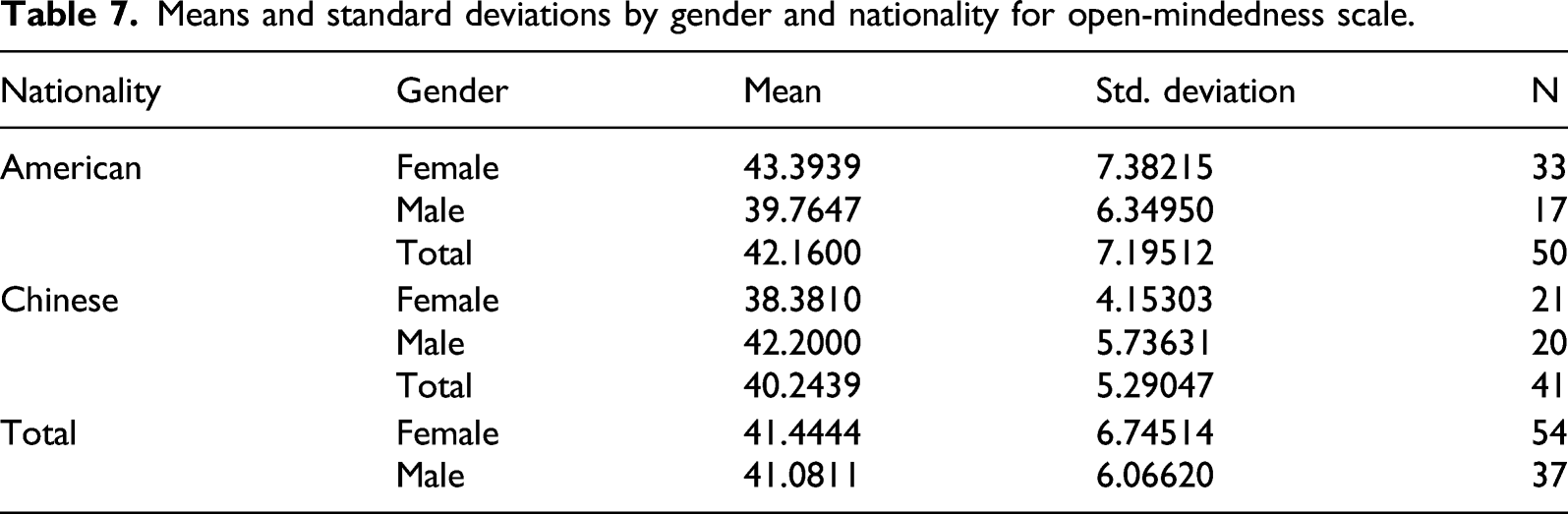
Means and standard deviations by gender and nationality for open-mindedness scale.
Discussion
The present study found that males from China scored higher than females from China in the open-mindedness critical thinking disposition and yet the opposite finding with the American males and females. The females from America scored higher in the open-mindedness disposition than the males from America. We do know that in this increasingly changing world, our leaders, whether they are male or female, should be armed with the relevant tools to lead. An open-mindedness disposition is just one of the important dispositions to think critically. Critical thinking skills are important and do need to be developed. Organizations and higher education institutions can play a role in this development and provide projects and an environment for individuals to share and welcome different perspectives and to not simply arrive at a conclusion without considering alternative ideas. Using this mindset will help students to graduate with a toolbox full of critical thinking skills they can use to lead and potential leaders with the mind to think openly.
Why did Chinese males score higher in open-mindedness than Chinese females? Perhaps it has something to do with the different treatments and experiences of males and females in China (Attane, 2012). Although China has demonstrated a significant commitment to improve education and in particular, higher education in China, there is still a difference in years of educational experiences and resources between males and females. Males have an average of 9.1 years of educational experience compared to women who have an average of 8.8 years in 2010 (Attane, 2012). However, there have been advancements in education and these are evident in the 2020 Blueprint (Zhao, 2011). Rather than simply use rote learning, China moved to a more participative approach where critical thinking and problem-solving is encouraged and practiced. Additional studies need to be conducted with a greater population of males and females to see if there is a trend of continued critical thinking increase as a result of the Blueprint vision. Among some of the limitations of this current study include the small sample size of 91 participants. It would have been helpful to have a larger sample size or conduct additional research. It would have been useful to know whether the students in the present study already had a high critical thinking disposition and high level of open-mindedness and that is why they decided to study in the United States as opposed to the students who did not choose to study in the United States. The instrument (CCTDI) is a self-reporting inventory, and therefore, participants self-reported their answers. Since the answer sheets were sent to Insight Assessment for total score and scores on the seven scales on the individual dispositions, the researchers were not able to calculate the Cronbach alphas. However, despite the limitations of the study, the finding of the dis-ordinal interaction of differences is worth taking note. American females scored higher than Chinese females and Chinese males scored higher than American males when measured on the scale of gender and open-mindedness. Are Chinese males encouraged to develop a disposition in open-mindedness and Chinese females not encouraged? Are Chinese males provided with more experiences than Chinese females? Even though China has advanced significantly in gender equality, there are still barriers that prevent females’ access to organizational resources than their male counterparts have (Wang et al., 2019). In China, social relationships and experiences are important and males are encouraged to socialize with colleagues outside of their workplace and outside of work hours. However, females run the risk of having their reputation tarnished (Leung, 2002). Organizational female leaders in China remain to be negatively impacted by “a male-dominated guanxi system inside and outside the firms, which can weaken their leadership capacity” (Wang et al., 2019 p.15). In this study, no consideration of the participants’ former experiences was considered (Dennett, 2013). It is true as Glaser (1942) articulates that experience can form the base that helps to develop logic and problem-solving skills when faced with a decision. Mezirow (1991) states that giving meaning to valuable experience is conducive to learning. It might have been helpful to include qualitative interviews to learn more about the students’ experiences prior to their university experience. In 2007, there were recommendations made to the China Enterprise Confederation regarding the necessity of equipping students with critical thinking skills. The education system in China may have made the changes within education to enhance these skills (Dahlman et al., 2007). US instructors continue to teach in universities located in China. Some of the studies included in this article use nurses as sample participants. As Arli et al. (2017) posit, the propensity to have a caring disposition as well as a critical thinking disposition are positively related. So perhaps nurses are trained to be caring and perhaps this influences their critical thinking dispositions. Or, perhaps nurses go into the nursing profession because they already have a caring attitude.
As we can clearly see from the literature, there is evidence that critical thinking and in particular open-mindedness are crucial for decision-making and in solving problems. It appears that there is a shared view that there is an equal need for both male and females to have strong critical thinking dispositions related to open-mindedness. The more these skills are developed early in life and in educational institutions, the more confident adults and leaders can be with their decision-making and in avoiding errors. Organizational leaders today need to build a diverse workforce with different perspectives and a disposition to being open-minded. With time, habits of seeking alternative solutions and involving diverse viewpoints will be the norm. Merriam et al. (2007) correctly state, problem-solving skills should be developed, especially to develop people to work in jobs that may not even exist today and in the future. Strong critical thinking skills can provide that base for our future leaders.
Even though the findings were small, this study is an important contribution to the existing literature. There are few studies that compare American students and Chinese students. Additional studies could be conducted in the future to see if there are still differences. Educational institutions should develop critical thinking dispositions within programs so that a solid foundation of critical thinking skills can be built. The CCTDI can be used in schools, universities and also in the workplace to expose gaps and to offer development opportunities. Even instructors of the adult learner can use these findings to include exercises and assessment in order to develop these important skills of open-mindedness and critical thinking. The findings included in this paper clearly tell us that there are implications within the educational and professional settings regarding gender differences as well as cultural differences in critical thinking dispositions. As adults and leaders navigate the turbulent waters in the competitive and ever-changing environment, their critical thinking skills should be top notch in order to reason and problem solve. If these competencies are strong, organization’s human resources are maximized. Organizations may risk costly errors and may be overtaken by the competition if they fail to develop these competencies (Dennett, 2013). The American culture is different to the culture in China. The role Confucianism plays in the Chinese culture is significant and plays a large part in education. There may be barriers to dispositions of critical thinking and by understanding the potential barriers, educators can develop curriculum to remove the barriers in order to build critical thinking skills. This current study provides a glimpse into American and Chinese male and female students’ critical thinking dispositions. Educators can provide opportunities to encourage the practice of skills in critical thinking for all students.
Footnotes
Declaration of conflicting interests
The author(s) declared no potential conflicts of interest with respect to the research, authorship, and/or publication of this article.
Funding
The author(s) received no financial support for the research, authorship, and/or publication of this article.