




Abstract
The digital transformation of education has created new opportunities for the professional development of rural teachers. While artificial intelligence (AI) can be integrated into teacher training programs, sustainable teacher growth emerges from the synergy between AI-enabled support and human experts’ contextual expertise. This study draws on the Interconnected Model of Teacher Professional Growth (IMTPG) to construct a cross-regional mentor-mentee interconnected framework. Using epistemic network analysis (ENA), it examines data from three rounds of online one-on-one sessions involving 15 mentor-mentee teacher pairs. Results reveal that expert-novice noticing differences can trigger a staged developmental process in which novice teachers progress from recognizing these differences to systematically reconstructing their professional identity. Finally, it proposes strategies to promote authentic, trust-based dialogic negotiation between mentors and mentees, emphasizing the role of mutual respect in sustaining meaningful professional learning relationships.
Introduction
A high-quality teaching profession is fundamental to building educational attainment and serves as the cornerstone of educational digital transformation. Rural teachers represent a vital component of this professional workforce, serving as key agents for promoting educational equity and quality in rural communities (Ministry of Education, 2024). Building on this recognition, President Xi referenced the “wooden barrel theory” at the 2,024 National Education Conference to underscore the strategic importance of enhancing rural teachers’ professional competencies, particularly in underdeveloped regions (Ministry of Education, 2024). Against this policy backdrop, the question of how to effectively promote professional development among rural teachers has gained critical importance. Meeting this challenge requires targeted interventions and sustained support via intelligent professional development platforms.
Existing research has reached a consensus on the “Human-Tech” integration approach that leverages human expertise and technological intelligence. Human expertise, particularly from expert teachers or instructional coaches, plays an irreplaceable role in addressing critical challenges in rural teacher development. They employ diverse coaching approaches including one-on-one mentoring (Saclarides & Munson, 2021) and group collaborations (Gibbons & Nieman, 2024), utilizing activities such as instructional design, lesson analysis (Tan et al., 2020), and practice-based research (Meneses et al., 2023) to meet rural teachers’ individualized needs (Zheng et al., 2024). These approaches support teachers in developing deeper understanding of teaching, formulating adaptive strategies, and continuously refining their professional trajectories (Rotem & Ayalon, 2023). Simultaneously, technological integration manifests through intelligent professional development platforms that consolidate high-quality materials and services (Carmi, 2024), enabling the co-construction and sharing of regional educational resources (Jin et al., 2025). These platforms also support the comprehensive recording and analysis of teachers’ learning and instructional processes, generating diagnostic reports to provide personalized and targeted support for rural teachers (Prilop et al., 2025; Qazi & Pachler, 2024).
Although research demonstrates the potential of integrating human “wisdom” and technological “intelligence”, significant implementation gaps persist in blended professional development programs for newly recruited rural teachers. Key challenges include insufficient intrinsic motivation (Kuhn et al., 2024), diminished teacher agency (Steadman, 2021), and misalignment between training content and situated rural teaching practices (Superfine & Akgul, 2025). These persistent challenges stem from fundamental experiential disparities between expert and novice teachers, rooted in differences in practice contexts and teaching experience. Such disparities generate varying levels of sensitivity, understanding, interpretation, and regulation in response to classroom events (Bastian et al., 2022). Professional development through mentor-mentee dialogues on intelligent platforms (Lefstein et al., 2020) requires both parties to acknowledge and constructively engage with these experiential differences. Without mutual recognition, establishing authentic professional conversations proves challenging (Gibbons & Nieman, 2024; Wang & Loughland, 2025), reducing mentoring interactions to superficial exchanges that fail to support transformative pedagogical growth (Saunders et al., 2023).
Both theoretical and empirical findings converge to indicate that effective teacher professional development must not only attend to mentees’ situated instructional needs but also constructively navigate the experiential and contextual differences between mentors and novice teachers (Stahnke & Blömeke, 2021; Wexler, 2020). Building on these insights, this study examines how instructional differences between mentors and mentees can be systematically leveraged to create personalized professional development trajectories. Specifically, we investigate. 1. What are the differences between expert and notice teachers’ noticing during one-on-one online discussions? 2. How do teachers’ noticing evolve across staged mentoring interactions?
Literature Review
Teacher Noticing: the Cognitive-Behavioral Interface in Pedagogical Practice
Teacher noticing originates from Goodwin’s (1994) concept of professional vision, which posits that professionals possess a distinct ability to selectively observe, reorganize, and interpret phenomena through a professional lens informed by their expertise and prior experience. Building on this foundation, Sherin introduced the notion of professional vision into educational research and, in collaboration with Van Es, developed the theoretical framework of teacher noticing (Van Es & Sherin, 2002). The conceptualization of teacher noticing has evolved to encompass multiple theoretical perspectives, including cognitive-psychological (König et al., 2022), socio-cultural, subject-specific mathematical, and teacher professional competence (Weyers et al., 2023). Despite these diverse theoretical orientations, teacher noticing consistently emphasizes three core processes: identifying salient aspects of teaching situations, interpreting instructional events through pedagogical reasoning, and connecting specific classroom occurrences to broader educational principles to inform adaptive instructional responses. These foundational processes have demonstrated significant utility in educational research, supporting investigations of classroom practices (Suh et al., 2021), analyses of teacher expertise variations (Stahnke & Blömeke, 2021), and assessments of instructional quality (Weyers et al., 2023).
Video-based analysis has become a predominant method, enabling educators to systematically identify and interpret key instructional events through classroom observations (Larison et al., 2024). Complementing this approach, researchers have utilized both open-ended and structured prompts to elicit teachers’ retrospective reflections on their instructional practices (Stoetzel et al., 2025), strengthening their pedagogical noticing and reasoning capabilities (Trevisan & Smits, 2023). Additionally, standardized assessment instruments such as “Observer” (Seidel & Stürmer, 2014) have been developed to provide systematic evaluation frameworks, often integrated with qualitative data sources including teacher reflective reports and in-depth interviews to ensure comprehensive assessment of teacher noticing development. Advanced technological tools have further enriched the research landscape. Eye-tracking technologies, for instance, have revealed distinct patterns that differentiate expert teachers from their novice counterparts (Grub et al., 2020).
A Framework for Learning to Notice
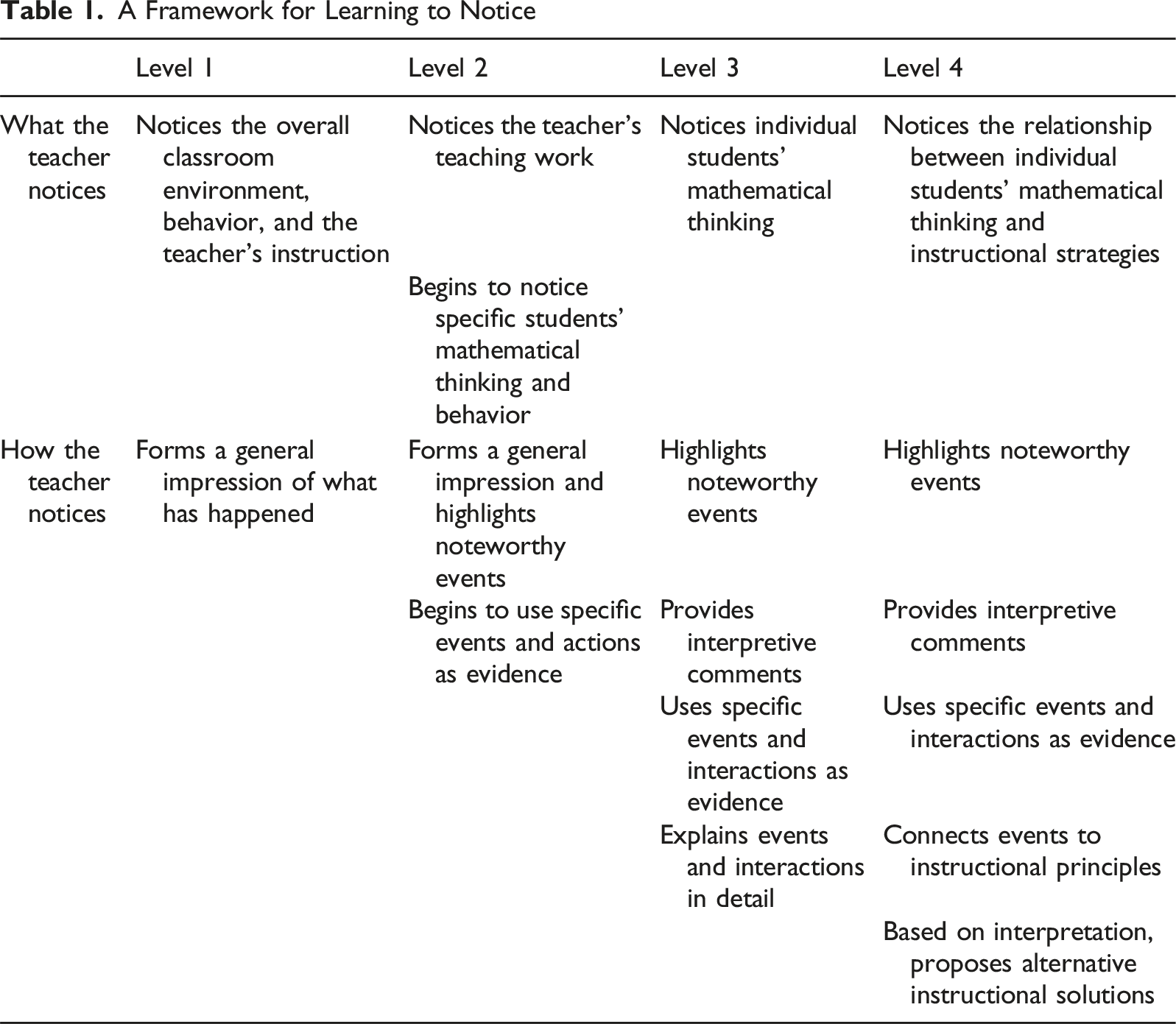
“Human-Tech” Integration in Mentoring Context
Mentoring is a widely adopted professional development approach that facilitates the systematic transfer of tacit pedagogical knowledge and experiential insights from expert to novice teachers (Strong & Baron, 2004). This approach is grounded in socio-cultural perspective of teacher learning, particularly theories of situated learning and communities of practice (Hoffman et al., 2015), which view professional growth as emerging through participation in contextually embedded activities. Over time, it has evolved from unidirectional transmission toward reciprocal learning and the collaborative co-construction of knowledge (Jin et al., 2021). Empirical studies show that high-quality mentoring relationships provide novice teachers with cognitive guidance, emotional encouragement, and practical instructional assistance, thereby enhancing teaching self-efficacy (Prilop et al., 2025), reducing pedagogical anxiety, and clarifying career development trajectories.
Recent educational paradigms have increasingly emphasized “Human-Tech” integration, leveraging emerging technological innovations within professional development frameworks to advance teachers’ professional growth. In the context of mentoring, digital platforms enable synchronous communication (Gillespie & Amador, 2024), facilitate resource sharing, and provide data-driven insights into instructional practices (Horn et al., 2017), thereby extending the sustainability of mentor-mentee interactions (Larsen et al., 2023). Furthermore, the integration of artificial intelligence (AI), especially generative AI (GenAI), has opened new avenues for personalized mentoring and adaptive professional development (Cai et al., 2025). Recent studies have highlighted the role of AI agents as cognitive partners that facilitate reflection, generate feedback, support the co-construction of knowledge and empower teachers’ instructional design competency (Sun & Huang, 2025; Wang et al., 2025; Zhang & Wang, 2025). Embedded within hybrid training models and intelligent mentoring platforms, these AI-supported systems have demonstrated strong potential to enhance teachers’ higher-order reasoning and professional vision, while preserving the collaborative and dialogic essence of human mentoring (Segal et al., 2018).
However, current training models reveal several interrelated limitations. To begin with, many frameworks prioritize instrumental support while overlooking the nuanced mechanisms of expert guidance within collaborative professional contexts. Moreover, limited attention is paid to the processes by which teachers negotiate pedagogical tensions and resolve instructional challenges. This lack of process awareness is further compounded by a predominant reliance on outcome-based assessments, rather than process-oriented evaluation methods grounded in systematic behavioral observations. Collectively, these issues restrict a comprehensive understanding of professional development effectiveness and the trajectories of teacher growth.
The Interconnected Model of Teacher Professional Growth
Contemporary mentoring frameworks increasingly call for a reconfiguration of the role of mentored teachers by foregrounding their professional agency and autonomy in the developmental process (Tan et al., 2022). This re-envision entails moving beyond training-centered approaches toward collaborative inquiry models that position educators as active constructors of professional knowledge and growth (Carmi, 2024).
Within this collaborative inquiry orientation, the Interconnected Model of Teacher Professional Growth (IMTPG) developed by Clarke and Hollingsworth (2002) provides a robust theoretical foundation for inquiry-based mentoring practices (see Figure 1). The model conceptualizes teacher professional growth through four interconnected domains that are linked by two key mechanisms - enactment and reflection. Specifically, these domains include: (1) the external domain, which represents sources of information, stimulus, or professional support; (2) the domain of practice, which involves professional experimentation and classroom implementation; (3) the domain of consequence, which refers to salient outcomes observed from practice; and (4) the personal domain, which encompasses teachers’ knowledge, beliefs, and attitudes. Enactment denotes the translation of pedagogical beliefs and external inputs into instructional practices, whereas reflection involves the critical examination of teaching experiences and underlying assumptions (Topçu & Çiftçi, 2023). At the core of the model lies the principle of interconnected transformation, whereby change in one developmental domain triggers adaptations in other domains, ultimately generating systemic effects throughout the professional development process (Qi et al., 2023). Interconnected Model of Teacher Professional Growth
Compared with traditional linear theories of professional development, the IMTPG highlights reciprocal and dynamic interactions among domains of teacher learning rather than depicting growth as a sequential accumulation of discrete skills (Clarke & Hollingsworth, 2002). Its theoretical breadth and adaptability have supported diverse applications, including the design of professional development programs (Perry & Boylan, 2018), the analysis of pedagogical interventions (Da Ponte et al., 2022), and the tracing of individual developmental trajectories (Sánchez-García, 2023). These studies provide robust empirical validation of the model’ s explanatory power across varied educational contexts. Drawing on this established theoretical framework, this study aims to construct a comprehensive model for analyzing how novice and expert teachers manifest instructional concerns on intelligent professional development platforms and revealing development trajectories in novice teachers. By integrating teacher noticing theory with the IMTPG framework, the research seeks to establish theoretical foundations for personalized mentoring mechanisms that address existing limitations in “Human-Tech” collaborative approaches to teacher professional development.
Methodology
Research Context
Drawing upon the IMTPG framework, this study designed cross-regional mentor-mentee collaborative activities facilitated through an intelligent professional development platform (see Figure 2). The mentoring model was developed based on an established professional development program that had undergone an iterative round of refinement. The mentoring program follows the design principle of “goal-setting and iterative refinement”, with professional development activities anchored in novice teachers’ authentic needs and individual growth trajectories. Through cyclical mentor-mentee discussions and lesson observations, the program facilitates teachers’ developmental progression from identifying pedagogical discrepancies, analyzing underlying challenges, to transforming insights into practice. This approach establishes a practical pathway for cross-regional blended mentoring in teacher professional development. Cross-Regional Peer-to-Peer Mentoring Model
Identifying Differences: Investigating Novice Teachers’ Specific Requirements through one-on-one Sessions
Through live-streamed one-on-one session (see Figure 3), expert teachers guide novice teachers in transforming abstract teaching challenges into concrete, measurable improvement goals. Expert teachers facilitate novice teachers in articulating key contextual factors, including class size, scheduling arrangements, student demographics, and specific pedagogical puzzles, while prompting them to examine the interconnections between their instructional role, student developmental needs, and curricular content. This self-articulation process serves a dual purpose: revealing novice teachers’ underlying pedagogical reasoning while enabling expert teachers to assess their current stage of professional development. Consequently, this systematic inquiry identifies the gap between current teaching practices and desired outcomes, whereupon mentors and mentees collaboratively negotiate mentoring themes, objectives, and implementation strategies to establish targeted mentoring interventions. Live-Streamed one-on-one Session
Analyzing Differences: Utilizing Online Intelligent Tools to Pinpoint Pedagogical Challenges
Expert teachers utilize the “Intelligent Lesson Observation” module to further investigate and pinpoint pedagogical challenges in novice teachers’ practice. Through the lesson study process, they guide novice teachers in perceiving, evaluating, and reflecting on previous instructional deficiencies to incorporate more critical and essential noticing elements into their teaching considerations. Expert teachers employ standardized assessment tools, including the Classroom Questioning Skills Scale and the Teacher Response Observation Scale, to conduct objective lesson feedback. These tools generate intelligent analyses of teaching demeanor, language use, instructional behavior, and classroom interaction patterns (see Figure 4), culminating in comprehensive diagnostic reports that examine the entire teaching-learning process. Based on these reports, mentors provide novice teachers with personalized learning resources targeting classroom management strategies, instructional problem-solving approaches, and differentiated teaching methods. Intelligent Lesson Observation
Operating Differences: Engaging in Joint Lesson Planning with Expert Guidance
Based on diagnostic analysis results, expert teachers provide individualized guidance through the “one-on-one session” module, enabling novice teachers to understand curriculum standards, clarify textbook concepts, and identify causes of rural students’ learning difficulties. Mentors and mentees then collaboratively develop targeted instructional intervention strategies and transfer these approaches into specific lesson designs with personalized preparation guidance. Through this process, novice teachers integrate theoretical knowledge with local teaching contexts, developing practical knowledge applicable to rural educational settings.
Transforming Differences: Enacting Insights into Practice through Iterative Implementation and Discussion
In the post-design implementation phase, novice teachers either invite expert teachers into their classrooms for lesson study or upload recorded lessons to the platform for synchronous online discussion. A subsequent one-on-one session is then held, focusing on insights gained from the implementation process. Drawing on expert feedback and student performance data, novice teachers articulate their emerging practical knowledge through reflective analysis and iteratively refine their instructional designs. Across multiple cycles of goal-setting, knowledge construction, instructional planning, and reflective evaluation, they move from merely recognizing pedagogical differences to implementing targeted interventions. This iterative process not only validates their instructional strategies in practice but also fosters sustained professional growth and continual enhancement of teaching competence.
Participants
Participants were recruited from the Beijing Open Online Teacher Development Program, a city-wide initiative funded by the Beijing Municipal Education Commission. All participants voluntarily joined the mentoring program without any financial compensation. Their sustained engagement was primarily driven by intrinsic motivation, as both mentors and mentees regarded the mentoring interactions as valuable opportunities for professional growth and reflective practice. The mentor teachers (N = 15) were selected based on the following criteria: (1) holding senior professional titles or full professor positions, (2) possessing extensive teaching experience (M = 20 years), and (3) active participation in the platform’s mentoring program. These teachers demonstrated proven pedagogical expertise and commitment to professional development initiatives. The mentee teachers (N = 15) were recruited from remote suburban schools and met these inclusion criteria: (1) early-career status with limited teaching experience (M = 2 years), (2) geographic location in undeveloped rural areas, and (3) voluntary enrollment in the platform’s professional development program seeking mentorship support. The study focused on 15 mentor-mentee pairs who completed an eight-week structured training program delivered through the platform. All participants provided informed consent for research participation, and ethical approval was obtained from the institutional review board.
Data Collection and Analysis
This study adopted a sequential mixed-methods design to investigate noticing differences between expert and novice teachers and their professional development trajectories through cross-regional mentoring interactions. Epistemic Network Analysis (ENA) was employed to examine differences in noticing and yield measurable indicators of professional development trajectories. Complementing the quantitative analysis, content analysis was used to explore teachers’ subjective experiences and self-perceived growth in noticing, thereby adding contextual depth and explanatory insight to the findings. The quantitative and qualitative phases were iteratively cross-validated throughout the analytical process through systematic comparison and convergent synthesis (see Figure 5). Data were systematically collected from three complementary sources: (1) transcribed discussions from three staged one-on-one mentoring sessions, (2) structured teacher reflection documents based on the IMTPG framework, and (3) semi-structured interviews exploring participants’ authentic experiences. This triangulation strategy strengthened methodological rigor while enhancing the credibility and trustworthiness of findings. Data Collection and Analysis Flow Chart
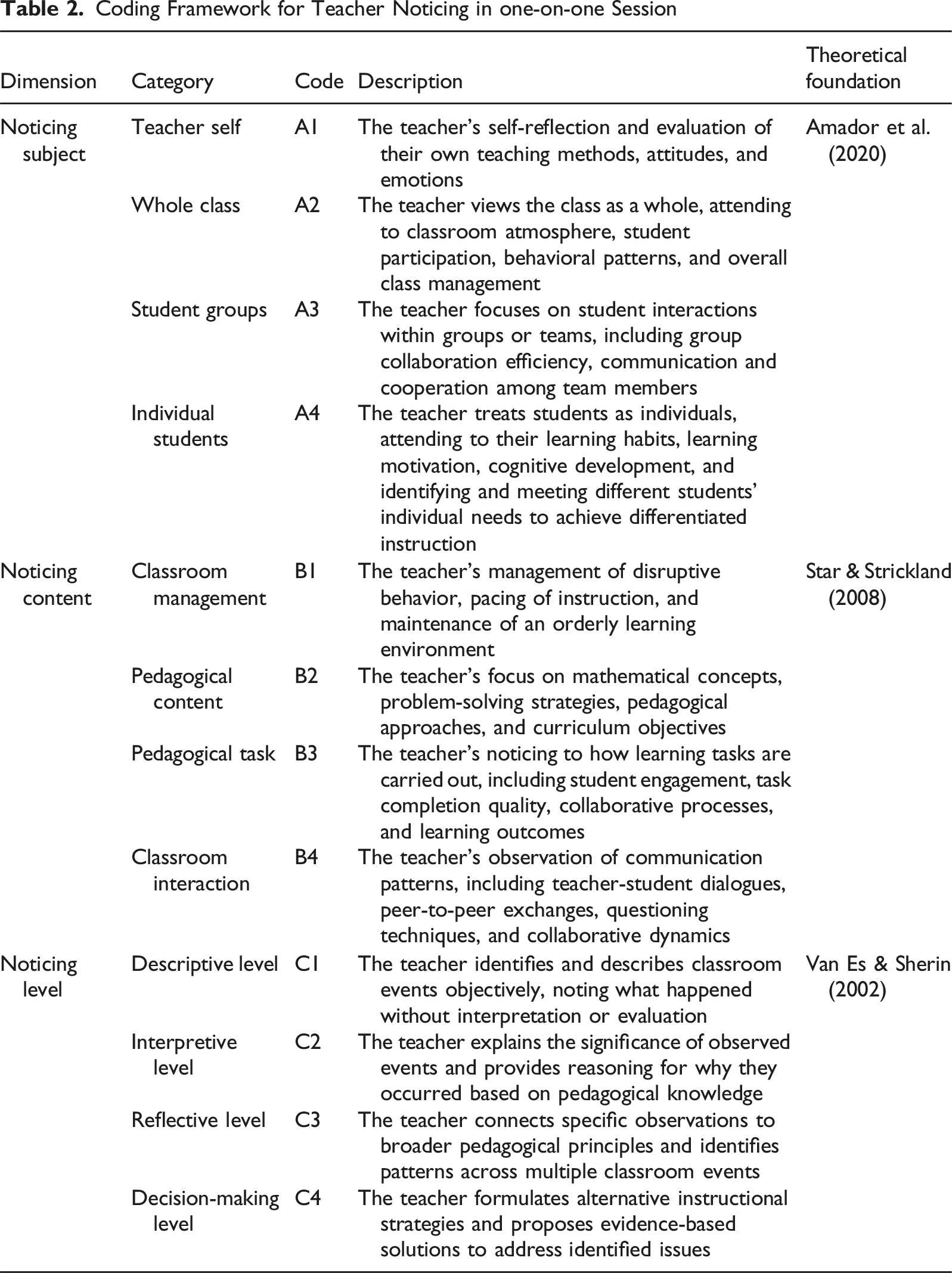
Fifteen teacher pairs were organized to engage in three stages of one-on-one discussions, representing complete cycles of “Needs Assessment”, “Collaborative Learning”, and “Iterative Implement” (see Figure 2). Each discussion session lasted approximately 45 minutes on average. Audio and video recordings were transcribed and segmented into meaningful discourse units, yielding a total of 2,390 valid utterances for analysis. To ensure coding reliability, two coders were first trained on the analytical framework and then independently coded a randomly selected 30% of the dataset. Cohen’s Kappa coefficient was calculated as 0.78, indicating a high level of reliability. Discrepancies were subsequently resolved through discussion, and the finalized coding scheme was applied to the remaining data. Utilizing the online epistemic network analysis tool (https://app.epistemicnetwork.org/), this study analyzed the characteristics of teacher noticing and traced its developmental trajectory across the mentoring process. To systematically capture the professional development process of teachers participating in the mentoring program, researchers developed an “Online Mentoring Phase Summary Sheet” based on the IMTPG model, focusing on three key domains: personal domain (e.g., professional identity), domain of practice (e.g., curriculum interpretation), and domain of consequence (e.g., students’ learning motivation). Furthermore, to explore novice teachers’ authentic experiences and their understanding of how mentoring fostered professional growth, researchers created a semi-structured interview protocol featuring questions such as “Based on communication with your mentor, what do you believe are the main causes of these teaching difficulties?” and “How did your mentor guide/support you in addressing these challenges?” This study conducted detailed analysis of 50 reflective reports and 4 interview transcripts submitted by teachers (totaling approximately 40,000 words). These data, integrated with platform discussion records, were used to examine how teachers utilized enactment-reflection cycles to achieve professional growth across developmental domains.
Research Tool: Teacher Noticing Coding Framework in one-on-one Sessions
Coding Framework for Teacher Noticing in one-on-one Session
Results
The results address expert and novice teachers’ noticing during three stages of one-on-one mentor-mentee discussions from two main perspectives. First, to address RQ1, we analyzed the differences between expert and novice teachers’ noticing. Descriptive analysis of discourse activity provided reference data on the frequency distribution of teachers’ utterances across different noticing dimensions, while epistemic network analysis (ENA) further revealed differences in the structure and interconnections of noticing across subject, content, and level. Second, to address RQ2, ENA was applied to examine the developmental trajectories of novice teachers’ noticing across staged mentoring interactions, illustrating how their attention, interpretation, and instructional decision-making evolved over time. Together, these analyses provided empirical evidence for understanding patterns of teacher noticing and the progression of novice teachers’ professional growth within mentor–mentee discussions.
Comparative Analysis of Expert and Novice Teachers’ Noticing in one-on-one Online Discussions
Descriptive Analysis of Discourse Activity Between Expert and Novice Teachers
Of the 2,390 total discussion utterances, expert teachers contributed 1,649 (69.0%) and novice teachers accounted 741 (31.0%). Figure 6 presents the distribution of utterances across different noticing dimensions. Expert teachers demonstrated significantly higher discourse engagement than novice teachers across all noticing dimensions, with particularly pronounced differences in individual students, pedagogical content, reflective level, and decision-making level, where experts produced approximately four times as many utterances in these areas. This pattern suggests that experts exhibit greater sensitivity and responsiveness to students’ individual developmental needs, enabling more sophisticated instructional decision-making through deeper analysis and reflection of student performance. Comparison of Various Dimensions of Mentor-Mentee Discussion
Epistemic Network Analysis of Noticing Differences Between Expert and Novice Teachers
Figures 7 and 8 illustrate the epistemic network characteristics of expert and novice teachers across noticing subject, content, and level during one-on-one sessions. In ENA, the centroid represents the weighted average position of all connections within the network model, serving as an indicator of the overall network structure. The figures demonstrate that the network centroid for expert and novice teachers exhibit distinct positioning across these noticing dimensions, indicating substantial structural differences in their respective epistemic networks. Independent samples t-tests conducted on the network coordinates along the X and Y dimensions revealed statistically differences between expert and novice teachers. Specifically, significant differences emerged in the X dimension for noticing subject and content (Cohen’s d = 1.15, t = 3.16, p < 0.01), as well as in the X dimension for noticing level (Cohen’s d = 2.16, t = 5.91, p < 0.01). Epistemic Network Analysis of Teachers’ Noticing Subject and Content. Note: The X-Axis Represents the Type of Knowledge Involved in Teachers’ Noticing, Ranging From “Declarative” (Left) to “Procedural” (Right). The Y-Axis Represents the Subject of Teachers’ Noticing, Ranging From “Teacher-Individuals” (Top) to “Student-Groups” (Down) Epistemic Network Analysis of Teachers’ Noticing Level. Note: The X-Axis Represents the Level of Teachers’ Noticing, Ranging From “Comprehension” (Left) to “Decision-Making” (Right). The Y-Axis Represents the Action Orientation of Teachers’ Noticing, Ranging From “Reflective” (Top) to “Practical” (Bottom)

Differences in Teachers’ Epistemic Network Structure

Developmental Trajectories of Teachers’ Noticing Across Stages of Mentoring Interactions
To explore whether teachers’ noticing characteristics regarding noticing subject, content, and level change over time, we used ENA centroid plots to analyze the average epistemic networks of expert and novice teachers in three stages during one-on-one sessions. Figure 9 shows that the centroid of both expert and novice teachers’ epistemic networks shifted across the three developmental stages. While T-test results revealed no statistically significant differences between groups, novice teachers demonstrated greater variability in network positioning compared to expert teachers. Specifically, novice teachers showed notable changes in noticing subject and content dimensions, whereas changes in noticing level were less pronounced for both groups, with expert teachers maintaining relatively stable patterns throughout the mentoring process. Epistemic Network Analysis of Teachers’ Noticing Trajectories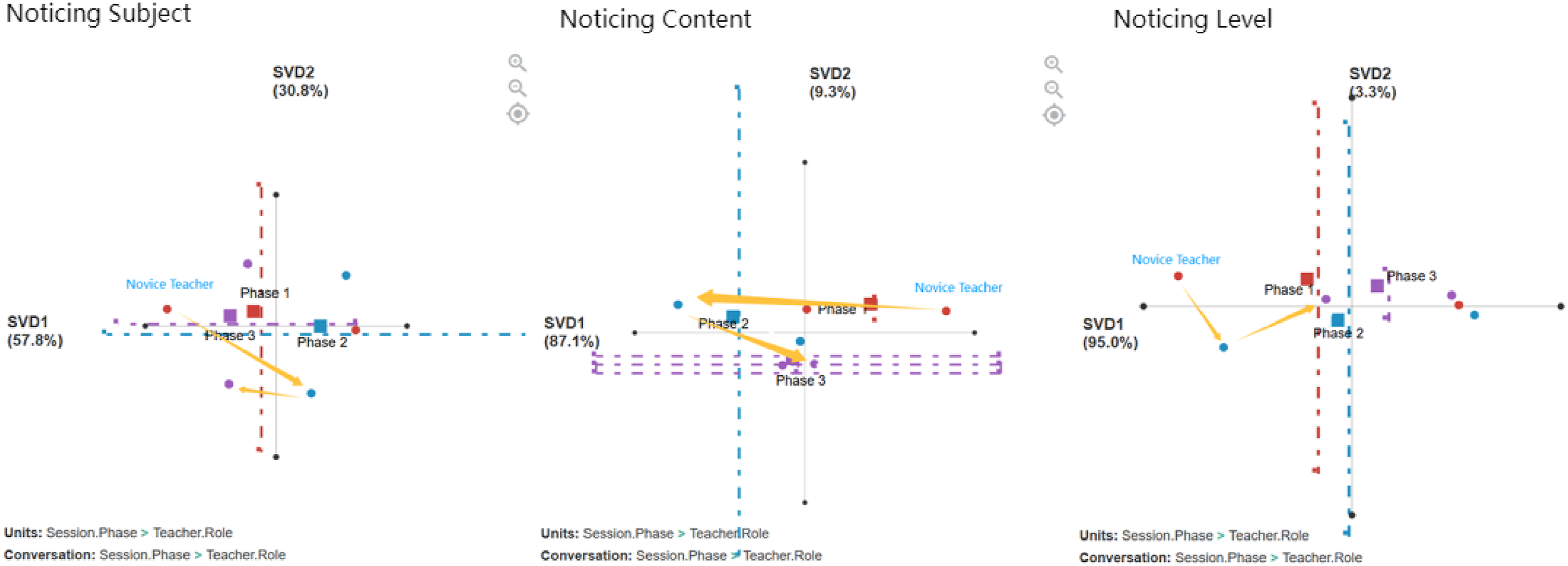
Differences in Teachers’ Epistemic Network Structure Across Stages

Discussion
Drawing on the analysis of differences in teacher noticing within mentor–mentee one-on-one sessions, and integrating evidence from teachers’ reflection reports and interview data, this section discusses the key findings and offers corresponding implications for practice.
From Noticing Differences to Reshaping Professional Identity
Differences in teacher noticing between novice and expert teachers during one-on-one sessions can generate cognitive conflict, which serves as a critical catalyst for reflective practice by activating novice teachers’ intrinsic motivation for professional development (Trachtenberg-Maslaton et al., 2023). This study, drawing on a tracking analysis of novice teachers’ noticing, proposes a five-stage developmental trajectory: self-awareness, conceptual learning and comprehension, transformative design, practical verification, and iterative reconstruction (see Figure 10). The process begins as expert teachers guide novices to articulate pedagogical challenges and identify gaps between current practice and desired outcomes. Through this initial guidance, novice teachers engage in structured reflection and targeted feedback, which fosters heightened awareness of their professional needs. Building on this awareness, expert teachers help translate identified concerns into actionable planning by linking them to prospective classroom behaviors. A critical turning point emerges when novices operationalize theoretical knowledge gained from professional seminars into concrete teaching practices, thereby forging explicit connections between specific classroom actions and broader educational principles. Through such cycles, the trajectory embodies the developmental shift from initial unawareness to understanding and enactment, ultimately achieving an integrated praxis in which practice and conceptual knowledge mutually reinforce each other (Widjaja et al., 2017). The Hierarchical Evolution of Novice Teachers’ Noticing
This transformation is not limited to imitation but instead involves the reconstruction of professional identity through dialogic engagement with expert practitioners (Rinne et al., 2025). Such dialogic exchanges underscore the role of professional discourse as a critical arena for constructing and developing teacher subjectivity (Babichenko et al., 2021). Within these interactions, teachers cultivate interpretive competence regarding appropriate pedagogical actions, which enables them to make thoughtful and deliberate decisions in complex classroom situations rather than relying exclusively on external directives (Wang, Husu, & Toom, 2025).
From Situational Dilemmas to Actionable Decision-Making
Our analysis revealed that novice teachers operating within the education reform context face a fundamental pedagogical challenge: designing instruction that engages learners while sustaining meaningful learning outcomes. Yet, despite their theoretical awareness of student-centered principles, novices systematically struggle to translate such knowledge into effective practice. Our epistemic network analysis further demonstrated a critical misdirection in novice teachers’ decision-making. When student performance disappointed, they focused excessively on surface-level engagement strategies, including the selection of appealing content and the design of novel activities, rather than conducting systematic analyses of individual learner needs. As one teacher reflected, “I always try to make the classroom lively by creating scenarios and designing many activities, but student participation still remains low. They may be active initially, yet after a few days, many start skipping class again.”
To address these challenges, considering the realities of rural students’ weak learning motivation, passive attitudes, and ineffective learning strategies, we propose three practical recommendations to guide novice teachers in shifting their instructional focus and enhancing their pedagogical awareness. First, teachers must transition from focusing narrowly on isolated teaching segments to regulating interconnections among all instructional components from a holistic perspective. When designing and implementing instruction, teachers should not only attend to effective execution of specific teaching activities but also examine the entire teaching process from a macro perspective, considering the interconnections and coordination among teaching beliefs, objectives, methods, and assessments (Contreras et al., 2025). Second, teachers can employ multiple data-gathering strategies, including targeted assessments and questionnaires to evaluate students’ cognitive levels. By integrating these diverse information sources into comprehensive learner profiles, teachers can move beyond one-size-fits-all instruction to deliver truly differentiated teaching that addresses authentic student needs (Svojanovský & Obrovská, 2024). Third, instruction must evolve from knowledge transmission toward comprehensive skill development that integrates interest cultivation, critical thinking, and collaborative learning. This transformation requires teachers to design learning activities that engage students in analysis, inquiry, evaluation, and synthesis, positioning learners as active constructors of knowledge rather than passive recipients. In rural educational contexts specifically, achieving such authentic engagement necessitates leveraging students’ lived experiences as pedagogical resources (Preminger et al., 2024). This involves developing localized teaching materials that meaningfully connect disciplinary knowledge to students’ familiar cultural and environmental contexts.
Respect and Trust: Fostering Reciprocal Learning through Mentor-Mentee Engagement
Expert teachers’ perceptions of their mentoring role profoundly influence the guidance strategies and behaviors they employ in practice (Carmi, 2024). While hierarchical power dynamics can inhibit collaborative inquiry and constrain novice teachers’ transformative learning potential, our findings reveal a more nuanced reality. Despite expert teachers’ stated commitment to equal participation, reciprocal respect, and facilitative mentoring approaches, their actual discourse practices often revert to direct, prescriptive instruction (Dittrich et al., 2025). This gap between espoused values and enacted practices appears to stem from time constraints, institutional pressures, and deeply ingrained habits of authoritative teaching. However, this directive approach creates unintended consequences by intensifying novice teachers’ pedagogical anxiety, fostering over-reliance on expert guidance, and ultimately diminishing their capacity for independent problem-solving and contextual adaptation. As one novice teacher articulated: “Every discussion with my mentor seems perfectly logical, but when I return to lesson planning independently, I find myself at a loss - something essential always feels missing.”
Teacher collaborative dialogue represents a generative process of understanding students, teachers, and pedagogical content through systematic questioning and analytical engagement (Onrubia et al., 2022). This conceptual framework has particular relevance for rural mentoring contexts, where novice teachers require support in navigating unique contextual challenges. To operationalize such collaborative dialogue, effective mentoring discourse should create conditions where novice teachers feel empowered to engage in questioning while expert teachers employ dialogic strategies such as counter-questioning and systematic inquiry to develop mutual reflective and critical thinking capabilities (Larsen et al., 2023). This approach prioritizes exploratory dialogue that welcomes diverse perspectives over unidirectional knowledge transmission. The foundation for such productive discourse lies in establishing authentic relationships grounded in mutual respect and trust (Gibbons & Nieman, 2024). When both participants collaborate as co-constructors of knowledge, interpreting and meaning-making around teaching challenges together, they move beyond hierarchical mentoring models toward genuinely reciprocal professional partnerships.
Conclusion
This study demonstrates that cross-regional, mentor-mentee hybrid training programs can effectively address the professional development needs of novice rural teachers when grounded in systematic pedagogical frameworks and “Human-Tech” integration approaches. Employing Epistemic Network Analysis (ENA), we examined the interaction characteristics and dynamic shifts in teacher noticing during mentoring dialogues. The findings not only validate the effectiveness of the activity design but also illuminate how expert teachers scaffold novices in progressing from recognizing and analyzing differences to transforming them. These insights offer a valuable reference pathway for fostering teachers’ subjective professional growth, especially those serving remote or rural communities.
While the study provides meaningful insights into the dynamics of mentoring and the scaffolding processes that support novice teachers’ professional growth, several limitations should be acknowledged. First, the relatively small sample size and regional specificity limit the generalizability of the results. Nevertheless, the in-depth mixed-methods design employed in this study, combining qualitative and quantitative approaches, helps mitigate this limitation by providing nuanced and interpretive insights into teacher noticing. Future research should replicate these findings with larger and more diverse teacher populations to enhance validity and ensure the broader applicability. Second, the short-term investigation constrained our ability to examine sustained patterns of professional growth, highlighting the need for longitudinal studies that track mentoring impacts over extended periods. Finally, given the rapid evolution of artificial intelligence in educational contexts, future research should investigate how AI-powered tools and large language models might be strategically integrated into collaborative mentoring processes to enhance dialogue quality and amplify professional learning outcomes.
Footnotes

Funding
The authors received no financial support for the research, authorship, and/or publication of this article.
Declaration of Conflicting Interests
The authors declared no potential conflicts of interest with respect to the research, authorship, and/or publication of this article.