



Abstract
Mobile AI technology provides personalized guidance, real-time feedback, and flexible learning methods for art learners. However, few studies have investigated the effect of using mobile AI technology in dance practice applications. Therefore, this study designed and developed an AI-assisted dance practice AI-ADP application to support students’ dance learning. This study used 60 preschool education students from a university in southern China as the research subjects and attempted to fill this gap by evaluating the effectiveness of mobile AI in students’ dance learning. The study used an AI-based design dance practice app (the 3D poses evaluation algorithm YOLO-Pose and react canvas video cropping compression) to assess students’ learning motivation, learning outcomes, and engagement through questionnaires and scales. The results showed that compared with traditional teaching, the interactivity of AI can create learning content with timely feedback, significantly improving students’ learning motivation, learning outcomes, and engagement. In addition, the study also discusses the theoretical and practical value.
Introduction
With the widespread application of information and communication technologies in education, the digital revolution is reshaping traditional teaching models, and mobile technology has provided new opportunities and methods for promoting active learning (Sobral, 2020). As a rapidly developing emerging technology, mobile artificial intelligence has gradually evolved into a teaching tool widely adopted by educational institutions around the world, and its potential advantages are becoming increasingly apparent (Criollo-C et al., 2021). In recent years, mobile-based learning formats have continued to evolve. Driven by both technological innovation and shifts in pedagogical philosophy, innovative educational frameworks integrating artificial intelligence with mobile learning have emerged, pointing to an important direction for future educational development (Lai & Tu, 2024; Moya & Camacho, 2024).
Previous studies have further demonstrated that mobile learning, due to its high interactivity, has long been widely used in teaching-oriented learning models. The integration of artificial intelligence technology into the mobile learning environment helps to strengthen its real-time feedback function, thereby effectively improving student engagement (Alam & Mohanty, 2023). Mobile AI technology can precisely identify deviations in students’ key movements during dance practice and provide instant feedback through real-time motion capture and analysis. This technology enables students to quickly identify and correct problems in their independent practice, thereby improving the accuracy of their movements and academic achievement (Kang et al., 2023). Some researchers believe that AI-driven mobile learning is a promising educational change. For example, mobile technology AI tools can promote learner autonomy and enhance positive attitudes towards learning (Arini et al., 2022).
University preschool education dance courses include dance fundamentals, folk dance training and achievement, classical dance training and achievement, and children’s dance achievement and creation. Integrating physical expression and artistic emotion demonstrates dance education’s unique value and significance in children’s physical and mental development (Tao et al., 2022). The rapid development of the digital media industry has promoted the deep integration of art education and emerging technologies, and the introduction of mobile AI scoring systems has provided innovative solutions for dance teaching. Through real-time motion capture and intelligent feedback, this technology not only improves the efficiency of students’ independent learning but also opens up new paths for the digital transformation of art education (Dimitriadou & Lanitis, 2023). However, as (Lee & Lee, 2023) point out, despite the growing interest in AI as a promising educational tool, its application is mainly focused on subjects such as science and languages, while research related to dance education is still limited. In addition, a recent study by Kuleto et al. (2021) points out that although academia is gradually recognizing the potential value of AI in art education, research on its application in actual teaching scenarios is still lacking, and practical experience in various directions is urgently needed.
In response to the research gaps identified in the above paragraphs, this study proposes to develop a mobile dance practice app based on AI scoring technology to support dance learning for preschool education students. This study aims to construct a practical framework that combines AI scoring with mobile learning by exploring the impact of AI-driven mobile learning environments on student learning outcomes. The study will be conducted in a university in southern China, and the practical application effect of the technology will be evaluated by comparing the changes in students’ learning motivation, academic achievement, and participation in dance education courses before and after the implementation of the mobile AI scoring app (AI-ADP).
Mobile-based (AI-ADP) learning approach. This study aims to address the following research questions: (1) How does mobile (AI-ADP) affect Chinese college students’ academic achievement in dance education? (2) How does mobile (AI-ADP) affect Chinese college students’ dance education motivation? (3) How does mobile (AI-ADP) affect Chinese college students’ dance education engagement?
Literature Review
Mobile Technology in Education
Mobile devices’ popularity and Internet technology advances have provided new learning pathways for distance learners (Awajan et al., 2022). The application of mobile technology in higher education is becoming increasingly popular, leading to profound changes in teaching practices (Chen, 2024). Mobile technology education breaks through the limitations of time and space through digital devices, helping higher education cultivate innovation capabilities and helping students master the necessary skills to cope with rapid social changes (Alam & Mohanty, 2023). The flexibility of mobile technology provides convenience for both teachers and students (Al-Rahmi et al., 2022), supporting students’ instant access to resources, participation in virtual learning, and diverse learning activities (Criollo-C et al., 2022). In addition, mobile technology also supports communication with experts and the sharing of learning experiences through social media, further expanding the learning scenario (Alam & Mohanty, 2023).
However, mobile technology also faces some challenges in education. Mobile learning requires the scientific allocation of teaching tasks inside and outside the classroom and the rational arrangement of teaching objectives, which puts forward higher requirements for instructional design (Bernacki et al., 2020) Existing mobile interactive technologies are difficult to adapt to diverse teaching scenarios and cannot fully meet students’ individual needs. There is an urgent need for intelligent teaching by integrating new technologies (Chang & Liu, 2023). In addition, as a multi-sensory interactive tool, the complexity of mobile technology may pose a barrier to users with insufficient technical skills (Javed, 2024). Despite these significant challenges, technological development is expected to ease many problems gradually (Holmes, 2019).
Mobile AI Scoring Technology in Dance Education
Dance is an art form that combines physical expression, emotional communication, and cultural symbolism. It expresses individual creativity and aesthetic awareness through rhythm, movement, and the use of space (Fink et al., 2021). Dance teaching is an important part of arts and achievement education in higher education. However, teachers often face challenges when using traditional teaching methods to assess students’ dance skills and expressiveness. For example, it is not easy to provide targeted guidance to students in large classes (Andersson, 2018). Notably, the use of artificial intelligence in dance teaching has gradually increased in recent years. For example, a research team has developed an AI-based real-time scoring system that uses smart devices to capture students’ dance movements and combines machine learning algorithms to instantly evaluate the movements’ accuracy, fluency, and expressiveness. With mobile AI technology, teachers can objectively quantify students’ dance achievements and provide personalized feedback, helping students improve their skills more efficiently (Dos Santos et al., 2022). The application of this technology not only improves the accuracy of teaching but also injects more interactivity and personalization into dance education.
Another example is using artificial intelligence (AI) technology to assist in analyzing and scoring dance movements, which are often difficult to assess due to individual differences and subjective judgments. By capturing and analyzing dance movements through AI technology, the system can automatically identify the accuracy and rhythm of movements and provide real-time feedback. Research shows that students who use AI scoring systems find this technology more objective and immediate than traditional teacher assessment (Xu et al., 2025). In addition, research on the acceptance and willingness of dance students to use AI-assisted teaching tools shows that the three main factors that affect their perception are: ‘technical practicability’, ‘learning efficiency’, and ‘interactive experience’. The research results show that AI-based teaching can give students a clearer understanding of dance movements’ technical details and artistic expression, providing new perspectives to optimize dance training and curriculum design (Cao, 2024).
In an era of rapid technological development, choosing the right teaching tools for dance education is crucial. The advantage of artificial intelligence (AI) technology is that it can significantly improve students’ understanding of dance movements, help them break through the limitations of traditional teaching methods, and cultivate their technical precision and artistic expression. However, existing research shows that although AI scoring technology can provide objective and real-time feedback through motion capture and data analysis, its potential in dance education has yet to be fully explored. For example, AI feedback can improve learning outcomes, but it still has limitations in motivation and understanding complex behaviors.
The Relationship Between Learning Motivation and Engagement
Motivation is a complex and dynamic construct that plays an important role in shaping human behavior and cognitive engagement. Motivation is a key determinant of student learning in education, influencing their effort, persistence, and overall academic achievement (Bembenutty et al., 2022). Ryan and Deci (2020) in empirical studies have shown that motivation is closely related to learning outcomes, and students with higher levels of motivation tend to engage more actively in academic tasks, show more extraordinary perseverance, and achieve better academic achievement. Conversely, a lack of motivation can lead to a lack of goal orientation and persistence in the learning process, affecting academic achievement and cognitive development (Theobald, 2021). In addition, mobile learning apps can provide personalized feedback and adaptive content to meet individual learning preferences, further enhancing learning motivation (Kem, 2022).
Engagement is another core factor that affects student learning outcomes, which determines the depth of students’ interaction with learning materials, their persistence in academic tasks, and ultimately their learning achievement (Singh et al., 2022) shows that engagement is a multidimensional concept that includes behavioral, affective, and cognitive dimensions, each contributing uniquely to academic success. Engagement is primarily reflected in students’ active participation in classroom activities and the timely completion of learning tasks. These behaviors correlate significantly with better information memory and higher academic achievement (Li & Xue, 2023). When students are engaged, they are more likely to meet academic expectations and invest energy in learning, which improves learning outcomes. These are closely related to motivation and the learning environment, which affect student achievement.
Methodology
Participants
To evaluate the effectiveness of the mobile AI scoring technology tool (AI-ADP) in helping students learn dance. A quasi-experimental design was used in a dance course at a university in Sichuan, China. The study looked at 60 first-year university students who were majoring in preschool dance between the ages of 18 and 19. Participants were divided into two groups, Group A and Group B, with 30 students in each group. All students had no formal dance training and lacked experience in dance learning.
Sixty female students were selected as subjects for the study and randomly divided into an experimental group and a control group, with 30 students in each group. The students in the experimental group came from Class A and used the mobile AI scoring technology to assist in dance teaching. Specifically, during classroom teaching, the teacher systematically explained and demonstrated the operation process and precautions for using the software, then explained in detail the technical specifications and essentials of dance movements. Under the teacher’s guidance, the students practiced in class and then reviewed and imitated independently after class through the mobile AI scoring app. The app allows students to record their dance achievements while practicing at home. It provides real-time intelligent scoring of key movements and a comparative analysis of students’ movements with the standard movements and personalized improvement suggestions. The control group (Class B) used the traditional teaching model, in which the teacher gives regular explanations and demonstrations of dance movements in class and provides students with standard dance teaching videos for reference after class. Students practice imitating by watching the videos.
This study was conducted under the supervision of a senior professor with 12 years of dance teaching experience and in strict accordance with academic ethics. Before the study was implemented, all participants (including the experimental group and the control group) were informed of the detailed purpose, process, and potential impact of the study and signed a written informed consent form to ensure the transparency of the research process and fully protect the participants’ right to know. There were no ethical disputes during the study, and all participants completed the established experimental process without withdrawal.
Data Collection Instruments
This study adopted a pre-test and post-test design to evaluate students’ dance performance. The assessment was based on the dance achievement standards proposed by Rcampus (2018). To ensure the content validity and construct validity of the scoring criteria, three experts with over 10 years of experience in dance education were invited to review and validate the assessment criteria. The reliability of the scale was verified by Cronbach’s alpha coefficient of 0.844, indicating good internal consistency. The original assessment framework included four dimensions: dance knowledge, technical skills, performance skills, and rhythm and timing. After expert review, the ‘dance knowledge’ dimension was removed to better align the scoring criteria with the actual assessment needs of dance performance. The final scoring criteria consist of three dimensions and utilize a five-point grading system.
In addition to the assessment of dance achievement, the learner’s motivation and engagement were also assessed using a scale based on a 5-point Likert scale. Learner motivation was adapted from the Instructional Materials Motivation Survey (IMMS) and utilized the ARCS model (Keller, 1987). The IMMS consists of 36 items using a 5-point Likert scale. Responses range from 1 (unconfirmed) to 5 (very true). The scale is divided into four dimensions, with 12 questions testing the Attention item, focusing on how the course content, writing style, and course organization attract and maintain attention or help avoid boredom. Nine items tested the relevance subscale, assessing how the information is connected to the learner’s prior knowledge and experience, perceived needs, and potential future applications. Nine items tested the confidence subscale, addressing the perceived difficulty of the material and how the course presentation ensured learning success. Six items tested the satisfaction subscale: assessing enjoyment during the course and a sense of accomplishment after the course (refer to Appendix B). The overall reliability of the IMMS, as measured by Cronbach’s alpha, was 0.96. In addition, previous researchers have rigorously tested its high reliability through experiments, with an overall reliability Cronbach’s alpha of 0.93, a satisfaction sub-dimension reliability of 0.89, a confidence sub-dimension reliability of 0.75, a relevance sub-dimension reliability of 0.78, and an attention sub-dimension reliability of 0.82 (Cook et al., 2009).
In addition, this study used the Student Learning Engagement Scale developed by (Fredricks et al., 2004) to measure engagement. This scale consists of 30 items divided into three dimensions, with 10 test items in each dimension, including affective engagement, behavioral engagement, and cognitive engagement. The Engagement Scale demonstrated excellent internal consistency, with an overall Cronbach’s alpha coefficient of 0.956. The Engagement Scale demonstrated excellent internal consistency, with an overall Cronbach’s alpha coefficient of 0.956. The value is considered highly reliable if the internal consistency reliability coefficient is higher than 0.90
Emotional involvement is 0.92, behavioral involvement is 0.93, cognitive involvement is 0.93, and extracurricular involvement is 0.82 (Robert & DeVellis, 2003). In addition, the scale is a well-established scale that has been rigorously tested in multiple experiments to confirm its validity and reliability (Gunuc & Kuzu, 2015; Ramadhani & Purwono, 2023; Ramos et al., 2019).
Experimental Procedures
The experiment used a pre-test and post-test design to evaluate the effectiveness of an app that uses mobile AI scoring technology to assist dance practice. The system uses the 3D pose evaluation algorithm YOLO-Pose and React Canvas video cropping and compression. Each student used their mobile phone during the experiment, and the experimental and control groups used dance courseware related to Dai dance. The activity lasted 90 minutes, equivalent to two standard class periods. At the beginning of the experiment, the teacher introduced the task to all participants, which lasted 10 min. After the introduction, the participants completed the pre-test of the dance achievement.
The dance achievement pretest was a dance achievement assessment in which three teachers scored the students’ dance achievement. The test was based on the dance achievement assessment criteria proposed by Rcampus (2018) and aimed to assess students’ dance skills (10 minutes). We invited three experts with at least 15 years of dance teaching experience to evaluate and verify the scoring criteria.
After the pretest phase, each student participated in a 30-min learning session. The same dance learning material was used for the experimental and control groups, but the teaching methods differed. The experimental group used an app based on mobile AI scoring technology to assist dance practice, while the control group used traditional video learning. First, the teacher provides learning materials related to the dance course. Students in the experimental group use the AI-ADP to assist their dance practice. When the students practiced the dance movements, the system’s front camera was turned on to display a real-time comparison of the students’ movements with the standard movements. The system would give a real-time score for the students’ dance compared to the standard dance, and the score would be displayed at the bottom of the screen so that the students could identify their inadequate movements. In addition, the system will evaluate the student’s overall dance achievement, give a rating, and provide learning suggestions to improve the student’s dance skills (as shown in Figure 1). After the learning session, all participants took the same dance test as the pre-test to evaluate their achievement, learning motivation, and engagement (40 min). The content order of the pre-test and post-test is different. AI-ADP Scoring Interface
The study cycle was four weeks. Before the experiment, all students were required to spend 10 min taking the pretest of dance achievement. In addition, the teacher also needed to inform the students about the usage method and process of the mobile AI scoring technology-assisted dance practice application. Students became familiar with the application’s functions and specific operations, which helped reduce the new influences that may affect students when using new technology. The teacher needed 30 min to demonstrate the prelude dance movements in the second week. Then, the students used the application to practice dancing for 60 min. The teacher must spend 30 min demonstrating floor dance moves in the third week. Then, students use the app for 60 min of dance practice. In the fourth week, a post-test, engagement, and motivation test are conducted for 40 min. The experimental and control groups have 45 min of class time because the standard class time at the university is 45 min, and two consecutive classes are held each time for a total of 90 minutes. (as shown in Figure 2) Students Practicing Dance With AI-ADP in the Classroom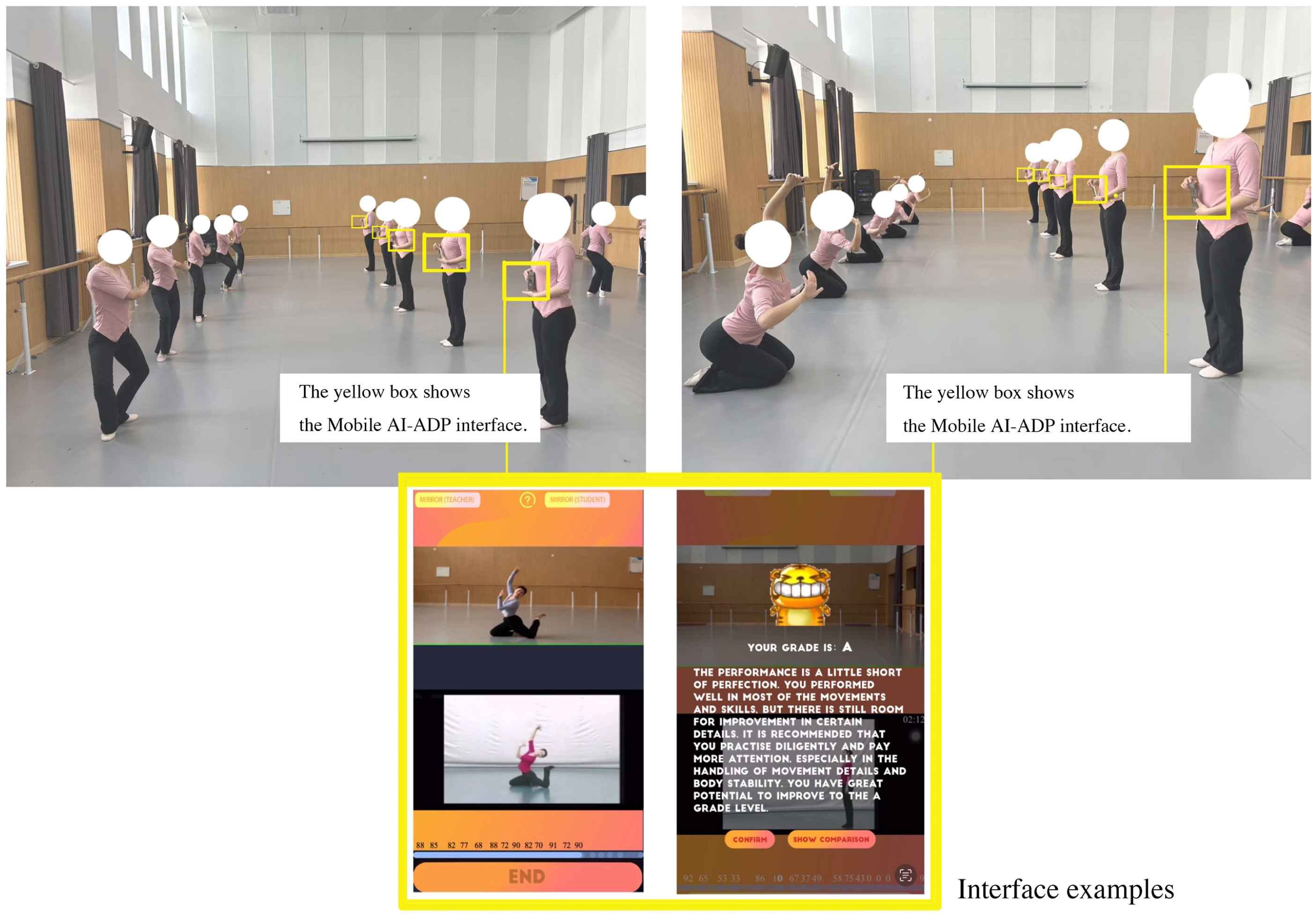
Data Analysis
This study used SPSS to quantitatively analyze the scales for the three research questions, the pretest and posttest scales. The impact of the mobile AI scoring assistant dance learning app on students’ academic achievement, learning motivation, and engagement was assessed by conducting multiple paired-sample t-tests. Significant differences were found when pretest and posttest scores were compared. It is worth noting that the number of subjects in the experimental group was the same as in the control group, namely 30 students.
The subjects completed one pretest and one posttest, which were the same content but in order. The motivation scale used four subscales to collect feedback to measure learning motivation and engagement. Engagement included three subscales to assess changes in student engagement. Two researchers completed quantitative data analysis. All hypotheses proposed in this study were tested at a significance level of 0.05. In the analysis, p ≤ .05 indicates that the result is statistically significant, p < .01 is considered statistically significant, and p < .001 is highly statistically significant. If p > .05, the result is considered not statistically significant. Additionally, the effect size and the range of Cohen d were calculated (d = 0.2 “small”, 0.5 “medium”, 0.8 “large”.
Results
Achievement
T-Tests Comparing the Pre- and Post-Test Scores of Students’ Dance Achievement

The research findings effectively address the research question: ‘In terms of academic achievement, do students who receive timely feedback through mobile interactive artificial intelligence technology perform better in dance than those who receive traditional teaching methods?’ This study validated the question through empirical data. Pre- and post-test results showed that students in the experimental group who used mobile AI scoring technology to assist their dance practice performed significantly better than those in the control group who received traditional instruction, and the achievement differences between the two groups were statistically significant. The t-test results indicated a highly significant difference between the two groups (p < .001), suggesting that the improvement in learning outcomes in the experimental group was not due to chance factors. Therefore, the research findings support the potential application of mobile AI scoring technology in dance education, and such technology plays a positive role in enhancing the learning outcomes of university students in dance.
Motivation
T-Test Comparing the Motivation Sub-dimension Scores of TL and AI-ADP

Note. *p < .05, **p < .01.
The results in Table 2 provides a detailed answer to the research question of “How does mobile AI scoring technology affect the motivation of Chinese college students in dance education?” Overall, the experimental group was significantly better than the control group in the four sub-dimensions (confidence, attention, satisfaction, and relevance). The AI-ADP method not only performed significantly in statistical terms but also demonstrated greater effectiveness in practical terms, especially in improving confidence and relevance.
Engagement
T-Test Comparing the Engagement Sub-Dimension Scores of TL and AI-ADP

Note. *p < .05, **p < .01,***p < .001.
In summary, the scores (M and SD) of the experimental group (AI-ADP) were significantly higher than those of the control group (TL) in the three dimensions of affective engagement, behavioral engagement, and cognitive engagement, and the t-tests all reached the level of statistical significance. Effect size analysis showed that AI-ADP had a particularly significant effect on enhancing affective and cognitive engagement.
Discussion
This study designed and developed a mobile interactive dance learning tool that integrates artificial intelligence technology with real-time feedback mechanisms, aiming to provide students with a new learning experience. The study was conducted at a university in Sichuan, China, using a quasi-experimental research design. The effectiveness of the tool in improving students’ dance performance, learning engagement, and learning motivation was systematically evaluated and compared with traditional teaching methods. Through pre- and post-test comparisons, the results showed that the dance learning application based on the mobile AI scoring system significantly enhanced students’ learning outcomes. Further analysis indicated that the tool also had a significant positive impact on improving students’ learning motivation and engagement.
Assisting Middle School Students’ Dance Achievement during Dance Practice Based on Mobile AI Scoring Technology
Dance exercises based on mobile AI scoring technology can improve students’ learning outcomes. The benefits of dance exercises using mobile AI scoring technology may be due to the following reasons. First, the mobile AI scoring system provides students with immediate and accurate feedback through real-time motion capture and analysis, effectively solving the problem of delayed feedback in traditional dance teaching (Raheb et al., 2019). In traditional teaching methods, teachers usually use the “demonstrate-imitate-feedback” method. However, the large class size makes it difficult for teachers to provide timely and detailed guidance to each student. Students often have to rely on limited class time for imitation practice, and there is a lack of an effective feedback mechanism after class, making it difficult to correct movement errors promptly. In contrast, mobile AI technology can identify subtle movement deviations through intelligent algorithms and present them in the form of visual data, helping students quickly adjust their posture and thus improve the accuracy and fluency of their movements. This instant feedback mechanism not only compensates for the shortcomings of insufficient feedback in traditional teaching, but also significantly enhances students’ self-monitoring ability and improves learning efficiency (Kang et al., 2023).
Second, mobile AI scoring technology meets the diverse learning needs of students through data-driven personalized learning paths. In traditional teaching, teachers usually adopt a uniform teaching pace and content, making it difficult to consider individual student differences. In particular, students with weaker foundations or slower learning progress often fail to receive sufficient attention and support (Chao et al., 2021). The mobile AI system, however, can generate customized training plans based on students’ exercise achievement and provide targeted guidance on weak links (Li, 2024). For example, the system will recommend specific exercises and monitor improvements in real time for students with unstable rotation movements. This personalized support not only makes up for the shortcomings of teachers in traditional classrooms, who find it difficult to pay attention to each student, but also enhances students’ sense of self-efficacy and motivates them to learn through data visualization. In addition, mobile AI technology also supports interactive learning among students, such as peer review through video sharing, which further enriches the learning experience and makes up for the lack of student interaction in traditional teaching.
Finally, the mobile AI scoring technology significantly improves the efficiency of students’ dance skill mastery through data-driven, precise analysis and feedback mechanisms. In traditional teaching, teachers teach dance moves through verbal explanations and demonstrations. However, due to time constraints, it is not easy to comprehensively evaluate and provide feedback on the details of each student’s movements (Xu et al., 2025). In contrast, the mobile AI system can evaluate each student’s practice from multiple dimensions, including key indicators such as strength, rhythm, and coordination of movements, and it can help students identify areas for improvement through intuitive data reports. This data-based feedback enhances students’ self-reflection skills and improves their learning confidence and motivation through continuous positive encouragement (Dimitriadou & Lanitis, 2023). In addition, mobile AI technology also supports efficient interaction between students and teachers. Teachers can quickly understand students’ learning progress through the system-generated assessment reports and adjust teaching strategies accordingly (Cao, 2024). This deep integration of technology and teaching not only optimizes the allocation of teaching resources but also provides strong support for students’ independent learning, thereby improving dance education’s overall quality and effectiveness.
Students’ Motivation in Dance Practice Assisted by Mobile AI Scoring Technology
A significant difference was found in learning motivation between the experimental group (EG) and the control group (CG). This indicates that mobile AI scoring technology improves students’ dance skills and effectively enhances their learning motivation. Compared with traditional teaching methods, mobile AI technology provides students with a more interactive and engaging learning experience through instant feedback and personalized guidance, thus stimulating their interest and intrinsic motivation in learning (Wang & Zheng, 2020). For example, the system allows students to monitor their learning progress through real-time motion tracking and visual performance analysis. This instant feedback provides a sense of achievement, which in turn boosts students’ confidence and engagement in learning. In addition, the application of mobile technology enables learners to set personalized goals and adjust their practice strategies based on their learning outcomes. This autonomy satisfies students’ psychological needs and becomes an important driving force for sustained motivation in dance learning.
The study also found that mobile-based scoring technology provides continuous motivation and support for college students by integrating diverse learning tools and interactive features. For example, the system provides instant feedback on learning outcomes and enables peer interaction and evaluation through video sharing. This social learning approach not only encourages students to actively participate, but also enhances their sense of belonging and community awareness in the learning environment (Zhou, 2023). During the interviews, some students said, “Mobile AI technology has made me feel the joy of dance learning. Every time I see my progress, I continue practicing.” This positive learning experience is closely related to high motivation levels, which further verifies the effectiveness of mobile AI technology in improving learning motivation.
Student Engagement in Mobile AI Scoring Technology-Assisted Dance Practice
Significant differences were found in learning engagement between the experimental group (EG) and the control group (CG). This indicates that mobile AI scoring technology can enhance college students’ learning engagement. In traditional dance teaching, students’ learning engagement is often affected by class time constraints and insufficient teacher attention, which makes it difficult for some students to continue to invest in their studies (Zhang, 2024). In contrast, mobile AI technology provides students with a more flexible and personalized learning experience through real-time feedback and interactive functions. For example, students can view their practice data at any time through the system and adjust their movements based on the feedback. This immediate interaction significantly enhances their sense of learning engagement. This is consistent with the results of similar existing studies. After repeated practice experiences, students can proficiently remember the movements, become more interested in practicing dance, and their participation has significantly improved.
In traditional teaching models, student engagement mainly depends on the teacher’s classroom organization and students’ self-motivation. However, the large class size makes it difficult for the teacher to pay attention to each student’s learning status (Hsia & Hwang, 2020). In contrast, mobile AI scoring technology enables students to arrange their practice time and monitor their learning progress in real-time through data-driven learning paths and instant feedback mechanisms. For example, the system generates personalized learning tasks based on students’ practice achievement and displays learning outcomes through visualized data. This transparent learning process significantly improves students’ engagement and learning motivation.
The study also found a significant positive correlation between learning engagement and student learning outcomes. Students with high engagement performed better in dance skills and demonstrated more substantial learning confidence and self-efficacy (Hsia & Hwang, 2021). In the interviews, some students said, “Mobile AI technology allows me to practice anytime, anywhere, and I can see my progress every time I practice, which makes me more willing to invest time and energy.”
This study also examined the important influence of learning engagement on dance achievement. This result is consistent with Alexander et al. (2023) views who believe that highly engaged students can be more actively involved in practice and thus acquire higher dance skills. When conducting dance teaching activities, teachers should also pay more attention to students with low engagement and provide personalized learning support and instant feedback through mobile AI scoring technology to help them accumulate successful learning experiences and improve their learning engagement and dance achievement.
Deviation and Accuracy Issues in Assisting Dance Practice Based on Mobile AI Scoring
Although mobile AI technology shows significant potential for scoring and assisting dance practice, we must still address the bias and accuracy issues in practical applications. The fairness and accuracy of an AI system largely depend on the diversity and representativeness of its training data. Our training data sets mainly come from specific dancers, lacking sufficient coverage of different dance types, genders, body types, ages, and cultural backgrounds. This imbalance in data may lead to biased scoring and feedback from the system for certain groups, thus affecting the fairness of the user experience. For this reason, we recommend that future data collection prioritize diversity and inclusion, incorporate more data from dancers from diverse backgrounds, and establish a fairness assessment mechanism to identify and correct potential biases systematically.
In addition, the accuracy of mobile AI scoring systems is also constrained by various external factors. For example, the camera achievement of mobile devices, changes in ambient light, the complexity of dance moves, and the stability of the user’s device can all significantly impact the scoring results. Especially in dynamic environments, insufficient lighting or poor camera angles may lead to inaccurate motion capture, affecting the score’s reliability. To improve the system’s accuracy, future research should focus on optimizing image processing algorithms for mobile devices, developing intelligent adjustment techniques that adapt to different lighting conditions, and enhancing motion capture accuracy. At the same time, the integrated analysis of multimodal data (such as accelerometers, gyroscopes, and audio feedback) can further improve the accuracy and comprehensiveness of the score.
Limitations
This study aims to explore the impact of mobile-based scoring technology on students’ learning motivation, learning outcomes, and engagement in dance practice. Although the research findings are insightful and positive, it is important to acknowledge several limitations of this study. First, the sample size was relatively small, with participants primarily concentrated in a specific age group and dance proficiency level, limiting the generalizability of the findings. Therefore, future research should expand the sample size and include learners with diverse backgrounds, such as students of different ages, dance experience, and cultural backgrounds, to further validate the applicability and effectiveness of mobile scoring technology in broader educational contexts.
Second, this study focused primarily on macro-level outcome variables such as learning motivation, learning outcomes, and participation levels, without delving into the specific learning behaviors of students during the system usage process. For example, how learners adjust their practice strategies after receiving feedback, and the specific impacts of different feedback formats (e.g., visual, auditory, or tactile cues) on learning pathways and outcomes remain areas for further investigation. Future research can combine learning behavior analysis technology to track and explore the interaction process of students, thereby providing empirical support for the optimization of feedback mechanisms and the improvement of learning efficiency.
Finally, although the mobile scoring system has shown good results in motivating students and promoting learning participation, there is still room for improvement in its functional design. For example, by enhancing gamification mechanisms and personalized feedback functions, a more attractive, learner-centered learning environment can be created. Future system development should place greater emphasis on the interactivity and adaptability of content to better meet the individual needs of different learners and provide high-quality, customized learning support. Such optimizations will not only help maintain learning motivation but also promote students’ continued engagement and in-depth development in dance learning. The above research directions can provide useful references and insights for the continuous innovation and application of mobile scoring technology in the field of education.
Conclusion
This study proposes and validates a mobile artificial intelligence-based scoring technology aimed at assisting students in their learning process during dance practice. The system utilizes real-time motion capture, automatic assessment, corrective suggestions, and instant feedback to help learners improve their dance skills and encourage reflection and self-adjustment during training. Experimental results indicate that this innovative teaching method significantly improves students’ dance performance while effectively enhancing their learning motivation and classroom participation. The research findings provide empirical support for teachers and educators, demonstrating the practical feasibility and positive effects of artificial intelligence technology in dance education. Further analysis shows that effectively integrating technological tools into the teaching process not only helps stimulate students’ interest and initiative in learning, but also plays a key role in promoting their academic achievement. These findings offer valuable references for educational practitioners in designing and implementing technology-based teaching activities, and lay a theoretical and practical foundation for the application of AI-assisted teaching in broader educational fields (El Amine Ghobrini et al., 2021).
Footnotes

Ethical Consideration
This study has been cleared by the ethics committee.
Author Contribution
X.S.N., W.A.J.W.Y., N.S., and Z.S.Y. contributed to the design and implementation of the research, the analysis of the results, and writing of the manuscript. All authors contributed to the article and approved the submitted version.
Funding
The authors received no financial support for the research, authorship, and/or publication of this article.
Declaration of Conflicting Interests
The authors declared no potential conflicts of interest with respect to the research, authorship, and/or publication of this article.
Data Availability Statement
The raw data supporting the conclusions of this article will be made available by the authors, without undue reservation.