



Abstract
Critical Policy Analysis (CPA) is a framework for examining policies that focuses on power, privilege, and social inequalities. Research on the impact of the Double Reduction educational policy is varied as the policy is new and may not be universally equitable for all students. Some studies have demonstrated the anticipated positive outcomes of the policy, however, contrasting findings have been reported in other studies. This analytical paper aims to provide a comprehensive understanding of the Double Reduction educational policy in China and discuss the implications for equity and inclusion through the lens of CPA. It addresses gaps in current research by evaluating the policy’s effectiveness and its differential impact on various student demographics. By examining existing literature, this paper offers recommendations for policymakers to enhance the impact of the Double Reduction educational policy, particularly for students from disadvantaged socioeconomic, ethnic minority, and geographic backgrounds.
Introduction
Chinese education, largely shaped by Confucianism, emphasizes the importance of learning, while also valuing parental participation and dedication to their children’s education (Wong et al., 2012). This emphasis on learning has deep historical roots dating back to the 7th century in Imperial China (Zhang, 2014). People studied Confucian texts with the aim of advancing their social status through an imperial exam (Wu, 1994). This pursuit of social advancement through education remains prevalent in contemporary Chinese society (Zhao, 2023).
The annual high-stakes college entrance exam serves as the mechanism for selecting the most capable students for higher education (Ross & Wang, 2010). According to Oyeniran and Uwamahoro (2017), college entrance exam has historically been the primary pathway for achieving social advancement in Chinese society since the 10th century. It ensures equal access to higher education by providing standardized scores that are comparable nationwide (You & Hu, 2013). Further, attending an elite college is positively linked to higher starting salaries for young people in their first job after graduation (Jia & Li, 2021), motivating millions of Chinese students to rigorously prepare for the exam.
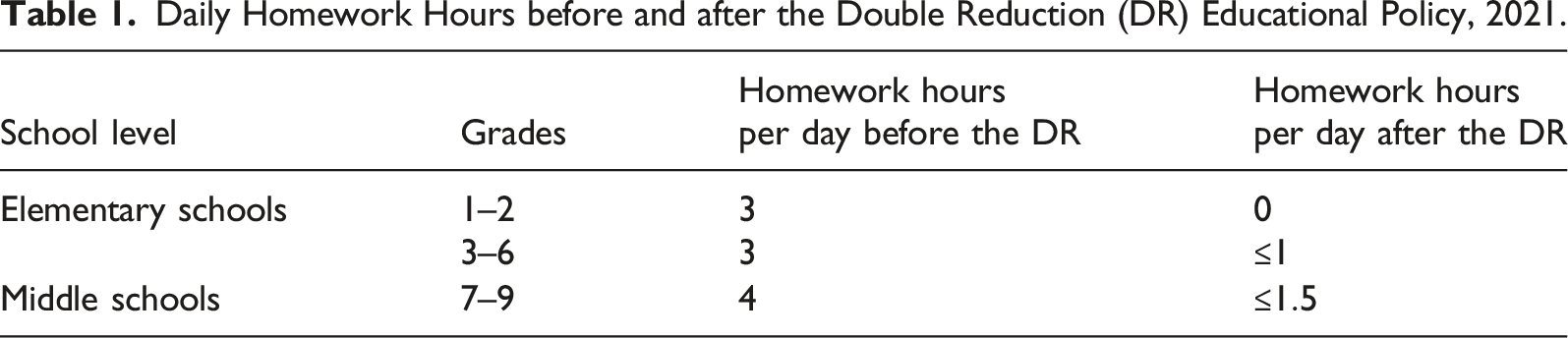
To excel in national college entrance exam and to gain admission to universities or colleges in China, according to Hu and Mu’s research conducted in 2020, middle school students, on average, dedicate approximately 4 hours per day to work on their school assignments. Elementary school students spend 3 hours daily on academic-related work, including homework assigned by their teachers, on top of a 7–8 hour school day (Ren et al., 2017). In addition to regular school and homework, in 2016, a total of 137 million elementary and middle school students were enrolled in academic subject tutoring. The nationwide average rate for academic subject tutoring enrollment from kindergarten to grade 12 (K-12) stood at 37% in 2014, and it was estimated to increase to 50% by the year 2020, with an even higher rate of 80%–90% expected in major cities (Zheng et al., 2020). However, the combination of long school hours and additional academic tutoring has adversely affected the health of Chinese students (Hesketh et al., 2010; Jiang et al., 2021; Zhu et al., 2021).
In addition to that, on average, in 2017, each household spent approximately 5616 yuan per year on tutoring services, equivalent to 770 US dollars (Bin, 2022). Research findings have indicated a significant and positive relationship between academic subject tutoring and students’ test scores (Zheng et al., 2020). Students from more privileged socioeconomic backgrounds exhibit even a greater participation rate, spend more money on academic subject tutoring and have better grades (Xue & Fang, 2018). At the same time, China had over 380,000 tutoring institutions in 2016 (Guo et al., 2020), and the market for after-school tutoring reached nearly 87 billion yuan (12 billion US dollars) in 2017 (Dai, 2023).
Concerns revolve around exacerbated study stress for elementary and middle students when combined with the demands of academic subject tutoring. Against this backdrop, to reduce excessive homework and after-school burden on students and improve their mental and physical health, the government has introduced the Double Reduction policy in Grades 1–9 (elementary and middle schools) in China (Zhang et al., 2022). This policy aims to create a more balanced and less stressful educational environment, promoting overall well-being and personalized development among Chinese students (Meng et al., 2022).
Double Reduction educational policy
In accordance with the Compulsory Education Law of the People’s Republic of China, China enforces a nine-year, cost-free, and mandatory education for all children of school age (Guo et al., 2019). Toward the conclusion of middle school in 9th grade, students are chosen for high schools (Grades 10–12) by their high school entrance examination scores. In Grade 12, the national college entrance examination serves as the primary means for university admissions (Liu & Bray, 2017). This focus on exam results has led researchers to express concerns (Zhao et al., 2015).
As a matter of fact, reducing the academic burden on students has been a consistent goal in Chinese educational policies since the establishment of the People’s Republic of China in 1949 (Yang & Zhang, 2019). In 1955, the first official educational policy designed to alleviate the academic workload of students was introduced (Hu & Yin, 2015). Since the beginning of 21st century, ‘the Chinese Ministry of Education issued ‘Ten Regulations on Reducing the Burden of Primary School Students’ in August, 2013. In February, 2018, the General Office of the Ministry of Education and other four departments further issued ‘the Notice on Effectively Reducing the Extra Curricular Burden of Primary and Middle School Students’. Later on, the government released ‘the Opinions on Regulating the Development of After-school Tutoring Institutions’ in August, 2018' (Dai, 2023, p. 3). The Double Reduction educational policy, implemented in July, 2021, includes a reduction in both the quantity of homework in Grades 1–9 as well as a reduction in the burden associated with academic subject tutoring (Song, 2022).
Daily Homework Hours before and after the Double Reduction (DR) Educational Policy, 2021.
Bray (2013) uses the term “shadow education” to describe academic subject tutoring, because it emulates the regular education system, involves paid instruction on academic subjects, and occurs after regular school hours. Li (2016) summarizes three features of academic subject tutoring in China: (1) academic subject tutoring occurred outside the scope of formal mainstream education; (2) the curriculum of academic subject tutoring mirrored that of mainstream education, with a particular emphasis on academic subjects, aims at assisting students in achieving higher grades; (3) academic subject tutoring is primarily directed toward students enrolled in elementary and middle schools.
According to Du (2021), the compulsory educational policy implemented in South Korea, which shares similarities with China in terms of examination systems and the prevalence of academic subject tutoring, offered insights for the design of Double Reduction educational policy. In South Korea, academic subject tutoring is commonly referred to as “hagwons” (Seth, 2002). Intense competition to gain admission to prestigious universities has resulted in an increase in the demand for academic subject tutoring, raising societal concerns due to its negative impact on the mental and physical development of students (Kim, 2002). As a result, the South Korean government opted to eliminate the entrance examination system for middle schools in 1968 and implemented a lottery-based system for student selection. Simultaneously, the government made efforts to achieve equality among middle schools by ensuring equitable allocation of resources, including teachers and facilities. According to Li (2021), under the laws and regulations of the South Korean government, teachers must rotate between urban and rural areas to ensure the equal distribution of quality education.
Similarly, in 1977, Japan introduced the “relaxed education” policy, which is used to solve the tendency of “fill-in-the-bag” education in the past. This policy has reduced the emphasis on curriculum knowledge and shorter classroom hours, prioritizing instead students’ independent learning and critical thinking skills (Kong, 2023). Moreover, Japan has mandated a transition to a five-day school week for all public schools. Further, there is a shift away from the traditional lecture and testing model, accompanied by a reduction in curriculum content. Teachers are encouraged to move beyond rote memorization and to explore instructional strategies aimed at fostering critical thinking skills among students (Bjork, 2011).
Drawing from South Korea’s and Japan’s experiences, China has implemented the Double Reduction policy in compulsory education with the objective of alleviating students’ burden and fostering healthy development of students. Yet, Fischer (2003) pointed out public policy is subject to various perspectives and viewpoints. This holds true for Double Reduction educational policy in China, which has elicited diverse opinions and generated inconclusive research findings to date.
Impact of double reduction educational policy
Similar to other policies in education, Double Reduction policy has both advantages and disadvantages (She et al., 2023; Yao, 2022). To date, scholarly investigations on the Double Reduction policy has yielded inconclusive findings, with studies suggesting positive outcomes. For example, following the implementation of the Double Reduction policy, Guo (2022) found the adjustment of homework quantity provides students with increased opportunities to engage in hobbies and facilitated holistic development. Li (2022) reached similar conclusions, suggesting students having less homework and more sleep enhanced their physical and mental health. Additionally, Song (2022) concluded Double Reduction educational policy has required teachers’ assistance in enabling students to complete the majority of their academic tasks during school hours, eliminating the need for students to work additionally after school.
With regard to the mental health of Chinese students, Wang et al. (2022) found the Double Reduction policy has led to a notable reduction in overall levels of depression and anxiety. Data were collected on two occasions, prior to and subsequent to the implementation of the policy. The depression scores were lower after the implementation of the Double Reduction policy, suggesting an improvement in mental health. Similar findings were observed in anxiety scores (t = 2.44, p = .015, d = 0.015). One limitation of this study is the two data collection periods, specifically April and December of 2021. The post-test was conducted just five months after the introduction of the Double Reduction educational policy, potentially contributing to the observed small effect size.
Cheng (2021) observed elementary and middle schools have enhanced the establishment of a collaborative home-school education mechanism. By discontinuing academic subject tutoring, students are engaged more with their teachers, fostering improved communication between teachers and parents. A similar conclusion was drawn from a mesosystem perspective, indicating the relationship between tutoring institutions and families significantly diminished, where the parent-school relationship strengthened (Li et al., 2022). As a result of the prohibition of academic subject tutoring, parents are able to spend less on the associated costs (Chen, 2022).
Disadvantages of Double Reduction educational policy
While studies have discovered evidence supporting the positive impact of the policy, some findings have suggested otherwise. For example, Chen’s research findings (2022) indicated 88.5% of students in academic subject tutoring programs experience grade improvements in school. Xue and Fang (2018) found students achieving better grades exhibit a greater rate of participation in academic subject tutoring services. Considering the education system in China continues to heavily rely on examination-based evaluations, so the absence of accessible academic subject tutoring services under Double Reduction educational policy is likely to have a detrimental impact on students’ scores.
Pan (2022) believed the implementation of the Double Reduction policy does not fundamentally alter the competitive nature of the Chinese education system, nor would it diminish the perceptions of attending prestigious universities. Despite efforts to restrict academic subject tutoring centers or reduce homework load, a substantial number of students continue to compete at the college entrance exam for a limited number of spots at elite Chinese universities. Instead of alleviating family financial burdens, Double Reduction policy actually has exacerbated it as families now seek live-in tutors who tend to be more expensive. Besides, the persistence of high-stakes examinations coupled with the prohibition of academic subject tutoring has amplified parental anxieties under the Double Reduction policy (Jin & Sun, 2022; Zhang, 2022). Meng et al. (2022) revealed 73.2% of 511,043 surveyed parents attribute their anxieties to their perceived inability to tutor their children. Hence, contrary to alleviating anxieties, the policy seems to shift a portion of parental anxiety to find live-in tutors (Cai & Hu, 2022; Zhang, 2023).
Yu et al. (2022) found a positive correlation between parents’ level of knowledge regarding the Double Reduction policy and their level of anxiety. In other words, as parents become more informed about the policy, their level of anxiety increases. Zhang (2022) concluded Double Reduction policy failed to relieve academic anxiety experienced by both parents and students as the level of difficulty in high school and college entrance exams has not diminished. In reality, as stated by Mikesell (2021), the Double Reduction policy does not bring about substantial changes related to practices of Chinese families or students.
In summary, the literature presents divergent findings regarding the Double Reduction educational policy. Some studies indicate the policy has yielded favorable results. Specifically, it has resulted in increased sleep and leisure time, alongside improved mental well-being. Additionally, parents have experienced reduced financial costs associated with academic subject tutoring and have reported enhanced parent-teacher relationships. Conversely, other studies have indicated contrasting outcomes. Specifically, due to the competitive nature of college entrance exams, in the absence of accessible academic subject tutoring centers, parents experience heightened anxiety and feel compelled to hire costly live-in home tutors. At the same time, students continue to work hard and face intense competition for admission to colleges and universities.
Equity and inclusion of double reduction policy through critical policy analysis
According to Wright et al. (2020), “Critical Policy Analysis (CPA) seeks to identify power, privilege, and oppression embedded within policy decisions” (p. 431). CPA helps researchers understand how “well-intentioned” policies may inadvertently harm marginalized populations (Chase et al., 2014) by addressing questions like “Who benefits?,” “Who loses?,” and “How do low-income and minoritized students fare as a result of the policy?” (Bacchi, 1999). The critical framework also emphasizes the need to counter resource allocations that result in or reinforce racial inequity (Chesler & Crowfoot, 2000). This paper adopts the CPA framework because it provides a lens to examine how the Double Reduction educational policy impacts inclusion and equity among students, with a particular focus on those from disadvantaged backgrounds.
Despite the claim that the Double Reduction policy is “to strengthen the importance of school education, in-depth management of off-campus educational institutions, relieve parental anxiety, build a safe educational environment, and improve the overall development and health of students” (She et al., 2023, p. 2), Pan (2022) argued the proposed outcomes of the Double Reduction policy may inadvertently lead to opposite intended outcomes, further widening educational disparities among students. Specifically, Double Reduction policy has removed moderately priced academic subject tutoring programs, presenting families with a dilemma: relying on a live-in home tutor, a luxury a considerable number of families might find economically unattainable. As a result, the policy is poised to further entrench existing hierarchical structure and societal impact of the upper class. The privileged few would be primary beneficiaries capable of affording live-in tutors for their children and securing resources.
A similar conclusion was made by Liu (2023). Families who could afford home live-in tutoring services continues providing uninterrupted instructions, regardless of the policy. In contrast, students from families who could not afford live-in tutors are compelled to discontinue the original economical after-school group tutoring services. Further, Cui (2022) concluded Double Reduction policy put children from less privileged backgrounds at an even greater disadvantage in academic competition, making it challenging for parents in these families to support their children in achieving high grades. This, in turn, further widens the social divide between more advantaged and less advantaged families.
In addition to exacerbating the social divide between families from advantaged socioeconomic backgrounds and those from less privileged backgrounds, students from ethnic minority and rural regions are also placed at a more disadvantaged position. For example, Muthanna and Sang (2016) stated the college entrance exam underscores the importance of memory skills. Consequently, students who engage in practice tend to achieve higher grades. Besides, the time allocated to homework tasks is linked not only to improved academic performance but also to increased educational aspiration (Hu & Mu, 2020). Hence, under the implementation of Double Reduction educational policy, decreasing homework load for ethnic minority and rural students may result in reduced study time, potentially leading to less practice and lower performance on the national college entrance exam and a decreased likelihood of attending colleges or universities for these students. The educational attainment of students from ethnic minority backgrounds could also deteriorate. Lacking access to higher education exacerbates inequality for students from disadvantaged backgrounds, particularly ethnic minority communities, thus perpetuating their marginalized status.
Similarly, Zhang et al. (2015) revealed significant disparities in the educational performance of students persist between rural and urban areas. Specifically, test scores of rural students were .24 standard deviations lower than those of their urban counterparts. With a reduction in homework and less time for studying, students from rural areas may experience even lower test scores, therefore, the likelihoods of attaining high scores on the standardized national college entrance exam and gaining admission to colleges or universities are diminished.
In conclusion, when scrutinizing the equity and inclusion of the Double Reduction educational policy using a Critical Policy Analysis framework, students from more affluent economic backgrounds, living in urban areas, and belonging to the majority demographic continue to enjoy the privilege of having access to live-in tutors, which potentially results in better academic performance. Conversely, students from lower-income families, originating from rural and ethnic minority backgrounds, find themselves in an even less advantageous position in exams due to reduced study time and unaffordable tutoring. As a result, their chances of gaining acceptance into higher education institutions decrease, leading to lower educational attainment for these students. Thus, Double Reduction educational policy exacerbates inequality and widens the educational attainment gap among students from wealthy and lower-income backgrounds, those residing in rural and urban areas, and minority and majority populations.
Recommendations to Double Reduction educational policy
As a recently introduced policy, Double Reduction educational policy offers promising opportunities to mitigate students’ homework, enhance well-beings of elementary and middle school students, and relieve financial costs to families. However, an initial body of research has demonstrated that the policy results in unintended outcomes, exacerbating social inequalities. Li et al. (2023) believed Double Reduction educational policy does not change the degree of competition within Chinese education system. Zhao (2023) stated Double Reduction policy concentrates on reducing syllabus contents and limiting learning hours, with little consideration for the ultimate goal of education in China, which is still the college entrance examination. Additionally, Du (2021) concluded “Double Reduction policy has not yet solved the fundamental problem of compulsory education, that is, the unbalanced distribution of educational resources and the score-oriented form of student ability assessment” (p. 52).
Hence, in place of solely exam-based assessment, alternative student placements could be considered. For example, in 1968, the South Korean government removed the middle school entrance examination and implemented a lottery system for assigning students to schools (Kim, 2002). Later, in 1974, the South Korean government implemented a policy called the “High School Equalization Policy” (HSEP), which seeks to standardize various factors within schools, including operational expenses, student admissions, class sizes, and educational facilities (Kim, 2002). Further, South Korean government expanded the capacity for college aspirations by granting accreditation to a greater number of private institutions (Kim, 2002). Similarly, Japan has diversified its admission criteria, incorporating elements like interviews and written essays (Mori, 2002). This shift aims to move away from a system that selects students for higher education primarily based on test scores and encourages institutions to consider students’ talents, aspirations, and potentials.
Therefore, shifting from a score-oriented approach to a diverse assessment paradigm is necessary (Yin & Lai, 2021; Zhang, 2023). Rather than solely relying on test scores for student selection, schools can embrace a more diverse assessment approach, thereby transcending the limited scope of standardized testing and exploring alternative means of assessing students’ academic capabilities. This shift has the potential to reduce students’ exam stress. Further, it could enhance parents’ receptiveness to the Double Reduction educational policy and alleviate concerns regarding students’ grades.
Studies have already indicated insufficient investments in rural education have led to a rapid widening of the urban-rural disparity in children’s educational achievements, school quality, and the benefits derived from education (Zhang, 2017). Through a Critical Policy Analysis, under the implementation of the policy, it is found the disparity between students coming from good socioeconomic backgrounds in urban areas and those from lower-income families, belonging to marginalized groups is persistently widening. Attention is also needed toward children of migrant workers (Zhu, 2023).
According to Campos et al. (2016), “one additional year of education will increase earned incomes of ethnic minorities by 26.3%–28% and in particular by 13.5%–14.4% for women from an ethnic minority group, by 10.4%–14% for ethnic minorities with urban house-hold registration, and by 10.8% for ethnic minorities with rural household registration” (p. 253). Besides, Gustafsson and Sai (2009) reported nearly one-third of ethnic minorities in China encountered poverty over the course of the three years under examination. In contrast, among the majority, this proportion was only about half as significant. Hence, it is crucial to ensure equitable educational opportunities for ethnic minority students and improve their educational attainment as a strategy for poverty alleviation within the framework of the Double Reduction policy. Otherwise, reduced study time places them at a disadvantage in exams, leading to decreased educational attainment and the persistence of poverty.
One approach to achieving educational equity is by implementing a teacher transfer system (Xie, 2021). Specifically, encourage teacher exchanges and rotations, create platforms for cross-school interactions and collaborations, and share educational resources. Beijing has pioneered initiatives for teacher rotation to ensure the equitable distribution of quality education and resources. “There are several implementations, including an urban-rural teacher’s cooperative teaching program, a teachers’ lateral rotation plan, and a principal-in-charge-system” (Zhao, 2023, p. 22).
Conclusion
With the primary goal of mitigating academic burdens on students and promoting healthy student development, Double Reduction policy has been implemented in China in July, 2021. This paper aims to analyze whether this policy has yielded the desired outcomes. Scholarly investigations into the policy have generated inconclusive outcomes. Some studies suggest the policy has been effective. Specifically, researchers have found the implementation of the Double Reduction policy has led to strengthened relationships between parents and schools (Cheng, 2021; Li et al., 2022). The policy has reduced the amount of homework assigned to students, alleviating their academic workload (Guo, 2022; Song, 2022). Besides, the Double Reduction policy has resulted in a decrease in depression and anxiety levels, leading to an enhancement in the mental well-being of Chinese students (Wang et al., 2022). Further, it has had a positive impact on the financial well-being of families, relieving the stress associated with educational expenses (Chen, 2022). On the other hand, other studies contend the situation for students and parents has not changed due to the persisting influence of the exam-oriented education system (Pan, 2022). These researchers argue in the absence of accessible academic subject tutoring centers, students’ grades are affected, leading to heightened anxieties among parents (Jin & Sun, 2022; Zhang, 2022).
Double Reduction policy aims to reduce academic burdens and improve well-being of elementary and middle school students, however, without addressing the score-oriented system and the unequal distribution of educational resources, it may not achieve its intended outcomes. Adopting the Critical Policy Analysis framework, families with better financial and educational backgrounds may continue academic subject tutoring for their children, while students in less favorable circumstances could face academic disadvantages due to less homework and the absence of affordable tutoring services. Students from lower-income families, with parents having lower levels of education, and coming from rural or ethnic minority backgrounds, face a further disadvantage in exams due to reduced study time and the unaffordability of tutoring. That further exacerbates social disparities.
It is important to explore the examination system to improve the impact of Double Reduction policy. China, Japan, and South Korea share commonalities in their examination systems and the widespread practice of academic subject tutoring (Du, 2021). The experiences of South Korea and Japan offer insights for the improvement of the Double reduction policy. For instance, Jones (2013) emphasized the need for South Korea to increase local autonomy, expand school choice at the elementary level, and enhance the diversity of institutions at the high school level. Similarly, Yamanaka and Suzuki (2020) suggested that schools and education boards in Japan should possess autonomy and discipline, as these qualities enable them to use their creativity to enhance the local education system. Lessons from these countries can be applied to improve the Double Reduction educational policy in China.
In conclusion, the Double Reduction policy in China has generated a range of early findings, reflecting both positive and negative outcomes. Understanding the significance of “policy as a complex, ongoing social practice of normative cultural production constituted by diverse actors across diverse contexts” is crucial (Levinson et al., 2009, p. 770). Also, “when a new education policy is implemented, it may receive doubts, criticisms, and support from the public, but its results will gradually become apparent over time (Zhang et al., 2023, p. 1242). Hence, ongoing research on this relatively recent policy is essential to gain further insights and understanding.
Footnotes
Declaration of Conflicting Interests
The author(s) declared no potential conflicts of interest with respect to the research, authorship, and/or publication of this article.
Funding
The author(s) received no financial support for the research, authorship, and/or publication of this article.
