



Abstract
The aim of the study was to investigate the experiences of Chinese doctoral students at a Spanish university, aiming to enhance understanding of transcultural experiences. Challenges perceived during their cultural transition throughout their doctoral studies were explored, along with the strategies they employed to overcome these obstacles. Following a qualitative approach, eight participants were interviewed in depth on critical incidents experienced in academic and sociocultural settings. Effective communication emerged as the main challenge. Most critical incidents in the relationship with supervisors were associated with mismatched expectations and misunderstandings regarding learning objectives and activities. Limitations in writing in English and unfamiliarity with the sociocultural environment of the host university were perceived as hindering the achievement of academic goals and the adaptation to the local culture. Interaction with other doctoral students, self-determination, critical reflexivity, and autonomy were coping strategies that facilitated cross-cultural adaptation. The results confirm the legitimate socio-educational needs of Chinese students and their broad cultural and pedagogical agency. Results are useful for institutional support programs and to help doctoral students and supervisors establish adaptive cross-cultural relationships. Moreover, the study shows the resourcefulness of Chinese students in dealing with the challenges of cross-cultural transition and emphasizes the role that higher education institutions must play in serving international students.
Introduction
Doctoral training involves a set of diverse and complex experiences that facilitate the acquisition of disciplinary knowledge, professional competencies, and the values of academia through a process of socialization that often involves high levels of stress (Mcalpine et al., 2020). Socialization occurs through a progressive appropriation of norms, roles, and practices, while students gain recognition from other significant individuals (Sun & Trent, 2020). This doctoral journey, typically challenging, is even more so for international students, as cultural differences add complexity to the process (Taušová et al., 2019).
Attention to the experiences and needs of international students has gained greater relevance in recent years as a result of the increasing internationalization of higher education, which has extended significantly to Asian countries, particularly to China. Currently, there are approximately 703,500 Chinese international students (Ministry of Education of the People’s Republic of China, 2020), a large part of whom are located in European universities (Kim, 2015), among which Spanish universities are a preferred destination.
Studies that have addressed the processes of international mobility highlight the challenges derived from the cross-cultural transitions that students experience when pursuing higher education abroad and the barriers they must overcome; particularly, those non-Western students who study at Anglo-Saxon and European universities (Ammigan et al., 2023; Hung & Hyun, 2010; Yang & MacCallum, 2022). However, studies relating to the Spanish context and universities that are not English-speaking are very scarce, and although there are various studies on the experiences of Chinese students abroad (Li & Collins, 2018; Shen et al., 2017; Ye & Edwards, 2015; Yu & Moskal, 2018; Zhang & Brunton, 2007), knowledge about the global perspective of students’ experiences during the transition and the use of different strategies they employ to face challenges remains limited (Jia & Yeung, 2023).
This research focuses on the experiences of Chinese students during their cross-cultural transition and its impact on the socialization and agency of doctoral candidates during their stay at a foreign university. Since cross-cultural transition involves adapting to a new context where socialization occurs, for international students, their doctoral training represents a transformative journey that requires them to adjust psychologically, socially, and academically to their new environment (Shu et al., 2020).
From this perspective, we understand the process of cross-cultural transition as a multidirectional adjustment. Students are agents who modulate their participation in challenging social environments, which in turn affects the contexts in which they engage (Volet & Jones, 2012). Thus, we recognize the unique ability of individuals to reflect on, feel, and intentionally act upon their experiences while effectively engaging in the academic community.
In this regard, and to the extent that learning is always situated, we understand that in cross-cultural transitions, the academic and social dimensions are intertwined (Gu et al., 2010). The academic dimension involves mastering disciplinary knowledge and playing a central role in the university academic community and includes the network of intra- or extra-university social relationships that form the support network for students in their doctoral training (Shu et al., 2020). Therefore, for analytical purposes, we differentiate an academic dimension and a social dimension to explore the transcultural experience of the Chinese international students (CIS) participating in this study.
The challenges and strategies of cross-cultural transition
One aspect that emerges as a common theme in studies on cross-cultural transition among Chinese International Students (CIS) is communication, which stands out as one of the most challenging obstacles these students must face (Ma & Wang, 2012; Meng et al., 2017).
Much of the literature explains communication difficulties through the discourse of deficit (Cross & Hitchcock, 2007) and cultural gap (Song, 2020; Zhang & Brunton, 2007). The former attributes these difficulties to a low level of linguistic competence and a certain passivity and fear among Chinese learners, which are seen as stemming from Confucian heritage (Cross & Hitchcock, 2007); while the latter links these difficulties to the contrast between individualistic and collectivist cultures (Jin & Cortazzi, 2006). However, authors such as Ye and Edwards (2015), and Xu (2022) critically challenge these views and point out that, contrary to such homogenizing explanations, an emerging body of literature reveals the heterogeneity of Chinese students and highlights their criticality, agency, and capacity for intercultural learning.
However, cultural context and language are intricately intertwined and cannot be understood in isolation. Therefore, communication difficulties are not solely related to mastery of oral or written language, or specific attitudes, but to how communicative contexts are constructed to make such communication effective. In this regard, Wang and Parr (2021) point to the existence of a “third intercultural space” where a dialogic encounter of negotiating meanings occurs, allowing L2 writers/speakers to develop a hybrid form of communication in which speakers and listeners, readers and writers, can productively address the apparent differences that a host culture and other cultures bring to any act of communication.
In the same vein, our study views communication difficulties not as a personal attribute of students, but rather defines the use of language as a vital tool for cultural mediation (Liddicoat, 2014) that enables navigation and understanding of the context in which individuals operate. Consequently, communication skills are related to acculturation and the appropriation of the cultural tools of the context, making it necessary to emphasize the importance of considering the cultural aspects inherent to learning in a second language and within a socialization context different from one’s own cultural background (Taušová et al., 2019).
From this perspective, we first highlight that limited proficiency in the vehicular language is not only an obstacle to the fluid discussion of discipline-specific content but also a barrier to the ability of Chinese International Students (CIS) to position their ideas, participate, and engage effectively in learning activities (Hung & Hyun, 2010). In environments characterized by substantial cultural diversity and limited opportunities for intercultural exchange, unequal power dynamics in knowledge construction occur (Beaven & Borghetti, 2016; Yu & Moskal, 2018).
Secondly, given that in doctoral studies the learning process relies heavily on a dyadic supervisory relationship, this relationship is also affected by communication difficulties (Lee, 2011). Communication difficulties between Chinese International Students (CIS) and their European supervisors often manifest as implicit misunderstandings that generate stressful and difficult-to-handle situations (Gu et al., 2010; Hu et al., 2016; Jiang & Shen, 2019), revolving around different implicit expectations and contradictory teaching and learning experiences (Parker-Jenkins, 2018). These misunderstandings are complex and, while partly stemming from cultural distinctions between Western and Eastern academic cultures (Gu et al., 2010; Zheng, 2019), they are also related to the challenging transition CIS undergo towards a more autonomous researcher role to which they are not used (Hu et al., 2016; Mantai, 2019).
Thirdly, there is a notable contrast in the authority distance between the supervisor and the student (Wang & Hannes, 2014). While in Chinese universities, hierarchical relationships between supervisors and students are predominantly established, where the professor embodies the figure of authority, in Western universities, more horizontal supervisory relationships are established (Ma & Wang, 2012; Zheng, 2019).
It is noteworthy that, despite the difficulties arising from differences in the supervisory relationship, Chinese International Students (CIS) report higher satisfaction when they establish more egalitarian relationships with their supervisors; they perceive that such relationships enhance their competence in English communication and academic writing (Sun & Trent, 2020), engaging in critical and constructive dialogue in feedback sessions (Jiang & Shen, 2019). As is well-known, feedback plays a significant role in supervisory dynamics, exerting a profound impact on both academic progress and the emotional well-being of students (Wei et al., 2019; Weise et al., 2020).
Finally, an unfamiliar environment poses a significant challenge for cross-cultural transitions, especially when it comes to understanding the local culture and university lifestyle in the host country (Khawaja & Stallman, 2011; Ye & Edwards, 2015). Chinese students, in particular, struggle with disorientation in markedly different learning environments, leading to social isolation (Lokhtina et al., 2022) and feelings of marginalization (Lee, 2011). Chinese International Students (CIS) claim to experience strong emotional reactions when they perceive that the learning practices, they developed in their previous studies were inadequate to confront the challenges of the new environment (Curtin et al., 2013; Li, 2019).
However, previous studies (Wang & Hannes, 2014) also indicate that international students, in their effort to adapt to their new circumstances, actively seek knowledge and formulate coping strategies for the challenges of cross-cultural transition. Similarly, CIS frequently confronted these challenges by harnessing their self-determination (Peltonen et al., 2017; Heng, 2018; Ma & Wang, 2012), employing critical self-reflection, autonomy, and agency (Heng, 2018; Xu, 2022), and placing significant emphasis on peer support.
The role of social support for both academic and social learning (Vekkaila et al., 2016) is necessary for addressing doctoral studies abroad (Jairam & Kahl, 2012). Increased engagement with local students and faculty, collaborative group projects, and institutional assistance have been linked to reducing social challenges, improving communication skills, and overall, achieving a more satisfactory adaptation to life abroad (Shu et al., 2020). Similarly, Wang and Hannes (2014) emphasize that, in addition to formal supervision, informal immersion within social and academic networks plays a vital role in the supervision and socialization of doctoral researchers within the community of practice.
Based on the above, studying the case of Chinese International Students (CIS) in Spain offers an opportunity to delve into the experiences of international students facing cultural contrasts. Thus, this study aims to contribute to a better understanding of the transcultural experiences of CIS in the Catalan university context by exploring the perceived challenges in their cross-cultural transition during their doctoral studies and the coping strategies they developed to overcome the obstacles that arose in the process.
Method
Given the qualitative-interpretive (Elliott & Timulak 2005) nature of this research, the data are derived from a study that allows exploring perceptions and experiences to gain insight and interpretation of phenomena as perceived by the participants (Denzin & Lincoln, 2017). This approach is particularly useful in exploring complex phenomena within their natural settings, enabling researchers to gain deep insights into participants’ perspectives, motivations, and cultural contexts. It supports the development of rich, detailed explanations that are grounded in participants’ lived experiences (Elliott & Timulak, 2005).
The study based on students’ narratives (Castelló et al., 2018) was conducted at a Catalan university that currently offers more than 65 doctoral programs in different areas of interest.
Through the doctoral school, we invited all Chinese students in the first year of their PhD to participate via personal email. We selected fresh students because we wanted to capture the most vivid experiences during their very first period of transition. By focusing on this timeframe, we aimed to ensure that the participants’ experiences were current and reflective of their initial transcultural experience, capturing the very first challenges when starting doctoral studies in a different context.
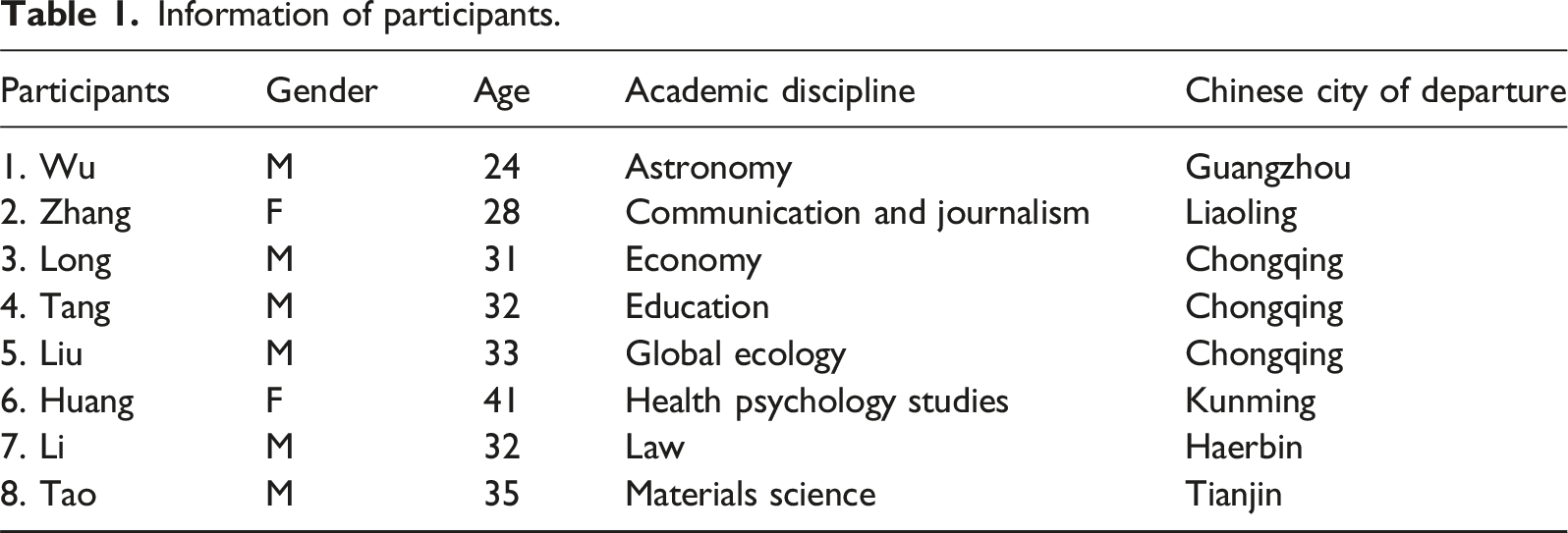
Of the 37 students contacted, 11 met the conditions and agreed to be interviewed. Finally, 3 participants were eliminated for not completing the required information, leaving 8 participants for the in-depth interview included in this study (see Table 1). Criteria for inclusion were (a) being in their first year of PhD studies, (b) being enrolled at the host university, (c) The richness of the information provided in the interview, which means completing the in-depth interview offering developed and extended ideas regarding all the topics answered.
All of them voluntarily agreed to participate and signed an informed consent form following the guidelines of the university research ethics committee. To protect their privacy, they were assigned pseudonyms, and all information was stored on a secure server.
Data collection proceeded in two stages. Initially, a survey comprising closed-ended questions regarding demographics and the predominant experiences of Chinese students at the host university was administered. This survey elicited responses from 20 out of the 37 CIS enrolled at the host institution. Two primary areas, wherein critical incidents occurred, were discerned from this survey: academic and social realms. Utilizing the survey data, participants were then selected for in-depth interviews. Notably, this study is entirely reliant on the data collected in the second stage.
In the second stage, in-depth interviews were conducted with open-ended questions to delve into the interpretation and assessment of critical academic and social events experienced during participants’ tenure at the host university, as well as the coping strategies utilized, employing critical incidents analysis. These interviews, developed as conversations, focused on four main themes: identification of critical incidents, their nature, context (academic or social), and coping strategies.
Critical Incidents (CIs) are unforeseen and destabilizing events confined to specific times and places that mark significant experiences for individuals. They compel reflective review, enabling individuals to assign meaning to their experiences (Monereo et al., 2013; Castelló et al., 2018). Consequently, CIs facilitate examination of events, including their characteristics and emotional impact, while also exploring pivotal moments in personal trajectories, thereby fostering reflective learning and personal development. They have been widely utilized in doctoral studies and other disciplines, allowing examination of events, their characteristics, emotional load, and exploration of turning points in personal trajectories, while promoting reflective learning and personal development (e.g., Boncori & Smith, 2020; Geng & Yu, 2024; Weng, 2020).
Interviews were recorded and transcribed verbatim in Mandarin Chinese (the native language of the participants and the interviewer) and subsequently reviewed by the participants. A bilingual professional immersed in the cultural context of this study translated quotes used in the analysis into English from the original Chinese transcripts. The data corpus consists of the transcripts of 12 hours of audio.
Data analysis was conducted using an iterative and cyclical process of thematic analysis, as described by Braun and Clarke (2006), conducting categorization by using predefined categories derived from the themes outlined in the interview script. These encompassed critical incidents experienced in both social and academic settings, as well as the coping strategies employed.
From the interview data, emerging categories were identified following the principles of thematic analysis previously mentioned (Neuendorf, 2018). Thus, a recursive procedure was followed in four stages, using Atlas ti V8, within a: inductive exploration, coding, description, and interpretation of the data considering our objectives. The main themes that emerged from the thematic analysis were grouped around language and communication issues, supervisory relationships, academic contexts related to the academic dimension. Regarding the socio-cultural dimension, the emergent themes were grouped under socialization difficulties with the locals, lack of social support and understanding of the locals.
To guarantee trustworthiness, the principal investigator, who belongs to the Chinese community and two specialists in the area of the research group supporting the project independently coded the transcripts with a representative sample of primary data (25%). The first coding was revised until arriving at a consensus of the categories. Once the category system was established, the rest of the information was coded, and the degree of agreement was calculated among the researchers who independently applied the categories to all the interviews. The codebook was adjusted to a degree of agreement of 80.39% in the assignment of all quotations, which confirmed the reliability of the category system.
Results
Challenges, barriers, and coping strategies in the academic dimension
Regarding the academic dimension, the themes the participants mentioned the most during the interviews were the perceived limitations regarding language abilities, followed by difficulties in interactions with supervisors. Those limitations in communication are perceived as a barrier, particularly affecting the development of academic activities and the relationship with supervisors, leading to frustration.
Many students attributed their difficulties to a lack of experience in English academic writing, noting that they only used English for communicative purposes but never in learning contexts. When I first arrived, I couldn't understand anything my advisor said. English is his fourth language since he speaks Spanish, Catalan, French, and English. Neither my advisor nor I am from target language countries. I bring a Chinese accent to my English which results in Chinglish; while my advisor brings a Spanish accent, which makes him rather difficult to understand. Our communication was often limited to writing notes or using Google Translate just to gain a basic understanding of one another. It was really discouraging. (Tang)
According to participants, these limitations caused them great stress since they hindered their interactions, impairing the achievement of the Ph.D. objectives regarding the research plan preparation. Problems understanding the scientific literature in English, the slower pace of work among locals, and the lack of confidence to participate actively also triggered CI in the academic environment, as expressed by Wu: I was scared to say anything because I worried that my spoken grammar would be wrong, and people would laugh at me. I wasn’t used to asking questions and didn't know how to ask questions. I was so scared that my questions would be seen as stupid or irrelevant.
Regarding the supervisory relationship, the interviews highlighted that the greatest distress was due to uncertainty in interacting with the supervisor, differences in expectations, and difficulties in negotiating the meaning of the tasks assigned. Participants referred to events that clearly affected interactions with the supervisor and were influenced by their perception of appropriate distance in dealing with them.
Li’s account is a good example of how the differences in distance and communication style affected the relationship with supervisors: As for addressing my advisor by the first name, I was afraid to, but I didn't know what to call him, whether Professor or Dr. or Department Chair. […] Moreover, I didn't understand what he was saying and was afraid to ask. I just kept nodding my head. My advisor said that if you don't understand something, you should ask immediately. Don't just keep nodding your head […]. He said it so directly and so clearly that I felt a little embarrassed. It was too direct. I felt so humiliated and depressed about it all.
According to the participants, another aspect that generated CI was the differences in expectations. First, they pointed out that their supervisors expected them to develop more autonomous, individual work and to make decisions on their own, whereas the students expected more direction and guidance, as well as approval from their supervisor.
Participants acknowledged challenges in transitioning to a more autonomous work approach, underlining the pivotal role of their supervisors and feedback in cultivating autonomy. They also cited their limited experience and inadequate research tools as hindrances to embracing autonomy. Furthermore, CIS in the study expressed substantial pressure to excel, meet supervisor expectations, and fulfill self-set objectives, often without full clarity, as exemplified by Wu. I was worried that I wouldn't be able to catch up and that my advisor would be upset. I could even recognize the sound of my advisor’s footsteps since he needed to walk past my office every day, and I was afraid he would ask me how things were going. I felt so much pressure.
Another salient aspect of the CIS accounts are events related to the differences in the role of supervisors and students in Chinese university contexts and the host university. The participants perceived the latter as an unfriendly context, which is difficult for them to understand or even in conflict with their previous values.
They point out that the role supervisors play is distant, very restricted to the accomplishment of certain tasks, and rather understood as guidance in terms of individual and autonomous work. Advisors here have a different role from those in China. Here they only serve as guides, unlike in China, where they manage everything. Here they will not tell students a lot of details but rather ask us to learn on our own. (Zhang)
In addition to this, CIS are unaware of the institutional norms and culture, referring particularly to the lack of institutional support that they would expect to have received. They perceived substantial differences in norms, values, and procedures at the host university from those practiced at Chinese universities.
Participants recounted that it was rather confusing that they could not find anyone to assist students with their efforts to find resources or information as Huang stated: The doctoral students here are on one-on-one modes, unlike in China, where classes take place with the concept of close classmates and seniors, etc. In China, when I had some difficulties […], I would ask my classmates for help, and with the help of many friends and classmates, the problem could be solved in a few minutes. However, here, everything is very unfriendly. I need to rely completely on myself, which is a major challenge. At first, I was at a loss. Every day I felt like a year had passed.
As illustrated by the quotes, the lack of contextual knowledge of the host university and the scarce institutional support received were referred to by the participants as significant sources of obstacles that hindered their cross-cultural experience and, therefore, the development of their doctoral studies.
Strategies used to cope with ci in the academic dimension
While participants reported struggling with a series of CI in their cross-cultural adaptation and academic activities, they also reported experiencing a process of growth in which they developed a series of coping strategies.
Consistent with the main difficulties encountered, the most highly mentioned strategies related to improved language skills; increased willingness to understand each other and improved skills to be independent and become familiar with the host educational system.
The interviewees believed that broadening their engagement with residents allowed CIS to hone their communication and language skills, despite English not being the local language. Interactions with native students served as a valuable source of insight into the local academic culture and offered an avenue to build confidence in their communication abilities. This newfound confidence was subsequently applied within the academic context, as Tao expressed. From my interactions with other local Ph.D. students, I slowly began to learn the pronunciation of the Spanish alphabet, and after a long time, I became more familiar with it. Now I can understand the advisors better and am becoming familiar with their accents and the words used here.
Study participants also mentioned numerous strategies employed to improve academic writing. Most of them referred to immersive processes that allowed them to gradually understand the logic of structuring academic texts and the type of skills required: By forcing myself to read more, I slowly improved as I read more and more. I could basically understand the organization of the papers and progressed from reading one paper a week to being able to read 3-5 papers per week. It slowly improves my writing skills, especially writing a research plan. (Liu)
Most of the strategies employed by the participants relate to greater openness in recognizing cultural differences, both in terms of the type of relationship established between supervisor and student, as well as in the local institutional academic culture: I know that in each meeting, my advisor likes to get to the main points directly. Our discussions are also quite unlike those between advisors and students in China. There's no need to beat around the bush and make the advisor guess. Instead, we are quite direct, simple, and clear. (Tang)
According to the participants’ accounts, the strategies mentioned above allowed them to increase their understanding of the tasks’ meaning, the differences in expectations, and the meaning of interactions with supervisors.
Participants also mentioned that dealing with the distant role of supervisors and the lack of institutional support led them to become more autonomous and to develop strategies in this regard. Many learned Spanish and/or Catalan in their free time and went from “not knowing anything at first” (Huang) to better understanding and interacting with locals in their mother tongue and even following some of the locals’ cultural patterns.
Likewise, the participants interviewed reported that, gradually, solving problems in daily life helped them to solve problems in academic life: During this process, it slowly occurred to me that I did more thinking on my own and learned how to do critical thinking. Every meeting, I was expected to have my own questions and ideas, and after I had an idea, if it was appropriate for me to do it, I would discuss it with my mentor so that our communication was more efficient. (Li)
In general, the experiences reported emphasized the need to change habits, learn to be independent, and make a greater effort to become familiar with the host educational context without the presence and collaboration of family and close friends.
Challenges, barriers, and coping strategies in the sociocultural dimension
The analysis of the interviews showed that the most important challenges faced by the CIS participating in our study were socialization difficulties with the locals, lack of social support to cope with daily life tasks and understanding of the locals.
Participants linked these difficulties to the cultural contrast between their home country and the host environment. They perceived significant cultural differences in establishing interpersonal relationships, which were difficult for them to understand and were clearly an obstacle to their integration into the local culture, causing them stress and confusion.
The clearly perceived differences in the participants’ accounts are the norms of interaction in non-formal spaces, such as greeting each other or the appropriate physical distance for this purpose, gender relations, values towards life, degree of sensitivity towards international students, rigidity in behavior, and pace of life, as we appreciate in the following quote: I feel that the locals' attitude towards life, their personality, the distance between men and women, their independence, and lack of empathy all make me rather confused. They don't consider others' feelings and seem selfish and self-centered. Everything requires an appointment (Long)
This made it difficult for CIS to participate in social activities outside university, which was also hindered by the remote location of the university residence, whose campus is far from major cities. It was hard at first; I was like a blind person touching an elephant. It was hard. I lived in the Vila [University campus residence], and generally, I studied at home, alone in my room. I was really busy and facing a lot of pressure, so I barely went out. (Wu)
The lack of social support networks was a very important aspect since, in addition to making socialization difficult, it also led to periods of loneliness, stress, and hopelessness, which made it even more difficult for the students to adapt. I had no friends at the beginning, and my family was not around. The environment was different, and I felt really lonely. I didn’t know how to cook. I felt really uncomfortable, with no sense of belonging, and often I cried alone in my dorm. (Zhang)
Participants reported feeling abandoned, with little information, and with services that were not at all adapted to their needs. Language barriers were again mentioned as one of the factors contributing to a perceived lack of support.
The participants’ narratives vividly depict the profound implications of cross-cultural transitions and the significant personal toll they entail. According to the CIS, this journey involves much more than a shift in academic or social environments; it’s a life-altering experience. It requires deciphering the cultural norms of the local population, who often seem distant from their own cultural references. Additionally, they need to acquire new life skills that were previously unnecessary, all while navigating this challenging path in isolation without substantial social support.
Strategies used to cope with ci in the sociocultural dimension
The analysis of the accounts provided in the interviews on possible strategies to cope with the perceived difficulties in this dimension revealed the importance given to understanding the local culture. They mentioned that by participating in local activities, they could observe, communicate and gain a better understanding of hosts’ customs: As I got to know more local people, I learned more about the collectivism of China and the individualism here. Here they are really independent, and they like to have their own space, but we like to live with our parents. (Liu)
This, in turn, facilitated informal contact in leisure situations with host people, which, according to the participants, helped them to become more aware of the differences and similarities between the values, implicit norms, and lifestyles between China and Spain. Likewise, they felt greater interest from the locals in their culture, facilitating situations of exchange and mutual enrichment: I participated in the Chinese cultural festival organized by the university. A few local or Spanish students were interested in Chinese calligraphy [...]. At the festival, we made some Chinese food […]. All the Spanish students and the other international students said everything tasted good. I made a few friends. (Tao)
However, respondents found the greatest social support from others in a similar situation. They reported gradually developing their own social network, consisting mainly of other Chinese students. Remote support from their families had been equally important, but they reported feeling better with greater personal independence. Having these networks helped them solve concrete problems, obtain information, and improve their emotional well-being, which confirms the significant role of social and academic support in international Ph.D.’s cross-cultural adaptation.
Discussion
This study examined the challenges that new Chinese doctoral students perceived at their host Spanish university in both academic and socio-cultural realms and how they faced them, with the aim of improving our understanding of how students experienced the cross-cultural transition. During this process, students recounted challenging experiences that demonstrate the complexity of their adaptation to the new social and learning environment when attempting to pursue a PhD abroad, highlighting the need to build a holistic approach to better understand the interconnectedness of different dimensions and the multidirectionality of adaptation that occurs during cross-cultural transition (Shu et al., 2020). In line with Yang and MacCallum (2022) our results acknowledges that doctoral experiences abroad are dynamic, situated, and interactive, noting the multiplicity of dynamic factors that shape the student’s experiences emphasising the need for future research to give account on the changing and contextual nature of doctoral experiences abroad, carrying out longitudinal studies.
With regards to the most salient experiences, consistently with previous studies, our participants mentioned as the greatest challenge overcoming communication barriers. This finding shows that difficulties in communicating effectively (orally and by writing) are the main obstacle in students’ cross-cultural experiences. Although all participants felt themselves sufficiently proficient to communicate in English, many attributed the perceived difficulties to limitations in academic writing, which implies the need to improve their skills managing this specific genre adding difficulty to the process of pursuing the PhD (Ammigan et al., 2023; Ma & Wang, 2012; Meng et al., Zhu & Cao, 2017).
However, our study also highlights the broad role of language and its interconnection with academic and cultural environments (Wang & Parr, 2021) since communication difficulties affected other areas of their learning, hindering too the quality of interactions and relationships with supervisors and local peers.
Beyond acquiring specific skills, our study underscores the profound impact of language in the transcultural transition (Wang & Parr, 2021). On one side communication difficulties not only hindered learning and in various domains, but also compromised the quality of interactions with supervisors and local peers, immensely affecting the whole experience.
According to the participants’ accounts, communication difficulties were also expressed as barriers to building effective dialogic spaces (Wang & Parr, 2021) as they reported facing challenges in positioning their ideas and participating effectively in learning activities, generating frustration (Hung & Hyun, 2010) and undermining their efforts to become researchers and successfully complete their PhD (McAlpine et al., 2020).
On the other side, our findings showed how meaningful dialogues using hybrid forms of communication with locals, with a scarce knowledge of the host language (Wang and Parr, 2021) allowed CISs to integrate different cultural perspectives, having positive and encouraging experiences, which facilitate their adaptation.
Another crucial aspect identified in our study is the relationship with supervisors, often characterized by misunderstandings (Alebaikan et al., 2023; Hu et al., 2016). These misunderstandings extend beyond cultural contrasts between CISs and local supervisors. They may be linked to implicit mindsets regarding language, teaching methods, and learning approaches within academic disciplinary systems, which are deeply rooted in different cultural contexts (Taušová et al., 2019; Volet & Jones, 2012).
Additionally, although in the narratives, we corroborated that CISs positively value the development of an egalitarian and constructive relationship with their supervisors, enriching their experience (Elliot & Kobayashi, 2018, Jiang & Shen, 2019; Sun & Trent, 2020), the difficulties in managing social distance when interacting with supervisors, contravening the usual norms of formality and distance according to their cultural origin, cause a strong sense of disorientation, confusion, and distress (Taušová et al., 2019; Zheng, 2019).
The aforementioned gap is a constant source of tensions, frustrations, and conflicts that must be considered when preparing students to study abroad (Taušová et al., 2019; Volet & Jones, 2012), taking into account on the one hand the emotional impact involved in the cross-cultural transition of doctoral students (Carter & Kumar, 2017; Wei et al., 2019) and on the other the necessary preparation of supervisors to support this process.
Regarding the socio-cultural dimension, relationship building was often challenging and highlighted the Chines students’ difficulties in dealing with perceived cultural differences. However, as they interact with peers and navigate within diverse sociocultural demands, they reshape their experiences and find ways to adapt (Heng, 2018; Wang & Hannes, 2014). This reshaping underscores how attitudes, decisions, and behaviors in culturally and socially unfamiliar contexts are influenced by interactions within diverse sociocultural intersections (Cross & Hitchcock, 2007; Song, 2020). Effective integration into social and academic networks, facilitated by peers and socializing agents, also plays a crucial role in their supervision and socialization within the community of practice (Vekkaila et al., 2016; Elliot & Kobayashi, 2018).
Despite their interest in increasing contact, some participants found little willingness from local students to engage with them, which generated feelings of isolation and marginalization that CIS has also reported in other contexts (Erichsen & Bolliger, 2011). Therefore, doctoral programs must pay more attention to increasing cultural sensitivity in the host context by generating opportunities for interrelationships with local students (Xu, 2022; Shu et al., 2020; Sun & Trent, 2020).
Overall, our data show in the experienced IC, the capacity for self-reflection and self-determination of CIS to respond to supervisors’ expectations, based on an effort to understand the demands and develop the skills necessary to compensate for the difficulties they encountered in their cross-cultural experience, which evidences the agency of CIS in their cross-cultural transitions, refuting the criticisms of passivity that have been attributed to them in previous studies (Xu, 2022; Ye & Edwards, 2015).
Conclusions
Information of participants.
Firstly, although Chinese international students have demonstrated their inventiveness and resources for coping with challenges in both academic and sociocultural realms, it is evident that doctoral training must pay attention to their specificities and offer dialogical contexts for knowledge generation that accommodate diversity and the negotiation of cultural meanings.
The results affirm the need to regard Chinese international students as a specific population with legitimate pedagogical needs, considering their notable heterogeneity and their broad social and cultural agency. From this perspective, this study contributes to fostering developments in literature that move away from a deficit approach. We believe that beyond demystifying the negative discourse surrounding the supposed passivity and problems of Chinese students abroad, it is necessary to consider that despite the challenges it poses, the perceived differences between Western and Eastern academic cultures, as well as the set of experienced ICs, are actually opportunities for learning and development, and coping with them is constitutive of the transition process.
Secondly, the need to facilitate the cross-cultural trajectory of Chinese international students and all international students is evident. For this reason, the organization of doctoral training—including institutional facilities, accommodations, and training activities offered to students—must be culturally responsive and foster peer and academic community support.
Thirdly, the relevance of supervision in cross-cultural transition processes and the role of language as a tool for cultural mediation are notable. We think supervisors should have specific training to participate in effective intercultural relationships and facilitate students’ adaptation to the new academic and sociocultural context. However, to address this objective, it is necessary to deepen the understanding of intercultural supervisory issues, which might be covered in subsequent studies.
Fourth, we would like to emphasize that a lack of intercultural contact may lead to unequal opportunities in learning and in the development of doctoral trajectories, whereas sociocultural diversity in doctoral training is beneficial not only for international students since quality intercultural contact enhances the intercultural sensitivity of local students in a global society and enables them to acquire core competencies of doctoral training. It is important to explore these aspects further in subsequent studies since students are expected to actively participate in knowledge production and innovation in international settings.
Finally, it should be noted that while our results are useful for understanding intercultural transition in contexts similar to our study, the results are tied to specific characteristics of the context such as the doctoral modality, institutional environment, and other personal factors that have not been specifically addressed in this study and could be explored in future research. Therefore, readers should be cautious when transferring perceptions to other contexts.
Footnotes
Author contributions
All authors listed have made a substantial, direct, and intellectual contribution to the work, and approved it for publication. The specific contributions of each author are listed below:
CL: Design, data collection, draft preparation, and review of the manuscript.
CW: Design, draft preparation, and review of the manuscript.
IMA: Design, draft preparation, and review of the manuscript.
Declaration of conflicting interests
The author(s) declared no potential conflicts of interest with respect to the research, authorship, and/or publication of this article.
Funding
The author(s) disclosed receipt of the following financial support for the research, authorship, and/or publication of this article: This project has been funded by Social Science Department of Kunming University [Grant numbers YJW2007]. The researchers would like to thank the Chinese international students who voluntarily participated in this study.
