



Abstract
This editorial piece sets out the background of the special issue ‘Redesigning higher education in East Asia for a better future’. On the one hand, East Asian higher education has made phenomenal achievements in the last two decades, in both quantity and quality. On the other hand, it faces lingering intrinsic and extrinsic challenges. A major source of the intrinsic challenges is the persisting tensions between the local cultures and the imported modern Western university model. The extrinsic challenges are related with the global power dynamics in higher education, manifested in global knowledge asymmetries, academic dependence, and the center-periphery continuum in the global higher education system. Focusing on the efforts and opportunities in East Asian higher education, the nine articles of this special issue center around the question of ‘how can higher education in East Asia be redesigned to advance its own development and contributions to society?’ Diverse perspectives are employed to explore East Asian higher education at macro, meso, and micro levels, surrounding three themes. It is hoped that this issue can contribute to the ongoing exploration of higher education in East Asia and attract more attention from worldwide higher education researchers to study this rich and important field.
The development and achievements of higher education in East Asia
The two last decades have witnessed phenomenal developments and achievements of higher education in East Asia, manifested in both of its quantity and quality. In this editorial piece and special issue, East Asia is understood as a geographical region and East Asian higher education considers higher education systems of Japan, Hong Kong SAR, mainland China, South Korea, and Taiwan. In terms of the quantity development, between 1970 and 2020, the Gross Tertiary Enrolment Ratio in East Asia and the Pacific increased from 2.3 percent to 51 percent (UNESCO, 2023). As Figure 1 shows, among the East Asian countries and regions, mainland China and Hong Kong, in particular, have experienced rapid expansion of their higher education systems, while Japan and South Korea have kept high participation ratios in higher education. Considering the large population of East Asia, with 1.7 billion and taking up around 20 percent of the global population in 2023 (IMF, 2023), the ongoing practices and future development of East Asian higher education deserve attention within the region and across the world. Gross enrolment ratio for tertiary education (%) (UNESCO, 2023).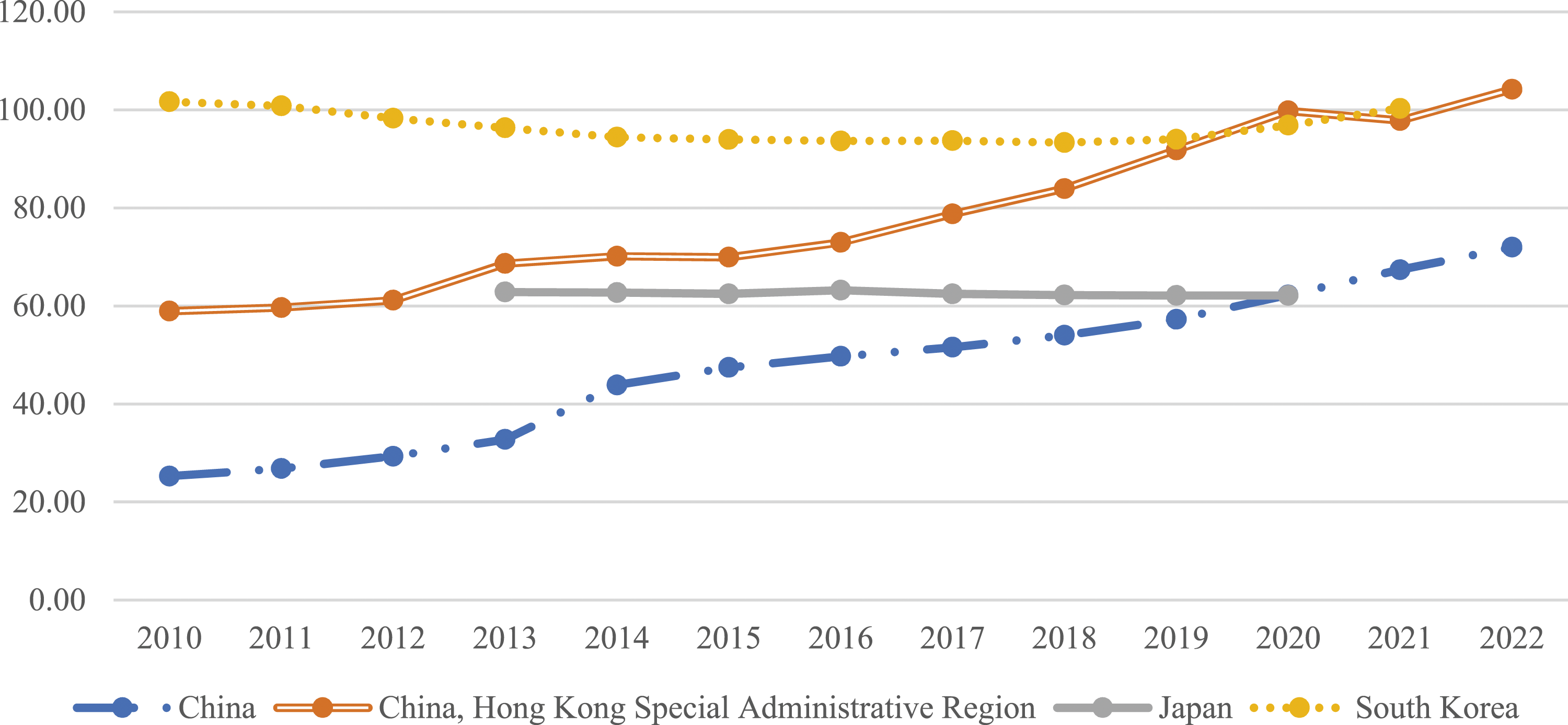
In addition to the scale, there is also significant development of the overall quality and research capacity of East Asian higher education institutions. Except for a slight decrease in the number of universities in Japan, all other East Asian countries and regions have had a considerable increase in the number of their globally top universities. According to the Academic Ranking of World Universities, between 2003 and 2023, the number of the globally top 1000 universities changed from to 9 to 191 for mainland China, 5 to 7 for Hong Kong, 5 to 14 for Taiwan, 36 to 32 for Japan, and 8 to 30 for South Korea (ARWU, 2023). Mainland China is now the largest producer of Scopus-indexed English scientific journal articles worldwide (NSB, 2022), let alone the large number of scientific outputs written in Chinese. Many researchers aver that China has become a global research powerhouse (Marginson, 2022; Wen et al., 2022). More broadly, there is the argument that ‘our century will be an Asian century’ (Maçaes, 2019, p. 1).
Lingering challenges: Local roots and agency versus global inequalities and power
Despite the above developments and achievements, however, studies have pointed out that East Asian higher education faces lingering challenges and problems. Some are intrinsic, related with the internal design and practices of higher education systems in East Asian countries and regions. Arguably, a major intrinsic challenge derives from the fact that East Asian universities are largely transplants of Western university models (Yang, 2022), which could lead to cultural tensions and conflicts in the local contexts (e.g., Hayhoe, 2004; Yang, 2019). The tensions are further perpetuated by the sweeping influence of neoliberalism in higher education and the global convergence of research universities. It seems that although the local educational traditions and cultures still hold potency in East Asian universities, how they interact with the modern Western university model remains less clear. Yang (2023) therefore argues that a major mission of East Asian universities today is to find ways to traverse local cultures and traditions and modern Western university experiences. Another problem with East Asian higher education is related with the internal inequalities within a higher education system. Mok (2016) and Luo et al. (2018) argue that many higher education systems in East Asia are vertically hierarchical, which are detrimental to the sustainable development of higher education and social equity. Altbach (2013) claims that higher education systems in China and probably more broadly East Asia may reach a ‘glass ceiling’ in their development.
Meanwhile, there exist extrinsic challenges for East Asian higher education, which are associated with the global higher education dynamics and inequalities. On the one hand, there is increasing multipolarity and plurality in the global higher education system, with the rise of the higher education systems outside the Euro-America (Marginson, 2022). On the other hand, there also exist inequalities and power struggles. Marked by colonial and imperial history, the former imperial and colonial powers––mostly Euro-American countries––now play dominant and even hegemonic roles in research and higher education (Collyer, et al., 2019).
The global higher education system is multipolarising and pluralising, as evidenced in the above discussion about the development of East Asian higher education. This is largely a result of the exercise of agency by various national/regional, institutional, and individual agents in higher education (Marginson & Xu, 2023; Yang et al., 2023). As Archer (1995) argues, people have the agency freedom to determine what they hope to achieve and work towards their goals. Various reforms are being attempted in East Asian higher education. The initiatives of building world-class universities (Byun et al., 2013; Yang et al., 2021) and incentives for the internationalization of higher education (In Mok & Yu, 2013) are distinctive examples.
Nevertheless, in the view of the world system theory (Wallerstein, 2004), the global higher education system is a hierarchical center-peripheral continuum, composed of three major clusters of national/local systems: center, semi-periphery, and periphery systems (Wallerstein, 2004). Resources and influence held by knowledge systems in different clusters are not equal. Euro-American systems are at the center. They possess more resources, have higher influence globally, and reproduce their central status through language, agenda and topics, disciplinary and publishing regulations, and leading institutions (Marginson & Xu, 2023). As Alatas (2003, 2022) underlines, non-central systems have academic dependence on central ones in seven dimensions: the dependence on (1) ideas and theories provided by the center; (2) the media of ideas provided by the center including books, academic journals, electronic materials, and conferences; (3) educational technology developed by the center; (4) research assistance and training provided by the center; (5) direct educational investments from the center; (6) expertise from the center; and (7) academic recognition from the center.
In this center-peripheral continuum, East Asian research and higher education is yet at the ‘center’ and is academically dependent on the central systems (e.g., Han & Appelbaum, 2018; Marginson, 2021). Indeed, East Asia higher education may struggle with the exclusion of indigenous cultures and knowledges in education and research, Euro-American dominance of discourse in research, difficulties in connecting indigenous and Euro-American knowledges in teaching and governance, and the need to follow Euro-American norms of scholarship and to win recognition from Euro-American universities and scholars (Hountondji, 2006; Shahjahan et al., 2017; Yang et al., 2019). In this sense, the Western supremacy and dominance in higher education is constraining the future development of East Asian higher education (Shahjahan & Edwards, 2022). Yet, East Asian higher education has demonstrated strong agency in confronting the Global Western dominance in higher education in the process of realizing self-development. It becomes key to explore how to continue the development of higher education in East Asia in the next a few decades.
Delving into the efforts and opportunities: Articles in this special issue
Against this backdrop, this Special Issue (SI) asks a central question of ‘how can higher education in East Asia be redesigned to advance its own development and contributions to society?’ While there is no intention, nor is it possible, to provide final answers to this question, the objective of this SI is to provide insights into the challenges of East Asian higher education, the ongoing attempts and reforms in East Asia, and the implications for higher education worldwide. Receiving the support from International Journal of Chinese Education, I sent out a number of invitations to higher education researchers who are based in or studying East Asia to share their research articles for this SI. In order to give contributors liberty and space, they were invited to respond to the above central question from a perspective of their own choice. Diversity of perspectives were particularly pursued in selecting articles for the SI. This emphasis on diversity is also reflected in the title of the SI––‘Redesigning Higher Education in East Asia for a Better Future’, which is a broad theme and could encompass various aspects of higher education.
Nine articles from eighteen contributors constitute this SI. The articles focus on three major themes about higher education in mainland China, Taiwan, and South Korea. One theme employs a macro perspective to explore universities in East Asia, including their historical development and cultural missions. Lin and Yang (2022) look into the cultural awareness of universities in Taiwan amidst the government-driven reforms of imposing Western metrics in university performance assessment. Through empirical data collected from two premier universities in Taiwan, the article reveals the cultural affinities of Taiwan universities to rally a blended model of universities that synthesizes the imported Western experiences and longstanding indigenized values. Focusing on mainland China, Shen et al. (2022) examine the historical development and reforms of mainland Chinese higher education since 1978, especially the de-Sovietization reforms. They find that learning from the West was a primary strategy employed by mainland Chinese higher education to de-Sovietize. This was partly realized through internationalization of higher education. Nevertheless, despite the efforts, they claim that the legacies of the Soviet Model are still evident in mainland China’s higher education system, manifested in the existence of specialized higher educational institutions, the planned economy mindset, and the government’s control of the higher education system.
The second theme centers around the ecosystem of higher education at the meso level, with special focuses on higher education’s contributions to the local development. With the aim of developing a ‘Shenzhen model’ of higher education, Fang and Liu (2023) explore the development of higher education in Shenzhen and how the local government and universities navigate the existing policy framework in this process. Kang (2023) investigates local innovation system of Shenzhen and the role played by higher education institutions in facilitating the social and economic transformation of the city. Similarly, Xie et al. (2022) turn their attention to the regional development of the Greater Bay Area and ask the question of how universities in Shenzhen may better support the Area’s regional development. They argue that universities are important players in promoting research capacity, fostering international collaboration, and upgrading the Area’s higher education sector. While the previous three articles are about the Greater Bay Area, Zeng and Wu (2023) look into the city-level higher education hub in Hangzhou, a city in the Yangtze River Delta region of mainland China. Through an exploration of the process of knowledge production and dissemination in three types of higher education institutions, they demonstrate how the local government and universities jointly work together in developing higher education at the local level.
The third theme pays attention to more micro-level higher education phenomena and activities, including academic entrepreneurialism, university image-creation, and international student mobility. Tang and Zhang (2023) ask the research question of ‘is academic entrepreneurialism a universal concept’ and attempt to unpack to what extent this concept captures cultural nuances and variances across contexts. Engaging with the existing literature, they argue that although academic entrepreneurialism is not a universal or all-encompassing concept, it may serve as a starting point for more constitutive, continuous, and complex transformations of institutional reasoning by universities across the world. Lee (2022) employs a text-mining analysis to explore the president’s message of 105 South Korean universities, which often covers the missions, visions, and strategies of the university. The analysis shows that these universities present themselves in a rather homogenous way, though there exist differences across different types of universities (i.e., public or private, metropolitan or local, and top-ranked or mid-to low-ranked universities). Also focusing on South Korean universities, Song and Kim (2022) look at short-term exchange programs to unearth how universities’ institutional characteristics are reflected in the layered experience of short-term mobility. They point out that the experience is indeed associated with the stratification of universities.
Concluding remarks
To a large extent, the higher education development in East Asia has been a constant struggle between learning from the West and engaging with the local cultures and wisdoms since the 19th century. An important task for researchers today is to engage with both the local and the global experiences in understanding, explaining, and conceptualizing East Asian higher education phenomena and activities, and looking for ways to further develop and better contribute to the broad society. The articles of this SI belong to this line of efforts and offer diverse insights. It is hoped that the SI can contribute to the ongoing exploration of higher education in East Asia and attract more attention from worldwide higher education researchers to look into this rich and important field.
Footnotes
Acknowledgsments
I warmly thank Executive Chief Editor Hamish Coates for the kind support for this special issue.
Declaration of conflicting interests
The author(s) declared no potential conflicts of interest with respect to the research, authorship, and/or publication of this article.
Funding
The author(s) received no financial support for the research, authorship, and/or publication of this article.