



Abstract
The purpose of this study is to explore how a language teacher helped her emergent bilingual students with literacy learning in a community-based Chinese heritage language classroom during the Covid-19 pandemic. The theoretical concept of the Zone of Proximal Development was utilized to support the exploration. Data that informed this article included field notes, video recordings of class conversations, and artifacts made by the participants. The findings show that the teacher strategically asked questions, used digital technology, and drew upon visual means to create opportunities for the children to engage in literacy learning and move toward advanced levels of literacy development. The study informs suggestions for heritage language teaching practices and advocates for sustaining emergent bilingual children’s Chinese heritage language in the post-pandemic world.
Introduction
Data show that the number of Chinese immigrants moving to the United States has increased in recent decades (Camarota & Zeigler, 2017; Echeverria-Estrada & Batalova, 2020). While becoming familiar with the culture and education system in the adopted land, Chinese families are finding it difficult to sustain Chinese heritage language, culture, and identity (Cui, 2017; Li & Wen, 2015; Yochim & Servage, 2017). Li and Wen (2015) state that “major responsibilities to maintain Asian HL (Heritage Language) have been left to immigrant families and community language schools” (p. 276). Indeed, even though there are bilingual programs in the U.S. public schools, Asian languages, such as Chinese, have been marginalized in the formal institutional discourse (Kuo, 1998; Li, 2006; Li & Wen, 2015). How can children from Chinese immigrant and heritage backgrounds be helped to sustain their heritage language and develop reading and writing skills in the language? This is an important but unaddressed question that needs attention not only from communities but also from educational institutions and schools.
While sustaining the Chinese heritage language was not easy before the pandemic, language maintenance during the Covid-19 pandemic seemed impossible as many countries faced great challenges (Daniel, 2020; Feng et al., 2021; Mok et al., 2021; Tarkar, 2020; Toquero, 2020). There was little time for schools and teachers to deal with the challenge and prepare for offering online education to continue supporting students and families whose lives were also disrupted (Almaiah et al., 2020; Daniel, 2020; Ge et al., 2022). Before the pandemic, various Chinese heritage language programs were marginalized from the dominant institutional discourse (Li & Wen, 2015; Tse, 2000). Since the Covid-19 outbreak occurred, these programs have faced even more barriers to helping children and youth from cultural and linguistic backgrounds continue to maintain their heritage language learning.
Although many studies have focused on online learning during the crisis (Ali, 2020; Chakraborty et al., 2021; Pokhrel & Chhetri, 2021; Sari, T., & Nayır, 2020), very limited research has explored heritage language schools (Wang, 2021; Young & White, 2022). Wang (2021) studied Chinese heritage language schools in Germany and found that these schools expanded their programs and classes to meet Chinese immigrant parents’ expectations for their children’s heritage language learning. Young and White (2022) investigated Polish heritage language schools in the UK and found that the school heads shared their concerns, the relations of these schools to the broader education system, and challenges in the pandemic. Both studies mentioned the challenges, expectations, and possibilities related to heritage language schools. However, little research has investigated the specific ways of teaching and learning in community-based Chinese heritage language programs in the United States during the unprecedented time. The present study aims to explore how a teacher provides space for emergent bilingual children to continue their heritage language and literacy learning in a virtual classroom during the middle of the pandemic. In particular, the study was guided by the following research question: How did a language teacher help her students develop literacy learning in a community-based Chinese heritage language classroom during the Covid-19 pandemic?
Literature review
Many Chinese heritage language programs share similar teaching practices, such as focusing on authorized teaching Chinese as second language textbooks and teaching through repetition and memorization (Chiang, 2000; Li, 2005; Wang, 2004). Wang (2004) explored the roles of Chinese families and heritage language schools in their children’s literacy learning and pointed out that the teaching and learning practices in heritage language schools primarily focused on coding and decoding. Li (2005) conducted a study in Chinese heritage language schools in Phoenix and found that students learned through repetition and memorization. Sun & Kwon, (2020) analyzed Chinese and Korean heritage language textbooks used in most heritage language schools and found that these textbooks lacked representation of multicultural and multilingual perspectives. It seems that the content in these textbooks is mismatched from Chinese and Korean children from immigrant families in the United States (Sun & Kwon, 2020). These studies illuminate the concerns of using effective pedagogical methods that are relevant to immigrant students’ culture and lives.
On the other hand, limited research has examined the positive impact of using cultural resources or valuing students’ learning experiences on heritage language and literacy development at Chinese heritage language schools (Huang, 2012; Wu, 2011). For example, Wu (2011) examined Chinese heritage language teachers’ perspectives on using culturally relevant pedagogy for their classrooms and found that teachers used various methods (e.g., play-based activities, class discussions) related to Chinese culture to motivate students to acquire language and become culturally competent. Similarly, Wu and Chang (2010) explored Chinese heritage language teachers’ design and use their research-based curriculum that values students’ prior knowledge to acquire literacy skills in Chinese heritage language programs in community settings, and their findings illustrate that the curriculum facilitated the students’ identity construction and their motivation to continue their heritage language acquisition. These studies shared the common theme that community-based Chinese heritage language schools have a positive impact on children’s language and literacy development and on sustaining cultural practices (Huang, 2012; Wu, 2011). In these programs, heritage language teachers play essential roles in children’s literacy learning. The present study focuses on the ways that a heritage language teacher provided various resources and support for students through analysis of class conversations.
Theoretical framework
This study draws upon the sociocultural theory, which conceptualizes human learning and development through various mediational means in social and cultural contexts (Vygotsky, 1981, 1987). The initial work was written by Lev Vygostky in the psychology field, and later, it led to major impacts on educational areas. Many educational scholars have adopted the theory to explore children’s learning and development (Bodrova, 2008; Edwards & Cutter-Mackenzie, 2013; Gupta, 2009). While different concepts are included in sociocultural theory, this study specifically focuses on the concept of Zone of Proximal Development (ZPD), which was defined as “the distance between the actual developmental level as determined by independent problem solving and the level of potential development as determined through problem solving under adult guidance or in collaboration with more capable peers” (Vygotsky, 1978, p.86). The level of “actual development” means a child is able to work on a task independently, and the level of “potential development” refers to that the child could complete a task but needs help and support from parents, teachers, other adults, or more capable peers. Through this theoretical lens, children’s learning is viewed as a social and contextual process (Chang-Wells & Wells, 1993; John-Steiner et al., 1994; Mahn & John‐Steiner, 2012). Based on the theoretical foundation, Bodrova and Leong (2007) state three implications of ZPD in the educational field: 1. How to assist a child in performing a task 2. How to assess children 3. How to determine what is developmentally appropriate (p.44).
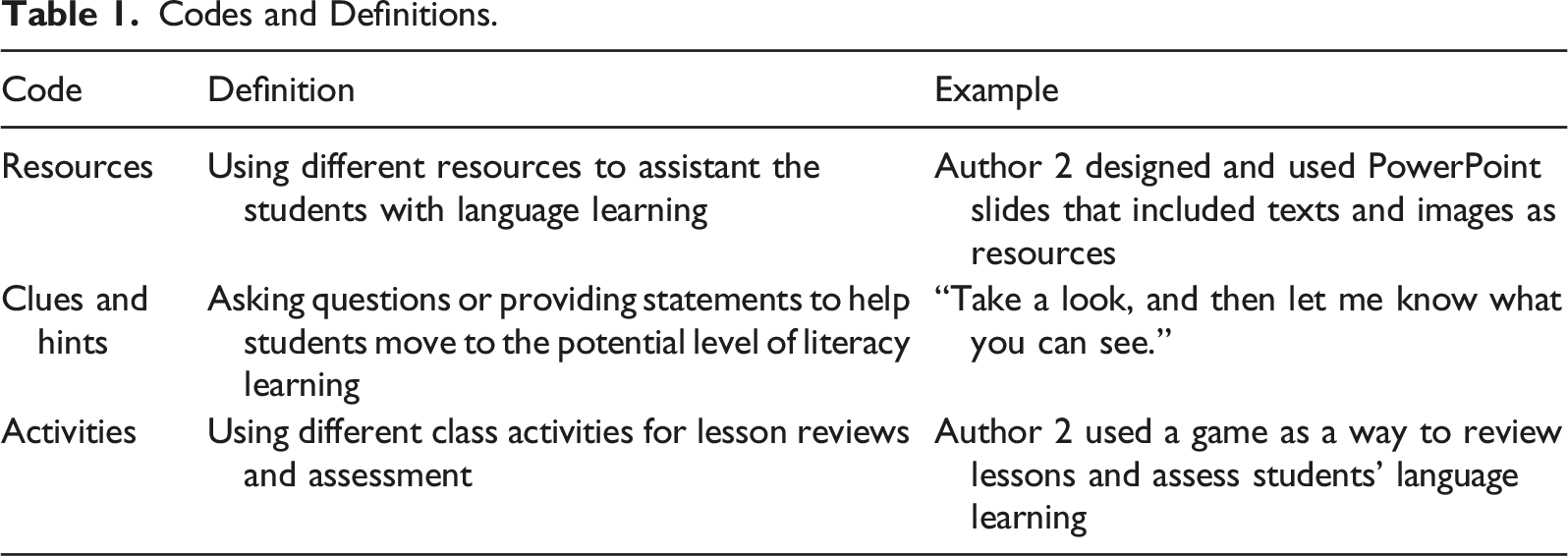
These three important implications allow educators to measure a child’s existing knowledge, consider what kinds of clues, hints, and mediational means are needed to provide for a child to perform a task at the potential level, and offer appropriate activities to help them meet their individual learning goals. The literature shows that the concept of ZPD has been utilized to explore immigrant children’s language and literacy learning (Eksner & Orellana, 2012; Iddings et al., 2009; Liang & Shin, 2021; Qian & Pan, 2006; Ttueba, 1999). Similarly, the study utilizes this theoretical concept to understand the language and literacy learning of children from Chinese immigrant families in a heritage language classroom.
Methodology
Context and participants
The data for this article were collected at a Chinese language weekend school in a large city in the southwestern United States. The school was initiated over forty years ago by a group of Chinese parents who highly valued Chinese culture and language and expected their children to sustain their language. There were various Chinese language and arts classes offered for students who were five years old through adults in the local community. During the COVID-19 pandemic in 2021, all classes were held via Zoom every Sunday. Approval from the Institutional Review Board was received before conducting the study.
One of the language teachers, Author 2, was willing to open her virtual classroom for Author 1 to collect data. Author 2 was originally from China, and she spoke fluent Chinese and English. She holds a master’s degree in education from a public research university in the UK. She has been teaching the Chinese language in different education programs in the U.S. for three years. During the time of data collection, there were six children aged five through seven in Author 2’s primary classroom. All the children were emergent bilinguals who were able to speak both English and Chinese, and they attended U.S. schools on weekdays and took the Chinese language classes on Sundays. All the children’s names in this manuscript are pseudonyms to keep their confidential information.
Researcher positionality
Author 1 visited Author 2’s classroom as an educational researcher. Author 1 spoke Mandarin Chinese as her first language and English as an additional language. Her language background and experience enabled her to access the research site and build rapport with the participants. During class time, Author 1 played the role of observer with nonparticipation, which means “the observer who has no involvement with the people or activities studied” (Spradley, 1980, p. 59). When Author 2 and the students engaged in their class activities, Author 1 took her field notes with a muted sound and video. However, she changed her role to a participant observer (Spradley, 1987) a few times. For example, before the virtual Chinese New Year Celebration in the Spring 2021 semester at the school, Author 2 invited Author 1 to practice a nursery song with the children together during their break time. At these moments, Author 1 was positioned as an insider – a volunteer teaching assistant – to help the students prepare for their performance at the Celebration during the Chinese New Year week. Additionally, when the authors had conversations after class, Author 1 also shared her thoughts and suggestions. These conversations also allowed Author 1 to do member checks to ensure trustworthiness (Glesne, 2011).
Data collection
We used a case study design for this research project. Creswell (2013) states that a case study is a qualitative approach in which the researcher “explores a real-life contemporary bounded system (a case) or multiple bounded systems (cases) over time, through detailed in-depth data collection involving multiple sources of information” (p. 97). In this study, multiple data sources were collected to understand the case of the investigation of teaching and learning in a Chinese heritage language classroom.
Data were collected in approximately fourteen weeks in the Spring 2021 semester via Zoom. Data sources collected in Author 2’s class included the researcher’s field notes, audio and video recordings of classes, and artifacts created by the participants. All the data sources were collected virtually. Each class lasted for approximately 90 minutes, including a short break. Author 1 began the preliminary analysis by reviewing her field notes after each data collection was complete. If Author 1 had questions based on her preliminary analysis, she had a conversation with Author 2 after class to map potential misunderstandings.
Data analysis
Codes and Definitions.
Findings
Author 2 strategically used the digital tool and function via Zoom to provide a space where her students could engage in literacy development in their heritage language using various resources (e.g., texts, images) and playful activities, such as class conversations, games, images, video stories, and nursery songs. More importantly, she did not randomly design these class activities. Instead, she designed and used these class activities for specific learning purposes. The data analysis showed that the teacher created ZPDs by asking questions, drawing upon visual resources, and using games. The class conversations described below provide examples of the ways that Author 2 created ZPDs.
Introducing new knowledge
Author 2 understood her students’ existing level of sounding out words based on the Chinese phonics system, Pinyin, and the advanced level the students needed to reach was knowing the meaning of vocabulary words. To create a ZPD, she drew upon various visual resources to engage the children in meaning making in the virtual space. Examples of visual resources included images and videos. Author 2 determined the use of visuals as appropriate pedagogical ways based on her established skills of using digital technology. Literature has shown that digital technologies provide various channels for teachers and students to engage in educational activities (Burden, K., & Atkinson, 2008; Ng & Ng, 2015; Oliver, 2005). Since the heritage language classes were offered in the virtual space (i.e., Zoom) during the pandemic, Author 2 strategically used the digital technology to create visual-based class activities. The pattern of using visual resources was frequently shown in every data collection. For example, during a class, Author 2 taught a lesson on Chinese characters, and she shared an image of each Chinese character on the screen to invite students to discuss possible meanings: 1. Author 2: 今天我们要学习新的词 (We will learn new words today). 很有意思 (Very meaningful). You can speak English and tell me what you can see in this picture? 看一看 (Take a look), 然后告诉我你看到了什么(and then let me know what you can see). If you cannot speak Chinese, you can use English to tell me, what did you see in this picture? 你看到了什么? (What did you see?) What did you see? 2. Thomas: Water 3. Author 2: 看到了什么? (What did you see?) Water! Thomas看到了(saw water). 还有谁看到了(Who else saw) water? 4. Xuan: 水 (Water) 5. Author 2: Xuan看到了水(saw water), 非常好 (very good), 还有吗(what else)? 还有其他的吗(what else)? What did you see in this picture? 6. Students: the red one 7. Author 2: Red one. What is the red one? 8. Thomas: Sun 9. Author 2: 有人说是 (someone said) Sun, 是(it’s) Sun (Author 2 is writing down the word “Sun” next to the image on the screen). What is this one? (Author 2 is pointing to the image that looks like a mountain.) 10. Thomas: Mountain, mountain. 11. Author 2: Mountain. 非常好 (very good). 这是(This is) mountain. This is river, water, and this is mountain, and this is the Sun. 今天我们要来学习这些字 (Author 2 is circling the Chinese characters “日 for Sun), 山 (mountain), 水 (water)” on the screen.)
In this lesson, acquiring the new vocabulary words (e.g., 日, 山, 水) was the level of the children’s potential language development (Vygotsky, 1978). To help the children move to this level, Author 2 did not directly explain the meanings of the Chinese characters. Instead, she posted the images on the screen and used questions and hints as scaffolding methods (Van de Pol et al., 2010) to draw students’ attention to the screen to discuss the graphics and possible meanings represented on the screen. It seems that the conversation fits the Initial-Response-Evaluation (IRE) patterns, but after situating the conversation in the context and analyzing it, we found it moves beyond IRE, and it involves specific purposes: (1) drawing students’ attention to focus on the lesson, (2) introducing new knowledge, (3) using questions to invite students to talk, and (4) asking students to make predictions and discuss their thoughts.
Additionally, Author 2 played the role “as a direct participant and as the person who promotes, plans, and creates the opportunities for shared activity to develop between children and their partners” (Bodrova & Leong, 2007, p. 83). In this conversation, Author 2 used visual means and questions to create opportunities for students to engage in the class discussion, which means that students had opportunities to share their understanding and experiences rather than only the teacher dominating the discussion (Newman et al., 1989). These visual resources and conversations potentially helped the children learn about vocabulary words in Chinese. This conversation is the beginning part of a lesson on teaching Chinese characters, which are pictographs. The pictographs usually look like objects naturally in image forms. Figure 1 served as an example of the pictographs “山” and “水” on Author 2’s screen when it was mentioned in the conversation above. The images of pictographs, 山(Mountain) and 水(Water), on Author 2’s screen.
The lesson on the Chinese Lunar New Year
During the week of the Chinese Lunar New Year, Author 2 created a PowerPoint slide as a resource to present the major events that occurred during the Chinese New Year. The evidence of ZPD (Vygotsky, 1978) was also shown in this lesson. The children’s existing knowledge and language level included understanding the Chinese Lunar New Year based on their families’ cultural practices and knowing how to describe the festival in English. On the other hand, the students still needed adult guidance to acquire the vocabulary in Chinese and describe the holiday using their heritage language. To help the students achieve their potential language level, Author 2 used the PowerPoint slide as a scaffolding tool.
On the slide, the background color red was used to highlight the unique meaning related to Chinese culture and festivals: luck and joy. Six animated people images were illustrated to express the meaning of a family: grandparents, parents, and children. These visual means were adopted to signify that a family reunion was a huge event during the New Year. In addition to the visual means, she also added words and sentences in Chinese and English to emphasize the meaning. The traditional events were written in the upper area of the screen “拜年 (New Year Greetings)” and “发红包 (Give Read Envelopes).” The PowerPoint slides represented the unique meaning related to Chinese tradition: during the Lunar New Year celebration, family members usually return to their hometowns to have a reunion dinner together and give red envelopes to family members and friends to wish them luck. While showing the slide, Author 2 also engaged the students in the class conversation: 1. Author 2: After we finish the reunion diner, we will give best wishes to elderly people, and they will give us lucky money. Do you know the lucky money in the red envelope? (Author 2 is pointing to the red envelope on the screen.) 2. Nan: Last New Year, I got a hundred dollars. 3. Author 2: Haha. You got one hundred dollars! 4. Thomas: 红包 5. Author 2: Yes. We call it红包 (red envelope). 红 means red. 包 means envelope. 红包 (red envelope). Remember before you receive it from your grandparents, you need to say some blessing words to them, give them best wishes, like 祝你新年快乐 (Wish you a happy new year) or祝你健康 (wish you good health). Grandma, grandpa, I wish you good health. (Author 2 is pointing to the sentence “Grandma, grandpa, I wish you good health” on the screen.)
This excerpt shows that not only did Author 2 display her PowerPoint slides to the students, but she also drew upon spoken language and gestures to explain the meaning related to the tradition during the Lunar New Year. It is interesting to find that one of the students, Nan, was connecting his life experience of obtaining a red envelope to respond to his teacher’s question. This moment indicates that the students had the opportunity to draw upon their experiences to contribute to the class conversation. Author 2 usually took the lead in the classroom discussions, but it did not mean that she did most of the talking. Instead, she asked questions not just to understand whether the students knew the answers but also to invite her students to share their experiences or thoughts to build knowledge together. In other words, the questions were used as scaffolding methods to engage the children in language learning (Van de Pol et al., 2010).
Reviewing by playing a game
Not only did Author 2 strategically assist students in moving toward the higher levels of their literacy learning (Vygotsky, 1978), but she also assessed the students’ learning in playful and meaningful ways (Bodrova & Leong, 2007). Specifically, Author 2 designed and employed various games as class activities to help the students with literacy learning every weekend. Bodrova and Leong (2007) state that “Vygotskian think that children are able to engage in games at approximately 5 years of age” (p. 154). Indeed, all the children actively participated in the games when Author 2 displayed these games on the screen. The games were not used randomly. Instead, she purposefully used digital technology and designed visual games for specific major purposes – as an assessment tool to understand students’ learning and a means of engaging students in reviewing previously attained knowledge.
A game the teacher usually used to assess students was the lucky spin game. Before the class played the game, Author 2 usually explained the rule of playing the game: she said “start,” and the wheel would be spinning, and when a student said “stop,” the spinner stopped spinning and stayed on a word and a prize. If the student could explain the meaning of the word, the student would win the prize (i.e., points). If a student worked hard and received many points, the student could receive an award at the end of the semester. Providing points was a method Author 2 used to motivate students to keep working hard. After the students learned the meanings related to the verbs “去(go),” “来(come),” “入(enter),” and “出(exit),” for a few weeks, Author 2 wanted to know whether the students had mastered the words, displayed the game and invited her students to participate: 1. Author 2: 我们开始这个游戏 (Let’s start and see what word you can get.) Let us start and see what word you can get. 2. Nan: All the numbers (points) will I get? 3. Author 2: Haha. The numbers will make you happy. Who wants to go first? Nan, you want to go first? 4. Nan: How can I start? 5. Author 2: You say “start,” I will click start. 6. Nan: Start! 7. Nan: Stop! 8. Author 2: You could get 500 [points]! However, you need to read the word first. (The spinner stayed on the segment with the word 入(enter). What’s this word? 9. Nan: We learned it. 10. Author 2: Yes, we have learned it. 11. Nan: Um…(Nan was looking at his textbook) 12. Yang: 入(enter). 13. Author 2: 对 (Yes). 我把拼音写在这 (I wrote down the Pinyin here.) 入 (enter) (The teacher wrote down Pinyin for the Chinese character.) Remember? 14. Nan: 入 (enter), 入 (enter), 入 (enter) 15. Author 2: yes, 入 (enter). Next one. Who wants to try the next one? (Students were raising their hands.) Ok, Yang. This is your turn. You say “go.” 16. Yang: Go. 17. Author 2: Did you say “stop?” 18. Yang: No (Yang was shaking his head). 19. Author 2: Ok, try again. 20. Yang: Stop! 21. Author 2: In the middle? You choose the red or the green? (The spinner stopped in the middle of two segments, which are represented in red and green as background colors.) 22. Yang: On the green. 23. Author 2: Ok, green! What’s this word? 24. Yang: 来(come). 25. Author 2: yes, 很棒(very good). It’s 来(come). 来(come).
Similarly, the evidence of the ZPD is also indicated in the conversation. Author 2 used the game as a class activity to create a comfortable ZPD space to engage students in reviewing the knowledge they learned. After the teacher explained the game, Nan expressed his interest and motivation to play the game (Turn 2). The ability to recognize and know the meaning of the word was within his ZPD, but he needed assistance to help him recall the word and review the knowledge already learned. There were also different types of resources as mediational means (Vygotsky, 1981) shown at this moment. One type was Nan’s book on his desk. He quickly looked at his book and tried to review and find the word. His statement (Turn 9) indicates that he recalled his memory and knew he had learned the word. This example implied that this game served as a catalyst for students to be motivated to review the knowledge Nan had already learned, although he was not able to recognize it in a timely manner. Peer support was another type of assistance. It is interesting to find that Yang helped his peer say the word (Turn 11). Based on my initial analysis, I thought the conversation showed the teacher-student pattern. However, the analysis of turns of talk enabled me to find that peer support also occurred. This is not surprising because asking the children to support each other was the classroom culture shown at various points throughout the project. The teacher did not ask other students to help Nan in this conversation, but she invited other students to help their peers when a student was not able to answer a question on other days. Yang might have internalized this classroom cultural practice and offered his support in this conversation.
As Bodrova and Leong (2007) state, “Instead of limiting assessment only to what children can do independently, we should include what they can do with different levels of assistance” (p. 44). The focus of asking Nan to participate in the game was not simply to assess if he had the ability to say the word independently and whether he could receive points. Instead, this game created an opportunity for the teacher and other students to help their class community members and review the knowledge together. For example, Author 2 provided hints by writing down Pinyin (Turn 12) to encourage Nan to recall his prior knowledge. Yang’s statement (Turn 11) was a kind of peer assistance to contribute to the group learning and assessment. To give assessment, Author 2 strategically used a game to not just know individual students’ existing level of literacy development but also to create a space for the students to review their existing knowledge together.
Discussion
This study explores how a language teacher drew upon various resources to help her students develop literacy learning in a community-based Chinese heritage language classroom during the Covid-19 pandemic. Bodrova and Leong (2007) state three implications of ZPD in the education field: “How to assist a child in performing a task, how to assess children, and how to determine what is developmentally appropriate” (p. 44). This theoretical perspective allowed us to analyze qualitative data sources and gain insights into the ways that Author 2 utilized various resources, hints, clues, and class activities to engage emergent bilingual children in literacy learning and participate in games for assessment. Data analysis generated findings, which showed that Author 2 created ZPDs (Vygostky, 1978) by asking questions, engaging students in discussions, and using visual resources and games. The class conversations involved IRE patterns but also showed that the children had opportunities to ask questions and share their life experiences.
When Author 2 noticed a student who was possibly less willing to participate in class activities, she usually invited the student to join class discussions by asking questions (e.g., “What do you think, [student name]?”). Author 2 utilized questioning as an institutional strategy to include all students rather than only asking questions about the content. She also invited all students to take turns playing games or participating in class activities to ensure that every student had equal opportunities to participate in the activities. In addition to the classes, Author 2 communicated with the students’ parents in various ways, such as sending emails and using the popular Chinese social media app WeChat. This enabled Author 2 to bridge home-school connections and gain a better understanding of the students’ heritage language learning and progress. When she recognized that a student did not participate in class activities, she also communicated with their parents to identify possible factors that might influence the student’s participation, and she and the parents discussed effective ways to better support the student in heritage language learning.
The findings also indicated that Author 2 used games to achieve “dynamic assessment” (Bodrova & Leong, 2007). In class, she strategically designed and used games to motivate students to share their existing knowledge and review their previous lessons together as a class community. To Author 2, assessment did not only mean whether students could pass tests and receive grades. Even though giving points was part of some of the games, it was not used to determine students’ abilities. Instead, it was used to motivate students to work hard on their learning over time to obtain an award in the final week.
The digital tool and online space afforded more visual and audio resources for Author 2 to design online class activities and games to engage the students in language learning and participate in dynamic assessment (Bodrova & Leong, 2007). During the interview with Author 2, she shared her perspectives on using games pre-pandemic and during the Covid-19 pandemic. Author 2 stated, “The big difference is using computers. Computers were not used a lot in classrooms in the past, but during the pandemic, classes were offered virtually. I used the laptop a lot to create PowerPoint slides, videos, and pictures to draw the students’ attention to learning. It’s not easy for them [the students] to focus on learning for a long time at home during the pandemic, but the computer and Zoom helped me create various activities and games to keep them [the students] engaged and I really like using games to understand whether or not they mastered the words, the language.”
This statement shows that the use of digital tools played an essential role in motivating students in language learning and allowing Author 2 to effectively assess students’ learning during the Covid-19 pandemic. Games were also used pre-pandemic, but most of them were physical activities in classrooms. Even though online learning is not a new topic, teachers paid more attention to navigating digital tools after all of their classes moved to the online space during the pandemic. In the virtual context, Author 2 designed online-based games that included various multimodalities (e.g., sound, images, words) to express their understanding. The existing literature shows the possibilities and challenges linked to online assessment (Adedoyin & Soykan, 2023; Elzainy et al., 2020). Many factors can help decide whether online assessment leads to possibilities or challenges, such as the specific classroom contexts, students’ age groups, and the ways that teachers view assessment. In the present study, Author 2 defined assessment as “dynamic assessment” to dynamically monitor students’ progress (Bodrova & Leong, 2007) instead of using final exams. Additionally, Author 2 wanted to use games as joyful and effective class activities to engage the specific group of students, emergent bilingual children, to participate in these activities for assessment. The digital tools allowed Author 2 to use various visual and audio resources to design online-based games to increase the effectiveness of the assessment to understand students’ language learning.
Conclusion
By drawing upon the concept of ZPD (Vygotsky, 1978), this study explored the nuances of Author 2’s teaching in a community-based Chinese heritage language classroom during the Covid-19 pandemic. The findings showed that Author 2 asked questions, drew upon visual resources, and utilized digital technology to create opportunities for her students who were emergent bilingual learners to engage in vocabulary word learning, digital writing practices, and reviewing knowledge together as a class community. While limited research has investigated teaching heritage language and literacy through sociocultural lenses (Cun, 2023; Huang, 2012; Wu, 2011), the findings of the study highlighted that Author 2’s virtual classroom serves as an example for language teachers to strategically use a variety of resources and means as mediation (Vygotsky, 1981) to create ZPDs for the emergent bilingual children review their existing knowledge and move towards higher levels of literacy learning.
Many studies have discussed educational challenges during the COVID-19 pandemic (Azhari & Fajri, 2021; Bozkurt et al., 2020; Buonsenso et al., 2021). In a conversation after class, Author 2 also stated challenges she experienced in her virtual classroom. However, she did not spend much time thinking about challenges. Instead, she valued and used digital technology to create more opportunities for her students to be exposed to heritage language and literacy learning in the virtual learning space. Not only did she draw upon visual mediational means to engage students in class conversations, but she also provided opportunities for her students to practice writing. In every class, she invited her students to circle, draw, and write on the screen via the annotate function available in Zoom. The screen became the whiteboard not only for the teacher but also for the beginner writers to experience and develop digital writing practices as a class community. The previous literature shows that most Chinese heritage language classes focused on repetition and memorization and relied on authorized Chinese language textbooks (Chiang, 2000; Li, 2005; Wang, 2004). Author 2 also hoped her students could remember the knowledge they discussed in class, but she did not simply ask students to achieve this goal through repetition. She also employed various visual-based class activities and mediational means (Vygotsky, 1981) for students to actively engage in literacy learning in the virtual classroom.
While valuing the critical role of language teachers in Chinese and other emergent bilingual children’s literacy learning, sustaining Chinese heritage language also needs attention and effort from the U.S. formal schools and educational institutions. Since the Covid-19 pandemic, many formal schools and educational institutions have shifted their classes from normal in-person settings to virtual space without preparation (Azhari & Fajri, 2021; Bozkurt et al., 2020; Buonsenso et al., 2021), helping children continue attending community-based Chinese heritage language schools that have been marginalized from the dominant educational discourse (Li & Wen, 2015; Tse, 2000) has become more challenging. Drawing on digital technology and using visual means to create ZPDs were identified as important lessons learned and these lessons potentially help Author 2 and other heritage language teachers consider how to strategically use digital technology and resources to engage young children in literacy learning in the post-pandemic world. While highlighting the implications based on Author 2’s virtual classroom practices, the study also suggests that U.S. schools, other educational institutions, and language policymakers need to consider the maintenance and loss of Chinese and other Asian heritage languages (Kezar & Holcombe, 2018; Li & Wen, 2015) and better support young children in sustaining their heritage languages.
Footnotes
Declaration of conflicting interests
The author(s) declared no potential conflicts of interest with respect to the research, authorship, and/or publication of this article.
Funding
The author(s) received no financial support for the research, authorship, and/or publication of this article.