




Abstract
In recent decades, some cities in emerging Asian economies have developed into international higher education hubs. This has been mainly facilitated by the rapid growth of their higher education and high-tech industries. This study analyzes the processes and outcomes of knowledge production and transmission in three types of higher education institutions and their interactions with the local socio-economic development in the case of Hangzhou, located in China’s Yangtze River Delta region. This paper aims to present an example of an emerging higher education hub at the city level that has been exposed to the impact of Internet thinking and indigenous traditions. This will offer an insight into the latest developments of city-level higher education hubs that are in the process of emerging in relatively developed and internationalized regions within emerging economies.
Introduction
In recent decades, several cities in emerging Asian economies have become major international hubs for higher education (HE) due to rapid development of HE and high-tech industries. Some of these hubs are Bangalore in India, Hsinchu in Taiwan, as well as Shenzhen and Hangzhou in mainland China’s Greater Bay Area and Yangtze River Delta region, respectively. These cities are home to a range of traditional and new HE institutions (HEIs) that engage in knowledge production and transmission, which synergistically enhances local socio-economic development. Hangzhou, located in China’s Yangtze River Delta region, is an exemplary emerging HE hub that houses a prestigious national research university, Zhejiang University, influential high-tech enterprises such as Alibaba and NetEase, a young elite research institution, Westlake University, and Sino-foreign joint programs and HEIs such as the upcoming Zhongfa Aviation University. This study focuses on the knowledge production and transmission processes and outcomes of three different types of HEIs in Hangzhou, as well as their interactions with the local economy. The primary objective of this study is to tentatively propose an ideal type of new HE hub that complements Knight’s (2012b) widely cited definition. It aims to offer an insight into the latest developments of city-level higher education hubs that are in the process of emerging in relatively developed and internationalized regions within emerging Asian economies, which draws on the influence of Internet thinking and indigenous traditions. This study attempts to address the primary research questions: How did Hangzhou develop into a city-level HE hub in an emerging Asian economy? Specifically, it attempts to tentatively investigate the following sub-questions: (1) What are the similarities and disparities in knowledge production and transmission among various HE institutions in the hub, and how do they contribute to local socio-economic development? (2) To what extent has the development of Hangzhou as an HE hub been influenced by Internet thinking and indigenous traditions?
Theoretical and Knowledge Bases
Based on Knight’s (1994) widely cited definition, HE internationalization has been further identified as an “intentional process of integrating an international, intercultural, or global dimension into the purpose, functions, and delivery of post-secondary education, in order to enhance the quality of education and research for all students and staff, and to make a meaningful contribution to society” (De Wit & Hunter, 2015, p. 312). Knight (2012a) proposes two different approaches to HE internationalization: internationalization at home and cross-border HE, with the latter divided into four major categories: student mobility, program mobility, provider mobility, and project mobility (Knight, 2010). To explain the escalation of program and institutional mobility, Knight (2012b) also suggests that the development of cross-border HE can be divided into three phases: the mobility of students, the mobility of programs, and the establishment of educational hubs (p.13). Knight (2014) defines an international HE hub as a critical mass of cross-border educational activities, which can be categorized into three models of student hubs, talent hubs, and innovation/knowledge hubs. The term “international” is deployed to “make a distinction between a domestic-level hub that only involves local actors”, while the term “hub” addresses the interaction and collaboration between local and international actors (Knight, 2014, p. 21; p.20). “A knowledge/innovation hub usually focuses on the production and application of new knowledge which has the potential for commercial use” and it “may significantly increase public funding for research and use publication records or patent applications to gauge success” (Knight, 2014, pp. 33–34). Moreover, Lee (2014) argues that “education hubs stand out as large-scale initiatives supported by extensive planning and investment” (p. 807). Drawing on the aforementioned theoretical perspectives, this study focuses on the city-level “knowledge/innovation hub” of Hangzhou, examining the relationship between HE development, internationalization, and local socio-economic development.
“Rather than relying on physical labor or natural resource inputs in an industrial economy, a knowledge economy is driven by the production and transmission of information and knowledge” (Powell & Snellman, 2004; cited in Kim & Song, 2018, p. 92). The actors and mechanisms involved in the production and transmission of knowledge are continuously changing as society progresses and transforms. Several meta-narratives exist to comprehending how HEIs influence the socio-economic development of a city/country through the production and transmission of knowledge. For instance, modes of knowledge production and transmission can be categorized into three phases: the first phase of single-disciplinary knowledge production, the second phase of interdisciplinary knowledge production prioritizing applied and problem-solving research (Nowotny, 2001; see also Carayannis, 2016), and the third phase of transdisciplinary knowledge production emphasizing the strategic development of innovative practices (Carayannis, 2016). The first phase of knowledge production (referred to as Mode 1) is typically organized according to academic disciplines and does not necessarily prioritize the practical application of knowledge/innovation (Gibbons, 1994; see also Carayannis, 2016). On the other hand, Gibbons (1994) classifies transdisciplinary and application-oriented knowledge production as Mode 2. A Mode 2 society “has moved beyond the categorizations of modernity into discrete domains, such as politics, culture, and the market” (Gibbons, 1994, p. 4). Carayannis (2012) has further developed Gibbons’s (1994) theory by introducing Mode 3, which highlights the role of innovation networks and knowledge clusters in shaping knowledge production. With the evolution of knowledge production modes comes an increased speed of knowledge/innovation transmission. Such narratives on modes of knowledge production are instrumental in conducting case studies that examine the processes and outcomes of knowledge production and transmission among different types of HEIs within the targeted city-level hub.
Marginson and Rhoades’s (2002) glonacal agency heuristic highlights the importance of both organizational and individual agencies involved in HE development and internationalization across different geographical dimensions. Our study focuses on actors and agencies at different levels within our selected institutional cases (i.e., Zhejiang University, Westlake University, and Zhongfa Aviation University) and their impact on the local economy. A modified version of the theory has been proposed to emphasize the role of space and scale in HE and to highlight the tensions between sameness and difference in HE spaces (Marginson, 2022). Marginson (2022) argues that “space is one of the primary coordinates of the HE world” (p.1390), and “visibility and potency of difference [are greater] when the various cultural, scholarly and institutional traditions are brought closer together” (P.1378). A city-level HE hub can therefore be perceived as a space that integrate different traditions. Etzkowitz’s (2000) triple helix theory describes the interrelations between universities, industry, and government during knowledge production and transmission within a certain space. According to Etzkowitz (2000), “different possible resolutions of the relations among the institutional spheres of universities, industry, and government can help to generate alternative strategies for economic growth and social transformation” (Etzkowitz, 2000, p. 110). Carayannis (2016) extends this theory with the quintuple helix model, which incorporates the roles of media/culture-based public and civil societies. In the current mode, “the emphasis in HE is changing from just producing competent graduates for places of work, but also a critical citizenry” (Sandstrom, 2014, p. 25). It “requires universities to make an ‘ontological turn’ in addressing not only knowing and acting but also being in an uncertain world” (Barnett, 2000; cited in Sandstrom, 2014, p. 22). In the context of China, Marginson (2011) argues that the Chinese government plays a significant role in the governance of the HE system, using a post-Confucian state policy that effectively mobilizes both institutions and individuals.
According to these theories, it can be argued that actors from both traditional and new types of HEIs in the city-level hub interact in the production and transmission of knowledge, which ultimately contributes to enhancing local socio-economic development. As municipal governments in Asian emerging economies increasingly adopt the strategy of developing international HE hubs – such as Bangalore’s announcing its intention to establish an educational hub with numerous reputed academic centers and research facilities (Popkin & Iyenger, 2007; cited in Yeravdekar, 2014, p. 170), it is important to examine the case of Hangzhou and its traditional and new types of HEIs, particularly regarding their knowledge production/transmission and interactions with local development. Drawing on the theoretical and knowledge bases, our analysis focused on three aspects: (1) the development mode of a city-level HE hub in an emerging economy in Asia, (2) the processes and outcomes of knowledge production and transmission of different types of Chinese HEIs, including a prestigious public research university, a private elite research university, and a Sino-foreign joint institution, and (3) the interactions between these HEIs and local socio-economic development. The aim of this study was to explore how knowledge production and dissemination in different types of universities shape the formation and development of a city-level HE hub in emerging Asian economies, and to attentively discuss the potential influence of Internet thinking and China’s indigenous traditions, especially Confucianism, during the formation and development of the hub.
Context: Hangzhou as a HE Hub
Located in the Yangtze River Delta region, Hangzhou is the capital city of Zhejiang Province, one of the most developed provinces in mainland China. Since the turn of the 21st century, Hangzhou has emerged as a major player in the Internet economy, with one-third of China’s major Internet companies based in the city, including Alibaba Group, NetEase, ByteDance, and Ant Group. As an Internet giant, Alibaba Group operates various businesses, including Taobao, the largest customer-to-customer (C2C) e-commerce platform in China, and Alibaba, the world’s largest business-to-business (B2B) e-commerce platform. Alipay operated by Ant Group is the leading digital payment platform in mainland China.
According to Knight (2014), a knowledge/innovation hub is dedicated to “the production and application of new knowledge that has the potential for commercial use” (p.33). This is exactly the case of Hangzhou, given its remarkable achievements in the Internet economy. Moreover, it has been recognized as the city of innovation and entrepreneurship for micro-enterprises in 2018 and ranked third in the National Innovative City Rankings in 2020 (Institute of Science & Technical Information of China, 2020). Its 14th Municipal Five-Year Plan of High-Tech Industries Development, proposed in 2021, emphasizes that “Hangzhou has always taken scientific and technological innovation as the main engine of local development and actively carried out policy reform experiments” (Hangzhou Science and Technology Bureau & Hangzhou Development and Reform Commission, 2021). The city has committed itself to becoming China’s “first city of the digital economy” and “a world-class digital hub” (Zhou, 2020, p. 21; 37).
Hangzhou’s HE system is characterized by its diversity and uniqueness. It comprises four major components: a prestigious national research university (i.e., Zhejiang University), provincial and municipal universities and colleges, non-government HEIs, and Sino-foreign joint institutes and projects. As of 2020, Hangzhou is home to 40 HEIs, which enrolled 556,600 full-time undergraduate and postgraduate students in total. Of these students, 470,500 were enrolled in Zhejiang University and 32 provincial universities and colleges, while the remaining 80,100 were enrolled in seven municipal HEIs. In addition to public universities, Hangzhou has nine private [minban] institutions, including several teaching-oriented private universities and colleges, as well as one small-scale private research university, Westlake University. Furthermore, Hangzhou is home to 23 Sino-foreign joint HE projects, one Sino-foreign joint university (i.e., Zhongfa Aviation University), seven branch campuses and affiliated graduate schools of domestic institutions, and 26 high-level research institutes established by China’s leading universities such as Yangtze Delta Region Institute of Tsinghua University (Hangzhou Municipal Bureau of Education, 2021).
Knight (2011) defines an “educational hub” as it “involves a coordinated and strategic effort to build a critical mass of local and foreign actors, including students, education institutions, training companies, knowledge industries and science and technology centers” (p.221). With influential high-tech enterprises such as Alibaba and NetEase, as well as a diverse HE system, that includes a prestigious national research university, a small-scale young elite research university, and Sino-foreign joint institutions/projects, Hangzhou can be considered a prime example of an emerging HE hub. This diverse HE system can interact with local industries differently in the process of knowledge production and transmission. Thus, exploring the interactions between different types of HEIs and local socio-economic development can provide valuable insights into the formation and development of a city-level HE hub in East Asia.
Method
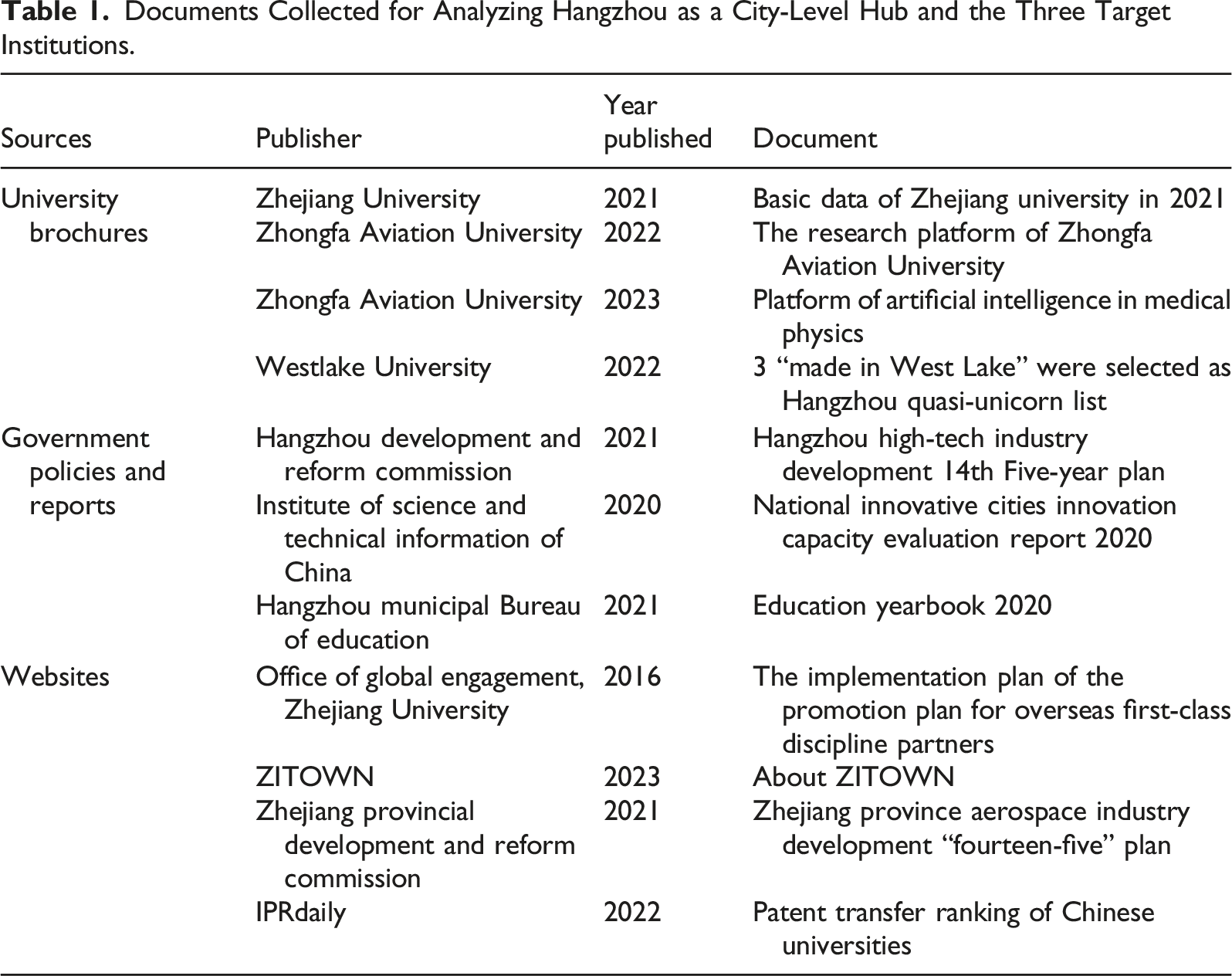
Documents Collected for Analyzing Hangzhou as a City-Level Hub and the Three Target Institutions.
Findings
Hangzhou’s development as an emerging HE hub can be attributed to its focus on meeting local and national needs for scientific knowledge system advancement through attracting and utilizing domestic and international resources working on new technology industries such as biotechnology, cloud computing, and artificial intelligence. In effect, the city has long been committed to increasing the number of HEIs to train skilled professionals and promote technological innovation, thereby accumulating intellectual resources to encourage regional industrial upgrading and the development of new industries. The goal of Hangzhou is to establish itself as a center for knowledge production and transmission, which it aims to achieve through effective industry-university-research collaboration. To investigate Hangzhou’s HE system and its correlation with local development, we selected institutional cases based on their capacity for knowledge production and transmission, their commitment to HE internationalization, and their uniqueness within the local HE system. The first case is Zhejiang University (ZJU), a prestigious comprehensive research university supported by China’s Double First-class initiative, as well as the former Project 211 and Project 985 initiatives. The second case is Westlake University (WLU), a private small-scale young elite research university established in 2018 that focuses on natural sciences and advanced technologies. The third case is Zhongfa Aviation University (ZFAU), a Sino-foreign joint venture co-founded by China’s Beihang University (BUAA) and France’s Ecole Nationale de l'Aviation Civile (ENAC).
The case of Zhejiang University as a Prestigious National Research University
Zhejiang University (ZJU) is a comprehensive national research university that has made significant scientific and technological advancements in recent years, as evidenced by its National Science and Technology Progress Grand Prizes. During the republican period, ZJU was one of the most productive national universities in China, and after 1949, it underwent a major restructuring of departments, following the Soviet model in 1952. This restructuring led to the formation of several new HEIs in Hangzhou, including a leading polytechnic university, a comprehensive university of arts and sciences (i.e., the former Hangzhou University), an agricultural university, and a medical institute. These specialized institutions were remerged in 1998 by the central government to form the current comprehensive research-oriented ZJU. Currently, ZJU has a total enrollment of 75,561 students, including 29,286 undergraduate students, 25,304 master’s students, and 15,362 doctoral students, with 5609 international students from all over the globe (Zhejiang University, 2021). ZJU has 39 disciplinary schools, one polytechnic institute co-established with Zhejiang Province, and two Sino-foreign joint institutions, located in seven major campuses in Hangzhou and other cities in Zhejiang Province. It also has seven affiliated hospitals in different parts of the city and other parts of Zhejiang.
According to its mission and vision, ZJU places a strong emphasis on innovative research, cultivating students with leadership attributes, global vision, and social responsibility, as well as on knowledge transformation to benefit local and global communities (Zhejiang University, n.d.a). As a leading public research university, ZJU provides intelligence resources to social development through a variety of high-quality and international academic platforms. As “an explicit priority in the development strategy” of most leading research universities (Welch, 2018, p. 518), ZJU is equally committed to promoting internationalization and has established exchange or collaborative training programs conjointly with 32 prestigious overseas universities, such as Imperial College London, University of Illinois at Urbana-Champaign, and University of Edinburgh (Office of Global Engagement of ZJU, 2016). It has established an international campus in Haining, a satellite city in the Hangzhou metropolitan area, offering Sino-foreign joint degree programs and carrying out international collaborative research.
As mentioned earlier, this study considered both the organizational and individual dimensions of knowledge production agencies within HEIs. Organizational agencies in HEIs typically include key laboratories and research centers. ZJU has 10 national key laboratories, 12 national engineering research centers, and four national engineering technology centers (ZJU, 2021), making it a leading contributor to the knowledge economy at the local and national level. Additionally, outstanding researchers are crucial actors in a HE hub. The university has established a leading team of faculty members through recruitment of both young and senior scholars from home and abroad, with some of China’s most distinguished scholars in various fields. In 2022, its faculty members published nearly 20 research papers in top-tier journals such as Nature, Science, and Cell as first/co-first or corresponding authors (Zhejiang University, n.d.b). Furthermore, ZJU also demonstrates its commitment to knowledge transmission through commercialization of research outcomes, consistently ranking in the top 10 in China for patent transformation (IPRdaily & incoPat, 2022). In fact, ZJU was one of the earliest universities in China to establish a science park (i.e., Zhejiang University Science Park established in 2001) for promoting the commercial use of research to serve local development. More recently, the university has collaborated with the local government of Xihu District in 2020 to establish ZITOWN, a high-tech and information industry innovation and entrepreneurship platform near its main campus. ZITOWN is home to 3508 startups, with a total output value of 13 billion RMB (ZITOWN, 2023).
As stated, “the scientific and social roles of the university need not amount to a zero-sum game” (Gibbons, 1994, p. 84). Carayannis (2016) argues that “a Mode 3 university seeks to create innovative organizational contexts for research and innovation by combining and integrating different principles of knowledge production and knowledge application” (p.18). ZJU has made various efforts to promote industry-university-research cooperation models with local major manufacturing enterprises and high-tech companies. For instance, it has established a cyberspace security laboratory in collaboration with Alibaba Group in 2018, focusing on data protection, artificial intelligence security, and cloud security (School of Cyber Science and Technology of ZJU, 2018). Moreover, it has initiated the Zhejiang University Innovation Institute International in 2008 and ZJU-Hangzhou Global Scientific and Technological Innovation Center in 2019 in order to support the development of prospective local industries. The center aims at “deepening the strategic cooperation between a well-developed city and a top university” (ZJU-Hangzhou Global Scientific and Technological Innovation Center, 2023, para.1). Additionally, ZJU established research institutes jointly with 11 municipal governments in Zhejiang Province to transfer its research outcomes to local industries. Overall, ZJU’s commitment to industry-university-research cooperation and knowledge transmission reflects its determination to promote innovation and support local development. Its efforts to establish various platforms, research institutes, and joint ventures with high-tech companies demonstrate its commitment to Mode 3 knowledge production.
The case of Westlake University as a Young Elite Research Institution
Formerly known as Zhejiang Westlake Institute for Advanced Study, Westlake University (WLU) is a private, small-scale young elite research university founded in 2018 with the support of the Hangzhou Westlake Education Foundation and the municipal government. Its establishment is part of China’s ongoing efforts to develop world-class universities that experiment with alternative models (Wu, 2017). WLU’s founding president, who is an internationally renowned structural biologist and former Vice President of Tsinghua University, has brought together Caltech’s institutional model and Stanford’s vision. Currently, the university has over 1000 doctoral students in fields such as mathematics, physics, and computer science and three academic schools focusing on life sciences, natural sciences, and engineering (Westlake University, n.d.a). It also has highly internationalized faculty members who were affiliated with prestigious universities around the world. For instance, Mohamad Sawan, a renowned scientist in the field of smart biomedical devices, has been recruited as the chair professor of the School of Engineering (Westlake University, n.d.b). As emphasized by Carayannis (2012), the Model 3 of knowledge production emphasizes the coexistence and coevolution of different knowledge and innovation modes. WLU has created several innovation platforms around life sciences, medical research, physical sciences, and engineering, including provincial key laboratories (e.g., Zhejiang Provincial Key Laboratory for Structural Biology Research) and university-run research institutes (e.g., Research Center for Industries of the Future, and Center of Artificial Photosynthesis for Solar Fuels) (Westlake University, n.d.c).
Also, WLU has built strong connections with local industries and has succeeded in commercializing some of its cutting-edge research findings. Its commercialization and transformation system consists of a comprehensive service platform, a financial investment platform, and an industrial support platform (Westlake University, n.d.d, para.1). WLU has established a professional “technology broker” team and an Office of Technology Transfer and Development to create its knowledge transfer service system (Westlake University, n.d.d, para.1), which has already achieved some success. Some of its commercialization/transformation projects, such as Westlake Omni, Westlake Biomedical, and Westlake Future Smart, have been selected for the list of Hangzhou’s quasi-unicorns (Westlake University, 2022). Compared to other young elite research HEIs in mainland China, such as Shanghai-Tech and Southern University of Science and Technology, WLU may have a higher degree of institutional autonomy during knowledge production and transformation given its predominant support from private sources (Wu, 2017). Its distinctive knowledge production model restricts knowledge generation to specific cutting-edge fields and collaborates with prestigious universities at home and abroad. It is also experimenting with different models of knowledge transformation and commercialization in China’s policy context while serving the local economy.
The Case of Zhongfa Aviation University as a Sino-foreign Joint University
Zhongfa Aviation University (ZFAU)is a Sino-foreign joint university established through collaboration between China’s Beihang University (BUAA) and Ecole Nationale de l’Aviation Civile (ENAC) in France. BUAA is a renowned polytechnic university in Beijing with a focus on aeronautics and astronautics, while ENAC is a leading French grande école in civil aviation. Since the mid-2000s, “Sino-foreign joint HEIs have been established jointly by foreign universities and their Chinese partners as an alternative form of HE” (Wu & Li, 2021, p. 697). Compared to other cases such as University of Nottingham Ningbo, New York University Shanghai, and Duke Kunshan University, ZFAU “dedicated to multidisciplinary and innovation-oriented education as well as cutting-edge and core technology research”, especially in aeronautics and civil aviation (ZFAU, n.d.a, para.1). To achieve this goal, ZFAU has established five academic schools, including civil aviation, aerospace, informatics, engineering, and science, as well as an international school committed to providing collaborative programs such as the Beihang-Group of Ecoles Centrale master’s double degree program (ZFAU, n.d.b). ZFAU has been enrolling postgraduate students since 2020, who are currently studying at the Beihang Hangzhou Innovation Research Institute since the university is still under construction (ZFAU, 2023). It plans to enroll its first cohort of undergraduate students in 2023 (ZFAU, 2023). As a research university, ZFAU has also established 11 research platforms, including the Urban Air Mobility Joint Laboratory and the Air Traffic Management Platform, and has developed partnerships with China’s national key laboratories in aeronautics (ZFAUc, n.d.c). ZFAU’s School of Civil Aviation, for instance, has collaborated with China’s National Engineering Laboratory to explore the field of air traffic and civil aviation transportation management (ZFAUd, n.d.d, para.1). The university has already achieved some research outcomes that have a significant economic and social impact in the aerospace field, with profound application prospects, such as its research about nanometer materials which could open up new avenues for producing more high-production and stable quantum materials.
Knight (2014) suggested that “policy sectors leading the development of a knowledge/innovation hub are science and technology, trade, industry, economic development, and education” (p.34). In the context of this case, the local governments have played an active role in the establishment and development of this Sino-foreign joint institution. Specifically, both the provincial education department and the municipal government are listed as supporting units in the cooperation framework agreement signed by the governmental sectors and Beihang University (ZFAU, n.d.e, para.1). One of the main reasons for such government support for the establishment of this Sino-foreign joint institution is its alignment with the city’s future industrial development strategies, such as becoming one of the national pilot zones for civil unmanned aerial by the Civil Aviation Administration of China in 2020 (Zhejiang Provincial Development and Reform Commission, 2021). Although the city’s current R&D capabilities and industrial scale in this field are relatively limited, both provincial and municipal governments have ambitious plans for the development of local civil aeronautical industries, according to its 14th (Provincial) Five-Year Plan for the Development of Aeronautical Industries (Zhejiang Provincial Development and Reform Commission, 2021). While ZFAU is still in the process of establishing its industry-university-research cooperation model, it has already undertaken some experiments and achieved some research results with significant potential for transformation and commercialization. For instance, its research platform of Artificial Intelligence in medical physics on dual-energy CT imaging and single-projection volumetric CT reconstruction has practical applications in the healthcare industry (ZAFU, n.d.f). Moreover, Wu and Zhang (2015) note that the establishment of international joint HE projects not only imports high-quality educational resources but also enables learning from Western educational, administrative, and policy formulation philosophies. The establishment of ZFAU may also inspire institutional-level policy innovation in other types of universities in Hangzhou in the future.
Further Discussion: Internet Thinking and Confucian Tradition
Internet thinking is a term that refers to a set of values, attitudes, and practices organized around ideas such as openness, collaboration, decentralization, and innovation, which have emerged alongside the development and widespread use of the Internet. Hangzhou’s emergence as both an emerging HE hub and a highland of the Internet industry in China has created an apt opportunity for leveraging these values in the creation of more dynamic and flexible ecosystems for knowledge production and innovation. This has in turn enabled institutions and stakeholders to easily share and mobilize resources across the regional HE system. Indeed, Hangzhou has created an environment conducive to innovation led by “Internet thinking”, which represents “connectivity at anytime, anywhere to anyone so as to create and capture customer value” as emphasized by Alibaba’s Chief Strategy Officer Ming Zeng (Chiang, 2014, para.2). This facilitates the transition of HE knowledge production from Mode 2 to Mode 3 and enhances the efficiency of knowledge transfer. Meanwhile, Confucian traditions, which emphasize the importance of (higher) education, have also played a significant role in developing Hangzhou’s HE. This has been reflected in the priorities of national and local development strategies, as well as the strong support for different types of HE institutions by the government. The municipal government, like most local governments in Confucian heritage societies, has tended to address socio-economic issues through cooperation with universities. It is also worth noting that both Internet thinking and the Confucian tradition share the characteristic of inclusiveness, which allows for the potential coexistence of diverse values and cultures. The prevailing local commercial culture, along with Internet thinking and Confucian traditions have jointly promoted the creation of strong partnerships between universities, industry, and government in the development of a HE system characterized by innovation and creativity. The result is the formation of a dynamic and vibrant hub of talent and knowledge/innovation that contributes to local and national economic growth and social development.
Conclusion
Based on the three institutional cases, the study has sought to illuminate how Hangzhou has become an emerging HE hub with unique approaches to knowledge production and transmission across different levels. At the regional level, the municipal government has been actively supporting the development of a national research university, a young elite research university, and a Sino-foreign joint research institution. Its motives are partly pragmatic and partly derived from the influence of the Confucian tradition. The government’s expectation that HEIs address the social needs exists in most Confucian heritage societies. At the institutional level, these universities have developed interdisciplinary research platforms to foster collaboration among different academic fields, as well as knowledge transformation platforms to strengthen industry-university-research partnerships. Individual researchers and laboratories have produced research outcomes with high potential for commercialization, demonstrating the effectiveness of Hangzhou’s mode of becoming an HE hub. Its approach to promoting HE and local development provides an example of a HE hub in a Confucian heritage society and an emerging economy, which highlights the importance of regional support, diversification of agency types, and academic knowledge production in driving innovation and economic growth. Moreover, institutions within this hub have aimed to improve the quality and efficiency of knowledge production and transmission through internationalization, such as promoting cross-border mobility of students and scholars, providing joint degree programs, and establishing joint research platforms. Local and international actors have been attracted to be part of the hub.
The study also highlights variations in the processes and outputs of knowledge production and transmission across different types of HEIs within the hub. The quasi-autonomy afforded to both institutional and local government levels present an opportunity for bottom-up innovation and exploration. In addition to the leading role of the national public research university in enhancing regional competitiveness, the young elite research university has its unique advantages as well, such as its highly internationalized research teams, the focus placed on a few promising fields, the transformation of research outcomes, and the incubation of innovative enterprises. In a foreseeable sense, the Sino-foreign joint university will consistently make effective use of global HE and human resources to translate foreign and local scientific achievements, and attract foreign investments. Hangzhou’s rich Internet thinking and entrepreneurial spirit have also contributed to the formation of the HE hub. It can serve as an example of an emerging city-level HE hub integrating resources from both traditional and new types of HEIs, while benefiting from the influence of Internet thinking and indigenous traditions. This approach can help foster an innovative and entrepreneurial environment.
Footnotes
Declaration of Conflicting Interests
The author(s) declared no potential conflicts of interest with respect to the research, authorship, and/or publication of this article.
Funding
The author(s) disclosed receipt of the following financial support for the research, authorship, and/or publication of this article: This work was supported by the National Social Science Fund of China (Education) [grant number CIA210277].