



Abstract
Cai Yuanpei was a renowned 20th century Chinese educator. He is best known for his role as the chancellor of Peking University and his belief in “inclusiveness and tolerance (jianrong bingbao).” This essay examines Cai Yuanpei’s knowledge taxonomy both in his early 20th century writings and in his academic policies as Chancellor of National Peking University (1917–1923). As chancellor, Cai made a conscious effort to recruit faculty members who aimed to bring about revolutionary changes to Chinese culture. While his original vision was to integrate scientific methodologies with the intuitive philosophies of xuanxue (玄学), the dominant trend in Chinese scholarship became heavily focused on science. This essay delves into Cai’s exposure to Japanese intellectual influences around 1900, and how it influenced Cai’s initial knowledge taxonomy and its connection to Cai’s definition of science disciplines in modern Chinese education. Cai’s view toward science and philosophy evolved from an emphasis on a continuum between the two in the early 1900s to their separation, as science gained momentum and philosophy became increasingly subordinate to science. The essay shows how Cai’s efforts to create a modern educational system in China where science would be balanced with intuitive learning played out to a predominance of science in Chinese learning.
Introduction
Cai Yuanpei (1868–1940) was a renowned 20th century Chinese educator who had a significant impact on modern Chinese education. Starting in 1898, he initiated local educational reforms in Zhejiang. He served as the first Minister of Education of the Republic of China in 1912, and Chancellor of National Peking University from 1917 to 1923. While Cai’s influence by German education is rather extensively studied, (for instance, Lin, 2005, pp. 47–52; Zarrow, 2021, chap. 3) the influence of Japanese education on him has received relatively little attention, despite a few interpreters such as Wang Qing (Wang, 2013A, 2013B, 2021). This essay explores Japanese influence on Cai Yuanpei in the early 1900s, specifically in the taxonomy of academic disciplines by Inoue Enryō (1858–1919). It then examines how Cai shifted gradually to a taxonomy of academic disciplines more influenced by German universities’ emphasis on transcendental ideals, and moved toward an increasing distinction between science and philosophy. By examining Cai’s transition from a continuum between science and philosophy to acknowledging a limited space for xuanxue (metaphysics) in a world increasingly dominated by science, this essay aims to illuminate the emergence of the dichotomy between science and metaphysics, as well as the growing association of Chinese scholarship with metaphysics in early 1920s China.
From Zhang Zhidong to Cai Yuanpei: Japanese Influence and Modern Chinese Academic Disciplines
The most important contributions to institutional changes in Chinese education in the late 19th century were made by Zhang Zhidong. Zhang (1837–1909), a Hanlin Academician and Governor-general, was the most important modern Chinese educational administrator before Cai Yuanpei. Zhang, as Governor-general of the two Yangtze provinces and later Hunan and Hubei, leaned to Japan for ideas of educational reform after the Sino-Japanese War (1894–1895), when Japanese military leaders Kamio Mitsuomi and Tarō Utsunomiya were sent by the Japanese army staff to persuade Chinese Governor-generals to study the Japanese educational system and army organization. (Lu, 2015, pp. 149–150) Zhang subsequently organized Chinese learning into classical literature, history, different philosophical schools, principles of morality, rhetoric, politics, geography, and arithmetic, based on the Japanese taxonomy of academic disciplines in his 1898 essay Exhortation to Learning (quanxue pian). (Lu, 2015, 152)
In 1902, Zhang Zhidong, together with Duanfang, Inspector-general (xunfu) of Hubei, proposed a comprehensive plan for school systems from primary to tertiary levels, based on extensive research trips to Japan conducted by Zhang’s staff. (Li, 2002, p.126) This proposal eventually became the blueprint for the modern Chinese educational system, known as the 1904 Daxuetang zhangcheng (Imperial college rules and regulations), which served as the guideline for the Imperial Peking University, the first state university in China. Although Zhang included a very modern taxonomy of academic disciplines, he also kept a division for Confucian classical studies in his proposed university curricula, which included 11 subfields/classics. (Lin, 2005, p. 12) While Zhang built a framework for the modern Chinese academic disciplines, it was Cai Yuanpei, the first Minister of Education in Republican China in 1912 and chancellor of Peking University in 1917, who developed an academic structure for a fuller integration of Chinese and Western learning.
Cai, a Hanlin scholar turned avid private educational reformer after 1898, saw comprehensive educational reform as necessary for China to become internationally competitive. (Lin, 2021) Between 1898 and 1900, Cai not only helped found modern schools, such as the Shanghai Patriotic School 上海爱国学社, and taught in multiple new schools such as the Nanyang Mission College 南洋公学, but also did extensive translation of philosophical and educational works from Japanese into Chinese. Cai started teaching himself Japanese in May/June 1898 around the beginning of the Hundred Day reform (June 11‒Sept. 21, 1898). (Wang, 1998, p. 33) After the reform failed, Cai left Beijing and became the supervisor of the East West School中西学堂 at Shaoxing, his hometown, in Dec., 1898, where he continued to study Japanese and hired some Japanese teachers from Hangzhou in 1900. (Wang, 1998, pp. 35–39; Gao, 1996, pp. 153–159) Cai had extensive contact with multiple Japanese scholars and students, including Japanese poet Honda Kōnosuke 本田幸之助, and Suzuki Hiroma 鈴木広間, an exchange student from Higashi Hongan Temple, in January 1900. In February and March 1900, Cai visited Japanese scholars in Hangzhou. (Wang, 2010, pp. 74, 75, 79) It was possible that in these encounters Cai Yuanpei learned of the work of Inoue Enryō, one of the Japanese philosophers who would have an extensive influence on Cai Yuanpei. 1
Inoue Enryō (1858–1919) was a student of Inoue Tetsujirō (1856–1944), a Japanese philosopher and the first to teach the history of the philosophy of China and India at Imperial Tokyo University in 1883. (Sang, 2010, pp. 1, 3, 5) Inoue Enryō joined the Philosophy faculty at Tokyo University after graduation. He was most noted for teaching eastern philosophy, and, for his attempts to revive Buddhism that was increasingly marginalized by Western learning in Japan. Inoue aimed to convert Buddhism into philosophy, defining it as the application (ōyō) 应用) of philosophy: Buddhism was the synthesis of philosophy and religion, embodying universal truth as philosophy and leading one to enlightenment as religion. (Godart, 2004, p. 113) Inoue removed the mysticism from Buddhism. He saw Buddhist faith as serving a therapeutic effect, similar to a placebo effect in medicine, where it could make one feel better even if there was no actual intervention. Inoue removed the mysticism from Buddhism and made its impact tangible, though not necessarily measurable by scientific standards. (Schulzer, 2019, p. 111, p. 111)
As Buddhism declined and Western ideas flooded Japan, Inoue Enryō believed that defending Buddhism was defending the Japanese nation. (Staggs, 1983, pp. 253–254, 259) By emphasizing that Buddhism was a religion based on philosophy, he reinterpreted the history of Buddhism in evolutionary terms, so that it followed the same developmental rules as Western philosophy. (Godart, 2004, pp. 123–130)
Inoue Enryō also provided a modern knowledge taxonomy where Buddhism was treated as a sub-category of philosophy. In his 1886 book The Golden Needle of Truth, Inoue divided academic disciplines into 1) scientific disciplines, 2) empirical philosophy, including analytic and ethical philosophy, and 3) metaphysical philosophy, which he also called pure philosophy or religion. Inoue called religion philosophy, or scientific religion, and said religion was universal and rational. Inoue excluded Christianity from philosophy because Christianity “has a master who controls heaven and earth,” and that Christianity and pre-Shakyamuni Buddhism were “generated by imagination and the development of fear,” but Buddhism after Shakyamuni “was established on the basis of philosophical principles, following the rules of logic, which is called knowing and then believing,” thus Buddhism was a philosophical religion compared to other religions such as Christianity. Inoue’s goal was creating an academic space for Buddhism while combating Christianity. (Wang, 2013B)
Inoue Enryō was first introduced to China through Lin Tingyu林廷玉’s translation of Inoue’s Diaries on Politics and Religion in the US and Europe (欧米各国政教日记) in 1890. It was also one of the first translations of Japanese books into Chinese. (Sun, 2001) Inoue’s books were more rapidly introduced into China between 1896 and 1911. (Li, 2018) Inoue was familiar with Kang Youwei’s works and visited Kang at Darjeeling in India in 1902. (Li, 2018; Peng, 2018) Zhang Taiyan was also influenced by Inoue’s psychological methods and translated Inoue’s Lectures on Mystery Studies, although the translation might not have been published. (Peng, 2018, p. 26) Liang Qichao met Inoue Enryō at the Japanese Philosophical Academy meeting and Inoue discussed the influence of Kant in Japan with Liang. Liang spent years in Japan and was well-versed in Japanese academic discipline taxonomy, which he introduced to China in his article “Guidelines to Japanese Books (东籍月旦)”. (Liang, 1902) Liang introduced general liberal studies subjects including ethics, Chinese, foreign languages, history, geography, mathematics, natural history, physics and chemistry, law, and economics, and reading lists for each subject. Inoue Enryō’s Outline of Ethics (伦理通论) (1887) was one of the books on Liang’s reading list for ethics. (Liang, 1902) Inoue Enryō’s influence in China was quite extensive in the early 20th century, so much so that his The Origins of Politics and Religion in Europe and America 欧美政教记原 was found on Emperor Guangxu’s last reading list in January 1908, along with multiple other books on Japanese, European and American politics, education, and economy. (Li, 2018; Yang, 2013)
Cai Yuanpei researcher Wang Qing believes that Inoue had a great influence on Cai Yuanpei’s evolving philosophical outlook. Wang Qing examined Cai Yuanpei’s diaries up to 1903, and found many references to Inoue’s work, such as Cai purchasing and commissioned to translate Lectures on Mystery Studies; borrowing A Morning Conversation about Philosophy and Buddhist Heterodox Philosophy; purchasing New Theory of Religion; and investigating the “Correspondence Education Methods at the Philosophy Academy,” all Inoue’s works. In addition, in an article “A Theory on School Curriculum (xuetang jiaoke lun)” published in October 1901, Cai based the classification of school subjects on the doctrine of the “Japanese Inoue Fusui” (Inoue’s other name was Fusui). Cai Yuanpei’s “Introduction to Philosophy” published in 1901 was a partial translation of Inoue’s “Living Discourse on Buddhism.” In the “Regulations of the Two Dai’s Academies in Shanshan” published on February 27, 1900, Cai said that he came across Yan Fu’s translation of the theory of evolution in 1898 and came to know the meaning of evolution. And he explored the words of the Japanese philosophers in relation to the “disputes of the times and the changes of human conditions,” and became more and more convinced of the truth of these ideas. Wang believes the Japanese philosopher referred to was Inoue, who was particularly interested in Spencer’s theory of social evolution. (Wang, 2013B)
In March 1900, Cai Yuanpei wrote an article titled “Treatise on Buddhism Protecting the Nation 佛教护国论," where he highlighted Inoue’s use of Buddhism for nationalism. Inoue’s approach reconciling Buddhism, philosophy, and science also inspired Cai Yuanpei. Cai quoted Inoue as saying, “Hinayana is equivalent to science; the embodiment of Mahayana in Buddhas is empirical philosophy; the dharmata, or ultimate reality of Mahayana is metaphysics.” Cai then applied this taxonomy of Buddhism to Chinese schools of thought. He compared the Analects to the Hinayana, the Mencius to applied Mahayana, and the Zhuangzi to theoretical Mahayana. He also suggested that where the Analects, Mencius, and Zhuangzi lacked sufficient detail, they could be supplemented with Buddhism. In this way, Inoue’s transformation of Buddhism inspired Cai Yuanpei to transform Chinese learning. (Cai, 1900, p. 273, p. 273)
Cai was particularly drawn to Inoue’s approach to organize academic disciplines as shown in his partial translation of Inoue’s Living Discourse on Buddhism in his “Zhexue zonglun 哲学总论 (Introduction to philosophy),” (Cai, 1901C, p. 9; Cai, 1901D, p. 6) his translation of Inoue’s Lectures on Mystery Studies: General Theory in 1905, and his “Xuetang jiaoke lun 学堂教科论 (A theory on school curriculum)” published in 1901. However, Cai Yuanpei’s taxonomy of academic disciplines differed from Inoue’s original formulation.
Cai Yuanpei’s Knowledge Taxonomy (1901): Daoxue as a Unifier of all Sciences
While Cai Yuanpei’s taxonomy of knowledge was significantly influenced by Inoue Enryō, Cai diverged from Inoue’s emphasis on an overlapping relationship between science and philosophy. Inoue categorized scientific disciplines like physics, chemistry, biology, astronomy, geology, and physiology as empirical sciences (youxing lixue 有形理学) due to their focus on tangible entities with specific forms. Conversely, subjects such as psychology and ethics were classified as metaphysical sciences (wuxing lixue 无形理学) since they explored intangible subjects without specific forms. In order to highlight the interconnectedness of science and philosophy, Inoue also referred to metaphysical sciences as empirical philosophy (youxiang zhexue 有象哲学). This designation stemmed from the fact that the study of metaphysical sciences would be based on the rules and methodologies of empirical sciences, and the principles derived from this study would contribute to the foundation of empirical sciences. The objects of study within empirical philosophy, such as the manifestations of the mind like intelligence, willpower, and emotions, lack tangible forms but exhibit observable characteristics. As a result, the exploration of these observable manifestations in mental activities, including subjects like logic, ethics, aesthetics, sociology, education, and political science, falls within the domain of empirical philosophy. Conversely, the nature of abstract concepts such as gods or the mind itself is non-observable, surpassing the realm of empirical study. The investigation and exploration of these subjects lie within the domain of metaphysical philosophy (wuxiang zhexue 无象哲学). (Cai, 1901B, pp. 355, 359–361) For Inoue, the foundation of knowledge rested upon two essential pillars: empirical science on one hand, and empirical and metaphysical philosophy on the other. (See Figure 1 below.) In Inoue’s framework, empirical sciences were likened to local governments, while metaphysical sciences/empirical philosophy was compared to prefectural governments. Metaphysical philosophy, on the other hand, was likened to the central government’s cabinet, overseeing, and coordinating the activities of both prefectural and local governments. This analogy highlighted the hierarchical relationship between these domains of knowledge, with empirical sciences operating at a more localized level, metaphysical sciences/empirical philosophy occupying an intermediate level, and metaphysical philosophy serving as the overarching authority. (Cai, 1901B, pp. 360–361) Cai would do away with the categories of empirical and metaphysical philosophies. Classification of empirical sciences and unifying studies/philosophy by Inoue Enryo in A Living Theory of Buddhism, and Lectures on Mystery Studies: General Theory.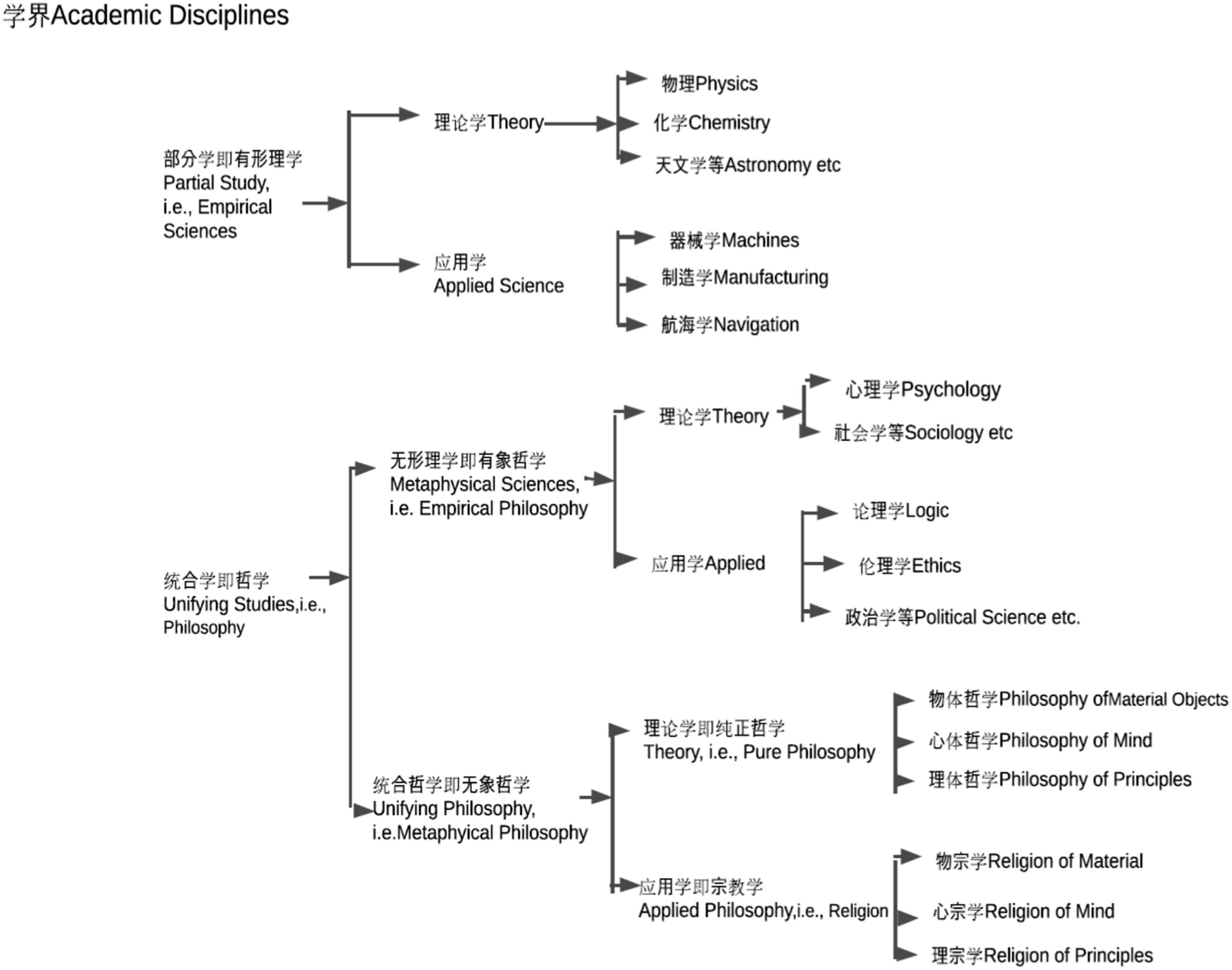
Inoue Enryō also had a meticulous mapping of the interconnections of subjects within the same major category by dividing each of the categories of empirical science, empirical and metaphysical philosophy, into theoretical and applied components. (See Figure 1 above) Therefore physics, chemistry and astronomy would be the theoretical part of empirical science, while machines, navigation, and astronomy would be the applied components. Similarly, psychology and sociology would be the theoretical part of metaphysical science or empirical philosophy, while logic, ethics, and political science would be the applications. In this taxonomy, religion would be classified as applied philosophy. (See Figure 1) This taxonomy accorded with Inoue Enryō’s goal to employ a rational approach to dispel the false mysteries of Buddhism, leading humans into the true mystery of its religious realm. Inoue did not intend to rationalize Buddhism. For him, religion is beyond the realm of rational thinking. The phenomena of the world reflect principles that are already within the boundaries of science and can be examined through physical or psychological explanations. Religion, however, is beyond the scope of science, but humans can gain some understanding of it through the infinite power of the mind. Nevertheless, questions about the universe remain both knowable and unknowable, suggesting that some things are entirely beyond the limits of human thought and everything in the universe. (Wang, 2013B) Inoue positioned Buddhist studies within the discipline of philosophy to provide a rational and legitimate space to explore the true mysteries of Buddhism. Cai did away with the bifurcation of the theoretical and applied in each of his knowledge categories.
In his 1901 “A Theory on School Curriculum”—his classification of academic disciplines, Cai referred to Inoue’s metaphysical science 无形理学 as a unifier (tongbu 统部) of empirical sciences 有形理学, meaning metaphysical science was the repository of all principles of the empirical sciences. (Cai, 1901A, p. 334) However, Cai decided not to follow through with Inoue’s classification of the metaphysical sciences also as empirical philosophy in his own knowledge taxonomy, keeping only Inoue’s empirical and metaphysical sciences. (See Figures 2 and 3 below) Cai also had a philosophy section in his taxonomy, which, however, had only three disciplines, philosophy, religion, and psychology. Cai named his category for philosophy Daoxue (the study of Dao). (See Figure 3) Cai also said his Daoxue was equivalent to Inoue’s metaphysical philosophy. (Cai, 1901A, p. 334) Empirical sciences classification (1901). Metaphysical sciences and Daoxueclassification (1901).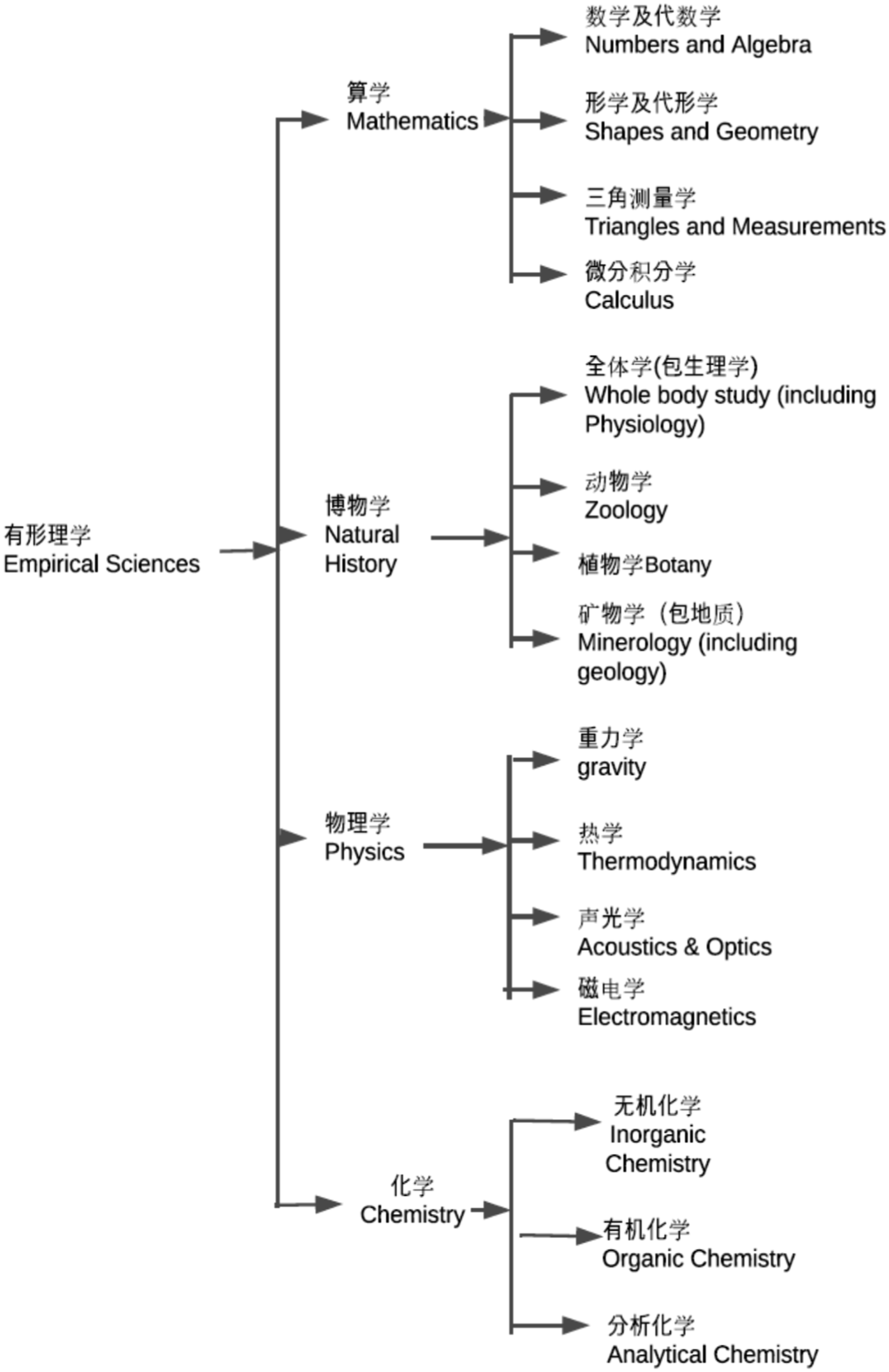
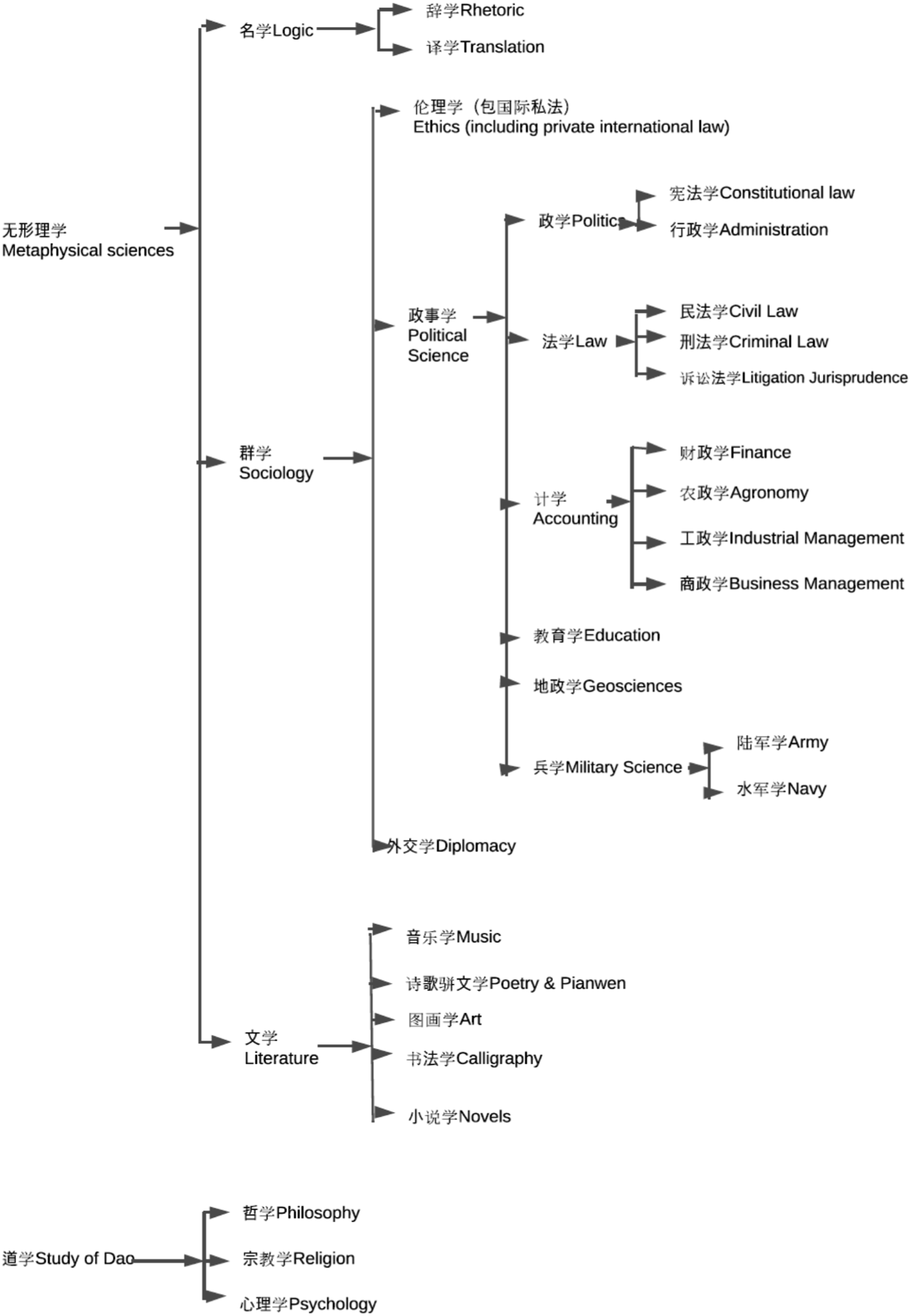
One reason for this definition of most academic disciplines as science, rather than the blending of science and philosophy that Inoue Enryō deployed in the interchangeable terms of metaphysical science and empirical philosophy was to highlight the unifying force of what Cai defined as philosophy in his discipline of Daoxue. This could be seen in Cai’s “A Theory on School Curriculum,” where Cai quoted the Hanfeizi to illustrate the relationship between specialized knowledge and more universal knowledge. According to the Hanfeizi, principles/li (理) were the rules realized in things, and the Dao道 was the totality of all principles. To Cai, what he defined as Daoxue 道学, namely philosophy, religion, and psychology would be the unifier of all other learning. (Cai, 1901A, p. 334)
The differences between Inoue Enryō and Cai’s taxonomies of science and philosophy reflect their divergent goals. Inoue’s distinction between the theoretical and applied enabled the classification of religion as applied philosophy. Although Cai brought up the distinction multiple times in his introduction to Inoue, it had no major use for Cai and was absent in Cai’s taxonomy. While Inoue tried to create an overlapping taxonomy of science and philosophy, Cai’s adoption of Inoue’s concept of metaphysical science but not empirical philosophy was to highlight the distinction between the sciences and the philosophy that Cai called Daoxue, hence heightening the importance of Daoxue as the unifying principles for all the sciences.
In deploying the concept of Daoxue, Cai connected with a traditional Chinese concept even though Cai’s Daoxue differed from the traditional Daoxue. It also differed from Inoue’s metaphysical philosophy. A notable difference between Cai’s Daoxue and the latter was Cai’s inclusion of psychology, which Inoue classified under empirical, not metaphysical philosophy. Cai explained that only philosophy should exclusively belong to Daoxue, and both psychology and religion were just affiliated with it. He classified psychology under Daoxue because “psychological phenomena have to be explained with philosophical rules.” As for religion, only Zhuangzi [a traditional component of Daoism] and Buddhism appropriately belonged to Daoxue. (Cai, 1901A, p. 337)
Cai’s Daoxue more resembled a reconstructed Chinese “core” that included philosophy from different sources, a modern Western discipline of psychology, and non-Confucian sources of Chinese thought including Zhuangzi and Buddhism. This core, For Cai, would guide a deeper understanding of the universe and human existence through the unification of different fields of knowledge. Unlike Inoue, Cai treated religion as superstition. (Wang, 2013B) Thus, Cai did not mean to mine the mysticism of Buddhism in the philosophy section, but treated Buddhism as a way of thinking. Cai hoped to find something beyond science but short of religious mysticism to describe human lives.
Borrowing from Inoue Enryō’s knowledge taxonomy, Cai Yuanpei was able to build a system of knowledge that transcended Zhang Zhidong’s bifurcation of Confucian classics and other academic subjects in Zhang’s taxonomy of academic disciplines for the Imperial Peking University, with a new core for China as represented in the discipline of Daoxue.
Cai Yuanpei: From Philosophy and Science to Science Versus Metaphysics
Cai’s definition of philosophy underwent major changes when he became the first Minister of Education in the newly founded Republic of China in 1912. From 1901, with his initial knowledge taxonomy for secondary school students, to 1911 when the Republic of China replaced the Qing Dynasty, Cai played an important role in the establishment of modern schools in Zhejiang, and the search for a moral framework that would align with his vision of a modern education system. His ideal was the German educational system, where higher education was given autonomy to help foster a national culture. Disappointed with the state of Chinese politics and education, Cai sought inspiration in the German higher educational system which had been established by Wilhelm von Humboldt in early 19th century Germany. Cai studied at the University of Leipzig between 1908 and 1911, with educational reformers such as Wilhelm Wundt and took courses in aesthetics and experimental psychology, among others. (Lin, 2005, pp. 47–51)
Upon assuming the role of the first Minister of Education of Republican China, Cai entrusted the university with a crucial task: Developing a core of moral and theoretical knowledge that would ultimately contribute to Chinese national salvation while maintaining its autonomy because the knowledge it produced was linked to a transcendental level of truth not controlled by the state, reflected in the University Decree (daxue ling 大学令) promulgated in October, 1912. The University Decree was based on Cai’s suggested content, with some clauses drafted by Cai himself. (Cai, 1912B, p. 212note) It emphasized the establishment of colleges dedicated to the arts and sciences, with the requirement that at least one of these colleges be present within a university. (Cai, 1912B, p. 212) Research was also central to Cai’s university decree. There were research institutes (daxue yuan大学院) within universities for college graduates or those with equivalent qualifications for further research. The emphasis on both pure learning and research was borrowed from German universities. So was an emphasis on faculty self-governance. (Cai, 1912A, pp. 212–213) Cai also cut the Confucian classics division from university curriculum. The University Decree underscored the principles of university autonomy and bestowed a revered status upon pure knowledge, particularly the fields of arts and sciences.
The rationale behind the pursuit of pure knowledge was elucidated in an article published by Cai in February 1912. Titled “Duiyu xinjiaoyu zhi yijian (My views on new education),” (Cai, 1912A) the article argued that for the future of the whole society, there must be goals beyond the individual and the present life. Education should bridge the worlds of phenomena and politics, and noumena and religion. Championing religious education often led to the exclusion of the present world. The worlds of phenomena and noumena were a continuum and not mutually exclusive. To bridge the two worlds, aesthetics education would facilitate a worldview that bred noble and esthetic sentiments, freeing one from either a negation of or a tight hold onto the present world. (Cai, 1912A) This article was published shortly after Cai became the Minister of Education and can be seen as Cai’s manifesto for the new education in China. Its emphasis on an education transcending the individual and this world was reflected in the University Decree, with the latter’s emphasis on pure versus practical knowledge and university autonomy from politics and society. As Minister of Education, Cai established a transcendental worldview as the highest goal of learning for the modern Chinese university modeled after the German university. Cai extended this transcendental goal to life in an article written after he resigned from the Minister of Education in June 1912, justifying it on the grounds of evolution, and the writings of Chinese thinkers including Confucius, Mencius, and Mozi, among others. (Cai, 1912C)
The importance of aesthetics and transcendental goals in higher education in Cai’s (1912A) “My views on new education,” and the autonomy of learning as reflected in his University Decree marked an important departure from Cai’s earlier writings before 1908, when he studied in Germany. The symbolic association between philosophy and Chinese learning, as represented by the term Daoxue in 1901, was gone by 1912. Philosophy for the post‒1912 Cai maintained a unique status in connection with science but in closer connection with the higher realms of truth compared with science. This order of knowledge differed from the relationship between the sciences and Daoxue in Cai’s knowledge taxonomy from 1901, where Daoxue embodied the unifying principles underlying all sciences. Cai’s philosophy in 1912 was no longer the embodiment of all principles but a means to reach out for a higher order of truth.
After becoming the chancellor of Peking University, Cai emphasized the elevated position of university education. In his inaugural speech as the chancellor of Peking University in January 1917, Cai reiterated that the university was a place for in-depth research, (Cai, 1917A) a point Cai further emphasized at the new student convocation in 1918. (Cai, 1918) In 1917, to promote pure learning, Cai followed the German university practice of turning all the applied divisions at National Peking University, such as engineering, medicine, and commerce, into independent polytechnic universities. He would have abolished the Division of Law and Politics had he not met with strong opposition from the faculty. (Lin, 2005, p. 54)
As time went on, however, the definition of philosophy underwent further changes for Cai: From Cai’s initial vision of philosophy as a unifying force for all sciences, philosophy increasingly became dependent on the progress of science. One prominent example of Cai’s definition of this new relationship between the sciences and philosophy was in a flag he designed for Peking University in 1920, which was filled with different colors and laced with a thin, black border. (See Figure 4 above) The colors of red, blue, yellow, and white referred to different academic subjects. Red stood for phenomenological sciences such as physics and chemistry, blue for the genetic sciences of natural and human history, and yellow for systematic sciences such as flora, fauna, and physiology. The deployment of the terms phenomenological, genetic and systematic in the classification of different sciences were Cai’s borrowings from Wilhelm Wundt, for whom the phenomenological sciences concerned processes including psychology, the systematic sciences concerned the investigation of the productions in nature or in the mind, such as law and economics, and the genetic sciences concerned the study of the formation and development of such productions. (Vidal, 2014, p. 17) White, a synthesis of seven colors, represented philosophy to Cai, which included both natural philosophy: the summation of all natural sciences, and the application of natural sciences to the study of human thought, linking up all principles of the world, such as in the synthetic philosophy of Herbert Spencer and the positivism of August Comte. (Cai, 1920) Peking University flag that Cai Yuanpei designed in 1920. Source: https://zh.wikipedia.org/wiki/%E5%8C%97%E4%BA%AC%E5%A4%A7%E5%AD%A6#/media/File:Seal_and_Flag,_Peking_University.jpg.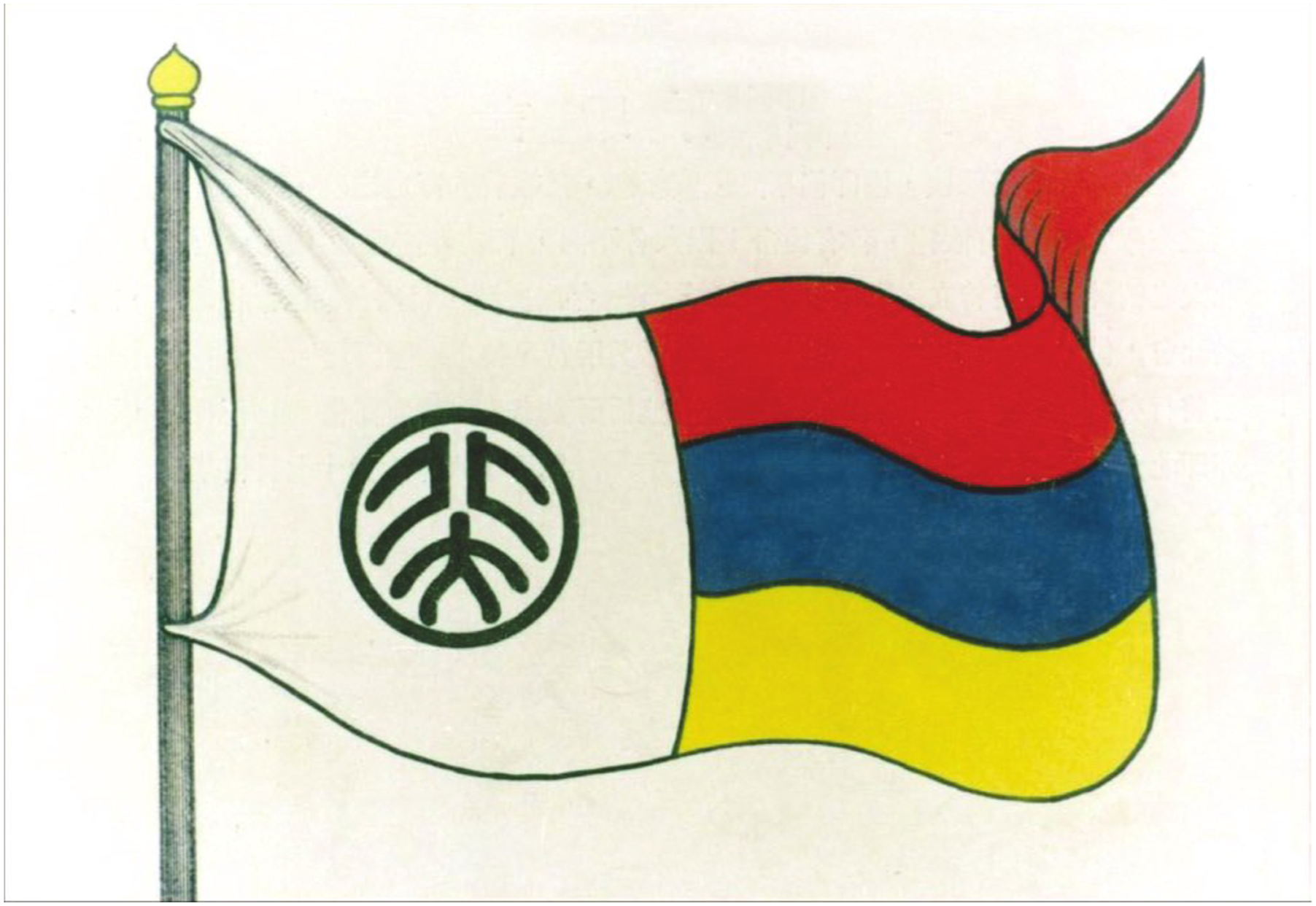
Here, Cai’s definition of philosophy as both a summary of scientific principles and the application of these principles to the spiritual world rendered philosophy subordinate to science. Instead of the Daoxue in his 1901 taxonomy where philosophy represented principles apart from, but unifying all sciences, philosophy became the product of science.
While expanding the range of science in his knowledge taxonomy, Cai also created a category called xuanxue 玄学, a field of learning not discussed in his writings prior to 1916. Unlike philosophy that Cai argued was absorbed into science to a great extent, xuanxue was beyond the reach of science and could not be included in the philosophy of synthesis 综合哲学 or empirical philosophy 实证哲学. On the Peking University flag Cai designed, Cai used a thin black border to describe xuanxue, literally, black study, which could not be accessed through scientific analysis but only intuition. Therefore, Henri Bergson’s intuitive approach would be classified as xuanxue. Cai said xuanxue was also Schopenhauer’s will, which was the inner essence of the entire world and could not be understood. It is Herbert Spencer’s the unknowable, Eduard von Hartmann’s unconscious, the xuan (black) of the Daoists, and the nirvana of the Buddhists. Xuanxue represented the result of human curiosity that could not be met with by synthetic and empirical philosophy and could not be proved by scientific reasoning. The color black occupied the smallest space on the flag because only a small number of people studied xuanxue. (Cai, 1920)
Cai’s intention behind the idea of xuanxue on the Peking University flag could be better explained with his article “Zhexue yu kexue (Philosophy and science),” published in the inaugural issue of Peking University Monthly in January 1919. In that article, Cai gave a genealogy of science, as specializations that developed from philosophy, including both natural phenomena and psychology, anthropology, comparative religion, comparative linguistics, and other subjects that once belonged to philosophy but now could be approached with induction and became subjects of scientific inquiry. (Cai, 1919)
Where would that leave philosophy then? Cai quoted Albert Lange that future philosophy would just be thought-provoking literature. And Hegel thought philosophy would simply be the history of philosophy. Cai went on to say that even though the branches of philosophy had evolved into science, what remained of philosophy was more than thought-provoking literature or the history of philosophy. While the common rules governed natural and spiritual sciences form the highest level of philosophy, such as the positivism of Auguste Comte, and Herbert Spencer’s synthetic philosophy, each academic discipline would have its own philosophy, such as the philosophies of mathematics and the sciences. There would also be a third form of philosophy, xuanxue, based on the synthesis of various scientific rules and the evolutionary ideas behind a history of philosophy. Even though Cai treated xuanxue as a furtherance of science and philosophy, Cai also made it clear that xuanxue would address unresolved questions of philosophy with new ideas, such as the evolutionary theory of Henri Bergson, and that xuanxue was above science玄学超乎科学之上. Xuanxue, Cai stated, was the last stand of philosophy that could not be absorbed by science, as other branches of philosophy would lose their individual identity with the passage of time. (Cai, 1919)
The distinction between science and xuanxue was not about Chinese versus Western learning, since much of Confucian studies could be classified under philosophy or science by Cai’s classification method. And as seen from Cai’s definition of xuanxue in his university flag article, a most notable component of xuanxue was Western metaphysical thought. Despite his championship of science, Cai believed that specialization in science alone was boring, and an overemphasis on mechanical acts would lead to a mechanical outlook on the universe, a loss of interest in life or society, and a depletion of creativity (Cui, 2006, p. 43). In a conversation with a journalist from Shidai huabao 时代画报 (Modern Miscellany) in 1930, Cai said that science and religion had opposite goals: Science respected material things, and religion focused on sentiments. The more materialism developed, the more sentiments and emotions declined. Humans became more and more separate and killed one another. Humans made machines but were enslaved by machines. (Cai, 1930) Cai’s solution to the problem was championing esthetic education. He was interested in aesthetics from the first time he studied in Germany, at the University of Leipzig (1908–1911), where he took courses in aesthetics. As chancellor of Peking University, he gave public lectures on aesthetics.
Cai celebrated the progress of science, but the remarkable progress of science and its expanding influence began to raise apprehensions for Cai, particularly regarding the diminishing space for human activities that fell outside the realm of scientific exploration. Cai started using the new category xuanxue in January 1917. In his article “Zhu kexue (A eulogy to science)” for the Science magazine, Cai depicted the evolution of human thought from mythology to religion and philosophy. With the advancement of experimental sciences, Cai observed that scientific disciplines, including psychology, experimental education, and experimental aesthetics, encroached upon the realms of philosophy and the spiritual world. Consequently, apart from xuanxue (metaphysics), philosophy itself was poised to be transformed into scientific disciplines. (Cai, 1917B) In other words, xuanxue signified the little space in human thought that Cai wanted to reserve beyond a rapidly developing science.
Despite his ambivalence toward science, Cai actively promoted the widespread dissemination of scientific ideas. As Chancellor of Peking University, Cai’s promotion for transforming the Chinese culture led to the legitimation and dominance of scientific methods at Peking University. Cai established a universal framework for knowledge with the slogan of jianrong bingbao 兼容並包 (inclusiveness and tolerance), reflected in Cai’s policies of hiring scholars from different schools and ideologies. However, Cai also had a larger goal in mind—to transform Chinese learning and culture through Peking University, the first modern state university in China. To achieve this goal, Cai initially hired many faculty members who were radical reformers or revolutionaries, despite their differences in scholarship and viewpoints. Many of these faculty members came from contributors to the journal New Youth, such as Liu Bannong 刘半农, Gao Yihan 高一涵, Li Dazhao 李大钊, and Wang Xinggong 王星拱, (Cai, 2014, 98) who would become intellectual and sometimes political leaders. Chen Duxiu 陈独秀, the editor of New Youth and a long-time acquaintance of Cai, was appointed the Humanities Dean at Peking University in 1917. Chen Duxiu also introduced Hu Shi胡适, a New Youth contributing writer and a Ph.D. student at Columbia University, to Cai Yuanpei. (Lin, 2021)
Among all of Cai’s appointees, Hu Shi played the most significant role in promoting scientific methods. (Makeham, 2012B) He combined scientific and evolutionary methods with a more traditional approach to textual exegesis in Chinese learning. Hu taught students to use scientific study of sources to assess the authenticity of ancient history. Hu Shi’s “bold hypothesis and careful proof (dadan jiashe xiaoxin qiuzheng大胆假设小心求证)” gradually became integrated with the textual analytical method that typified Chinese studies faculty at Peking University after 1917. (Lin, 2021) The close connection between scientific methods and textual analysis helped implement scientific methods into Chinese studies. The scientific methodology soon became the dominant trend in Chinese studies, especially after several radical conservative scholars either left Peking University or died after 1920. 2
In some way, Cai’s dichotomy of science and xuanxue signified an inherent conflict between Cai’s goal of using Peking University to create new cultural and national leadership in thought, and doubts about the complete triumph of science. Cai’s dichotomy of science and xuanxue was formed before the end of World War I. It was soon echoed by increasing doubts about science because of the outcome of World War I. Chinese travelers to Europe after WWI often questioned the omnipotence of science. Liang Qichao梁启超, for instance, adopted agnosticism towards science after touring Europe upon finishing his work as the Chinese envoy to the Paris Peace Conference of 1919. (Lin, 2024)
Meanwhile, as some Chinese scholars sought to avoid completely subjecting Chinese learning to scientific methods, the visits of Western scholars to China, especially John Dewey (1919–1921) and Bertrand Russell (1920–1921), inadvertently contributed to the popularization of anti-intellectualist trends in Western culture, such as the philosophy of Henri Bergson (Hu, 2017), in China. Xuanxue increasingly became designated as the sanctuary for metaphysical learning, and for those who opposed the universal application of scientific methods in Chinese studies, such as Liang Shuming, they increasingly designated Chinese learning as a form of metaphysics. These scholars equated Chinese learning with the internal workings of the mind or intuitive thinking.
Conclusion
This essay serves as an initial exploration into the rise of scientific methods in early 20th century Chinese academic disciplines. During this period, science became ubiquitous and powerful, and was referred to as scientism—a belief in science rather than a tool for verification. (Kwok, 1965) While the purpose of this essay is not to provide an answer to the reasons behind the popularity of scientific methods in Chinese academic disciplines, it aims to revive an intellectual discussion on this crucial aspect of modern Chinese history and education.
The essay begins by discussing the Japanese influence on Cai Yuanpei, particularly the work of Inoue Enryō, whose taxonomy of academic disciplines provided Cai with a rationale for more thoroughly integrating Chinese learning into a modern, Western-based university curriculum than his predecessor Zhang Zhidong. Cai believed that education could transform China, and in his efforts to achieve this, he placed greater emphasis on a scientific taxonomy of knowledge. Cai also hoped to transform Chinese culture through a new Daoxue core, made up of philosophy, Buddhism, the Daoism of Zhuangzi, and psychology. Cai’s view of philosophy became more transcendental in his plans for Peking University, the only state university in China in 1912 when he was the Minister of Education and compiled the University Decree, and as the Chancellor of Peking University. However, his goal to transform the Chinese culture also led to the ascendance of scientific methods at Peking University, despite Cai’s own skepticism about the omnipotence of science. The opposition to the rapid rise of scientific influence in China led to skeptics of science aligning Chinese learning with xuanxue, a philosophical system that encompassed both Chinese and Western metaphysical schools of thought. This outcome was likely not what Cai had anticipated when he used xuanxue to designate the realm of human thought beyond science. Through exploring iterations of Cai Yuanpei’s taxonomy of science and philosophy in early 20th century China, this essay provides a starting point for discussions on the complex relationship between science, intuition, and traditional Chinese philosophy in modern Chinese education.
Footnotes
Acknowledgments
This paper is partially based on two presentations. One was on Cai Yuanpei and Peking University at the New York Academic Forum organized by Z. George Hong (洪朝辉) of Fordham University in August 2021. I thank George Hong, Cai Leiluo 蔡磊砢, and Lu Yin 陆胤 for valuable comments on the presentation that were incorporated into this paper. I thank especially Lu Yin for alerting me to the influence of Inoue Enryō’s knowledge taxonomy on Cai Yuanpei. The second was on the intellectual influences on Feng Youlan’s philosophy at the International Conference on Sociological Approaches to Modern Confucian Philosophy at the University of Basel in August 2022. I thank Philippe Major and Ralph Weber for inviting me to the conference and valuable feedback from the conference participants. I also thank the very helpful comments from an anonymous reviewer. Any errors in this article are my sole responsibility.
Declaration of Conflicting Interests
The author(s) declared no potential conflicts of interest with respect to the research, authorship, and/or publication of this article.
Funding
The author(s) received no financial support for the research, authorship, and/or publication of this article.
