




Abstract
The relevance of the stated topic of scientific research is determined by the presence of many problems associated with the need to study the impact of the “double reduction” policy on the educational processes of Chinese students who are educated in Europe. This research work is aimed at studying the features of the “double reduction” policy, its advantages and disadvantages, as well as its impact on the educational processes of Chinese students studying in European educational institutions. The basis of the methodological approach in this research work is a qualitative combination of various theoretical research methods. In particular, analysis, synthesis, interpretation and generalization were used to study the “double reduction” policy, and the descriptive method and the comparative method were used to analyse the impact of this policy on the education of Chinese students studying in Europe. The results of this scientific study, as well as the conclusions formulated on their basis, are of practical value for teachers, methodologists, government officials and many other scientists who are actively involved in the topical problems of modern education in China, the issues of improving the quality of education and the overall improvement of the educational process in educational institutions in China.
Keywords
Introduction
Since the 1990s in the People’s Republic of China, millions of students have taken numerous extracurricular activities to improve their knowledge and grades, which not only increased the workload for them but also greatly increased the economic pressure on their families. To solve this problem, on July 24, 2021, the General Administration of the Central Committee of the Communist Party of China, together with the General Administration of the State Council of the People’s Republic of China, issued “Opinions on further reducing the burden of homework and extracurricular studies on students in compulsory education”, which was later called the policy of “dual abbreviations” (Chen, 2022; Huang et al., 2022).
The double reduction policy provides for a reduction in homework and extracurricular activities for Chinese students who receive compulsory tuition. The double reduction policy targets primary, middle school, and even preschool children (Eryong & Li, 2022). Under this policy, the government obliges schools to reduce the amount of homework for students and prohibits off-campus schools from conducting classes during public holidays, weekends, and during the winter and summer holidays (Yu, 2022). Thus, this public policy is to strengthen the importance of school education, in-depth management of off-campus educational institutions, relieve parental anxiety, build a safe educational environment, and improve the overall development and health of students.
From the moment the “double reduction” policy was announced to the present day, numerous disputes have not subsided, and multiple disagreements have arisen based on discussing the features of this state policy (Kolomiiets et al., 2021). And researchers, in turn, do not stop discussing its main advantages and disadvantages, analysing the consequences of its implementation, as well as the impact of this state policy on various spheres of life in Chinese society. However, an analysis of the scientific literature on the identified issues showed the lack of solid scientific research on the impact of the “double reduction” policy on the educational processes of Chinese students studying in Europe. Based on this, the purpose of this research work is to study the impact of the “double reduction” policy on the educational processes of students from China who decided to study in European countries.
Zhan (2021) in “The Impact of the “Double Reduction” Policy on the Stock Performance of Education Industry” analyses the impact of the “double reduction” policy on the stock returns of Chinese educational technology corporations and concludes that this policy has a negative impact in this aspect. Chen (2022) analyses in his article “The Impact of Chinese “Double Reduction” Policy on Listed Educational Tutoring Institutions Taking New Oriental Study Group as an Example” examines the essence of the “double reduction” policy, its main pros and cons, and also argues that this policy generally harms on the New Oriental. Yu et al. (2022) in the publication “The Transformation of Parents' Perception of Education Involution Under the Background of “Double Reduction” Policy: The Mediating Role of Education Anxiety and Perception of Education Equity” analyse the specifics of public policy “double reduction” in general terms and explore the anxiety of parents associated with their children’s education. Mikesell (2021), in his article “The “Double Reduction” Crackdown and the Future of Private Education in China,” also discusses the features of the “double reduction” policy and concludes that this policy did not bring significant changes to the daily lives of students, but it negatively affected the private the tutoring sector, which was forced to change its profile in the new environment and find new earning opportunities. Li et al. (2022) in their work “The Impact of the Double Reduction Policy” characterize the policy of “double reduction,” consider its background, and also pay special attention to the problems of the impact of this policy on micro and mesosystems.
This research work is aimed at studying the features of the “double reduction” policy, its advantages and disadvantages, as well as its impact on the educational processes of Chinese students studying in European educational institutions.
Materials and methods
The methodological approach of this research work is based on a combination of various theoretical research methods. In particular, analysis, synthesis, interpretation, and generalization were applied to study, describe and characterize the “double reduction” policy. In turn, the descriptive method, the method of statistical data analysis and the comparative method were used to analyse the impact of this government policy on the education of Chinese students studying in European countries. Thus, the methodology of this research work is based on the application of various methods of theoretical analysis, descriptive methods and analysis of statistical data. The work also used regression analysis, which was used to investigate the relationship between various quantitative variables.
The presented research work was carried out in three main stages. At the first stage of this study, its theoretical base was prepared. In addition, at this stage, an analysis was made of the key concept for this study, that is, the concept of “double reduction policy,” the features of this state policy of China were analysed, as well as its main goal, role and place in the modern educational process, its main advantages and the shortcomings and features of its impact on students and the educational process in general. In addition, at the first stage of this scientific research, the views and publications of many modern scientists were studied and analysed in detail, regarding issues related to the “double reduction” policy and the nature of its impact on students, their parents, economic performance, on the educational system and Chinese society as a whole.
In the second stage of this research work, a detailed study and analysis of statistical data were carried out to determine the specifics of the impact of the “double reduction” policy on the educational processes of Chinese students studying in European countries. The necessary data for the analysis were taken from secondary sources, which were studies conducted by modern statistical organizations and institutions, and the statistical results were obtained on their basis. The combination of the above sources contributed to the collection of more reliable and, to some extent, reduced the likelihood of their loss. Thus, three main sources of data were used in the present study, all free from bias. These sources include the following: 2) New Oriental Education and Technology Group (New Oriental Education and Technology Group, 2022); 3) Statista (2022).
In addition, in the second stage of this research work, an analytical comparison of the results of a kind of “policy analysis” obtained with the results and conclusions of some other modern scientists who were actively involved in the problems of the state policy of “double reduction,” its sphere of influence, its features and specifics were carried out.
At the third stage of this research work, based on the results obtained, the conclusions of the scientific study were formulated, which are the final display of these results and determine the overall characteristics of the “double reduction” policy, its main advantages and disadvantages, as well as its features and nature. impact on the educational processes of students in China, and students in different countries of Europe.
Results
The “double reduction” policy includes both a reduction in the length of extracurricular or post-curricular programs and a reduction in the amount of homework in general. This public policy also aims to reduce social inequalities, further regulate and standardize off-campus learning (including both online and offline learning), reduce social inequalities, reduce excessive teaching load and protect student health, and strictly enforce compulsory education. Deep consideration and study of the “double reduction” policy suggest that this policy may lead to the formation of a large flow of Chinese students to foreign countries for education since private tutoring is not prohibited in these countries and there are opportunities to attend various additional off-campus activities. Thus, the policy of “double reduction” can act as a factor in the immigration of Chinese students to different countries of the world, including European countries. Based on this, it is necessary to analyse the impact of the “double reduction” policy on the educational processes of Chinese students who have decided to study in European countries.
To study the main features of the impact of the “double reduction” policy on the educational processes of Chinese students studying in various European countries, an analysis of statistical data was carried out. The data used to identify the features and impact of the “double reduction” policy was obtained from secondary sources. In the course of this study, it was revealed that China ranks first in the world in terms of the number of students studying abroad. According to the UNESCO Institute for Statistics, posted on the organization’s website, a total of 1,061,511 Chinese students study abroad, of which 28% are older students with compulsory education. The most popular countries for training are the United States of America, Australia and the United Kingdom (see Figure 1). Most popular countries for education among Chinese students. Source: UNESCO Institute for Statistics, 2022.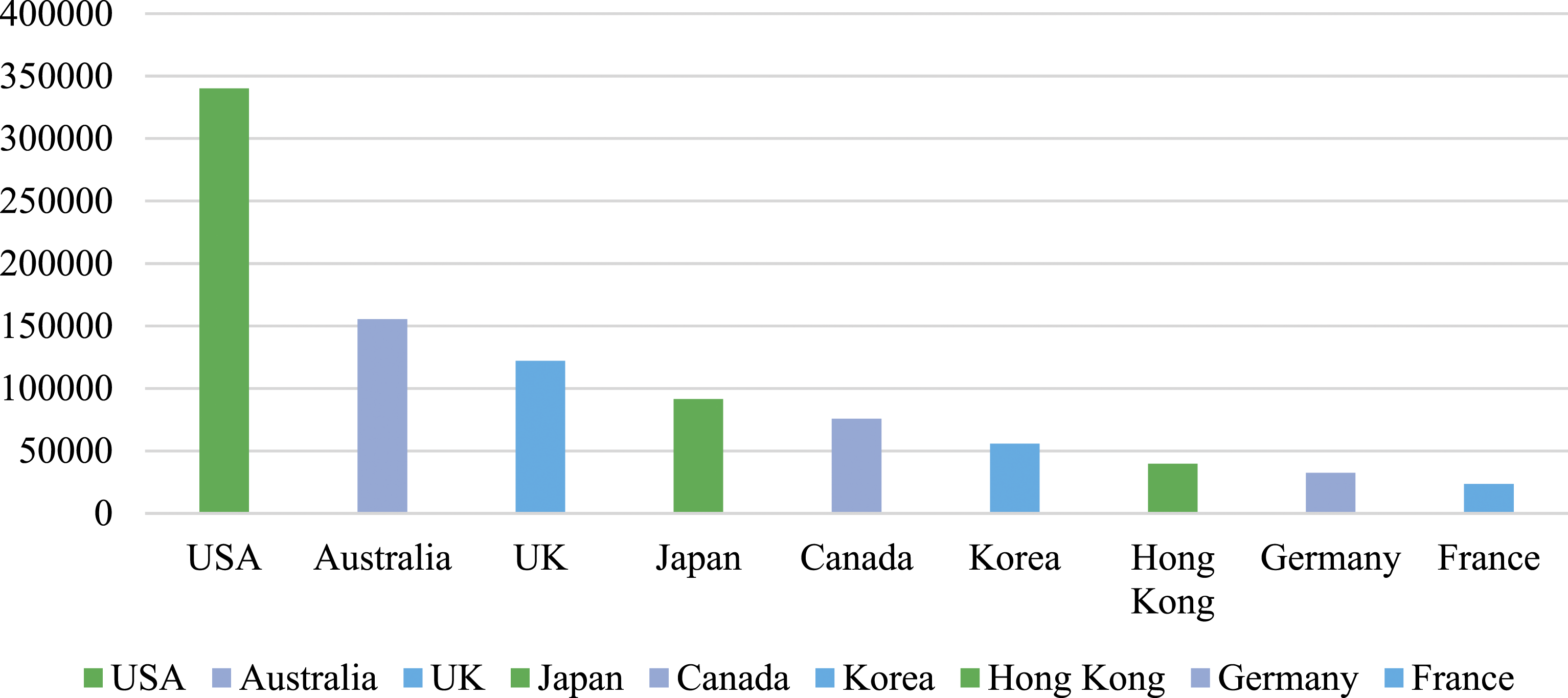
Thus, according to UNESCO statistics, more than a million Chinese students study abroad, and their tuition fees become a huge source of income for many countries. It is not surprising that the largest number of students study and live in the United States of America and Great Britain since English is the dominant foreign language in the Chinese education system. It is important to note that other large European countries with well-known universities with high rankings attract a significant number of students from China. For example, Germany with over 39,000 students, France with almost 25,000, and smaller European countries such as Ireland, Sweden, Switzerland, and Hungary also host about 2000 students from China each (Xue & Tan, 2022).
Statista’s January-February 2022 Education Survey, the UK and the US have emerged as the top destinations for Chinese students to study abroad (see Figure 2). In addition, which proved that the average age of the respondents was 18–20. List of countries most attractive for Chinese students to study in the period from 2015 to 2022. Source: Statista, 2022.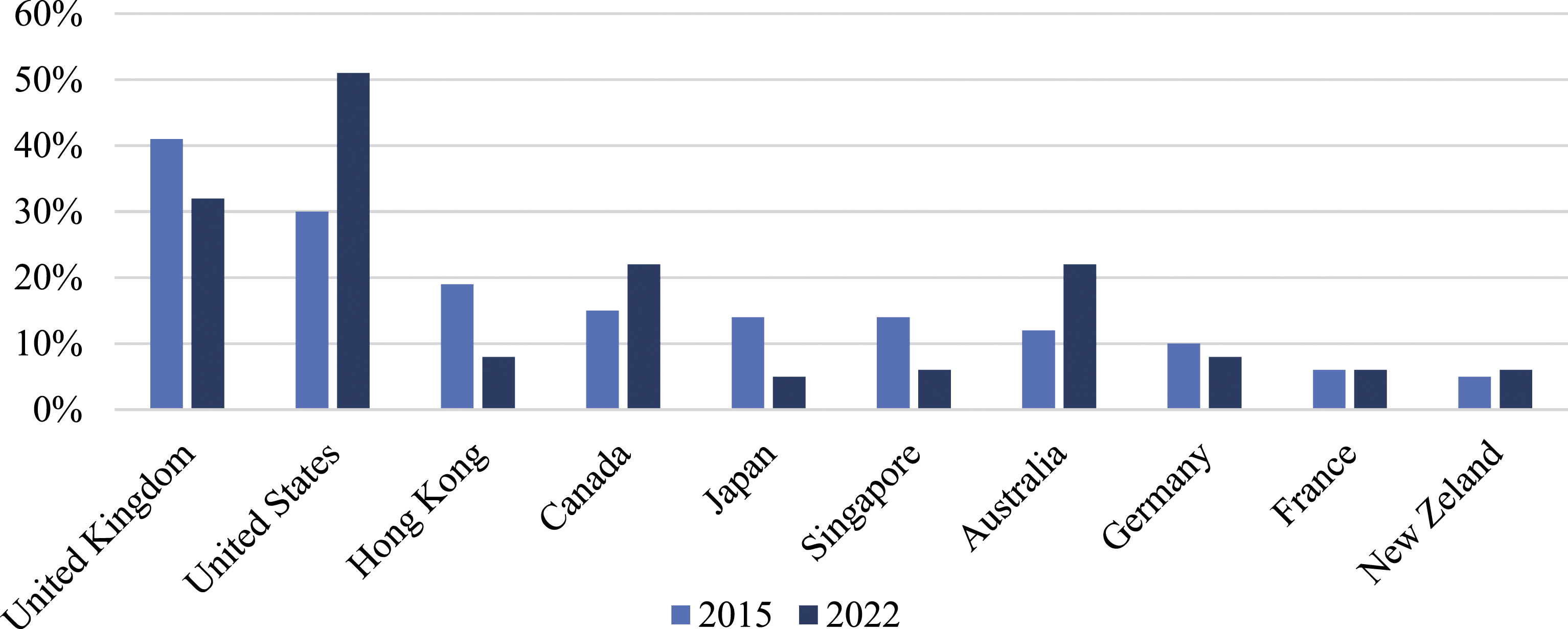
According to statistics provided by the New Oriental Education and Technology Group (2022), 97% of Chinese graduates studying abroad find work within 1 year of graduation when they return home, while among graduates who were educated in China for this time only 49% find a job. That is, compared with students who studied in China, students who have studied abroad are easier to interview, find jobs faster, and generally have better prospects after graduation.
In addition, numerous studies from 1990 to 2020, including a study by Henze and Zhu (2012), conclude that the majority of Chinese students are passive, memorizing texts, and obedient learners, they have difficulty actively participating in discussions and involvement in the learning process. It was found that very often students in China get lost in the classroom when other students and the teacher are actively discussing, discussing important issues, and expressing their opinion or vision of a particular problem. One of the main reasons for such a low level of participation in the educational process, according to researchers, is that Chinese students lack sufficient language skills, creativity, critical thinking and activity. In the author’s opinion, the identified problems are primarily related to the fact that the Chinese education system and the presented state policy of “double reduction,” among other things, do not quite take into account modern trends in the development of students’ personalities, their abilities, social skills and social interaction skills, where there are many different people, cultures, idiosyncrasies and challenges that need to be dealt with. At the same time, the Chinese education system and the “double reduction” policy are more focused on solving problems related to the social status of students and their psychological health, which is certainly also important, but secondary, since their resolution will not bring significant results soon.
Indicators of improvement in student achievement through participation in extracurricular activities with tutors.
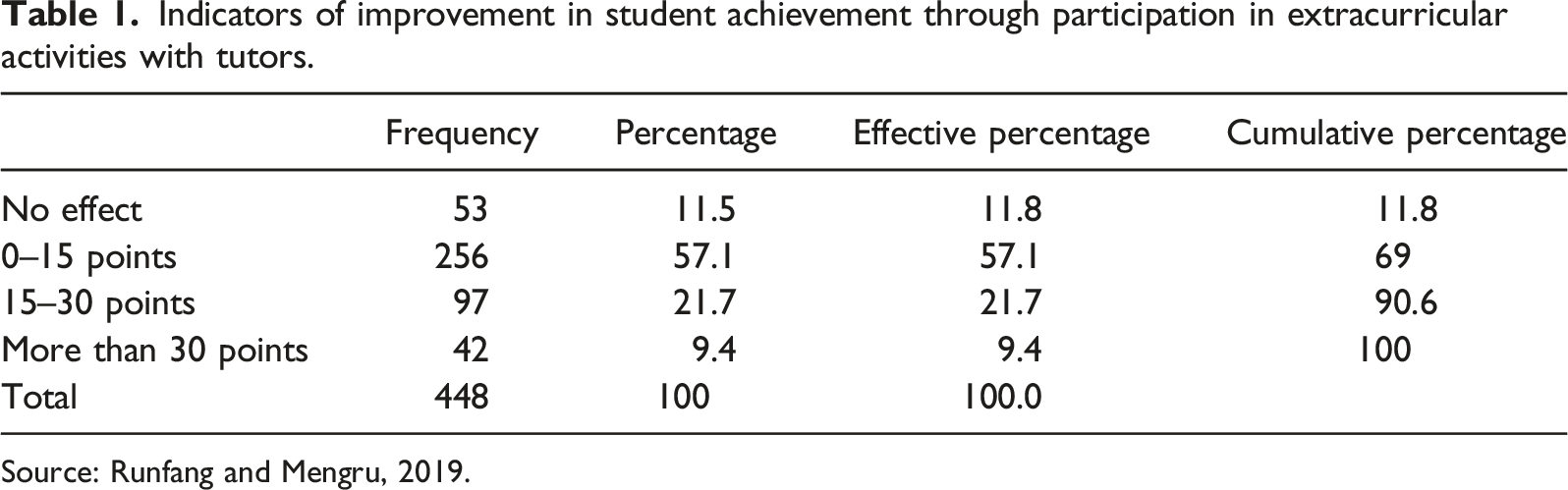
Source: Runfang and Mengru, 2019.
Thus, in the event of a “double reduction” policy prohibiting extra tutoring, students will have a lower GPA on a test and their performance may noticeably decline (Runfang & Mengru, 2019). In addition, a ban on attending additional classes can lead not only to the fact that students will be less prepared and will have a low level of knowledge, but will also be even less prepared socially for intercultural communication and active interaction with foreign students, that is, they do not have social skills will suffice. In addition, it emerges from this that more and more students and their parents will be dissatisfied with this arrangement of things and will try to go abroad as soon as possible to have more opportunities there to improve their knowledge, social skills and abilities. The average age of Chinese young people going abroad for education fell from 18 in 2014 to 16 in 2016, and this age will continue to decline. William Vanbergen, founder and managing director of one of the leading education consulting firms based in Shanghai, claims that 60% of students in Shanghai currently plan to go abroad and study there between the ages of 13 and 14 (Yuan, 2022). It becomes clear that parents do not always trust the Chinese education system and most of them are convinced that due to familiarity with Western culture, their education system, as well as being in an English-speaking environment, their children will be able to receive a better education, and in the future will be able to find employment and get a good job. Figure 3 gives an idea of the decision of parents and students to apply for a visa to study abroad. Flow chart of the decision-making process of parents and children. Source: compiled by the authors.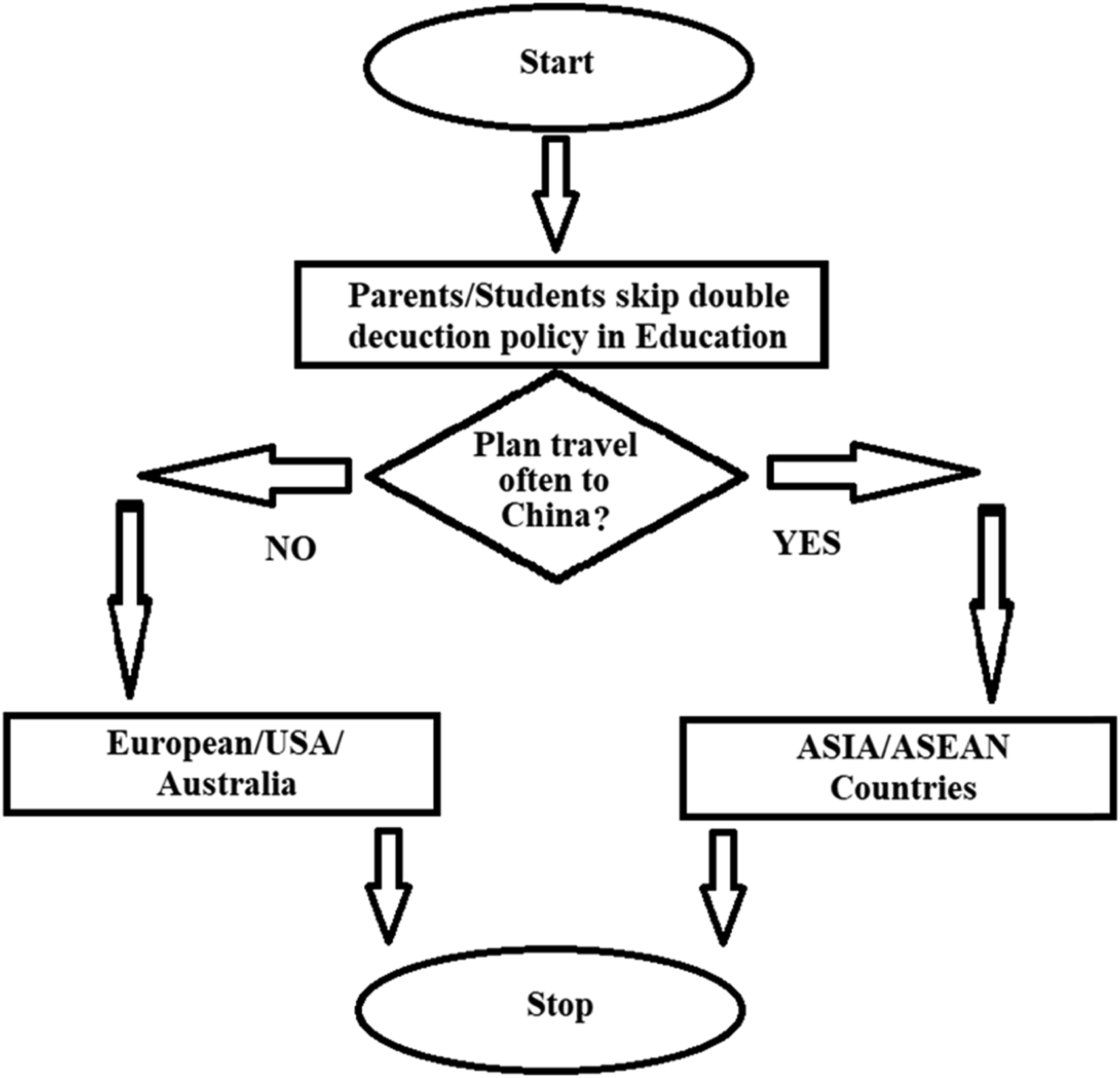
Thus, as a result of the study of the peculiarities of the influence of the “double reduction” policy on the educational processes of Chinese students who receive education in European countries, it was found that in general this state policy, like any other policy in the field of education, has both positive and negative sides. The “double reduction” policy can be described as strong, competitive and thorough, and its implementation is mainly aimed at eliminating inequalities in the Chinese education system and improving the welfare of students. Education in China has always been closely linked to the opportunity to significantly improve the status of the family and its economic structure. Due to the ban on private training centres and tutoring, students and their parents are forced to move to Europe, the USA and Australia to obtain opportunities for quality education. Although China is actively trying to improve the educational system, Chinese parents and their children leave the country for such main reasons as great opportunities, getting to know the world, learning new cultures, gaining new valuable experiences and knowledge, as well as the English language. It is revealed that the state policy of “double reduction” will have a positive impact on the overseas education market for Chinese students since many students will continue to travel abroad for education. Moreover, the age of students who wish to leave will only decrease.
Discussion
At the present stage in China, the policy of “double reduction” is one of the main topics for numerous discussions, disputes and arguments, which are based on the wide dissemination of information in the media. According to Li et al. (2022), most students, parents, and teachers in China are aware of the “double reduction” policy, and various researchers share their views on the impact of the policy on student academic achievement. These scholars also note that in September and October 2021, the media significantly increased coverage of these public policies. In addition, they note that the “double reduction” policy, from the very moment it was announced, has become a national event, deeply discussed throughout the country.
Yu et al. (2022), for example, note that the “double reduction” policy is a great reform of the Chinese educational system, politics and economics, which since its implementation has attracted close attention not only from society but also from a wide scientific community and is focused on reducing the burden of learning. As for the challenges that the Double Reduction Policy might bring, two possible challenges are considered in study Li et al. (2021). On the one hand, family education will receive more attention after the Double Reduction Policy was released, and children need parents to accompany them in their growth. On the other hand, the policy also challenges schools to return to the lead of education. Li and Huo (2021) think, that in the reform, it is necessary to focus on the penetration of aesthetic education in various disciplines, lead students to understand and create beauty in scientific practice, and continuously optimize construction measures according to the aesthetic education of various universities. To form a full coverage, diversified, and high-quality modern school aesthetic education system with Chinese characteristics.
Chen (2022) believes that the “double reduction” policy has both significant advantages and significant disadvantages. The main advantages of the researcher include, first of all, the fact that this state policy has a positive meaning for parents since it enables them to save on the high fees for extracurricular activities for their children and allows them to focus mainly on their work. Since after the implementation of the “double reduction” policy, primary and secondary schools must increase the number of extracurricular activities, and students who previously did not attend any classes and wasted their time after school can now attend classes, and their parents will be calm, they will be able to better focus on work. According to X. Chen, as a result of the implementation of this policy, parents will no longer worry about their children, their safety and the entertainment while they are working, which will allow them to perform their professional duties better. X. Chen also argues that the “double reduction” policy has a positive impact on students because as a result of its implementation, they will have more free time for doing their own business, and spending time with family and friends, as well as more time for rest and sleep. In addition, X. Chen is convinced that the “double reduction” policy can make education more equitable.
Cheng (2021) notes, that since the implementation of the “double reduction” policy, primary and secondary schools have gradually strengthened the construction of a home-school collaborative education mechanism. Home-school communication means that parents and teachers transmit or exchange the contents of education plans and development plans of students through various forms. It is not only a direct way for parents to participate in the school but also an important link to home-school collaborative education. There are still problems such as too few communication channels between teachers and parents, single content, parents' distrust of the concept of collaborative education, and lack of planning in home-school communication.
Chen (2022) refers to the disadvantages of the fact that the “double reduction” policy, in his opinion, prohibited the capitalization of education, which in turn led to a decrease in the GDP produced by the education industry. The scientist is also sure that this state policy has become the main reason that millions of teachers lose their jobs, and millions of graduates cannot find jobs. All this entails serious consequences, including unemployment, the deterioration of the country’s economic indicators, and many social problems.
China’s new regulation towards after-school tutoring impacts the industry rapidly. The Chinese government’s crackdowns on the tutoring industry set guidelines for different types of tutoring classes and industries will have to reshape. Those crackdowns are not intended to eliminate private business in China. The control of private tutoring industries by the Chinese government is crucial to its goal of achieving common prosperity (B. Wu, 2021). S. Wu (2021) notes that China and Korea had placed strict restrictions on private tutoring, while the US administrator has joined supplemental tutoring efforts in the sphere of public education through collaboration with private sectors. Schooling concerns, private education’s socioeconomic repercussions, the state of the market economy, and traditional governmental accustoms in diverse contexts are all shown to have a substantial impact on educational policies concerning shadow education in different countries.
Yin and Lai (2021) note that doing a good job in the transformation of primary and secondary education institutions is a major problem facing primary and secondary school students in improving quality education. The research shows that under the “double reduction” policy, the focus on quality education will return to schools. Although the government and educational institutions have taken a series of measures to reduce the “double reduction” policy, the transformation of primary and secondary educational institutions is still restricted by the demands of schools, parents and students. To improve the quality of education of primary and secondary school students, China should not only limit the off-campus training institutions but also perfect the examination system in schools and improve the teaching level. In addition, they should also actively guide the transformation of educational institutions and promote the balanced development of educational resources.
Wang et al. (2022) found that the “double down” policy also contributed to the reduction in the number of off-campus schools. The researchers found that compared to the beginning of 2021, the number of off-campus schools decreased by at least 87% by the end of this year, due to the implementation of the new policy. In addition, these researchers believe that due to the “double down” policy, there was a complete transition among private tutoring institutions from for-profit to non-profit during the year. Researchers also believe that private tutoring fees have been reduced by at least 40% as a result of the “double reduction” policy, and some companies have even announced that they will stop providing subject training services in compulsory education.
Guo (2021) notes similar consequences and changes due to the announcement of the “double reduction” policy. According to the scientist, this state policy led to the fact that some educational institutions decided to reduce the staff, thus tens of thousands of teachers were left without work. In addition, the scientist emphasizes that the policy of “double reduction” caused the loss of 100 billion dollars in the market value of tutoring institutions in China. Based on this, Guo (2021) concluded that although this policy is focused on ensuring equality in access to educational services and improving the mental health of students, it also caused negative consequences, in particular job losses, foreign investment in the country’s capital markets, etc.
The results of the survey and comparison show that although both Japan and China have implemented strict restrictions on the shadow education industry, China’s policies have not promoted the healthy development of the shadow education industry, and there are still more flaws in the management approach and policy implementation. In the future, the Chinese government needs to learn from Japan’s shadow education policy in order to promote the healthy and sustainable development of the industry in China (Zhang & Chen, 2022).
Huang and Zheng (2021) have been actively investigating why Chinese students are so eager to study abroad. They determined that the main reasons why students want to study in other countries, in particular in the UK, are the high quality of courses offered at foreign universities, the opportunity to improve their level of English, and social skills, and the opportunity to get acquainted with Western culture.
Thus, the analysis of numerous publications of scientific literature led to the conclusion that the policy of “double reduction” is a key topic for discussion not only in the works of researchers but also in the media. It is important to note that the study of the characteristics and impact of the “double reduction” policy in the context of this research work once again confirms the views of various scientists on the features of this public policy, its sphere of influence, as well as its main advantages and disadvantages. However, it is important to note that scientists have not yet paid due attention to the study of the impact of the “double reduction” policy on the educational processes of Chinese students who are educated in European countries. Such studies, in the opinion of the author, are very important and necessary at the present stage, since they make it possible to determine the specifics of the impact of the “double reduction” policy on Chinese students studying abroad and to identify the consequences of the outflow of a large number of students from the country and the associated changes in various spheres of society.
Conclusions
The conducted scientific study of the impact of the “double reduction” policy on the education of Chinese students studying in European countries gives grounds for formulating the following conclusions. The “double reduction” policy has many positive and negative sides, it is primarily aimed at eliminating inequalities in the Chinese education system and improving the welfare of students, as well as improving the status of the family and its economic structure. However, due to the ban on private educational centres and tutoring classes, as a result of the introduction of the “double reduction” policy, students and their parents are forced to move to Europe, the USA and Australia to receive ample opportunities for better education. That is, the government’s “double reduction” policy will have a positive impact on the overseas education market for Chinese students, as many students will continue to go abroad for education, and the age of students who want to go will only decrease.
The results obtained in the course of this scientific study, as well as the conclusions formulated on their basis, can be further applied as an effective scientific basis for studying the specifics of the “double reduction” policy and the characteristics of its impact on the educational process in China as a whole and on students who decide to receive education in European countries. In addition, the materials of this article can be used by teachers, methodologists and government officials who study the problems of modern education in China, as well as other scientists who work on the issue of the exodus of Chinese students to foreign countries for education. The prospect for further study of the problem is, first of all, a statistical analysis of the impact of the “double reduction” policy on Chinese education and society as a whole. It is also worth paying close attention to identifying the reasons for the exodus of Chinese students abroad to study and their relationship with the state policy of “double reduction.”
Footnotes
Declaration of conflicting interests
The author(s) declared no potential conflicts of interest with respect to the research, authorship, and/or publication of this article.
Funding
The author(s) received no financial support for the research, authorship, and/or publication of this article.