



Abstract
China’s regulatory framework for transnational higher education (TNHE) is important for foreign higher education institutions (HEIs) to access the Chinese education market and for TNHE to operate in China. First, this research synthesizes China’s regulatory framework for TNHE. Second, through documentary analysis, this research examines policy development and its impacts on TNHE. Third, through institutional logics analysis, this research analyzes the rationales for policy development. It finds that the development of TNHE is driven by China’s development demands, the forces of social demands, and the challenges of globalization. China is expanding its openness to education by allowing for-profit, foreign majority-owned, and wholly foreign-owned HEIs and granting them legal status and more autonomy. TNHE is transiting from quantity to quality, China has established a quality assurance system. In the meantime, the development of TNHE is restricted by China’s concerns on national educational sovereignty. China always emphasizes its educational sovereignty and social values. This suggests that China aims to utilize TNHE to serve its development while guaranteeing its educational sovereignty and social values.
Introduction
Transnational higher education (TNHE), which refers to all types of higher education study programs, courses, or educational services in which the learners are located in a country different from the one where the awarding institution is based (United Nations Educational & Council of Europe, 2001), is one of the approaches of internationalization of higher education. China plays an important role in the global TNHE landscape. First, China is the largest market for international students in the world (Institute of International Education, 2020). TNHE is one of the options for foreign higher education institutions (HEIs) to access the Chinese education market. Second, China is the largest host country of TNHE institutions and programs. The number of TNHE institutions and programs increased from 71 in 1995 to 2332 at the end of 2020 in China (Tang & Tang, 2022). TNHE may take various forms, while foreign HEIs have to partner with Chinese HEIs to operate institutions and programs in China (Helms, 2008; Huang, 2008). TNHE institutions and programs may be the most complicated activities of the internationalization of higher education. Their deliveries are often restricted by national regulatory frameworks (Hou et al., 2018). China’s regulatory framework for TNHE is crucial for foreign HEIs to access China market and for current TNHE institutions and programs to operate in China.
Current studies on TNHE policies have shed light on policy periodization using key political, economic, and legislative occurrences as watersheds, including the Reform and Opening-Up in 1978, the Students’ Movement in 1989, Deng Xiaoping’s southern tour in 1992, the enactment of the Education Law (2021) and Interim Provisions for Chinese-foreign Cooperation in Running Schools (Education Commission, 1995; hereafter Interim Provisions for CFCRS) in 1995, and the enactment of the Regulations on Chinese-foreign Cooperation in Running Schools (State Council, 2019; hereafter the Regulations on CFCRS) in 2003 (see, e.g. Huang, 2003a, 2003b; Li, 2018; Tang & Tang, 2022; Yang, 2008). These studies examined the broad areas of internationalization of higher education, without a focus on TNHE (see, e.g. Huang, 2003a). Further, some of them focused on particular policies and plans rather than the comprehensive regulatory framework for TNHE (see, e.g. Gu, 2009; He, 2016; Helms, 2008; Hou et al., 2018; Huang, 2003b, 2008; Mok & Han, 2016; Yang, 2008).
This research aims to explore the development of regulations for TNHE, its impacts on TNHE, and the rationales for policy development. The findings can advise TNHE providers on market access and operation in China. For the purposes of this discussion, this article reviews China’s policies on TNHE and further synthesizes China’s regulatory framework for TNHE. To understand China’s responses in terms of regulations to the development of TNHE and the rationales for the development of the regulations, three research questions are employed as follows:
What is China’s regulatory framework for TNHE?
How is China’s regulatory framework for TNHE developed in response to the development of TNHE?
What are the rationales for the development of China’s regulatory framework for TNHE?
Literature Review
From 1978 to 1992, Chinese policies and regulations mainly focused on student and faculty mobility. Since 1993, attention has been paid to TNHE and internationalization at home (Huang, 2003a). The Chinese government welcomes TNHE for capacity building, higher education expansion, and response to globalization, such as the challenges of the World Trade Organization (WTO) (Huang, 2003a; 2003b, 2008). TNHE in China has transformed from an informal, incidental, and laissez-faire activity to a more systematic and regulated project through license, accreditation, evaluation, curricula and study field restriction, and control of types and levels of academic degrees by the government (Huang, 2003b). China’s national policies regulate the access and operation of TNHE. The implementation of relevant regulations on TNHE ensures China’s sovereignty and facilities the internationalization of higher education in China (Huang, 2008).
Although the continued opening up of the education market, like other countries, national sovereignty is the first priority in China. China always strongly maintains and protects its national character and identity through legislation, which makes the regulations and documents for TNHE restrictive and rigid in terms of requirements and procedures (Huang, 2003a). To avoid the erosion of TNHE on national sovereignty, foreign HEIs are required to partner with Chinese HEIs to establish TNHE institutions and programs (Helms, 2008; Huang, 2008). In the meantime, Chinese HEIs do not have full autonomy for TNHE activities because of the centralized management of the government (Li, 2018). For-profit TNHE institutions and programs are permitted (Huang, 2008), but it is assumed by foreign HEIs that they are not encouraged (Helms, 2008). Since 2003, TNHE has been encouraged, particularly in less developed regions, to transform the Chinese higher education system (Hou et al., 2018). In the past two decades, China has deregulated regulations to attract top foreign HEIs. TNHE institutions partnering with world-class foreign HEIs have been encouraged to promote the quality of Chinese higher education (Hou et al., 2018). The characteristics of the TNHE institutions approved in 1995 and 2003/2004 have reflected the policy changes that China welcomed TNHE institutions a) from high-ranked European HEIs, b) without independent legal person status, and c) offering IT, science, or engineering programs (He, 2016). However, the findings are based on the information of the TNHE institutions approved, which cannot fully reflect the policy changes.
China’s national policies also regulate the operation of TNHE. TNHE is in a transition from a laissez-faire model to a quality model in China (Gu, 2009). Traditionally, China has relied on the home country’s quality assurance models (Hou et al., 2018). Today, China has developed its own national quality assurance agency and promulgated an evaluation plan for TNHE (Mok & Han, 2016) with a comprehensive quality assurance process (Hou et al., 2018). China Academic Degrees and Graduate Education Development Centre (CDGDC) is delegated to conduct the evaluation of TNHE institutions and programs in China. According to CDGDC, the evaluation process includes self-evaluation, a desk-based study of self-evaluation reports, and on-site evaluation. The TNHE institutions and programs failing evaluations may be suspended from student recruitment and even terminated. In the meantime, TNHE institutions and programs have to pass the evaluations of the quality assurance agencies from their home countries. Therefore, China applies the “duplication” and “home accreditor” quality assurance models (Hou et al., 2018). China’s quality assurance falls in the category of restrict regulation of quality provision models (Ziguras & McBurnie, 2014). Particularly, to comply with China’s regulations and fulfill home campus’ requirements, TNHE institutions and programs have to modify course content or add new courses (Hou et al., 2018). Although TNHE institutions and programs must go through a compulsory evaluation process, the process tended to be a type of formality rather than a focus on quality improvement (Hou et al., 2018). Therefore, China needs to form an effective regulatory framework to govern TNHE, especially in terms of quality (Gu, 2009; Li, 2018; Yang, 2008).
Although China keeps improving its legal and regulatory framework for international education, it needs to optimize its legal and policy environment in response to the new developments as the further opening-up of its education market (Gu, 2009).
Method
The regulations relevant to TNHE are collected from the websites and archive databases of the National People’s Congress, State Council, Ministry of Education, Ministry of Commerce, and Ministry of Human Resources and Social Security. Then, a thorough review of these regulations is conducted to synthesize China’s regulatory framework for TNHE to answer RQ 1.
Documentary analysis is used to understand the role and nature of regulations in the Chinese context and to examine the changes in regulations and their impacts on TNHE, particularly market access and operation, to answer RQ 2. Documentary analysis can provide a means to track changes, which can reflect substantive developments (Bowen, 2009). Further, institutional logics analysis is adopted to understand the rationales for the development of the regulations for TNHE to answer RQ 3. Institutional theory has become a popular and powerful explanatory tool to study organizational issues in the context of higher education (Cai & Mehari, 2015). Institutional logics refers to “a set of material practices and symbolic constructions” (Friedland & Alford, 1991, p. 248), which can be identified through pattern deducing, pattern matching, and pattern inducing (Reay & Jones, 2016). Deduction and induction approaches at societal and field levels are commonly adopted in higher education studies (Cai & Mountford, 2022). Finally, the effectiveness of China’s regulatory framework for TNHE is evaluated.
The author’s positionality is germane to policy analysis (Yorke & Vidovich, 2016). The author was a practitioner in three TNHE institutions in China; therefore, he experienced the implementation of these relevant regulations and was aware of the impacts of the implementation of these regulations at the institutional level.
This article is structured as follows. First, it synthesizes the regulations regarding TNHE and presents China’s regulatory framework for TNHE, which answers RQ 1. Second, it examines the policymaking and policy changes and their impacts on TNHE, particularly market access and operation, to answer RQ 2, followed by a discussion of the rationales for policy development to answer RQ 3. Finally, conclusions are drawn regarding the development of the regulatory framework for TNHE and its rationales, recommendations for TNHE providers, and restrictions of this research.
Regulatory framework
China’s Regulatory Framework for Transnational Higher Education.
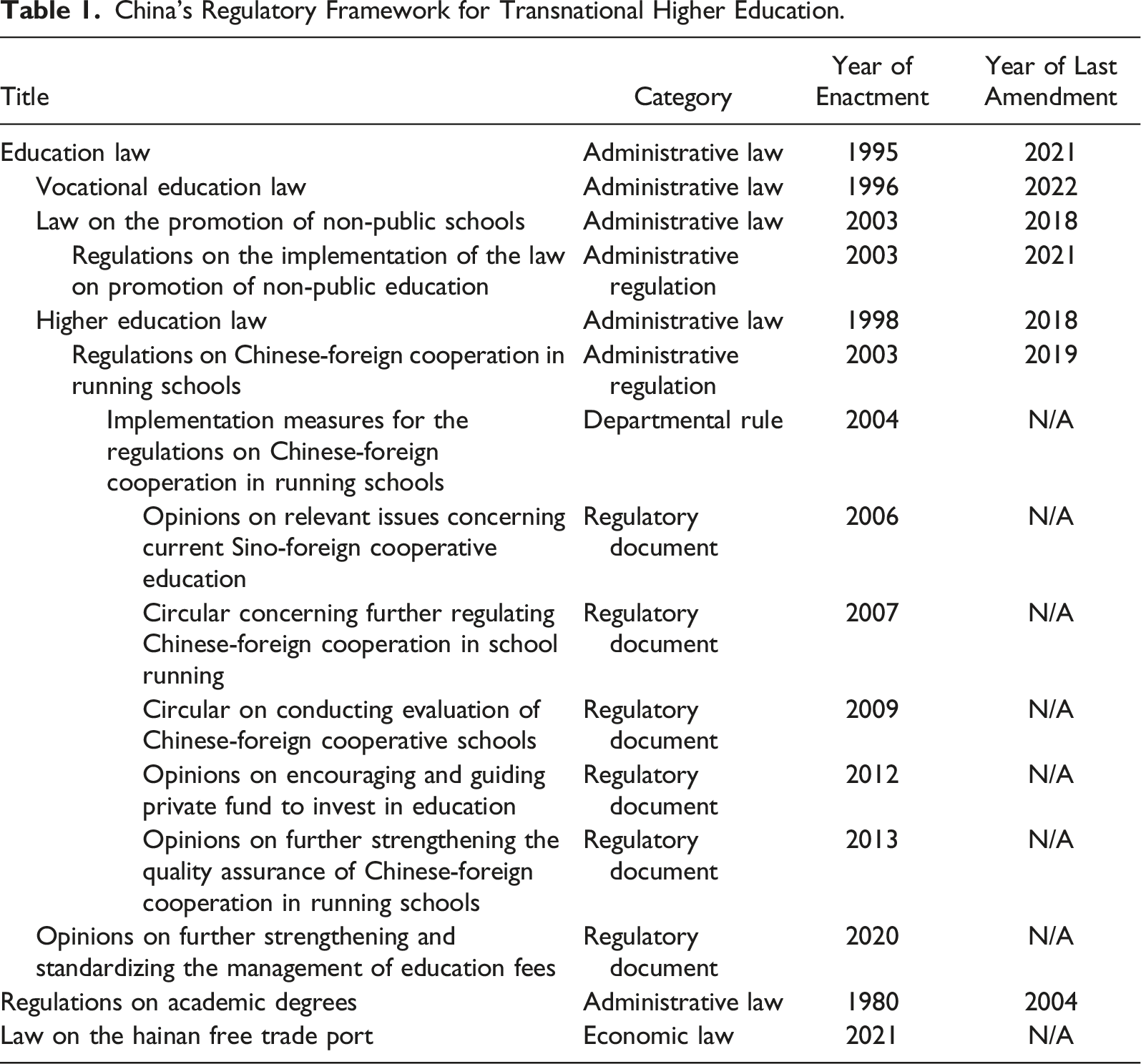
The regulatory framework has a clear hierarchical structure, which is composed of laws, administrative regulations, departmental rules, and regulatory documents. Laws, administrative regulations, and departmental rules have the force of law, while regulatory documents should not have the force of law (Zhang, 2014). Laws are made only by the National People’s Congress and its Standing Committee. Administrative regulations are made by the State Council. Departmental rules are issued by the constituent departments of the State Council. Regulatory documents may be made by either the State Council or its constituent departments. The regulatory framework involves multiple stakeholders. The Ministry of Education is the main authority, while other agencies including the National Development and Reform Commission, Ministry of Finance, Ministry of Human Resources and Social Security, State Administration of Market Regulation, Ministry of Commerce, National Press and Publication Administration, and Ministry of Public Security are also stakeholders. It suggests that administering TNHE is a complicated project and collaboration is needed among these agencies to produce a consistent regulatory framework.
The laws regarding TNHE include the Education Law (2021), the Vocational Education Law (2022), the Higher Education Law (2018), and the Law on the Promotion of Non-public Schools (2018). For these TNHE institutions and programs that award both degrees of foreign and Chinese partners, they have to follow the relevant policies regarding degree awards of their home countries and China. The Regulations on Academic Degrees (2004) regulates Chinese degree-awarding. These administrative laws are general, but not specific to TNHE. They are usually implemented together with supplementary administrative regulations. Hainan province enjoys special policies. The Law on the Hainan Free Trade Port (2021) specially prescribes policies on foreign investment, including TNHE, in Hainan province.
The administrative regulations pertaining to TNHE include the Regulations on the Implementation of the Law on Promotion of Non-public Education (State Council, 2021) and the Regulations on CFCRS. The former especially states that the support policies, such as taxation, donation, national loan, and local fund for private institutions, apply to TNHE. The latter was issued in 2003 after the lapse of the departmental rule Interim Provisions for CFCRS (Education Commission, 1995). It regulates the establishment, organization and administration, education, assets and finance, alteration and termination, and legal liability of TNHE programs and institutions. These regulations, particularly the Regulations on CFCRS, are specific to TNHE. TNHE institutions and programs, which admit Chinese students from China, should abide by these regulations.
The Interim Provisions for CFCRS is the first departmental rule to govern TNHE, which states that TNHE is a supplementary component of the Chinese higher education system (Provision 3, Chapter 1). The Implementation Measures for the Regulations on Chinese-foreign Cooperation in Running Schools (Ministry of Education, 2004; hereafter the Implementation Measures for the Regulations) is a critical departmental rule regarding TNHE to implement the Regulations on CFCRS. It together with the Regulations on CFCRS prescribe the establishment, governance, academic, finance, alteration, and termination of TNHE institutions and programs. Foreign HEIs must partner with Chinese HEIs to establish TNHE institutions and programs. The standards to establish an institution refer to those of establishments of Chinese HEIs. In terms of governance, the total number of board of trustees or board of directors should not be less than five and Chinese members shall not be less than half of the total number. The president or the principal administrator shall be a person with Chinese nationality and be domiciled in the territory of China. Foreign partners are encouraged to contribute more to academics that at least one-third of the whole courses and the core courses should be provided by the foreign partners, and one-third of the core courses should be taught by faculty recruited by the foreign partners. It is required to offer courses on the constitution, laws, ethics of citizens, and basic facts about China.
For the emergence of TNHE in China, the Education Commission circulated the Notice Concerning Cooperation of Operating Schools by Overseas Institutions and Individuals (Education Commission, 1993) in 1993, which is the first regulation regarding TNHE, as a guide before the enactments of related regulations. It mainly prescribed the authorization to govern different TNHE institutions and programs among different levels of government. The current two regulatory documents regarding TNHE include the Circular Concerning Further Regulating Chinese-foreign Cooperation in School Running (Ministry of Education, 2007) and Opinions on Relevant Issues Concerning Current Sino-foreign Cooperative Education (Ministry of Education, 2006). These two regulatory documents emphasized the quality, discipline distribution, public welfare, and educational sovereignty of TNHE.
In response to these two regulatory documents, China promulgated a plan of evaluation in 2009. The evaluation plan in the regulatory document - Circular on Conducting Evaluation of Chinese-foreign Cooperative Schools (Ministry of Education, 2009) - promulgates the evaluation indicators for TNHE institutions and programs, respectively. The process includes self-evaluation, a desk-based study of self-evaluation reports, and on-site evaluation. A pilot evaluation was conducted in Liaoning province, Jiangsu province, Hainan province, and Tianjin City in 2009, and a formal evaluation was conducted in the whole country in 2021. In response to the quality issues of TNHE, the Opinions of further Strengthening the Quality Assurance of Chinese-foreign Cooperation in Running Schools (Ministry of Education, 2013), issued in 2013, emphasizes the planning of the type of TNHE institutions, regional distribution of TNHE institutions and programs, and distribution of subjects. TNHE institutions without an independent legal person status, TNHE institutions and programs in Central China and West China, and subjects filling the needs of China are encouraged. In the meantime, it emphasizes the importation of high-quality education, foreign HEIs with lower quality, having multiple TNHE institutions and programs in China, or offering oversupplied programs in China, will be strictly examined during the approval process. It also refers to the strength of the quality evaluation system and the establishment of a quality accreditation system partnering with international quality assurance agencies.
The Opinions on Encouraging and Guiding Private Fund to Invest in Education (Ministry of Education, 2012) is a regulatory document that regulates the equity ratio of foreign investors in TNHE institutions. It requires that the equity ratio of foreign investors shall be less than 50% (Provision 7, Chapter 2). The Opinions on Further Strengthening and Standardizing Education Fees (Ministry of Education, 2020) is another regulatory document, which regulates the tuition fee for educational services. The tuition fees of non-for-profit institutions should be approved by provincial authorities, while those of for-profit institutions are decided by the TNHE institutions themselves (Provision 5, Chapter 2).
In addition to the regulations directly related to educational services, other regulations may impact TNHE. TNHE as one mode of international trade of educational service is governed by foreign investment regulations. The latest Hainan Free Trade Port Negative List (Ministry of Commerce, 2020) has removed the investment restriction on foreign high-level HEIs of science, engineering, agriculture, and medicine, vocational colleges, and non-academic vocational training institutions (Provision 18, Chapter 9). Therefore, these organizations may operate TNHE institutions independently in Hainan province.
Further, TNHE as an educational activity involves faculty mobility. Therefore, the regulations on visa and work permits, which include the Law on Control of the Entry and Exit of Aliens (2013), Regulations on Administration of the Entry and Exit of Foreigners (State Council, 2013), and Rules for the Administration of Employment of Foreigners (Ministry of Human Resources and Social Security, 2017) in China, should be considered.
Policy Development and Rationales
This section examines the policymaking and policy changes and their impacts on TNHE to answer RQ 2, and further discusses the rationales for the policy development to answer RQ 3.
Previous studies (see, e.g. Huang, 2003a, 2003b; Li, 2018; Tang & Tang, 2022; Yang, 2008) have identified the policy periodization, which can also be identified within the regulatory framework for TNHE with an institutional logics analysis. The Notice Concerning Cooperation of Operating Schools by Overseas Institutions and Individuals (Education Commission, 1993), the Interim Provisions for CFCRS in 1995, and the Regulations on CFCRS in 2003 are the three most important regulations for TNHE, which are specific for TNHE. Their development reflects China’s institutional logics in the modernization process. From China’s Reform and Opening-up in 1978 to 1992, government policies and regulations mainly focused on student and faculty mobility, the attraction of foreign scholars and experts to China, and foreign languages acquisition for the urgent demand for professionals and experts after over 20 years of isolation from the Western world after the Korean War. Since 1993, government policies and regulations have paid attention to the attraction of overseas Chinese scholars and international students, TNHE, and internationalization at home (Huang, 2003a). Accordingly, the regulatory document – Notice Concerning Cooperation of Operating Schools by Overseas Institutions and Individuals (Education Commission, 1993) was issued, which is the first regulation regarding TNHE, after Deng Xiaoping’s southern tour, which resumed and reinforced the Reform and Opening-up in China. In 1995, China continued expanding its openness and began the negotiation to participate in the WTO. In the same year, the department rule - Interim Provisions for CFCRS (Education Commission, 1995) was issued. After 1999, China attempted to expand its higher education capacity to satisfy the demand for higher education by implementing TNHE institutions and programs (Huang, 2003b). In 2001, China successfully accessed the WTO. China has to meet its commitments to open its market, including the education market. In 2003, the administrative regulation - Regulations on CFCRS was promulgated, and the Implementation Measures for the Regulations to implement the Regulations on CFCRS was enacted 1 year later. These suggest that the opening-up for TNHE is driven by Chinese demand for labor with advanced knowledge, the forces of social demands, and the challenges of globalization.
China endeavors to broaden its market access to educational services. The 2015 amendment of the Education Law (2021) supports the importation of quality educational resources to conduct TNHE (Provision 67, Chapter 8), which remains in the latest amendment in 2021. Accordingly, the latest amendment of the Vocational Education Law (2022) in 2022 supports the importation of foreign quality resources for the growth of vocational education (Provision 13, Chapter 1). The 2016 amendment of the Law on the Promotion of Non-public Schools (2018) permits for-profit schools at different levels except for compulsory education (Provision 19, Chapter 2), which makes for-profit TNHE possible. Several for-profit TNHE institutions and programs, such as the Sino-European School of Technology at Shanghai University and Lambton College at Jilin University, were approved in the 2010s. However, although China opens its education market to profit-driven institutions, it seems they are not encouraged that no profit-driven TNHE institutions and programs are approved after the 2010s. China emphasizes that TNHE is public goods rather than private commodities, which can be found in the Regulations on CFCRS (Provision 3, Chapter 1). This can be explained by the socialist society of China, which is based on the idea of public ownership of resources. Although foreign HEIs have to partner with Chinese HEIs to establish TNHE institutions and programs (Helms, 2008; Huang, 2008) in China, this is exempt in Hainan province. The Law on the Hainan Free Trade Port (2021) permits high-level foreign universities and vocational schools to set up schools of science, engineering, agriculture, and medical science in Hainan province (Provision 40, Chapter 6). Accordingly, the Hainan Free Trade Port Negative List also removes the restriction on HEIs independently operating schools of science, engineering, agriculture, and medical science in Hainan province (Provision 19, Chapter 9).
In addition to the expansion of market access, TNHE has gained its legal status in the Chinese higher education system in the past decades. The Interim Provisions for CFCRS in 1995 stated that TNHE is only a supplementary part of the Chinese higher education system, while the Regulations on CFCRS, issued in 2003, stipulates clearly that TNHE is an integrated part of the Chinese higher education system. This change may be due to the rapid development of TNHE that a large number of students are studying at TNHE institutions (Yang & Wu, 2021), and the Chinese government’s belief that TNHE is controllable because of its successful operation in China for several years.
TNHE institutions and programs are granted a certain level of autonomy at the operational level (Mok & Han, 2016). According to the Regulations on CFCRS, TNHE institutions are governed by a board system instead of their Chinese partner HEIs for their strategies, plans, and daily operations (Chapter 3). The 2013 amendment of the Regulations on CFCRS does not require approval from the authority for the appointment of a principal administrator anymore, while its 2019 amendment does not further relax the control, which just reflects the organizational structure change of the State Council. It seems that the requirements for a principal administrator and the dominance of the board of trustees or board of directors can guarantee China’s national educational sovereignty. According to the Implementation Measures for the Regulations, TNHE institutions may establish their own standards and procedures to admit students, while they have to comply with Chinese regulations and policies if they award Chinese degrees (Provision 26, Chapter 3). Mok & Han’s (2016) empirical study found that TNHE institutions and programs without an independent legal person status, which award Chinese degrees, have to follow the admission criteria of its Chinese partners; TNHE Institutions with an independent legal person status may establish their own standards and procedures complying with Chinese regulations and policies; even, TNHE institutions and programs, which do not award Chinese degrees, may decide their own admission criteria.
Transnational higher education is transiting from quantity to quality in China, which has impacts on both market access and operation. Both the Education Law (2021) and the Vocational Education Law (2022) support the importation of foreign-quality educational resources. The Opinions on Relevant Issues Concerning Current Sino-foreign Cooperative Education (Ministry of Education, 2006) has emphasized that Chinese HEIs should import high-quality programs in partnership with world high-ranking HEIs to serve its social and economic demands (Provision 3). Also, the Circular Concerning Further Regulating Chinese-foreign Cooperation in School Running (Ministry of Education, 2007) pointed out that Chinese HEIs should import high-quality programs (Provision 3). The Opinions on Further Strengthening the Quality Assurance of Chinese-foreign Cooperation in Running Schools (Ministry of Education, 2013) further emphasizes the quality of the whole process of TNHE activity. In the meantime, China aims to improve the quality of the existing TNHE institutions and programs through evaluation. China has spent over 10 years establishing an evaluation system since its promulgation of the first evaluation plan in 2009. Although China has promulgated the evaluation plan, TNHE institutions with an independent legal person status are exempted from the evaluation (Mok & Han, 2016). The quality assurance review process focuses on formality rather than quality improvement (Hou et al., 2018). TNHE institutions and programs have to design their curricula to meet the requirements of their home and China’s quality assurance agencies. This “duplication” and “home accreditor” quality assurance model costs more time and effort but does not affect the quality assurance of the foreign HEIs.
Transnational higher education erodes national educational sovereignty and threatens the cultural security of the host country (Gu, 2009). China endeavors to prevent the erosion of national security and identity in the whole process including market access and operation, although China is expanding its opening-up of the education market. China always emphasizes its national educational sovereignty, which can be found in almost all regulations and policies. First, the latest amendment of the Regulations on the Implementation of the Law on Promotion of Non-public Education (State Council, 2021) in 2021 strengthens the leadership of the Communist Party of China (CPC) in non-public schools that the CPC leader or representative in a non-public school should be in the decision-making and supervising bodies (Provision 19, Chapter 2). This is a sign that the leadership of the CPC will be further strengthened. Second, the Regulations on CFCRS regulates the ratio of Chinese members on the board of trustees or board of directors and the nationality of the president or the principal administrator (Provision 25, Chapter 3). Third, the Regulations on CFCRS regulates that TNHE institutions and programs have to deliver Chinese culture and society courses (Provision 30, Chapter 4). Fourth, although the Law on the Hainan Free Trade Port (2021) permits foreign HEIs to independently operate TNHE institutions in Hainan province (Provision 40, Chapter 6), there are still restrictions on fields of study, types of educational providers, and regions to operate. The fields are limited to the subjects that China has urgent demand for and less ideological concerns; the types of educational providers are restricted to foreign high-level HEIs and vocational colleges; the regions include only Hainan province. It is a sign of broadening opening-up and it is also a tradition of China to pilot reform projects in one region before fully implementing them in the whole country. This suggests that China would like to benefit from TNHE while guaranteeing its educational sovereignty and social values by strengthening the leadership of CPC on campus, influencing the board of trustees or board of directors, delivering Chinese culture and society courses, and limiting the fields of study to science, engineering, and medicine, which have less ideological concerns. TNHE institutions have to partner with the CPC on campus because of China’s political and economic systems. The Chinese partners may be good at handling these issues, but it is not clear how it works in wholly foreign-owned TNHE institutions without Chinese partners.
Chinese regulations serve its national strategies, and their marking and amendments reflect the indication of China’s national strategies. The National Medium and Long-term Plan for Education Reform and Development 2010–2020 claims that China will expand openness to import quality education resources (Central Committee of CPC & State Council, 2010). This provides a guide for the development of TNHE from 2010 to 2020. The Opinions on Encouraging and Guiding Private Fund to Invest in Education (Ministry of Education, 2012) limits the equity ratio of foreign investors to 50% (Provision 7, Chapter 2). In 2018, Chinese President Xi Jinping announced at the China International Import Expo that “the foreign equity caps are going to be raised in the education and medical service sectors” (Xi, 2018), which means China will broaden education market access to allow establishing joint institutions with foreign majority ownership. The Greater Bay Area and Hainan province are two pioneers in TNHE. The Development Plan for the Guangdong-Hong Kong-Macao Greater Bay Area (Central Committee of CPC & State Council, 2019) promotes cooperation and development in education in the Greater Bay Area. Hong Kong Baptist University, the Chinese University of Hong Kong, and the Hong Kong University of Science and Technology have established campuses in the Greater Bay Area. The University of Hong Kong, City University of Hong Kong, Hong Kong Polytechnic University, and Macau University of Science and Technology are also establishing campuses in this area. The Implementation Plan of Supporting the Deepening of Education Reform and Opening up in Hainan (Ministry of Education & Hainan Provincial Government, 2019) supports a pilot implementation of TNHE. It allows foreign HEIs of science, engineering, agriculture, and medicine, and vocational colleges, as well as high-level enterprises to run TNHE institutions independently in Hainan province, which means foreign HEIs do not have to partner with Chinese HEIs to establish institutions. To implement this strategy, the Law on the Hainan Free Trade Port permits high-level foreign universities and vocational schools to set up schools of science, engineering, agriculture, and medical science in the Hainan Free Trade Port. (Provision 40, Chapter 6), and the latest Hainan Free Trade Port Negative List (Ministry of Commerce, 2020) has relaxed controls to allow foreign high-level HEIs of science, engineering, agriculture, and medicine, as well as vocational colleges, to operate TNHE institutions and programs independently in Hainan province (Provision 18, Chapter 9). Thus, these HEIs do not have to partner with Chinese HEIs to operate in Hainan province. For example, the Bielefeld University of Applied Sciences (FH Bielefeld) from Germany is planning to establish an independent campus in Hainan province. However, there is no regulation governing TNHE institutions and programs wholly owned by foreign HEIs. It seems the legislation for TNHE lags to meet the requirements of the national strategies.
Conclusions
This article has presented China’s regulatory framework for TNHE, examined its development in response to the development of TNHE, and discussed the rationales for policy development. China’s regulatory framework for TNHE is hierarchically structured. It is composed of regulations at different levels and its legislation and enforcement involve different stakeholders.
The development of TNHE is driven by China’s development demands, the forces of social demands, and the challenges of globalization, and is restricted by China’s concerns on national educational sovereignty. China has relaxed education market access for non-for-profit, for-profit, foreign majority-owned, and wholly foreign-owned institutions and programs by stages, although the implementation needs further regulatory support. For the nature of China as a socialist society, the regulations emphasize that TNHE is public goods rather than private commodities. In the past decades, TNHE has gained its legal status, which was a supplementary component in history and today is an integrated part of the Chinese higher education system. TNHE institutions and programs have been granted more autonomy in terms of governance. TNHE is in the transition from quantity to quality. Foreign high-ranking HEIs of science, engineering, agriculture, and medicine, as well as vocational colleges have more opportunities, while low-ranking HEIs have fewer opportunities to access China market. The regulations serve China’s national strategies, but they lag to meet the requirements of the national strategies. Like other countries, China always prevents TNHE from eroding its national security and identity. The opening-up of TNHE institutions and programs is limited to certain fields of study, types of educational providers, and pilot zones. China is striking a balance between opening-up and national educational sovereignty.
Foreign HEIs that would like to operate TNHE institutions or programs in China should comprehensively evaluate China’s regulatory framework for TNHE, in addition to the Chinese education market and culture, to make their final decisions. They should understand China’s concerns on national security and identity, as well as quality. They also should be ready to accept the existence of the CPC on campus, modify their course contents, and deliver ideology and military courses to meet regulatory requirements. Their Chinese partners may be good at handling these issues. For the existent TNHE institutions and programs, they should follow the policy development and provide training to their faculty and staff to be updated with the latest policies and be sensitive to Chinese politics and culture.
Finally, this article focuses on legislation, while law enforcement is also important for the delivery of TNHE. Therefore, foreign HEIs should pay attention to the practices of law enforcement in addition to the regulatory framework presented and discussed in this article. Further, TNHE may be influenced by geopolitics and crisis. The geopolitical tension between China and Australia has interrupted the cooperation that only three TNHE institutions and no TNHE programs from Australia have been approved since 2020. In the meantime, travel restriction caused by the pandemic of Covid-19 has influenced the development of TNHE because a significant proportion of the faculty of TNHE institutions and programs are foreigners.
Footnotes
Declaration of Conflicting Interests
The author(s) declared no potential conflicts of interest with respect to the research, authorship, and/or publication of this article.
Funding
The author(s) received no financial support for the research, authorship, and/or publication of this article.
