




Abstract
A zero-rejection policy was adopted by the Chinese government to ensure that educational services are accessible to learners with a range of different needs. This included multiple provision mechanisms to ensure equal learning opportunities and a sense of belonging. This study highlights the existing gaps between males and females, basic and primary schools versus high and vocational schools, as well as urban and rural areas. Interviews with nine Chinese stakeholders provided insightful perspectives as attributions for such observed gaps. Several factors can explain the gender difference, including social (parents prefer to keep girls at home), biological (men are more vulnerable to disabilities), and demographic (males outnumber females). The disparity between rural and urban areas is caused by the movement of workers towards industrialized areas in search of work and thereby increasing the number of learners, requiring additional educational facilities. There are many rural areas that are scattered over a large distance which makes it difficult to open schools in all places. The enrolment is likely to be higher in primary and middle schools due to free compulsory education since parents tend to have difficulties managing tuition fees and living expenses for younger children attending high or vocational schools.
Introduction
Several studies investigating the development of special education in China reported a gap in equity between providing services to males and females, urban and rural areas, basic and middle schools as opposed to high schools and vocational schools. The studies attributed these gaps to several factors, including inconsistencies in enrolment procedures, funding allocation and policy implementation (Alduais, 2020; Alduais & Deng, 2019; Alduais et al., 2019). The present study extended this argument by disputing the lack of a clear definition of Learning in Regular Classrooms (LRC), yet maintained its support of comprehensive, inclusive educational settings. The following research question was addressed: 1. Is there a perception that there are existing gaps between special education and inclusive education services in terms of discrimination between females and males, urban and rural areas, and enrolment procedures?
Emergence of Inclusive Education in China
An et al. (2018) emphasised that two movements affected the rise and development of inclusive education in China. They stated, “two national movements, Compulsory Education and LRC, serve as important anchors for understanding the development of inclusive education in China” (p. 1). More importantly, “in 2014, to further the cause of compulsory education for all children and LRC for children with disabilities in particular, the Ministry of Education released the Special Education Improvement Act” (p. 2). The authors explored a number of barriers hindering the development of inclusive education of which “there is a dearth of research around the efficacy of Chinese inclusive education”, “no law mandates that public schools are responsible for the education of all children with disabilities”, “Chinese public school system currently has many features”, “the current approach to teacher preparation has created some additional barriers [subject-based teachers]” and finally “way in which families’ roles in their children’s education have been traditionally conceived” (p. 3).
Weaknesses of Inclusive Education in China
Deng and Guo (2007) found based on their qualitative study that there was a gap between inclusive in theory and practice from the perspective of special education administrators. It is said that there was a preference for special education to inclusion as the former had better services. The notion of the lower social status associated with this community is still dominating the current Chinese society to the extent that “the core values of inclusion such as equity, individualism, and pluralism have been missing in LRC model” (p. 706).
In another study, Deng and Manset stated “in spite of significant progress in school enrolment, a large number of children with special educational needs are still excluded from public school education” (as cited in Deng & Holdsworth, 2007, p. 508). The inclusive education seems to be inapplicable in rural areas in China. The authors stated their concern that “people with disabilities are …in the lowest strata of social life and their education has been neglected” as opposed to “a rigid, competitive educational system has been observed to be a barrier to girls and children with disabilities having equal access to schooling” (p. 520). The authors described this situation as “in such a context those core values related to inclusion, such as equity and pluralism, present a radical challenge to the local culture” (p. 520).
In addition, Deng (2008) found that teachers in primary schools of both urban and rural China have positive attitudes towards both inclusion and segregation. Some teachers prefer segregation to inclusion due to the better services provided in special education as opposed by limitation of sources in the case of inclusion. More interestingly, the urban teachers showed more negative attitudes towards inclusion although it is well-know that schools in urban areas are more developed. The author also mentioned that there are more special education schools and more pressure on academic achievement in the urban areas.
One more study is by Deng and Poon-Mcbrayer (2012) who reviewed special education development in China mainly the LRC model and found “concerted efforts from policy makers at all levels, teacher training institutes and school leaders are necessary to move inclusive education beyond offering school access, and to provide quality education for students with disabilities” (p. 121). Deng (2012) also mentioned:
In China, as in many other developing countries, special education has just been recognised as one of the governmental and societal focuses recently, and not surprisingly, professional development and well-being of special education teachers have not drawn much attention from policy-makers, administrators and researchers, and relevant research is almost none. (p. 128)
With respect to attitudes on inclusion and segregation, Feng explored the positive attitudes of special education and inclusive education teachers in China and reported as: Teachers who were appointed to work in special schools as part of the practice of replacing a retiring parent, some with no teaching qualification or desire to teach in general, and with no wish to work in a special school where the stigma of disability appears to encompass the staff as well as the students, describe how they became more positive about their teaching position with time. (As cited in Croft, 2012, p. 126)
However, school change towards inclusion can be impacted by many factors of which “capacity, ideology, and local power limit the ability of central authorities to change schools. It both provides examples of how central education policy influences implementers’ daily practice and provides examples of how behaviors by local implementer shape and delimit policy implementation” Yu (as cited in Osher, 2014, p. 463).
One more study is by Wang et al. (2015) who asserted “children with disabilities were traditionally educated in special schools” and “this segregation approach adopted by special education was based on the medical deficit model that aimed to correct the abnormalities, fix the problems, or cure the diseases associated with disabled children” (p. 1). The authors proposed five-dimension model for classroom support in inclusive education, namely, physical support, specialist support, peer support, institutional support and cultural support. In this regard, the inclusive education teachers are described as “LRC teachers are agents, participants, and irreplaceable practitioners of inclusive education in China” (p. 12). The authors recommended the support of special education teachers to LRC teachers towards more effective inclusive education.
The same author with others, Deng and Zhu (2016), examined the competency of inclusive education teachers in China proposing a validation of an assessment tool in terms of four factors: “teaching and instruction, communication and cooperation, attitudes and beliefs, and reflection and development” (p. 1). The authors believe this developed tool “provides the knowledge needed to develop professional standards and teacher education programmes for inclusive education in China” (p. 10).
Another study by Xu et al. (2017) found that “self-monitoring with guided goal setting was related to Shawn’s increased academic engagement in an inclusive classroom” (p. 6) leading to support “those who are denied by general schools” and “must attend special education schools that are not designed to address their needs (and often get denied there as well), travel to other areas to obtain costly rehabilitation services provided by private agencies, or stay home if their families cannot afford costly services” (p. 7). Similar to this, Poon-McBrayer (2016) conducted a study on resource teachers (RTs) as part of the LRC. The study approached this issue using four criteria: available services, available measures, served types of disabilities and faced challenges.
Moreover, Wang et al. (2017) found that “treating teacher agency as an independent variable throughout the analyses stresses the agentic orientations and the agency work of LRC teachers” and “agentic LRC teachers navigate themselves to possible support and ultimately improve their professional skills within the resource-scarce LRC context in China” (p. 119). At the same time, Mu et al. (2017) pointed out “the past three decades have seen students with disabilities (e.g., autism, visual impairments, hearing impairments, learning disabilities, and physical disabilities) becoming increasingly visible in regular classrooms” (p. 132) and “students with disabilities are plagued by multiple risks (e.g., disability, poverty, discrimination, bullying) and associated with undesirable outcomes. Of particular concern is the low teacher support perceived by these students” (p. 132).
Inequity in Provision Between Urban and Rural Areas
In regard to the gap between urban and rural areas, Qiu and Zhao (2019) mentioned “China has been experiencing rapid urbanization as the result of the most significant internal mass migration in history” (p. 57) and “urban inclusiveness changes the relative distribution of skilled and unskilled workers across Chinese cities and leads to increasing income inequality” (p. 64). Similarly, (Hu & Wang, 2019) claimed “urbanization has driven economic growth in China and other developing countries, but urban dwellers do not benefit from growth equally” (p. 51). The authors concluded that “economic factors such as local income level and industrial structure are influential, whereas cultural openness only marginally affects urban inclusiveness” (p. 60).
More importantly, Liu and Laura (2018) pointed out the fact of the huge flow of children from rural areas to urban areas and the efforts of the government to include them but still there is a gap on this inclusion policy. Pang (2018) mentioned “in recent years with increased legislative support and evidence-based studies for individuals with disabilities, China witnessed improved rehabilitative services and early intervention opportunities for individuals with disabilities” (p. 3). The author also asserted “inclusion of children with disabilities in general education classroom is more common in rural areas than in developed regions in China, where children with disabilities more likely attend special education programs” (p. 3) due to the availability of more facilities in the developed regions. Above all the researcher reported that the interviewed teachers on this study stated they “didn’t feel the teacher education program coursework adequately prepare them to work with children with disabilities” (p. 15).
Inclusion in China and the West
In comparison, Xu et al. (2017) described the difference between inclusion in China and the west as “in contrast to the social–political context of the LRC in China, the idea of inclusive education is grounded in Western liberal democracy with individualism value” (p. 11). The authors argued that the LRC is not identical or even similar to the inclusive education on the western context. They state “Chinese researchers often translate the LRC into the integration or inclusion for internationally professional communication or academic exchanges. However, the LRC appears to be quite different from integration or inclusion” (p. 12). Further, the authors claimed “in Western legislation and policies in relation to inclusion, none of the Chinese government documents have offered a clear definition of the LRC” (p. 12) and “the main focus of the LRC today is still on the education of the three types of disabilities, instead of all learners that Western inclusive education targets” which means “the type and severity of children with disabilities determine their placement in regular classrooms” (p. 12). It is concluded “the core challenge of the LRC within Socialist China lies in how to promote equality of educational opportunity” (p. 15).
Another study by Yu et al. (2011) who explored the LRC model as a Chinese approach for the western inclusion approach. The authors praised the LRC model stating, “inclusion in China has been practiced for more than two decades and has a unique format in the context of Chinese economics, politics, and culture” and “as a pragmatic model of inclusion in China, the LRC benefits a great number of children with disabilities and continues to be a door allowing more children with disabilities to access equal education” (p. 367). Further, the authors believe the economic development of the country will help overcome the ongoing problems delaying the development of special education in general and inclusive education in particular. The authors seemed to be so positive predicting that the model of inclusive education in China not only will be a developed and effective model for China, but also for the rest of the world.
Method
By exploring gaps in the provision of special education and inclusion education in China from the perspectives of stakeholders, this qualitative, constructivist perspective study contributes to a broader understanding of this phenomenon (Järvinen & Mik-Meyer, 2020; Yin, 2016). The benefit of qualitative research, in particular one pertinent to this paper, is the ability to study the context, which is special and inclusive education in China (Tracy, 2020). In the following sections, we discuss the study design, data collection, procedures, the reliability of the data, ethical considerations, and data analysis.
Study Participants
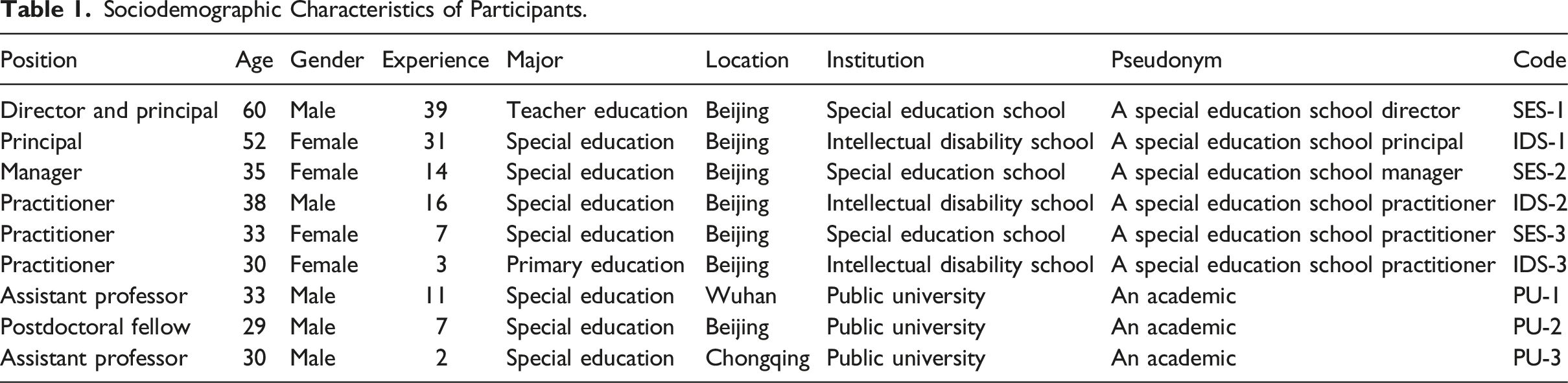
According to (Bronfenbrenner, 1986; Bronfenbrenner & Ceci, 1994; Bronfenbrenner & Evans, 2000; Bronfenbrenner & Morris, 2007), the examined topic 'equity gaps in special education development' is formed, practiced, and operated by the interactions and interrelationships between numerous different factors within the microsystem, mesosystem, exosystem, macrosystem, and chronosystem. These include social leaders and policy makers, special education practitioners, special education students, parents, society, and even the country’s economy, policy, etc. As the scope of the study does not permit the inclusion of all these factors, they are not considered. As a consequence, non-probability sampling was utilized with heterogeneity sampling from both school principals and school practitioners, as well as expert sampling from three special education academics. Following are descriptions of the sampling frame (Figure 1) and sociodemographic characteristics of participants (Table 1). Sampling framework. Sociodemographic Characteristics of Participants.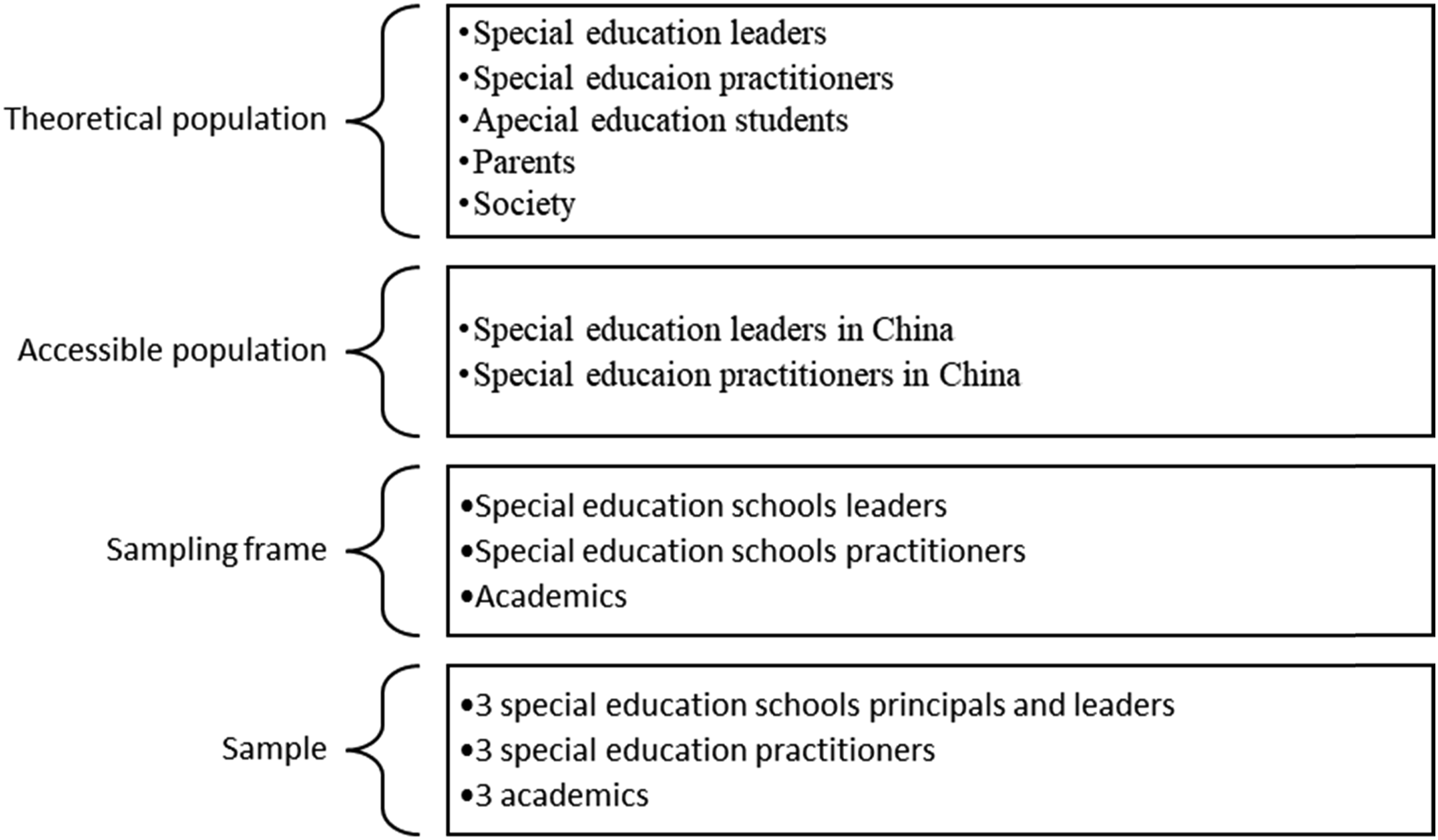
Design
Study design encompassed five phases, including thematic analysis of nine interviews collected and analysed in five phases. Upon consideration of the views and experiences of the principals, practitioners, and academics, it was assumed that they provided valuable insight into equity gaps in providing special education in China. Figure 2 illustrates the study design. Thematic analysis study design.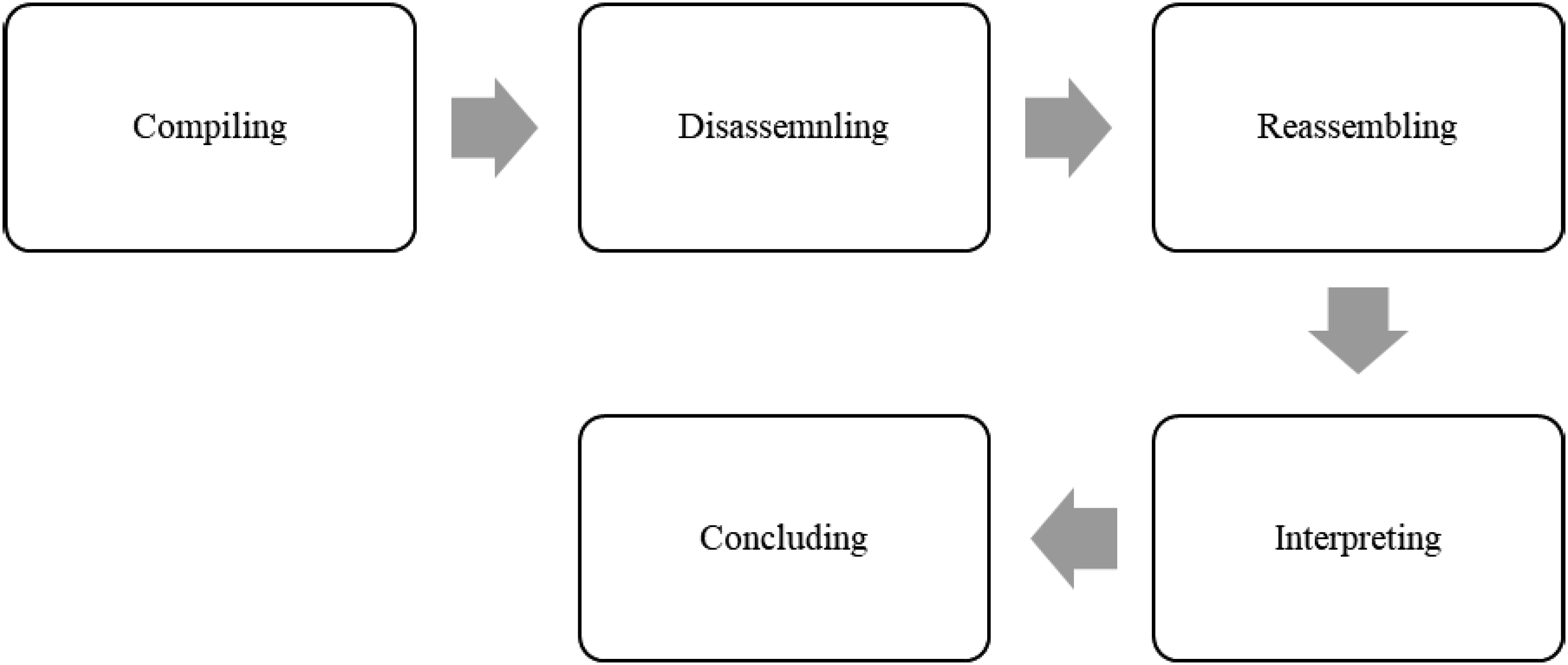
Data Collection
The collected data was collected between 1.05.2019 and 30.06.2019 in Beijing, China. Three interviews were conducted at three different locations in Beijing: three in a special-education school, three in a school for persons with intellectual disabilities, two in a university, and one online. Approximately 50–75 minutes were spent at each interview. Participants signed consent forms prior to recording the interviews (See Appendix B.). The consent form, however, was verbally signed during the online interview, which was conducted through WeChat. Even though four academics had been requested to conduct the interview, one of the academics declined to do so and indicated that he did not wish to share his experiences.
When conducting the interviews, the assisting researchers were guided by certain themes and guiding questions. This form has been reviewed and edited by an expert in special education. After reviewing his comments, the prepared list has been shortened and a section on demographics has been added (Interview questions are included in Appendix C). The expert who conducted the interviews with the nine interviewees reported that only one of the nine individuals was able to communicate effectively in English. In this regard, three researchers offered their assistance to conduct the interviews in Chinese along with the researcher. The researcher arranged the interview and discussed the procedures with them via WeChat. A few suggestions and questions were raised. Following clarifications and answers to their questions, a meeting was scheduled to review each question individually. Furthermore, the procedures have been verified with the assistance of three assisting researchers currently pursuing their master’s degree in special education. For instance, the researcher recommended that they avoid in-depth discussions about special education policy, laws, and administrative issues with the special education practitioners and rather discuss them with the principal, manager, and director. They were also advised not to discuss teaching methods with administrators and special education practitioners in detail. They were, however, advised to leave the door open for each interviewee to communicate their viewpoint and experiences, regardless of their position.
Once the interviews were complete, one of the interviews was transcribed in Chinese and translated into English. This transcript was initially considered too long and contained unnecessary information. Accordingly, it was decided to extract data based on the prepared questions and themes. Ultimately, the assisting researcher decided whether to transcribe directly in English or first in Chinese, and then to translate. It was recommended, however, that they avoid creative translations and concentrate on literal translations. Eight Word documents were provided by assisting researchers through WeChat. In the ninth interview, the researcher conducted it himself using his mobile phone and recorded it in English prior to transcribing it. A selective transcription method was adopted to avoid accumulating unnecessary information and wasting time.
Procedures
The data collection was carried out through in-depth interviews with special education stakeholders, with nine interviews being conducted in total. The purpose of an in-depth interview is to obtain additional information from interviewees and to allow them to freely share their experiences and knowledge in relation to equity gaps in inclusion and segregation, and special education in general (Yin, 2018). Interviews, according to Yin (2014), are a valuable tool for validating data previously collected. He said that generally speaking, "the primary purpose of an interview might simply be to confirm certain conclusions that are already believed to have been established, rather than to ask about other topics of a broader, open-ended nature" (p. 179), although the primary purpose of the interviews was to collect more data than simply validating quantitative results.
Trustworthiness
A thematic analysis of the interviews involved five phases. These included assembling data, disassembling, reassembling, interpreting and concluding. A deeper understanding of special education in China is attributed to the views and experiences of school principals, practitioners, and academics.
The nine interviews were analysed using content analysis and primarily thematic analysis (Allen, 2017; Trochim, 2006). During the different phases of thematic analysis, trustworthiness is maintained (Castleberry & Nolen, 2018; Nowell et al., 2017). This was achieved by means of different methods. First, the trustworthiness is expressed by four criteria, namely credibility, transferability, dependability, and confirmability, each of which has been approached by different means at the various stages of thematic analysis — compilation, dissembling, reassembling, interpreting, and concluding.
The first phase (compiling) was performed using triangulation, thick descriptions, detailed documentation, and peer review. Through guiding themes and questions, the triangulation process allowed the verification of the collected data through nine interviews. To ensure the transferability of the data compiled, a detailed description of how the data were compiled was given in the methods section of this study. This study described and documented all of the steps involved in compiling data, in order to ensure that the data were reliable. The collected data was verified by three researchers, with a researcher further checking the data to ensure confirmability on this phase.
Phase two, (i.e., dissembling), included triangulation, detailed description, and peer review. Initially, triangulation was conducted to ensure credibility, but too much data was taken since in-depth interviews were conducted. Transcription of the first interview took too much time and resulted in a large body of information. A decision was made to selectively transcribe the data. Transcription and subsequent translation of the documents into Chinese took a considerable amount of time. In the first step of data verification, the researcher with the best English was selected. To achieve a high degree of transferability, a thick explanation of coding and analysis was provided in the section dedicated to the procedures and analysis of data. Documentation was extensively used during this phase to ensure dependability, as all steps, processes, and procedures were documented in detail. Peer checking was used to ensure confirmability on this phase, where one of three researchers who helped conduct interviews, transcribe, and transliterate into English, checked the coding of themes and analysis steps.
In the third phase (i.e., reassembling), we discussed the emic and folk perspectives of the participants, provided a detailed description, and drafted detailed documentation. In this phase of the study, researchers used participants' emic and folk viewpoints to obtain credibility. In addition, the researcher instructed the researchers who assisted in the data collection not to alter the questions or attempt to steer the interview towards any specific point. Interviewers are explicitly instructed to allow interviewees to express their views and share their experiences freely without imposing their viewpoints or ideas on them. Furthermore, the researcher advised the researchers to translate the data honestly and literally, and to avoid using creative methods in translation. To facilitate transferability, a thick description of the final themes was described in detail on the data analysis. We used detailed documentation to ensure dependability, with all steps, processes, and procedures of data reassembling clearly documented. Finally, to guarantee that the final data was not outside the scope of the study, peer checking was carried out to achieve confirmability. This is where both the generated and emerging themes were compared to the objectives of the study. An expert in the field has verified this.
In the fourth phase (i.e., interpretation), there was a progressive subjectivity check, detailed documentation, and repeated reviews of the details. To ensure credibility, the researcher used progressive subjectivity checks, in which he or she checked periodically whether the data he or she analysed contradicted some theories and proved others. These findings were discussed in further detail in the study discussion as well as limitations and future research. The procedure and data analysis sections provided detailed descriptions in order to achieve transferability. A detailed documentation of all data interpretation procedures was used in order to ensure dependability. The final step in ensuring confirmability was repeated checks-repeated checks were used to verify and confirm the interpretation.
In the fifth phase (i.e., completing the project), we conducted a peer debriefing, a thick description, detailed documentation, and peer review. We used peer debriefing as a method to ensure credibility. A peer suggested that we focus on the conclusions and explain their relevance and contribution to the field, society, and nation. For the sake of transferability, a description, an analysis, and an explanation were used for the results, and discussion and inference were used for the conclusions. To achieve dependability, detailed documentation was used where all steps, processes and procedures of data conclusion were documented in detail. For this phase, peer checking helped to ensure confirmability-a peer checked the conclusions as an outcome of the findings and yet answered the study questions.
Ethical Concerns
It was also a priority to maintain ethical standards during interviews, with the schools requesting that photographs not be taken and names of schools and universities not be revealed. In addition to the names and affiliations of interviewees, their names were also coded.
A preliminary agreement on the list of interviewees was made by the supervisor, and the research assistants and researcher arranged the date and location for the interviews. Participants signed a consent form before the interview began. Assisting researchers also provided them with interview questions in Chinese.
Data Analysis
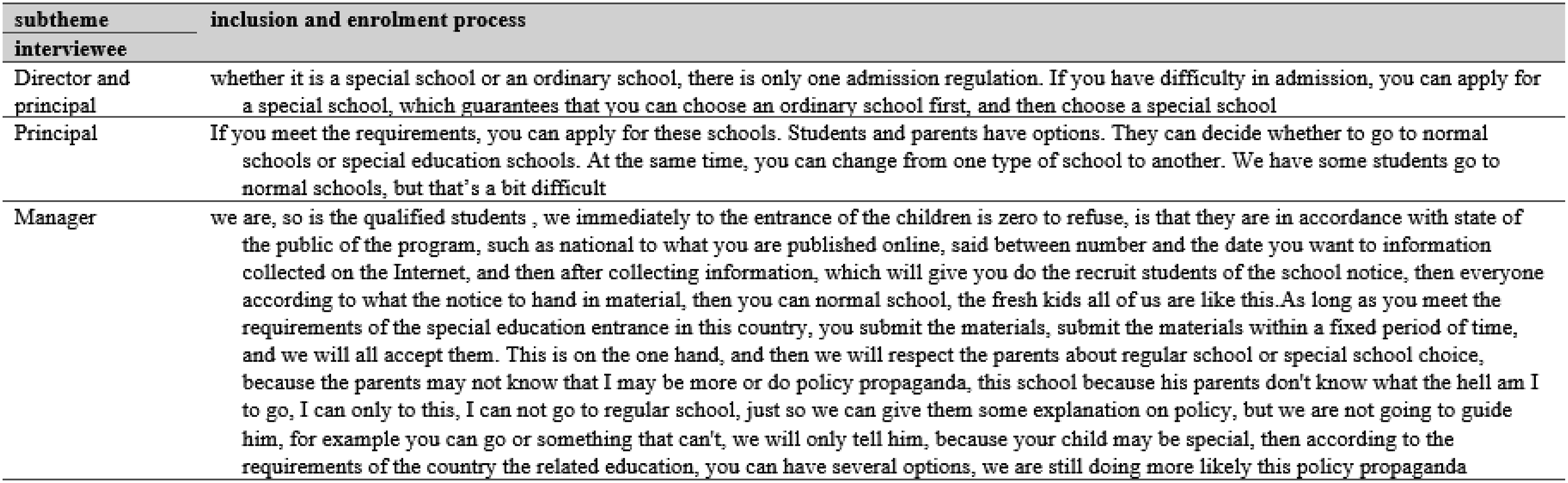
Five phases of analysis were undertaken: compiling, disassembling, reassembling, interpreting, and concluding. Having compiled, disassembled, and reassembled the data, it was organized according to the views and opinions of the leaders, practitioners, and academics. Following this, the remainder of the analysis is guided by the themes that were expressed on the interview form. As well as summarizing and paraphrasing, select excerpts were chosen based on their relevance to the themes (See Figures 3 and 4. Full version of extracted data is attached in Appendix A). Throughout the results, discussions, and remainder of the study, the interviewees were referred to by their titles (director, principal, manager, special education practitioner, and special education academic/expert). Therefore, the names of the schools and university affiliations of the interviewees have been changed to (special education school, school for intellectual disability, Beijing University, University of Wuhan, University in southwest China). Sample data extraction screenshot for stakeholders’ views provision gaps. Sample data extraction screenshot for stakeholders’ views on enrolment process.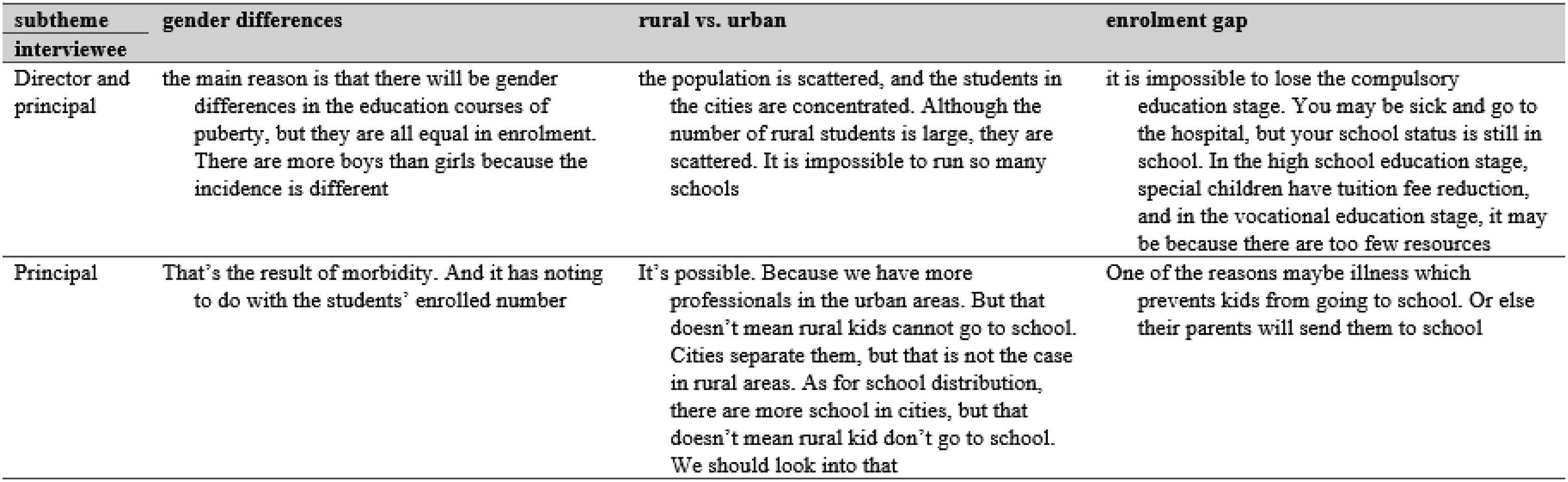
Results
Equity Gaps in Providing Special and Inclusive Education
Results Overview
A set of six questions guided the interview, yet open discussion within these topics was permitted. First, the participants are asked to share a personal account of their motivation for working in the field of special education. One of the administrators stated that she moved from teaching to administration in contrast with the Director and Principal who has 39 years of experience. Among the practitioners, the reason was attributed to the study’s major, one that seems similar to the academics who stated they chose to work in special education because it was challenging and they had the chance to do a better job, apart from the Assistant Professor with 2 years of experience who stated that he was forced into the field. Rest of the questions were focused on the existing gaps in special education and inclusive education services in relation to gender, rural versus urban areas, enrolment shortcomings, and finally, inclusion and enrolment process.
Gender, Enrolment, and Equity Gaps
Zero Rejection and Multiple Provision Forms
Having the National Plan 2010-2020 and many others—been pushing towards a zero-rejection strategy for learners with special educational needs, special education still manifests several shortcomings according to the conducted quantitative synthesis in this study because it showed more enrolled males than females, it declared more schools in urban areas than rural areas, and it demonstrated a decrease in high school enrolment.
First, special education manifests several shortcomings according to the conducted quantitative synthesis in this study because it showed more enrolled males than females. All the participants disagreed to this finding, and they argued that:
This difference could be biological other than enrolment process … it has nothing to do with enrollment … males more exposed to disabilities and this could be true in rural areas … it cannot be caused by policy and could be just by number of learners … it doesn’t exist and it could just because the social problem if preference to boys … could be related to population gender difference … numbers of boys with disabilities are more than girls … could exist but generally is not a big problem for education. (SES-1; IDS-1; SES-2; IDS-2; SES-3; IDS-3; PU-1; PU-2; PU-3)
Additionally, it declared more schools in urban areas than rural areas. Some participants just refused this finding and insist that: It is impossible to have so many schools in both rural and urban areas in a big country such China … it is normal as urban areas should develop first and then rural areas come next … this is an international problem and also rural areas have scattered population. (SES-1; SES-2; PU-1)
The rest of the participants found it existing but with different causes: It could be possible as more experts are available in urban areas … it is true as awareness of parents is more in urban areas and so are resources … it exists and needs consideration … in some areas parents have no idea of integration and will just send their kids to any school … some teachers refuse to work in rural areas, it is not a policy problem … it is certainly more in urban areas as they seek for quality and just education. (IDS-1; IDS-2; SES-3; IDS-3; PU-2; PU-3)
Finally, special education manifests several shortcomings according to the conducted quantitative synthesis in this study because it demonstrated a decrease in high school enrolment. All the participants totally rejected this finding and they think that: Could be related to sick leave to because high and vocational schools require tuition fees … could be related to illness … could be fear of exams at this stage … it couldn’t be because of tuition fees as some schools can support in this, but could be because high school is not part of the compulsory education … it does not exist the way you raised the question … our school has the opposite where we have more high school students than primary and middle school … it should be related to students’ academic performance—maybe they cannot do it so they drop out … average families can afford tuitions, so it could be academic performance problem … age increase and upper level of education are the main reasons in addition to high school is related to university education. (SES-1; IDS-1; SES-2; IDS-2; SES-3; IDS-3; PU-1; PU-2; PU-3)
Thus, while the National Plan 2010-2020 and many others have been pushing towards a zero-rejection strategy for learners with special educational needs, special education still manifests several shortcomings. In Figure 5, a summary and visualization of the stakeholder perspectives on equity gaps in the provision of special education services are presented. Visualization of views on equity gaps in providing special education.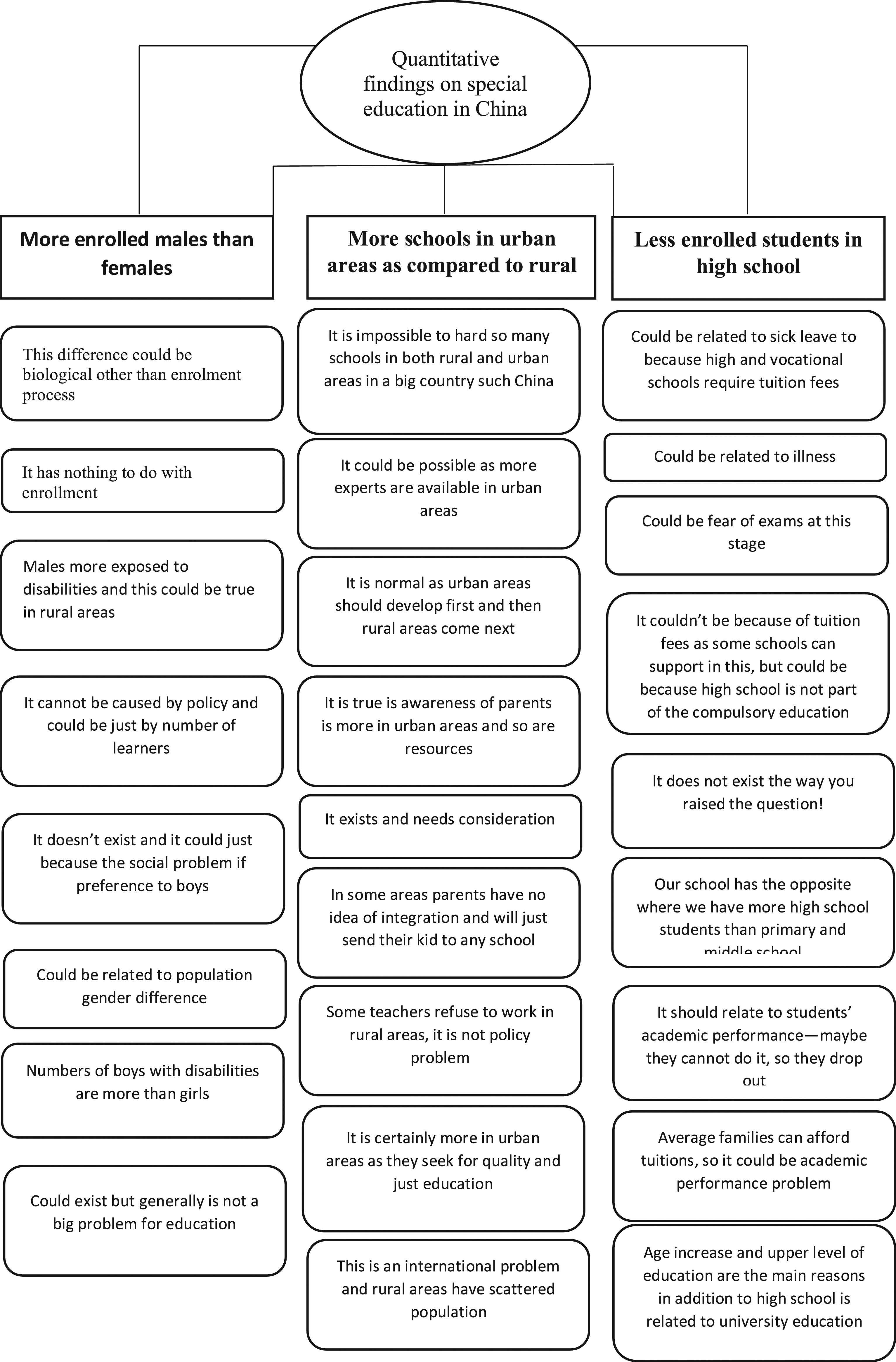
Equity of Special Education Services: Rural vs. Urban Areas
Equality in Inclusion and Segregation
Achieving equality, learning and belongingness requires equity in distribution of financial capital and provision of services between urban areas versus rural areas. The interviewed stakeholders viewed their perspective regarding this finding. In general, most of the interviewees rejected the claim that this would be attributed to policy and law, and they provided different justification, in case this really exists.
For instance, “SES-1” attributed this to that “the population is scattered, and the students in the cities are concentrated. Although the number of rural students is large, they are scattered. It is impossible to run so many schools”. “IDS-1” thinks this finding is possible and ascertained: It’s possible. Because we have more professionals in the urban areas. But that doesn’t mean rural kids cannot go to school. Cities separate them, but that is not the case in rural areas. As for school distribution, there are more school in cities, but that doesn’t mean rural kid don’t go to school. We should look into that.
“IDS-2” confirmed this finding with more explanations causing this gap:
This is real, particularly as the rural areas, you will find that there are a lot of that kind of, that child is a matter, parents also don't understand this, may be for them to know about as mentally retarded children, but for cerebral palsy, autism, or attention deficit disorder, or is that kind of emotion, or fine points that parents don't understand, just treat it as a fool, and then, more school city side, the city will be certainly money rich resources has the resources, must be developed first pay, first, this also conforms to China's policies, is the city promote rural.
“SES-3” stated “that may be affected by city’s better equipment, scattered population in rural areas, parents’ ideas and education levels”.
An academic agreed to this but he attributed this to teachers’ preferences. “PU-1” mentioned:
I think it is based on the resources. Some teachers refuse to go to rural areas. I do not think it is the policy, it is rather a personal preference. Most of the teachers find well-paid jobs in urban areas so they simply refuse to go to the rural areas.
Another academic, attributed this to parents’ qualification and expectation of their children. “PU-2” pointed out:
The special school is more, in China or the county in the county, mild-to-moderate special children go to a special school, but in the cities, may be moderate, and severe special children will be sent to ordinary schools, because parents education idea, the county's parents feel the child just can accept education, but the city's parents to pursue higher education quality.
Last but not least, an academic believes that there could be two reasons supporting the existence of a gap between rural and urban areas: economic development and the distribution of rural population on distanced and remote areas-making it difficult to provide equal services to those existing in urban areas. “PU-3” explained:
Economic development in rural areas, so sure than cities, so economic development will not come he doesn't have so many resources, then lead to special children, sometimes ordinary children will be ignored, so ordinary rural school enrolment, it must be lower than urban, dropout rates are higher. The second is the rural area, which is quite scattered, especially in the mid-west where there are some rural areas, maybe a few hundred people in a village, so there are a few special children, so how do they go to school? So it does have an impact. Then it's a matter of perception, there is an idea in rural areas, for people with disabilities, or some mild disability, he can do many some manual labor, to the child's life won't have too big effect.
Stakeholders’ Perspectives on Consistency of Enrolment and Inclusion Processes
Systematic Inclusion or Preferential! We raised the issue that enrolment in inclusion could be problematic in following inconsistent enrolment procedure in such a large country like China. This issue was also discussed with the interviewed stakeholders who showed total disagreement to this claim except for a few of them who admitted the existence of some inconsistency in less developed areas. However, they all agreed that whatever shortcomings are existing, the basic objectives of zero rejection strategy are being strictly followed and applied nationwide (Figure 6 shows the visualisation of views on the enrolment process). Visualization of enrolment process for inclusion.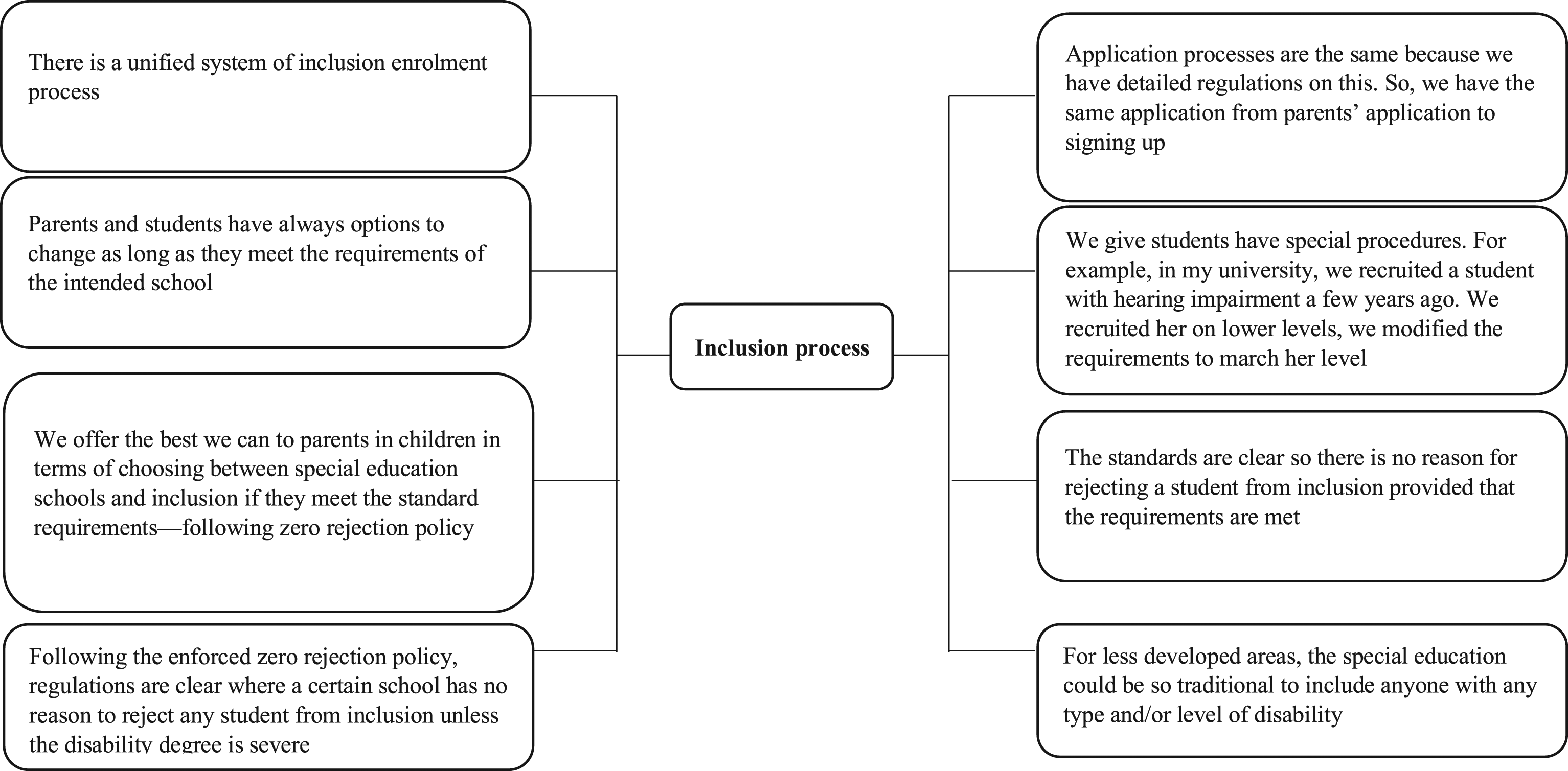
An administrator stated that there is a unified regulation of admission for both regular education and special education at the national level: Whether it is a special school or an ordinary school, there is only one admission regulation. If you have difficulty in admission, you can apply for a special school, which guarantees that you can choose an ordinary school first, and then choose a special school. (SES-1)
Another administrator supported this view adding that: If you meet the requirements, you can apply for these schools. Students and parents have options. They can decide whether to go to normal schools or special education schools. At the same time, you can change from one type of school to another. We have some students go to normal schools, but that’s a bit difficult. (IDS-1)
This view is also confirmed by a practitioner who elaborated: As long as you meet the requirements of the special education entrance in this country, you submit the materials, submit the materials within a fixed period of time, and we will all accept them. This is on the one hand, and then we will respect the parents about regular school or special school choice, because the parents may not know that I may be more or do policy propaganda … we will only tell him, because your child may be special, then according to the requirements of the country the related education, you can have several options, we are still doing more likely this policy propaganda. (SES-2)
A more detailed elaboration is also brought by another practitioner who declared: We all follow the normal procedure; as long as it is in line with the policy, we have no right to refuse. For our school, the admission procedure is no problem, but there is one, can accept so many questions. Our school is only so big, and then, there are so many people that we have no classrooms or teachers to undertake so much, so Haidian district takes both sides of inclusive and special education these years. Special education and inclusive education. As long as people meet the requirements of the policy, whether they choose ordinary schools or special schools, we have no right to refuse. (IDS-2)
One more practitioner also pointed out that there is specifically a certain unified application form to ensure consistency of the procedure. SES-3 mentioned “as far as I know, application processes are the same because we have detailed regulations on this. So, we have the same application from parents’ application to signing up”.
Academics agreed that there is inconsistency, but they had controversial views on this issue. For instance, for an academic, there are specific regulations to match the needs and the rights of such students. PU-1 pointed out that “we give students special procedures. For example, in my university, we recruited a student with hearing impairment a few years ago. We recruited her on lower levels, we modified the requirements to march her level”. On the other hand, another academic argued that inconsistency exists, and it is attributed to the educational development of the area but still this does not hinder the process of application. PU-3 argued that: There is no standard process … in many areas because of any school compulsory education stage, a special child, he has no right to reject any so as long as parents think this still fit, so he can apply for ordinary schools, then into the process, the most important is, do some evaluation on study of special children, so far, some good parts, then through the organization of special education school teacher or guidance centre of the teacher to assess him.
PU3 added:
For some of the less developed areas, may be that on the one hand, also have no, so his admission application or the admission process, did not establish strict or scientific admission process, so the special education school as long as he is disabled children, it can all go to special education school, this also there's no application problems.
Discussion
In this study, we aimed to extend discussion from prior research based on quantitative findings that highlighted equity gaps in offering special and inclusive education to males and females, rural and urban areas, and elementary and middle schools in comparison to high and vocational schools. To uncover the views and experiences of Chinese stakeholders in regard to these equity gaps, extensive interviews were conducted. Several interpretations of the findings are provided below.
Firstly, regarding the quantitative findings that there are more males enrolled than females, this will likely be due to several reasons other than policy. These include demographic differences (men are more prevalent than girls), disability vulnerability (males are more vulnerable to disabilities), and social circumstances (families prefer to keep their daughters indoors to keep them out of sight). As for the higher number of schools in urban areas, this can again be attributed to other factors, other than inadequate policy or laws. Among these factors are a larger population in urban areas; better services in urban areas, which explains the preference for urban areas, scattered population in rural areas and remote areas, which makes it difficult to locate schools. Third, owing to the limited number of students attending high and vocational schools, this is not the fault of policies or laws, but rather a result of social factors (families choosing to keep their children at home), academic (students failing to meet the requirements), and economic (families cannot afford tuition) because some schools offer support while others do not and high school does not fall under the free compulsory education program. Fourth, the enrolment procedures across the country are standardized and parents have the right to select the form of provision provided that the conditions are met, and this all falls within the parameters of the zero-rejection policy that no school or individual is permitted to breach.
However, while the above findings differ from previous studies reporting such gaps (Alduais, 2020; Alduais & Deng, 2019; Alduais et al., 2019), they are consistent with other recent studies that have identified several shortcomings in the provision of special education in China (Cheng, 2021; Jia & Santi, 2021; Li & Li, 2020; Xie, Deng, & Ma, 2021; Xie, Deng, & Zhu, 2021; Xu & Cooper, 2020; Zhang et al., 2019).
At least two implications may result from these interpretations. First, there is no clear evidence that these gaps are due to shortcomings in laws and policies. The gender gap can largely be attributed to social factors, with parents choosing to hide their children from others. This is more common in high schools, vocational schools, and colleges when parents prefer to keep their female students at home. The government does not have the authority to force parents to enrol their children in high school, vocational school, or university. Additionally, the movement of people from urban to rural areas is out of control unless there is further urbanization. While this leads to an adverse effect on the environment, displacing the agricultural sector in favour of the industrial sector, it can also help to equalize the educational services across the country by decreasing the population expansion in urban areas.
Limitations
Using in-depth interviews, this study attempted to verify previously reported quantitative results that indicated equity gaps in providing special education services in China. However, there are at least two limitations to the study. In the first instance, the data were limited to interviews conducted with stakeholders in developed areas in China as well as in other regions, however they were conducted online without access to the schools. Due to language and administrative barriers, we were unable to reach other stakeholders. Second, the participation of parents, learners with special educational needs, members of society, and other parties would have resulted in more thorough yet insightful evaluations of the gaps and their impact on the provision of better special education services.
Conclusions
Findings of this study provided insightful attributions for existing reported equity gaps in special education and inclusive education. Stakeholders have given insight into why males have a higher enrolment rate, why high schools and vocational schools have a lower percentage of learners with disabilities, and why the gap between rural and urban areas is difficult to bridge regardless of economic power.
Supplemental Material
Supplemental Material - Stakeholders’ perceptions of equity in providing special education and inclusive education services in China: Zero rejection and multiple provision mechanisms
Supplemental Material for Stakeholders’ perceptions of equity in providing special education and inclusive education services in China: Zero rejection and multiple provision mechanisms by Ahmed M Alduais and Meng Deng in International Journal of Chinese Education
Supplemental Material
Supplemental Material - Stakeholders’ perceptions of equity in providing special education and inclusive education services in China: Zero rejection and multiple provision mechanisms
Supplemental Material for Stakeholders’ perceptions of equity in providing special education and inclusive education services in China: Zero rejection and multiple provision mechanisms by Ahmed M Alduais and Meng Deng in International Journal of Chinese Education
Supplemental Material
Supplemental Material - Stakeholders’ perceptions of equity in providing special education and inclusive education services in China: Zero rejection and multiple provision mechanisms
Supplemental Material for Stakeholders’ perceptions of equity in providing special education and inclusive education services in China: Zero rejection and multiple provision mechanisms by Ahmed M Alduais and Meng Deng in International Journal of Chinese Education
Footnotes
Author Contributions
All the authors listed in this research have practically, partially but effectively and positively participated in this research and have agreed to the current version submission to the named journal as provided in this form.
Declaration of conflicting interests
The author(s) declared no potential conflicts of interest with respect to the research, authorship, and/or publication of this article.
Funding
The author(s) disclosed receipt of the following financial support for the research, authorship, and/or publication of this article: This work was supported by the Università degli Studi di Verona, Open access fee.
Ethical statement
All ethical issues concerning research have been fully and carefully considered as advised in the consent form.
Disclaimer
There is no copyrighted material, and the measures used in the research are original. Besides, all quoted materials, summarised or whatsoever, have been fully cited in the text and in the list of references.

Supplemental Material
Supplemental material for this article is available online.
References
Supplementary Material
Please find the following supplemental material available below.
For Open Access articles published under a Creative Commons License, all supplemental material carries the same license as the article it is associated with.
For non-Open Access articles published, all supplemental material carries a non-exclusive license, and permission requests for re-use of supplemental material or any part of supplemental material shall be sent directly to the copyright owner as specified in the copyright notice associated with the article.
