




Abstract
The high turnover rate of Chinese college counselors has become a social issue that is increasingly being concerned about. Many scholars have tried to analyze the reasons for this issue from different perspectives. This study selects a qualitative approach to explore the college counselors’ turnover intention from the perspective of subjective career success while analyzing the relationship between subjective career success and turnover intention. This study finds that the three dimensions of career success criteria could be successfully applied to evaluate counselors’ subjective career success. Career safety and stability can, in combination with the interview results, be incorporated into the measurement of subjective career success under the dimension of external compensation. Meanwhile, college counselors’ subjective career success is correlated with turnover intention. College counselors will evaluate different dimensions of subjective career success and balance the same against their work values. The findings of this study provide empirical support on college counselors’ evaluation of their career status and turnover intention, which helps colleges analyze counselors’ turnover intentions from a new perspective and reduce turnover rate.
Introduction
The high turnover rate of Chinese college counselors has become an emerging issue in recent years, which has fallen within the research scope of many scholars. The Chinese college counselors, who are in charge of student affairs in Chinese colleges and universities, have a rapid growth of its number from 140,870 in 2017 to 240,800 1 in 2022. According to Fan (2016), more than 50% of college counselors decide to leave the position if the right opportunity arises. More and more researchers have paid attention to this career and its current situation (Chen & Wang, 2021; Kaniki & Kaniki, 2021; Mullen et al., 2017).
Previously, some scholars analyzed the turnover intention of college counselors from the perspective of occupational pressure, stating that excessive pressure caused by insufficient counselors is an important reason for their resignation (T. He, 2016c). With the influx of a large number of new counselors in the position and the introduction of relevant safety policies by the government, the high turnover rate of this group still exists (Chen & Wang, 2021). It is necessary to analyze the turnover of counselors from a new perspective, which can also give us a fresh research perspective on the practices of human resources management in colleges and universities.
Currently, working in a fixed position in an organization for a long time becomes less and less attractive to employees, no matter which countries or what careers. They will cross organizational boundaries and seek new career opportunities (Enache & Sallan, 2011) or change their jobs within the organization. Employees’ subjective career success can be important predictors of employee turnover intention nowadays (e.g., Guan et al. (2017), Han (2016a), Pan et al. (2016) and Weng and McElroy (2012)) Studies in western contexts on subjective career success, however, can not be directly applied to China because of the differences in cultural values and social milieus between the two. Few empirical research in this respect has been conducted in China. Hence, relatively little is known about how employees’ subjective career success influences turnover intention in China, especially for the career of Chinese college counselors.
This research aims to investigate the reasons for high turnover intention of Chinese college counselors, the current career status, and the relationship between subjective career success and turnover intention. A new perspective on how to retain college counselors can be found in this research as well, which facilitates policy makers, organizations, and individuals to develop better career development plans. It is also instructive for future research on similar careers in different contexts in whatever countries.
Literature Review
This part will review the literature and lay the solid theoretical foundation to which this study is related. The models include the turnover intention model and the Job-Demand and Resources model. The relevant theories consist of research on subjective career success and the career status of Chinese college counselors.
Turnover Intention Models
There are many factors influence the turnover intention of employees. The turnover intention can be analyzed from two perspectives: intention to leave and intention to stay. Here are the three turnover models that have been widely used in different research areas. In 1979, Mobley proposed an extended mediating chain model, which is known as Mobley’s model. Mobley et al. (1979) analyzed the withdrawal and turnover behaviors of employees from organizational, work, and personal levels. His model was designed to analyze the process of employees’ decisions on turnover. Steers and Mowday (1981) proposed a model embracing employee turnover and post-decision accommodation processes. In Steers’ study, he stated that both job expectations and the values of employees influence their job attitudes, which include many jobs- and organization-related variables such as job satisfaction, organizational commitment, and job engagement. Subjective attitudes and some non-job-related factors influence the intention to leave or stay, thus leading to turnover behavior. Price (2001) proposed a new model from a holistic perspective, which has been applied more often in actual employee surveys in China (Chu, 2017).
Another notable theoretical model that is widely used to explain turnover intention is the job-demand resources (JD-R) model. The model was developed by Bakker and Demerouti to explain burnout at first and further enriched three times by adding three variables into it (Demerouti et al., 2001; Schaufeli, 2017; Xanthopoulou et al., 2009). According to the JD-R model, jobs include resources and demands, which have positive and negative effects on employees. Job demands are the physical, social, or organizational aspects that are required to be endured and work through both physically and mentally. In this sense, job demands can have a negative impact on both physical and psychological levels. Job resources involve physical, psychological, social, or organizational aspects that have the positive effects on personal career growth.
Moreover, these models (e.g., Mobley, Steers and Mowday, and Price Muller’s models) employ a narrow definition of turnover behavior (Peng et al., 2011), which is considered to be the behavior of employees leaving the organization. Thus, the turnover intention of these studies is generally based on employees’ willingness to leave the organization. Nevertheless, some scholars also consider turnover as employees leaving their jobs, positions, occupations, or industries. Xiao et al. (2014) showed that the concept of turnover includes 3 dimensions, which are regional movement, occupational movement, and industrial movement. He referred to the turnover behavior of nurses as leaving the sector for which they are working for the time being, then their current hospitals, and finally the nursing profession. This shows that turnover behavior, a step-by-step process, can be either within or out of the organization (Xiao et al., 2014). Mäkelä et al. (2014) considered teacher mobility to include changing schools (relocation), teaching in a different subject area (field transfer), or entering school administration positions.
In sum, research on turnover intention should also be differentiated based on specific situations. Analyzing turnover intention without distinguishing from different dimensions can easily lead to inaccurate conclusions or failure to achieve the depth of research in willingness. The definitions of turnover intention also vary because of the differences in the definition of turnover behavior. Turnover intention has also been defined as the willingness that employees decide to leave their position or current job (Chen et al., 2021). In our research, the differences of intention to leave an organization or a job within the organization will be distinguished during the qualitative interview process.
Criteria and Evaluation of Subjective Career Success
Career success is seen as a key element that influences the way individuals in an organization view and react to their careers (Pan et al., 2016). Zhou defined the concept of career success criteria by combing the studies of work values and career success. She conducted several research in China and finally developed a three-dimension model for evaluating employees’ criteria of career success, which are intrinsic fulfillment, external compensation and work-life balance. Career success criteria can reflect employees’ work values as it is part of the work values (Zhou, 2008). Based on the western academic research, Zhou’s study focuses more on the measurement of criteria for subjective career success. (Shockley et al., 2016)
Subjective career success (SCS) refers to individuals’ subjective evaluations and affective reactions to their careers (Greenhaus et al., 1990; Ng & Feldman, 2014). Shockley et al. (2016) employed the same research method based on Zhou et al.’s (2013) study to develop a scale of subjective career success for western countries. The outcome of his study indicates that the SCS has negative impacts on employees’ withdrawal cognition. However, due to the significant cultural and value differences between China and the western world, this study’s results cannot be applied to China directly. It is worth noting that Zhou et al.’s (2013) focused on the criteria of career success, not the employees’ perspective on professional development and evaluation. Moreover, the criteria in her study were developed in a generalized framework to evaluate professionals with different job duties. Professionals with different job duties have different intrinsic career values and goals, and so do the college counselors. However, the current status of research on SCS and the connection to its relevant theories are still insufficient for college counselors. The study will base on the findings of Zhou et al.’s (2013) research on career success criteria when analyzing the turnover intention of college counselors.
Career Status of Chinese College Counselors
The Chinese college counselors are managing student affairs and responsible for coordinating all types of student-related matters. They are not only ideological and political teachers and leaders of students, but also teachers engaged in teaching and research on the moral education of students (Li & Fang, 2017). Their work patterns are also complicated, as they are required to complete the tasks assigned by many different departments as well as their own faculties (Gong, 2011). The Student Work Office and the School League Committee are often set at the university level to be engaged in students’ affairs. At the faculty level, each faculty has administrative and party branches to which student party branches, student councils, and league committees are subordinated. Meanwhile, all kinds of affairs involving interests and needs of students are dispersed to different functional departments such as academic affairs, logistics, medical care, admissions and employment, defense, and sports departments. In other words, Chinese college counselors must carry out or acquaint themselves with all notices pertaining to student affairs from multifarious departments, assuming the added responsibilities of providing ethical, political, and career guidance, and dealing with different kinds of problems from students (D. He, 2016b).
Recently, college counselors have become a hot object of interdisciplinary studies (e.g., philosophy, education, management, psychology) as well in China. Management issues for this group are emerging and waiting to be addressed. According to (Chen & Wang, 2021), literature relevant to Chinese college counselors embraces institutional development, role responsibilities, competence level, status mobility, career advancement, and advice. Fewer systematic, empirical studies based on experience have been conducted against this research. The mechanisms and principles of this research area still need to be further discovered, although the importance of some issues has been identified. Such opinions given in those studies as professionalization of college counselors have been practiced but still have not been improved from the current situation yet.
Based on the above literature review, it is critical to explore innovative thoughts and methods for research in order to deal with the high turnover rate of college counselors. It is helpful to introduce new theories with different perspectives for analysis. On the other hand, the SCS is an important criterion to evaluate employees’ career development status (Ng & Feldman, 2014). However, the SCS still lacks of more application and research in China. As a result, this study focuses on exploring answers to two questions. The first one is what causes the high turnover rate of college counselors? The second one is what are college counselors’ subjective working experience and the perception of their career situation? Zhou’s three dimension method is adopted as the primary study framework for this question.
Methodology
Research Design
This research mainly used qualitative research methods to answer the above two questions, and tried to find out the main reasons that affect college counselors’ turnover intention from different dimensions, so as to provide important data reference for policy formulation and improvement of measures. Zhou’s research framework was adopted as an important theoretical tool in this study to facilitate the categorization of interviewing content.
Data Collection and Analysis
The qualitative research method refers to taking the researcher himself as a research tool to explore the object of study in a natural context and in a holistic manner through a variety of data collection methods. In this way, the researcher can arrive at explanatory conclusions or theories about the behaviors and meaning of individuals or groups (Chen, 2000). The research form of qualitative research method does fall within the scope of positivism, although its philosophical basis is not empirical.
In this study, the respondents were recruited from various online platforms. Those who have working experience as college counselors were recruited for this study. The semi-structured interviews were conducted on an online or offline basis. The interview questions focused on the following aspects: (a). The reason for choosing college counselor as their career and their career plans; (b). Perceptions, feelings and evaluation about the career of college counselor; (c). Their turnover intention and reasons; (d). Suggestions for this career. These questions had been translated into Chinese before the interview, and the interview data and conclusions would be translated back into English after the interview and data analysis.
The Profile of Participants.
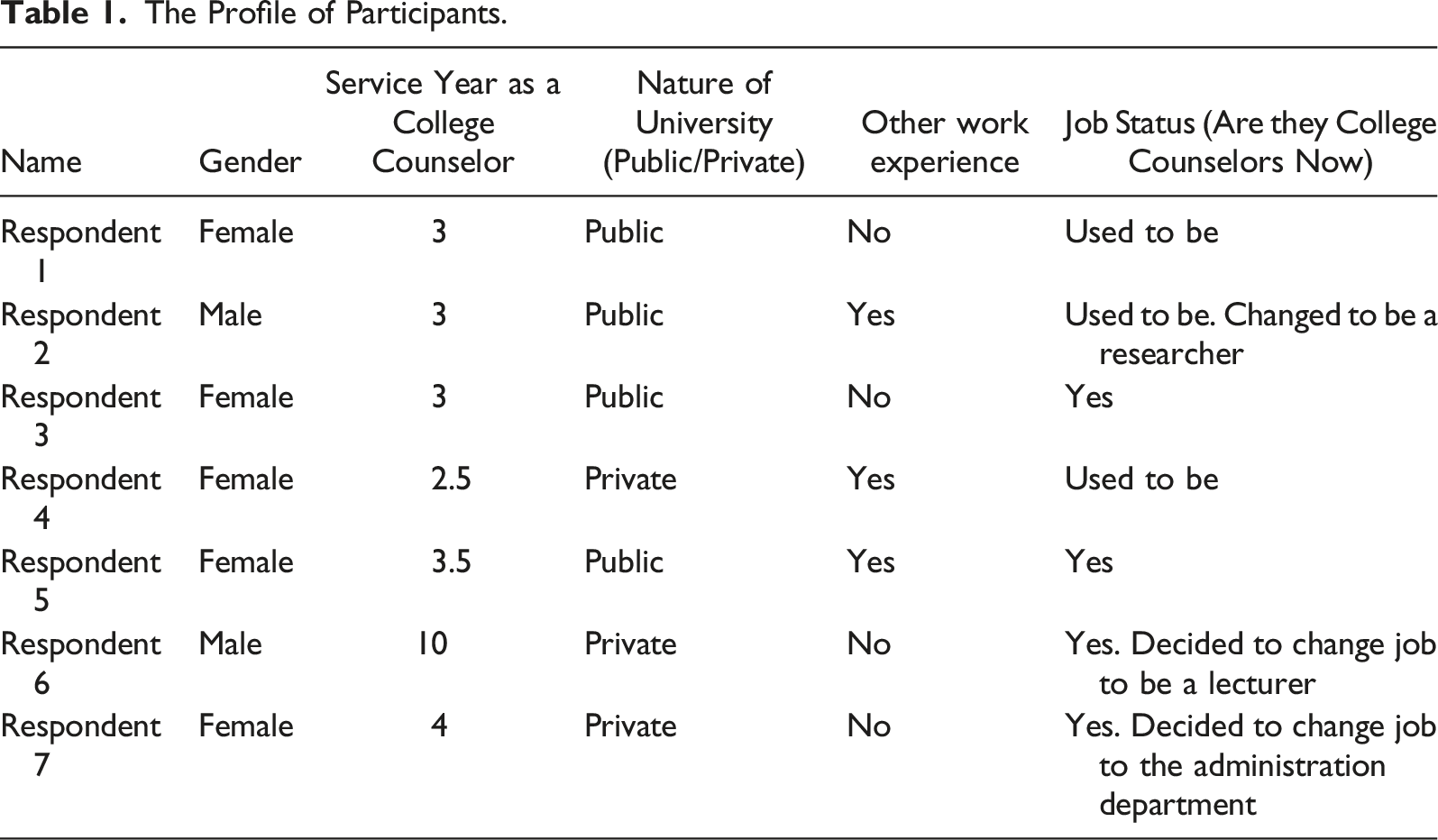
Ethical issues were also taken into account in the study, which facilitated the purpose of data collection and respected the willingness of the respondents. When recruitment information was released online and accepted by the respondents, they were given informed consent to participate in the study at the same time. Before the interviews began, respondents were again informed of the purpose and use of the study, and they could withdraw at any time during the interviews. Each interviewee shared their thoughts and ideas throughout the interview, and after answering the designed questions, the interviewee and interviewer were engaged in a free exchange. After completing the interviews, the interviews were transcribed and categorized into different themes using inductive coding, and the information was extracted and summarized into key points layer by layer (Thomas, 2006).
Theoretical Saturation Test
Since this study is mainly concerned with the inductive analysis of interview-based data, the adequacy of the data obtained will directly affect its conclusions. In order to ensure the adequacy and reliability of the interview results, the “theoretical saturation” was used as a test (Glaser and Strauss, 1967). This means that if other newly enrolled respondents who joined were unable to provide anymore new data categories, the researcher can stop collecting data and move to the theory-building stage. It was found that the first 7 respondents provided the core data for this study. The other respondents’ responses did not show any new keywords or categories other than expressions different from these 7 respondents. Meanwhile, multiple posts relevant to college counselors’ working experience were collected and analyzed, but no new categories or contents were identified. Based on this, the research assumed that the information collected from the interviews meet the requirements of theoretical saturation. And the theoretical saturation is relative to this study and only for the current stage.
Findings and Discussions
This section is divided into two parts. The first part analyzed the college counselor’s turnover intention from two perspectives: intention to stay and intention to leave. This primarily aims at reflecting the overall career status of college counselors and the main factors affecting their mobility willingness. Combined with the three dimensions of Zhou et al.’s (2013) view of career success, the second part mainly considered the main factors that affect counselors’ turnover intention, that is, career success expectations and career success feelings. We further examined how these career value criteria affect their career evaluation, causing them to have the mobility willingness.
Themes on Turnover Intention
The considerations of different college counselors may vary when it comes to resignation. One is willing to stay, and the other is willing to leave. This section mainly discussed and analyzed the counselors’ overall turnover intention and the main factors that affect their turnover intention from two perspectives: intention to stay and intention to leave. Of the seven respondents, the majority wished to leave their jobs. Five respondents expressed a willingness to leave, or have already left, the counselor position. These findings are consistent with the results of previous studies.
Intention to Stay
In the interviews, it can be found that the main reasons why the respondents chose to stay or were willing to stay in the position for a long time are the recognition of students, the matching of abilities and expectations, and the lack of pressure. However, the key factors that influence respondents’ stay intention vary from person to person due to their values and experiences.
In terms of being recognized by students, counselors, as college teachers, gain recognition from students is an affirmation of their values and can bring them a sense of achievement. The Respondent 3 expressed strong intention to stay on as a counselor, “I am willing to work as a counselor for more than 10 years. I like dealing with students and also value their recognition. The current work pressure is within my tolerance range.” Respondent 3 works as a counselor in a public college, a relatively higher platform than the other respondents.
In the process of further communication with Respondent 3, the author learned that she attaches great importance to the recognition from students, followed by professional title and salary. One of the most important reasons for Respondent 3 to choose to stay is that her current career just meets the needs of her career values, and also gives her a higher degree of subjective evaluation and affirmation of her career.
Then, the combination of ability matching, expectation matching and low pressure also became an important reason for the respondents to stay. Respondent 3 mentioned in the interview that the less stress from her job has increased her intention to stay as a counselor for a long time. According to the JD-R model, work stress is a negative factor that consumes individual energy, leads to job burnout and reduction of employees’ enthusiasm for work, thus generating the intention to leave the position. Conversely, it is beneficial for employees to stay (Demerouti et al., 2001; Lewig et al., 2007; Schaufeli et al., 2009). Respondent 2 also mentioned in the interview that “young college counselors who are willing to work for a long time mainly because they have satisfied their own pursuits in all aspects. There are three main reasons why the older counselors in our university can stay as is for a long time. In the first place, some of them are forced by life and cannot easily change jobs. In the second place, they may be tired of changing positions and yearn for settling down because they are getting older. In the third place, they are expert in the profession of counselor. Anyway, they have experienced a lot of things and are very calm. Unlike those young counselors who just started to work, they are very sensitive to any trouble and pressure. Finally, they felt that their ability is suitable for the position of counselor, and they may not be qualified for other jobs.” (Respondent 2)
In the interview, Respondent 2 also mentioned competence, career aspirations and work stress. We learned from communication with Respondent 2 that he has predicted the career development result of his long-term stay as a counselor in the future. He observed counselors of all ages around him and accordingly adjusted his career plans. He believed that those who choose to stay would evaluate the actual experience of the job in light of their abilities and career expectations. The results of their evaluation have an impact on their turnover intention.
Intention to Leave
Out of the seven interviewees, two of them (Respondent 3 and Respondent 5) decided to continue their careers as college counselors, whereas the rest interviewees (Respondents 1, 2, 4, 6, 7) expressed their intention to leave or have already chosen to leave. Of these five interviewees, two college counselors said that they wanted to leave their current careers and were applying for a transfer on campus. One of them (Respondent 6) wanted to become a full-time lecturer and the other hoped to transfer to administration (Respondent 7). One college counselor (Respondent 2) said that he had been successfully transferred to be a researcher. Another two college counselors have left their colleges, one of whom (Respondent 1) moved to a public vocational college to work as a full-time teacher, and the other (Respondent 4) just left and planned to enter a public school.
Respondent 2 is a counselor who has been successfully transferred to another position on campus. He said of the counselors he knew on campus, “I feel that about 70 percent of our counselors want to leave the university to find jobs in other places, or transfer to administrative departments, such as publicity department, organization department, youth league committee or other office in the university.” (Respondent 2)
It can be seen that the analysis of different career turnover intentions should be combined with the characteristics of the industry in which they are located. Most previous studies tended to assume that personnel mobility depends on whether a person leaves the organization for which he/she is working (Meyer & Allen, 1991; Mobley, 1977; Tschopp et al., 2014). In this study, however, this presupposition is obviously not comprehensive. Combined with the interview results, we believes that the analysis of college counselors’ turnover intention should take into account intra-university transfer and leaving university.
Dissatisfaction with the current career, organizational environment, or the mismatch between the ideal career to the actual one were all cited by the interviewees as important factors that prompt counselors to leave their current positions, which are reflected in Respondent 1’s view and experiences: “Some people just want to regard college counselors as a stepping stone”; “If there is a reason for me to stay in my previous university, it might be that I still hope to be transferred to the teaching position in the future” (Respondent 1).
Respondent 1 is a college counselor who has left from a public university. She is very clear about her career plan. During the interview, she expressed fewer negative attitudes about the job content of a counselor. However, when it came to the reasons for leaving, she believed that the job of a counselor was not as good as a full-time teacher in terms of salary, promotion, etc., nor did she give full play to her professional expertise. And becoming a full-time teacher is her ideal job. Her narratives are also consistent with the classic turnover models. Mobley (1977) pointed out that employees’ turnover behavior can be analyzed from organizational, work, and individual aspects. Steers and Mowday (1981) turnover model showed that subjective attitudes and some non-job-related factors can influence employee’s turnover intention. In the interview, Respondent 1 formed her own subjective perception and judgment by combining the subjective and objective situation of the organization, work and individual, which directly affected her own turnover intention.
Given this theme, it can be seen that subjective and objective factors such as personal work values, current career experience, overall career success feeling, organizational environment, etc., are impacting the turnover intention of counselors, which resonates with the previous classic turnover model (Mobley et al., 1979; Steers & Mowday, 1981). In combination with the three dimensions of Zhou et al. (2013) career success criteria, college counselors compared salary and promotion system with other on-campus positions in the interview, which reflects the importance that counselors have attached to external compensation dimensions. The emphasis on recognition of students, the positioning of self-ability, and the evaluation of work happiness can be attributed to the dimension of internal satisfaction. The perception of the current situation of life and family and the level of stress can be attributed to the dimension of work-life balance. This actually answers the first question raised in this study, that is, the three-dimensional career success criteria proposed by Zhou Wenxia can be further applied to evaluate the subjective career success of the counselor groups.
Themes on Criteria and Evaluation of Career Success
According to previous western studies, subjective career success has an impact on employees’ career withdrawal cognitions (Shockley et al., 2016). In the Chinese context, however, it’s worth exploring in depth how subjective career success affects turnover intention. In addition, the great impact of the epidemic of COVID-19 on economy and life has also profoundly affected people’s outlook on career success. Considering that counselors is a kind of teaching profession, they generally have their unique professional characteristics, although the three dimensions proposed by Zhou et al. (2013) on the career success criteria can be used to examine their subjective career success of counselors. Subject to the impact of the epidemic of COVID-19 in China, it is worth exploring whether the values contained in the three dimensions need to be further enriched. This section will take three dimensions of career success criteria as the initial analytical framework to deeply explore these issues.
External Compensation
External compensation mainly emphasizes the instrumental benefits obtained from one’s career, including material reward, money, promotion, and power status (Zhou, 2008; Zhou et al., 2013). In the aspect of material reward and promotion system, every interviewee mentioned the imbalance between work input and gain. They thought that they have invested a lot of time and energy, but there is no equivalent return in money, material or promotion. A more typical view was brought about by Respondent 6. “College counselors may have to deal with student affairs at any time, especially on weekends and in evenings. Sometimes dormitories have to be checked at night, so there are some special allowances. But the amount of time and energy it takes is out of proportion to the benefits, and I'd rather not to take these benefits. The promotion system of private university still needs to be improved. It is definitely better to be a professional teacher.” (Respondent 6)
Price (2001) mentioned that there is beneficial exchange between employees and the organization. Employees will think about maximizing their own benefits. Therefore, when the exchange of benefits is out of balance and employees do not get the rewards that they should have been given or they have been expecting, their willingness to leave will increase. At this point, the counselors generally dissatisfied with and confused about the expectations of their future work. There are many obstacles to their expected career success, which also make them have different degrees of willingness to leave.
In terms of power status, interviewees will compare their current careers with other jobs on and off campus. People working outside universities generally consider college counselors as teachers. Almost all interviewed counselors believed that the prestigious profession of teacher, with a certain social status, has been universally recognized by the society. As far as other positions in the colleges and universities are concerned, however, counselors are at the bottom in the opinion of the interviewees. Therefore, it is interesting that most of the instructors who intended to leave their jobs said that their first choice was to become a professional teacher (Respondents 1, 2, 4, 6, 7), rather than directly job-hopping to off-campus enterprises. They would however consider leaving the organization (Respondents 1, 5) only when the first choice cannot be realized due to the limitation of personal ability or objective factors such as social environment: “In the eyes of outsiders, college counselors in colleges and universities have a higher social status. But in colleges and universities, it is the bottom position, and many departments can assign tasks to counselors.” (Respondent 1)
Respondent 1 recognized the value of being a full-time professional teacher more than the college counselor. The university she was in could not meet the needs of her job change for the time being, so that she chose to change to work in another public university. Steers and Mowday (1981) stated that employees’ job expectations and values influence their job attitudes in his research on turnover models. Maslow’s hierarchical need theory (1970) also pointed out that when people’s lower-level needs are satisfied, they will turn to achieve higher-level needs. Respondent 1’s expectation is obviously more in agreement with the professional value of full-time teachers. Her current job can met her low-level needs, but she hoped to meet the needs of self-realization. While she didn’t have many negative comments on the job as a counselor overall, she chose to leave. She is satisfied with her new career as a full-time teacher.
In addition, many respondents also mentioned occupational safety and stability, which were not mentioned in Zhou et al.’s (2013) external compensation dimension. A novel finding of this paper is that of the counselors interviewed in public universities who were willing to leave or have left, none of them chose to work in a private university as their choice. The counselors of private colleges also wanted to work in public colleges. Respondent 5 used to be a counselor in a private college for 1 year. She has now worked as a counselor in a public college for 3 years. She proposed more representative experience and answers. “I was admitted by a public university in my hometown, so I came back. Because the public university is a platform better than that of the private university before. I also can take care of my family…… It's like climbing layers of stairs. I moved from a private institution to a public one. Supposing that I leave this position, I have to either switch to be a professional teacher or the next institution must be a public institution which is better than the one I work now…… In the private university I worked before, few counselors could stay for five or six years. They were all thinking about how to go to public institutions or transfer jobs” (Respondent 5).
In the interview, it is evident that Respondent 5 attached great importance to career safety and stability. This has become an important reason for her to leave the original private university. Safety and stability can reflect the external compensation an organization gives to its employees. Obviously, public institutions in this respect are superior to private institutions. In Zhou et al.’s (2013) research conclusion, she mentioned that career safety and stability were not incorporated into the career success criteria, which is possibly because career safety and stability are people’s needs rather than a kind of success (Zhou, 2008). In the interviews with counselors, however, the author found that the subjective career success, as proposed by the respondents, should also include career safety and stability (Respondent 5, 6, 7). Especially under the impact of the epidemic of COVID-19, the safety and stability of their careers underpin the long-term career development and constitute an integral part of their career success.
It has also been mentioned in many previous studies that Chinese employees have a higher demand for job safety (Gomez, 2003; Oyserman et al., 2002), and are also more motivated by stable careers (Probst and Lawler, 2006). In consequence, this study suggests that safety and stability be regarded as one of the subjective criteria of career success valued by employees, which are also related to employees’ turnover intention.
Intrinsic Fulfillment
This dimension analyzes whether individuals have an intrinsic fulfillment in their career, such as fully utilizing one’s talents and abilities; being respected and gaining recognition from others; making contribution to organization and society; liking the job and being happy during the work, etc. (Zhou et al., 2013). The dimension of external compensation is about people’s subjective perception of the “objective” career success, while intrinsic fulfillment is totally about people’s subjective career success.
The positive feelings of the interviewers in this part mainly came from the professional attributes of teachers, that is, helping others, contributing to the society, and the positive emotions, such as happiness, sense of accomplishment, recognition, and respect. Their negative emotions are mainly related to the trivial work content, busyness, and accumulation and weak transferability of professional ability. Especially in terms of ability, the interviewers believed that this career could not reflect and improve their ability, and even accumulate experience. Respondent 6 mentioned in the interview, for example, “I can't say that I have not gained anything from being a counselor over the years. For example, it is quite rewarding to help students grow, and I have a stronger ability to deal with those student affairs. But I rarely use what I've learned in my previous major, and I can't see any good prospects for my career development. The professional title from primary to senior is subject to many objective factors.” (Respondent 6)
Respondent 6 is a college counselor with 10 years of experience. After graduation, he worked as a counselor in the current private college. During these 10 years, he has not held any management positions except for the titles ranging from primary to intermediate. In his opinion, the sense of achievement and happiness that this job brought him could not balance the negative feelings of unfulfillment in his work, and he did not rate his overall subjective career success highly. According to the dual-path model theory of the JD-R model (Schaufeli et al., 2009), we know that the job resources brought by the career of counselor are not attractive enough to him, and the job requirements consume too much personal energy. As a result, Respondent 6’s negative performance was reflected in his apparent turnover intention. He put more amateur time on publishing professional papers, hoping to have an opportunity to apply for a teaching position.
Work-life Balance
This dimension emphasizes the balance between work and other aspects of individual’s life, such as work-life balance, harmonious family life, mental health, physical health, and time to enjoy life. The professional characteristics of college counselors lead to certain contradictions in the dimension of work-life balance. The pace of work for college counselors is similar to that of professional teachers; they have winter and summer vacations, too. They are able to better balance the work and life during the vacations. In addition, most interviewers also mentioned that professional characteristics require counselors to be “online 24 hours a day”, which is not conducive to personal work-life balance.
As mentioned above, Respondent 6 believed that this job affects personal weekends and rest time in the evening. This is exactly how this job is not conducive to work-life balance. And after losing his work-life balance, he did not receive more external compensation, which intensified Respondent 6’s willingness to leave. But Respondent 4 also mentioned, “I have a colleague who said that she wanted to change jobs, but her husband always said that it is good for her to work as a counselor. Considering family factors, she had no choice but to stay because of the reality. (Respondent 4)." In the end, Respondent 4’s colleague stayed on as a counselor because her family recognized the career on the ground of summer and winter vacations, which was good for work-life balance.
It is obvious that the differences in micro-organizations and families have diversified effects on individuals’ career experience, which in turn affects their turnover intention. This echoes with the turnover model (Mobley et al., 1979). But no matter how different these individual differences are, when employees, like Respondent 6, perceive that the job is not conducive to work-life balance, they will yearn for quitting. When their overall subjective evaluation is favorable, they will consider staying, as Respondent 4’s colleague finally decided.
In combination with this theme, a comprehensive analysis of external compensation, internal fulfillment and work-life balance of our research found that employees would balance their subjective perceptions among these three dimensions. Under the influence of personal work values, subjective career success ultimately affects the individual’s willingness to leave. In the interview, a sharp contrast was seen from Respondent 5’s different working experiences in the two universities. “I used to be able to leave work on time at a private college and freely arrange my personal life, and I felt very happy at that time. Now I am in a public college, and the workload has doubled or tripled. Except for winter and summer vacations, I have almost no personal time. There are a lot of assignments, and when I work overtime at night to complete the written materials, I have to continue to solve problems for the students.” (Respondent 5)
Respondent 5’s answer seems to contradict the previous analysis. Working in a private college can balance work and life, but she chose to leave. She is very busy in the public university, but she is willing to stay on. In the whole communication with Respondent 5, however, it can be found that the public university she is currently working for can provide higher salary, promotion opportunities, and job stability. Compared with work-life balance, Respondent 5 currently pays more attention to the dimension of external compensation, so she is willing to sacrifice part of her work-life balance experience to obtain higher external compensation. This also shows evidence that a single dimension has only a partial impact on employees’ turnover intention. Many scholars have pointed out that subjective career success should examine the impact of outcome variables from separate dimensions, which has been recognized (Shockley et al., 2016; Zhou et al., 2013). This study however believes that in future quantitative research, it is worthwhile not only studying each dimension but also employing a new research method to integrate the three dimensions to analyze the turnover intention.
Conclusion
This research discussed the reason for the high turnover rate of Chinese college counselors. Unlike other studies, this study combined employees’ subjective career success to analyze the turnover intentions. First of all, this study analyzed the main factors that influence college counselors’ choice to stay and leave from two perspectives: willingness to stay and willingness to leave. In the analysis of this part, it is found that these factors can be classified into the three dimensions (external compensation, internal fulfillment, work-life balance) of the career success criteria proposed by Zhou (2008). Furthermore, the three dimensions of career success criteria can be further used for the analysis of subjective career success.
Then, we, based on Zhou et al.’s (2013) framework, proposed that career safety and stability are one of the factors to which counselors’ professional group attaches great importance in the process of analyzing how subjective career success affects counselors’ willingness to leave. This point is also an evaluation indicator of subjective career success that counselors value and that affect their willingness to leave, although it was not mentioned in Zhou’s framework. This contributes to a larger scale in the group of college counselors, which also forms the foundation for quantitative analysis as the next step. The career safety and stability that an organization can provide is the compensation that the organization can give to its employees, i.e., the dimension of external compensation (Zhou, 2008; Zhou et al., 2013). According to the hypotheses of JD-R model, we considered that career safety and stability can be a kind of work resource. Job resource is a positive factor that helps to reduce the negative impact of job requirements on employees (Bakker et al., 2005), therefore helping to lower employees’ turnover intention.
Finally, this study also found that employees would balance their subjective evaluation among the three dimensions, and ultimately affect their willingness to leave under the influence of personal professional values. This finding is also consistent with the previous turnover model mentioned by Mobley et al. (1979), Steers and Mowday (1981) and Price (2001) that work value would have an impact on employees’ turnover intentions. The balance mechanism between the three dimensions and whether this mechanism has a predictive effect on turnover intention can be analyzed and demonstrated using the quantitative research in the future.
The results of this study demonstrate that Zhou’s career success criteria can be used to analyze employees’ subjective career success. Job safety and stability should be incorporated into one of the career success criteria. Employees’ subjective career success is correlated with turnover intention. In terms of theoretical contribution, this research analyzing through new data is conducive to boosting the theoretical development of academic research on subjective career success and turnover intention in Chinese context. For the empirical contribution, the research conclusions drawn by taking the mobility of counselors as the research starting point are conducive to solving the group’s organizational management problems. For policy makers, on the one hand, they can understand the main reasons that affect the mobility of counselors from the perspectives of the intention to stay or leave, so as to formulate corresponding talent management measures. On the other hand, it is possible to compare the different dimensions of subjective career success one by one, thus better understanding the employees’ need of career success in the organization, dividing them into different groups, and taking measures to optimize the organizational environment and meet talents’ needs. In this way universities can attract and retain people who are suitable for the desired position. For employees, they themselves can also analyze and evaluate their career success criteria and current status of their subjective career success one by one using these three dimensions, and make career plans and choices in line with their career development in a timely manner. Consequently, not only are our findings applicable to the counselor group, but the ideas and methods of the study can be widely applied to other professional groups.
Limitation and Future Research
A few limitations are acknowledged in this study. One of them is the selection of a qualitative approach to explore turnover intention and subjective career success of college counselors. Although the connection between the two was further deepened in this study, it still needs to be verified. Also, the impacts of subjective career success’s dimensional criteria on turnover intention must be accessed quantitatively to ensure its applicability. The second limitation of this study is the sampling scope of interviewees, which only covered a handful of people from universities in Guangdong province, China. Therefore, the outcome of this study might not be able to reveal the full picture of college counselors’ subjective career success and turnover intention in China. More studies are needed for universities in other areas of China, and they are encouraged to apply the findings of this study to verify its effectiveness. Based on this study, it is recommended for future studies use numerical models to conduct quantitative evaluations to further analyze the subjective career success’s impacts on turnover intention. Models can include more factors, such as employees’ cultural background, private and public-funded universities, universities in different areas of China, and gender differences. Considering more factors enables the decision-makers to deliver a more detailed plan for solving the high turnover rate issue.
Footnotes
Declaration of Conflicting Interests
The author(s) declared no potential conflicts of interest with respect to the research, authorship, and/or publication of this article.
Funding
The author(s) received no financial support for the research, authorship, and/or publication of this article.
