




Abstract
In international development of education, the United Nation’s Sustainable Development Goal four monitors the scholarships offered by Western donors to developing countries. This paper, based on a qualitative study with 43 students from 26 developing countries, examined the foreign students’ perceptions of Chinese scholarships. By looking at students’ scholarship application, university experience and post-study plans, the findings revealed a centralised multi-level scholarship system, in particular attracting post-graduate students. The language of instruction in both Chinese and English, knowledge in shared development contexts and the perceived good value for future career had a combined effect to the students’ experience. In considering education as a cultural political economic ensemble in the global context, the paper concluded that China’s scholarship and higher education practice, serving the country’s soft power and representing South-South Cooperation, contributed to the global education targets from both quantity and quality dimensions but could step further towards education for social and global justice.
Global context
Globally, higher education is facing epistemic challenge today. The knowledge in higher education needs to be de-colonised across the Global North and South, in terms of its production and transformation (Bhambra et al. 2018; Hall & Tandon, 2017). The space of higher education is influenced by new technology, international relations, emergencies such as pandemic and conflict, and in particular, the neoliberal global market that has led the commodification in higher education (McCowan, 2019; Naidoo et al. 2011). The capacity of higher education has been therefore questioned in terms of its promise in international targets and actual practice that is driven by various factors. Higher education is argued that has been playing a role to reinforces the social inequality rather than mobility (Marginson, 2016).
At the policy level, from Education for All, Millennium Development Goals, to Sustainable Development Goals (SDGs), we can see a return to higher education and its role for international development. However, there are only two targets which are specific to higher education in the SDG 4, the goal for equal and equitable education (United Nations, 2015). This can be seen in SDG 4.3: ‘By 2030, ensure equal access for all women and men to affordable quality technical, vocational and tertiary education, including university’. Moreover, SDG 4.b specifically sets out to ‘substantially expand globally the number of scholarships available to developing countries’. The indicator 4.b.1 related to this target is the ‘volume of official development assistance [ODA] flows for scholarships by sector and type of study’ (United Nations, 2017). Here ODA is mainly financed and monitored by OECD’s Development Assistance Committee (DAC) countries, mostly from the Global North.
This one-way flow from the Global North to South contrasts the shift from donorship to partnership in international development. From aid harmonisation discourse in the Paris Declaration (OECD, 2005), to the inclusion of emerging donors (non-DAC donors) in the Busan Partnership Agreement (OECD, 2011), to the current SDG 17 regarding revitalising global partnership, there is a clear message on tackling global issues by global coordinated action and international cooperation.
Furthermore, in the post-2020 era, the COVID-19 pandemic significantly decreased international student mobility. The traditional international provision of higher education has been dramatically influenced. Mok (2022) found that East Asian countries have become popular destinations for studying abroad. There are some potential implications for countries that are closely linked geographically; it may create more opportunities for non-Western universities to recruit international students.
Thus, this study stemmed from the context discussed above, to explore the case of China in international higher education and its increasing scholarships for applicants from the Global South. Is China, not a DAC member but as an emerging donor and a destination for a growing number of international students, contributing to quality and equity in higher education as promised in the SDGs?
It is necessary to highlight that, different from the wide range of studies on international student mobility and China’s internationalisation of higher education, this paper enters into the area of study from an international political economic perspective and critically sees ‘education’ as a cultural political economic ensemble.
China and the missing data: a ‘non official’ higher education provider?
Classified as an ‘upper-middle income country’ (World Bank, 2022), China has leapt in university global rankings (Huang, 2015), expanded domestic massive participation (Mok & Marginson, 2021), and international recruitment in the last two decades, making China the largest overseas study destination in Asia (Liu & Wang, 2020). The present study focused on the last aspect. China has a long tradition of student exchanges and teacher secondment. Universities in China have been hosting international programmes (long and short term) for foreign students and visitors for decades (Yuan, 2014). In 2020, Ministry of Education announced deepening ‘international cooperation and further open [ing] up on education to nurture more high-level professionals with global perspective’ and aim to ‘pull its resources to facilitate the realization of the education goals set out in the United Nation’s 2030 Agenda for Sustainable Development’ (Xinhua, 2020).
However, it is difficult to review official data about China’s scholarship provision for developing countries. Two evidences can be seen here. First, SDG 4.3 is officially monitored by the UNESCO Institute for Statistics (UIS) through the indicator ‘gross enrolment ratio for tertiary education’. UIS also has ‘Global Flow of Tertiary-Level Students’ which answers the questions of ‘where do students come from’ (inbound countries) and ‘where do students go’ (outbound countries) in each country (UIS, 2021). In reviewing this data, the country specific information for China’s inbound students are notably missing, meaning that UIS does not show where the foreign students come from and how many students are from each country. Second, the only indicator of SDG 4.b, as aforementioned, measures the official flow for scholarships from the DAC donors to ODA recipient countries in US dollars (United Nations, 2022). This means the scholarship flow among countries in the Global South is not clearly indicated, and it is difficult to compare if any other non-ODA flow is not calculated in US dollars.
At the policy level, China’s international cooperation in the Global South is framed by blueprints such as the Forum of China and Africa Cooperation (FOCAC) and Belt and Road Initiative (BRI). FOCAC has been holding forums and releasing action plans every 3 years since 2000. This clearly represents a shift in the China−Africa relationship, from a socialist brotherhood to a strategic win-win relationship (Shelton, 2016). Borrowing from the ancient Chinese ‘Silk Road’ history, BRI was initiated in 2015, aiming to promote a wider range of cooperation among counties across Asia, Europe, and Africa.
China’s education promise can be seen in FOCAC’s action plans (FOCAC, 2006, 2009, 2012, 2015, 2018, 2021), China’s African Policies (FOCAC, 2007; Xinhua, 2015), China’s foreign aid white papers (State Council, 2011, 2014) and the BRI Education Action Plan (Ministry of Education, 2016). Since 2009, there has been a growing focus on tertiary-level educational aid and cooperation in FOCAC, including formal education (especially with university scholarships), short-term training, research cooperation, and think-tank cooperation, where universities become the main platform for various programmes and projects (FOCAC, 2009). The Foreign Aid White Paper (2014) highlighted teacher education, vocational training and government scholarship in its education statement with the objective of poverty reduction in developing countries (State Council, 2014). The latest white paper on ‘China’s international development cooperation in the new era’ emphasised China’s scholarship provision and ‘quality education’ in developing countries: ‘launching training and scholarship programs for people from other developing countries to study in China’ and ‘continue to run the Chinese government scholarship Silk Road Program’ (State Council, 2021).
Recent statistics indicate that students from South Asia, Southeast Asia, and Central Asia account for 80% of the international students from countries along the ‘Belt and Road’ (Zong & Li, 2021). Furthermore, international students from BRI countries accounted for only 28.27% of China’s overall foreign student recruitment of in 1999, but 60.01% in 2017 (ibid). Notably, although developing countries comprise 75% of the BRI, high-income countries such as Singapore and New Zealand are also included (Green Belt and Road Initiative Centre, 2021).
BRI has a strong focus promoting postgraduate study, evidenced by postgraduate student recruitment increasing from 19.57% in 1999 to 31.79% in 2017 (Zong & Li, 2021). Notably, although most BRI students come from Asia, most postgraduates come from Central and Eastern Europe, West Asia, and North Africa (ibid). BRI is also particularly featured in terms of vocational education and training, such as the creation of Luban Workshop with innovative engineering training in developing countries such as India, Indonesia, and Nigeria (Ministry of Education, 2018). Language education is also highlighted in the BRI educational plan in a two-way initiative: funding Chinese students overseas to gain foreign languages and training foreign students Mandarin in various types of programmes (Ministry of Education, 2016). King (2020) found that, at the discourse level and continued from the FOCAC series, BRI still holds a strong win−win voice and promotes exchange, mutual benefits, and people-to-people ties. It cannot be viewed solely as a cultural event but also as an economic and political network/blueprint initiated by China in the post-2015 era.
With a focus on the tertiary level of international education cooperation, China’s increasing number of international scholarship provision is all-level (offered to undergraduate to doctoral candidates) and extensive. Apart from African countries and countries geographically nearby, the allocation of Chinese scholarships demonstrates a wider range of covered areas, such as Pacific Island countries (PIC) and Middle Eastern countries (Zhang et al. 2017). Therefore the present study seeks to explore voice of students from a diversity of destinations and levels.
Present study
Literature review
Similar to the missing UIS data mentioned above, the topic of China as a higher education destination is relatively new, compared with the popular discussion regarding Chinese students studying abroad. Prior to the past decade, most studies either examined China’s international relations and sometimes included education as a part of discussion, explored how China culturally attracted foreign students, or reviewed China’s engagement in international education practice (such as curricula, international schools, and university global rankings).
As Tian and Lu (2020) noted, earlier research about China’s international provision of higher education could be traced back to Yu (2010), who investigated foreign students studying Chinese as a second language and found that ‘integrative motivation plays a very important positive role while language anxiety plays a very important negative role in both sociocultural adaptation and academic adaptation’ (ibid.: 301). These studies focused on the cultural aspects of overseas study in China, and usually had a broad conception of ‘foreign students’, rather than students from developing countries. For example, Tian and Lowe (2014) specifically explored the intercultural identity of American students in China, while Kuroda (2014) examined English-medium programmes in China. Recent findings from Mulvey (2022) drew on ‘culture capital’ and mobility regime, by looking at African students’ post study plan. This shed light on a more critical reflection about to what extent the migration of African students may affect the global social mobility and brain drain. The above studies, although analytically cross-disciplinary, were commonly centered on foreign students as main research objects in terms of their decision making and related driving force of their choice and mobility. Very few studies focus on international fundings in China and the relation to achieving international targets in education.
From a more political exploration, discussions on China’s international relations and BRI do not always address education. However, related to education, soft power is a main theme in the BRI discourse (King, 2013), especially regarding some comments about China’s intentions, which are to engage in ‘promotion’ rather than systematic economic construction/expansion (e.g. infrastructure). Competition and cooperation have been considered as BRI’s central aim, rather than a ‘grand strategy’ to reshape the international order (Jones & Zeng, 2019). Kirby and van der Wende (2019) contrasted China’s global engagement in higher education with Western uncertainties, such as Brexit. They explored China’s policy promise on cultural exchange and training cooperation, and revealed China’s attraction to BRI students and the challenges it faces, such as the tension between China’s domestic ideological climate and its potential to be the ‘best and most attractive in the world’. BRI highlights cultural and people-to-people exchanges, especially in contrast to the declining trend of cultural exchange in the West (King, 2020; Peters, 2019). From an economic account, a quantitative study, with data from 40 countries and regions along the Belt and Road route, found ‘education of foreign students in parent country will promote the countries’ direct investment in host country by reducing culture distance, promoting bilateral economic development, improving host countries’ infrastructure, stabilizing bilateral diplomatic relations’ and so on (Wang, 2020).
Some articles examined higher education cooperation as a part of China’s public diplomacy and foreign aid strategy, but mainly focused on African countries (Yuan, 2014; King, 2014; Mulvey, 2019). Both of Mulvey and Yuan also revealed students’ mixed voice regarding China and China’s higher education. Although the study lacked empirical data, Wu (2019) explored three dimension of China’s ‘onward-oriented’ higher education internationalisation: Confucius Institutes (CIs) as cultural diplomacy, ‘aid’ in higher education, and international student recruitment at the university level. The present paper would argue that it is hard to separate these dimensions. For example, in Africa, institutions that establish CIs are usually also involved in China’s international student recruitment (e.g. sending their tutors to study in China) and receive certain types of aid (e.g. teacher secondment) from China. CIs also work closely with local Chinese political bodies and business groups and act much more than its cultural role (Li, 2021). These studies focus on characterizing China’s position and intention, and the role of education is playing.
However, few recent studies explore China’s international provision of higher education in (and for) the Global South and engage in the discussion on a ‘blended’ political, economic, and cultural account of education. For example, pre-2015 discussions focused more on cultural perspective, while BRI-related discussions concerned China’s political and economic implications. This provided a potential space for the present empirical study, which explored education as a comprehensive and complex ensemble.
A ‘CCPEE’ approach
This study used the analytical approach proposed by Robertson and Dale (2015) to examine the findings through a critical cultural political economy account of education (CCPEE). Based on critical realistic ontology that can be traced back to Roy Bhaskar’s multiple level of reality, and tradition from critical theory, a CCPEE approach looks at structural issues that deeply explain educational phenomenon. It does not explain education from separate angles and in particular, avoids viewing politics, economy, and culture as ECONOMY, POLITICS, and discourse (or semiotics). Notably, the term ‘culture’ is used more broadly here, ‘as civilizational projects– such as western modernity, Confucianism, Islam, and so on’ (ibid, 154). Therefore, from a critical realist perspective this study focused on both the ‘observable’ and ‘unobservable’ parts of education, namely, not only the practice of scholarship provision but also its relationship to the wider culture, politics, and economy of China and the world.
Four education moments that create an ensemble, as illustrated by Robertson and Dale (2015), will be used to discuss this study. They are
The empirical research
This study examined how foreign students from developing countries perceive Chinese university study and scholarships. It aimed to reveal the students’ application and learning experiences, rationale for their life/study choices, and post-study plans.
Specifically, the qualitative empirical data collection was based on semi-structured focus groups and one-to-one interviews. Face to face focus group interview was the first choice for data collection based on its advantages to encourage interaction, develop individual opinions to a deeper level, and efficiently gather collective views (Finch & Lewis, 2003). For practical reason mainly due to space and time, two one-to-one interviews including the only online interview were conducted in addition to eight face to face focus group meetings.
Participants information.
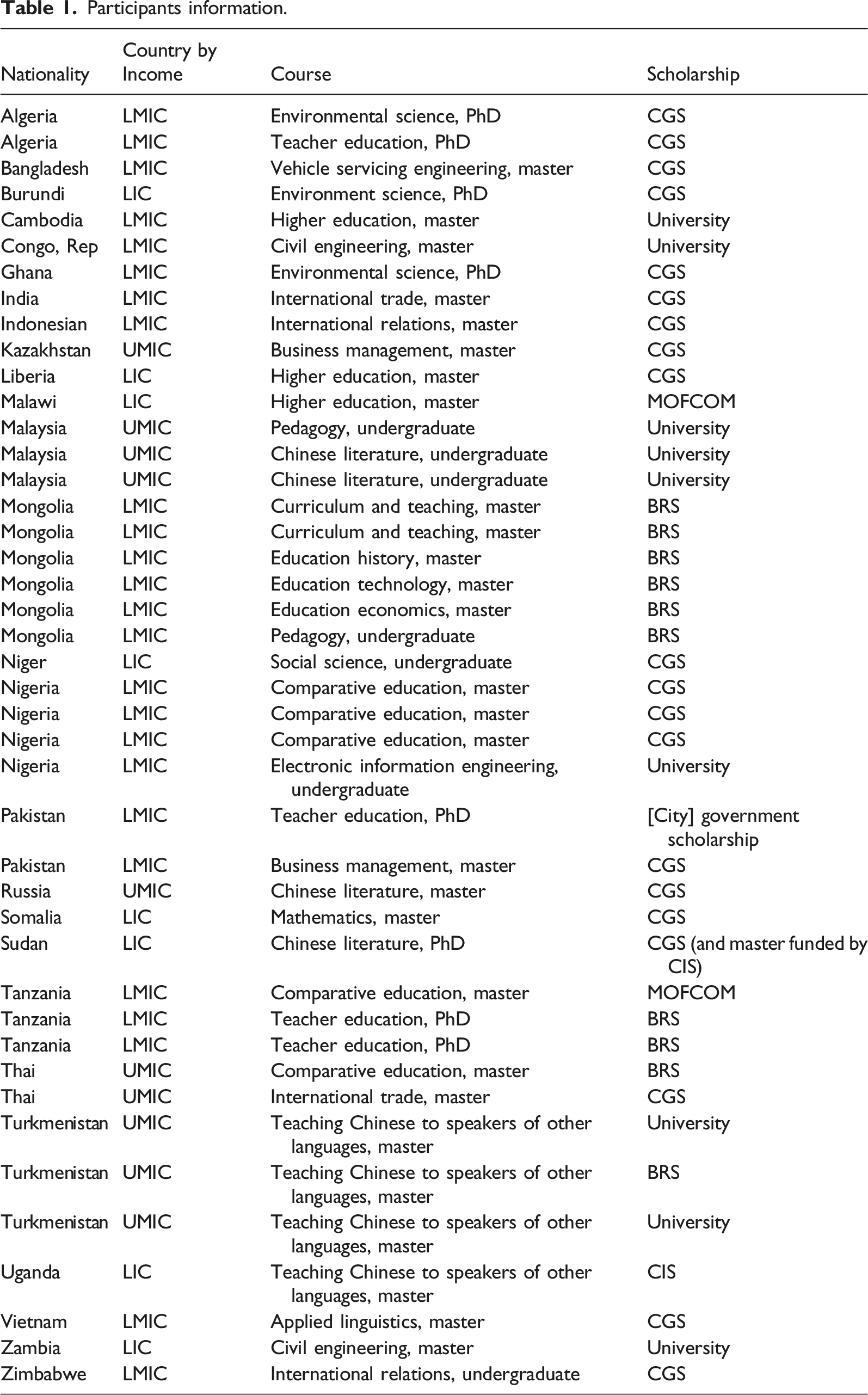
Participants were chosen based on two criteria: holding scholarships granted by China and being from a developing country. According to World Bank’s four categories of countries based on their GNI: low-income country (LIC), lower-middle-income country (LMIC), upper-middle-income country (UMIC), and high-income country (World Bank, 2022), ‘developing countries’ in this study include the first three categories (see Table 1). The participants were from eight LICs, thirteen LMICs, and five UMICs. They studied various subjects in China, including international trade, management, Chinese literature, education, and engineering, representing diverse academic backgrounds.
All participants provided signed written consent and agreed to the conversations being digital recorded. The participants were anonymised and not identified in this paper. Four types of questions were asked in the interviews: scholarship application, learning experiences, social life experiences, and value of the degree/future plans. Accordingly, the focus group/interview data were coded using eight categories: name, background, application, scholarship resource and types, study, life, future plans, and overall. Based on this, thematic results are presented in the next section. The Arabic number in their coded names shows the group number. For a more valid representation of the participants, the direct quotes are all from different students.
Results
Centralised scholarship allocation with institutional and local varieties
China has a massive scholarship system which can be seen from the scholarship types on the official website of the Chinese Scholarship Council (CSC)—‘campuschina’. In this study, the participants received four main types of scholarship: Chinese Government Scholarships (CGS); Belt and Road Scholarships (BRS); MOFCOM Scholarships (will be mentioned as 'MOFCOM' in this paper), and Confucius Institute Scholarships (CIS). Others included scholarships provided at the municipal or institutional level, such as the Beijing Government Scholarship. Compared with governmental one, these scholarships vary from fully to partially funded, some are also tied to specific universities or cooperation programmes, such as teacher education programmes. Participants considered the CGS to be more competitive and perhaps the most popular scholarship among them, with which they are fully funded, including accommodations and a stipend (CSC, 2022b).
BRS offers a similar amount of the funding. Applicants are expected to be from one of the countries along the “Belt and Road” across Asia, Europe, and Africa. It usually funds Master’s and doctoral studies only.
There was a common recognition among the participants of the strict requirements for CIS. One participant mentioned that their studies were also rigorously monitored, especially through an intensive Chinese language learning. CIS are typically awarded to students who can already speak Chinese, for example, those who have passed a Level 3 Hanyu Shuiping Kaoshi (HSK) test.
MOFCOM is another fully funded scholarship offered for Masters’ and PhD studies. Different from government scholarships, MOFCOM is sponsored by the Ministry of Commerce and eligible applicants should be public officials from a developing country. This scholarship clearly demonstrates the diplomatic and economic purposes of educational cooperation. MOFCOM also covers more expenses, such as plane tickets (CSC, 2022a).
The information the participants provided demonstrated a clear centrality of the major types of scholarships and funding allocation. There are diplomatic mission, cultural and academic purpose oriented scholarships, such as MOFCOM, CIS and CGS. BRS carries a more all-round aims, from cultural historical roots to political geographical modern vision. While the government mainly controls the funding amount and general scholarship principles, there are local varieties, such as the different languages of instruction policies (will be discussed in the following sections) and local city environments that affected students’ overall experiences.
Most students expressed satisfactions towards the generous funding amounts and coverage: R6a: ‘I applied for the Chinese and I also applied for another country, in Europe, but the scholarship was very less and I could not afford’…‘the [Chinese] universities who are offering the scholarships are the top ranking universities’. R10a: ‘no other country has given this kind of scholarship like China. China is giving many kinds of scholarship, many types, for post-doc, for Master’s, for PhD, like everything.’
Although a number of students made significant efforts to find the best universities, usually in ‘top’ cities such as Beijing, some students said they received more attention, customised support and ‘case based’ care (due to less foreign students) and enjoyed local life better in less expensive cities.
Network of information
Compared with the general positive feedback about the funding coverage, the ideas about funding application procedure were mixed. Information sources were mainly Chinese embassies and students’ personal networks. Students found that application information from previous applicants was very useful: R2a: ‘The issues [are]… for the beginner who does not know exactly how to apply, what you are supposed to do, and what your final destination of the applications, it can be a challenge, but if we have in this / the one who already benefited from the scholarships, so that they can direct you to do this and this, … especially in those attachment of the materials, the issues of Internet…’
Apart from seeking information from Chinese embassies in their home countries, students were informed (or influenced to apply) by family members, friends, and colleagues. It appeared common for them to pass information from one to another and also learn directly from their senior peers, older siblings, or parents about their experiences in China. R1a ‘my first challenge was because in [home country] we normally use Firefox Browser, … so my first challenge was to log on the CSC Website, yes, with Firefox Browser. It was very difficult. So I tried about three times and I told my cousin, who was here, and it took like 2 days to figure out how I could log on the system.’
Two participants mentioned their parents had worked in China, which had influenced them very much: R6b ‘for my childhood I just heard that China is very good and it is also very near to China, so it is also those reasons…’
In these cases, a network of experiences and information was more important than Internet advertisements or official introductions, especially for gaining advice for technical issues such as using internet and gaining required documents. However, this also suggested that it could be difficult for people who do not have a ‘network’ to identify application opportunities and related useful information. This can be also difficult for those without access to embassy information, either from physically visiting an embassy or searching for information on the Internet.
Quality improvement
The present findings, especially compared with an earlier study that interviewed retuning African students (Yuan, 2013), revealed progress and improvement in pedagogical practice (e.g. teaching methods, tutor−student relationships, rigor of the learning target and assessment, pastoral care for students) in China’s higher education provision and management.
First, the participants discussed some innovative teaching strategies and learner-centred approaches. The doctoral students use ‘excellent’, ‘very encouraging’ and ‘well organised’ to rate the teaching quality. They also highly commented the co-teaching sessions, for example, it is very engaging for them to see ‘two professors debating’. The use of posters, group discussion and end of session course evaluation were also mentioned as positive experience from them. The ‘top level facilities and labs’ and high technology, were also generally commented by the participants. R6c: ‘The instruction, attitude…they are willing to help’; R3a: ‘not just test and exam...’ R2b ‘whenever you like give a complaint, they try to act fast, like we remember last year we complain about the Chinese certificate because [it was] not translated to English, … so we went there last year and I think that issue was resolved’.
Second, the courses are seen as ‘international’, and international perspectives were commonly incorporated into their course contents: R2c: ‘We have a lot of things you know we learn here, not in a Chinese perspective, but in an international perspectives’. ‘… they try to make sure that everything we are given here it meet the international standard.’ R7a: ‘very international… you can find students from all the continents here… I compare my experience with other friends who study in xxx (a Western developed country) and they told me like they don’t see many different is happening here’
In contrast to the earlier study in which participants felt a course could be more challenging and tutors could be less ‘tolerant’ (ibid), it was very common for the participants to feel ‘strict’ and ‘hard’ in their academic journey in the present study. The participants expressed positive opinions regarding teaching quality and how they liked to be challenged. Despite sharing some specific ideas about what courses they did or did not like, participants showed a good level of appreciation for their tutors’ general support: R6d: [The tutors are] ‘beyond my imagination.’ R7b: ‘they are just dealing with you as same [to Chinese students], respecting you and helpful’ R10b: ‘the teachers were like friend, some are like our sisters, and you know/like they care us too much, care us too much.’
Another difference compared with the previous study is about tutor-student communication. In the earlier study, participants complained about their tutors’ English (ibid); however, in this study, participants recognised that tutors generally spoke fluent English, partly because many of them were trained internationally: R2d: ‘many of the Chinese Professors has experience abroad, so its also enhanced the teaching quality so much’… ‘We have some foreign professors as well.’
Notably, some students viewed China as a developing/growing country, and therefore also perceived problems in China were under a developing context. A student said that ‘the style of teaching’ and ‘soft’ part of higher education (administration; attitudes; transparency) can be improved but believed this would be a ‘transition age’ – ‘I don’t think these could be changed in a short time’ (R4a).
Language matters
As noted above, participants were generally happy with their tutors’ English; however, they had varying opinions on Chinese language learning. In general, participants’ overall satisfaction was closely associated with their Chinese language acquisition. Speaking English was not always helpful, and some of the non-English speakers found it difficult when could not speak either Chinese or English fluently.
First, one requirement for undergraduate and postgraduate recipients of the CGS is Chinese language acquisition, either HSK Level 3 or Level 4 (CSC, 2022b). It was found that fluent Chinese speakers wanted to challenge themselves with more Chinese/locally taught courses rather than English courses, while students new to Chinese experienced significant pressure to complete both subject and language courses: R1b: ‘can’t be more challenging…The Chinese idioms are so difficult…’ R2e: ‘I think there should be increased number of hours of Chinese class.’ R6e: ‘for qualitative study, it is very very important to learn the language… so I am changing a lot of things [to quantitative study] because of this’
Second, even with the international atmosphere on many Chinese campuses today, it was still hard for foreign students to ‘live’ there, either on campus or more broadly, in Chinese society. Small issues such as looking for books, even English books, always required basic Chinese language skills for students to read index and labels in libraries. In city life, it was also essential for students to acquire Chinese language skills to live more confidently.
Some research students found that research events programmes were written in Chinese only: R6f: ‘one symposium I wanted to attend, but that was in Chinese. And I really want to understand the Chinese [sessions].’
The level of Chinese language acquisition directly increased students’ study and living happiness, especially when they can be involved in the Chinese community: R3b: [the Chinese students) ‘helped us a lot’; ‘to us the advantage is that we can attend classes with Chinese students’. R7c: ‘I think for every international student, especially the undergraduate level, once you’ve been in China for just one or 2 years, it’s just the language that’s the main problem, but then over time, I think you get used to [the language]…’
Compared with the curriculum, teaching and learning practice, and facilities that students were generally satisfied, it seemed there were gaps between their academic experience and social experience. In many cases language was the main issue. Language could be the drive of their enthusiasms in China (which echoed Mulvey, 2019) but also the barrier of their social inclusion.
Value of the Chinese degree
The participants tended to link China’s rising-up to the potential value of their courses that provided them with necessary and unique knowledge, especially the knowledge for development in their home countries: R2f: ‘recently we have a lot of [nationals] coming to China so I think if I obtain my Degree from here, yes, I think it will be useful in my country’…‘so we try to explore / to sharing the experience, technology and other things like that, so it is so useful for our countries.’…‘we cannot compare Chinese with other universities and other countries because for me I think it's too unique’. R7d: ‘it has become very possible to open some Master programme and PhD programme and the [home country] needs to develop technology… then when we get PhD here it’s good for my country because those will help to open the different programmes…’ R8a: ‘the technology that is in China presently is amazing and also like in the U.S., they have all the mechanical industries, the electrical industries, the aeronautical industries … you would come to China and find out that a lot of Chinese people, Chinese companies, who have all that knowledge.’
The ‘Chinese degrees’ showed strong pragmatism (e.g. connection to students’ future careers) among the foreign students, especially foreign students from neighbouring countries. A few participants discussed the ‘value for [the] money’ (quality price ratio) of Chinese degrees, compared with expensive Western diplomas. They recognised that, when combined, the geographic location (to their home countries), education quality (with growing recognition in their home countries and globally), and price (scholarship grants and the living expenditure) won out against prestigious Western universities. This did not mean they thought China had done exceptionally well in any of these specific areas, but they evaluated the value as a package, associated with China’s economic growth and market potential: R7e: ‘because of the scholarships most of the [home country] students are coming here now …especially in Science, is cheaper and the standards here are not less than Europe...’
The last point was the value of Chinese language. Several participants recognised that having a good grasp of this language would bring them better employability in the future (e.g. a Chinese teacher or translator in their home country), or allow them to continue to live and work in China or run business between their home country and China: R10c: ‘if I can get it in China so one is my Chinese language, one is my Degree, and many opportunities will be open for me’…‘if you go to USA, if you go back to your country, you have nothing to do with … but if you came to China, learn Chinese, go back to your country, you'll find any job because there are lots of Chinese companies, they need translator/ interpreter, …you can do as a guide, many things you can do. Maybe you are going to start a business.’
Overall experience
As an ending and a summary of the group or interview discussion, the participants were asked to evaluate their overall experience (application, study and social life) on a scale of 1–10 after each interview. The higher score means the better overall experience. It was noted that the postgraduate students, especially doctoral students, gave relatively higher ratings than undergraduate students for their overall experience. Among 41 (out of 43 participants) valid answers, students all scored five or above, with an average score of 8. Two students noted that their rating increased from 5 (undergraduate) to 8 (postgraduate) and from 6 (master) to 9 (PhD) during their study.
Discussion
The above findings demonstrate the complexity of Chinese scholarships that falls into EDUCATION but more than ‘Educational’. It is cultural, political and clearly connected to China’s position of economic development. This matches the core idea of the aforementioned CCPEE approach (Robertson & Dale, 2015) which will be used to analyse the case of Chinese scholarships through the four moments of ‘education ensemble’:
Moment of educational practice
This moment considers the forms and distribution of knowledge (who is taught what) and the related circumstances (ibid). This study’s participants had a good level of satisfaction based on the forms of knowledge (especially their practicality) and of knowledge delivery (teaching and learning methods). What they are taught is seen to be very helpful to students’ post-study development in China or their home countries. These results show some similarities with Zhang et al. (2017) on PIC students’ experience about their language training, and teaching quality in China: ‘87.5% of the students believed Chinese scholarship program will be useful for their future career’ (ibid).
Related to learning experience, the findings also demonstrate students’ combined rationales for their pursuit in China. This can be explained by discussion on 'proximity': close collaboration relationships can be maintained by traditional geographic proximity, but also a multi-scaled consideration related to cognitive proximity, technological proximity, social and cultural proximity, and institutional proximity (Boschma, 2010; Baldwin, R. 2014; Mahdad et al., 2020). To participants in this study, decision to come to China are based on not only educational reasons (quality of higher education) but also geographic, cultural/family and economic reasons, and these reasons affect the ‘what’ question – they have a clear intention and expectation on what they need to pursuit.
Regarding the ‘who’ question of this moment, this paper wonders that with the rapidly increased recruitment and wide international coverage (from FOCAC to BRI countries), is there also a broad coverage of students’ social groups? The findings have shown that China’s international higher education provision has progressed at both quantitative (- attracting more foreign students) and qualitative levels (- generally satisfying the foreign students, especially in teaching and learning practice). Moreover, it contributes to the existing international scholarship flow in the Global South which could be seen as an addition to the ODA flow indicated by SDG 4.b.1. However, it is unclear whether foreign students from disadvantaged social backgrounds can easily access the necessary information, resources, and opportunities, especially when the applicants rely a lot on their ‘network of information’ as shown in the findings. Scholarships such as MOFCOM clearly states one of the eligibilities should be ‘public officials of division level and above (or corresponding level) in government sectors, or senior management staff of organizations and enterprises, or academic backbones of universities and research institutions’ (CSC, 2022a). Despite the specific requirements of each scholarship type, in this study we can also see the social status from participants’ career (for example, as officials, teachers or lecturers in their home countries) or family (for example, family business in China, private education experience) backgrounds.
Echoing the global context at the beginning of this paper, in the neoliberal trend of globalisation, the above problems are not distinct to Chinese scholarships. However, can political missions even reinforce the inequalities of higher education in developing contexts? China, as a generous provider from the Global South, may further consider what types of educational practices could contribute to educational equality and equity in developing social contexts rather than quality control only within the higher education contexts.
Moment of education politics
This moment ‘raises issues around the relationship between policy and practice, such as “how and by whom are these things decided”’ (Robertson & Dale, 2015:156)? In this case, first the education politics are multi-layered, ranging from the central government (such as the Ministry of Education and Ministry of Commerce) to local authorities and universities, with differentiations at local and institutional levels (e.g., course structure and teacher professionalism; language test policy). Second, there is also a complexity of policies. Scholarship policies are not just education policies. They can be related to education, diplomatic, (economic) development, and cultural (language study) policies. For example, there are various programmes under the Government Scholarships. The Bilateral Programme ‘accords with the cooperation and exchange agreements or consensus reached by the Chinese government and the governments and institutions of other nations’, while the University Programme seems less diplomacy driven and provides funding to ‘talented international students’ who are nominated by the Chinese universities directly (CSC, 2022b). Moreover, there are diverse types of bilateral agreements for educational cooperation. The scholarship scheme can be related to bilateral cultural agreements, memorandum of understanding, or whitepapers and action plans at a more holistic level. In a word, the scholarship policies are not just simply decided by the education sector – either Ministry of Education or any other local educational agencies but embedded in China’s political economic promises which is related to the next moment.
Moment of politics of education
This moment reflects the ‘rules of the game’ and is fundamentally concerned with both political-economic and cultural structures. A key issue in this moment, as noted by Robertson and Dale (2015: 157), is the opening up to the global market, meaning that ‘new actors’ and ‘commercial logics’ can influence education. This is interesting in the case of China, especially regarding its special position with one role as a communist country (with its socialist ideology) and another active role in the global market (following commercial logic by, for example, joining the WTO).
Some characteristics could be viewed for the particular ‘politics’ and may differ China from the Western donors. First, the current scholarship provision in developing contexts represents China’s engagement in the South-South Cooperation (SSC) that covers cooperation in multiple areas, from economic, to political, to cultural activities. Education as a sector is embedded in this complexity and interacts with other sectors. Education itself also enables people to gain knowledge in relation to the economy, culture, and politics. This role of education can be seen from the goal of China’s establishment of the Institute of South-South Cooperation and Development in 2016. It’s aiming to ‘share China’s experience in state governance and train talent from other developing countries to modernize their governance capacity’ (China Daily Global, 2021).
Second, it is challenging the traditional nature of scholarship provision in the international political economy, such as China as a non-DAC provider, using both Chinese and English as the language of instrument and being within a rising market in a developing economy that attracts applicants and graduates. In this study foreign students commonly recognise this as distinct to China and see this as a reason to come to China. Mogaji et al. (2020) have argued that Africa needs a more regulated market (rather than a Western-style free market) to better solve a combination of issues, such as inequality, poverty, unemployment, and corruption. China, although with on-going and emerging problems in its social economic political systems, is operating under different rules of the game: state regulated market economy, centralised finance for higher education, increasingly globalised educational practice contrasting its maintained culture and language. These elements collectively have attracted the international students.
Third, the scholarship provision represents China’s different logic in national and international development. From 1990s to the 21st century, there has been a shift from China’s Cold War political alignment orientation to the development oriented towards international cooperation. China has developed a strategic economic win-win relationship with developing countries in the 21st century, which has been enhanced by its engagement in cultural and people-to-people relationship (Benadballah, 2020; FOCAC, 2006). Higher education is viewed as a solid foundation and part of China’s growing soft power and international development cooperation (King, 2013; Mok & Ong, 2013; Yang, 2007). Although China was not the first one to promote higher education for public diplomacy, the country’s strong position on independent development and experience sharing demonstrates its different development logic from the Western donors (Yuan, 2014, 2019). The latter have been seen as prescribing development policies to recipient countries for decades since the end of the Second World War, including neoliberal intervention in education policies (Robertson et al. 2007).
Moment of outcomes
This moment ‘include [s] not only the immediate consequences … but also their wider personal/individual, community collective, social and economic qualities arising from the operation of education ensembles’ (Robertson & Dale, 2015: 157). A key question here is: ‘[h]ow far are the successes of some achieved at the expense of others?’ (ibid).
Here, immediate consequences can be seen from the volume growth of scholarship provision and participation in higher education especially in South-South context. However, this outcome is vaguely demonstrated due to the limitation of SDG indicators that mainly look at North-South flow in achieving global development targets.
Regarding wider outcomes, we would like to see what the ‘expense’ might be. In other words, it would be meaningful to see whether this practice contributes to education as form of global public goods, as a part of neoliberal market provision, or something else. Using McCowan’s (2016) three dimensions for higher education equity (i.e. availability, accessibility and horizontality), scholarship availability can be seen as improved to some extent, along with the accessibility from the Global South. However, it is unclear whether this group of students from the Global South will reduce the chances of accessibility for others from the same area (a justice issue). Horizontality refers to a higher education system with not only diversity but also ‘even prestige and quality’ across institutions (ibid: 659). In this case, highly ranked Chinese universities are increasingly participating in the provision of government scholarships, and they represent the quality Chinese higher education, but not all universities in China are government authorised for training foreign students with these scholarships. There are only 208 CGS institutions (less than 1/10 among China’s 3000+ higher education institutions), with 38 located in Beijing (Ministry of Education, 2014). Therefore, two types of potential expense may occur: first, will this affect the capacity of these top public universities’ education for domestic students? Second, will the enhanced international provision along with the central funding allocation in these top universities further enlarge the unequal development (e.g. resource, funding, enrolment) among all of the universities in China?
Conclusion
Foreign students’ perceptions in this study demonstrate some key features of Chinese higher education in the global context: a strong centralised investment in university scholarship for foreign students especially students from the Global South, a clear embeddedness of education in national foreign strategies (e.g. FOCAC and BRI policies) in which education as a soft power featured for shared development experiences and people-to-people relations, a challenging Chinese language training and requirement that contrasts the common use of English as a global language across universities in many developing and developed contexts (Salomone, 2022); and a well perceived good value for students’ employability or long term post-study plans.
I would like to conclude by echoing the three dimensions mentioned in the beginning of this paper. First, regarding knowledge, SDGs as targets consider the accessibility more than the nature of knowledge in higher education, but higher education plays a much extensive role across education, culture, politics and trade (Marginson, 2010). The changing global political economy brings epistemic challenges to knowledge production, prescription, and transformation, and universities are involved in making and facing these changes. The higher education provision from ‘emerging powers’ is not indicated comparably and consistently in the UN database, although these countries, such as China, are increasingly seen as development partners (rather than recipients) today. Not only the massive number of scholarships China provides to foreign students today, but also how they train the future professionals, are making an impact to the current global dynamics.
Second, in relation to space, ‘overseas’ experience is no longer equal to Western experience when students want to obtain an internationally reputable university diploma. BRI country locations have shown a new power dynamic through multiple connections including relationships built through higher education. Cultural and geographic proximities remain attractive or even become more important when students consider financial and mobility issues. This new dynamic is different from relations maintained by the historical hierarchy, such as those related to colonial legacies, and different from SSC, which focus more on the division between ‘developing’ as South and ‘developed’ as North.
Regarding capacity, this paper has revealed the limitation of the current global measurements (e.g. indicators in SDG 4) and doubt whether higher education can fulfill its role for social and global justice. Can countries such as China contribute not only to ‘quantity’ and ‘quality’ but also ‘equity’ in higher education? Despite Chinese official discourse on education quality and poverty reduction that seem to be convergent with the international agendas, and the participants’ feedback of some good practices of Chinese scholarship programmes, this paper is still concerned with the extent to which this provision can benefit more students from disadvantaged background in the developing context due to their lack of network and access to information. While countries today are keen on linking capacity to the ‘world class’ status and ‘greatness’ of a university (Robertson, 2021), which can be seen from these internationally or nationally top ranked Chinese universities that are authorised for the scholarship programmes, more explicit global policies with official measurements are needed to examine universities’ contribution to not only greater international flow of students but also higher social mobility at the global level.
Footnotes
Declaration of conflicting interests
The author(s) declared no potential conflicts of interest with respect to the research, authorship, and/or publication of this article.
Funding
The author(s) disclosed receipt of the following financial support for the research, authorship, and/or publication of this article: A part of the fieldwork was funded by an internal research grant from the School of Education, Bath Spa University.
