




Abstract
Utilizing a national longitudinal sample from China Family Panel Studies (2018), this study examined how family socioeconomic status (SES) is related to young children’s learning behaviors through parental expectation, parental involvement and home learning environment. A total of 1348 children aged 3–5 years were included. Mediation analysis was conducted to test the hypotheses. The results identified a significant relationship between family SES and home learning environment and parental involvement, whereas family SES was only partially related to parental academic expectations. There were no statistically significant relationships between SES and children’s learning behaviors. Moreover, no indirect effects were found between parental expectation, home learning environment, and children’s learning behaviors. However, parental involvement had an indirect effect on children’s learning behaviors. The present study highlights the need to consider the role of parental involvement in supporting the development of young children’s learning behaviors. The findings and discussions raise implications for researchers and practitioners to provide parental involvement support programs for Chinese families from diverse SES backgrounds.
To date, many educators and researchers are devoted to investigating how family and parent factors predict children’s development. For example, Bronfenbrenner’s ecological system theory suggests that child development is a complex system affected by multiple levels of their surrounding environment, with family and parent attributes sitting in the hub of this system (Bronfenbrenner & Morris, 2007). Dearing and Tang (2009) further specifically depict the reciprocal relationships among home learning environment, parental expectation, parental involvement, and children’s development and learning. Super and Harkness (1986) claim that children are shaped by three subsystems of developmental niche: the physical and social settings, the customs and practices, and the psychology of the caregivers. As one important predictor, parental belief systems will affect the type of home environment and parenting techniques parents will use, which will ultimately predict children’s development and learning outcomes.
Although abundant studies have been done to examine how family SES is associated with children’s development and learning, studies that focus on preschool children and Chinese families are still inadequate. The purpose of the present study is to use a national-wide household survey dataset, the latest China Family Panel Study (CFPS) 2018, to assess the relationships among family socioeconomic status (SES), parental expectation, home learning environment, parental involvement and Chinese 3–5 years children’s learning behaviors. Studies concerning early childhood education in China received less attention. The CFPS provides invaluable information about Chinese young children and their families regarding early childhood education. However, existing research that is based on CFPS and focuses on the early years is limited. Therefore, the present study will expand the literature on early childhood education by adding more Chinese context. Moreover, family SES is often used as a composite measurement, however, there are studies demonstrating that family income and parental education affect the home learning environment and parental involvement differently (e.g., Son & Morrison, 2010; X. Zhang et al., 2021). Therefore, this study will look into detail if parental education and family income are differently associated with home learning environment, parental involvement and young children’s learning behaviors in Chinese context and how.
Literature Review
Family socioeconomic status (SES), a combined measure of parental education, parental occupation, and family income (Stevens & Featherman, 1981), is considered an important factor in predicting children’s optimal development (Loft & Waldfogel, 2021), academic achievement (Ogg & Anthony, 2020) and children’s learning behaviors (Luo & Gao, 2022). Some studies found that the three components of SES correlate to children’s learning differently. Son and Morrison (2010) claimed that income itself did not result in significant changes in physical home learning environment. X. Zhang and colleagues' (2021) meta-analysis research demonstrated that although both family income and parental education significantly predicted young ESL learners' vocabulary development, parental education is a stronger predictor respectively. Thus, although this study will examine how SES affects the researched dependent variables, I will look at each SES component separately. The influence of SES on children’s learning and achievement is widely believed to be mediated by parental involvement (Tan et al., 2020; F. Zhang et al., 2020). Tan et al. (2020) further summarized six types of parental involvement that are important predictors of children’s learning and achievement, among which, parental expectations, interactional strategies (e.g., shared reading), and parental tutoring are the interest of the present study.
Poon (2020) found that parents from high SES backgrounds tended to set higher academic expectations and involve more in children’s learning both at school and at home. Parental academic expectation positively influences children’s learning because children tend to internalize parents’ expectations and beliefs about learning and achievement (Cheung & Pomerantz, 2012), leading to higher self-regulatory learning behaviors and ultimate school engagement and attainment. Chinese parents were found to place a high value on children’s education, resulting in a prevalent phenomenon that Chinese parents place high educational expectations on their children independent of family SES (Butler, 2014). This study thus aims to test if Bulter’s findings could be found.
Family SES is also strongly linked to the quantity and quality of parent-child interactions. According to Adams (1990), by entering primary school, children from middle SES backgrounds received 1000–1700 hours of shared reading at home, outdistancing children from low SES households who only got 25 hours of shared reading. This difference is still existing. Barnes and Puccioni (2017) found that the quantity and quality of parent-child reading significantly vary between different SES families, with more frequent and more high-quality shared reading in higher SES households, as high SES families are academically and financially competent in supporting and involving in their children’s education (Tan et al., 2020). Given parental involvement, a number of studies demonstrate that it contributes to improving children’s social and emotional functioning, including enhancing their self-esteem, self-management, and social awareness (Christenson, 2004). Parental involvement is also associated with children’s high academic performance (Galindo & Sheldon, 2012), high parent-oriented motivation and self-regulated learning (Cheung & Pomerantz, 2012), and reduction in challenging behaviors (Stormshak et al., 2009).
Examining home learning environment, according to Dearing and Tang's (2009) conceptual framework, home learning environment and parent/family characteristics are reciprocally influenced by each other. Parents’ attributes, such as their skills, knowledge, and motivation, will influence their expectations, beliefs and values about children’s learning, which will directly determine what kind of home environment that parents will provide for children. All of these factors play a key role in cultivating children’s motivation and attitudes about learning, and eventually positively predict children’s achievement. Empirical evidence supports this loop. For example, the findings from studies by Peixoto et al. (2022) revealed that mothers’ literacy beliefs predict the quantity and quality of home literacy practices which will eventually contribute to children’s language and literacy development. Although the present study will not attempt to establish the correlation between family/parent characteristics and children’s ultimate learning outcomes, according to Dearing and Tang's (2009) home learning framework, children’s learning behaviors will mediate the effects that how their parents perceive child development and what kind support that parents can provide have on children’s achievement. Therefore, this study is going to explore what kind of family and or parent factors influence children’s learning behaviors and how.
Based on the literature I have reviewed; I proposed a hypothesized parallel mediator model examining the interrelationships among family SES, parental expectation, home learning environment, parental involvement and children’s learning behaviors (see Figure 1). Specifical hypotheses are presented as follows: Hypothesis 1: Family SES positively predicts parental expectation, home learning environment, and parental involvement. Hypothesis 2: Family SES has a significant effect on learning behaviors mediated by parental expectation, home learning environment, and parental involvement. A parallel multiple mediator model for the present study.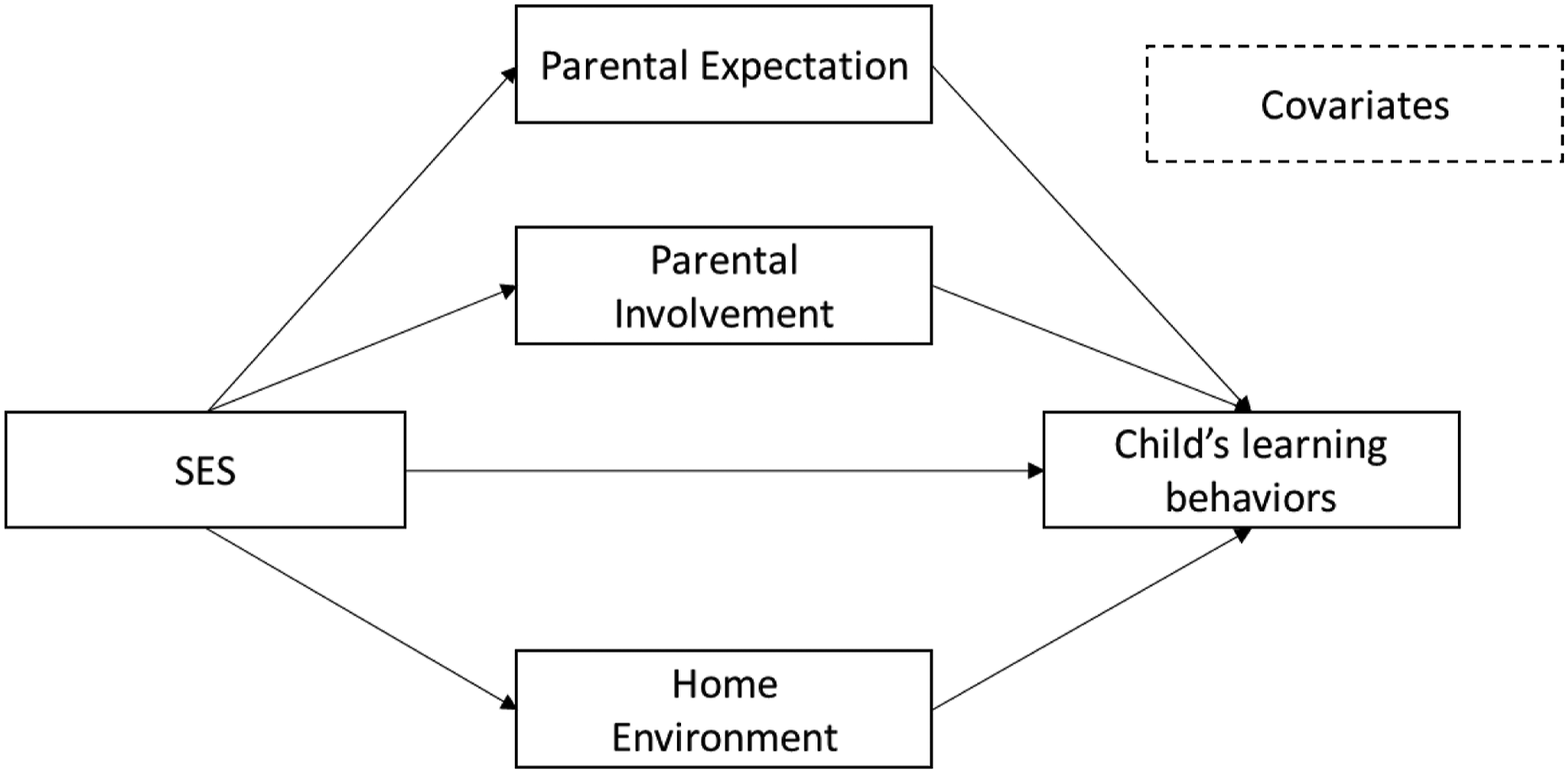
Method
Data and Sample
The present study is based on the CFPS2018 dataset. CFPS is a nationwide longitudinal survey conducted by Peking University and aims to depict a comprehensive image of contemporary Chinese individuals’ lives and perspectives from a variety of lenses, including family dynamics, education, economic status, health, and child-rearing, etc. (Xie & Hu, 2014). To date, six waves of CFPS have been conducted. This study depended on the CFPS2018 dataset to explore how family and parent factors are related to young children’s learning behaviors. CFPS2018 was conducted by face-to-face or telephone interviews. It employed a three-stage probability proportional to size sampling in the ordinal level: 1. city or county, 2. neighborhood community, and 3. household (Xie & Hu, 2014). Socioeconomic development (i.e., local GDP) and the size of administrative units were used as implicit stratification to ensure a better representation of Chinese society. CFPS2018 consists of five questionnaires: 1. family roster questionnaire; 2. family economic questionnaire; 3. individual self-report; 4. individual proxy questionnaire; 5. child proxy questionnaire (Wu et al., 2021). All five questionnaires can be linked using individual, family, and proxy identifiers. This study integrated the family economic questionnaire and individual self-report into the child proxy questionnaire to add SES and parental information. Listwise deletion approach was used to remove participants if the cases cannot be linked with the other two questionnaires, leading to 25.6% of case deletion. Another 1% of cases were deleted due to over 60% of missing data. The final sample includes 1348 children aged 3–5 years.
Measures
Children’s learning behavior
Young children’s learning behavior was measured by parents’ reports on a 5-point Likert scale from “Totally disagree (1)”, “Disagree (2)”, “Neither agree nor disagree (3)”, “Agree (4)” to “Totally agree (5)”. CFPS measured seven items: studying hard; checking homework; playing only after homework; concentrating on what is doing; respecting rules; always completing what is doing; keeping school things in order. A series of questions featuring display logic are related to this measurement. Parents of children who are enrolled in daycare or kindergarten were first asked if their children had homework last semester. If yes, parents were further asked to evaluate their children’s learning behaviors aforementioned. Face validity was checked according to existing literature. For example, homework checking that seems unusual for preschoolers was also identified as one popular parental involvement interaction in Lau and colleagues’ study that focused on Chinese kindergarten children in Hong Kong and Shenzhen (Lau et al., 2011). This is consistent with the findings from Mao (2020) that found Chinese parents are frequently engaged in helping with homework and homework checking. Pearson’s rs were calculated to check the convergent validity, with all rs=.8 or above (ps<.01, two-tailed), indicating a high level of positive convergent validity according to Terwee et al. (2007). Cronbach’s α was run and the score (α=.74) indicated acceptable internal reliability. Then a composite score on children’s learning behaviors using the mean of each item was computed.
Family socioeconomic status
Family SES is indicated by parental education, parental occupation, and annual family income. Due to a large amount of missing data on parental occupation, in the present study, family SES was indicated by parental education and annual family income. Following Yang et al. (2020), parent’s level of education was transformed into a five-point Likert scale: 1 = below elementary school and elementary school; 2 = junior high school, 3 = senior high school; 4 = bachelor’s degree; 5 = postgraduate and doctoral degrees. Annual household income was measured, and the scores were standardized for later analysis. Previous studies often compute an SES composite score as one independent variable. However, studies that focus on examining the relationships between SES and home learning environment and parental involvement demonstrated that family income and parental education affect home learning environment and parental involvement differently (e.g., Son & Morrison, 2010; X. Zhang et al., 2021). Therefore, this study decided to explore how family income and parental education predict the examined variables separately.
Parental expectation
Child’s future education degree was used to imply parents’ educational expectations for their children. The CFPS asked parents to express their expectations for their children’s highest education degree (1 = elementary school and below; 2 = junior high school, 3 = senior high school; 4 = bachelor’s degree; 5 = postgraduate degree).
Parental involvement
Specifically, four items were used to measure parental involvement: 1. frequency of shared reading; 2. frequency of buying books for children; 3. frequency of outdoor play; 4. frequency of learning games. All the items were measured on a 5-point Likert scale: 1 = several times a year or less; 2 = once a month; 3 = 2–3 times a month; 4 = several times a week; 5 = every day. Face validity was first examined based on existing literature. Previous studies have shown that parents of preschoolers involve in various home involvement discussed in the present study (e.g., Kwok, 2015; Lau et al., 2011; Mao & Pesco, 2022). Convergent validity was further examined. Forty percentage of tested correlations are scoring at .68 or above in Pearson’s r (all ps < .01, two-tailed). The rest is at .3 or above, meaning the parental involvement measurement selected in the present study reaches a positive convergent validity at a moderate to high level according to Terwee et al. (2007). An internal consistency test was run and Cronbach’s α = .68, indicating fairly acceptable internal reliability. A composite score based on mean value was computed.
Home learning environment
To better understand the home environment, the interviewer observed and rated at a 5-level Likert scale from “strongly disagree to strongly agree” regarding if the home environment indicates parents’ care about children’s education, for example, if books and other learning materials that are designed for children were observed by the interviewers.
Covariates
Child, parent, and family characteristics that might affect children’s learning behavior were controlled. These include child age (3, 4, 5) and gender (0 = girls, 1 = boys), child’s school attendance status (0 = not attend school, 1 = attend), residency type (0 = rural areas, 1 = urban areas), and family size (= 2–20 family members).
Analytic Strategies
SPSS 26 version was used to analyze data. Overall, this dataset had minimal missing data (2.9%). Except for the following five items which had more missing data (range = 16%–29%), including “interviewer’s rating in parents’ care about child’s education”, “keeping school things in order”, “respecting rules”, “concentrating on what is doing”, “always completing what is doing”, all other variables had minimal missing data (<5%). Multiple imputation technique that is considered one of the most plausible methods (Prime et al., 2014) was utilized to deal with all missing data. Missing values were substituted with plausible values based 10 times imputations and the result was pooled. Correlation analysis and multiple regression tests were first carried out to interpret the linear relationships among all variables. To explore if children’s learning behaviors are influenced by SES mediated by parental expectation, home learning environment and parental involvement, parallel multiple mediation tests were run using the macro Process for SPSS (Hayes, 2018). In parallel multiple mediator models, the dependent variables are influenced by independent variables directly and by two or more mediators indirectly which are not causally influencing one another though they might be correlated with one another (Hayes, 2018).
Results
Descriptive Statistics
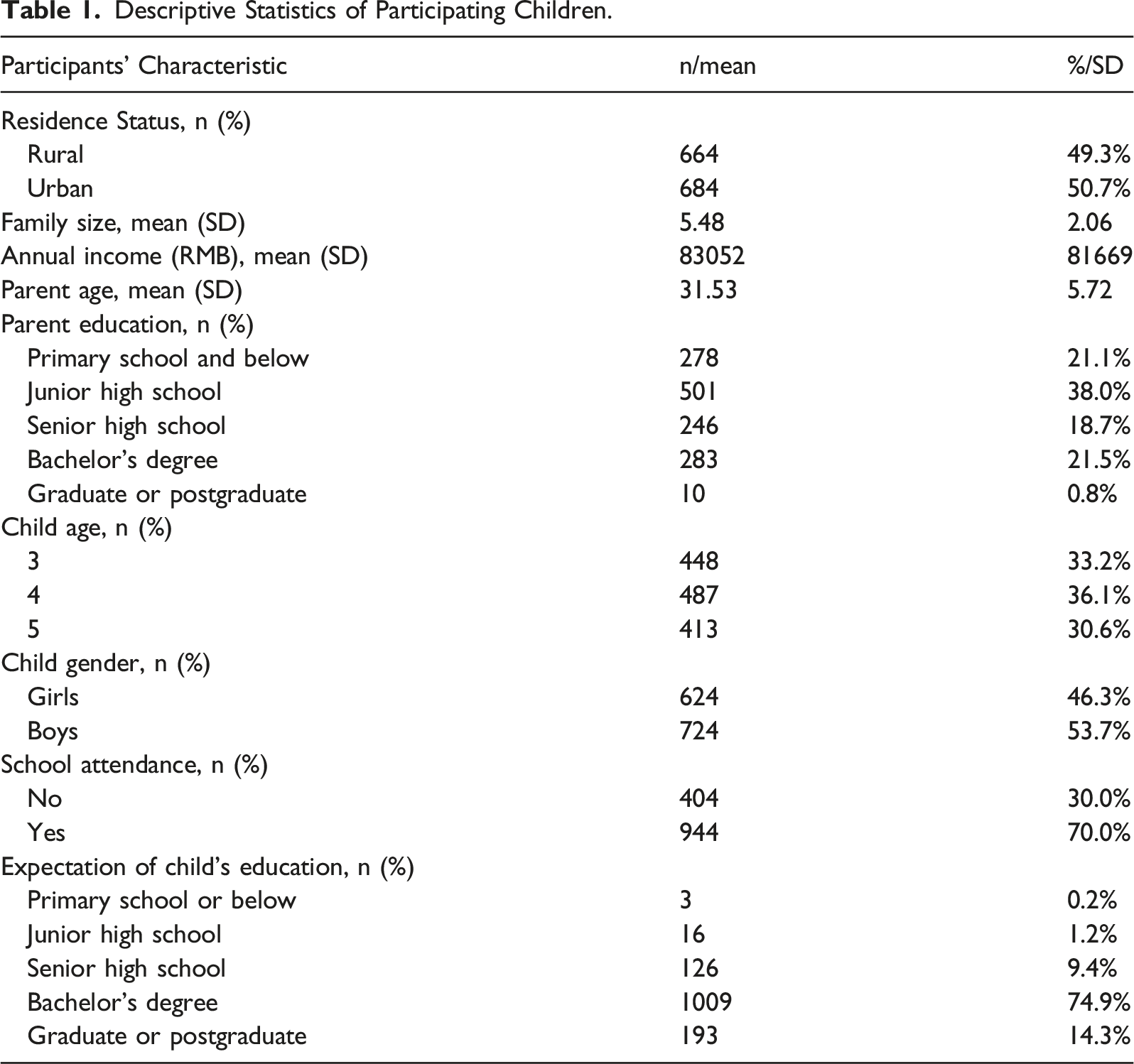
Descriptive Statistics of Participating Children.
Correlation Analyses
Pearson’s Correlations Among Study Variables.
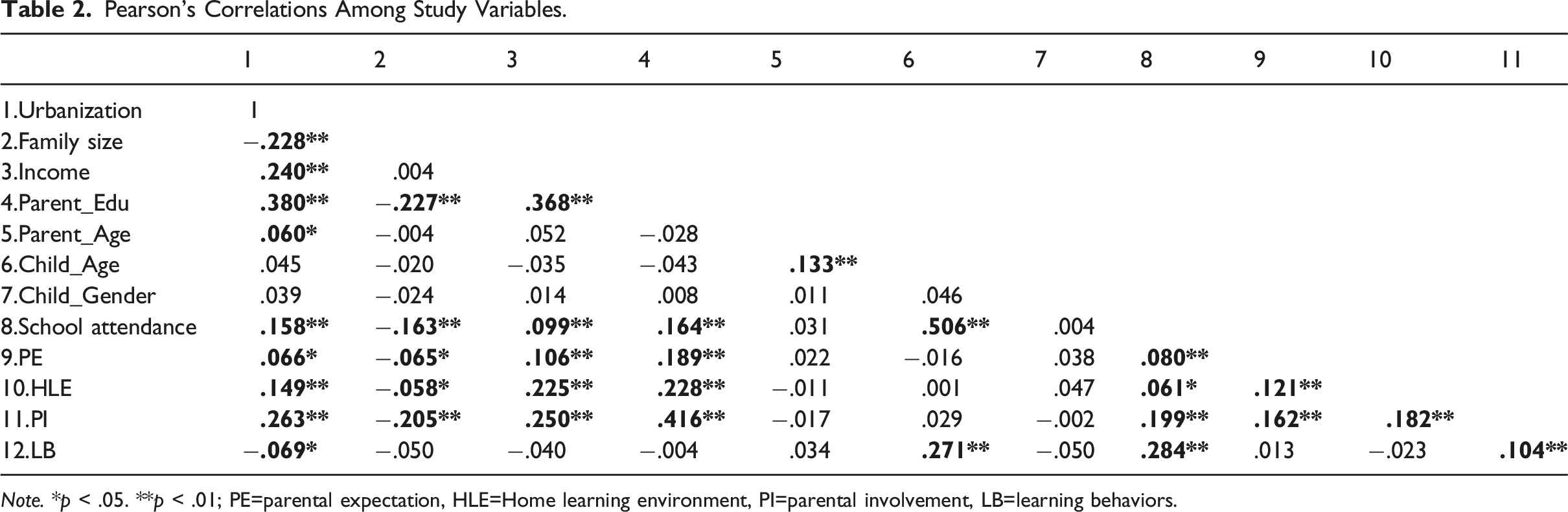
Note. *p < .05. **p < .01; PE=parental expectation, HLE=Home learning environment, PI=parental involvement, LB=learning behaviors.
Multiple Regression Tests
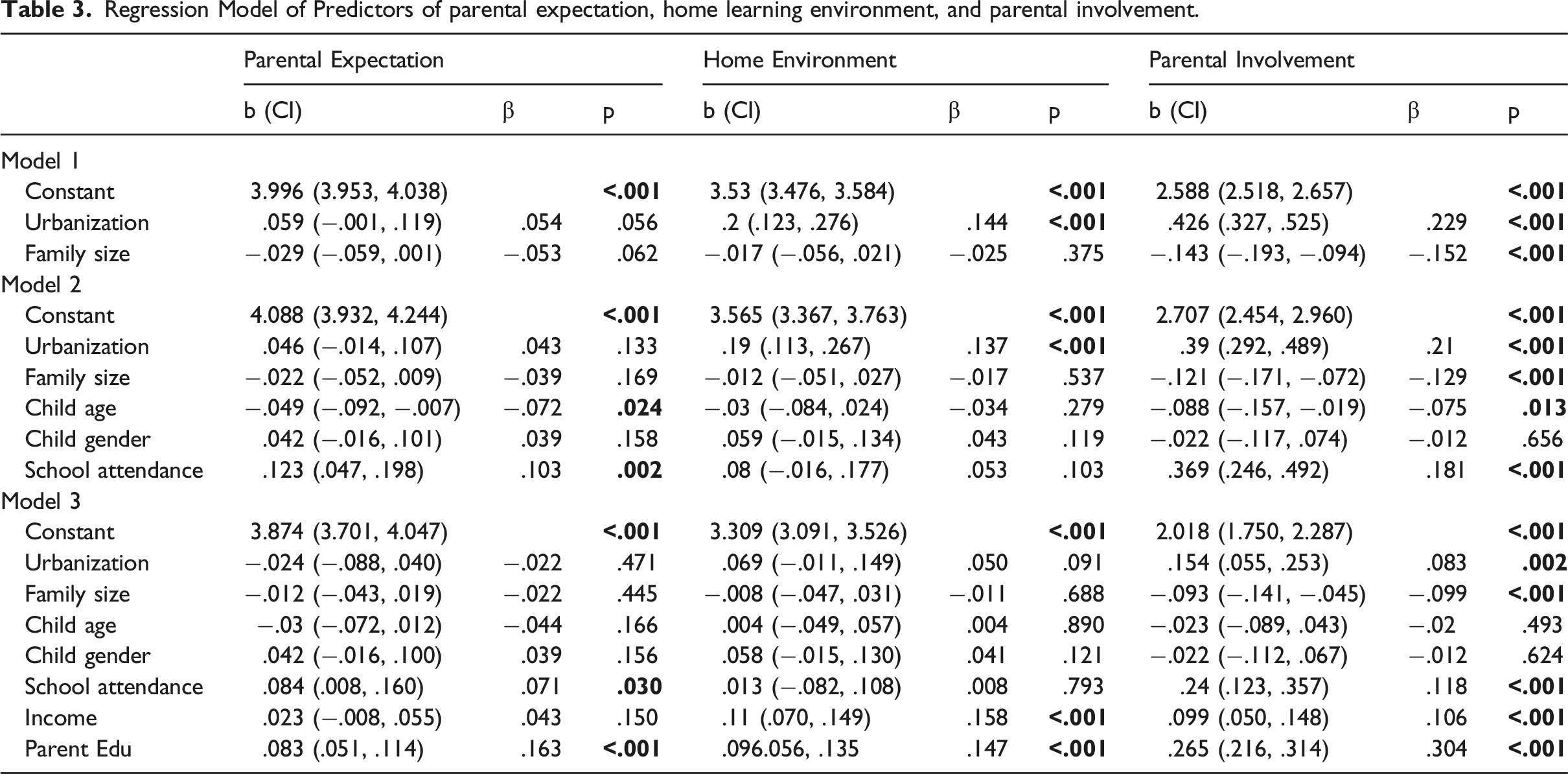
Regression Model of Predictors of parental expectation, home learning environment, and parental involvement.
Mediation Effect Tests
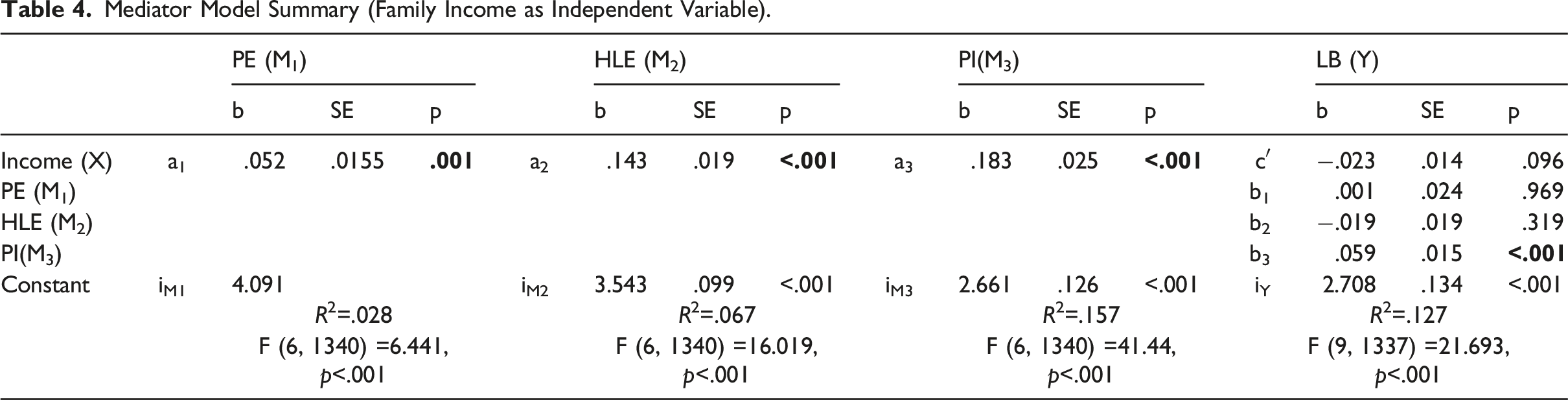
Mediator Model Summary (Family Income as Independent Variable).
Mediator Model Summary (Parent Education Level as Independent Variable).
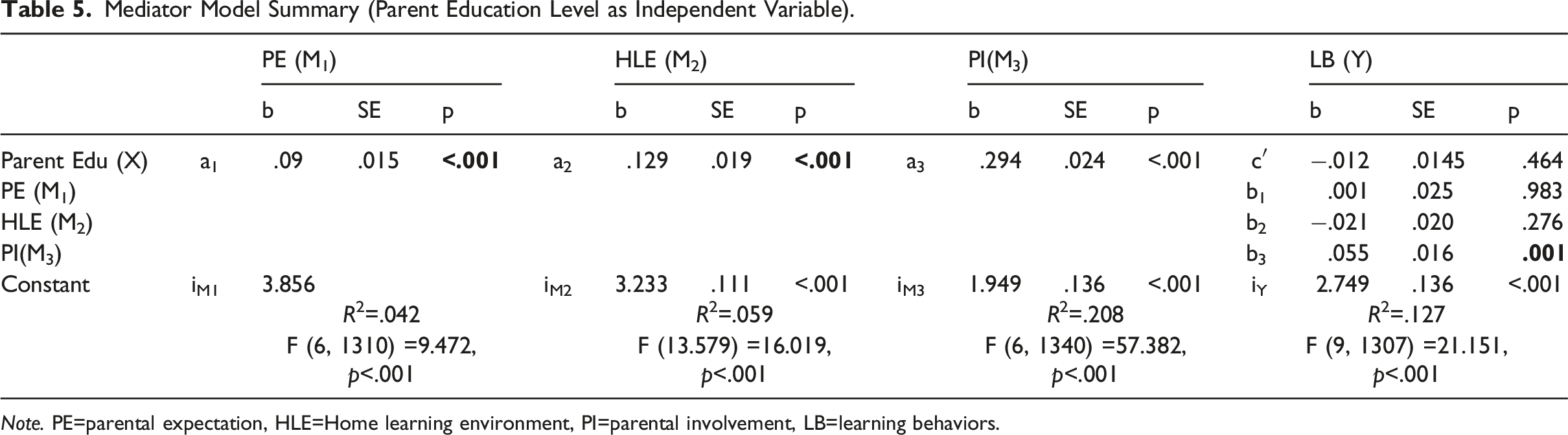
Note. PE=parental expectation, HLE=Home learning environment, PI=parental involvement, LB=learning behaviors.
Discussion
Examining the results from multiple regression tests and mediation analysis, similar trends were identified. SES significantly and positively predicted home learning environment and parental involvement, and partially predicted parental expectation, supporting hypothesis 1. Home learning environment was significantly predicted by two SES factors which is in line with previous studies (Barnes & Puccioni, 2017; Miser & Hupp, 2012). Except for child age and child gender (no significant correlations) and family size (significant negative correlation), all other variables significantly positively correlated to parental involvement. These findings were also suggested by previous studies (Barnes & Puccioni, 2017; Poon, 2020). It is worth noting that family size negatively affects parental involvement which is also identified by (Prime et al., 2014). In 2016, one-child policy was lifted in China, this finding would raise valuable implications for Chinese families. As suggested by many studies, parental resources will be diluted as the children increase, however, the decrease in parental involvement and resources in big size family can be compensated by sibling interactions (Backer-Grøndahl & Nærde, 2017; Prime et al., 2014).
The relationships between SES and parental expectations are mixed. According to the results from multiple regression tests, parental expectation about their children’s future education level was only significantly predicted by school attendance and parents' education level. Also, data showed that 89.2% of parents expected their children to have a bachelor’s degree or above as shown in Table 1. However, mediation analysis demonstrated that parental expectation was linked to both family income and parental education, although with a relatively lower effect size in family income. It is consistent with the mixed results revealed by previous studies. For example, Poon’s (2020) study showed a strong and positive relationship between SES and parental expectations, whereas De Keyser et al. (2020) found an opposite path, reporting significantly higher academic expectations in low-SES households than high SES families.
Examining the studies that were specifically conducted in China, the relationships between SES and parental academic expectations are also mixed. For example, Butler (2014) found no differences between different SES groups regarding parental expectations of students’ English learning. Whereas consistent with the present study, the findings from Luo and Gao (2022) only identified the positive association between parental education level and parental expectations, not family income. This finding could be explained by parents’ cultural belief in “万般皆下品, 惟有读书高” (All jobs are inferior and only study is superior) and expectations of “望子成龙, 望女成凤” (Wishing the children become big shots), indicating that Chinese parents widely hold a high expectation on their children’s education with no relation to SES and other family characteristics.
However, differing from previous studies (Backer-Grøndahl & Nærde, 2017; Luo & Gao, 2022), hypothesis two was not supported, indicating that SES did not present significant direct effects on children’s learning behaviors. Moreover, except for parental involvement, all other two variables were not found significant individual indirect effects. One possible reason for this inconsistency is that the present study only focused on 3–5 years children. As identified by previous studies (Warash et al., 2017), parents of preschoolers tended not to emphasize learning. Additionally, the subscales of child’s learning behaviors measurement could ascribe to these non-significant findings. For example, parents were asked if their children respected rules, concentrated in class, and persisted in what is doing. More than child’s learning behaviors, these subscales reflected a cultural and moral value in respecting orders and perseverance which is highly emphasized in many Chinese families (Li et al., 2014). These cultural values could be less correlated to SES or other family characteristics.
Limitations and Future Directions
This study has some limitations that should be taken into account when interpreting the results. First, future studies could include other longitudinal research methods, for example, experimental and interventional studies, to further investigate the causal conclusions and establish the direction of the associations between parental involvement and children’s learning behaviors. Qualitative research may also be needed to help interpret the associations between family and parental factors and children’s learning. Second, in terms of the CFPS measurements, as the lack of standard, it solely depends on the researchers to interpret which set of questions measures a specific variable. Therefore, slightly different from Luo and Gao (2022), the present study also included the interviewers’ report based on their observations to represent the home learning environment. Additionally, the CFPS measurements were self-reported and might cause the issue of social-desirability bias (Rosenman et al., 2011). To address the above concerns, future studies may employ existing inventories to measure the variables.
Conclusion
In summary, the findings from the current study found that both family income and parental education level were significantly related to home learning environment and parental involvement, whereas only parental education level predicted parental academic expectations. There were no statistically significant relationships between SES and children’s learning behaviors, but parental involvement had an indirect effect on children’s learning behaviors. I would consider this finding a good sign as SES is quite a fixed indicator that educators cannot do much to change. Parental involvement’s positive association with children’s learning behaviors independent of family income and parental education raises implications for educators and practitioners regarding designing parenting programs for families from diverse SES backgrounds. A question remains as to how to design a program that parents favor, can easily implement at home and meanwhile will maintain even after the intervention or experiment is over. Parental involvement as a popular topic has been extensively studied and quite a few specific techniques are proposed and examined, for example, dialogic reading, parent-child coviewing TV programs, reminiscing conversations, etc. Although as discussed above, these parental interaction techniques are tested to be strong predictors of children’s development and learning, few studies were done to explore how parents perceive parental involvement. As a result, a high dropout rate (40%) from parent intervention projects was identified by both Justice et al. (2015) and Lonigan and Whitehurst (1998). I believe that only when learning is reflecting both parents’ and children’s psychological characteristics and is situated in the context of both their social environment do parents and children learn best. Therefore, I proposed that in order to be successful, parental involvement program practitioners must recognize what parents and children truly need and want to learn and collaborate with them to design the programs that best suit both parents’ and children’s needs and interests.
Footnotes
Declaration of conflicting interests
The author(s) declared no potential conflicts of interest with respect to the research, authorship, and/or publication of this article.
Funding
The author(s) received no financial support for the research, authorship, and/or publication of this article.
