



Abstract
This exploratory quantitative study investigates the relationship between online learning readiness (OLR) and self-regulated learning (SRL), precisely the effect of OLR on SRL in an online learning context among 262 Chinese college students taking fully online courses. Results indicate that students’ OLR positively influences SRL. Specifically, communication competencies play the most significant role in affecting students’ online SRL, followed by technical and social competencies. Furthermore, Chinese college students with higher communication and technical competencies better manage their study time and self-evaluate their online learning. Likewise, students who are more capable of engaging in meaningful interactions with their instructor and peers are more likely to self-assess their learning. This exploratory study provides an overview of the correlation between OLR and SRL. It highlights the necessity of preparing college students in China, where face-to-face instruction was predominately used before the COVID-19 pandemic, to succeed in online learning.
Keywords
Introduction
The COVID-19 pandemic has significantly impacted instruction delivery for the past few years as online learning has become a primary approach among universities worldwide. In some countries, students have been undergoing fully online courses for the first time. For example, the traditional face-to-face instruction had been used as a predominant course delivery in universities in China (Thongsri et al., 2019) before the outburst of the COVID-19 pandemic. During the emergent transition from face-to-face to fully online learning in response to the pandemic, most Chinese college students were forced to experience the online learning modality without readiness. This maladaptation may bring challenges to their learning strategies within the online context. Specifically, students must become independent in online environments to self-regulate their learning. In other words, online learning— a time-independent learning format—requires students to equip with self-regulated learning (SRL) strategies to independently plan and manage their learning process (Broadbent, 2017). Previous studies noted that students with high SRL believe online learning could develop their knowledge and skills (Littlejohn et al., 2016), and these students can effectively interact with their learning content and thus achieve their learning goals (Kizilcec et al., 2017). Although using SRL strategies would positively impact one’s learning (Wong et al., 2021), students usually report difficulties using SRL strategies to sustain a commitment to their coursework (Artino, 2008). One reason is that online students may not be prepared for online learning, and they find tasks related to online SRL overwhelming and challenging in an environment where they need to determine when and how to engage with the learning content all by themselves (Kop, 2011; Lajoie & Azevedo, 2006). As a result, students’ online learning readiness (OLR) would influence their implementation of SRL strategies.
Due to the pandemic, fully online instruction has been offered for all former courses in Chinese universities across the nation. Since face-to-face learning was the main learning format, it is assumed that most students would have difficulties self-regulating their learning because they may not be ready for fully online learning. Therefore, this exploratory study aims to investigate the relationship between OLR and SRL, focusing on the effect of OLR on SRL among Chinese college students taking fully online courses. The research question that guided this study was what is the relationship between online learning readiness (ORL) and self-regulated learning (SRL) among Chinese college students in fully online learning environments? It is expected that this study will provide an overview of the correlation between OLR and SRL among college students attending online classes in China, so as to enlighten higher education professionals to better prepare these students with the necessary knowledge and skills for future online learning.
Literature Review
Self-Regulated Learning
Zimmerman (2008) defined SRL as “the self-directive processes and self-beliefs that enable learners to transform their mental abilities into an academic performance skill” (p. 166). SRL is a reciprocal interaction of personal, environmental, and behavioral factors. Personal factors consist of self-efficacy, goal orientation, and metacognition; environmental factors include instruction, peer learning, and help-seeking; behavioral factors contain learning performance (Schraw et al., 2006). In short, SRL is an active constructive process that involves goal-orientation, self-efficacy, self-control, motivation, cognitive strategy, and metacognitive self-regulation (Pintrich & Zusho, 2002). Zimmerman (1994) proposed a conceptual framework for academic self-regulation, which consisted of six major psychological dimensions: Motive (why: students’ motivation to regulate their own learning), Method (How: the method dimension of self-regulation), Time (When: the time dimension of self-regulation), Performance (What: the overt behavioral performance of self-regulated learners), Environmental (Where: the study place or the use of instructional supports), and Social (With whom: the social dimension of self-regulation) (Zimmerman & Risemberg, 1997). Based on the framework, self-regulated learners are often self-motivated; they use metacognitive learning strategies and usually report a high-level academic performance (Zimmerman & Pons, 1986).
Because SRL requires learners to continuously adjust cognitive activities and processes to adapt to a specific learning situation (Garcia & Pintrich, 1991), thus SRL is “highly context-dependent” (Zimmerman & Schunk, 2001, p.125). Compared to face-to-face learning, the online learning context is more challenging as it demands higher levels of self-regulation (Maldonado-Mahauad et al., 2018). One reason is that students must be independent and self-regulated to keep themselves cognitively engaged and motivated during their learning processes (McMahon & Oliver, 2001). Therefore, effectively using SRL strategies is key to students’ successful online learning. Previous studies proved that SRL learners usually engage more deeply with coursework and show better academic achievement (Zimmerman, 2002) within an online context. For example, Sun and Rueda (2012) investigated 203 online college students’ self-regulation and their behavioral, emotional, and cognitive engagement in an online learning environment. Their results showed that self-regulation is positively correlated with all types of engagement, indicating that students with higher levels of self-regulation demonstrate higher levels of engagement.
Additionally, learners’ SRL directly impacts learners’ engagement with learning activities in the online learning context. For instance, using mixed research methods to survey 788 MOOC participants and follow-up interviewing 32 learners to compare learning behaviors between learners with high and low SRL profiles, Littlejohn et al. (2016) found that learners with high SRL profiles are more engaged in learning activities and materials that meet their individual needs or interests, while learners with low SRL profiles complete all activities and evaluations simply to obtain a certificate and complete the course. Kizilcec et al. (2017) further looked at 4831 learners’ SRL in asynchronous online courses. Results revealed that learners with stronger SRL skills, mainly those who repeatedly use metacognitive strategies such as goal setting and strategic planning, are more engaged with reviewing previous course materials, particularly after the course assessment. Furthermore, using a mining approach to explore interaction sequences among 3458 online learners, Maldonado-Mahauad et al. (2018) identified three clusters of learners based on their interaction sequence patterns. Specifically, learners with the highest SRL profile are categorized as comprehensive learners, meaning that these learners are more engaged with gaining a deeper understanding of the learning content. Learners with a lower SRL profile compared to comprehensive learners are classified as target learners who often strategically engage with specific course content to pass the assessment. Lastly, learners with the lowest SRL profiles are sorted as sampling learners. These learners usually show more erratic and less goal-oriented behaviors. In sum, online SRL is a significant component affecting learners’ learning and course engagement within the online learning context.
Online Learning Readiness
OLR refers to the “cognitive awareness and maturity that a student develops for successful learning in a web-based environment. It manifests in the attributes of recognizing the self-directed nature, formulating learning strategies, obtaining technology competencies, adjusting to digital etiquettes, and being open for help-seeking” (Liu & Kaye, 2017, p. 242). Scholars described OLR as the ability to benefit from the advantages offered by online learning (Lopes, 2007), to utilize online learning resources and technologies to increase the quality of learning (Kaur & Abas, 2004), as a combination of students’ preferences for online delivery, their competence and confidence in using online communication, and their ability to engage online learning (Warner et al., 1998). In short, the concept of OLR depicts an individual’s preparedness to perform learning activities in an online environment (Liu, 2019) and the extent to which an individual possesses the prior knowledge, cognitive learning strategies, and motivation for an effective way of online learning (Yurdugul & Demir, 2017).
Three components comprise OLR: communication, technical, and social competencies. Yu (2018) furthermore divided the social competencies into social competencies with instructors and social competencies with classmates. These four factors were found to positively impact students’ learning outcomes and learner satisfaction, and they play significant roles in enhancing student retention in online learning (Carey, 2011; Lee & Choi, 2013). In addition to highlighting the importance of technical competencies for online learning, Yu’s OLR model with the four constructs identity social competencies as the most important factors for learning readiness in an online learning environment. One reason is that in online learning environments, students usually develop a sense of isolation and loneliness due to a lack of interpersonal relationships with their instructors and peers, leading to a perceived disconnection from the learning community (Bowers & Kumar, 2015). Students’ feeling of isolation would increase the online course dropout rate (Bowers & Kumar, 2015). Therefore, learners’ social competencies significantly impact students’ academic integration in the online learning environment. Meanwhile, communication competencies also assist students in help-seeking and peer support, enabling reciprocal learning. In short, the level of social and communication competencies would guarantee academic integration (Tinto, 1975; Yu, 2018) and allow students to hold commitments to their study goals, thus increasing online learning retention.
Scholars noted that OLR is fundamental to student learning engagement, class participation, interaction in online courses, and learning achievement (Liu & Kaye, 2017). OLR has a positive relationship with students’ academic achievement in the online learning environment. For instance, Tanya and Rachel (2020) examined the relationship between student OLR and their online learning performance among 620 college students enrolled in an online course in the US. Multiple regression analyses indicated that these participants’ OLR significantly influenced their learning outcomes. Their study also revealed that online socialization and online learning skills were significant predictors of learning satisfaction among all OLR factors. Similarly, Cigdem and Ozturk (2016) conducted a study on 155 post-secondary students in Turkey. After analyzing through Pearson correlation and linear regression, a significant positive relationship between OLR and students’ learning achievement was indicated. Importantly, self-direction toward online learning was the strongest predictor of learning achievement (Cigdem & Ozturk, 2016). Torun (2020) examined the relationship between OLR and the academic achievement of 153 first-year students who took an online EFL course. A relational model was proposed to measure the predicted readiness levels for academic achievement in online learning. Their results revealed that OLR is a strong predictor of students’ academic achievement.
Online Learning Readiness and Self-Regulated Learning
When discussing the relationship between OLR and SRL, studies noted that students’ confidence in their ability to use technology such as Learning Management Systems (LMSs) for online learning is significantly correlated with their self-regulation (Eom, 2012). A more recent study (Landrum, 2020) researched the relationship between 88 college students’ confidence regarding their ability to use online learning platforms, use of SRL strategies, and their ability to learn in online classes. Multiple regression analysis indicated significant and positive correlations between students’ LMS self-efficacy and SRL. Landrum concluded that students with greater confidence in their ability to use the LMS and their ability to learn online are more likely to adopt and practice skills and strategies in their online courses. Significant relationships between students’ communication capability and online SRL were also found. Tsai et al.’s (2013) study researched 125 college students using path analysis to unfold the intertwined relationships between students’ self-regulation and social constructs within an online learning context. Their results showed a significant positive relationship between students’ online SRL and their social ability, including social navigation, communication skills, and interaction with the instructor and peers. Likewise, Zhu et al. (2020) explored students’ SRL capability, online interactions, and online learning intention among 94 college students using paired samples t-tests and interviews. Their study noted that online social interactions are mediators between SRL and students’ online learning intention.
Early studies additionally supported that students’ readiness for learning would impact their implementation of SRL. For instance, Sahdan et al. (2017) examined whether students’ readiness can affect their use of SRL among 86 postgraduate students in Malaysia. They confirmed that students’ readiness for learning could lead to their use of SRL strategies. Other studies have yielded relevant findings on the positive correlation between OLR and SRL, indicating that OLR can scaffold SRL and lead to meaningful learning (Liu & Kaye, 2017). A more recent study (Yavuzalp & Bahcivan, 2021) examined the relationship between OLR and self-regulation, learning satisfaction, and academic achievement among 749 college students in Turkey. A structural equation model was developed, revealing that students’ OLR positively influenced SRL and academic achievement. In addition, Vahedi (2020) explored the effect of OLR on SRL and students’ behavioral tendency to learn in online environments. Results from 223 Iran college students showed that OLR positively influences SRL and behavioral tendency to online learning, with motivational beliefs as a mediating factor. In sum, OLR is an essential factor that would impact students’ SRL and thus their learning achievement within the online context.
The current study
Accordingly, examining the relationship between OLR and SRL has both research and practical significance. First, revealing the relationship between these two variable sets can provide insight into the correlation between OLR and SRL, which would add to the current literature. Second, from a practical perspective, there is a general shortage of knowledge specifically exploring the effect of students’ different components of OLR on their use of SRL strategies. Most previous studies focused on measuring students’ technological abilities to access online courses (e.g., Yu, 2018). However, mastering technical skills may not always guarantee students’ effective use of SRL strategies. Therefore, it is necessary to look at students’ online self-regulation by involving factors related to their readiness for online learning, including communication, technical, and social competencies. Additionally, given the condition that traditional face-to-face learning was the primary learning format before the pandemic in China. Most Chinese college students may have difficulties self-regulating their learning due to their unpreparedness for fully online learning. Therefore, this study examines the relationship between OLR and SRL, specifically among Chinese college students aiming to help higher education professionals better understand these students’ online learning profiles so that to facilitate their learning in fully online learning environments.
Methods
Participants and Procedure
Convenient sampling was used in this study. An invitation email with the link to an anonymous survey was sent to a total of 262 students in one university in North China. We chose this university because it is a public comprehensive university that admits students nationwide, which at some level would represent the diversity of Chinese college student body. Additionally, one of the authors has connections with faculty members of this university who facilitated distributing the survey as a third party. Students were recruited across different majors to ensure the sample diversity, including computer science, biology, engineering, linguistics, communication, public administration, economics, finance, law study, etc. A total of 206 (response rate equal to 78.6%) students completed the survey with age mean of 20 years old. Among these students, 64 (31.1%) were male, 138 (68.3%) were female, and four (1.9%) did not disclose their gender. The present study was approved by the Institutional Review Boards (IRBs) of both authors’ universities.
Instruments
Student Online Learning Readiness
The instrument used to examine students’ OLR was adopted from the Student Online Learning Readiness (SOLR) Instrument (Yu & Richardson, 2015). The SOLR was composed of 20 items, including five items to evaluate social competencies with the instructor (SWT), five items to measure social competencies with classmates (SWC), four items to assess communication competencies (CC), and six items to survey technical competencies (TC). The 10 items of SWT and SWC were adopted from Shen et al.’s (2013) online learning self-efficacy scale, and both SWT and SWC aim to measure students’ social competencies in online learning environments. These questions ask online students the level of their confidence they could do regarding different social interaction tasks with their instructors and classmates in online courses, such as “Clearly ask my instructor questions,” “Timely inform the instructor when unexpected situations arise,” “Initiate social interaction with classmates,” and “Develop friendships with my classmates.” CC measures students’ communication competencies in online learning, including their psychological characteristics (e.g., motivation, attitude, and confidence), learning style (e.g., group work, independence, and communication), and situational factors (e.g., commuting issues, schedule conflicts, and access) (Dray & Miszkiewicz, 2007). Four items were included to measure this dimension such as “I am comfortable expressing my opinion in writing to others,” “I give constructive and proactive feedback to others even when I disagree.” TC was adopted and modified from Wozney et al.’s (2006) instrument to measure online students’ technical competencies. Six items were selected to investigate students’ perceptions of the process of incorporating computer technology in online learning activities, their experience with computer technologies, and their professional views of computer technology. Sample questions include “I have a sense of self-confidence in using computer technologies for specific tasks” and “I am competent at integrating computer technologies into my learning activities.” A seven-point Likert scale (1 = Strongly Disagree to 7 = Strongly Agree with 4 = Neutral) was used. In this study, the Cronbach’s alpha for TC, CC, SWT, and SWC is 0.91, 0.89, 0.90, and 0.92, receptively, indicating this survey is valid.
Online Self-Regulated Learning Questionnaire
The Online Self-Regulated Learning Questionnaire (OSLQ) (Barnard et al., 2008, 2009) with 24 items was used to examine students’ online SRL. Six dimensions were extracted, including Goal Setting (GS) with five items (e.g., I set standards for my assignments in online courses, I set goals to help me manage studying time for my online courses.), Environment Structure (ES) with four items (e.g., I choose the location where I study to avoid too much distraction, I know where I can study most efficiently for online courses.), Task Strategies (TS) with four items (e.g., I read aloud instructional materials posted online to fight against distractions, I work extra problems in my online courses in addition to the assigned ones to master the course content.), Time Management (TM) with three items (e.g., I allocate extra studying time for my online courses because I know it is time-demanding, Although we don’t have to attend daily classes, I still try to distribute my studying time evenly across days.), Help-Seeking (HS) with four items (e.g., I am persistent in getting help from the instructor through email, I find someone who is knowledgeable in course content so that I can consult with him or her when I need help.), and Self-Evaluation (SEV) with four items (e.g., I summarize my learning in online courses to examine my understanding of what I have learned, I ask myself a lot of questions about the course material when studying for an online course.). A seven-point Likert scale (1 = Strongly Disagree to 7 = Strongly Agree with 4 = Neutral) was used. In this study, the Cronbach’s alpha for GS, ES, TS, TM, HS, and SEV is: 0.88, 0.87, 0.85, 0.86, 0.84, 0.88, receptively, indicating this survey is valid.
Data Analysis
The original items were in English and translated into Chinese. To guarantee the validity of the Chinese version of the measure, a standard translation and back-translation procedure was used (Hambleton & Patsula, 1998). Data were analyzed via SPSS. Descriptive statistics were used to examine students’ demographic status. Canonical Correlation was conducted to investigate the relationship between OLR and SRL, using OLR as the independent variable set and SRL as the dependent variable set. The assumption of Canonical Correlation was examined, and the alpha level was set at .05.
Results
Descriptive statistics of Online Learning Readiness and Self-Regulated Learning.
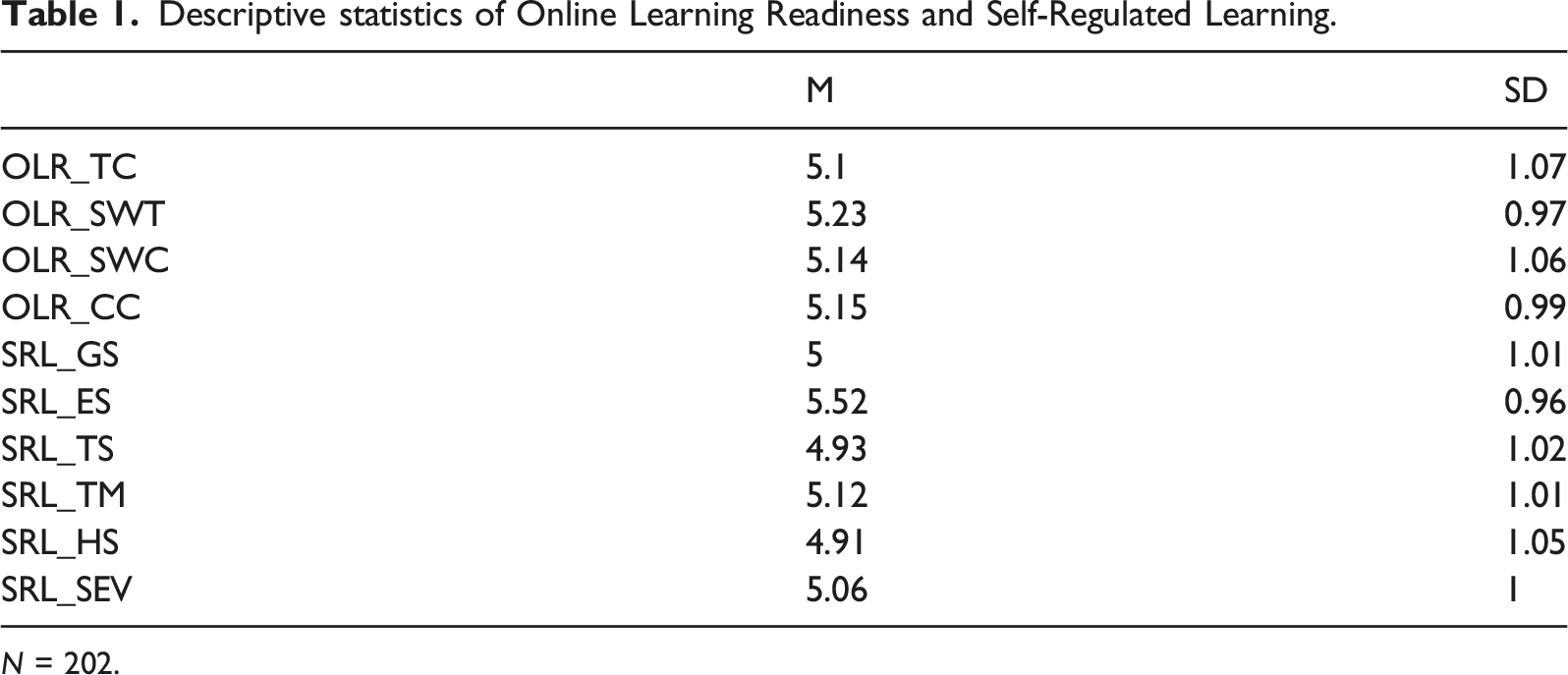
N = 202.
Intercorrelations between Variables.
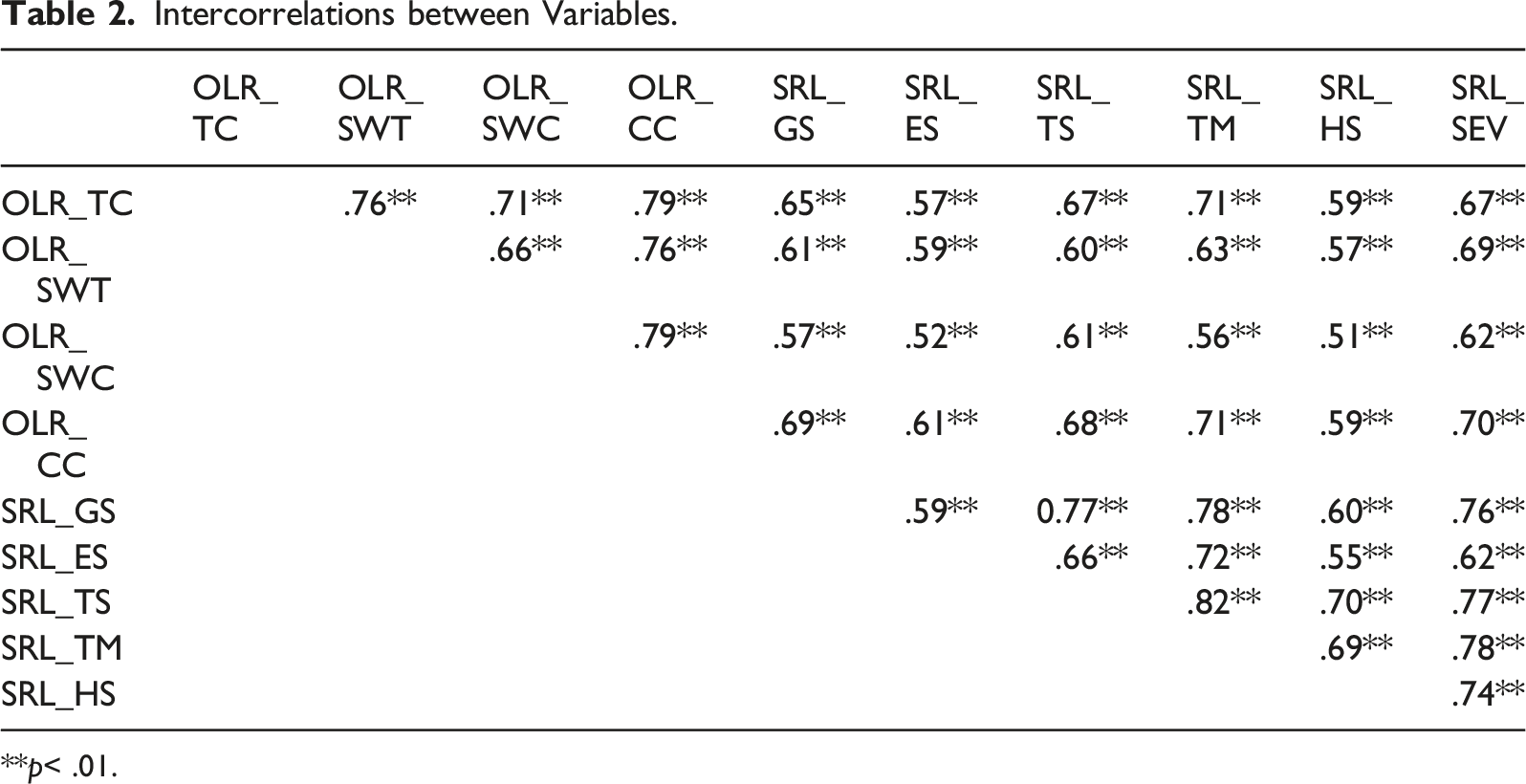
**p< .01.
Next, the Canonical Correlation was conducted to test the relationship between students’ OLR and their online SRL strategies. Independent variables were OLR, and the dependent variables were online SRL. Figure 1 shows that the relationship of ORL and SRL are significantly associated by canonical correlation (rc = 0.81, Λ = 0.32, F (24, 671) = 10.71, p < .001). Canonical correlation of online learning readiness and self-regulated learning.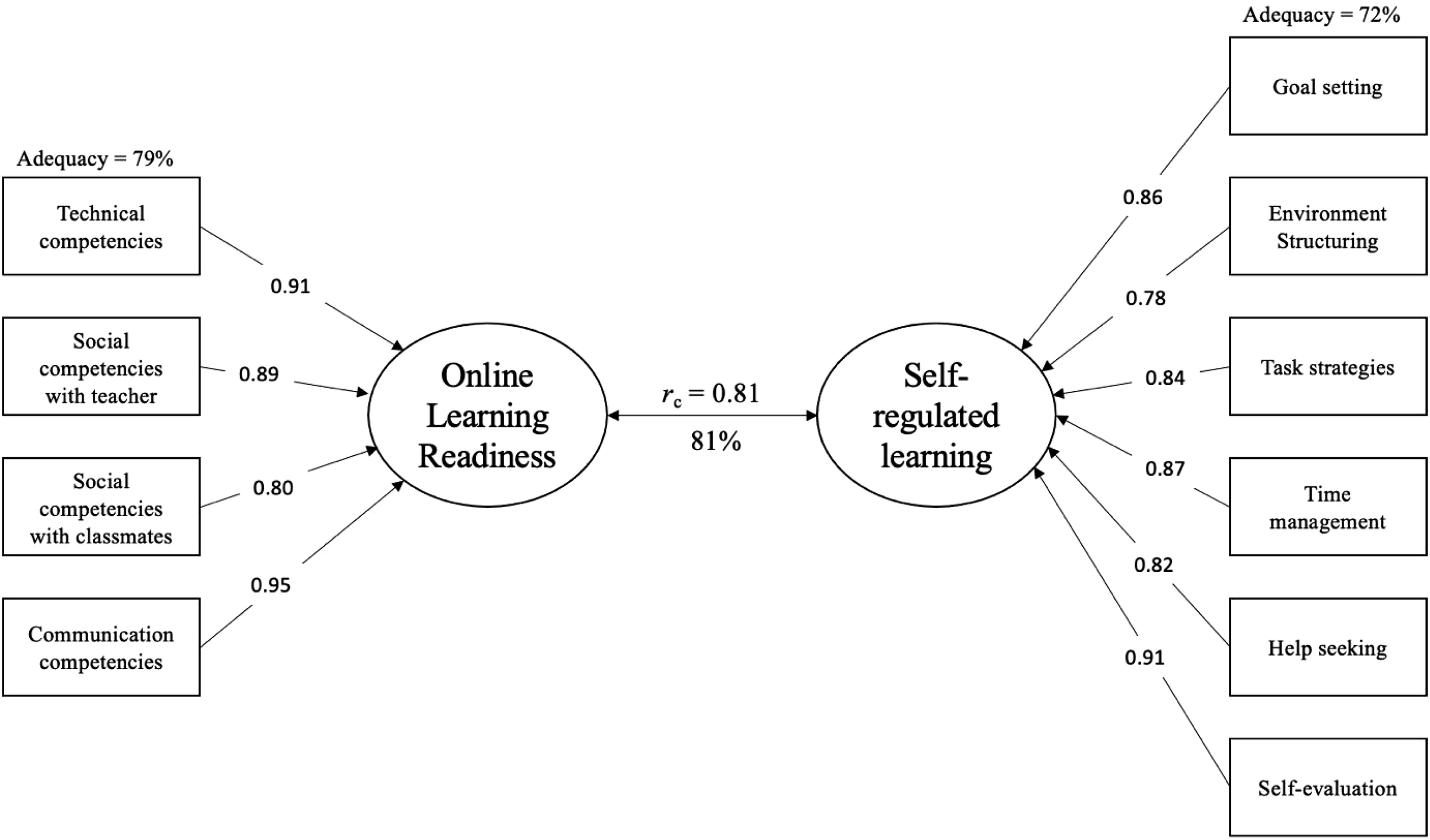
A cutoff structure coefficient of 0.30 was used to interpret the canonical variates (Tabachnick & Fidell, 2001). Results show that all variates of OLR were significantly related to the OLR variable set (see Table 1). In the online SRL set, all variates were significantly correlated with the online SRL variable set. The useful percentage of variables in explaining variance in the OLR set were: 83%, 79%, 64%, and 90% for TC, SCT, SCC, and CC, respectively. In terms of the online SRL set, the useful percentage of variables in explaining the variance of this set were: 74%, 61%, 71%, 76%, 67%, and 83% for GS, ES, TS, TM, HS, SE, respectively. The redundancy index—the amount of variance in a canonical variate explained by the other canonical variate in a canonical function—indicated that the OLR variate set could explain 52% of the online SRL variate set.
Standardized Canonical Coefficients, Structure Coefficients, and Squared Structure Coefficients for Canonical Function.
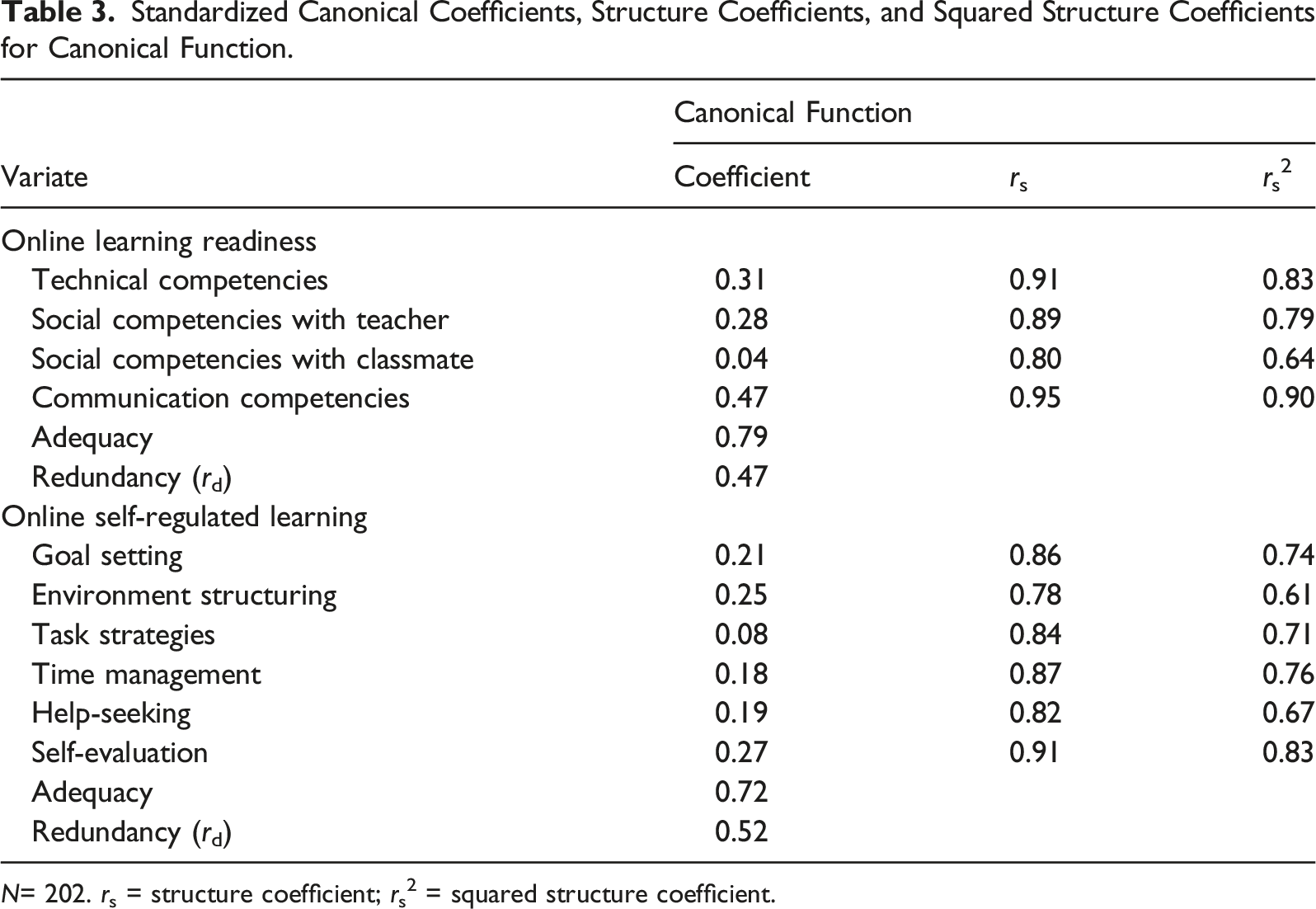
N= 202. rs = structure coefficient; rs2 = squared structure coefficient.
When looking at the individual SRL strategies, the correlations (see Table 2) show that CC has a strong positive association with TM (r = .71), followed by SEV (r = .70). This variable has a moderate association with GS (r = .69), TS (r = .68), ES (r = .61), and HS (r = .59). Similarly, TC has a strong positive association with TM (r = .71), and it has a moderate correlation with SEV (r = .67), TS (r = .67), GS (r = .65), HS (r = .59), and ES (r = .57). In terms of social competencies, SWT has a moderate association with all SRL variables, ranking from the highest to the lowest as SEV (r = .69), TM (r = .63), GS (r = .61), TS (r = .60), ES (r = .59), HS (r = .57). Likewise, SWC also moderate correlates with SRL variables, from the highest to the lowest ranks as SEV (r = .62), TS (r = .61), GS (r = .57), TM (r = .56), ES (r = .52), HS (r = .51).
Discussion
Previous studies show a positive relationship between OLR and SRL (Yayuzalp & Bahciyan, 2021). The present research well echoes this conclusion. Among all ORL variables, students’ communication competencies are the strongest predictor of their online SRL, followed by technical and social competencies. While further looking at the SRL variables, students’ communication competencies have a strong positive association with their time management skills, followed by self-evaluation strategies. Meanwhile, this type of competency correlates moderately with students’ goal settings, task strategies, environment structuring ability, and help-seeking skills. Similarly, students’ technical competencies are strongly positively associated with their time management skills and moderately correlated with their self-evaluation, task strategies, goal setting, help-seeking skills, and environment structuring strategies, respectively. Lastly, students’ social competencies with the instructor and peers are moderately linked with all SRL strategies.
By further exploring the relationship between the different facets of OLR and SRL, our study discovers that online students’ communication competencies play the most essential role in affecting their SRL. In other words, students who own “the ability to demonstrate knowledge of the socially appropriate communicative behavior in a given situation” (Myllylä & Torp, 2010, p. 24) are more likely to use various SRL strategies during online learning. Technical competencies refer to “self-efficacy in technology” (Heo, 2011, p. 61), the second most crucial factor influencing Chinese college students’ use of SRL strategies in online learning environments. Technical competencies were found to be a necessary component for successful online learning experiences that could predict students’ online learning outcomes (Cho, 2012; Watulak, 2012). Our study specifically identified that students with higher technical competencies are more likely to use SRL strategies for their online learning. Lastly, social competencies were defined as skills, competencies, and feelings of control essential for managing social situations and building and maintaining relationships (Myllylä & Torp, 2010). Students’ ability to interact with their instructor and peers often significantly relates to their online learning success and academic achievements (Betermieux & Heuel, 2009; Cho & Jonassen, 2009). Our study supports this conclusion revealing that students who own higher social competencies with both their instructor and peers are more likely to apply SRL strategies to their online learning. In short, our study indicates that CC, TC, SWT, and SWC all significantly impact Chinese college students’ use of SRL strategies for online learning. Thus, individuals who are well equipped with communication, technical, and social competencies are more likely to self-regulate their online learning using multiple strategies.
Additionally, findings show that Chinese college students with higher communication and technical competencies better manage their study time and conduct self-evaluations for their online learning. That is, in an online learning environment, students who are more confident in using technology tools for study and are more capable of digesting knowledge, as well as using and adapting that knowledge in various contexts, are more likely to organize and plan on dividing their time between different learning activities and self-assess their learning for improvement. Likewise, students who are more capable of engaging in meaningful interactions with their instructor and peers are more likely to self-evaluate their learning. Interestingly, ES (e.g., finding a place to study) and HS (e.g., seeking help from peers) reported a lower level of correlation with students’ online learning competencies. To follow the social distancing rule due to the pandemic in China, it is assumed that these students were often taking online courses at home. Thus, there was no necessity to find a special place for study. Meanwhile, the online learning environment may distance students from their peers, reducing peer interaction and support. Yet, more research is needed to explore these assumptions.
Because students’ readiness to be successful in an online learning environment can contribute to their online SRL, it is vital to prepare them for online learning. Students who enroll in online courses usually have different levels of readiness and preparedness that would influence their grades and course completion. Therefore, higher education professionals should help students evaluate their readiness to take online courses, thus offering corresponding preparation suggestions. For instance, universities can establish a detailed profile of their students’ online learning readiness through student self-reported surveys combining their previous online learning experiences. Based on the profile, the universities should offer workshops and training to prepare students with online learning knowledge and skills. Additionally, by providing the profile to faculty members, the instructors can design the course curriculum and structure to better support their students for online learning. For example, the instructors could develop specific activities, such as using online discussion boards, online presentations, and group projects to motivate students’ communication and social competencies within the online learning context. The instructors could also offer an online course orientation or tour to help students use LMSs.
Along with this line, faculty members may consider introducing the different tools and resources available for online learning. Lastly, the instructors can invite students who attended online courses before to share their experiences with students new to online learning. The instructors could also provide verbal encouragement, including feedback and tips to motivate students’ confidence for online learning. For those struggling with online learning, the instructors should provide resources related to counseling services that would be of great help in addition to facility assistance and IT support. On the other hand, being online learners, students should take advantage of the multiple resources provided by both the faculty and universities to enhance their readiness for online learning. Students should also frequently conduct self-assessments to adjust their study plans for their online learning. Given the situation that fully online courses are the first time vastly offered in Chinese universities, the effort must come from both the institutions, the faculty, and students to lead to successful online learning.
Lastly, ORL and SRL were often investigated separately among online students, one theoretical contribution of the present study is to reveal the relationship between these two variables, precisely the effect of ORL on SRL and among Chinese college student population. The OLR and SRL have been conducted in countries where online education is well-developed, and this learning format has been widely used for years, such as Germany (Betermieux & Heuel, 2009), South Korea (Lee & Choi, 2013), and the US (Shen et al., 2013). Therefore, our study adds to the literature presenting the correlation between these two variable sets among online students, specifically in China, where fully online learning was forced to implement due to the COVID-19 health emergency.
Some limitations exist in the study. First, convenient sampling was conducted at one university in China in this study. Convenient sampling is non-probability sampling as researchers choose the sample based on convenience. Thus, the results of this study cannot represent all Chinese online college students. Future studies should recruit participants from different Chinese universities. Meanwhile, universities in provinces with a higher gross domestic product (GDP) may provide more opportunities to access online learning and resources. Therefore, students from underdeveloped regions should be recruited to explore their readiness for online learning across the nation. Second, this study investigates the relationship between Chinese college students’ OLR and their online SRL without dividing online course formats (i.e., synchronous, asynchronous, and blended). The course modalities may yield different results. Therefore, future studies should further look into various course formats to explore whether different modalities would influence students’ online learning. In addition, students’ previous experiences of taking online courses could contribute to their different levels of online learning readiness, thus impacting their use of SRL strategies. Consequently, future studies should include students’ prior experiences of attending online courses to research the relationships between these variables. Still, the study’s limitations do not negate recognizing Chinese college students’ readiness for online courses and its impact on their online learning self-regulation.
Conclusions
This exploratory study investigated the relationship between students’ OLR and their use of SRL strategies within the context of a Chinese university. Findings noted that students’ preparedness for online learning significantly influences their SRL. Specifically, students with higher levels of skills regarding using technology tools and communicating with the learning content, instructor, and peers are more likely to better use SRL strategies for online learning. As a result, it is necessary to prepare students for online study sufficiently, thus, motivating them to self-regulate their learning and enhance their performance and outcome. As more universities have been preparing for reopening while waves of COVID-19 and related infections may spread rapidly and unexpectedly worldwide, online learning is still considered a promising option following the social distancing rule. It seems that in the future, higher education institutions may consider providing options between various online forms (e.g., hybrid) of teaching without being constrained by reasons of a healthy emergency (Potra et al., 2021). In echo with this trend, our study presents the significance of preparing college students, specifically in countries like China where face-to-face instruction was predominately used, to be successful in online learning environments. It is expected that this study would enlighten both higher educational professionals, university stakeholders, and students to understand the importance of gaining the necessary knowledge and skills for online learning to adapt to the new norm.
Footnotes
Declaration of Conflicting Interests
The author(s) declared no potential conflicts of interest with respect to the research, authorship, and/or publication of this article.
Funding
The author(s) received no financial support for the research, authorship, and/or publication of this article.
