



Abstract
Nowadays many schools take the Japanese language as the second language, although there are similarities in the writing of the Japanese and Chinese language, the student’s learning outcomes are a challenge for the teacher. This study is to explore the effect of multimedia principles (multimedia, temporal contiguity) in slides on students’ attitude and retention towards Japanese vocabulary among 10-grade students in Chinese rural areas. Using quasi-experimental research to form an experiment group and control group for 10 weeks. 90 participants have randomly selected sampling from Wucuan town, Zunyi city, Guizhou province. 5 Likert-scale questionnaire was used to collect the students’ attitudes and binary tests for the students’ retention. All the data were sorted out and input into the SPSS 26 version for description and inferential analysis. The results showed the students’ attitude and retention in EG are significantly different than the CG. Reveal the multimedia and temporal contiguity principles are a benefit to the students. Multimedia and contiguity principles used in the slides can change attitudes toward learning Japanese vocabulary and improve students’ retention.
Keywords
Introduction
In some rural areas of China, many high schools take Japanese as a second language (L2) in foreign language curriculum (Minami, 2017; Wakabayashi, 2003). Japanese is composed of three different scripts: hiragana, katakana, and kanji (Dylman & Kikutani, 2018). The words used in Japanese are hiragana, which is used to write all Japanese pronunciation, mainly for words with grammatical functions, and Kanji, which is used to indicate names or actions of objects. Katakana is used to write the names of loanwords, onomatopoeia, mimicry, and some animals and plants. In addition, the Japanese also use Roman characters. Kanji is consist of intricate character sets, meanwhile, stroke placement, position, and various other ways of decoding display their various strokes each meaning (Kitagawa & Komachi, 2018), kanji is the writing system that is most like that of Chinese, it would be much easier for a native speaker of some form of Chinese.
According to the dual-coding theory (DCT), students can receive and process vocabulary through two channels simultaneously during teachers’ presentations (Paivio, 2013; Wong & Samudra, 2019). In the content of the multimedia principle, when teachers did a presentation in class, animation and narrative are presented simultaneously better in recognition than showed text alone (Jiahui et al., 2018). Cognitive load theory (CLT), states that selectively attendant and processing incoming sensory data are limited in working memory capacity (Anmarkrud et al., 2019). Teachers use visual graphics and narration to match the students’ pace by the temporal contiguity principle, which not only makes use of language and visual working memory but also does not overload either of them, which can form a long-term memory effect (Mayer, 2020).
In Japanese teaching classrooms, teachers use slides as useful tools to help students better learn and understand Japanese vocabulary in class. However, the learning outcomes of students’ attitudes and retention are poor due to teachers’ lack the knowledge of using information communication technology (ICT). Many teachers used the ICT, but simply projected words in Japanese vocabulary in the classroom. On the one hand, the ICT will distract student attention (Erdogdu & Erdogdu, 2015; Wei et al., 2015). Many teachers lack technical knowledge, so they did not play to the advantages of learning Japanese vocabulary. These control instructional slides do not contribute to student learning outcomes because they ignore the effects of multimedia technology (Anmarkrud et al., 2019). Therefore, considering the cognitive theory of multimedia learning (CTML) (Mayer, 2014; Rudolph, 2017), the multimedia principle (Dawson et al., 2021) and temporal contiguity principle (Mayer, 2020) will be used.
Research Questions
The research proposal of this study is to explore the effect of multimedia, temporal contiguity principles in slides among 10-grade students in Chinese rural area High Schools. Based on that, the research questions of this study are: 1. Is there a significant difference in the students' attitude towards learning Japanese vocabulary among students using multimedia principle and temporal contiguity principle in the slide approach and control instructional slide learning approach? 2. Is there a significant difference in the students' retention in memorizing Japanese vocabulary among students using multimedia principle and temporal contiguity principle in the slide approach and control instructional learning approach?
The significance of the study
The aim is to increase students’ attitude, and retention by providing technology-filled lessons as well as to change the Japanese vocabulary stereotyping as an uninteresting subject through this approach. Otherwise, it is important to act as a guideline or important information for other Japanese curriculum teachers to evaluate their teaching approach when conducting Japanese vocabulary lessons to improve the quality of teaching.
Limitation of the study
Distance, time, and cost were three factors that limited the study, so the researcher only selected a limited group of students as research subjects. The study was conducted at rural high schools in Guizhou, China, because takes Japanese as a second foreign language.
Literature review
In the context of L2 teaching in Chinese high schools, how to do a better L2 and Japanese vocabulary learning are discussed. The review of the relevant theories and discussions in the past.
Cognitive theory of multimedia learning
There are five assumptions in the cognitive theory of multimedia learning (CTML) in Figure 1. First, the presentation includes audio and visual parts, the former is the phonological loop and the latter is the pictorial spatial sketch (Rudolph, 2017). Second, the words and pictures can be selected in a short time by the limited capacity of sensory memory (Anmarkrud et al., 2019). Third, meaningful learning occurs when relevant information is passed in and processed into coherent presentation structures. Fourth, corresponding visual representation happens in working memory, along with the verbal representation construct the connection at the same time (Paivio, 2013; Wong & Samudra, 2019). Finally, narration and graphical images produce verbal and visual mental representations, which integrate with prior knowledge to construct new knowledge (Anmarkrud et al., 2019). Cognitive theory of multimedia learning.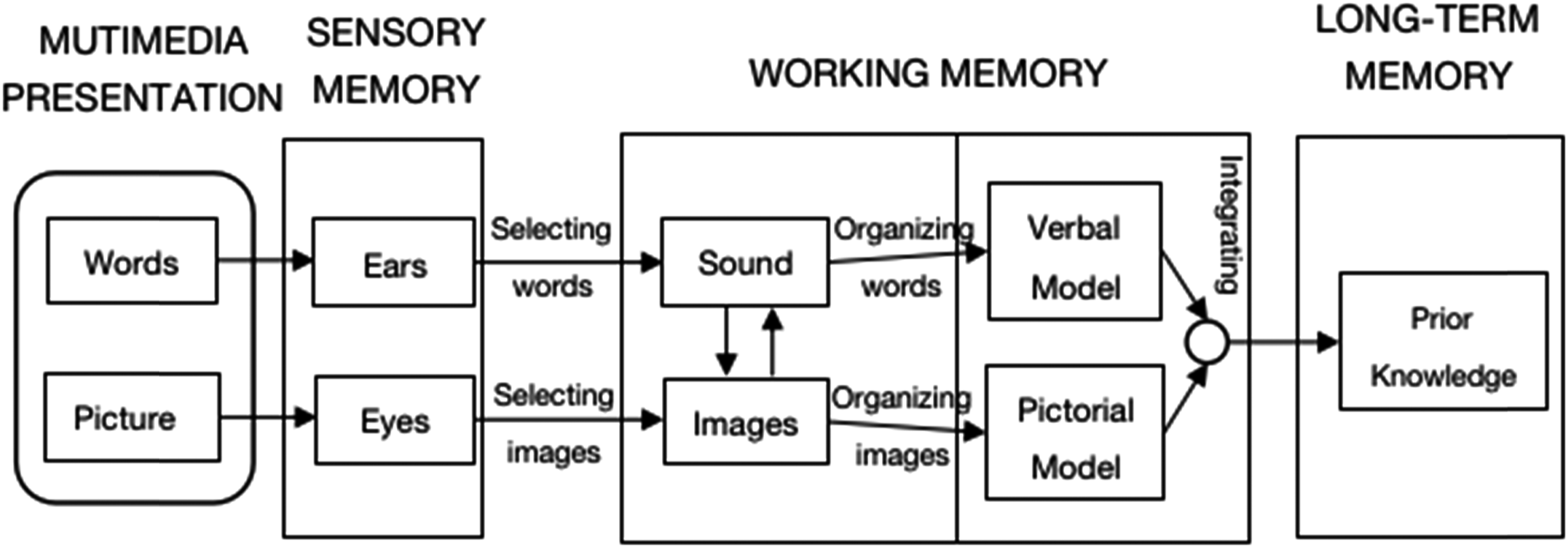
Multimedia and temporal contiguity principles
Visual, verbal, sound, and so on simultaneously carry on the dual system sensory stimulation, the ICT is the teacher curriculum’s best helper. In order to enhance the input function of language learning, more and more educators are getting help from technology (Marsh & Butler, 2013). Visually illustrated help the word and its meaning become more memorable (Paivio, 2013). In other words, when information is presented by visual and verbal models, it will be more elaborate and memorable (Nagmoti, 2017).
In the past, the application of multimedia technology in the classroom in a rural area of China is only a few simple demonstrations and not a comprehensive optimization of classroom slides. Ignore the DCT (Paivio, 2013; Wong & Samudra, 2019) and CLT (Anmarkrud et al., 2019) learning of students.
No additional sound is needed to explain the tone of the word and its classification. These studies confirm the contribution of multimedia principles to learning effects from one or more perspectives. Combine the multimedia principle and contiguity principle to foster the essential and generative processing of students, while not overusing special effects to additional burden to reduce extraneous processing. The multimedia principle suggested that students will learn better if there is text with pictures rather than absent at the same time (Dawson et al., 2021). Also, the function of the temporal contiguity is to give the image, and the information on the same screen will help a student learn better (Mayer, 2020).
Students’ attitude and retention
The attitude towards learning the language. Students' learning attitude is an influencing factor of language learning, and it plays an important role in the failure and success of learners (Khalid, 2016). Attitude can refer to someone’s familiar target, whether is enjoyment or boring (Hannula, 2002). The four domains self-confidence, value, enjoyment, and motivation are part of students’ attitudes (Abosalem, 2014; Tapia, 1996). The change of learning attitudes can usually be formed through the constant repetition of certain patterns (Casinillo et al., 2020). Through the improvement of learning, students can be interested in vocabulary courses and achieve their expected goals (Damara et al., 2019).
The retention in learning the language. The most common about learning retention is that the acquisition of knowledge is part of the organization, and this part of the content can be retrieved and used in the future (Vijayalakshmi & Reddy, 2021). Stavy et al. (2020) pointed out that lexical memory refers to the ability to remember new words learned within a cycle.
Methodology
Research design
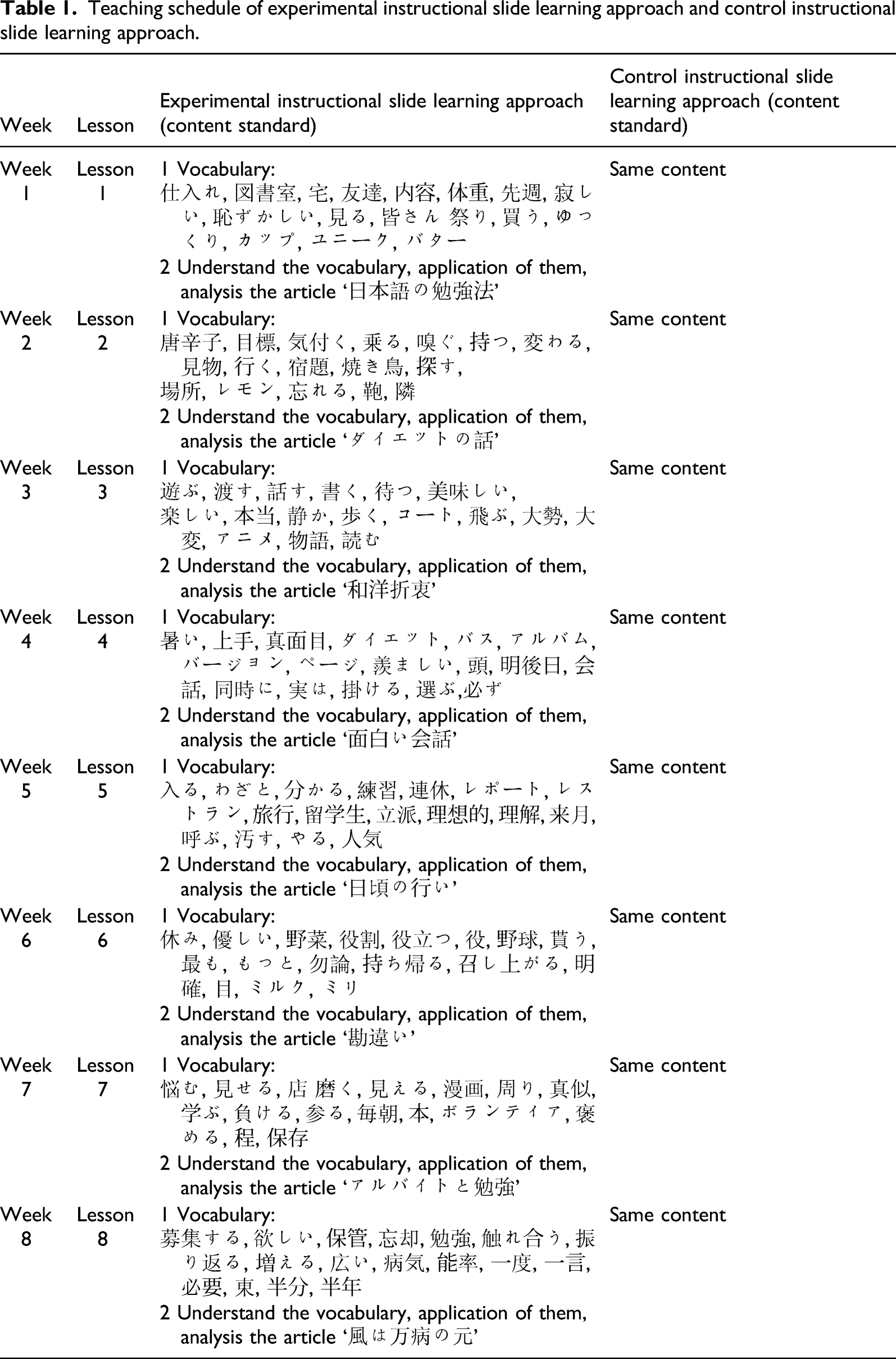
A quasi-experimental design is applied in this research. The whole study period was 10 weeks, the 1st and 10th weeks consisted of an attitude questionnaire and retention test. In the second week, specific teaching tasks of the course will be carried out, and 8 lesson plans will be used for eight consecutive weeks. The original attitude questionnaire was administered by Tapia (1996) and Abosalem (2014) suit it in mathematics, containing 40 items. Modify and delete some items to be adapted for this research purpose. The retention test is the way of dictation, and the 136 vocabularies will appear by the teachers randomly. Figure 2 shows the illustration of this study. Research design.
At first, the choice of the school is based on the support of the school, which takes Japanese teaching as its second foreign language teaching. And the area is located in Wucuan town, China. Simple random sampling (Latpate et al., 2021) was applied to choose the students of two classes in these areas from two schools. The 45 students of 10-grade are in the one class to keep existing classrooms intact. So, 90 students are selected as a sample for two groups, having a lottery to be the experimental group (EG) and a control group (CG).
For validation, two experienced Japanese language teachers at Huijia school are asked to validate the content, and two experts who are major in ICT curriculum to evaluate the experimental instructional slide. The Cohen’s Kappa values for attitude questionnaire in Japanese vocabulary validation is .824, and retention test is 1.0 respectively by the two experienced teachers. Besides, the experimental instructional slide content by experts showed the Cohen’s Kappa value is 1.0. The Cohen’s Kappa values are more than 0.8 indicate that the instruments are in high consistency (Wongpakaran et al., 2013).
For reliability, a pilot study is carried out on 30 students who never participate in the research from school Anshun No.2 High School in China. The Cronbach’s alpha value for the attitude questionnaires in Japanese vocabulary validation is .755 and the Kuder and Richardson 20 for retention is .92, values show the test has high reliability (Yusup, 2018).
Teaching schedule of experimental instructional slide learning approach and control instructional slide learning approach.
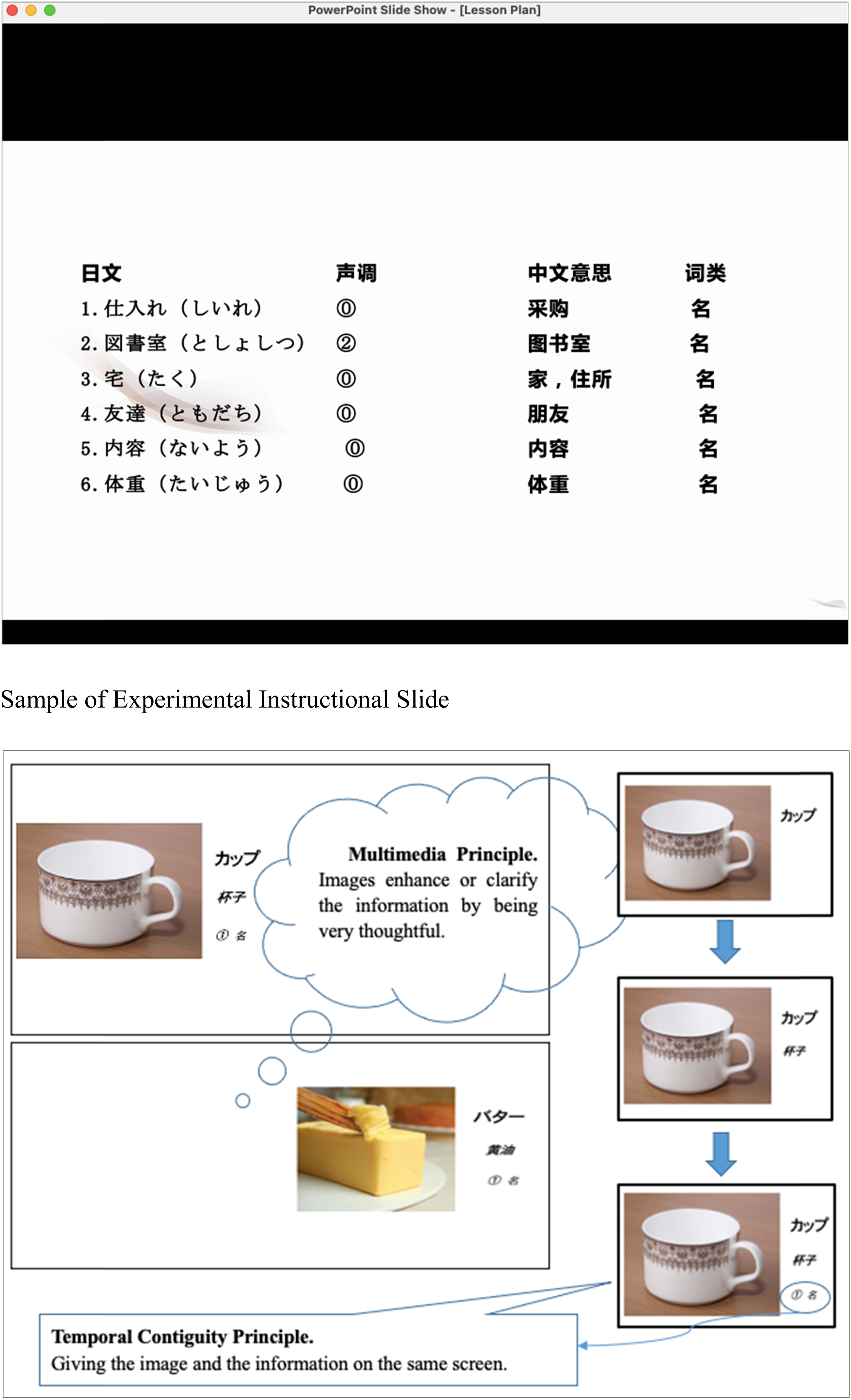
Sample of control instructional slide.
Results
Demographic information
Simple demographic information.
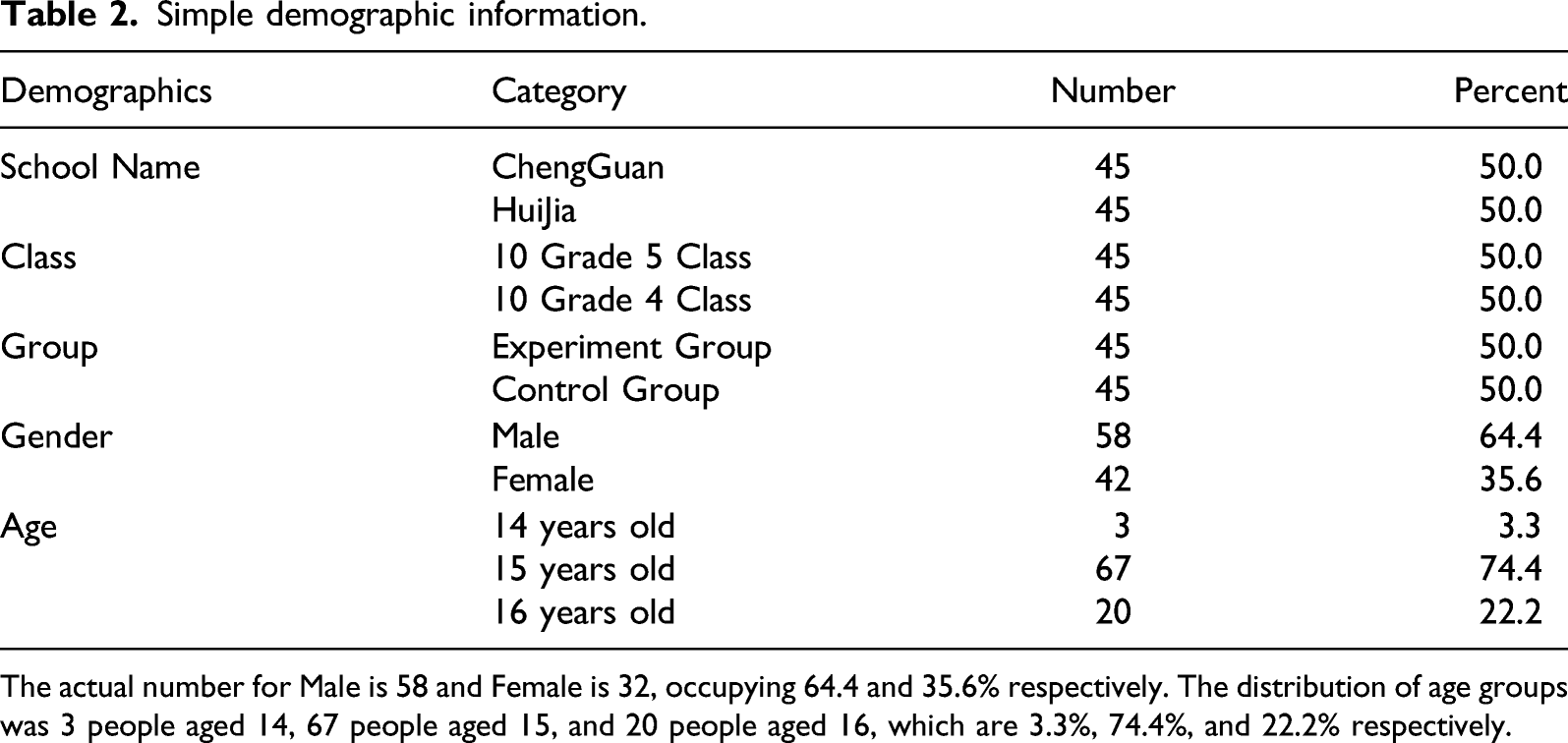
The actual number for Male is 58 and Female is 32, occupying 64.4 and 35.6% respectively. The distribution of age groups was 3 people aged 14, 67 people aged 15, and 20 people aged 16, which are 3.3%, 74.4%, and 22.2% respectively.
Mean Scores in Pre- and Post-Test Students’ Attitude (N = 90).
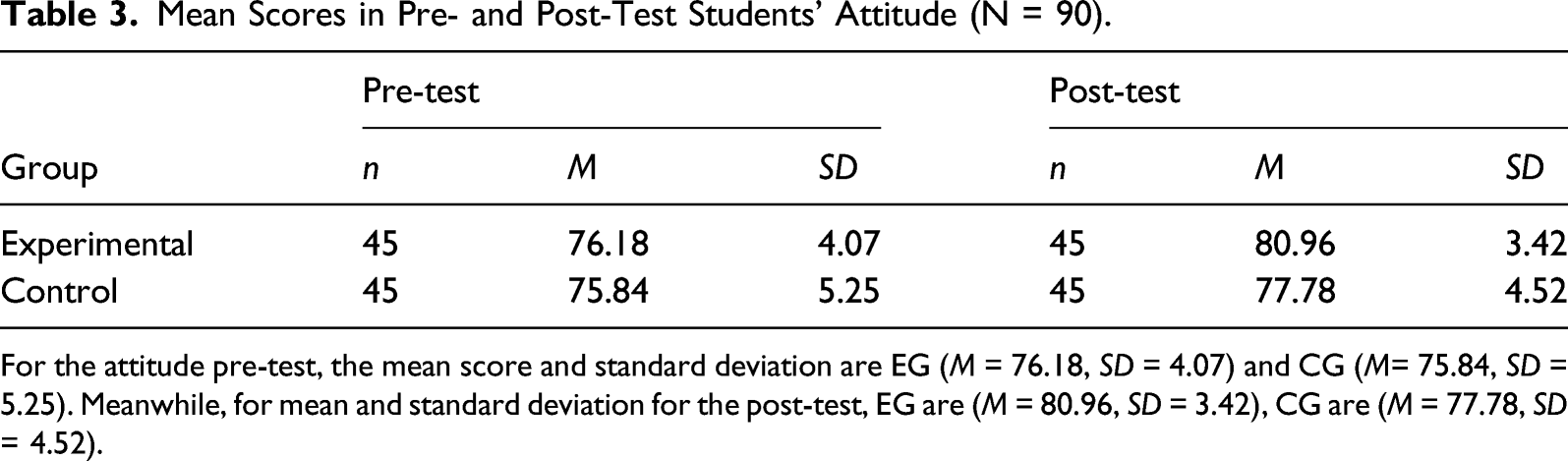
For the attitude pre-test, the mean score and standard deviation are EG (M = 76.18, SD = 4.07) and CG (M= 75.84, SD = 5.25). Meanwhile, for mean and standard deviation for the post-test, EG are (M = 80.96, SD = 3.42), CG are (M = 77.78, SD = 4.52).
Independent T-test for equality of means in students’ attitude.
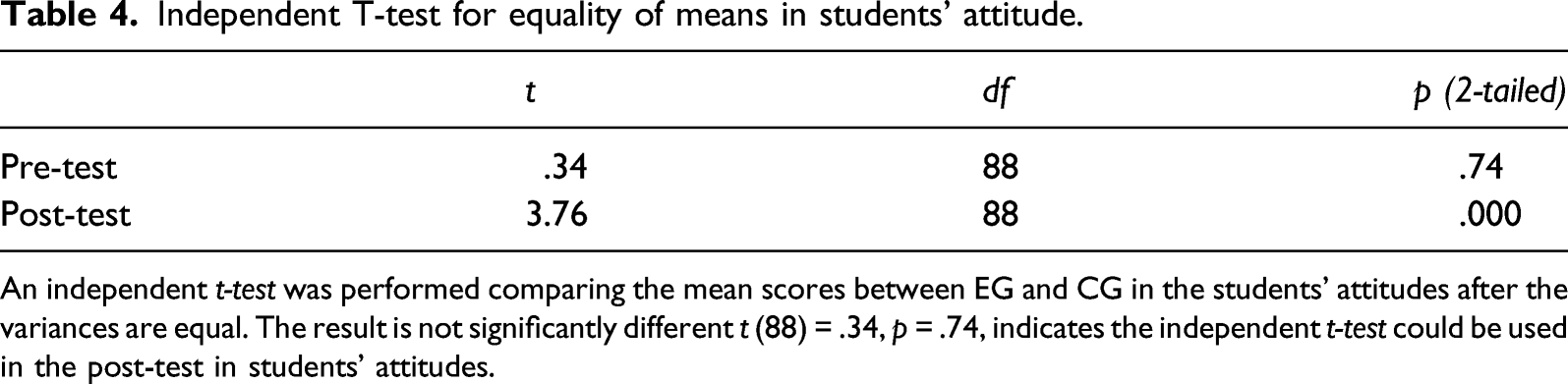
An independent t-test was performed comparing the mean scores between EG and CG in the students’ attitudes after the variances are equal. The result is not significantly different t (88) = .34, p = .74, indicates the independent t-test could be used in the post-test in students’ attitudes.
Mean scores in pre- and post-test students’ retention (N = 90).
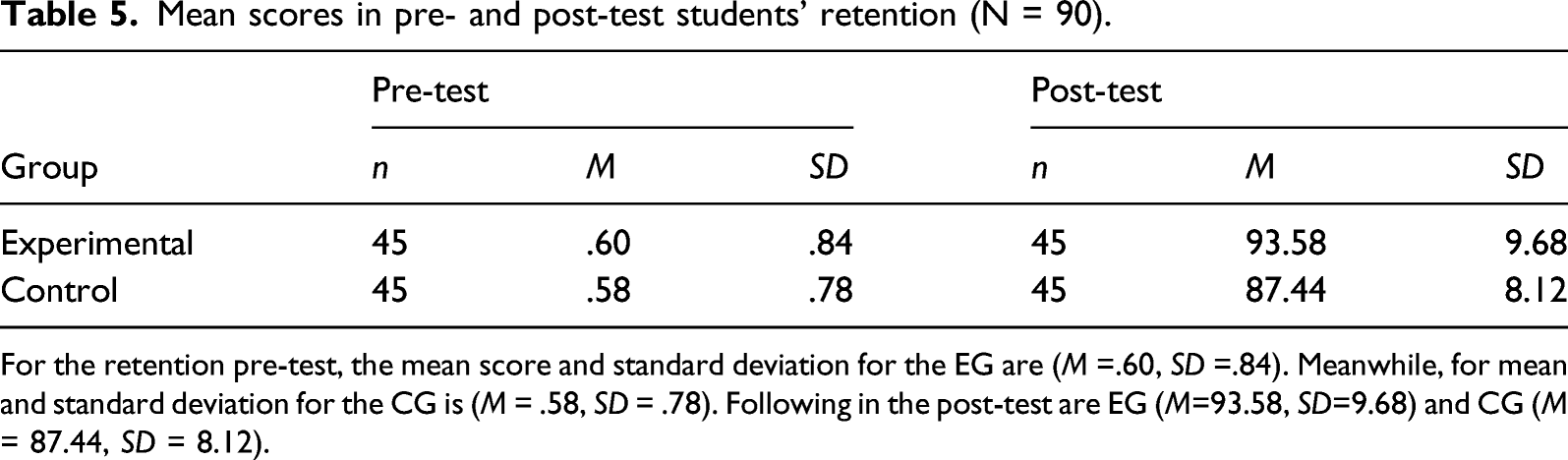
For the retention pre-test, the mean score and standard deviation for the EG are (M =.60, SD =.84). Meanwhile, for mean and standard deviation for the CG is (M = .58, SD = .78). Following in the post-test are EG (M=93.58, SD=9.68) and CG (M = 87.44, SD = 8.12).
Independent T-test in equality of means in students’ retention.
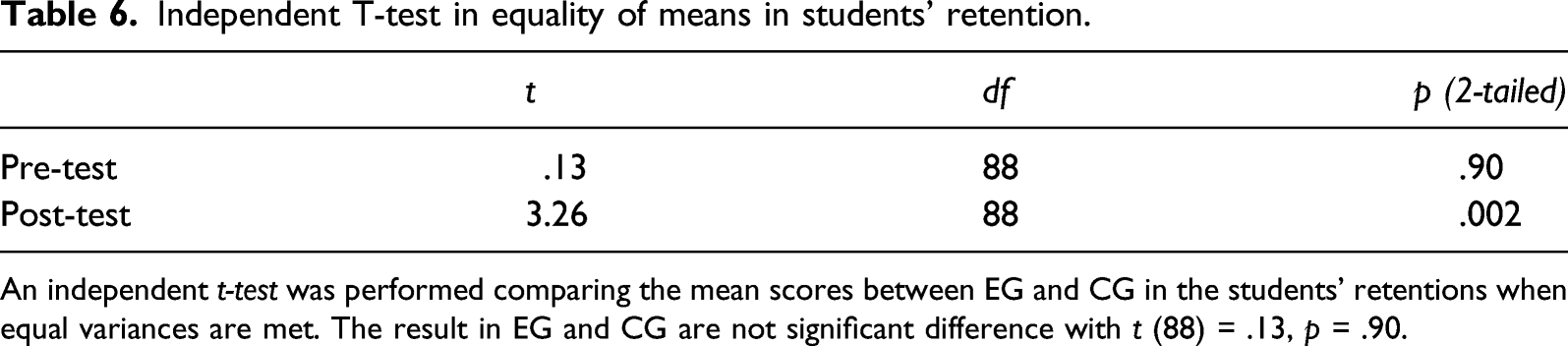
An independent t-test was performed comparing the mean scores between EG and CG in the students’ retentions when equal variances are met. The result in EG and CG are not significant difference with t (88) = .13, p = .90.
Description analysis in students’ attitude
Inferential analysis in students’ attitude
The normality test of the pre-test scores of students’ attitudes of the EG, the skewness is −.81 and the kurtosis is 2.68, while, in the CG skewness is .02 and the kurtosis is −.39. In the EG, the post-test score of students’ attitudes showed the skewness is .08 and the kurtosis is −.78. In the CG, the skewness is .59 and the kurtosis is −.35. All data in the range ±3.0 is consider normally.
The data in the pre-test score of students’ attitudes in EG and CG, and the post-test scores in EG and CG all showed the points form a linear pattern in the Q-Q plot. So, for one numerical normality and one graphic normality test result, the data could run the inferential statistics.
When the post-test attitude means scores between EG, and CG have equal variance, the assumption is met, the result revealed that the mean scores of EG and CG are significantly different with t (88) = 3.76, p = .001 in attitude post-test. Finding explains the positive results on attitude by learning Japanese vocabulary with multimedia principle and temporal contiguity.
Description analysis in students’ retention
Inferential analysis in students’ retention
For the normality test, the skewness is 1.13 and the kurtosis is .18 in the pre-test score of students’ retentions of the EG, while in CG, the skewness is .92 and the kurtosis is −.72. In the post-test score of students’ retentions of the EG, the skewness is −.06 and the kurtosis is −.54, meanwhile, the skewness is −.01 and the kurtosis is −.03 in CG. All data in the range ±2.0, the skewness or kurtosis for the distribution is not outside the range of normality, which can be considered normal.
The points form a linear pattern in the Q-Q plot in the pre-test students’ retention scores in EG, the pre-test retention scores in CG, the post-test retention scores in EG and CG. Based on these run the inferential statistics.
Do the independent t-test in the students’ retention post-test, result revealed that the mean scores in the post-test retention of EG d CG are significantly different with t (88) = 3.26, p = .002. The finding of the second object of students’ retention showed that there is a significant effect of using the experimental instructional slide in students’ retentions.
Discussion
Through the experiment and the analysis of the results, students' learning attitude and learning retention have been improved. Separately to do a deeply discussion after using the method of multimedia principle and temporal contiguity principle in the Japanese vocabulary approach.
First, for the effect on participants' attitudes after being trained in the new teaching method, results is positive that affirm the finding of Dawson et al. (2021) and Mayer (2020). The multimedia principle attracts student by using graphic and narration correspondently, and the temporal contiguity principle help student weak students’ disgust by reducing the unnecessary information in a short time. In the four domains: self-confidence, value, enjoyment, and motivation dimension, students in the EG presented a significant difference in attitude compared to students in the control group. With the application of experimental instructional slides, students' willingness to learn Japanese vocabulary has been enhanced. This result is consistent with Izquierdo et al. (2015) and Casinillo et al. (2020), that the effective use of multimedia knowledge can change students' learning attitudes. The students benefited in four domains, which are self-confidence, value, enjoyment, and motivation dimension by using the experimental instructional slides. Students' learning attitudes changed under the stimulation of animation and narration, such as pictures, texts, and voices (Dawson et al., 2021). The combination of pictures and words improves students' ability to recognize words. At the same time, the display effect of temporal contiguity will not increase the burden of memory perceived by students in a short time. The use of two multimedia principles helps students reduce the cognitive load and enhance students' attitudes (Sari & Istiningsih, 2019).
Second, in the part of students’ retention. Retention is improved through the teaching of experimental slides, same connected with results of Vijayalakshmi & Reddy (2021), the multimedia principle can avoid the problems of students' disorientation and cognitive overload. The temporal contiguity principle help students reduce the cognitive load, then better interact with prior knowledge (Mayer, 2020). With the help of the temporal contiguity principle, under the condition of not overloading, effectively convert perceptual memory to long-term memory. Under the action of two principles, slides present Japanese vocabulary in an effective way. Students can perceive and process information at the same time through their own verbal channel and visual channel. In addition, the quasi-experimental results of the quantitative analysis show that the EG has an influence on second language learning compared with the control group, which is consistent with the research results of Marsh and Butler (2013). Multimedia technology creates a technical condition for second language learning. The use of experimental instructional slides stimulates students' own cognitive system ability, strengthens students' dual-channel perceptual information function, and avoids cognitive load. With repeated use within the cycle, the multimedia principle optimizes the defects of ordinary slides and improves students' vocabulary long-term memory (Brunmair & Richter, 2019).
Conclusion
First, the study responded to the two study objects used by using multimedia and temporal contiguity principles in slides towards learning Japanese vocabulary among 10-grade students in Chinese rural area High Schools method in the attitude and retention of students' Japanese vocabulary. Give evidence on the application of two multimedia principles, which is the combination of words and pictures absorbs better than either one alone (Dawson et al., 2021), also a rhythmic presentation of course content is better than a large amount of text at the same time (Mayer, 2020). For whether there is a significant difference, presented because of quantitative data, the new slide compared with the control instructional slide influences students' attitudes, and retention of the three independent variables.
Furthermore, the study affirms the role of multimedia and temporal contiguity principles in classroom teaching. The new slide design based on this principle gives full play to students' dual coding information processing and avoids overload of information presentation. Give an evidence of the effect of the application in research, which is DCT (Paivio, 2013; Wong & Samudra, 2019) and CLT (Anmarkrud et al., 2019). Through the quantitative comparative experimental study of quasi-experiment, the attitude and retention of the students in the experimental group in Japanese vocabulary all resulted in good results due to this principle. In the use of multimedia, CTML (Rudolph, 2017) and so on should be learned by a teacher in order to play their auxiliary functions well.
Since the research limitations, the future research direction, on the one hand, can expand the research field, expand the research sample data field, urban students also join in the experimental instructional slide and control instructional slide comparison used in Japanese vocabulary learning. On the other hand, it is the time of research, the cycle of increasing students' use of new and old methods, half-semester, one academic year, and so on. In the future, the connection between teachers and students can be established through the network platform after class. The teacher shares the courseware used in class through the platform, and the students repeat the courseware to recite the words. The teacher can also issue some learning tasks for the students to complete, to consolidate and strengthen the effect on vocabulary.
Footnotes
Acknowledgements
I would like to thank the Universiti Sains Malaysia for affording me an opportunity to complete my study, despite all challenges which had frustrated all my efforts. I will not forget to thank my supervisor, Dr. Siti Mastura Baharudin whom for without his patience, guidance, and understanding, I would not have made it this far, especially with my dissertation. Prof. Madya Dr. Azidah Bt. Abu Ziden and Dr. Fadzilah Bt. Amzah give me suggestions and guidance to perfect my research proposal carefully and patiently. I also remain thankful for all who have managed and guided me throughout my time. In addition, I thank my sponsor the two rural area high schools named ‘Wucuan’ and ‘Huijia’ of the Wucuan town, Zunyi city, Guizhou province in China, and most precisely their teachers and students. And thank you for ‘Anshun No.2 High School’ where I had ever been a teacher to help me do the pilot study. I would also like to thank my friend named Lei Ting and his fellow, my colleagues Zhang Li and Duan Lina who empowered my skills measurably in the areas targeted.
Declaration of conflicting interests
The author(s) declared no potential conflicts of interest with respect to the research, authorship, and/or publication of this article.
Funding
The author(s) received no financial support for the research, authorship, and/or publication of this article.
