Abstract
PLENARY LECTURE REVIEW
LabAutomation99 opened with record attendance of over 2000 individuals at the Sheraton San Diego, Harbor and Marina. Chairman Robin Felder thanked the sponsors for their generosity in providing the resources to invite leading automation scientists from all over the world to this year's LabAutomation conference. Sponsorship was provided by a number of leading organizations (see inset box). The program opened with a series of plenary lectures on significant new technologies as well as a financial analysis of the state of the laboratory automation industry.
LA99 SPONSORS
A&T Corporation
Abbott
Aurora Biosciences
Bayer
Beckman Coulter
Becton Dickinson
Chiron Diagnostics
CRS Robotics
Dade International
Los Alamos National Laboratory
Olympus Corporation
Orchid Biocomputer
Ortho Clinical Diagnostics
Roche Diagnostics
Packard Instrument Company
Sysmex Corporation
Tecan
Zymark Corporation
Celera Genomics (Rockville, MD) was formed to rapidly sequence the human genome. The laboratories at Celera have been equipped with over 230 PE Biosystems DNA sequencers (Model 3700). This collection of sequencing horsepower will be capable of producing 100 million base pair sequences in 24 hours.
Laboratory automation technology will accelerate the current pace of molecular biology and increase the availability of useful genetic information for curing diseases.
Robin Felder, Conference Chairman, with Dennis Purcell

Dennis J. Purcell, Managing Director of Hambrecht & Quist's (New York, NY) Life Sciences Investment Banking has supervised over $6 billion in financing and advisory assignments. Mr. Purcell described the excitement that Celera is generating on Wall Street. Despite the popular notion that the nineties were going to be the biotech decade, these stocks have not performed well. The Russell 2000 showed that biotech stocks did not do well as a group. Large cap stocks out performed small cap stocks. The market has been difficult to predict as evidenced by the fact that less than only 10% of index fund managers outperformed the index they were tracking.
The achievements in the market focused on coronary stents, laser eye surgery and computer-controlled surgery and a few other biotech successes. Over 100 billion dollars was made in pharmaceutical and biotech sales in 1998, which is expected to triple in the next 10 years with a 12% anticipated growth. There are 5 times as many billion-dollar funds as there were 5 years ago. The new FDA commissioner is more biotech friendly and thus speed-to-market has improved with over 1/3 more pre-market drugs in the pipeline. Market penetration is now down to 3 years compared to 8 years a decade ago. However, only 9% of products that emerge from clinical trials get filed and approved. Europe has improved dramatically with over 90 billion dollars in new business.
Outsourcing is the latest wave in streamlining costs and increasing successful leads. Many pharmaceutical companies have purchased screening companies and outsource up to 29% of the discovery process.
There is much consternation in the industry with the reduction in Medicare expenditures (15% of their budget is spent on drugs). Medicare thinks that drug costs should only grow at 4–5% per year. This is clearly not in line with investor expectations. Only 1 billion dollars in public equities were raised last year (over 3 billion is necessary for a successful industry). Over 2/3 or all biotech companies reduced in value last year. Only 2–3% (out of 350 companies) of the biotech companies hold 60% of the market value, thus there is a widening gap in the “Haves vs the have-nots.” One third of the industry will run out of cash in the next 6 months.
Today, the expected timeline for investment payback is often measured every three months and in some cases it is measured in weeks. However, the gains expected in this industry may take quite a bit longer. The entire biotech market is valued at 138 billion dollars (180 billion for Merck vs 60 billion dollar valuation for the remaining market). They are bullish about aggressive growth companies. Purcell thinks that the lab automation is a 12 billion-dollar business with good growth potential. His analyst, Rob Olin, is one of the only industry investment managers who follow laboratory automation full time. Purcell sees that equity markets will improve, FDA approvals will increase, mergers will increase, partnerships will lead over acquisitions, and finally genetic information will begin to drive the drug discovery process.
One of the challenges to scientists in the pharmaceutical industry is the need to achieve more successes per capita and per year in order to remain in business. Structure based drug design has begun to yield positive results following the advent of important new technological advances in the last several years. Dr. Fitzgerald explained how discoveries made with traditional xray crystallography of purified proteins have not yielded structural detail that is equal to the use of synchrotron beams. High-resolution images of HIV protease provided key evidence that there were two binding sites in the catalytic site. Dr. Fitzgerald explained that the future of structural biology would be to elucidate the products of the human genome project, particularly those proteins that have no known function.

Combinatorial methods will allow the rapid discovery of new materials for a wide variety of industries. However, challenges remain as to the best approach to developing a screening program since a significant investment in equipment and expertise is required. New techniques will have to be developed to screen for novel materials.
A leading materials supplier has generated over 10,000 new compounds a year using combinatorial techniques. Even modest sized companies can create over 25,000 new compounds per year from the investment in one piece of equipment. However, it is important for companies to balance their system throughput between compound generation and compound analysis (e.g. molecular weight determination and glass transition temperature elucidation).
CLINICAL TRACK REVIEW
Clinical Laboratory Automation Comes of Age: Case Histories Abound at the LabAutomation′99 Conference
Mike Gannon provides consulting services to laboratories that are considering the purchase of advanced automated technology. He harnesses the power of computer simulation to allow laboratories to “design their laboratories on a computer,” in order to plan for the purchase of automation. Mr. Gannon explained that a system is a series of transformational processes that take raw material and turn it into products. In laboratories, data acquisition, specimen processing analysis and result review and reporting are the transformational processes. The complexities of clinical laboratories include multiple entries, complex arrival cycles, processes that flow across boundaries and influence other processes, shared resources, conditional processing which went before influences what comes next, and finally many outside influences on the internal lab process.
Initially, labs were process centric instead of system centric. If you try to optimize a process in isolation it can't optimize since it sets itself at zero after optimization. Total Systems Engineering (TSE) allows for the impact of external processes. TSE essentially “looks outside the laboratory”. Thus any optimizing process controller must have external inputs in order to be most effective. TSE has a premise that a laboratory has only one bottleneck at any one time. Solve that bottleneck and then look for the next rate-limiting step is a method to optimize a laboratory to become a lower cost system. The first question from the audience was whether it is better to focus on turnaround time or costs when optimizing a laboratory. Gannon answered that each laboratory will have its own criteria for long term survival. Using a simulation model one can add resources, change the resource base and or reengineer the process until one has the best idea of a plan for future laboratory development.

The A&T automation system uses a variety of techniques to speed the flow of specimens through the laboratory. For example, they use bypass lanes and high-speed transportation that are so fast that aliquots are generally not needed. The cost of analysis and specimen manipulation can be reduced significantly if one can reduce the need for aliquots. Mr. Hiragashi discussed specific benefits of automation. For example, using automation, the time to first chemistry report can be as little as 30 minutes and a glucose in 10 minutes and stats in record time compared to conventional analysis. At the Lizuka Hospital, for example, all stats are reported under an hour. At the Showa University, the number of FTEs was reduced from 26 to 14 technologists after automation. This laboratory would typically be staffed by 40–50 technologists in the USA. Reagent consumption at the Lizuka Hospital was reduced by 23.4% using automation systems. Many labs are designing laboratories as a branched system with a coagulation specimen line, hematology specimen line, and chemistry/immunoassay specimen line. By using a single high-speed line, the aliquot number can be reduced and all the instruments may be coupled together.
Some of the challenges facing automation include repeated sampling from the same container that may introduce cross contamination, or an analyzer that holds onto a specimen too long. Thus there is a need for a new breed of analyzer that dips into the specimen once and holds enough sample in case of difficulties. Mr. Hiragashi described a stepwise approach to building an automated system at the Komagome Hospital. As they could afford it, they added one instrument after another. The installation was done over a single weekend for each addition.
They use a client server type computer system that allows quick addition of additional automation. As additional modules are added, then they implemented individual input tables that allow new parameters to be registered into the system.
Automation failures resulted from users who insisted on over-investing in full automation systems too rapidly. In other cases, financial failure resulted from the use of analyzers that had expensive consumables that cannot be reduced. Too many single vendor constraints on the lab often does not allow for efficiency. Thus the LAS investor should consider a modular system based on NCCLS standards. The Clinilog Packages is an attempt to provide flexible automated systems that can be quickly tailored to market demands. A&T has a significant track record in the most demanding of environments since about 30 of their 200 installed chemistry automation systems are in commercial laboratories.
Mr. Dadoun described the automation strategies at St. Mary's Hospital Center in Montreal. He indicated that 88% of their test volume could be fully automated on clinical analyzers and the rest were manual tests. They separated their 5500 square foot hospital into two areas; an analyzer section and a manual test section. Mr. Dadoun described their total redesign of the laboratory. Their new reception area contained a new specimen preparation area in the middle of the room. A special microbiology section was equipped to plate specimens 24 hours a day. They have arranged to bar code 75% of the incoming specimens. One technician processes all the different specimens that are arriving at the same workstation. They have added a new LIS that provides auto validation, auto reflex testing and auto reporting to point of request. Therefore no paper is handled for 75% of the specimens. In Quebec, they closed many hospitals and then the population increased suddenly. During this period of rapid growth, with an automated system they were able to actually reduce their technologists from 20 FTEs to 17 FTEs. At the moment, they analyze 1.6 million tests on 750 patients in 61,000 worked hours (a 15.7% decrease over previous efficiency records). He presented efficiency data that demonstrated that any additional increase in volume will absolutely necessitate an increase in FTEs or a significant investment in automation. Thus, with automation they feel they can further increase productivity by 30% without the need for FTEs. By improving the biochemistry that constitutes two thirds of the volume, they can make a major reduction in turnaround time (TOT). With human operation there is a wide variation in standard deviation of specimen TOT. Using robotics they can make the process more efficient and reproducible.
Dr. Bingham stressed that the success of a laboratory automation system depends highly on the presence of a solid software backbone. Their laboratory information system (LIS) sends orders to the routing and scheduling system so that samples can be tracked and rerouted. They invested $20 million dollars for an automation system. They spent half of their money on hardware and half on facilities. Dr. Bingham suggested in retrospect, they would have taken a modular approach. They would have used NT instead of Unix because the costs are dramatically different.
Mainframe approaches are very expensive due to the costs of validation of the software. Each NT module can be modified and validated independently instead of revalidating the entire software each time a module is added. Their recent choice of SQL databases are scalable compared to the Sybase they originally selected. Special translator suite software can allow file sharing using FTP which can be used for LIS access instead of the rather fixed SQL. Operators can create their own custom designed interface using Visual Basic, without modifying the system performance.
After they installed automation, the SKB laboratory had one of the largest backbone systems in the USA. Their system could handle 7000 samples per hour or 100K per 10 hours in a relatively small space. They are now redesigning the backbone into oval shaped modular conveyor belt systems that can be linked to individual analyzers. For example, he described the benefits of the Tecan FE 1500 with many functions in a small box that can go up a freight elevator.
Dr. Bingham showed a diagram of a modular LAS data flow that was built with separate plug in modules. For example, a result viewer is a modern graphical interface with highlighted exceptions that allows technologists to monitor data. Cross-trained technologists were found to become quickly adapted to fields in which they just become exposed. Overview screens gave the technologist a quick look at the status of the laboratory process. If an analyzer was having a crisis, then the screen displayed a red warning that corresponded to a red light that was attached to the analyzer and can be seen throughout the laboratory. Devices could be operated using a virtual screen that even has virtual buttons on the instrument displayed.
He emphasized that an incremental installation of software and hardware minimizes the risk for the company. Using an NT platform is the most likely to succeed due to popularity and a myriad of software tools available. As instruments are produced that give status indicators through their data port, then they will become “plug-and-play” parts of the automated laboratory.
Dr. Bauer described the detailed layout of the Beth Israel laboratory automation system that was purchased from Beckman Coulter. They were asked to serve as the core for the Continuum of Health Partners Inc. that has 6 hospitals. Beth Israel has 850 beds serving a total of 2605 beds and they also serve 1600 patients per day. They have also acquired a series of downtown outpatient facilities such as the DOCS clinics. In addition they have Japanese focused clinics. They have adopted the traditional hub and spoke model of connecting the core to all the outlying Facilities. The transportation of specimens is the most critical part of the process. Specimens arrive in batches at 8–9 AM and then another batch arrives in the afternoon. They have LIS systems that are different in two locations. At St. Luke's they have a Cerner system while at Beth Israel they have a Sunquest LIS. Laboratory processing is complete within one hour. However, specimen transportation can take up to an hour (or more). The network of laboratories obtains the specimen from the patient, bar codes the specimens and packs them for transportation. In order to maximize the efficiency of their central laboratory technologists, they have trained the core laboratory to be completely cross-trained and they trained selected supervisors in the operation of the TLA.
Following the installation of automation hardware and software they experienced significant staff reductions. For example, they reduced the staff running the chemistry section of the laboratory from 30 to 16 technologists. Total savings in FTEs was 31% (100 technologists were reduced to 69). Payback for the system will be realized in 5 to 6 years. Despite the fact that it took four years to get the system completely installed, the system essentially had a return on investment of only 2 years. In 1999 they will show a profit of 1.7 million and in the year 2000 they will have a profit of over 2 million dollars.
Dr. Orsulak described their continuing process of automating the Toxicology section of the laboratory (Forensic Toxicology, CRS Robotics, Canada). In the toxicology laboratory they have a large number of specimens with large volumes. Usually they are required to collect two specimens per patient in order to provide a backup for legal purposes. Furthermore, the chain of command complicates the process. Their SPS system is a closed robotic system that handles a specialized urine container that has both the A and B urine specimens in the same container. Inside the system, that is around 8 feet long, they store and retrieve specimens, apply bar codes labels, opens containers, and perform the analysis. Urine specimens are transferred from the urine cups into aliquot tubes.
The discussion of the automated urine drug system was continued by Trevor Jones, CRS Robotics Corporation, (Burlington, Ontario, Canada). Mr. Jones explained that they have a central control computer that serves as the hub that controls 8 subsections. All logical decisions are made on the central PC, which are then translated onto a local area network. Web access can also be made by the system to obtain user information and software downloads. There are two robots in the system that are interfaced via active × to the PC based main logic program. There is an embedded PLC for discreet logic. They also decided on the Access database (Microsoft Corporation, Redmond, WA) since rapid changes could be made in the visual basic programming language. Using the database to store and retrieve primary specimens and keep track of all the activities did not slow down the process. The entire process had a one-hour walk away time. Vertical storage provided a place to store and retrieve specimens for the system up to 8 hours. A unique specimen container eliminates the need for probes and pipettes since the container can be inverted and the sample expressed into the tube through a compression mechanism.


A marketing presentation of the system was made by Paul Hansen. Mr. Hansen stressed that success in today's automation market is a result of getting to market quickly. In addition, innovative products are gaining a market edge with the early adopting automation customer. They have been looking at web-enabled learning systems as well as automated confirmation testing as a method to enhance the system.
The Karlsberger Group provides consulting services for laboratories that are considering the purchase of laboratory automation. Karen has personally designed over 3 million square feet of laboratory space. For example, many laboratories don't consider fire safety (egress, isolation of combustibles), biosafety hazard (isolation of aerosols), and ergonomics. Decappers have the liability of producing virus-containing aerosols that might cause contaminated surfaces. Noise issues can also be a problem. Automation and robotics can create a steady monotonous background noise that can cause irritation. There are many sound absorbing substances and surfaces that can be mounted above or around the equipment. Automation may reduce the number of FTEs, however, those that remain will have much more standing and walking fatigue to fill the automation with disposables. Modifying laboratory structure for automation can often require a redesign of floors, drains, structure, and supply services (air, vacuum, water). Automation can create heat, sound, and weight loads that can tax outdated laboratory facilities.
Thus, Dr. Mortland described the services their company can provide, drawing from the experience gained over the design of many laboratories.
Loyola University Medical Center is an administrative, 540 bed tertiary care facility in the Chicago area. They converted a chemistry laboratory to a multifunctional automated core laboratory. Their goal was to reduce pre-analytical turnaround time by 20%. They spent over a year in pre-planning and in dialogue with administrators in order to assure success of the project. During this year devoted to planning, they also cross-trained, consolidated, and put several services together in the same facility. As with most labs they had limited dollars, no additional space, and a tight time frame.
Their planning process included creating a pre-automation flow chart listing current specimen flow. They had to have internal benchmarks for success such as measuring turnaround time, number of paid overtime hours, and customer surveys. They assigned champions, or individuals, who would believe strongly in the process. Beckman Coulter provided a robotic readiness model as a checklist to determine if the lab had completed all the pre-automation task. Gantt charts were used to chart project progress and a continuous reward system was used to provide incentives for the technologists.
The Accelnet system was installed in about 1600 square feet of space. FTEs were reduced by about 20% and thus specimen turn-around time was reduced from 14 minutes to 11 minutes and reduced the requirement for one FTE. Krempel suggested that many laboratories (including his own) make too many rapid changes, and fail to standardize processes throughout the laboratory. For example they discovered that processes were performed differently on different shifts.
ARUP uses an MDS Inc. (Etobicoke, Ontario, Canada) based automation system controlled by MDS APX process control software linked to an ARUP proprietary LIS system. More of their core analyzers consist of immunoassay and protein analyzers (e.g. ACS-180, AxSym). The track system consists of two track systems that are linked to provide a continuous loop. Thirty ESP computer workstations are used to log in specimens. Three sorters sort all specimens into 30 different lanes each at a rate of 1000 tubes per hour. Thus, Hawker has focused on the sortation and transportation aspects of laboratory automation and will expand to coupling instruments to the line in the future.
ANALYTICAL TRACK REVIEW


The need for calibration and standardization of spectrometers is well established in analytical applications. Whereas standards for UV and infrared spectrometers are widely accessible, the availability of fluorescence and chemiluminescence standards remains to be a challenge.
Dr. O'Kane highlighted the critical importance of calibration and standardization in the diagnostics environment. He mentioned that experimental inaccuracies could have significant impact on the quality and cost of patient care. Ideally standards should be:
stable for daily and weekly calibrations without the need for fresh preparations,
robust to condition variations to allow inter-instrument calibration between organizations,
in a format compatible with the assay of interest.
After briefly describing some of the standards available, O'Kane concluded that there was nothing available in the market that is sufficiently reliable for chemiluminescence standardization and emphasized the importance of further work in this field.
Pope described a recent innovation in the production of fluorescence standards in a 96 and 384 well plate formats. He showed that organic dyes were unsuitable candidates for a reliable standard, because of their tendency to photo-decompose as well as sensitivity to temperature, solvent, pH and oxygen quenching effects.
Inorganic ions on the other hand are far superior especially when suspended in an inorganic host such as glass. The main drawback of such standards is the expense associated with production.
Recent developments in fabrication techniques led MATECH to produce high quality standardization plates that offers stability and reproducibility even when tested under thermal cycling conditions. Finally, Pope gave an insight on a future production that will include an excitation light source built within the plate, offering a reliable means of inter-standardization of fluorescent equipment between organizations.
Dr. Kramer traced the history of reference materials and described in some detail the design and methods used by the National Institute of Standards & Technology (NIST) to certify spectrometers and validate references. He pointed out that research programs at NIST are driven by industry needs rather than commercial profitability and outlined the criteria used to identify research prioritization. Dr. Kramer then mentioned a major limitation in the ability of NIST to meet the high customer demand on standards and introduced NIST Traceable Reference Materials program (NTRMs), which aims at transferring part of the production to the private sector. The program will have strict codes, blind testing and inspection of private manufacturing facilities to insure the quality and tractability of materials is not compromised in any way. The need to increase output and reduce costs in drug discovery raises new challenges in high throughput screening. To meet the challenge some organizations choose to modify existing systems, while others have designed completely different solutions.
Dr. Modlin gave an insight on LJL BioSystems' approach to provide solutions for scaling down fluorescence based HTS assays to low volumes. One approach is to enhance the sensitivity of the “traditional” 96/384 well plate fluorescence reader using HETM Technology. HETM is a high efficiency low volume plate, where the well shape has been redesigned to match the optics of the instrument.
The release of the second-generation fluorescence plate reader, ACQUESTTM, was also announced allowing detection using 1536 well plates. Dr. Modlin claimed that the throughput of ACQUESTTM approaches that of imaging systems but with a significant sensitivity advantage. In addition, LJL BioSystems is planning the release of a third generation plate reader equipped with FLARETM detection technology. The technology is a modification of the currently used time resolved florescence (TRF) but will use continuous data acquisition throughout the fluorescence life time instead of the single delayed flash measurement in TRF. LJL BioSystems believes that this technology will enhance the signal to noise ratio by reducing background noise.
Many laboratories are now faced with the dilemma of having to change existing equipment to meet the increased screening throughput demand. Dr. Ramaraj described an inexpensive alternative by modifying existing equipment and adding new modules to the core system. An “old” Zymark system designed for processing 96 well plates was acquired from another laboratory. The original system was slow requiring 5 hours to prepare 20 plates. By upgrading the operating system and the controller unit, it was possible to integrate new modules and convert the system into a 384 HTS robot. To enhance the speed, new modified fluid handling systems were used. Finally, Ramaraj showed that by modifying the Zymark arm, it was possible to activate some units by pushing buttons eliminating the need for expensive computer upgrade.

The automation team at Incyte choose to design and integrate a custom system for high throughput DNA sequencing sample preparation. Mr. Bevirt claims that the system (Zippy I) is the fastest ever built having a capacity of 20,000,000 samples/year. It is noteworthy that the complete procedure involves nearly 20 steps.
Some of the key features of Zippy I include a high-speed robotic arm, a compact design and a software allowing multitasking of instrument processes and error recovery. Moreover, the system is housed in a refrigerated Class I cabinet with a powerful air filtration unit reducing the possibility of DNA contamination. Mr. Bevirt then described some of the future systems being developed and gave a design insight on a very ambitious objective aiming at performing a billion screening event/year.
Carl Zeiss, a world leader in optics, made a strategic decision to enter the ultra high throughput screening automation market. Mr. Gluch described this Zeiss UHTS system, which is based on modular components linked by bi-directional conveyor belts. The modules can be used independently or linked to run full primary and secondary assays. A novel feature of the system is a high sensitivity reader with 96 parallel detection channels which is expected to set a new detection performance and speed standards in miniaturized assays. Moreover, the system uses intuitive software containing a combination of graphical interface and written commands, which adds to the flexibility of the system.
In a separate talk, Dr. Probst reported the initial evaluation of the Zeiss UHTS system. He explained that the key in maintaining a high running speed on this system is using the layer concept which means that solutions are added in layers to all wells at the same time. If different reagents need to be added to different wells on the same plate, the dispensing unit uses smart (subdivided) troughs. Though the system is still under evaluation, they expect it to have a throughput higher than currently available UHTS systems.
Another UHTS system with a capacity of 100,000 assays/day is the Allegro™ concept from Zymark. A key objective is “to be able to screen one plate a minute, every minute, regardless of the number or nature of steps involved in the screen”. Allegro™ uses modules linked in the order of which the individual assay steps are performed. Assay plates are transferred from one module to another via a modified Zymark arm and all modules operate in parallel at all times. To change from one assay to another the modules are rearranged to reflect the order of steps in the new assay. To take into account future assay miniaturization requirements, each module in Allegro™ is enclosed in a cabinet allowing humidity and temperature control. Tetreault also introduced a second-generation system that will allow bi-directional flow of assay plates eliminating the need for module rearrangement.
Tom Astle, President of Tomtec, introduced a state of the art innovation with the potential to resolve several problems associated with running ultra high throughput screening assays. Efficient compound storage and retrieval have always been a challenge because of:
the need to keep multiple copies, thus demanding huge refrigeration spaces,
the need to preserve sample integrity by reducing sample freeze/thaw cycles,
the logistics of handling 100,000 samples a day.
Tomtec is developing a tape roll 16 inches in diameter and 4 inches wide that will allow the storage of 100,000 compounds in 5uL aliquots. The tape is made of polypropylene and has a sealable embossed 384 well pattern with a 10μL well capacity. To use the tape, the seal is removed and a sprocket drive recalls any position within the tape to retrieve the sample of interest. The sample can then be transferred to an assay plate and the tape resealed or disposed of. In a second phase of the project it will be possible to run assays directly onto the tape. The tape concept will significantly reduce the cost of ultra high throughput screening.
EXHIBITION REVIEW
Microplate Systems
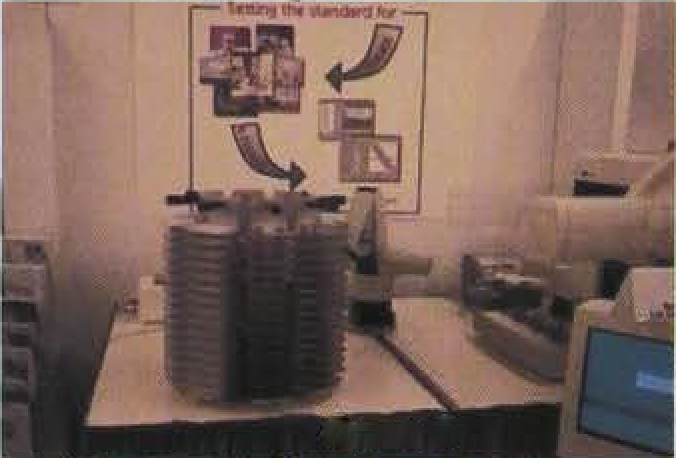
With the continued growth of high-speed synthesis and screening, the need to store and automatically access greater numbers of microtiter plates has been come a greater concern. Typical laboratory scale (20–200 plates) approaches have been plate hotel or carousels such as the
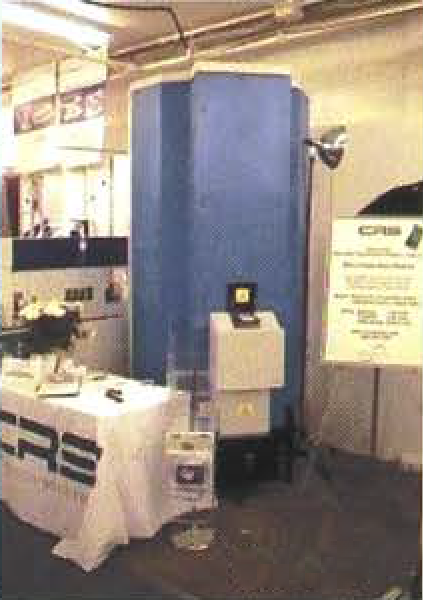
Several vendors at the conference showed an intermediate-scale option. The French company


It should be noted that the mechanical and software interface of any of these storage devices to other automation is still very prototypical.


HIGH SPEED CHEMICAL SYNTHESIS
The field of High Speed Chemical Synthesis is growing equally as fast as HTS, but is much more varied in approaches. Chemical synthesis offers unique challenges, such as harsh temperatures and aggressive chemicals. The typical systems are for solid phase reaction chemistry with temperature ranges from −20 deg C to 120 deg C capable of handling 1–2 atmospheres of internal pressure. With the ever increasing interest in flexibility some of these systems such as those from
Vendors at LA′99 showed the broad range of solutions such as the


The

Sample cleanup and quantification is a growing bottleneck in the high speed production of compounds.


OTHER TECHNOLOGIES
The


The software and hardware control of the motion is very sophisticated when working with multiple pods and often requires scheduler and motion controller. The magnetic platen is extremely sensitive to harsh environments and corrosion.