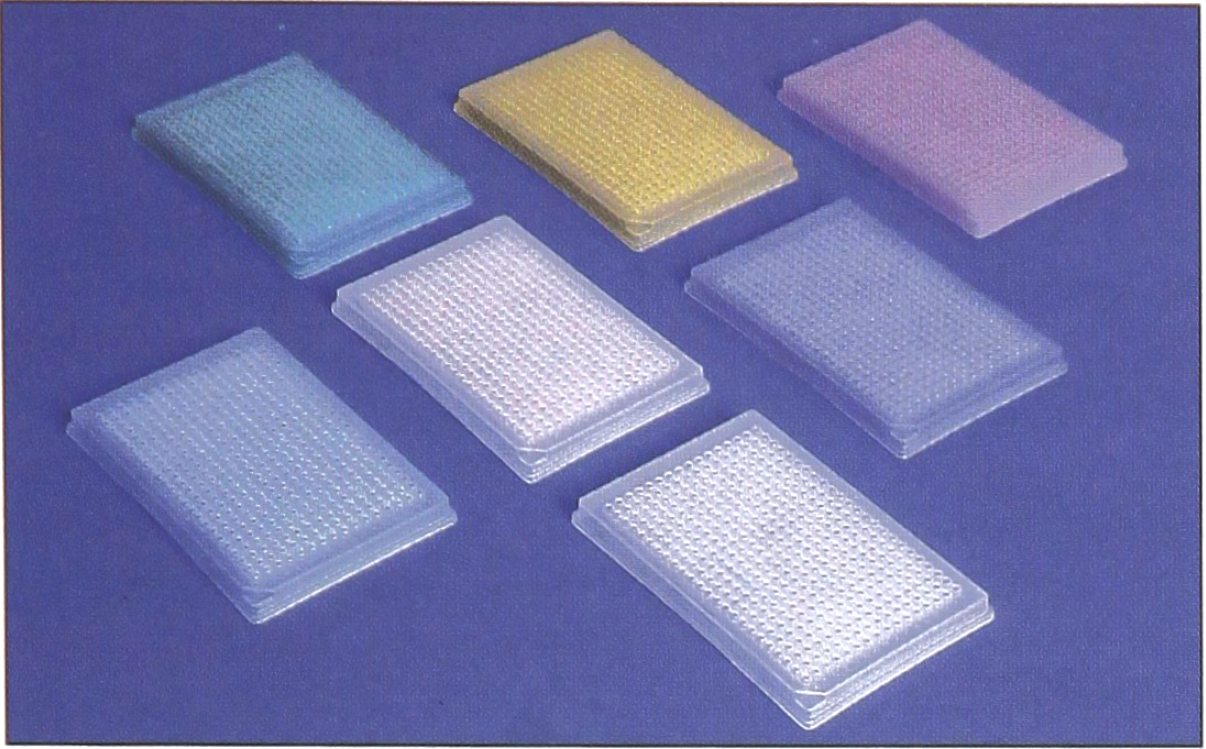
Zymark Corporation, Hopkinton, MA, March, 1999. New Automation Certified Pipet Tips. Zymark's Tempo™ Automation Certified Pipet Tips are now available in 100μl volumes for use with the Zymark equipment such as the RapidPlate® 96/384 Workstations. Tempo™ Pipet Tips are the only Zymark Automation Certified tips on the market today. They have been specifically engineered to enhance the operation of Zymark automation equipment. They provide guaranteed box-to-box uniformity and trouble-free performance. The rigid box design ensures consistent tip attachment and individual tip compartments prevent cross-contamination. They have a specially designed attachment point ensuring a reliable seal and accurate dispensing. The enhanced tip length reaches the bottom of deepwell plates, minimizing dead volume. They are available in 100 and 200μL volumes, with or without filters and sterile or unsterile packaging. The brightly colored tip boxes clearly differentiate the volume sizes to allow visual confirmation. For more information contact: Sharon Correia, Director of Marketing Communications, (508) 497–6403, sharon.correia@zymark.com.
Zymark Corporation, Hopkinton, MA, February, 1999. Enrique Bernal joins Zymark as Vice President of Research and Development. Zymark Corporation announced the appointment of Enrique (Rick) Bernal to the newly created position of Vice President of Research and Development in order to enhance Zymark's commitment to the development and introduction of new products for the pharmaceutical and biopharmaceutical markets.
Rick has a strong technical background in lasers, optical materials and modeling, and more than 20 years experience managing Product Development and Operations in the fields of medical equipment, electro-optics systems and sensors, and materials. He is the co-inventor of eight U.S. patents and has published 36 technical papers.
Zymark President and CEO, Kevin Hrusovsky, said that Bernal will be a key player in Zymark's rapid evolution as the premier provider of new generation laboratory automation solutions.
Contact: Sharon Correia, Director of Marketing Communications, (508) 497-6403, Fax (508) 435-3439
THK America Inc.
THK America Inc., Schaumburg, IL, March, 1999. THK Introduces the FGS15 Series Linear Actuator. THK, the leading and original manufacturer of linear motion guides, introduces the FGS15 Series Linear Actuator. This low-cost, lightweight and easy-to-install Series features a number of design advantages, including the SSR LM guide with breakthrough caged ball technology.
The SSR LM guide uses an elastomeric cage to separate and align the re-circulating ball bearings for a smoother and more consistent gliding motion. This incorporation of caged ball technology eliminates the heat associated with ball-to-ball friction, for increased speed and a longer product life. Operating sound levels are also decreased. Located within the ball cages are grease pockets designed to retain lubricant and minimize long term maintenance.
Designed and manufactured in the U.S., this new actuator is available from stock. FGS15 actuators are designed to accept NEMA23 dimension motors/reducers without any adapter flanges. NEMA34 dimension motors/reducers can be mounted with additional adapter flanges. Additional base plates can be ordered for applications requiring long strokes.
For more information on THK's new FGS15 Series, visit the THK website at: http://www.thk.com, or contact THK America Inc., 200 East Commerce Dr., Schaumburg, IL 60173, (800) 763–5459.
Robbins Scientific Corporation
Robbins Scientific Corporation, Sunnyvale, CA, April, 1999. CyclePlate®-384DW Thin Wall PCR Plate. Robbins introduces CyclePlate-384DW (discrete well) Thin Wall Plates — the latest product in Robbins' wide range of PCR plastics for high throughput genomics. CyclePlate-384DW maintains industry standard dimensions before and after thermal cycling. Pre-cycling assembly and post-cycling pooling of reactions can now be done with complete confidence using the Hydra® line of Microdispensers. Tight manufacturing process and quality control ensures that CyclePlate-384DW is the best 384 PCR plate available. CyclePlate-384DW plates are sealed with Robbins' CycleSeal® plate sealer and are compatible with the 384 well heating blocks used on both the MJ Research and Perkin-Elmer thermal cyclers.
For more information contact Robbins Scientific Corporation, 814 San Aleso Avenue, Sunnyvale, CA 94086-1411, (408) 734-8500, fax (408) 734-0300.
Robbins Scientific Corporation, Sunnyvale, California, February, 1999. 48 and 96 Well FlexChem® Reactor Blocks. Robbins introduced new 48 and 96 well reactor blocks for the FlexChem Organic Synthesis System. The new 48 well reactor block has an 8 by 6 well array with six wells per row instead of the usual 12 found in a 96 well plate. The resulting well has a total volume of 5.6mL, sufficient for performing reactions with over 300mg of solid support. To maximize volume, the wells have a unique design with square corners with smooth radii to prevent solvent from “creeping” up the corners and out of the wells. No additional hardware is required to use 48 well FlexChem reactors; they are fully compatible with the FlexChem 96 well reactor block sealing system, ovens, and Hydra dispensers found in laboratories around the world already using the FlexChem system.
A new and improved version of the FlexChem 96 well reactor has also recently been made available. Using the same design strategy as that used with the 48 well block described above, the wells of the new 96 well reactor are square with a gentle curve in each corner to prevent solvent from running up the corners. This new well design yields a total volume of 2.4mL; a 20% increase in volume over the 1.8mL round wells used in our first generation FlexChem reactor blocks. The increased volume of the new style reactor permits larger scale syntheses to be performed. For more information contact Robbins Scientific Corporation, 814 San Aleso Avenue, Sunnyvale, CA 94086-1411, (408) 734-8500, Fax: (408) 734-0300.
Robbins Scientific Corporation, Sunnyvale, CA, February, 1999. One-Step Loading of Dry Resin into FlexChem Reactor Blocks. Robbins introduced new FlexChem Resin Loaders for its FlexChem system for performing high throughput, parallel synthesis of small molecules. The “Flip” style resin loader is designed for loading dry resin into an empty FlexChem 96 reactor block. The loader consists of a flat anodized aluminum plate with 96 depressions that holds resin in the corresponding locations of the wells in the block. The volume of the depression defines the amount of resin that will be deposited into the well. Using the “Flip” loader is simple. The dry resin to be used is evenly spread across the surface of the plate and the FlexChem block placed upside down onto the plate. The entire assembly is then quickly inverted so that the resin falls into the wells. Four “Flip” loaders are available that deliver 25, 50, 75 or 100mg of dry silica into each well.
The “Trap Door” resin loader is used for depositing resin into a bottom-sealed FlexChem block that contains solvent, reagents, etc. It is ideal for adding scavenging resins or for dropping synthesis supports into a filled block. The “Trap Door” loader is similar to the “Flip” style loader except the 96 wells that hold the resin extend through the plate. A two-position slide mounted below the plate prevents the resin from falling out during loading. Resin in the wells is added to the block by moving the slide so that the 96 holes in the slide align with the bottom of the wells of the plate, allowing the resin to drop into the wells. “Trap Door” loaders are also available in four sizes for delivering 25, 50, 75 or 100mg of dry silica into each well in the block.
For more information contact Robbins Scientific Corporation, 814 San Aleso Avenue, Sunnyvale, CA 94086-1411, (408) 734-8500, Fax (408) 734-0300.
Packard Instrument Company
Packard Instrument Company, Meriden, CT, February 1999-Improved Robotic Access Simplifies Integration of TopCount® NXT™Microplate Counter. Packard Instrument Company announced a new, low cost, single-microplate stacker option that simplifies, speeds and reduces the cost of integrating the TopCount® NXT™ microplate scintillation and luminescence counter with robotic laboratory systems. The new device positions microplates well above the instrument, and ensures complete access to the microplate by the robotic gripper. The device enables robotic loading and unloading of plates from either the front (portrait) or the side (landscape) of the TopCount NXT, without requiring mechanical modification to the instrument. The new mechanism can be easily removed from the TopCount NXT to allow the conversion of the instrument to stand-alone, multi-plate stacker, or manual operation, in just a matter of minutes. This versatility is very important for laboratory situations in which changes in projects or type of analysis necessitates removing the TopCount NXT from the robotic system, or in cases when microplates from non-robotic sources must also be counted while the TopCount NXT is still connected to the robot.
For more information contact Packard Instrument Company, (800) 323–1891 (U.S. only), or 203-238-2351, http://www.packardinst.com. Refer to PR2004 when requesting information on this product.
Packard Instrument Company, Meriden, CT, February, 1999. New MultiPROBE® II: Applications in Genomics. Packard Instrument Company is pleased to announce that the MultiPROBE® II Expanded Robotic Liquid Handling System is available with new accessory items designed for use in molecular biology applications. The MultiPROBE II EX robotic liquid handling system is a flexible instrument and with the addition of two new modules is capable of automating a variety of applications utilized in molecular biology. The first module is a vacuum manifold control system that can be used to automate DNA extraction and Plasmid preparation protocols using commercially available kits. All liquid handling steps and control of the vacuum pump is performed by the WinPREP® operating software, a true 32 bit Windows® NT® design. The second module is an integration package for thermal cycler systems. Currently, this is available for MJ Research Remote Alpha Dock™ system (Watertown, MA). WinPREP software can activate any of the thermal cycler programs and both modules can be fitted within the removable left and right deck sections of the MultiPROBE II EX. Full DNA extraction and amplification assays can be performed including extraction, assay setup, sample/reagent transfer and cycle sequencing. For more information contact Packard Instrument Company, 800-323-1891 (U.S. only), or 203-238-2351, http://www.packardinst.com. Please refer to PR3004 when asking for information about this product.
Packard Instruments Company, Torrance, CA, March, 1999. The New MiniTrak™ — Compact Microplate Automation. Packard Instruments Company introduced the MiniTrak, the most compact, powerful and affordable microplate processing system available. This Mighty Mini is a four module conveyor based system with two microplate stacker cassettes, a 96 tip pipette dispenser and an open module for future expansion. The entire system is compatible with 96-, 384- and other formats including deepwell microplates. Unlike traditional automated pipettors, the open module provides unmatched flexibility and functionality via an optional 96 or 384 Tip Dispenser, Wash Module, Vacuum Filtration, Lidding Module or Turbo Aspirator/Dryer. The MiniTrak is specially designed for the efficient automation of microplate format applications utilized in pharmaceutical, biotech, clinical research and manufacturing processes.
For more information contact Packard Instrument Company, 800-323-1891; outside the U.S. call 203-238-2351, http://www.ccspackard.com. When requesting information on this product refer to PR7002-CCS.
Ortho Clinical Diagnostics
Ortho Clinical Diagnostics (OCD), Inc., Raritan, NJ, February, 1999. OCD has harnessed state-of-the-art data communications technology to streamline and enhance the technical support services it offers to immunoassay system customers. All new Vitros (ECi Immunodiagnostic Systems), OCD's leading-edge enhanced chemiluminescence instrument, will now include a Remote Diagnostics Feature. The new feature uses modem and telecommunications technology to enable OCD technical support personnel to remotely access and communicate with the ECi system. In addition, all laboratories currently using the ECi System will receive an upgrade, at no charge, that will equip the instrument with the Remote Diagnostics capability. OCD technical field representatives will perform the upgrades.
The Remote Diagnostics function provides: calibration, quality control and system configuration data; system condition codes; current inventory and expiration data for assay reagents and diluents; result files of Laboratory Information System test communication functions; system adjustments; and full electrical and mechanical status.
To use the telecommunications feature, the customer initiates a Remote Diagnostics session. Information about the ECi system is downloaded by Ortho-Clinical Diagnostics support staff, who then uses it to facilitate any required support services.
For more information contact Ortho-Clinical Diagnostics, (760) 438-5250, (760) 438-5230 fax.
Skatron Instrument
Skatron Instruments, Lier, Norway. Skatron was the first on the market with a microplate washer for the 384 well format, bringing washing into the computer age, with Windows-based software and robotic integration. They now present also the first washer for 1536 wells, based on the same innovative technology.
The EMBLA 1536 Washer further evolves the cost saving benefits of miniaturization and the speed of robotic integration. The unit has separate heads for dispense and aspiration, rapidly fills and evacuates 1536 wells in two steps, 768 wells at a time.
For more information contact: Skatron Instruments AS: P.O. Box 8, N-3401, Lier, Norway, 47.3285 4250, Fax 47.3285 4204, email: Info@skatron.no, USA and Canada: Skatron Instruments Inc., 108 Terminal Dr., Suite D, Sterling, VA 20166, USA, (800) 336 0191, Fax (703) 478 5197, email: Info@skatron.com, http://www.skatron.com
Cellomics, Inc., Pittsburgh, PA, March, 1999. The introduction of the ArrayScan™ System heralds a powerful paradigm shift in the target validation and lead optimization process. The automated system achieves subcellular resolution of fluorescence signals from many cells within multiple fields from wells in 96 and 1536-well microplates. Multi-channel, multi-parameter automated analysis with cross-correlation of temporal and spatial dynamics of these signals generates in formation-rich data regarding the effect of potential new drugs on target activity. As a result, the field of lead compounds selected to undergo animal and human clinical testing is narrowed to the most promising leads.
Labotix Automation Inc
Labotix Automation Inc., Peterborough, ON Canada, March, 1999. Labotix Automation Inc. is pleased to announce the addition of Adam Koch to their team. Adam will serve as Director of Sales & Marketing for Labotix in North America. Adam began his career 28 years ago with the Coulter Corporation. He has extensive laboratory automation experience that he brings to Labotix to enhance their mission to provide open, modular, cost-effective systems that can expand to meet any laboratories needs. For laboratory automation requests please contact Adam Koch directly. Telephone: (800) 661-5229 ext. 701, Fax: (705) 876-1499, email: akoch@labotix.ca