



Abstract
Laboratory Automation Symposium at the World's Largest Medical Trade Fair
Medica 1998, the world's largest trade fair of medicine and one of the largest for laboratory diagnostics will be held in Duesseldorf, Germany, from November 18 to 22. Each year, far more than 100,000 visitors come to Medica from all over the world.
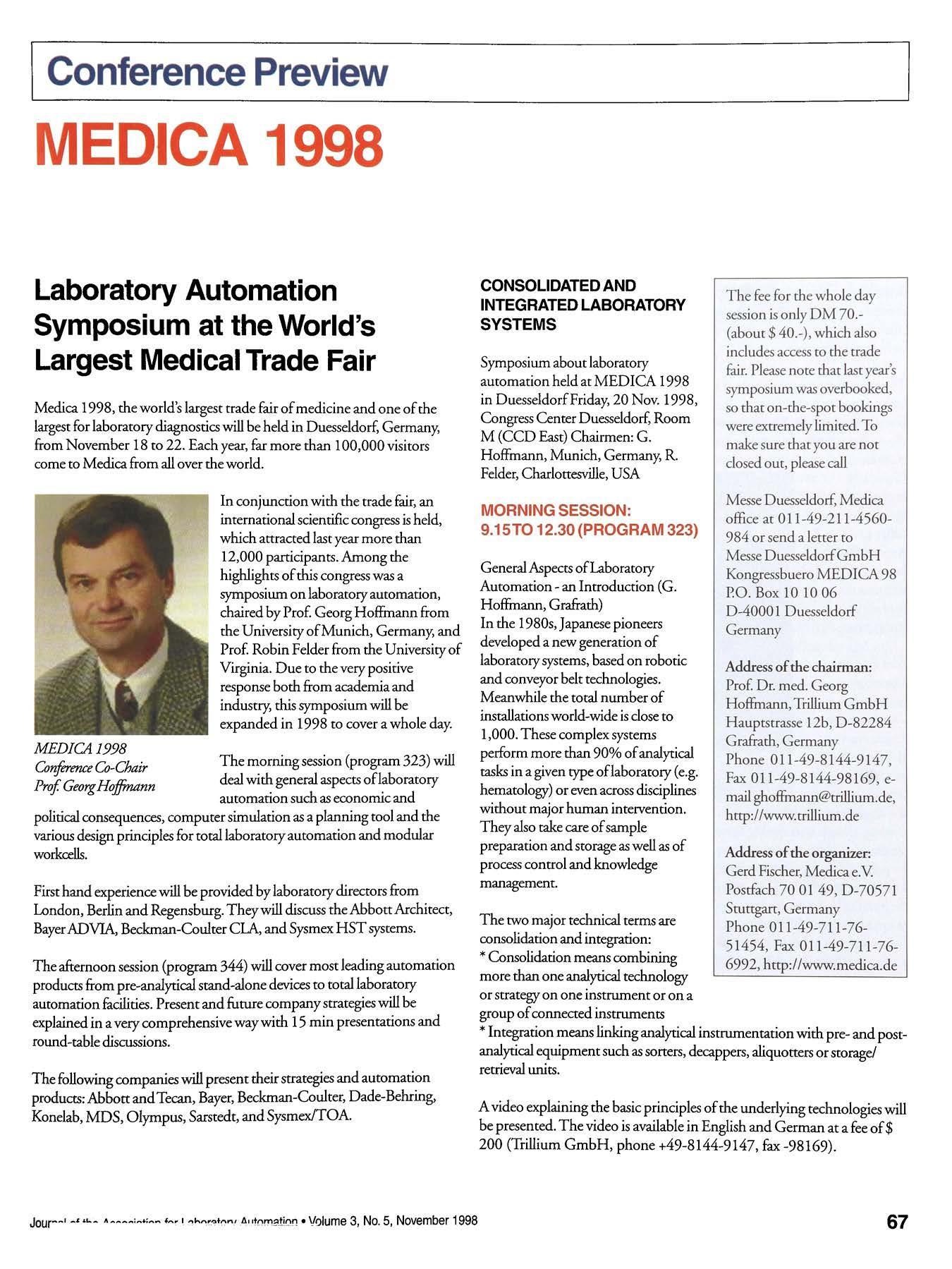
In conjunction with the trade fair, an international scientific congress is held, which attracted last year more than 12,000 participants. Among the highlights of this congress was a symposium on laboratory automation, chaired by Prof. Georg Hoffmann from the University of Munich, Germany, and Prof. Robin Felder from the University of Virginia. Due to the very positive response both from academia and industry this symposium will be expanded in 1998 to cover a whole day.

The morning session (program 323) will deal with general aspects of laboratory automation such as economic and political consequences, computer simulation as a planning tool and the various design principles for total laboratory automation and modular workcells.
First hand experience will be provided by laboratory directors from London, Berlin and Regensburg. They will discuss the Abbott Architect, Bayer ADVIA, Beckman-Coulter CIA, and Sysmex HST systems.
The afternoon session (program 344) will cover most leading automation products from pre-analytical stand-alone devices to total laboratory automation facilities. Present and future company strategies will be explained in a very comprehensive way with 15 min presentations and round-table discussions.
The following companies will present their strategies and automation products: Abbott and Tecan, Bayer, Beckman-Coulter, Dade-Behring, Konelab, MDS, Olympus, Sarstedt, and Sysmex/TOA.
CONSOLIDATED AND INTEGRATED LABORATORY SYSTEMS
Symposium about laboratory automation held at MEDICA 1998 in Duesseldorf Friday 20 Nov. 1998, Congress Center Duesseldorf, Room M (CCD East) Chairmen: G. Hoffmann, Munich, Germany, R. Felder, Charlottesville, USA
MORNING SESSION: 9.15 TO 12.30 (PROGRAM 323)
General Aspects of Laboratory Automation — an Introduction (G. Hoffmann, Grafrath) In the 1980s, Japanese pioneers developed a new generation of laboratory systems, based on robotic and conveyor belt technologies. Meanwhile the total number of installations world-wide is close to 1,000. These complex systems perform more than 90% of analytical tasks in a given type of laboratory (e.g. hematology) or even across disciplines without major human intervention. They also take care of sample preparation and storage as well as of process control and knowledge management.
The two major technical terms are consolidation and integration:
* Consolidation means combining more than one analytical technology or strategy on one instrument or on a group of connected instruments
* Integration means linking analytical instrumentation with pre- and post-analytical equipment such as sorters, decappers, aliquotters or storage/retrieval units.
A video explaining the basic principles of the underlying technologies will be presented. The video is available in English and German at a fee of $ 200 (Trillium GmbH, phone +49-8144-9147, fax -98169).
The fee for the whole day session is only DM 70.-(about $ 40.-), which also includes access to the trade fair. Please note that last year's symposium was overbooked, so that on-the-spot bookings were extremely limited. To make sure that you are not closed out, please call
Messe Duesseldorf, Medica office at 01 1-49-211-4560-984 or send a letter to Messe Duesseldorf GmbH Kongressbuero MEDICA 98 P.O. Box 10 10 06 D-40001 Duesseldorf Cermany
Address of the chairman: Prof Dr. med. Georg Hoffmann, Trillium GmbH Hauptstrasse 12b, D-82284 Grafrath, Germany Phone 011-49-8144-9147, Fax 011-49-8144-98169, e-mail
Address of the organizer; Gerd Fischer, Medica e. V. Postfach 70 01 49, D-70571 Stuttgart, Germany Phone 011-49-711-76-51454, Fax 011-49-711-76-6992, http://www.medica.de
THE ART OF LABORATORY AUTOMATION (R. FELDER, CHARLOTTESVILLE)
Laboratories must increase productivity in order to remain in business. Laboratory automation is the newest cost saving measure of the 1990s that will provide the needed efficiencies to allow laboratory survival into the next century. In the USA, over 1200 of the 3500 hospital and commercial laboratories are expected to buy automated laboratory systems in the next five years.
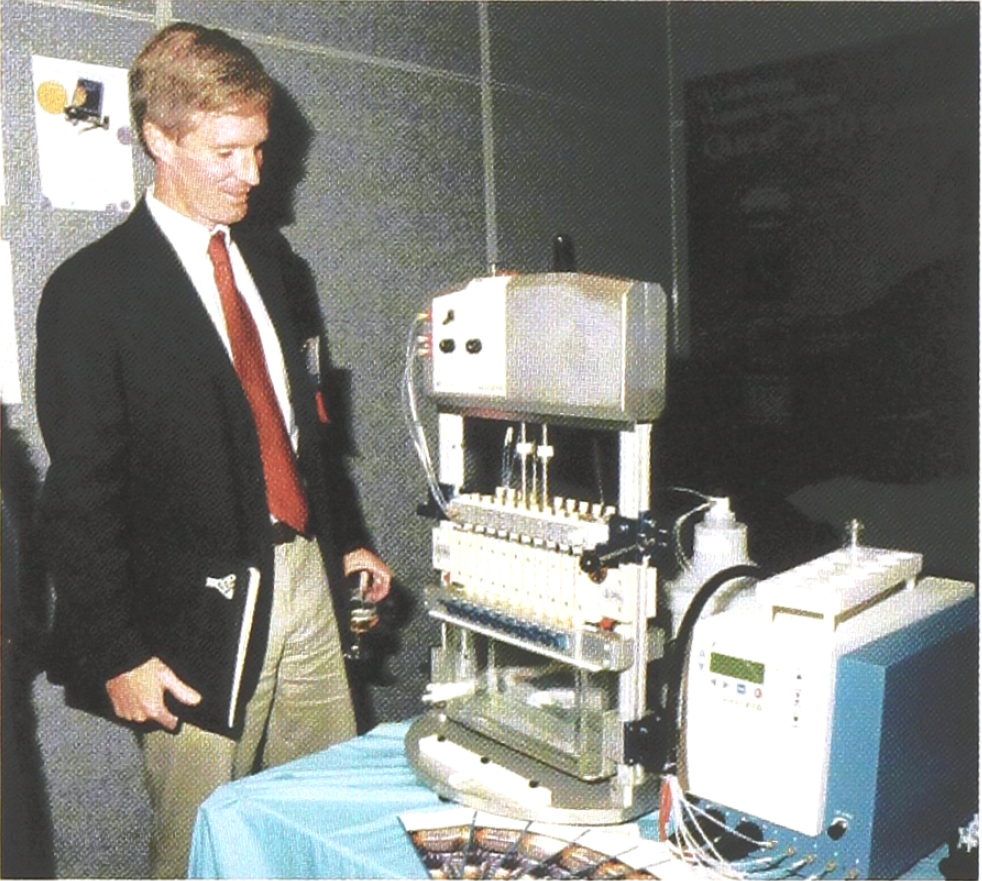
The most exciting development in total laboratory automation technology in the last several years has been the appearance of modular analytical workcells. These systems will reduce space, improve throughput, and reduce labor for sample analysis and system maintenance. Complete automation systems, on the other hand, will perform most laboratory tasks without the need for human interaction.
The success of laboratory automation systems in the future rests on the creation of machine intelligence with the capabilities to manage the many complex events that will be occurring simultaneously in an automated laboratory. Process control software and expert systems will be required to maintain a minute-to-minute database of specimen status and analytical results. This software system should also monitor for exceptions to the normal state (insufficient quantity, unreadable bar code, poor quality sample, improper container, and specimen damage) and then follow rules as to how exceptions should be treated. The more intelligent systems will learn from its experiences and use this information to optimize throughput and the utilization of resources. Most importantly, the expert system will have to keep the operators informed of all important events and analytical results so that timely decisions can be made.
Through intelligent process control, point-of-care testing will soon become the most profitable way to provide laboratory services. The central laboratory of the future is destined to become an esoteric testing center, while routine testing will be more economical when administered at the patient bedside.
ECONOMIC OUTCOME OF LABORATORY AUTOMATION (V.D. SCHULENBURG, UNIVERSITY OF HANNOVER)
To evaluate medical services from an economic point of view, one has to assess the costs and the benefits. However, in many cases the benefits cannot be calculated in monetary units. Issues to be addressed are: What are appropriate benefit measures for the outcome of laboratory automation? How can we aggregate the benefits of laboratory automation achievements such as reduced risk of sample mix-ups, shorter diagnostic response times, elimination of biohazards, saving valuable time of trained people etc.? The results of a recent study on these questions will be presented.
STAFFING ASPECTS: THE POLITICAL DIMENSION (J. OBST, VDGH, FRANKFURT)
Cost constraints and competitive pressure among diagnostic laboratories are forcing hospital and laboratory managers all over the world, to rethink their organization in terms of which procedural steps need to be performed by humans and which can be automated. With the advent of robotic technology, enthusisiasm about “total laboratory automation” and “human-less laboratories” came up among those who are in charge of economic survival, and this in turn, has led to rejection of technological progress by laboratorians, who are in fear of loosing their jobs and being replaced by robots.
The lecture will describe some of the political considerations leading to existing and future cost containment programs in the laboratory and discuss their impact on laboratory staffing. It will show that laboratories have already reached a cost benefit ratio, which is competitive with other medical areas, and that further savings will put a major instrument of total health care efficiency on risk. Finally, emphasis will be put on the fact that sufficient staffing will be needed to cope with the challenges of the future such as genomic resting.
COMPUTER SIMULATION FOR CLINICAL LABORATORIES (E. HAENSELER, UNIVERSITY HOSPITAL ZÜRICH)
The institute for Clinical Chemistry at the University of Zuerich, Switzerland, has applied computer simulation as a planning tool, to reduce turnaround times, expand the analytical spectrum and at the same time lower personnel costs. A “virtual laboratory model” was established with Simlab 3.0 on the basis of the current laboratory dealing with 260,000 orders (1.6 mio tests) a year. This computer model provided experimental access to the key logistics of the laboratory without putting daily operations on risk. It predicts a great potential for improvement just by reorganizing workflow patterns and work rules. Enhanced sample transportation and consolidation of STAT tests on routine analyzers proved to be efficient measures for simpler logistics and shorter turnaround times. To achieve even greater improvements, the impact of a modular workcell for clinical chemistry and immunochemistry was tested, using the Roche-Hitachi MODULAR system as an example.
THE FIRST STEPTOWARDS LABORATORY AUTOMATION (D. GUTHRIE, STTHOMAS' HOSPITAL, LONDON)
The merger of Guy's Hospital and St Thomas' Hospital created the need to re-engineer virtually every process within the new organisation giving the opportunity to consider automating those functions where there were possible economies of scale and improved service delivery resulting from better sample and data management. Major targets for automation were centrifugation of samples, prearation of serum aliquots and loading/unloading of analyzers. The decision was made for an integrated automation system from Beckman-Coulter. Planning and cost/benefit considerations will be described as well as a three step approach to automation.
SYSTEMIZATION OF HEMATOLOGY IN A LARGE UNIVERSITY HOSPITAL (P. SINHA, CHARITÉ, BERLIN)
In an attempt to make use of the positive Japanese experience with consolidated hematology workstations, we had to consider paperless requesting, supported by on-line help for the clinicians before going into the automation itself Also, storage and transfer of graphical information is becoming increasingly important. In this respect, the Sysmex PC-DPS offers attractive features for data storage and cumulation. With the introduction of the LAFIA digital photomicroscope by TOA Medical Electronics Co., storage of morphological data together with numerical and leucocyte scattergramme data is now possible.
PRACTICAL EXPERIENCE WITH THE ARCHITECT SYSTEM IN A LARGE LABORATORY (M. WHEELER, STTHOMAS' HOSPITAL, LONDON)
Although a fully automated laboratory may be attractive in concept, the cost is for most laboratories prohibitive. In Europe there are few laboratories large enough to warrant the commitment to total laboratory automation. Automated modular systems offer partial automation and potentially large cost savings without the need for a large initial outlay. First evaluation data will be presented for the Abbott ARCHITECT i2000 immunoassay system, as the first part of consolidated chemistry/immunochemistry testing.
FIRST ADVIA® LABCELL™ INSTALLATION IN A CENTRAL LABORATORY-DEVELOPING A LABORATORY FOR THE YEAR 2000 (G. SCHMITZ, UNIVERSITY HOSPITAL, REGENSBURG)
Future developments in the clinical chemistry laboratory will include total automation of high volume tests, very sophisticated high-end testing and point-of-care testing of vital parameters. The University Hospital of Regensburg is now getting prepared for step one of this evolution by installing the worlds first ADVIA® LabCell™ modular automation system from Bayer Diagnostics. First evaluation results will be presented.
AFTERNOON SESSION:14,30 TO 18.00 (PROGRAM 344)
AUTOMATION PRODUCTS AND STRATEGIES -AN INTRODUCTION (G. HOFFMANN, GRAFRATH)
Products for the new generation of automation systems can be divided into three subclasses:
Consolidated analytical workcells
Pre- and post-analytical automation devices
Components for systems integration
Manufacturers of such automation equipment favour either turnkey solutions out of one hand (single vendor approach) or solutions for specific tasks to be assembled with solutions from others (multi-vendor approach). A reasonable mix of the above based on site visits and computer simulation will be needed to accomplish the challenging task of leading a laboratory into the next century.
A PROGRESSIVE STRATEGY FOR THE SUCCESSFUL AUTOMATION OF THE LABORATORY (J. QUINT AND S. WILLS, BECKMAN COULTER, BREA)
The modular approach to laboratory automation permits the application of automation in a manner so as to derive the greatest efficiency and still control expenses. Six years ago, as the first to introduce laboratory automation to North America and Europe, Beckman Coulter recognized that, if laboratories were to be successful, only a modular approach would do. Both AccelNet and the Sample Preparation Module were early examples of this vision.
Beckman Coulter has built upon and improved these first generation systems. It is now possible to apply automation to all three phases of any laboratory process, i.e. pre-analytical specimen preparation, specimen analysis, and post-analytical information management and specimen storage. Workflow analysis and computer modeling permits the laboratory to understand the advantages of differing levels and combinations of systems, and where the greatest benefits will be derived, prior to actual installation. Many such systems are now in place in the United States, Canada, Australia, and Europe. Many more will follow.
REDEFINING MODULARITY: AFFORDABLE, OPEN, CUSTOMIZED AUTOMATION (D. MITCHELL, BAYER DIAGNOSTICS, TARRYTOWN, NY)
Many products today are called modular, but it is apparent that modularity means different things to different people. A modular system should provide a large menu of components from which to choose as well as the opportunity to creatively select and flexibly combine different engines or components so that the resulting automation solution meets the individual needs of the laboratory.
Concepts that should be considered when selecting the appropriate components for inclusion in an automation system include balancing the need to:
Manage instrument lifecycles
Upgrade and make changes to the system easily in a planned and timely manner
Do more with less
The ADVIA® family of products from Bayer Diagnostics offers a full range of automated instruments for the laboratory and includes ADVIA® 120 Hematology System, ADVIA® 1650 Chemistry System, ADVIA® Integrated Modular System as well as the ability to integrate them with pre-analytical equipment using the ADVIA® LabCell(TM) Modular Automation System. The advanced design concepts that are evidenced throughout the family of ADVIA® products provide the freedom to select the correct components to include in any automation decision— from a single instrument to total laboratory automation. The ADVIA® family of products is a comprehensive concept for laboratory reorganization, automation, and operation. ADVIA® allows the laboratory to make one decision that provides a lifetime of choice.
OLYMPUS LABORATORY AUTOMATION: THE VISIBLE DIFFERENCE (D. EHLERS, OLYMPUS, HAMBURG)
The Olympus Diagnostic Systems Division is a global systems provider for In Vitro Diagnostics. Based on its multiyear experience with redesigning processes in large laboratories, Olympus is now offering a broad range of automation solutions. The Olympus Laboratory Automation (OLA) Instrument Line comprises integrated, modular and consolidation concepts, allowing both primary and secondary tube driven workflows. Core elements are the ultra high speed decapper and sorter OLA1500, the high speed integrated aliquoter OLA2000 and the 30 channel aliquoter OLA6000. Additional centrifuge, decapping and rack transportation modules are also available.
The growing family of innovative Olympus AU Clinical Chemistry Systems with reagents, sample racks and software standardized across the instrument categories, allows flexible and easy adjustment to changing capacity needs, workstation consolidation or multisite laboratory structures. As of today more than 35 major installations of Olympus Laboratory Automation Systems do exist, both in hospitals and commercial laboratories.
LABORATORY AUTOMATION: A STEPWISE APPROACH TO “FLEXIBLE AUTOMATION” (D. DALY, ABBOTT, ABBOTT PARK)
Laboratory Automation — What's the right choice for your lab? With so many options being offered by diagnostic vendors and automation manufacturers, it can be difficult to determine what the best solution might be for each lab's unique requirements. To assist in this process, laboratories should remember to ensure that their automation decisions allow for true flexibility. Flexible Automation decisions can provide labs with the opportunity to take advantage of today's rapidly changing healthcare environment. However, before making any decisions, laboratories must first have an overall automation strategy in place.
As an alternative strategy for laboratory automation, the Stepwise Approach is gaining momentum. This approach involves the evaluation of process improvements, data management enhancements, and finally lab automation components (front-end, workcells, back-end, etc.). The focus of this strategy is to explore and implement lab automation in a step by step process. Potential automation customers need to first carefully evaluate laboratory processes and the opportunity for improvements (workflow analysis, computer simulation, reengineering). Second, data management enhancements should be considered. Well thought-out data management systems can greatly enhance the capabilities of any overall automation decisions. Finally, only when process improvements have been identified and implemented, and the optimal data management system is in place, should the laboratory explore the options that exist for lab automation.
Market data reveals that as much as 65% of a laboratories hands-on time is associated with pre-analytical activities, such as sample sorting, centrifugation, decapping, aliquotting, and racking of tubes into instrument specific racks. This represents by far the greatest amount of labor time within the lab. As a result, to maximize productivity gains while watching costs, front-end automation alternatives are a natural first step in the overall automation process. The next largest area for hands-on time in the lab is in the analytical phase. Diagnostic vendors are addressing this need via Workcells. When front-end automation systems and analytical workcells are combined, data shows that 80% of the hands-on labor within the lab can be impacted. By automating through the combination of pre-analytical workcells and analytical workcells, laboratories can maintain maximum flexibility, while taking a Stepwise Approach to ensure the right level of automation with the maximum return on invested dollars.
MODULAR PLATFORMS FOR LABORATORY AUTOMATION (J. TIMMERS, TECAN, HOMBRECHTIKON)
TECAN supplies solutions to laboratories world-wide, based on its automation expertise and modular platforms. In the past, TECAN platforms such as GENESIS Robotic Sample Processors, were used for medium to high throughput microplate processing in clinical applications which include infectious diseases screening. At MEDICA this year, TECAN is introducing the GENESIS Front End (FE) Workcell, which centrifuges, inspects and decaps tubes. The system also produces barcode labelled secondary tubes, aliquots samples and sorts primary and secondary tubes into analyzer racks.
Different situations, being presented in this lecture, show that the GENESIS FE Workcell can work with all kinds of different rack formats, throughputs, aliquoting ratios and analyzers. An upgrade path will be available from an aliquoter and secondary tube labeller configuration through a 500 and up to a 1500 tubes per hour instrument performing all pre-analytical tasks. Recently, Tecan and Abbott have signed a Co-Promotion agreement that allows customers to select from a wide variety of automation products for all phases of the laboratory diagnostics process.
SYSMEX HEMATOLOGY AND COAGULATION SYSTEMS -INTELLIGENT PATIENT ORIENTED DIAGNOSTICS IN A TOTALLY AUTOMATED LABORATORY (R. M. ROWAN, SYSMEX EUROPE, HAMBURG)
Recent technical developments enable the creation of fully automated consolidated core laboratories, involving analytical devices, robotic transportation and bi-directional information links, the latter extending from the laboratory to the physicians workstation.
The basic units in this type of laboratory include workstation specific transport modules, grouping analytical devices for multidisciplinary applications together. Test ordering is undertaken electronically. Specimen reception, separation by work station, preparation and distribution can be performed by an intelligent sample aliqotter and distributor. Finally, analytical data is transformed into useful clinical information using a knowledge-based system, to support analytical findings with diagnostic hints and suggestions for further investigation, then being returned to the clinician electronically. Sysmex offers concepts and solutions for many of the above aspects.
THE KONELAB APPROACHTO LABORATORY AUTOMATION (B. OESTMAN, KONELAB, ESPOO)
The Finnish company Konelab Corporation, until lately known as KONE Instruments Corporation, has supplied innovative and high-quality products to clinical laboratories all over the world for more than 25 years. The company's mission is openness and flexibility.
In the area of laboratory automation, medium- and high-throughput Konelab analyzers may be equipped with an optional module, the “Konelab Universal Sample Transport Interface”, allowing an easy connection to most robotic sample handling systems currently available on the market. Two or more Konelab analyzers may be interconnected by the “Konelink” software and a modular set of robotic sample handling and pre-analytical automation modules to form the “Konelab Clinical Chemistry Workcell”. The feasibility of the Konelab Laboratory Automation approach has been demonstrated in a real-life setup including a Konelab analyzer, analyzers from another vendor and robotic sample handling modules from CLIDS Automation, a Finnish systems integration company, which has specialized in laboratory automation.
DADE-BEHRING CENTRAL LABORATORY AUTOMATION SOLUTIONS (M. WOLSEY-PAIGE, DADE BEHRING)
Dade Behring pioneered the concept of multi-discipline workstations with its aca discrete chemistry analyzer, which combines general chemistry, drug, immunoassay, protein and coagulation testing (a menu of ninety-one tests), on a single, easy-to-use system. Its Dimension RxL analyzer builds on that heritage by adding higher throughput and a much lower cost of operation.
Dimension RxL offers, for the first time, chemistry and large molecule immunochemistry testing in the same device. This capability represents a major advance over current systems that, when coupled with a cross-trained generalise staff offers unique potential for lower cost operation while still providing quality support to physicians and nurses that order tests. Toyota's famous lean manufacturing approach offers an apt analogy for this combination of flexible staffing with more capable workstations. At Methodist Hospital in Peoria, Illinois (USA), the installation of three RxLs in parallel with extensive cross training allowed the laboratory to eliminate six workstations and 39 FTEs, thus proving the effectiveness of laboratory consolidation as a step towards lean production in the clinical laboratory.
THE SARSTEDT MODULAR SAMPLE DISTRIBUTION SYSTEM (R. REST, SARSTEDT, NÜMBRECHT)
Sarstedt is the number one tube supplier in its home country Germany and a major player in this field in many other countries. Recognizing the fact, that sample tubes are the major consumable of the pre-analytical phase, Sarstedt has been the first to go into a pre-analytical system business by combining this consumable with laboratory automation. This innovative approach includes tube sorting, opening, and aliquotting. The modular design of the new Sarstedt Sample Distribution System allows for easy and straight forward integration of pre-analytical and analytical processes without any need to change existing laboratory structures.
The system can be configured according to the specifications of the user and adapted to any type of analyzer. Since the transfer of preprocessed samples to analytical workstations occurs off-line, the requirements for integration are much easier to fulfill than in any conveyor-based system approach. Also, later adaptations to new analyzer generation are no problem at all. The new Sarstedt Cloning Module creates pre-labelled split tubes, which bear the barcode of the original primary tube plus some information in clear writing.
THE CHALLENGE OF AUTOMATION (S. MIDDLETON, MDS AUTOLAB, ETOBICOKE)
Clinical laboratories as well as the diagnostics industry have evolved from “labour intensive” to “knowledge intensive” production facilities. The experiences of the manufacturing sector indicate that the quality of human and technology interaction will be a critical factor in the success of this transformation. The presentation will review the essentials of this transformation process. Examples will be drawn from the techniques and tools developed by MDS AutoLab in the course of six automation projects. MDS has taken an integrated approach to laboratory automation using methodology which deals with the full scope of the change process including the creation of a regional laboratory service supported by a fully automated core laboratory. The way we define the laboratory itself, the skills required and the way in which we educate and train the future members of our profession, are all modified in the context of the new technology. The development of AutoLab technology is grounded in the view of the laboratory as a knowledge intensive enterprise and a provider of information.