



Abstract

Primary amino groups grafted onto a polystyrene surface via a spacer can be used for covalent coupling of peptides, steroid hormones, haptens, proteins and antibodies. This article describes the covalent coupling of two peptides to microplates with a primary amine surface: the C-terminal 10 amino acid residues of human brain acetylcholinesterease (AChE) and residues 378–384 of human lipoprotein lipase (HLPL). The immobilised AChE-peptide was detected by specific antibodies and the biotinylated HLPL-peptide by avidin-HRP.
INTRODUCTION
The immobilisation of peptides on a solid phase has many potential applications, e.g. in ELISAs. Direct, passive adsorption to a hydrophobic surface, such as polystyrene, is normally not possible due to the physical properties of peptides. This can only be accomplished using carrier proteins. However, direct covalent coupling offers a number of advantages such as a more robust surface, possibility for orientation, higher density of peptide epitopes and reduced problems with antibody recognition of the peptide due to masking of the epitope. In an ELISA, the background can be significantly reduced by using a “clean” epitope where cross reactive material such as a carrier protein is not present. Eliminating the need of a carrier protein, the CovaLink NH2 has been developed, which offers such a surface for direct covalent coupling mediated by primary amino groups grafted onto the surface.
COUPLING
The carboxylic acid groups of peptides and proteins serve as a handle for the formation of amide bonds to an aminated solid surface. In this experiment, two peptides were immobilized to the amino surface of the microplates. Water soluble carbodiimide (EDC) was used to activate the carboxylic acid group in the presence of sulfo-N-hydroxy succinimide (sulfo-NHS) (Fig 2). Sulfo-NHS efficiently suppresses the loss of activated peptide due to hydrolysis and the formation of stable N-acylurea via the generation of an activated ester.
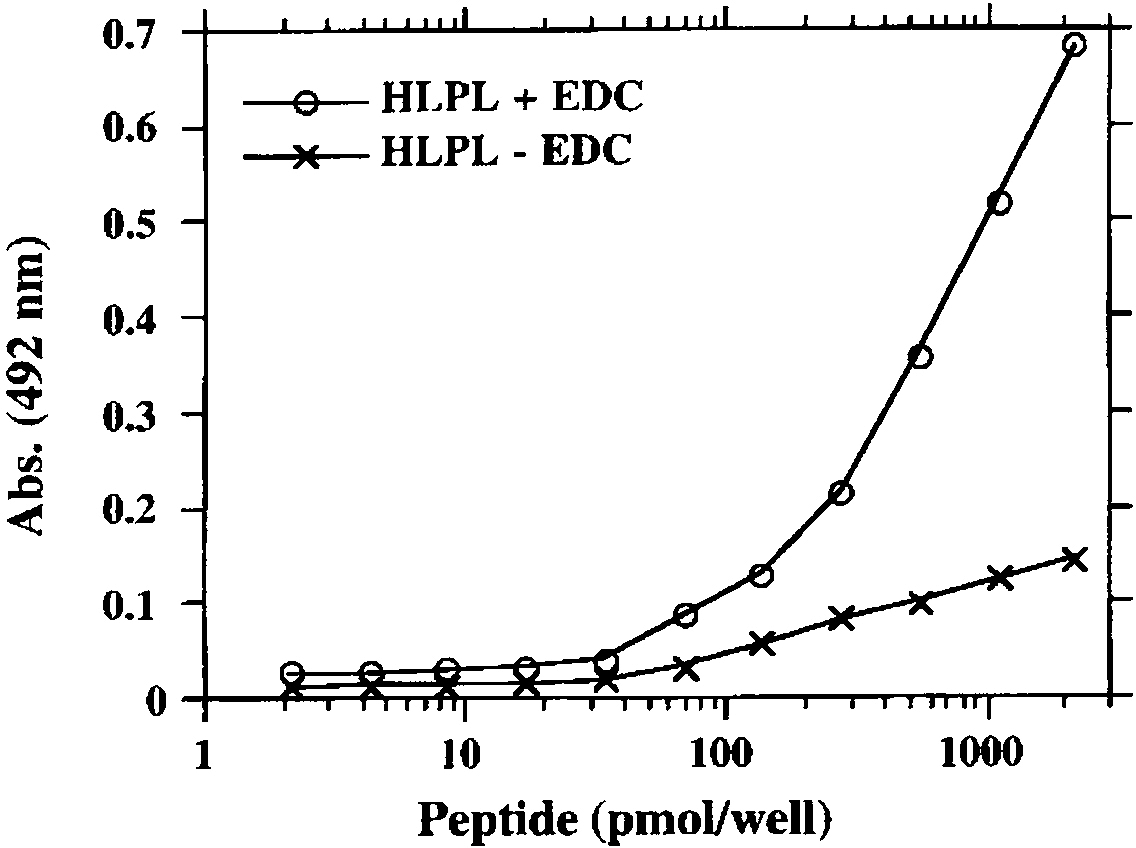
Detection of bound biotinylated HLPL-peptide as a function of peptide concentration. Effect of addition of coupling reagents.

Immobilisation of the pre-activated target molecule to the primary amine surface.
EXPERIMENTAL
Each peptide was added to two plates (A and B) in a two-fold dilution series in water including a negative control. Freshly prepared solutions of sulfo-NHS followed by EDC were added to each well on plate A. H20 was added to plate B which served as a control for no coupling reagents. After incubation and several washing steps, the biotinylated HLPL peptide was incubated with avidin-mix and the AChE peptide was incubated with the AChE-specific antibody Hyb190–2. Detection antibody and substrate solution was added to each well and the amount of bound detection antibody was quantified by reading the plates at 492nm in a microplate reader (see Fig 1 for HLPL data).
DISCUSSION
The results demonstrate that the NH2 plate can be used to covalently bind peptides using carbodiimide. The AChE peptide was furthermore presented on the surface in a conformation that allowed recognition by specific antibodies.
Nunc A/S, Kamstrupvej 90, 4000 Roskilde, Denmark, Tel: +45-46359065, Fax: +45-46350105, August 1998