




Abstract
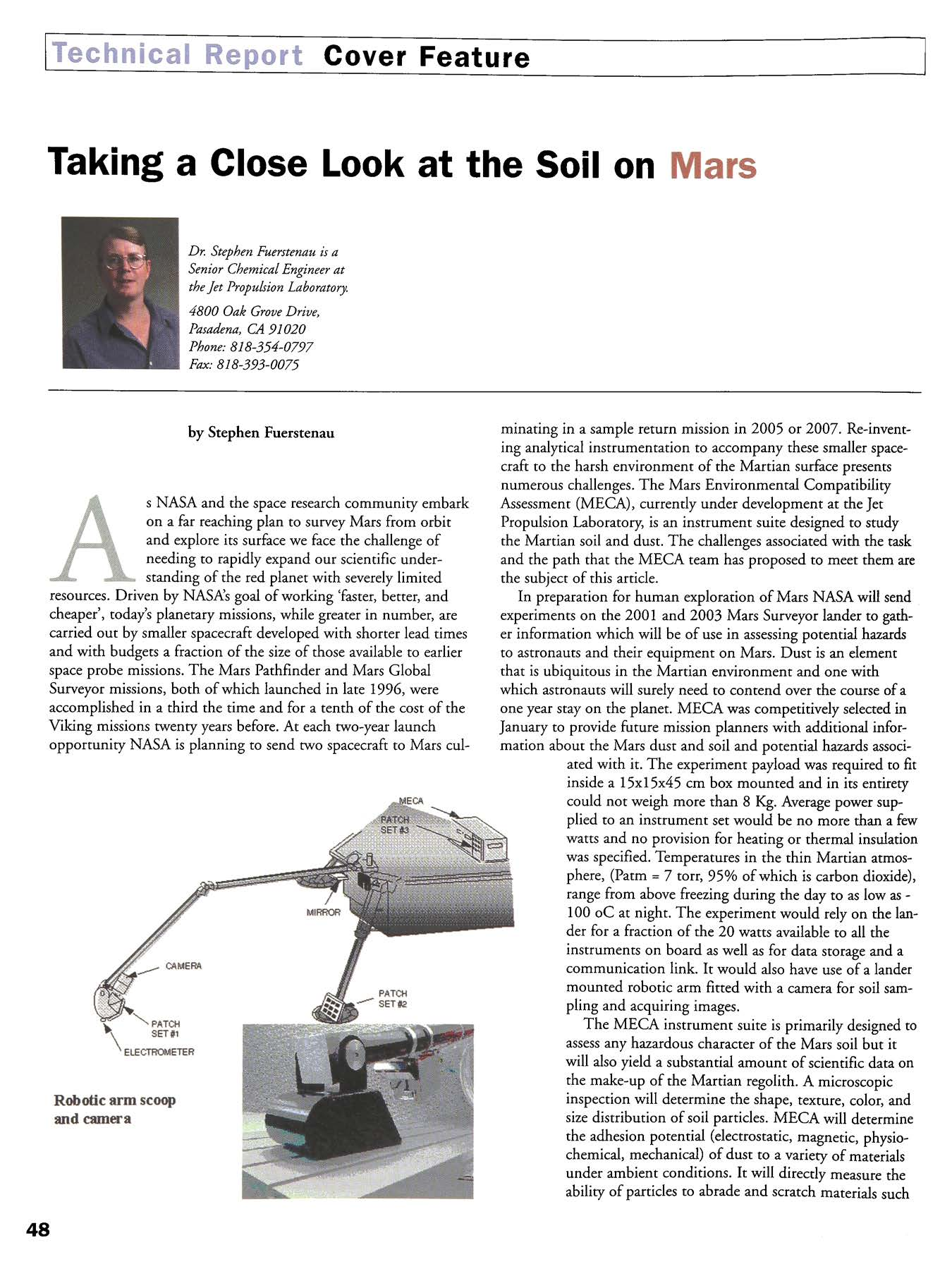

As NASA and the space research community embark on a far reaching plan to survey Mars from orbit and explore its surface we face the challenge of needing to rapidly expand our scientific understanding of the red planet with severely limited resources. Driven by NASA's goal of working ‘faster, better, and cheaper’, today's planetary missions, while greater in number, are carried out by smaller spacecraft developed with shorter lead times and with budgets a fraction of the size of those available to earlier space probe missions. The Mars Pathfinder and Mars Global Surveyor missions, both of which launched in late 1996, were accomplished in a third the time and for a tenth of the cost of the Viking missions twenty years before. At each two-year launch opportunity NASA is planning to send two spacecraft to Mars culminating in a sample return mission in 2005 or 2007. Re-inventing analytical instrumentation to accompany these smaller spacecraft to the harsh environment of the Martian surface presents numerous challenges. The Mars Environmental Compatibility Assessment (MECA), currently under development at the Jet Propulsion Laboratory, is an instrument suite designed to study the Martian soil and dust. The challenges associated with the task and the path that the MECA team has proposed to meet them are the subject of this article.
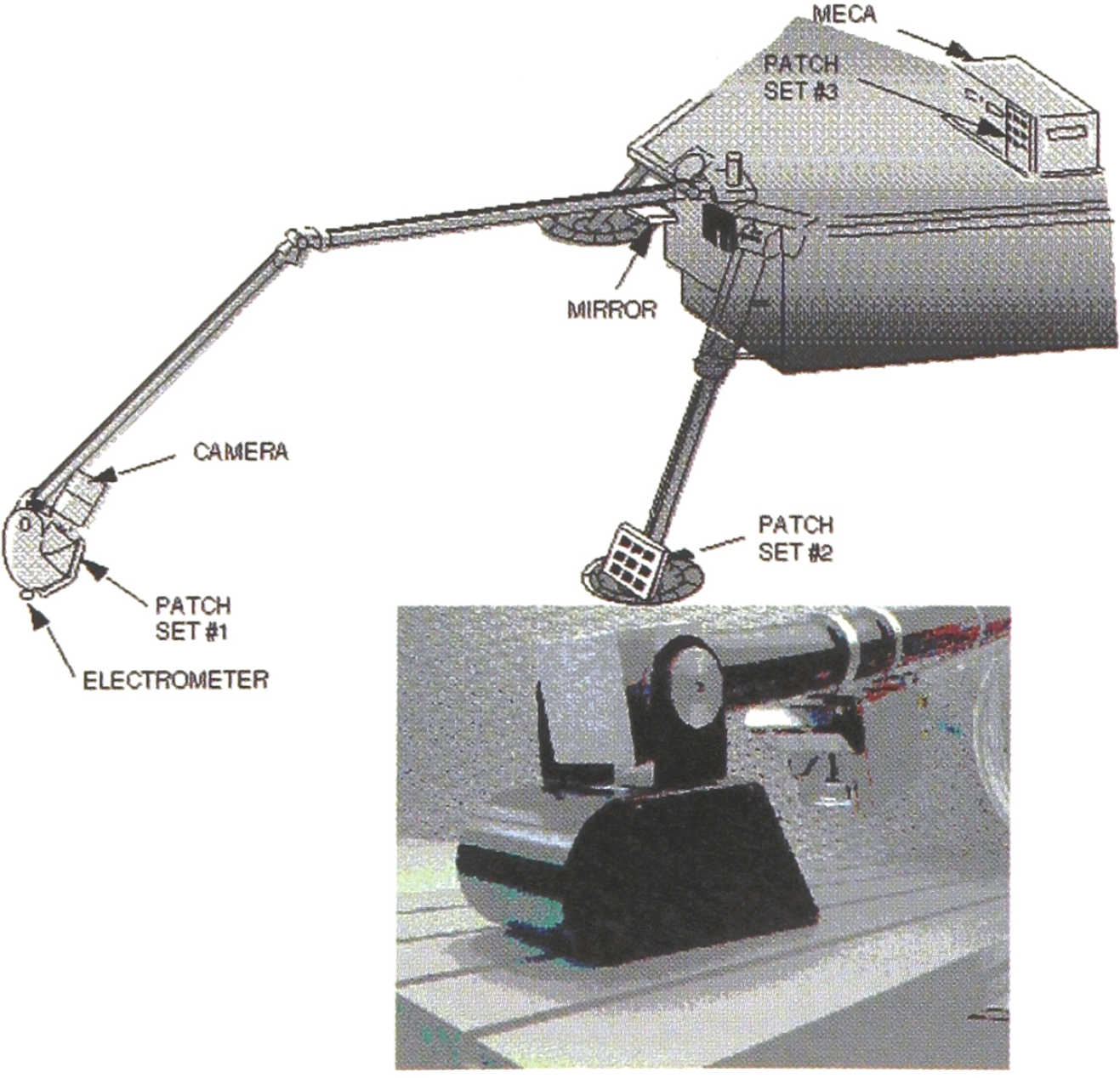
In preparation for human exploration of Mars NASA will send experiments on the 2001 and 2003 Mars Surveyor lander to gather information which will be of use in assessing potential hazards to astronauts and their equipment on Mars. Dust is an element that is ubiquitous in the Martian environment and one with which astronauts will surely need to contend over the course of a one year stay on the planet. MECA was competitively selected in January to provide future mission planners with additional information about the Mars dust and soil and potential hazards associated with it. The experiment payload was required to fit inside a 15×15×45 cm box mounted and in its entirety could not weigh more than 8 Kg. Average power supplied to an instrument set would be no more than a few watts and no provision for heating or thermal insulation was specified. Temperatures in the thin Martian atmosphere, (Patm = 7 torr, 95% of which is carbon dioxide), range from above freezing during the day to as low as −100°C at night. The experiment would rely on the lander for a fraction of the 20 watts available to all the instruments on board as well as for data storage and a communication link. It would also have use of a lander mounted robotic arm fitted with a camera for soil sampling and acquiring images.
The MECA instrument suite is primarily designed to assess any hazardous character of the Mars soil but it will also yield a substantial amount of scientific data on the make-up of the Martian regolith. A microscopic inspection will determine the shape, texture, color, and size distribution of soil particles. MECA will determine the adhesion potential (electrostatic, magnetic, physio-chemical, mechanical) of dust to a variety of materials under ambient conditions. It will directly measure the ability of particles to abrade and scratch materials such as visor glass. MECA will also assess the reactivity and corrosive properties of the soil when exposed to water as well as test for the presence of a variety of toxic metals. An electrometer will characterize the extent and variability of the electrification of the surface environment that may be a dominant driver of dust adhesion and transport. MECA may also reveal new information about the soluble species present on the surface of Mars and shed some light on questions concerning the fate of the water that at one time flowed on Mar's surface.
The microscopy and wet chemistry stations are housed inside the MECA experiment box mounted on the lander deck. The enclosure, made from a double vacuum wall for thermal insulation, also houses the MECA electronics boards. Microscope samples are collected on a rotating wheel, which in its sampling position protrudes outside the enclosure to where soil is deposited on it by the robot arm. The optical microscope, which is being provided by the Max Planck Institute for Aeronomy in Germany, consists of a dual magnification compact lens configuration focused onto a 256 × 256 CCD imaging array identical to that in the camera on Mars Pathfinder. An automatic focusing algorithm will acquire several images and assemble them in a composite image in which both the near field and far field will be in focus. Near the objective of the optical microscope will be mounted a compact atomic force microscope (AFM) which will be positioned by an independent motion stage and controller. The AFM operates by rastering an ultra-fine stylus probe over the sample surface with a constant displacement contact force, recording elevation as a function of position. The combination of the optical and AFM microscopes will allow the MECA team to see features ranging in size from millimeters to nanometers.

The MECA wet chemistry station contains four beakers, each with its own isolated 30 ml water reservoir situated above it. Soil is fed to each beaker via one of four sample drawers which protrude from the side of the MECA box and then close to form an air tight seal over the beakers. Each drawer delivers 1 gram of soil to the beaker. Excess soil from the robot arm scoop spills around the drawer. Once loading and closure of a soil drawer has been confirmed by an image taken with the robot arm camera, a mechanism breaks the seal on the water reservoir to allow the 30 ml to flow down into the beaker. A set of more than 20 miniature Ion Selective Electrodes (ISE's) will measure pH, total dissolved solids, redox potential, and a variety of toxic metals including cadmium, beryllium, lead and mercury. Addition of a reagent will allow MECA to assay the soluble carbonate content of the soil as well. ISE's, the most common example of which is the pH meter, in some instances can provide quantitative results down to ppm levels. The MECA ISE's will be hydrated upon use and will travel to Mars in a freeze dried state. A primary challenge with the wet chemistry station is the maintenance of a constant operating temperature of 20 oC for several hours. The situation is complicated by the fact that liquid water at any temperature will boil at the Martian atmospheric pressure of 7 torr, forcing the beakers to be operated under positive pressure. Each beaker reservoir assembly is equipped with two heaters that together will supply about 5 watts and is enclosed in foam insulation. The MECA wet chemistry experiments will run only during daylight hours when solar heating will raise the spacecraft temperature to near zero degrees Celsius.
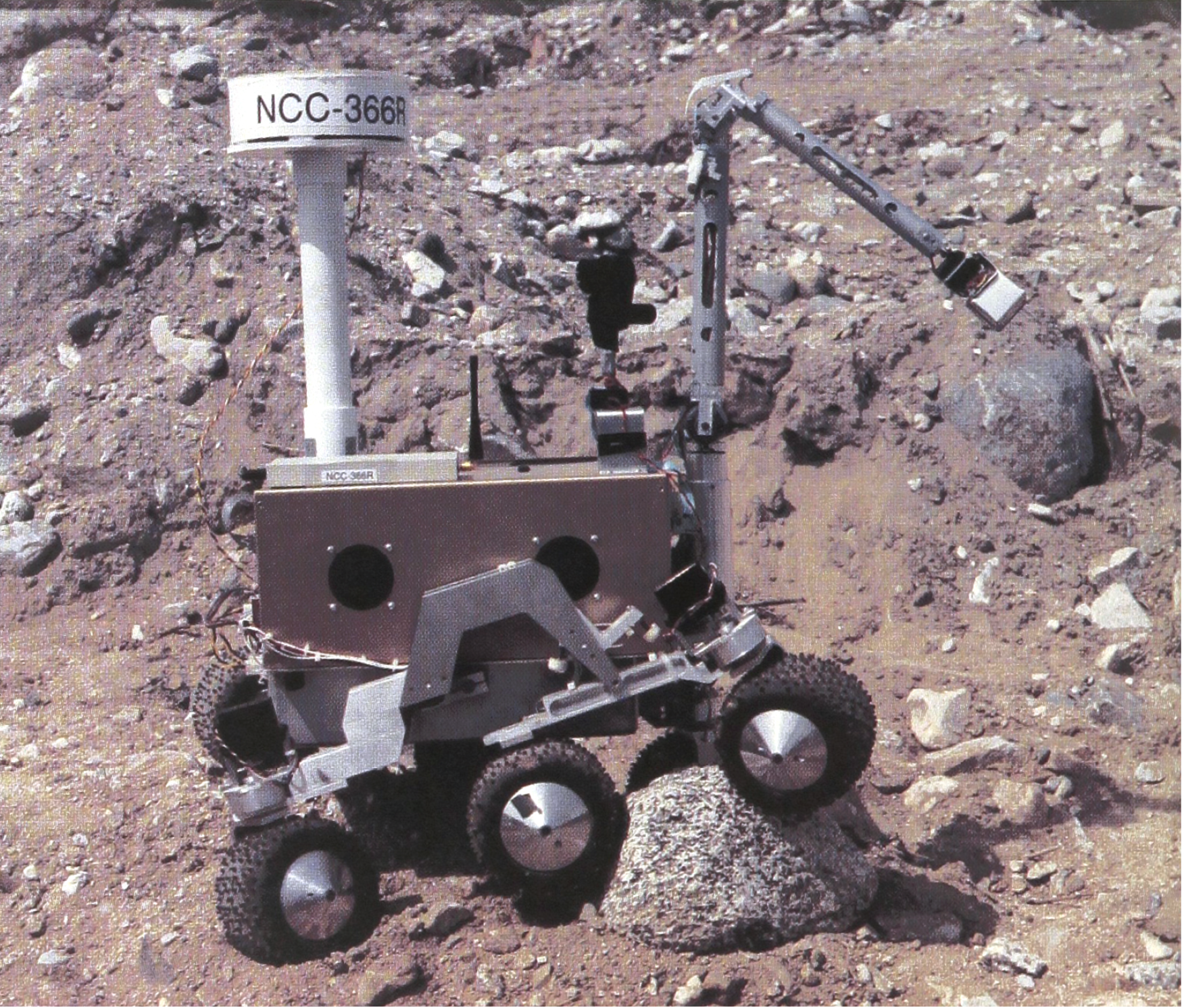
The robotic arm and camera provide MECA with a convenient platform for performing simple tests on the interaction of Martian soil with a variety of materials. The arm extends a full 1.7 meters and will be able to dig a 50cm deep trench in loose soil over the course of several days. Affixed to the arm is a scoop which will be used to acquire soil samples from a variety of depths. The robot arm is identical to the one being flown on the Mars Polar lander which will land at the south pole in November 1999. The arm has been designed to be light weight, reliable, and operated with a minimum of power between 10 and 25 watts. The arm tip translates at a speed of about 2 cm per second when fully extended. The robot arm will have the additional duty of deploying a 25 Kg pathfinder style rover from the lander deck to the surface a full 1 meter below.
Adhesion of particles to surfaces is a complex phenomenon that is dependent on a number of environmental factors in addition to the physical and chemical character of the particles and the surfaces to which they may adhere. For this reason MECA will seek to observe soil adhesion under Mars surface conditions. In addition the fundamental particle information that will be obtained with the microscopy station will allow mission planners to refine soil simulants used in laboratory tests. To quantify soil and dust adhesion to specific surfaces MECA will deploy two plates affixed with a series of patches including calibrated magnets, electrets, space suit fabrics and joint elastomers. One plate will be exposed to windblown dust while the other will have soil poured onto it by the robotic arm. The arm will then be used to shake off non-adhering dust particles. Data on the extent of dust adhesion will be gathered by imaging the patches with the camera which can take color images via a tricolor illumination system. A similar set of patches will also be present on the microscope stage which will be able to observe dust interaction with materials at a much finer scale/
The robot arm camera will also be used to inspect an abrasion test plate mounted to the front of the robot arm scoop. The arm will rub the plate against the soil to measure its ability to scratch surfaces of known hardness. The MECA team has identified fine quartz dust as the single most dangerous dust related health hazard that astronauts may encounter on Mars. On earth micron size silica particles are generated in mining operations and sand storms, and the deadly condition of silicosis of the lung is found primarily among two groups: miners and desert dwellers. While silica is abundant on Earth fine silica particles rapidly dissolve in water. On the dry, windblown surface of mars however, fine silica dust may abound. The MECA abrasion experiments will be able to suggest the presence of quartz particles if a metal slightly softer than quartz, eg. Iridium, is observed to be scratched by Martian soil.

The robot arm also supports an electrometer that will measure the extent of electrification of the dust arising from UV radiation as well as triboelectric charging of surfaces. The electric field near the surface, and the degree to which the dusts on Mars are charged, may play a substantial role in particle transport processes on Mars. Electrical breakdown of the atmosphere and the role that particles play in this potentially hazardous phenomena will also be studied.
The transfer of commands to the lander and the return of data will be preprogrammed and tested before the lander arrives at Mars. The robotic arm will be commanded to perform a sequence of motions that can be sent to the lander during two 12 minute overhead passes by an orbiter each day. The robotic arm will first acquire two images of the terrain beneath it to create a stereo map of the workspace. Motion sequences, which can be tested on the ground with a duplicate lander mockup, will be created with the use of the map and uplinked to the lander. Confirmation that the arm has properly executed a command can be received at the earliest 16 minutes after a sequence has been initiated. In practice MECA will probably not have confirmation of soil acquisition and delivery until the subsequent orbiter pass several hours later. It is estimated that an average of 3 Mbits of data will be available to the MECA experiments for downlink on each day. With modest onboard image compression algorithms, the MECA team estimates that a total of at least 500 high and low resolution images from both microscopes and the robotic arm camera will be sent to earth over the course of a nominal 100 day mission. A Martian day lasts 20 minutes longer than an Earth day.
The images provided by the MECA microscopes will contain a wealth of information about particles that comprise the Martian soil. As viewed by the cameras on the Viking and Mars Pathfinder missions the red soil of Mars appears homogeneous. MECA's microscopes will undoubtedly reveal that the Martian regolith is made up of a variety of particles, as are soils on earth. MECA will determine not only size and shape distributions of the soil particles at several depths but particle color and texture that will suggest the mineral composition of individual grains. Analysis of single particles with the AFM can yield, to the trained eye, evidence indicating the particle weathering history. A pebble surface imaged with the MECA prototype AFM revealed striations caused by water erosion as illustrated in the figure below. One unique feature about inspecting dust, as opposed to rocks, is that dusts contain particles of surface materials transported by wind from sites around the globe, while rocks are primarily associated with local geological features. Thousands of different samples, therefore, already exist at any landing site in the dust deposits. MECA will provide for the first time on Mars a means for studying such microscopic samples on a grain-by-grain basis. By bringing to Mars the most basic of laboratory instrumentation, microscopes and pH meters, the MECA investigations will provide fundamental knowledge about the Martian soil.

The MECA project is funded by the National Aeronautics and Space Administration under contract to West Virginia University and the Jet Propulsion Laboratory, California Institute of Technology.