With the changes that have occurred in the health care environment over the past several years, laboratorians have been requested to reduce their operating costs continually. These cost reductions were focused on the analytical portion of these laboratory tests, with some attention being directed toward the pre-analytical or post analytical testing areas. Any improvements in the overall operating budget could be attributed to some or all of the following;
Workstation Consolidation — As analyzers developed a much higher throughput, in conjunction with a larger test menu, duplicate workstations with identical test menus were almost totally eliminated. The cost savings from this consolidation could be directly related to reduced labor costs associated with fewer work stations requiring less maintenance, fewer calibrations, and easier cross training of personnel. Simplification of reagent and supply inventory and better tracking of reagent and supply cost also provided more accurate tracking of the actual cost per test.
Change From Serum Based Analysis to Plasma Based Analysis eliminated sample monitoring and provided a faster turn around time, freeing the operator to perform other tasks.
Choosing analyzers with the ability to run Multiple Matrices simultaneously eliminated the need for manual manipulation of the sample and the concurrent labor associated with this manual sample handling.
Auto Dilution of High Samples and Auto Re-Run of Critical Values eliminated the labor involved with manual dilutions.
Outsourcing of Expensive Non-Critical Assays eliminated the need to maintain expensive labor intensive instruments that were almost always associated with these assays.
Changes in Regulations in many states during the past several years allowed Non-Licensed Technicians to load bar-coded samples to host query or bi-directionally interfaced analyzers.
Moving to Quadrant or Sector Centrifugation allowed mass movement of a large number of samples, thereby reducing manual manipulations of single tubes.
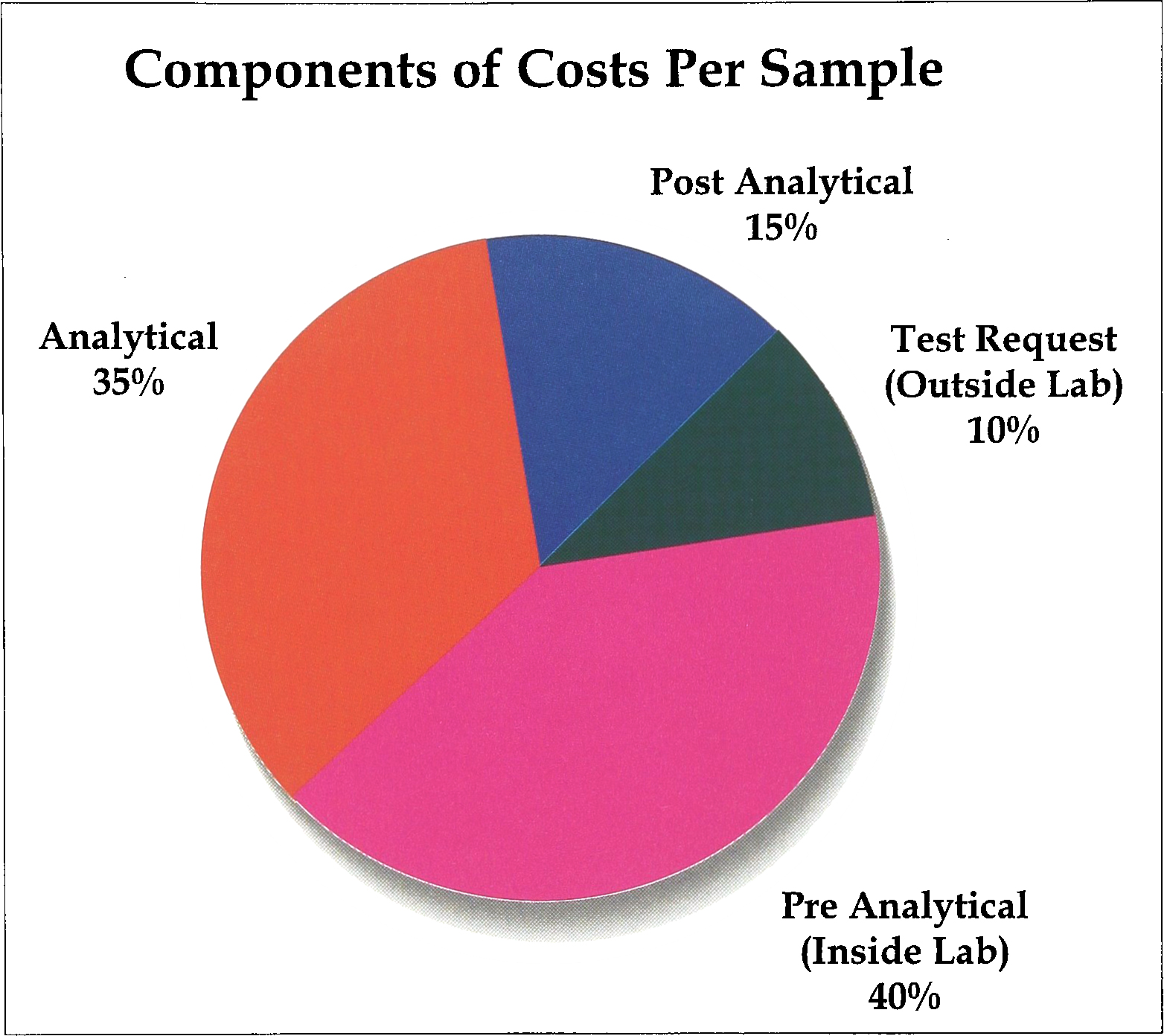
Considering the major changes already implemented, the laboratorians have reached the pinnacle as far as realizing meaningful cost savings, so what area could now be improved? Let's take a look at the total operating cost involved in processing the sample as depicted in the graph below:
Please notice that the analytical portion of this graph represents 35% of the total cost involved in running a sample. The area that offers the most significant cost savings of 40% is in the pre-analytical section. The post-analytical phase represents approximately 15% of the total cost and includes the time required to do test result verification. The remaining 10% represents the steps involved in ordering the test and getting the sample to the laboratory. In keeping with the previous information, what new steps can the laboratory take to effect real cost savings?
Beckman Instruments (Brea, CA) will offer to the market this year the Accelnet™ Automated Modular Robotic Workstation. The greatest cost benefit will be in the pre-analytical portion of testing. However, the analytical and post-analytical areas will also show significant cost savings. The process improvement in each area is listed as follows:
The total operating cost involved in processing a sample.
1. Pre-Analytical
Automatic Start Up is accomplished when a rack sensor detects that samples have been placed on the workstation. At this time the detector alerts the process controller, and the robotic arm moves into position and begins to pick up the samples. Multiple Tube Types (13, 16, 75, and 100 mm) are automatically loaded.
The User Can Define each rack location by function (Stat or Routine) and type (chemistry, hematology, serology, or coagulation).
Input Racks are automatically scanned for ID.
While the height of the specimen tube is being measured by the laser scanner, the robot “hand” grips the tube to determine the diameter. The barcode is read as the tube is rotated into scanning position by the “hand.” The correct path for the specimen is determined at this time. Hematology tubes are sorted to hematology racks. Chemistry and special chemistry tubes and coagulation tubes are sorted to the centrifuge loading area.
Test request information from the LIS system is dynamically downloaded to the process controller and the analyzer data manager continually.
The centrifuge is loaded and balanced automatically, and the centrifugation of the sample begins. (Timing sequence of the centrifuge is user programmable).
When the centrifuge completes the spin cycle, the robot removes the centrifuge adapters from the centrifuge, decaps the tubes, and places the tubes into the analyzer sectors. These sectors are placed onto the load position of the synchron analyzers.
2. Analytical Phase
The robotic side arm of the chemistry analyzer moves into position and picks up the sector and places it onto the analyzer auto loader. The bar code queries the analyzer data manager for the chemistry tests that are to be run.
The process controller starts the chemistry analyzer, and the sample testing begins.
3. Post Analytical Phase
After the testing is complete, the sample is removed from the analyzer by the synchron robotic side arm and placed back onto the workstation.
The tubes are sorted by size into bar coded storage racks. The location of the tube is mapped by the process controller, making future retrieval an effortless process. To rerun a sample, the sample ID is entered into the process controller data manager. The rack number and location of the tube is mapped. After locating the rack in the storage area, the entire rack can be placed on the workstation. The sample location in the rack is determined and the robotic arm picks up the sample and begins to process the sample without further input by the operator.
The Accelnet Modular Automation Workstation is interfaced to the Beckman synchron family of analyzers. It is sold and serviced through Beckman Instruments.