



Abstract

In 17 years, laboratory automation has grown from an expensive novelty to an indispensable economic survival tool for both clinical and pharmaceutical laboratories. The field of laboratory automation and robotics has its roots in the early 1980s where the Japanese were learning from Dr Sasaki that clinical laboratories could become more efficient if they adopted some of the technology that was already popular in manufacturing. On a parallel, but distinct, path the pharmaceutical industry was beginning to learn about the benefits of automated high throughput pharmaceutical screening for drug discovery.
In 1981, one of the earliest players in this emerging field was Zymark Corporation, which was founded by two enterprising senior executives, Frank Zenie and Burleigh Hutchins. Their goal was developing new solutions to problems facing research chemists and biochemists working in laboratories.
Since the early days, Zymark has evolved into an entirely different company. A modern approach to automation, software architecture, customer relationships, and connectivity has transformed the company into one that is equipped to maintain its leadership position in the automation field. Zymark has recently invested over 8 million dollars in research to develop new products and has revitalized its 125,000 square feet of applications development laboratories. They have expanded their customer support infrastructure, particularly in Europe and Asia. At this year's Pittsburgh Conference, Zymark launched 7 new products for new drug development and to improve laboratory productivity.
These new products are radically different from the first Zymate Laboratory Robotic System (figure 1, 2), that consisted of a robot, a controller, operating software, and laboratory stations for common functions such as pipetting and dispensing. The historic introduction of the Zymate was at PittCon in 1982 where the robot demonstrated the separation by solid phase extraction of grape Kool-Aid into three colored components: red, blue and clear. This year, Zymark's line-up included the Allegro UHTS (figure 2). In contrast to the circular approach of the early Zymates, the Allegro systems uses an assembly line approach to connect a series of interlinkable, modular workstations. Modular systems can grow and evolve along with the needs of the customer thus obviating any obsolescence inherent in more limited robotic systems.

The Zymate Laboratory Robotic System was introduced at PittCon in 1982.
Zymark has also been a pioneer in the development of robot compatible analytical instrumentation and peripheral devices (1). Their recently released Twister Microplate Handler is a microplate autosampler that interfaces with industry standard washers, readers, and dispensers (figure 2B). The Twister is a low cost, bench top plate handler designed to manipulate easily common microplates and serve as an auto-handler to a wide variety of scientific instruments. These include Microplate readers, washers and liquid dispensers from all major manufacturers. Twister Universal Microplate Handler individually moves up to 20 microplates from an input rack to the plate locator on the instrument. An optional loader can accommodate up to 60 additional plates.
Zymark has also taken a leading role in supporting physical and electronic connectivity with many popular analytical instruments from other vendors. For example, Zymark has recently announced partnerships with a number of vendors including, Millipore, Hewlett Packard, Vankel, Varian Sample Prep, Ansys Diagnostics, Dionex, Perkin Elmer, PerSeptive Biosystems, Molecular Devices, Bio-Tek Instruments, and Labsystems. Zymark will also continue to develop their own line of automation friendly peripheral devices such as the BenchMate workstation (a robotic arm with the benefits of a user-friendly environment to facilitate rapid development of sample preparation methods (Figure 3).) The BenchMate integrates sample weighing, dissolution, filtration, and pipetting into a small footprint device. Using their unique software, sample preparation parameters could be programmed off-line in the investigator's office and then brought to the BenchMate for final testing. Today, Zymark manufactures a full range of peripheral devices that feature robotic interfaces (Figure 4, 5) including the Allegro (shown on page 12).
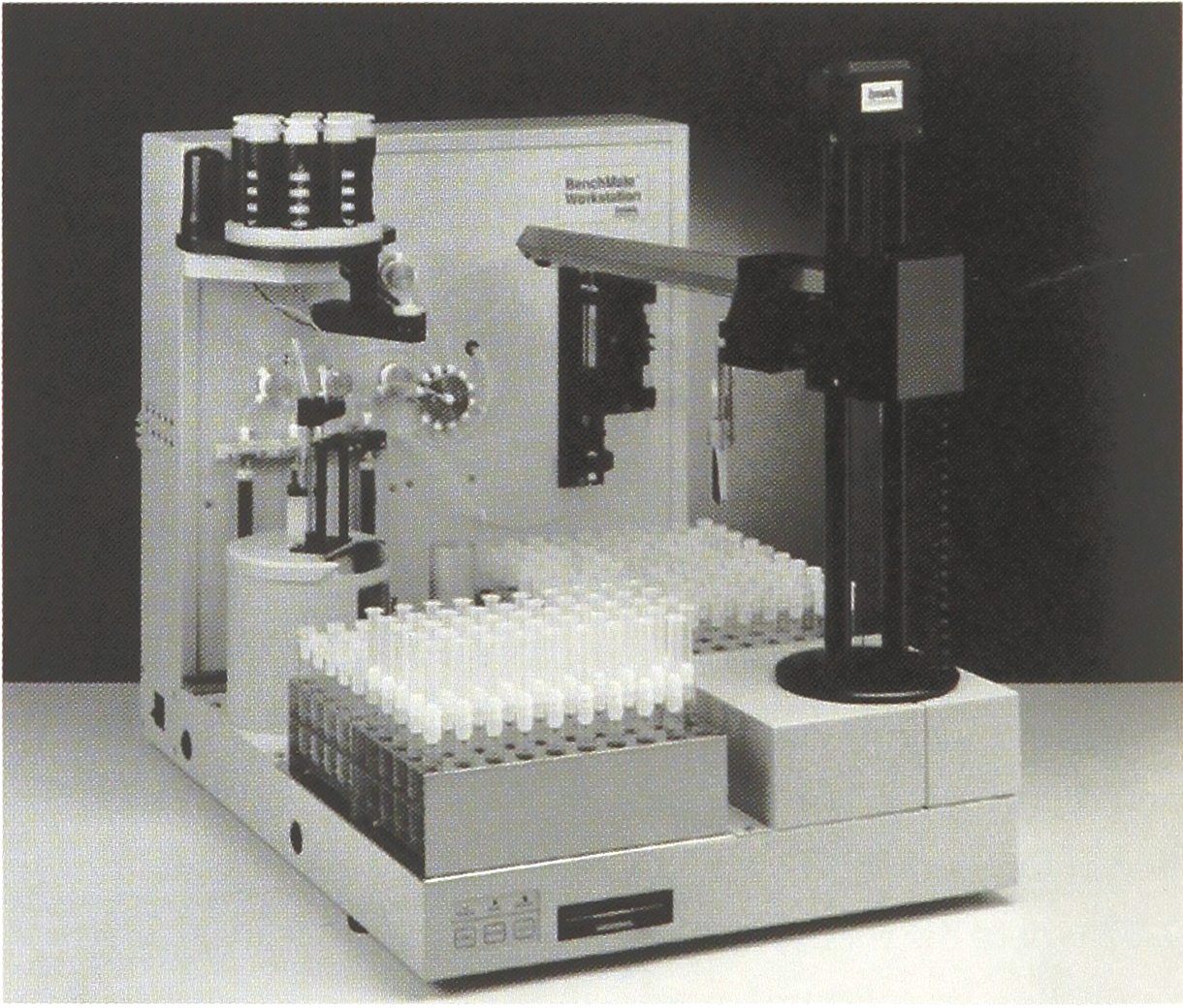
The BenchMate™ Workstation, introduced in 1990, was a sample prep platform that combined simple tasks such as weighing, filtering and SPE.

The Twister Microplate Handler loads and unloads standard microplate washers, readers and dispensers.

The Presto™ Microplate Sealer applies adhesive seals to the top of microplates. It is available as a stand-alone station, integrated into a robotic system or fed using the Twister Microplate Handler.
Zymark has also taken a leading role in providing education for customers regarding the benefits and features of robotics as well as strategies for their implementation. The ISLAR meeting (International Symposium for Laboratory Robotics and Automation) has been held for over 16 years and has an attendance of 400–600 individuals from all over the world. The proceedings of ISLAR are published annually and serve as a source of the latest scientific developments in the field (2).
Where does Zymark see its role in the future? “Zymark is committed to working with other industry leaders to create the automated solutions of the next century”, says their President, E. Kevin Hrusovsky. (Fig 6). Zymark's extensive market of installed automation marks it as one of the giants in the industry. For example, Zymark has over 2,400 customized robotic systems and thousands of workstation-based automation products in use worldwide. Its customers include Fortune 100 multinational corporations such as Bristol-Myers Squibb, Dow, E.I. DuPont, Johnson & Johnson, Eli Lilly, Merck, Monsanto, Proctor & Gamble, Rhone-Poulenc and Warner-Lambert. With 1995 sales at over $36 million, the privately owned company employs over 200 people in the U.S., Europe and Canada, with most working at its 100,000-square-foot headquarters called Zymark Center, in the Boston suburb of Hopkinton, Mass.
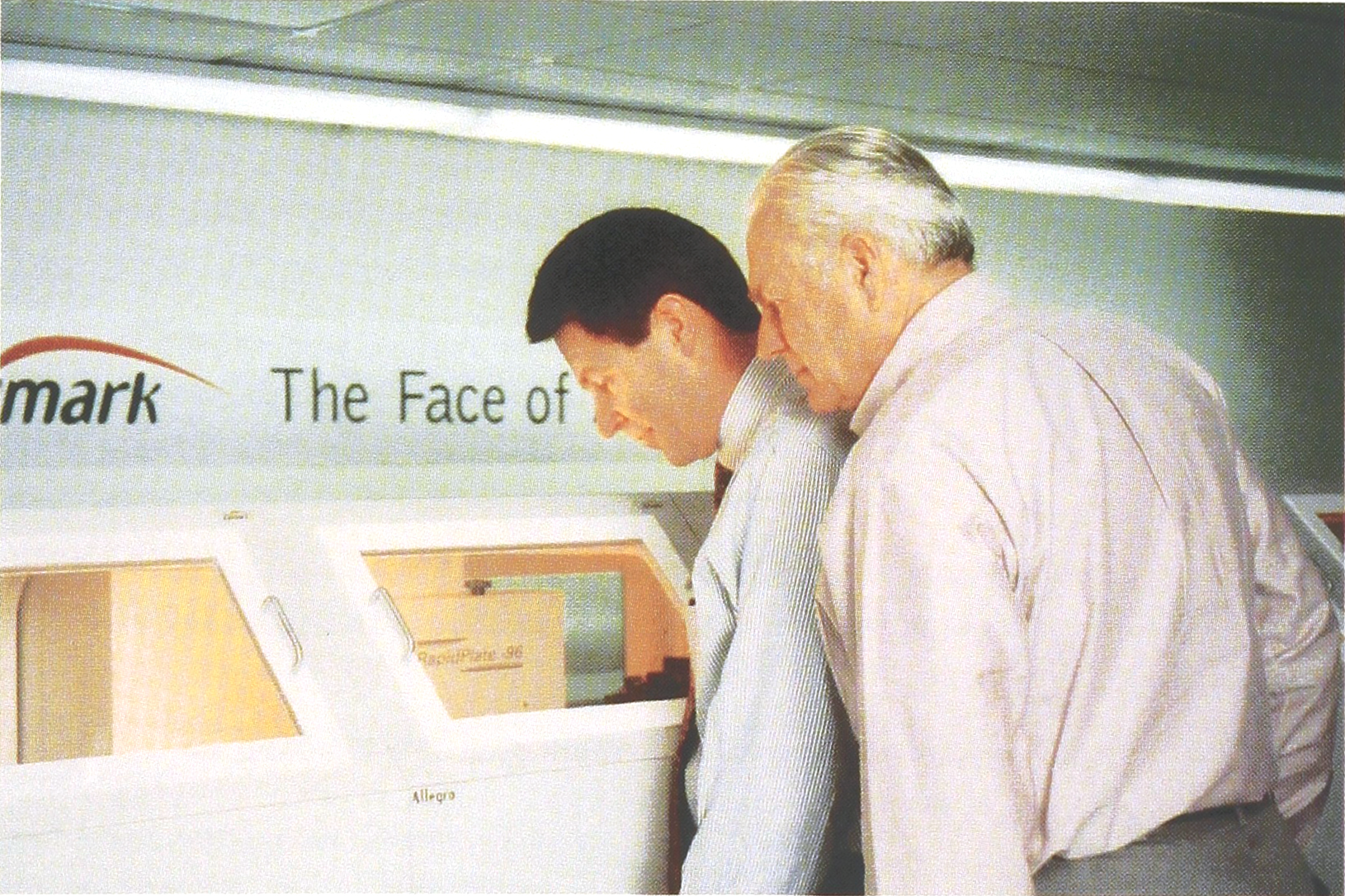
Kevin Hrusovsky, President, and Burleigh Hutchins, Founder and Chief Technical Officer, view a simulated ELISA running on the Allegro Ultra High Throughput Screening Systemat a rate of 1,000 plates per day.