



Abstract


Skatron's EMBLA 384 is designed for the HTS arena, and specifically for inclusion into laboratory automation systems. The EMBLA 384 incorporates Skatron's 21-year experience in designing and manufacturing plate washers. This is apparent in the flexible design, which allows for both 384 well and 96 well plates to be washed without any hardware changes. As such, the EMBLA 384 will be available in three versions, Stand Alone, Robotics and Stacker version. Other important features include electronic standardization of all instruments, as well as the Windows, Windows 95 and NT compatible software.
Wash Operation
The EMBLA 384 has two separate, adjacent heads with 192 probes each, one for aspirating and one for dispensing. This design facilitates speed, flexibility, and reliability. As the washing occurs, the plate is moved between the two wash heads at a rapid speed. Each head has 192 probes, allowing all 384 wells to be filled or aspirated in two steps. The probes are located in a 8×24 grid, so in the first step, rows A, C, D, etc., will be aspirated. In the second step, rows B, D, F, etc., will be aspirated. This operation will then be repeated by the dispense head.
Due to the EMBLA 384's unique design, no hardware change is necessary between washing a 384 well or 96 well plate. When washing the 96 well plate, two probes will enter each well, allowing all 192 probes to fit into the plate. This is made possible by the high precision of the plate lift. Skatron's R&D team chose this design after careful consideration. If the head had 384 probes it would be necessary to make hardware changes when switching from a 384 well plate to a 96 well plate. Another important decision was to separate the aspirate and the dispense heads. Combining these two functions in one head would either mean two parallel probes or concentric probes (one probe inside the other). Both of these designs were deemed inferior due to the restrictions in probe diameter, loss of flexibility between plate types, and increased clogging when salty and/or viscous liquids were used.
Dispense and Aspirate Accuracy
The EMBLA 384 has two separate inlets for two different liquids. These can either be used for two separate wash buffers, a wash solution and a dispense solution, or a wash solution and a rinse solution for easy cleaning at the end of a run.
The dispense range for the EMBLA 384 is 10 ml to 100 ml in a 384 well plate, and 20 ml to 350 ml in a 96 well plate. Final specifications were not available at the time of printing, but preliminary results were indicating CV's of less than 1% between 30 ml – 100 ml.
The aspiration efficiency in a washer is dependent on the precise placement of the aspirate probe. Skatron has recognized this and since designing its first 96 well washer in 1976, Skatron has always included a user adjustable plate holder or lift. The last two generations of 96 well washers, the SkanWasher Series, have allowed for program specific electronic adjustment of the aspirate probe position. Designing a flexible instrument that can be used by multiple users, performing multiple assays has always been Skatron's goal. By allowing for program specific adjustment, the same washer can be used for different plate types, performing both ELISA's and adherent cell washing. (Non-adherent cells require our dedicated Cell Washer.) This design philosophy has been carried forward into the EMBLA 384.
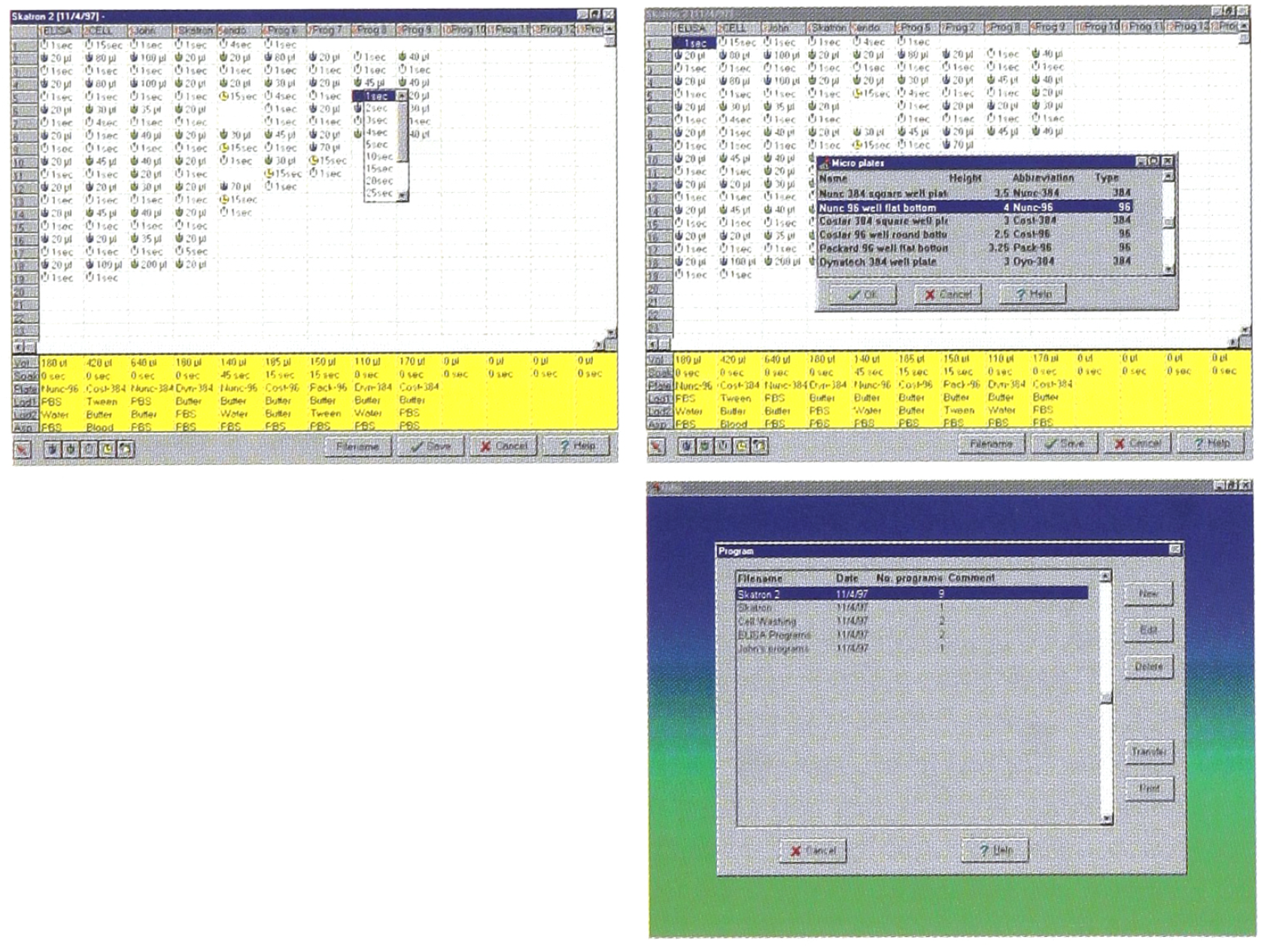
The aspirate probe height can be set separately for each of the 99 programs. Furthermore, to obtain the highest possible precision and reproducibility, the EMBLA 384 contain a complete plate library which include manufacturer, catalog number and well depth of most 96 and 384 well plates. This allows a user to choose the correct plate type, and then to decide on the height between the well bottom and the aspirate probe. This can be done in the software, without having to look at a particular instrument. Since each instrument is standardized electronically, a user will know that the distance is true for all instruments in case they are using several instruments. The electronic standardization is done by attaching an electronic sensor to one of the aspirate probes. This will then measure the distance between the plate holder and the aspirate head, regardless of minor mechanical tolerances. This standardization is done when the instrument is manufactured, as well as any time it is serviced. All necessary equipment and instructions to perform the standardization can also be purchased separately. This method will guarantee that a user with multiple instruments will have identical results from the different instruments.
Programming
The programming of the EMBLA 384 is done on a PC, using a familiar graphical user interface. The software is Windows and NT compatible, and offer tremendous benefits over regular washer software. The EMBLA 384 can store up to 99 programs with up to 50 steps each, and offer features such as password protection, menu driven software, program storage and printout, one-button transfer and an optional log file of the last 3000 plates run.
By moving the programming to a PC, the EMBLA 384 takes advantage of the familiar Windows environment. This simplifies the learning curve when adapting to new instruments. This also makes the instrument easier to integrate into other systems without having to create new programming software. All programming is done by clicking on icons for dispense, aspirate or soak. The actual program sheet bears a resemblance to an Excel spreadsheet, where the different programs occupy one column each. Each of the 50 “cells” represents one step in the program. These steps can be programmed in any order, so by clicking first on the aspirate button, one can add all the aspirate steps at once. One can also program each successive step as in traditional programming. After placing a dispense icon in a cell, the user can click on the right mouse button and a volume screen appears. By selecting the volume by using the mouse, no actual typing is necessary. For the aspirate step and the soak step, right clicking the mouse produces a menu where the user can select the time desired for that step.
Other features that can be set for each individual program includes the inlet port, viscosity for that fluid, plate type and the aspirate probe's actual position in the well. The software contains a plate library where the user select the manufacturer and catalog number for the plate in use. The EMBLA 384 will then know the measurements for that plate, and the user can then select the distance between the aspirate probe and the plate bottom in millimeters. This is a very significant step for several reasons. First, a user can switch between two different plate manufacturer's plate and know that the instrument does not have to be adjusted mechanically. Second, a user with multiple instruments will know that all plates are being washed exactly the same way. All instruments are standardized electronically to ensure that each instrument knows its own measurements, regardless of mechanical tolerances in production. Most other washers require a mechanical adjustment that is tested by “eyeing” the location of the aspirate probe. This process is of course impossible to duplicate exactly, and as every instrument has small variations in measurements, a possibility of unequal washing between instruments is introduced. In the 384 well format, this is of course a much more critical step. Skatron has electronically standardized the instruments and thereby removed that element of variation.

Another important new feature is the inclusion of passwords. By moving the programming from the washer to a PC, a certain level of control is obtained to ensure that no accidental changes of the program are made. The password feature furthers this goal by having three separate levels. The highest level can change all features and programs, including some system settings. A lower level password is included for other users who may want to program the unit, but does not have a need to access the system settings.
Although the EMBLA 384 can store up to 99 programs, further storage space can be accessed on the PC's hard drive. Each batch of up to 99 programs will be stored in a file, and a computer can of course store multiple files. This allows for tracking of different wash programs that may evolve for example when moving from the 96 well to the 384 well format. In addition, the programs can be printed out and kept for easy reference. After programming a file, the transfer is done simply by attaching an RS 232 cable between the PC and the EMBLA 384, and then pressing “Transfer”. The whole process should only take a few seconds, and the EMBLA 384 can then be disconnected from the PC. All 99 programs with its unique settings are stored in the washer. The only other time the EMBLA 384 needs to be connected to a PC is when the optional log file is read. The log file will store in the washer the last 3000 plates run, including the program selected and any error messages. This information can be downloaded to a PC and reviewed for quality control.
Skatron's EMBLA 384 is designed for the HTS arena, and specifically for inclusion into laboratory automation systems. Its versatile design handles both 96 well and 384 well plates without any hardware changes. The electronic standardization, coupled with the plate library, ensures reproducible results across multiple instruments, and the optional log file offers a complete record of the last 3000 plates run. This and the Windows and NT compatible software make this the natural choice for washing in an automated arena.
Skatron EMBLA 384 washer.
Aspirate head (left) and Dispense head each has 192 probes.
Programming screen with drop down volume menu.
The EMBLA 384 has a built in plate library.
The Programming Screen allows you to transfer to the Embla 384