



Abstract

On September 10, 1997 the installation of the first BM/Hitachi CLAS system in Europe began at the Department of Clinical Chemistry (DCC) of the Leiden University Medical Center in Leiden, The Netherlands, an 870 bed teaching hospital with approximately 220,000 outpatient visits per year. All analyses for clinical chemistry and immunochemistry, routine as well as statistical, are performed in the laboratory of the DCC. The system has been installed into the existing laboratory for clinical chemistry and immunology whilst in full operation. The system contains an I/O-unit, centrifuge, de-capper, aliquoter, re-capper, sorting unit, and stocking unit. The analytical equipment in CLAS comprises 2* BM/HITACHI 747, BM/Hitachi 911, for which instruments the primary tubes will be used, and Elecsys 2010 analyzing an aliquot taken from the primary tube. The use of the primary tube for the analysis offers the opportunity that one aliquoter can produce secondary tubes containing reference material, secondary tubes containing aliquots for off-line testing for 6 different allocations, and aliquots in cups for analysis on Elecsys.
The CLAS system will be operative seven days per week and twenty-four hours per day for regular and statistical analyses. The amount of primary samples to be handled by CLAS per day is approximately 1,000 samples giving rise to the production of 1,750 secondary aliquots. During rush-hours about 200 primary samples and 350 secondary samples per hour will be handled.
Important Aspects of this Development
The reasons for automation and the goals we hope to reach:
Quality improvement. We expect to increase gain quality by reducing the chance to interchange patient material.
Improvement of bio-safety for the collaborators; less handling of material by humans, less chance of contamination.
Influence on the organization of the flow of patient material and the availability of the results.
Turn-around-time. We expect all results handled by CLAS to be completed within one hour after delivery of the request and material at the lab-site
Reduction of staff by 4 persons the coming 10 years. Even after a reorganization of the laboratory in 1995, with a change of the analytical staff from 49 to 40, we expect to be able to handle our daily patient care samples with the involvement of less collaborators.
Possibility to accept a larger amount of work with this reduced workforce. Inside the hospital the urge to obtain the highest efficiency of operation is very pronounced. As already stated, the general clinical chemistry and immunochemistry analyses have been centralized towards this department. However, centralisation of other packages (e.g. immunology) may occur in the future without increase in workforce.

Layout of CLAS, Leiden, The Netherlands (see legend below)
Our reasons to expect reduction in necessary workforce are based upon:
The change in the handling of the patient material in the pre-analytical faze and of the aliquoting procedure.
Before CLAS, the samples were sorted after arriving at the laboratory, and then labeled with a bar-coded sample number. Subsequently, the samples were centrifuged and decanted into clean tubes. These tubes were used for analyses, manually splitting into aliquots, and storage afterwards. After the introduction of CLAS the barcode labeled primary tubes are placed into CLAS. The system takes care of the centrifugation. No decanting is performed. Instead an aliquot is taken by CLAS for storage of the material.
Also the aliquoting performed by CLAS of samples for off-CLAS analyses is expected to reduce the necessary staff.
Necessary Preparations
Analysis of the sample flow: A thorough analysis has been made of the number of samples arriving at the laboratory at different hours of the day. Also, it was analyzed how these samples had to be handled, which analyses had to be performed, and how many aliquots had to be taken.
Standardization of tubes; handling of small samples. Standardization of the blood collection material offered to the system has to take place. In the hospital a wide variety of containers for samples was used. However, in CLAS the use of one type of container is imperative. CLAS, in our layout, will handle plastic tubes with gel and rubber-stops, size 16 × 100 mm, and also so-called Cups-on-tubes. Small sized samples are going to be entered into CLAS after manual centrifugation and decanting the serum i into a small cup placed on the tube.
Connection of CLAS to the HIS: In the hospital the flow of data is organized via a central computer system main taining a web of monitor terminals. The CLAS system cannot be connected directly to this web, but an interface was needed. Via this interface, called Megaserver (BCO, Breda, The Nether lands), the CLAS is connected to the HIS. This connection offers us the possibility of technical validation of results at the laboratory site and then the preliminary results are instantly available to the wards. Authorization takes place at a later stage.
Back-up Procedure: Especially in the time of implementation of the CLAS and instruction to the operators, but also in situations of malfunctioning, it is necessary to be able to switch back to the situation of operation before CLAS. Using (seven) switchboxes it is possible to connect all apparatuses in CLAS with the HIS, or to connect one or all apparatuses to HIS in the same way as currently used.
Instruction to the technical staff: The acceptance of the introduction of CLAS by the technicians who are going to work with the system is very important. From the moment the idea to obtain the CLAS was becoming realistic the staff of the laboratory has been involved in the discussions not only about the consequences for the number of personnel due to the arrival of CLAS, but also about the consequences for the daily handling of materials.
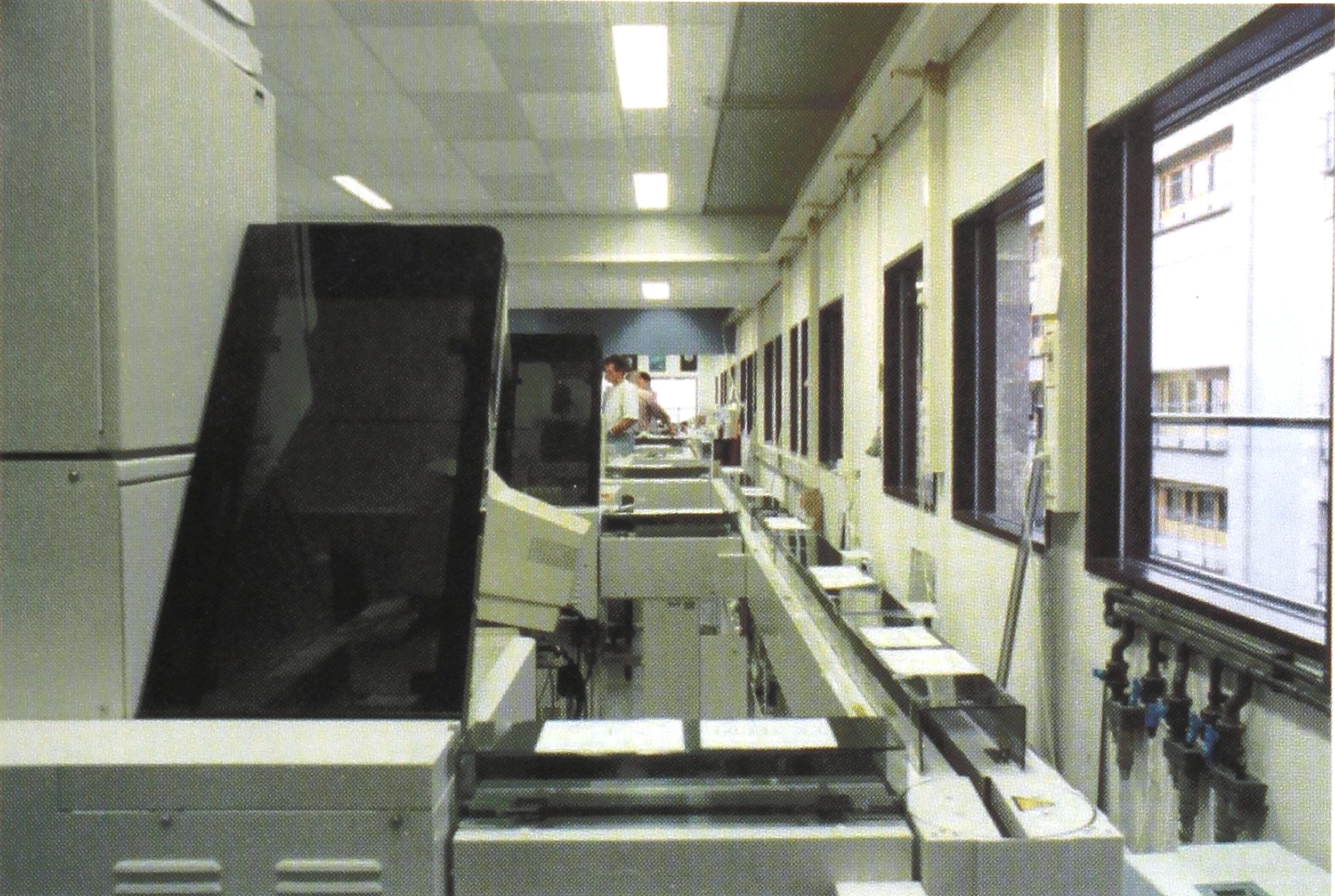
The lay-out of the system, space and orientation in the laboratory (see fig. 1) The layout of the system is based upon the philosophy that CLAS should be an easy accessible system. For services and to reach the separate modules sufficient space in and around the system has been planned. The use of the available floor space should be optimal. We came to an extended layout in which the maximal length is 17.20 m and the maximal width at one point is 5 m. The long conveyer belt is placed along the window side, while the apparatuses extend into the room as peninsulas.
Electrical wiring and data-lines: Any system like CLAS needs connections between the modular parts and the computer. The wiring is partly inside the CLAS system and partly put in tracks made in the floor of the room. This prevents the visibility of all the wiring needed, while the number of cables can still be changed. In those tracks also the compressed air lines are placed, but not, of course the supply lines for water.
We expect to use CLAS routinely from the middle of November 1997 onwards. Thanks to the close cooperation between the manufacturer (Hitachi), the supplier (Boehringer Mannheim), the software vendor (BCO) and ourselves we expect to reach this goal.