




Abstract

Dewitt Receives Significant Contribution Award from ALA
One of the Significant Contribution Awards from the Association for Laboratory Automation went to Sheila DeWitt. Dr. DeWitt is one of the original developers of the DIVERSOMER Technology, being instrumental in the design and implementation of proprietary equipment, automated synthesis methods, and high-throughput synthesis. In addition, she actively pursues the identification and coordination of projects related to molecular diversity among a wide variety of disciplines.

Dr. DeWitt, shown receiving her award from Dr. David Herold, received her B.A. from Cornell University and her Ph.D. from Duke University in Synthetic Organic Chemistry. Following two years in process research at FMC Corporation, she joined the Medicinal Chemistry Department at Parke-Davis. In 1991, she was a founding member of the BioOrganic Chemistry Group. Currently DeWitt is Vice President for Technology Development of DIVERSOMER Technologies, Inc. She was the recipient of the Michigan Leading Edge Technologies Award in 1993 and the Pioneer in Laboratory Robotics Award in 1995.
Automated Solid Phase Extraction Protocols for Drugs of Abuse Testing
ANSYS, Inc. has produced a monograph describing SPEC® automation solid phase extraction protocols for drugs of abuse testing using the Zymark RapidTrace® SPE Workstation. The 180-page document gives information on extracting the “SAMHSA-5” drugs of abuse from urine. The report includes introductory remarks about automation, results summary sheets, notes and comments on each protocol, RapidTrace extraction procedures, GC/MS methods used for analysis, raw data summarized in spreadsheets, and typical chromatograms. The “turn-key” automated extraction methods were evaluated for linearity, absolute recovery, precision (within-run and day-to-day), limits of quantitation and detection, high level carryover studies, and sample throughput per extraction module. The methods were developed to simplify steps and provide flexibility by sharing common solvents between methods.

The International Federation of Clinical Chemistry Creates Committee for Advanced Technology
The International Federation of Clinical Chemistry (IFCC), the largest international organization for laboratory medicine, has recently created a Committee for Advanced Technology under the auspices of its scientific division. The Chairman of the Committee is Prof.
Pierangelo Bonini; the Committee itself is made up of Profs. William Godolphin (Canada), Masahide Sasaki (Japan), Kazuo Yasuda (Japan), Georg Hoffman (Germany), and Larry Kricka (USA). The Committee, which will investigate innovations in laboratory diagnostics, had its first meeting in San Raffaele, Italy, this past December.
Pictured left to right are William Godolphin, Alberto Sanna, Masahide Sasaki, Georg Hoffman, Pierangelo Bonini, Kazuo Yasuda and Larry Kricka

Computerized Robotic Workstation From Cyberlab, Inc., Honored by Smithsonian Institution
Cyberlab, Inc. (Brookfield, CT) became part of the Smithsonian Institution's Perm-anent Research Collection of Information Technology Innovation at the National Museum of American History on June 10, 1997, when the 1997 Collection was formally presented to the Institution in Washington, DC. Cyberlab, Inc., has developed a fully automated robotic work-station which processes radioactive samples with 99 percent accuracy, allowing human operators to avoid contamination. The workstation is for use in a sealed area to process radioactive samples at the U.S. Department of Energy, Hanford site, Richland, WA.

Each year, the Computerworld Smithsonian Chairman's Committee nominates companies that are using information technology to improve society for inclusion in the Smithsonian's National IT Innovation Collection. Founded in 1989, the Computerworld Smithsonian Program searches for and recognizes companies who strive to use information technology in innovative ways across ten categories: Business and Related Services; Education and Academia; Environment, Energy and Agriculture; Finance, Insurance and Real Estate; Government and Non-Profit Organizations; Manufacturing; Media, Arts and Entertainment; Medicine; Science; and Transportation.
Haystack Compound Library Management System to be Utilized by SmithKline Beecham, Zeneca and Bristol-Myers Squibb
A Haystack automated sample management system is a feature of SmithKline Beecham's (Harlow, Essex, UK) New Frontiers Science Park which was officially opened on April 28, 1997. The system was commissioned from The Automation Partnership (TAP, Cambridge, UK) in October 1996 to manage the supply of samples for drug screening and is currently in final preparations for full operation.


Bristol-Myers Squibb (Wallingford, CT) soon expressed interest in the system, and signed a contract with TAP to receive a Haystack system to exploit the pharmaceutical company's compound archive as a source of new drug leads.
On May 12, less than two weeks after the contract with Bristol-Myers Squibb, Dr. Peter Doyle, Executive Director of Zeneca Group plc., opened another Haystack system built by TAP at Zeneca Pharmaceuticals (Alderley Park, Cheshire, UK). The Zeneca Haystack system is intended to manage an archive store of all samples made or acquired by the company over the last 40 years.

The Haystack system was designed to circumvent a bottleneck in sample supply to researchers. The modular system works by storing up to millions of compounds in carousels with robotic retrieval systems and conveyors which deliver samples to a dispensing area. Individual samples are identifiable by bar codes.
Frequency and Causes of Laboratory Errors Study Completed
A new study initiated to find the frequency and causes of laboratory errors has recently come to a conclusion. The study examined four departments and their laboratories, finding 65 errors out of 41,048 analyses, or 0.16%. This rate is lower than the 1:100 rate reported in some other studies. The error distribution illustrated that the preanalytical phase proved the most error-prone with 33 errors, or 58% of the total errors. Most commonly, these errors centered on inaccurate procedures for sample collection, resulting in such mistakes as sample dilution or storage in an inappropriate container. Incorrect department identification and the overlooking of physician's orders were also included in the preanalytical error rate.
The analytical phase, with 14 errors or 21% of the total, proved to be the most error-free, relatively speaking. Most frequently, analytical errors arose from equipment malfunction or lack of specificity in analysis. During the post-analytical phase, the number of errors rose to 18, or 28% of the whole. Faulty or lacking communication between laboratories and physicians contributed to this error rate, as well as faulty data entry. While most of these errors (74%) had no discernible effect on the quality of patient care, laboratory mistakes were still responsible for inappropriate therapy in 7 patients. In a further 15% of patients, laboratory errors prompted additional investigations, which in turn increased the cost of patient care. As a result, the authors of the study concluded that improving total quality management in patient care calls for a new focus on the total testing process, rather than a more narrow focus on merely the analytical activities within the laboratory. More reliable communications between clinicians and personnel outside the laboratories with the laboratory staff will also be mandatory in eradicating laboratory errors and raising total quality.
HP Forms Andover Working Group's HL7 Special Interest Group
Hewlett-Packard Company (Palo Alto, CA) announced in mid-May that HBO & Company (Salt Lake City, UT), Sunquest Information Systems (Tucson, AZ) and eight other vendors and consultants have signed up as core members of the Andover Working Group's HL7 Special Interest Group (SIG). The addition of these members brings core membership to 24 and supporting membership to nearly 200. Core members commit full-time technical experts to the effort.
The Andover Working Group, established by HP in 1996, includes more than 200 application and equipment vendors, healthcare providers, systems integrators and consultants working toward delivering object-oriented software for interoperable healthcare computing. In addition to its HL7 interoperability work, the Andover Working Group currently is organizing new committees to develop software for the DICOM and IEEE MIB standards.
Proof-of-concept interoperability demonstrations of the HL7 Enterprise Communication Framework, featuring applications from Andover Working Group core members, are planned for the Microsoft® Healthcare Users Group (MS-HUG) and the Andover Working Group Fall Member Conference.
Johnson & Johnson Clinical Diagnostics Launches a New Chemiluminescence Immunoassay Diagnostics System
Johnson & Johnson Clinical Diagnostics (Rochester, NY) launched a new enhanced chemiluminescence immunoassay diagnostics system. The Vitros ECi immunodiagnostic system contains features such as random access, continuous process operation, built-in inventory management, a universal bar code reader and ready-to-use reagent packs, among others.
The Vitros ECi system menu is organized specifically around disease states. At launch, the system menu features tests for thyroid disease and fertility, with tests for CKMB-Mass, testosterone and the Osteo-mark® test for NTx being planned.
The Vitros ECi system works by prolonging the light output of a chemiluminescent reaction to enhance the reaction's readability, the luminometer being sensitive to single photons.

European Confederation for Laboratory Medicine Organizes 4-Day Satellite Symposium to Medica
The European Confederation for Laboratory Medicine in collaboration with the German “Arbeitsgemeinschaft Medizinische Laboratroriums-diagnostik” has organized a 4-day satellite symposium to Medica, the world's largest trade fare in medicine. Topics will include aspects of laboratory automation and point of care testing, pre-analytical factors and future management of good laboratory services, among others. On Friday, November 21, a half-day symposium will be dedicated specifically to automation systems. This is going to be the first comprehensive overview of major integrated and consolidated automation systems in Europe.
Dr. Robin Felder, Director of the Medical Automation Research Center at the University of Virginia, will deliver the keynote speech, Automation Today and Beyond the Year 2000. Dr. Felder will give an overview on state of the art integrated and modular systems. His lecture will partly be based on video documentation entitled The Third Generation of Laboratory Systems, by Prof. Georg Hoffmann of the University of Munich. Professor Hoffman will then chair the remainder of the session, entitled Consolidated and Integrated Automation Systems. During this time, Abbott, Beckman, Boehringer (Roche), Coulter, Qrtho (Johnson & Johnson), Sysmex, and Tecan will present their company philosophies as well as their current lines of automation products.
Laboratory Automation News is now planning to edit more articles on specific European issues since the “automation wave” has reached Europe in 1997. The November issue of LAN, which will appear just at the time when the above congress is being held, will contain a specific section on European topics and a selection of articles written by European authors.
Zymark Corporation Opens MTOV Lab
Zymark Corporation recently opened its new Methods Transfer, Optimization and Validation Laboratory. The MTOV Lab was created to provide the pharmaceutical laboratory with fully documented automated methods.

The Transfer & Optimization Services run concurrently with the production, installation and instrument validation to provide implementation.
New Video Series Available

The first volumes of a video documentation of current automation installations in North America and Europe will be released in November 1997 at Medica. Professor Georg Hoffman, president of Trillium GmbH, Germany, currently produces this encyclopedia-style documentary. Our picture shows him interviewing Geoffrey Auchinleck from MDS/Automed in Vancouver, BC, on their modular automation system. LAN will publish excerpts of interviews with pioneers like Masahide Sasaki and Bill Godolphin as well as with lab directors of institutions like Beth Israel Hospital in NYC and South Bend Medical Foundation.
Lehigh Valley Hospital First in Country With Continuously Operating System
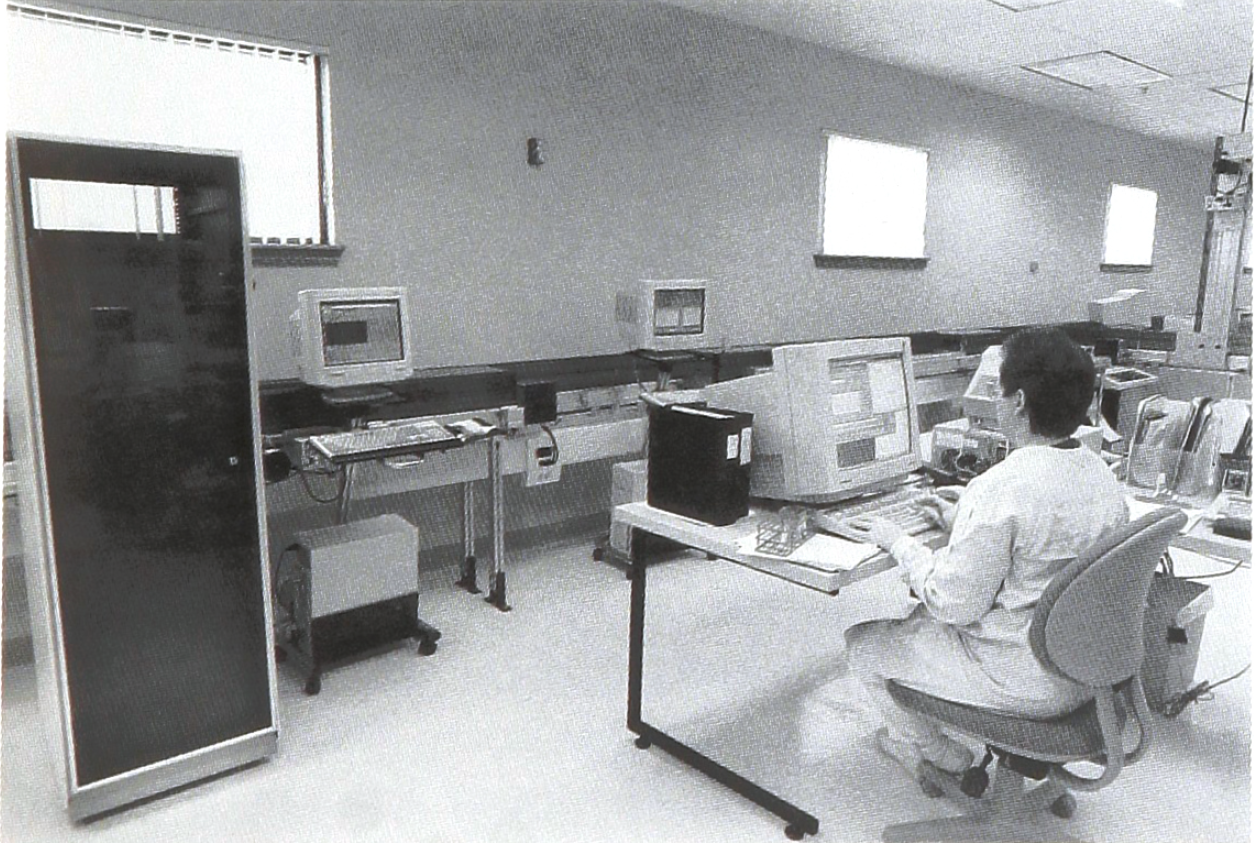
Lehigh Valley Hospital (Allentown, PA) is the first hospital in the country to install and have in continuous operation the latest robotics technology in its clinical laboratory, Health Network Laboratories (HNL).

The LAB-InterLink (Omaha, NE) automation system and the Johnson & Johnson Clinical Diagnostics (W. Henrietta, NY) Vitros 950AT chemistry system analyzer with on-track sampling, recently approved by the Food and Drug Administration, became operational on Feb. 19 and has remained so since.
This development is the first stage in a full robotics initiative that will have robotized chemistry, coagulation, hematology and immunochemistry work stations. The project includes the development and integration of automated instruments capable of on-track or robotic arm sampling, software with testing algorithms, and specimen transportation and routing systems
The project, consisting of a total of 10 work stations for scheduling and testing, will be completed by the end of the year. The design of the customized system was the result of a strategic partnership with Johnson & Johnson Clinical Diagnostics, Lab-InterLink Inc., Abbott Diagnostics (Abbott Park, IL) and Sunquest Information Systems (Tucson, AZ).
J&JCD is partnering with HNL for the chemistry, coagulation and immunochemistry work stations. The first to be operational is the Vitros 950AT chemistry analyzer. Released in January, the Vitros 950AT provides for on-track sampling of specimens, eliminating the need for robotics to transfer samples from the track to the testing instrument. The system also applies 1,400 rules to verify results or identify the need for technologist intervention.
Bristol-Myers Squibb Joins Electronic Notebooks Consortium to Develop Systems
Bristol-Myers Squibb Company has recently joined the Collaborative Electronic Notebook Systems (CENS) Consortium. Bristol-Myers Squibb, headquartered in New York City, is one of the world's largest health and personal care companies. The Collaborative Electronic Notebook Systems Consortium is a group of eleven Fortune 500 companies, both end users and vendors, working together to produce hardware and software solutions to electronic recordkeeping, collaboration and information management in scientific and technical fields
Karl Zoeckler, Senior Information Scientist for Bristol Myers Squibb explains, “Our strategy is to employ the CENS Consortium as a knowledge base to develop open solutions and standards that will fit into our existing computing environment and allow us to grow with the system.”
The Consortium is now recruiting additional members and vendors. The Consortium is a product research and development coalition, delivering extensive state-of-the-art knowledge, system specifications, hardware and software products and training. The work is being based on forward-looking, open standards technologies such as CORBA, Java, C++, XML, http, and others.