



Abstract

Timex recently launched the second model of their Data Link Watch Family. The new Timex Data Link offers the capability to transfer scheduling and personal information from your personal computer to your wrist.

This new model can store 150 entries, double its predecessor. A key addition is a scrolling message line found on the phone number, appointment, anniversary and list entries, which has been increased from 15 to 31 characters. Users now have a menu from which to chose a selection of sounds for alarms and appointment reminders. Owners of the Timex Data Link 1.0 software can transfer it to the 2.0 version. This technology has also been integrated into Schedule+ for Windows 95. The Data Link 150 has a recessed mineral glass face and a steel case.
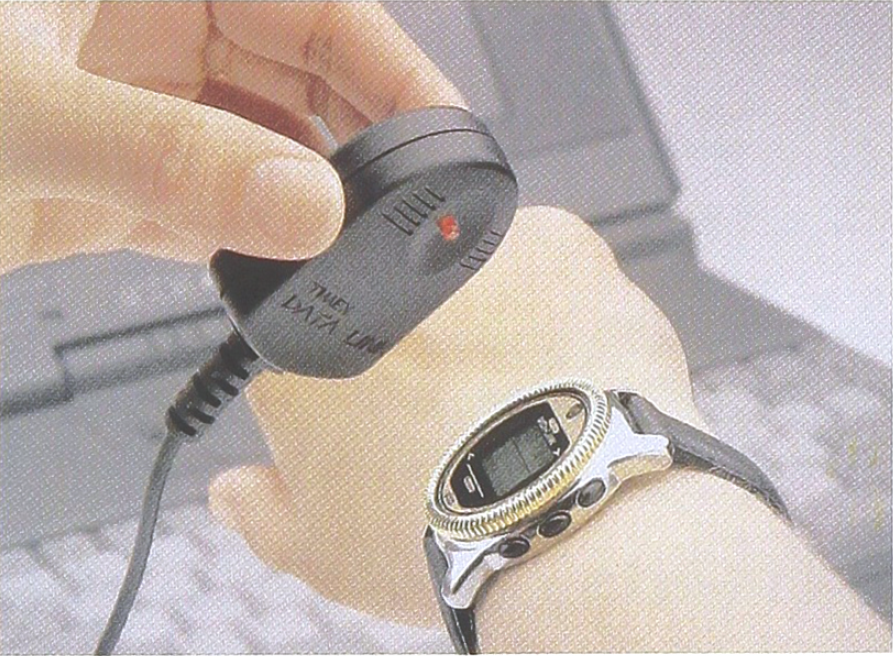

Timex new Notebook Adapter allows these watches to be used as personal computers that utilize LCD viewing screens, such as notebooks and laptops. The adapter plugs into the serial port of the PC notebook or laptop, and the software prompts the user to select this transmission method. The notebook works with both the original Timex Data Link 70, as well as memory-enhanced, second generation Timex Data Link 150.
Gilson Launches ASPEC XL4
Gilson has announced the launch of the ASPEC XL4 for high-thoughput, high-performance SPE. The ASPEC XL4 processes four SPE samples simultaneously. This means an average throughput of 25 samples per hour, and up to 50 sample per hour with optimized SPE methods.
The device has been designed for high throughput applications using both standard and disk-format SPE columns such as SPE prior to bioanalysis by LC/MS or GC, or combinatorial library purification.
Gilson relies on its positive-pressure displacement technology to ensure high-precision, multi-channel liquid handling with automatic drying of SPE columns.
Cartesian Engineering Introduces the BioJet Quanti 3000
Cartesian Engineering specializes in automation equipment for the Pharmaceutical Market. BioJet Quanti 3000 modules have the ability to dispense small drops, as low as 4 nanoliters, as well as large drops up to 10 microliters. These patent pending dispensing technologies can be used as a single head or designed into arrays to accommodate various microwell plate configurations.
Current applications for this technology include high throughput drug screening, combinatorial chemistry, genome mapping, and other applications where precision drop dispensing is required.
384 Well Cycler Plate is User Friendly
A 384-well microplate, specifically designed for high-throughput thermal cycling and robotic applications, is now available from MJ Research. The Microseal™ 384 plate fits precisely in the widely available 384-well block format and can be used with reaction volumes from 2μl to 30μl.

The wells are spaced at exactly half of the common 96-well spacing, so the plate can be filled using a standard multi-channel pipettor or automated fluid-handling system. The low profile of this plate (9mm high) means that wells are easily accessible using standard pipet tips.
The robotic-friendly design features rigid polypropylene construction and flat vertical sidewalls for secure handling and easy barcoding. Positioning in robotic workstations is precise and unambiguous due to the microplate's standard footprint and corner bevels. Raised rims around each well provide an excellent surface for tight sealing with Microseal ‘A’ film or other sealing systems. Plates are certified DNase and RNase-free.
New Product Introductions, Upgrades and Alliances at Synopsys Scientific Systems
Accord ActiveX™ Chemistry Control Brings Chemistry to Life on the Web

Synopsys Scientific Systems Ltd., a leading provider of chemical information software and database solutions, announced in March the first commercial ActiveX control for chemistry: the Accord ActiveX Chemistry Control. The beta/early experience version can be freely downloaded from Synopsys' Web Site at http://www.synopsys.co.uk/. The Accord ActiveX Chemistry Control chemistry-enables' Web Browsers, such as Microsoft Internet Explorer and Netscape Navigator. It can be used to specify chemical queries for submission to Web CGI search engines, display search results, perform chemical calculations and much more. The control allows content providers to design forms that contain active chemical objects, rather than just static, dead GIF images. The Accord ActiveX Chemistry Control understands a host of chemical formats, including native Accord, SMILES strings, ChemDraw files, MDL Molfiles and Rxnfiles. It also provides a wide selection of properties and events that can be used in conjunction with JavaScript or VB Script to develop sophisticated end-user chemical applications based on Web technologies.
The Accord ActiveX Chemistry Control provides the missing link in delivering and visualizing chemical content on the Web. Accord brings a Web Site to life by enabling client applications to understand active chemical content delivered over the Internet or corporate intranet. In addition, publication-quality chemical diagrams produced by the Accord ActiveX Chemistry Control can be transferred via the clipboard to other desktop applications quickly and easily for inclusion in internal reports, etc.
For example, a chemical supplier might design an HTML form allowing users to specify chemicals they are interested in purchasing. An exact or substructure search of an Accord for Access catalogue database via the Accord Web Driver might bring back availability and cost information. Similarly, a sample submission front-end might allow a chemist to register a new compound via a corporate intranet link to the corporate repository stored in Oracle or Accord/Universal Server, The Accord ActiveX Chemistry Control is available initially for Windows95/NT and is an integral component of Synopsys' Internet & corporate intranet initiative to enable the Web to understand chemistry the way chemists do — using the language of structural diagrams.
BioCatalysis Database Upgrade Introduced
Synopsys Scientific Systems Ltd., recently announced the release of a major new upgrade to its BioCatalysis database. Already in use by major fine-chemical and pharmaceutical companies, BioCatalysis provides scientists with reliable, up-to-date information on the use of biomolecules as catalysts in organic synthesis. BioCatalysis succeeds in maximizing information content, while minimizing the overlap, by the application of rigorous selection criteria and quality procedures during all phases of database development.
Accord Version 2.5 Now Available
In January Synopsys Scientific Systems Ltd., released Version 2.5 of its chemical spreadsheet, Accord. The new improved version provides cross-platform compatability allowing chemical spreadsheet files created on the Macintosh to be opened on the PC and vice versa. With Accord Excel users can insert chemical structures, reactions and substitutes directly into spreadsheet cells with retained Achemical awareness@. This allows chemically meaningful functions to be linked to chemical cells for calculating derived properties, such as molecular weight, percentage composition or Log P.
New Partnership Announced
Synopsys Scientific Systems Ltd and Informix Software announced in January that they have partnered to develop object-relational database solutions to meet the needs of researchers in pharmaceutical, fine chemical, agrochemical and biotechnology markets. The announcement of this strategic partnership was made at the official launch of INFORMIX-Universal Server, Informix's object-relational database system. Synopsys and Informix are combining to develop scalable enterprise and workgroup server solutions for the pharmaceutical and related markets.
Automation of Multiple Kinase Assays on an ORCA Rail System
Glaxo Wellcome is actively pursuing regulators of protein kinases (PKs) for the treatment of diseases such as cancer. Because signaling pathways are complexly interrelated, we are studying a large panel of PKs. We have developed assay methods and robotics to screen four different PKs simultaneously against approximately 1000 chemical samples in a 20 hour period. The kinase reaction mixture is made by mixing enzyme, which is prediluted on the robot just prior to use, a cocktail containing biotinylated peptide substrate and [g-33P]ATP, and a chemical sample.
This reaction mixture is then incubated, quenched, and transferred to a neutravidin-coated microtiter plate to allow the 33P-radiolabelled peptide to bind. Each binding plate is incubated, washed, and then counted.
This assay method was modified to ELISA and DELFIA (Dissociation Enhanced Lanthanide Fluorescent ImmunoAssay: Wallac) formats for studying tyrosine kinases. Both assays are non-radioactive, have higher throughput and use less enzyme. Under comparable conditions, we observed a signal to noise ratio (S/N) of approximately 20 for the ELISA format and 400 for the DELFIA.
This poster will review optimizing DELFIA for economical screening given its remarkable dynamic range. These assays were developed on an ORCA track system and scheduled using Scitec's WinClara. We obtained the flexibility to run simultaneous kinases by implementing custom arrays in the ORCA MDS software. This robot is integrated with a Tecan Genesis, Cavro syringe dispensers, Zymark RapidPlate, UV/ Vis spectrophotometer, a fluorometer, and is controlled by software developed in-house as well as software from outside vendors.
Becky Gooding Laskody, Anne Shrago Howe, Ann M.Edison, Peter Leitner, Jeremy Roth, Al Smith, Gaochao Tian, Paul Domanico. Glaxo Wellcome Inc., Five Moore Drive, PO Box 13398, RTP, NC 27709. TEL: (919) 483-6315, FAX: (919) 483-2494, Email:
New Products and Appointments at CRS Robotics
CRS Introduces New Software for Laboratory Automation

Laboratory automation supplier CRS Robotics has introduced a new software for laboratory automation called POLARA (Programming Architecture for Laboratory Automation). Designed for pharmaceutical, biotechnology, food and chemical industries, it is a powerful tool for building and operating automated systems. POLARA consists of an easy-to-use graphical user-interface that provides a single point of contact for creating, scheduling, running and monitoring methods and an underlying software architecture that allows automated systems to be easily modified or extended as application requirements change. POLARAs graphical interface runs on Windows NT.
New Technique for Ultra-High Throughput Screening
CRS Robotics announced in March a new technique for high throughput screening automation which will allow pharmaceutical and biotechnology companies involved in high throughput screening to increase significantly the throughput of their operations. The new system which CRS has developed involves processing microplates in batches of up to twenty. The microplates are moved from peripheral to peripheral in batches instead of one at a time. This batch processing is made possible by building automated systems which use a line of peripherals manufactured by Titertek Instruments, Inc.

CRS Appoints New North America Sales Manager

CRS Robotics has appointed a new Laboratory Automation Sales Manager for North America. Dr. Hansjoerg Haas will be responsible for promoting CRS line of turnkey systems and workstation products. Dr. Haas has several years experience in the pharmaceutical and biotechnology industries.
New Robotics Lab Unveiled at Lehigh Valley Hospital
On Thursday, March 20, Lehigh Valley Hospital (LVH), launched its new robotics clinical laboratory. The customized system was the result of a strategic partnership with Johnson & Johnson Clinical Diagnostics, LAB-Interlink Inc., Sunquest Information Systems and Abbott Diagnostics.
Labotix Awarded Contract from Kaiser Permanentes
Labotix Automation Inc., has been awarded a contract by Kaiser Permanentes Northwest Division to install a laboratory automation system. Known as RRUSH (Rapid Response Universal Specimen Handling), the system will use third generation Labotix computer modules to carry test tubes and specimens along a conveyor route to various workstations. The system will verify patient and specimen identification, uncap tubes, sort specimens by test, load testing racks, recap tubes, and sort tubes into assigned storage locations for future testing.