




Abstract
The purpose of this article is to alert the reader to a sensitve assay that can be easily employed to verify the pipetting accuracy of any manufacturer's multi-well pipettor.
Pipetting accuracy is an important variable in high throughput screening (HTS) at any scale including 96 or 384-well microplates. Often, the significance of this variable is taken for granted in the liquid handling steps of a HTS protocol. A question frequently asked of the Tomtec technical staff, regards the need to verify the accuracy of the multiwell pipettor employed in HTS assays.
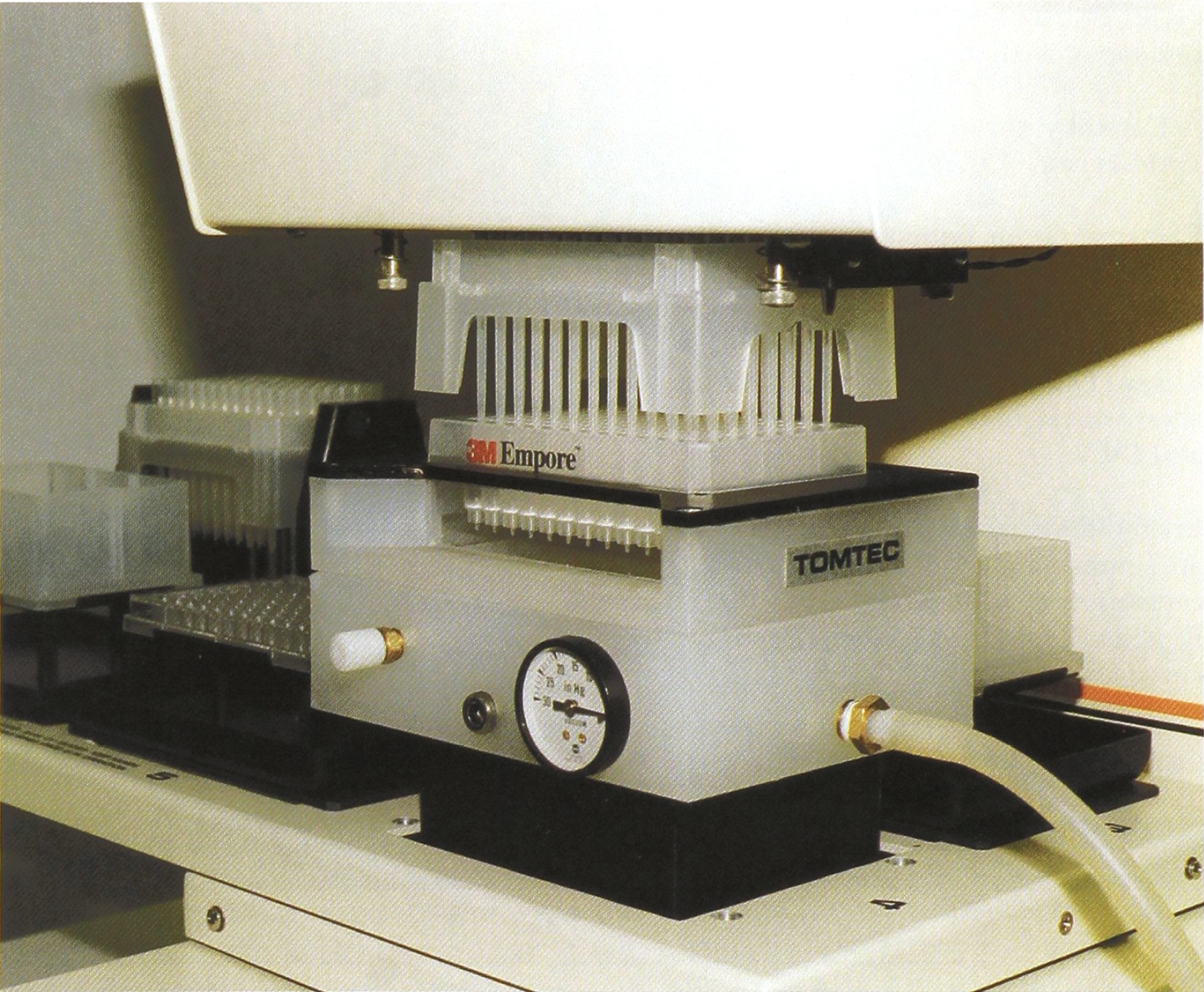
This article shares the quality assurance assay used by Tomtec to assay the pipetting accuracy of the Tomtec Quadra automated pipettors in the air displacement mode. This protocol utilizes a colorimetric analysis and can be easily converted to test the accuracy of any manufacturer's multiwell pipettor, regardless of the number of simultaneously operating tips employed. This accuracy verification assay and displayed results are presented for the Quadra96, a simultaneous 96-well pipettor. In addition, the versatility of this protocol is demonstrated with its adaptation for the Quadra384, a simultaneous 384-well pipettor.
An informative measurement of accuracy for any simultaneous-well pipettor is the relative variability of its liquid handling performance among its 96 or 384 samples. This is best defined as a measure of dispersion divided by a measure of central tendency. The coefficient of variability (CV%) is such an index and in this colorimetric analysis compares the raw optical density (OD492nm) data across the microplate after dispensing a specified volume of methyl orange dye solution into all 96 or 384-wells. It is calculated from the standard deviation divided by the mean and expressed as a percentage.
Materials and Methods:
Clean 96-well flat bottom polystyrene based microplates; carefully handled Tomtec polypropylene tips; deionized distilled water; methyl orange (Sigma Chemical #M-0402); microplate vortexer; spectrophotometer (set at measuring optical density at 492nm with simultaneous reference subtraction at 620nm) interfaced with a computer that has a programmable spreadsheet (to calculate mean, standard deviation and coefficient of variability amongst the OD492 readings of all 96-wells).
Make up the following fresh methyl orange solutions (w/v) in deionized distilled water:
0.1% methyl orange (0.1 gm methyl orange powder/100 ml water)
0.04% methyl orange (40ml 0.1 % methyl orange(w/v)/60ml water)
0.02% methyl orange (20ml 0.1% methyl orange(w/v)/80ml water)
0.01% methyl orange (10ml 0.1% methyl orange(w/v)/90ml water)
Programming scheme:
Load Tomtec polypropylene tips.
Aspirate 100ul air gap, then designated volume of water.
Aspirate 15ul air gap, then designated volume of dye
Dispense all 315ul of aspirate (includes air gaps) into microplate.
Mix 100ul of well volume with Quada mix cycle (aspirate from bottom of well, dispense into top of well) three times.
Carefully vortex microplate (e.g., orbital vortexer) for ∼1 min.
Insure no air bubbles inhibit light path within wells (remove with tapping, scraping or hot air from a hand held blower).
Read OD492, import raw data into spread sheet and calculate mean, standard deviation and CV%.
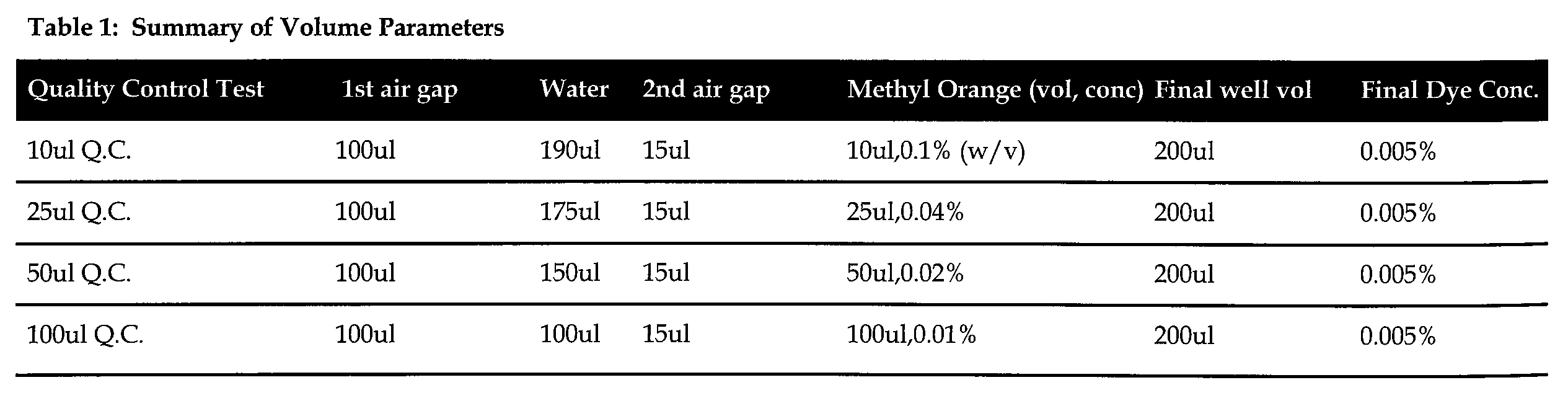
Briefly, the volume parameters of each test are summarized in Table 1. The final dye concentration of 0.005%(w/v) has been confirmed to be within the linear response of the curve for OD492 as a function of methyl orange concentration.
Summary of Volume Parameters
Results:
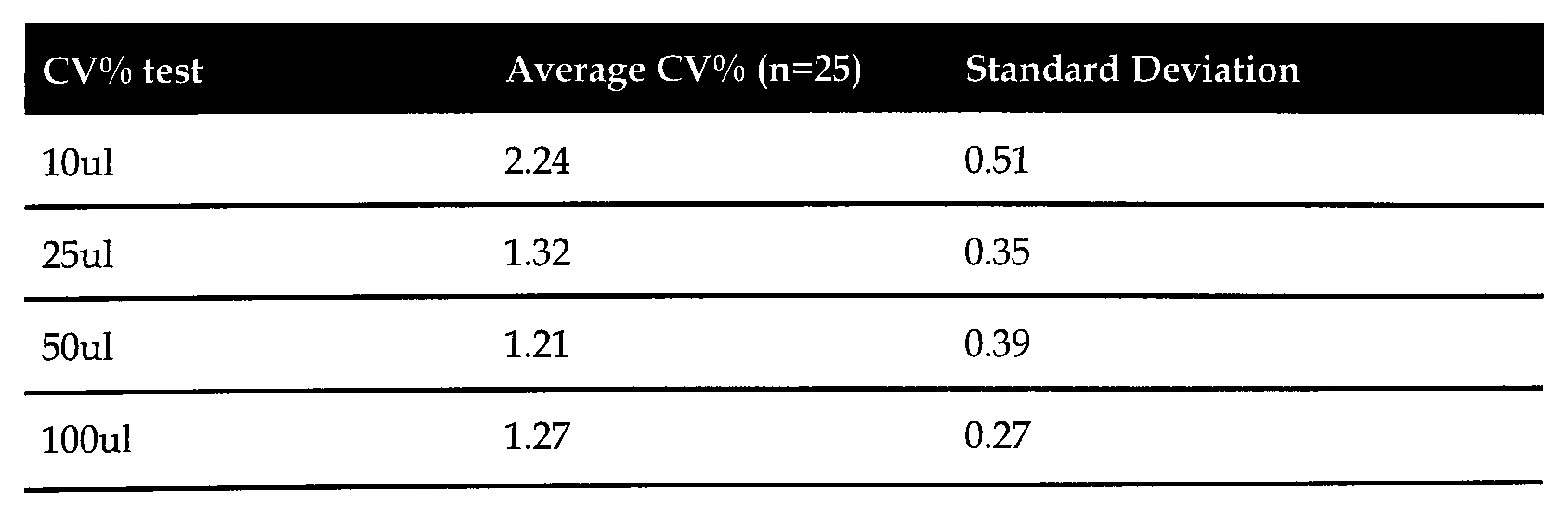
The following table contains the CV% results for the last 25 recently sold Quadra96 workstations (time period: 1/27/97–4/16/97) using this protocol by Tomtec Quality Control prior to shipment.
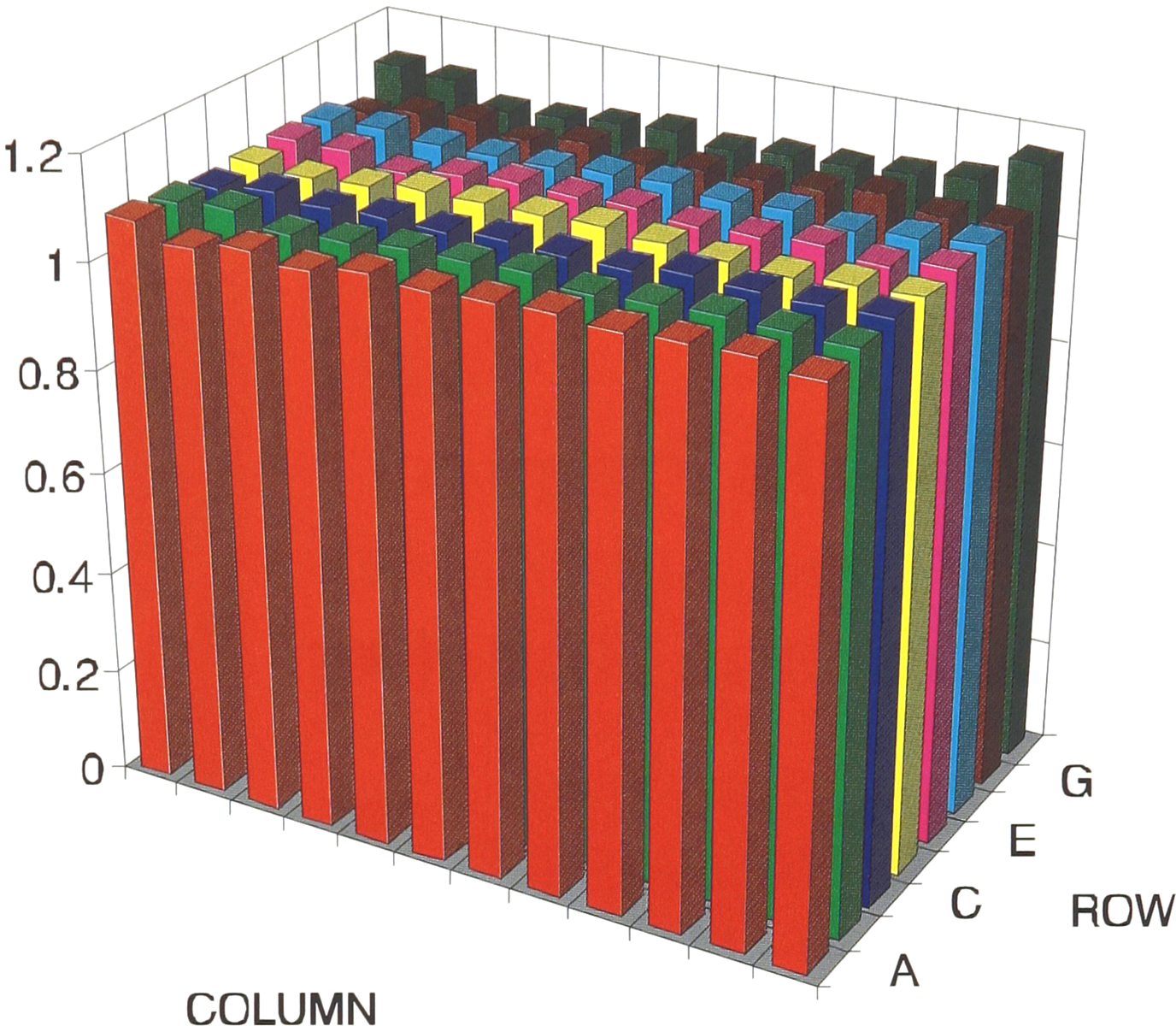
The results of a typical CV% assay are graphically presented for the Quadra workstations in figures 1 and 2. The results of this exact protocol for a 10ul assay with a calculated coefficient of variability of 1.14% for the Quadra96 is presented in Figure 1.
The results of this protocol for measuring the accuracy of pipetting a 10ul aspirate and dispense of a methyl orange dye solution using the Tomtec Quadra96 automated 96-well pipettor.
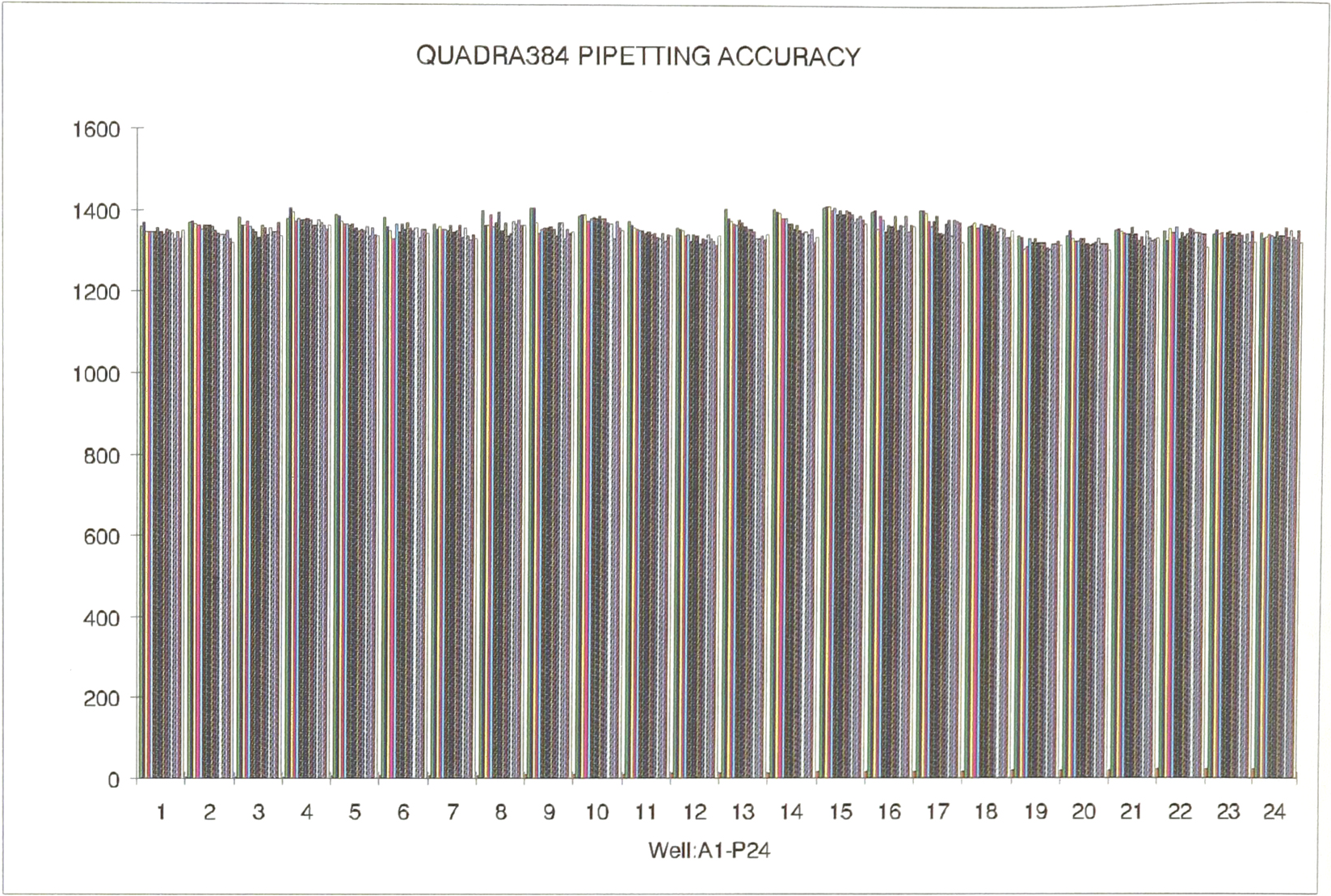
This figure configures raw OD492 data and its 3-D graphic illustration as a function of well number. For illustration, the pipetting peformance of the Quadra384 for aspirating 50ul of a neat 0.006%(w/v) methyl orange solution and dispensing into a dry bottom 384-well microplate simultaneously is illustrated in Figure 2. In this figure, the raw OD492 data is graphed as a function of well number with a calculated coefficient of variability of 1.63%. The ease of adaptation of this protocol into a 384-well pipettor, confirms its usefullness for verifying the pipetting accuracy of any multiwell pipettor.
A graphical illustration of the results from applying this protocol to the Quadra384 automated 384-well pipettor.
Discussion:
This colorimetric analysis takes advantage of Quadra96 specific design features that influence its accuracy performance. It is important that any user appreciate these features so as to increase success in all Quadra liquid handling applications.
The Quadra 96 uses a stepper motor to drive the individual 96 pistons in unison up and down. Whenever the stepper motor reverses direction there is backlash. This backlash is an artefactual result of mechanical windup in the gear train and drive plate of the Quadra 96 when initiating or changing from aspirate or dispense. The Quadra 96 control system automatically adds a backlash factor anytime the pistons are asked to change direction. The consequence of this correction is that better accuracy is obtained by including an aspirate of blow out air (i.e., initial air gap) so that the backlash correction occurs in the aspirate and subsequent dispense of this air gap and not in any desired liquid volumes.
When dispensing any volume from a small orifice, such as a pipette tip, there will be a certain amount retained at the tip orifice by surface tension and capillary action. This can be minimized by the included initial air gap, which serves as a blow out sweep to remove residual liquid from the tip.
The Quadra 96 uses two proprietary polypropylene tips differing by the internal diameter (0.026, 0.036 inches) at the tip orifice. Each tip is disposable or reusable and has a total volume of 450ul. The long narrow bottom configuration contains 90ul. The advantage of this bottom design is twofold, it can reach the bottom of deep well plates and allows convenient stacking of reagents separated by an air gap (i.e., 15ul air gap between water and dye) without mixing of reagents. In this protocol, this separation gap prevents artefactual upward diffusion of dye into the water layer before aspirating the dye which would result in greater inaccuracy. It also provides the end user the opportunity to maintain distinct reagents within the tip and start 96 distinct assays simultaneously with dispensing and mixing In addition, the Quadra workstations are configured with an automated shuttle of 2, 4 or 6 positions for reagent or accessory needs. The ease of integration of a variety of Quadra accessories (e.g., disposable tips, plate feeding stackers, vacuum boxes, tip washing stations, serial diluters, bar code readers, 96/384 plate indexer, etc.)expands the utilitarianism of this instrument. The advantages of these options in HTS have proven enormous.
The mixing function of the Quadra 96 allows setting different stage heights during the aspirate and dispense steps. Set the stage height so that tips aspirate from the bottom and dispense into the top of the well. This insures that the contents are turned over. Tomtec also strongly recommends further mixing with an orbital vortex to insure a heterogeneous solution for OD measurements. Care should be taken to remove any air bubbles that can impede light measurements.
The Quadra96 can operate in either the air displacement or positive displacement mode. In the positive displacement mode, the internal air column is replaced with liquid that has less compressibility and, therefore greater accuracy at the lower end of its volume transfer range. If backfilled with liquid, there must be a small air gap separating the backfill liquid from the aspirate. Any automated pipettor using a tip with a continuous taper from its orifice can only operate in the air displacement mode. The increasing cross sectional area of the tapered tip will collapse the separating air gap. Most Quadra users operate only in the air displacement mode to take advantage of the following. These include: increased capacity (450ul to 90ul), fear of contaminating backfill liquid; ease of changing tips and shortened setup times.