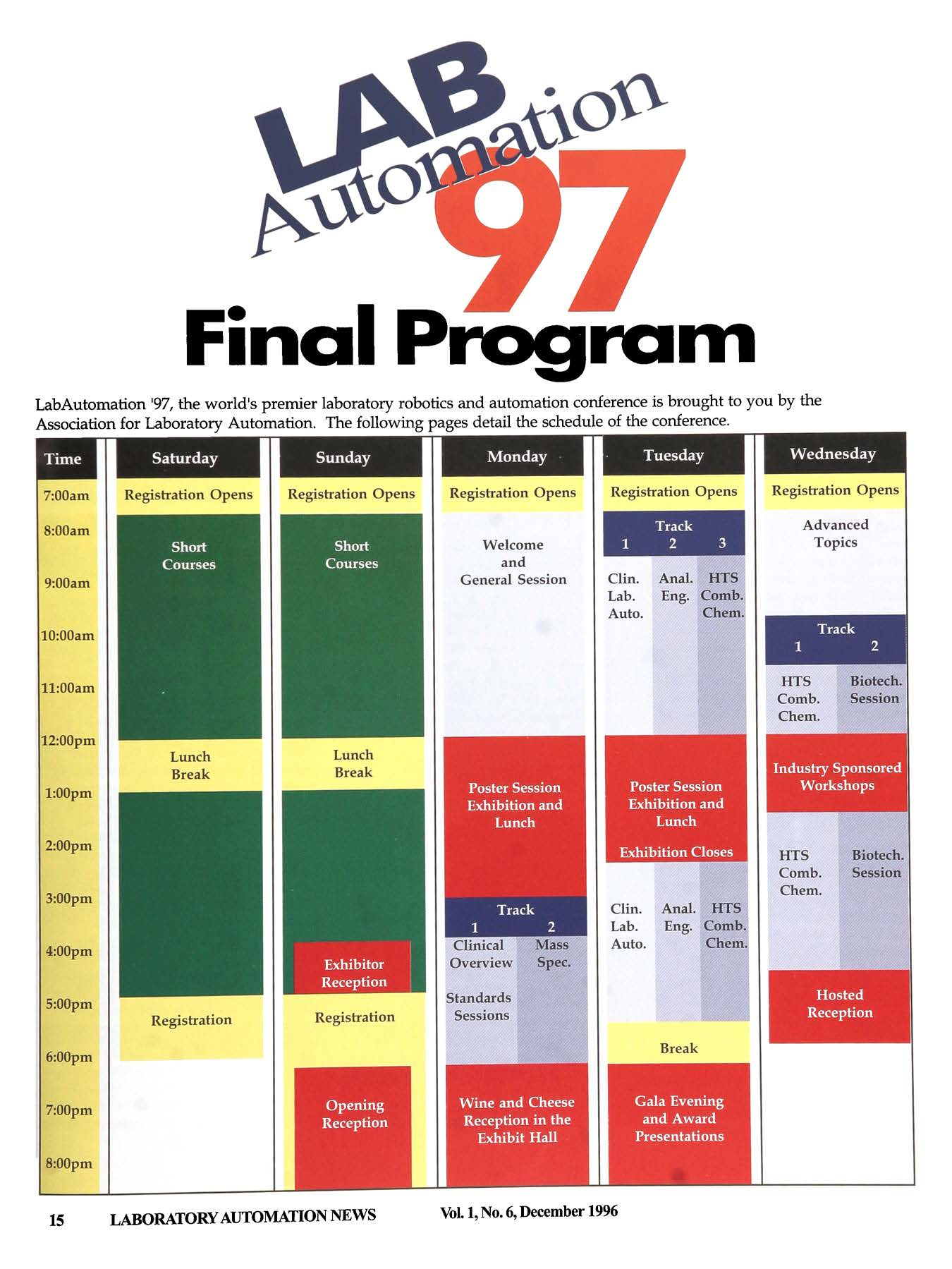
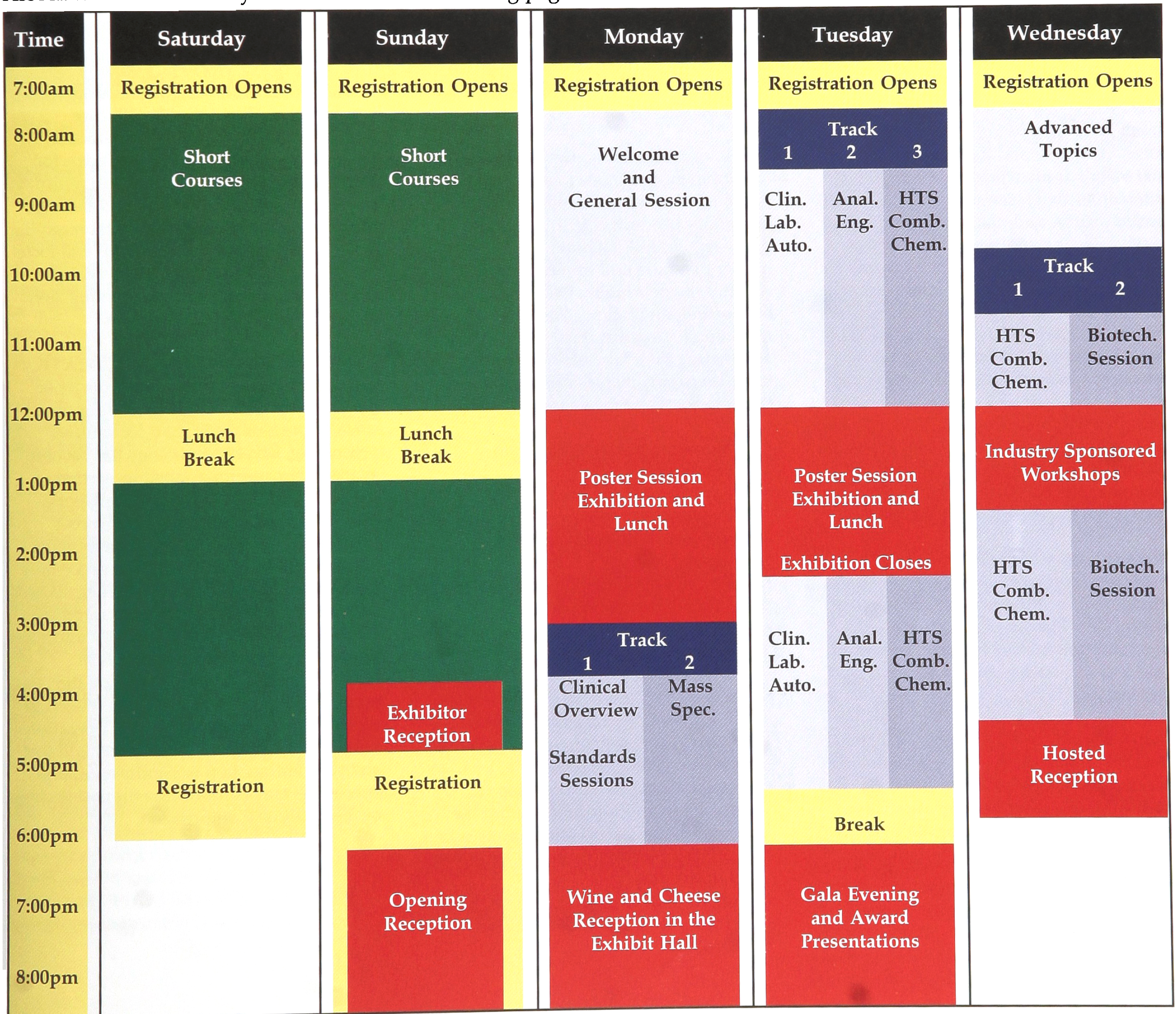
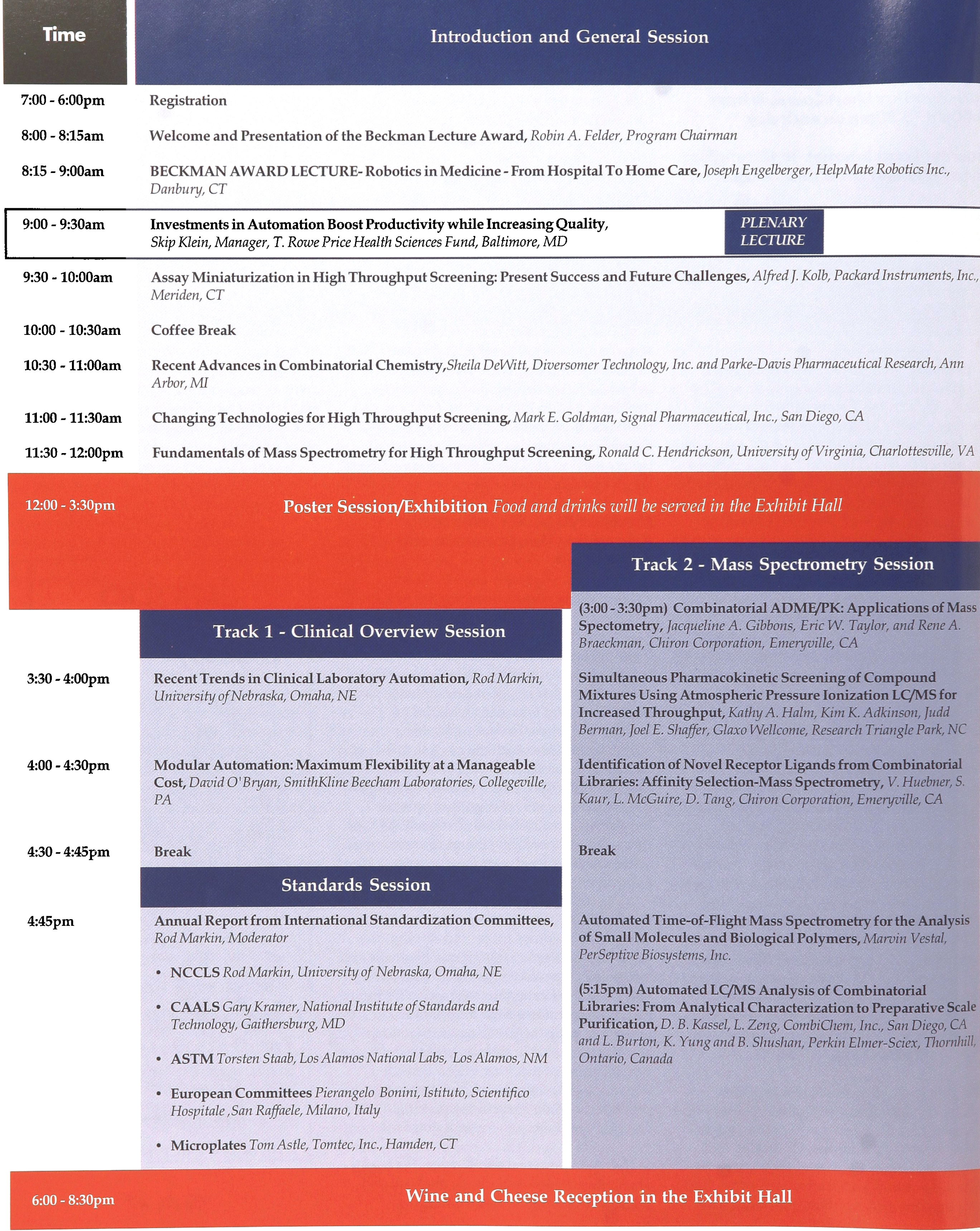
LabAutomation '97, the world's premier laboratory robotics and automation conference is brought to you by the Association for Laboratory Automation. The following pages detail the schedule of the conference.
Short Courses
SATURDAY, JANUARY 18, 1997
Saturday, January 18, 1997
8:00am – 5:00pm
Internet I: Introduction to the Internet and Untangling the World Wide Web
The Internet has become a vast information source with a growing network of people, ideas, resources and markets. More than 100 million users world-wide utilize it's interconnectivity, send and receive E-mail, access forums and databases, send and receive client, vendor and remote staff information. It is estimated that by the end of 1997, more than 1 million new domains will pop up. With this enormous explosion of information becoming readily available, now is a perfect time to learn about this amazing - and ever-popular - technology.
This course provides comprehensive hands- on experience with the Internet, geared to the needs of scientists. The content will be geared to the LabAutomation'97 attendee who is not necessarily a software expert.
A short history of the Internet will be provided. You will learn how to choose and implement the Internet connection most appropriate for you needs, install and configure Internet access tools, communicate text and data worldwide, locate and retrieve information using FTP, Gopher and the World Wide Web, utilize the various search engines and directories available on the Web, establish an on-line information service, protect you internal networks and data from unauthorized intrusion, and exploit the full range of Internet resources and services.
Introduction to Laboratory Automation and Roboticsby Dr. Steven D. Hamilton, Amgen, Inc., Boulder, CO; Dr. Gary W. Kramer, National Institute of Standards and Technology, Gaithersburg, MD, Dr. Mark F. Russo, Bristol Myers Squibb, Princeton, NJ
Today's increasingly competitive business environment continues to emphasize on the use of automation technology to improve laboratory productivity, to accelerate discovery, and to maintain quality. With the proper planning and implementation, robotics can be a highly flexible tool for laboratory automation. This is an introductory course, aimed at those considering automating their laboratory operations and those managing increasingly automated laboratories. The topics covered will be:
Reasons for employing laboratory automation.
An overview of current laboratory automation and robotics technology and usage, from workstations to fully integrated systems.
Planning, implementing and maintaining successful automation applications.
Automation specific issues involving documentation, validation, open systems and standards.
A review of specific automation-related technologies, such as automatic ID, sensors, vision systems, and software for system control and scheduling.
Understanding the relationship of automation and informatics, and the various options, tools and strategies that may be employed to manage automation-generated data.
A preview of emerging technologies that may have an impact on laboratory automation.
Introduction to Clinical Roboticsby Drs. Robin A. Felder, James C. Boyd, and John Savory, University of Virginia, Charlottesville, VA
Robotics and automation technology can improve the efficiency of health care delivery. However, laboratory directors must set reasonable automation goals for their laboratories. Based on a high return on investment, there are two basic choices for automating the laboratory, central receiving and point-of-care. This workshop will focus on discussion of the issues involved with considering, planning, implementing, and justifying laboratory automation.
CENTRAL RECEIVING AUTOMATION Central receiving is presumably the most likely area of the laboratory to automate since labor costs are highest for sample processing. Recent technology has become available for specimen labeling, sorting centrifuging, aliquotting, and transportation. In order for automation to be cost effective we must understand the benefits and limitations of pre-analytical processors. Recent progress will assist with their success such as new developing defacto standards for sample conveyance, laboratory information/automation system (LIS/LAS) software, interfaces which provide the necessary control data, and high reliability which should allow unattended operation. Limitations of sample tube variety and the ability of automation to handle exception specimens may compromise the cost savings of pre-analytical automation.
Three approaches to lab automation include:
The use of modular devices (e.g. Autolab Autoquot, BDC universal tube labeler, and LabInterlink conveyor system)
The use of a modular conveyor system (e.g. the LAS from Coulter/IDS),
The use of a full turnkey system (e.g. the CLAS from Boehringer Mannheim/Hitachi).
The benefits of each of these systems will be discussed.
POINT-OF-CARE AUTOMATION Point-of-care testing has traditionally been reserved for analytes which are necessary for rapid assessment of critically ill patients. Only limited menus of tests have been offered at point-of-care due to high costs and the lack of tests available on whole blood specimens. The ideal point-of-care system would utilize commercially available instruments, offer blood gases, electrolytes, chemistry, coagulation and hematology tests, provide rapid turnaround on whole blood specimens, be operated by nurses and ward clerks yet maintain control in the hands of laboratory professionals.
We have developed the Remote Automated Laboratory System (RALS™) which provides these features at a cost less than that of performing the same test in the central laboratory. Our clinical outcomes studies have demonstrated that automation of point-of-care analysis reduces the time patients spend on mechanical ventilation. Recently, many point-of-care systems which imitate RALS have come on to the market.
SUMMARY The need for central Laboratory Automation Systems will increase in the near future as laboratories consolidate into regional laboratories. Point-of-care automation will remain an expanding necessity during this consolidation process.
Eventually, 80% of laboratory testing will be performed at point-of-care with the remainder split between small on-site automated laboratories and a few large commercial laboratories. Therefore, laboratories should develop both central laboratory as well as point-of-care automation in order to be competitive in the upcoming medical marketplace.
SUNDAY, JANUARY 19, 1997
All Courses are from 8:00am – 5:00pm
Internet II: Intermediate - HTML Basics and Setting Up a Web Server
With the enormous explosion of information now available on the Web, there is no time like now to learn how to weave your own web space. This course provides comprehensive hands-on experience with HTML (HyperText Markup Language), the language of the Web. Participants must have at least an understanding of the Web or had attended Introduction to the Internet and Untangling the World Wide Web.
A brief overview of what HTML is will be provided. Students will learn how to create a homepage using basic HTML, including adding lists, hyperlinks, anchors, and images. Time allowing, students will also learn HTML 3.0, including tables. A presentation will be given in the afternoon on how to set-up and manage a Web site.
Visual BASIC for the Laboratoryby Dr. Martin M. Echol, SmithKline Beecham, Coatesville, PA, USA and Dr. Mark F. Russo, Bristol Myers Squibb Princeton, NJ, USA
The Visual Basic programming system for Microsoft Windows has become one of the most prominent custom application development tools for the automated laboratory. Visual Basic (VB) combines a simple programming language and an intuitive graphical user interface development environment with a wide range of built-in and third-party software libraries. This ease-of-use and continually increasing number of available software libraries make VB attractive for developing custom software components for automated laboratory systems.
This short course will introduce the Visual Basic programming system (version 4.0) and cover the features that make VB an invaluable tool for the laboratory. Several relevant sample programs will be examined. Hands-on sessions will provide the opportunity to work with VB and sample programs. Topics to be covered include:
The VB approach to graphical user interface development
Dynamic Data Exchange (DDE), Object Linking and Embedding (OLE) and OLE Automation
Instrument communication and control using RS-232 and IEEE protocols
Visual Basic for Applications (VBA)
Network application development with VB
Database application development with VB
Advanced topics
This class will provide a sufficient background to begin successful development of a wide range of custom laboratory applications using Visual Basic.
Introduction to Laboratory Robotics (see Saturday listing for a complete description)by Dr. Steven D. Hamilton, Amgen, Inc., Boulder, CO; Dr. Gary W. Kramer, National Institute of Standards and Technology, Gaithersburg, MD, Dr. Mark F. Russo, Bristol Myers Squibb, Princeton, NJ
Hands-On Training in Combinatorial Chemistryby Dr. Sheila DeWitt and Dr. Alasdair MacDonald, Diversomer Technologies, Inc., Ann Arbor, MI, USA
An informal workshop designed to provide chemists an opportunity to evaluate and implement alternative methods in combinatorial and automated synthesis. The workshop will focus on hands-on experiments, explanations of enabling technologies and commercial systems.
Electronic Laboratory Notebooksby Dr. Rich Lysakowski, The Collaborative Computing Institute, Sudbury, MA, USA
Collaborative electronic notebooks, groupware, workflow and document management systems, and other “team tools” are the next big wave in laboratory automation. These tools build on the networked technical and social infrastructures present in most medium to large organizations today, allowing specialists to build R&D team computing systems that provide real competitive advantage over commonly available LIMS and even Internet systems. The course gives a comprehensive survey of the new automation area of “R&D Team Computing.”
The first part of the course covers the legal, regulatory, technical, and social issues of collaborative electronic laboratory notebooks as an example of new types of scientific groupware systems hitting the market today. Background on the legal and regulatory requirements of recordkeeping and records management systems is given first to help attendees understand rigorously correct implementations of electronic notebooks based on the “Recordkeeping Business Rules” and “The 13 Fundamental Properties of Records.”
The second part of the course covers R&D team computing tools and systems, including groupware, electronic recordkeeping, electronic notebooks, workflow and document management, and collaboration systems used in R&D organizations now. Technical design features and benefits of these systems are covered in significant enough detail to allow attendees to begin to evaluate systems for in-house use after returning home. The social impact of these new R&D Team Computing Systems will be covered. The instructor will demonstrate several systems and show their application to scientific R&D problems solely to illustrate and drive home the concepts being introduced.
This course also covers key issues typically encountered when piloting such systems, and introduces methodologies to successfully deploy such systems. Case studies of successful deployments in large R&D organizations will discussed. Results from an on-going industry-wide study on R&D Team Computing will be presented also.
LIMS in the Organizationby Dr. Robert D. McDowall, McDowall Consulting, Bromley, Kent, UK
Laboratories are under increasing pressure to increase productivity and reduce costs. The implementation of a LIMS is one way of achieving these goals. However, the success rate of LIMS implementations is not high and organizations do not usually get payback from the investment they make in time, equipment, and human effort.
The aim of this course is to give participants the information and tools to implement a LIMS effectively, The course will cover:
Defining the scope and boundaries of a LIMS: what functions in an organization should a LIMS automate and where are the benefits realized? The targets the LIMS must hit should be defined before the project starts. The LIMS Matrix is the tool for this purpose.
The LIMS model and benefits of instrument connection: The LIMS model is a means of explaining the user functions of LIMS. One neglected feature of LIMS is instrument connection, less that 30% of systems have instruments connected. Why?
Performance metrics to measure success of the project: How can you convince yourself and senior management that your project is a success? Use performance metrics to provide solid data for an objective assessment of the project.
Change management implications: involving the users: Unless the users are involved in the project, the LIMS will fail. The success of a project lies not in the technology but in getting the users to change their ways of working. Human factors for success and failure will be outlined.
End-user validation of LIMS: The end users of a system are responsible for validating the LIMS in quality or regulated environments. A practical and common sense way of validation will be promoted.
Risk Assessment of a LIMS project: Be more proactive in managing the LIMS project and consider the risks that you face from the comfort of this course. Common risks at various stages of the project will be discussed.
There will be an open forum to discuss problems raised by the participants.
Target audience: Laboratory managers and senior analysts, computer scientists and quality assurance personnel involved in a LIMS project.
Introduction to Barcode Technologyby Mr. Bruce Sharf, Microscan Systems, Inc., Renton, WA, USA
Topics to be covered will include:
Overview of three main applications: patient sample ID tracking, reagent ID, and tray ID
Symbology Selection in Laboratory Automation
Barcode Scanner Technology in Laboratory Automation
Barcode Scanner Integration and Beyond
Beyond Scanning Barcodes
Robotics & Automation Intelligence Using Barcodes
SATURDAY-SUNDAY, JANUARY 18–19, 1997
Each Two-Day Short Course is from 8:00am – 5:00pm on each day
Internet I and Internet II: Untangling the WWW and HTML and Web Servers
See Saturday and Sunday listing for complete description.
Neural Networks-Hands-On Computer Workshopby Dr. Charles T. Butler, Computational Intelligence, Reston, VA, USA
This course is a two-day hands-on workshop in neural networks and their applications. Three other computational intelligence methods - knowledge-based and fuzzy systems and genetic algorithms - will be introduced and their areas of usefulness and overlap with neural systems discussed. On both days attendees will perform experiments, the first day using specially written software that allows them to watch a network as it learns a task, the second day using commercial professional software. A copy of the specially written software is included with the course textbook.
Neural networks are information processing systems modeled after the structure of the brain and are among the most innovative problem solving methods in use today. Unlike traditional computers, neural networks are trained to solve problems, learning appropriate solutions from examples rather than forcing the developer to provide detailed algorithmic instructions. They are often successful in problem domains that have not yielded to algorithmic or expert-system approaches. Neural networks can be applied to both spatial and temporal problems, including classifying patterns, controlling complex processes, providing expert-level advice, clustering unknown data, and mapping functions. They are especially appropriate for applications in which human expertise is the current usual solution, typically performing as well or better than their human counterparts at lower cost.
The hands-on nature of this workshop allows all participants to gain practical experience with these innovative systems. In the first day's sessions, Dr. Butler will introduce neural networks, then cover the two most useful application networks, back propagation and Kohonen self-organization. Attendees will train their own back propagation and Kohonen networks and learn the effects of several of the important parameters governing their operation. Dr. Butler will then introduce three complementary methods, expert systems, fuzzy systems, and genetic algorithms, and compare their areas of usefulness to those of neural systems.
On the second day, Dr. Butler will lead attendees in applying commercial professional simulator software to data from actual applications to help them gain experience in using back propagation networks to solve difficult “real-world” problems and to illustrate the need for and methods of proper data preparation. If time permits, the day will close with an open question-and-answer session on topics related to neural networks.
Machine Vision For Laboratory Automation -Fundamentals and Applicationsby Dr. John E. Agapakis and Dr. Sarath Krishnaswamy, Acuity Imaging, Inc., Nashua, NH, USA
Over the last fifteen years, machine vision - the extraction of useful symbolic descriptions from video images - has matured as a technology and is now considered an indispensable tool for manufacturing automation. Manufacturing applications of machine vision include part presence/absence detection, part location/orientation determination, part recognition, quality inspection, precise two-dimensional (2D) or three-dimensional (3D) gauging, robot or other machine guidance, and process control.
As the use of robotic automation in the laboratory becomes more widespread, the need for and application of machine vision technology has also expanded. Machine vision is now finding increasing utility in pharmaceutical research laboratories, in DNA mapping/sequencing automation applications, and in the clinical laboratory. Applications of machine vision include labware inspection, dissolution testing, procedure validation, colony picking, machine guidance, and quality control.
In this short course we will cover the basics of machine vision and image analysis and examine examples of these emerging applications of machine vision in the automated laboratory. The course will start with examples of laboratory applications of machine vision and will include interactive sessions for setting up sample applications. We will then detail the parts of the machine vision system and briefly cover some of the theory behind image processing and analysis. The latter segment of the course will be free time in which course participants will have access to state-of-the-art machine vision workstations on which they may explore and experiment with different image analysis algorithms and vision-guided motion applications. Participants are encouraged to bring their own ideas and lab consumables or other apparatus for mocking up applications on these development stations.
MONDAY, JANUARY 20, 1997
TUESDAY, JANUARY 21, 1997
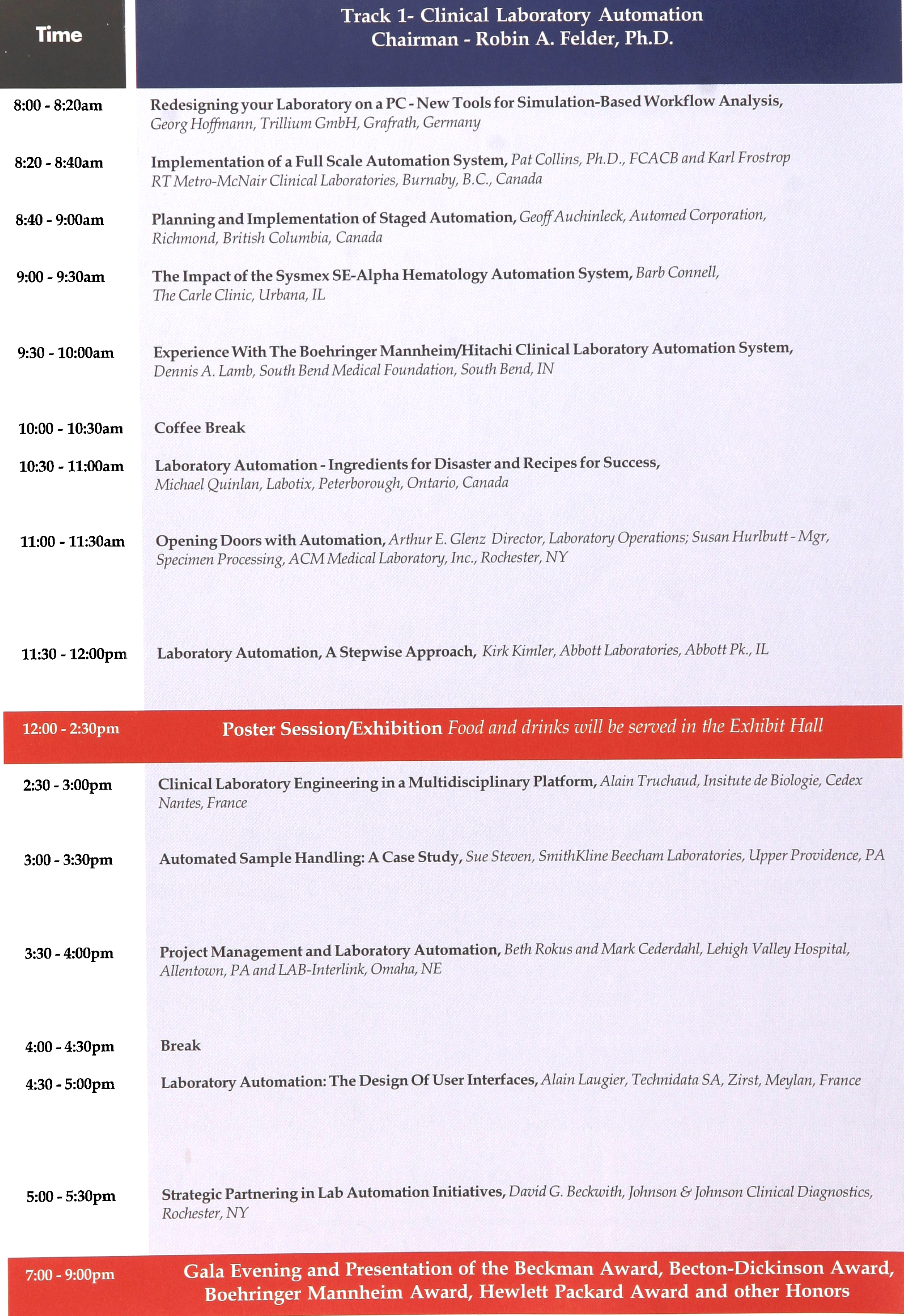
Time
Track 1- Clinical Laboratory Automation Chairman - Robin A. Felder, Ph.D.
8:00 – 8:20am
Redesigning your Laboratory on a PC - New Tools for Simulation-Based Workflow Analysis, Georg Hoffmann, Trillium GmbH, Grafrath, Germany
8:20 – 8:40am
Implementation of a Full Scale Automation System, Pat Collins, Ph.D., FCACB and Karl Frostrop RT Metro-McNair Clinical Laboratories, Burnaby, B.C., Canada
8:40 – 9:00am
Planning and Implementation of Staged Automation, Geoff Auchinleck, Automed Corporation, Richmond, British Columbia, Canada
9:00 – 9:30am
The Impact of the Sysmex SE-Alpha Hematology Automation System, Barb Connell, The Carle Clinic, Urbana, IL
9:30 – 10:00am
Experience With The Boehringer Mannheim/Hitachi Clinical Laboratory Automation System, Dennis A. Lamb, South Bend Medical Foundation, South Bend, IN
10:00 – 10:30am
Coffee Break
10:30 – 11:00am
Laboratory Automation - Ingredients for Disaster and Recipes for Success, Michael Quinlan, Labotix, Peterborough, Ontario, Canada
11:00 – 11:30am
Opening Doors with Automation, Arthur E. Glenz Director, Laboratory Operations; Susan Hurlbutt-Mgr, Specimen Processing, ACM Medical Laboratory, Inc., Rochester, NY
11:30 – 12:00pm
Laboratory Automation, A Stepwise Approach, Kirk Kimler, Abbott Laboratories, Abbott Pk., IL
12:00 – 2:30pm
Poster Session/ExhibitionFood and drinks will be served in the Exhibit Hall
2:30 – 3:00pm
Clinical Laboratory Engineering in a Multidisciplinary Platform, Alain Truchaud, Insitute de Biologie, Cedex Nantes, France
3:00 – 3:30pm
Automated Sample Handling: A Case Study, Sue Steven, SmithKline Beecham Laboratories, Upper Providence, PA
3:30 – 4:00pm
Project Management and Laboratory Automation, Beth Rokus and Mark Cederdahl, Lehigh Valley Hospital, Allentown, PA and LAB-Interlink, Omaha, NE
4:00 – 4:30pm
Break
4:30 – 5:00pm
Laboratory Automation: The Design Of User Interfaces, Alain Laugier, Technidata SA, Zirst, Meylan, France
5:00 – 5:30pm
Strategic Partnering in Lab Automation Initiatives, David G. Beckwith, Johnson & Johnson Clinical Diagnostics, Rochester, NY
7:00 – 9:00pm
Gala Evening and Presentation of the Beckman Award, Becton-Dickinson Award, Boehringer Mannheim Award, Hewlett Packard Award and other Honors
TUESDAY, JANUARY 21, 1997
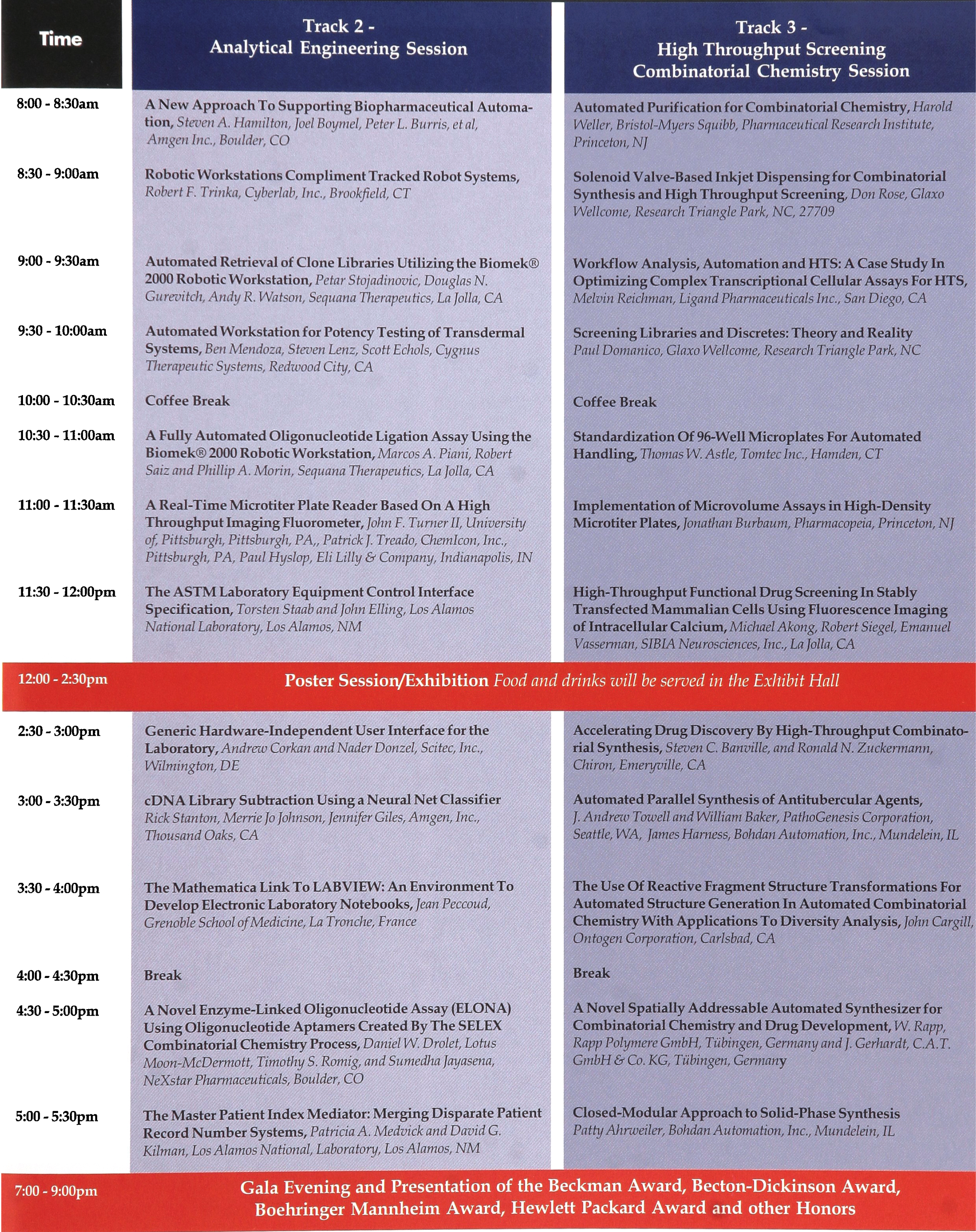
Time
Track 2 - Analytical Engineering Session
Track 3 - High Throughput Screening Combinatorial Chemistry Session
8:00 – 8:30am
A New Approach To Supporting Biopharmaceutical Automation, Steven A. Hamilton, Joel Boymel, Peter L. Burris, et al, Amgen Inc., Boulder, CO
Automated Purification for Combinatorial Chemistry, Harold Weller, Bristol-Myers Squibb, Pharmaceutical Research Institute, Princeton, NJ
8:30 – 9:00am
Robotic Workstations Compliment Tracked Robot Systems, Robert F. Trinka, Cyberlab, Inc., Brookfield, CT
Solenoid Valve-Based Inkjet Dispensing for Combinatorial Synthesis and High Throughput Screening, Don Rose, Glaxo Wellcome, Research Triangle Park, NC, 27709
9:00 – 9:30am
Automated Retrieval of Clone Libraries Utilizing the Biomek® 2000 Robotic Workstation, Petar Stojadinovic, Douglas N. Gurevitch, Andy R. Watson, Sequana Therapeutics, La Jolla, CA
Workflow Analysis, Automation and HTS: A Case Study In Optimizing Complex Transcriptional Cellular Assays For HTS, Melvin Reichman, Ligand Pharmaceuticals Inc., San Diego, CA
9:30 – 10:00am
Automated Workstation for Potency Testing of Transdermal Systems, Ben Mendoza, Steven Lenz, Scott Echols, Cygnus Therapeutic Systems, Redwood City, CA
Screening Libraries and Discretes: Theory and RealityPaul Domanico, Glaxo Wellcome, Research Triangle Park, NC
10:00 – 10:30am
Coffee Break
Coffee Break
10:30 – 11:00am
A Fully Automated Oligonucleotide Ligation Assay Using the Biomek® 2000 Robotic Workstation, Marcos A. Piani, Robert Saiz and Phillip A. Morin, Sequana Therapeutics, La Jolla, CA
Standardization Of 96-Well Microplates For Automated Handling, Thomas W. Astle, Tomtec Inc., Hamden, CT
11:00 – 11:30am
A Real-Time Microtiter Plate Reader Based On A High Throughput Imaging Fluorometer, John F. Turner II, University of, Pittsburgh, Pittsburgh, PA, Patrick J. Treado, ChemIcon, Inc., Pittsburgh, PA, Paul Hyslop, Eli Lilly & Company, Indianapolis, IN
Implementation of Microvolume Assays in High-Density Microtiter Plates, Jonathan Burbaum, Pharmacopeia, Princeton, NJ
11:30 – 12:00pm
The ASTM Laboratory Equipment Control Interface Specification, Torsten Staab and John Elling, Los Alamos National Laboratory, Los Alamos, NM
High-Throughput Functional Drug Screening In Stably Transfected Mammalian Cells Using Fluorescence Imaging of Intracellular Calcium, Michael Akong, Robert Siegel, Emanuel Vasserman, SIBIA Neurosciences, Inc., La Jolla, CA
12:00 – 2:30pm
Poster Session/ExhibitionFood and drinks will be served in the Exhibit Hall
2:30 – 3:00pm
Generic Hardware-Independent User Interface for the Laboratory, Andrew Corkan and Nader Donzel, Scitec, Inc., Wilmington, DE
Accelerating Drug Discovery By High-Throughput Combinatorial Synthesis, Steven C. Banville, and Ronald N. Zuckermann, Chiron, Emeryville, CA
3:00 – 3:30pm
cDN A Library Subtraction Usinga Neural Net ClassifierRick Stanton, Merrie Jo Johnson, Jennifer Giles, Amgen, Inc., Thousand Oaks, CA
Automated Parallel Synthesis of Antitubercular Agents, J. Andrew Towell and William Baker, PathoGenesis Corporation, Seattle, WA, James Harness, Bohdan Automation, Inc., Mundelein, IL
3:30 – 4:00pm
The Mathematica Link To LABVIEW: An Environment To Develop Electronic Laboratory Notebooks, Jean Peccoud, Grenoble School of Medicine, La Tronche, France
The Use Of Reactive Fragment Structure Transformations For Automated Structure Generation In Automated Combinatorial Chemistry With Applications To Diversity Analysis, John Cargill, Ontogen Corporation, Carlsbad, CA
4:00 – 4:30pm
Break
Break
4:30 – 5:00pm
A Novel Enzyme-Linked Oligonucleotide Assay (ELONA) Using Oligonucleotide Aptamers Created By The SELEX Combinatorial Chemistry Process, Daniel W. Drolet, Lotus Moon-McDermott, Timothy S. Romig, and Sumedha Jayasena, NeXstar Pharmaceuticals, Boulder, CO
A Novel Spatially Addressable Automated Synthesizer for Combinatorial Chemistry and Drug Development, W. Rapp, Rapp Polymere GmbH, Tübingen, Germany and J. Gerhardt, C.A.T. GmbH & Co. KG, Tübingen, Germany
5:00 – 5:30pm
The Master Patient Index Mediator: Merging Disparate Patient Record Number Systems, Patricia A. Medvick and David G. Kilman, Los Alamos National, Laboratory, Los Alamos, NM
Closed-Modular Approach to Solid-Phase SynthesisPatty Ahrweiler, Bohdan Automation, Inc., Mundelein, IL
7:00 – 9:00pm
Gala Evening and Presentation of the Beckman Award, Becton-Dickinson Award, Boehringer Mannheim Award, Hewlett Packard Award and other Honors
WEDNESDAY, JANUARY 22, 1997
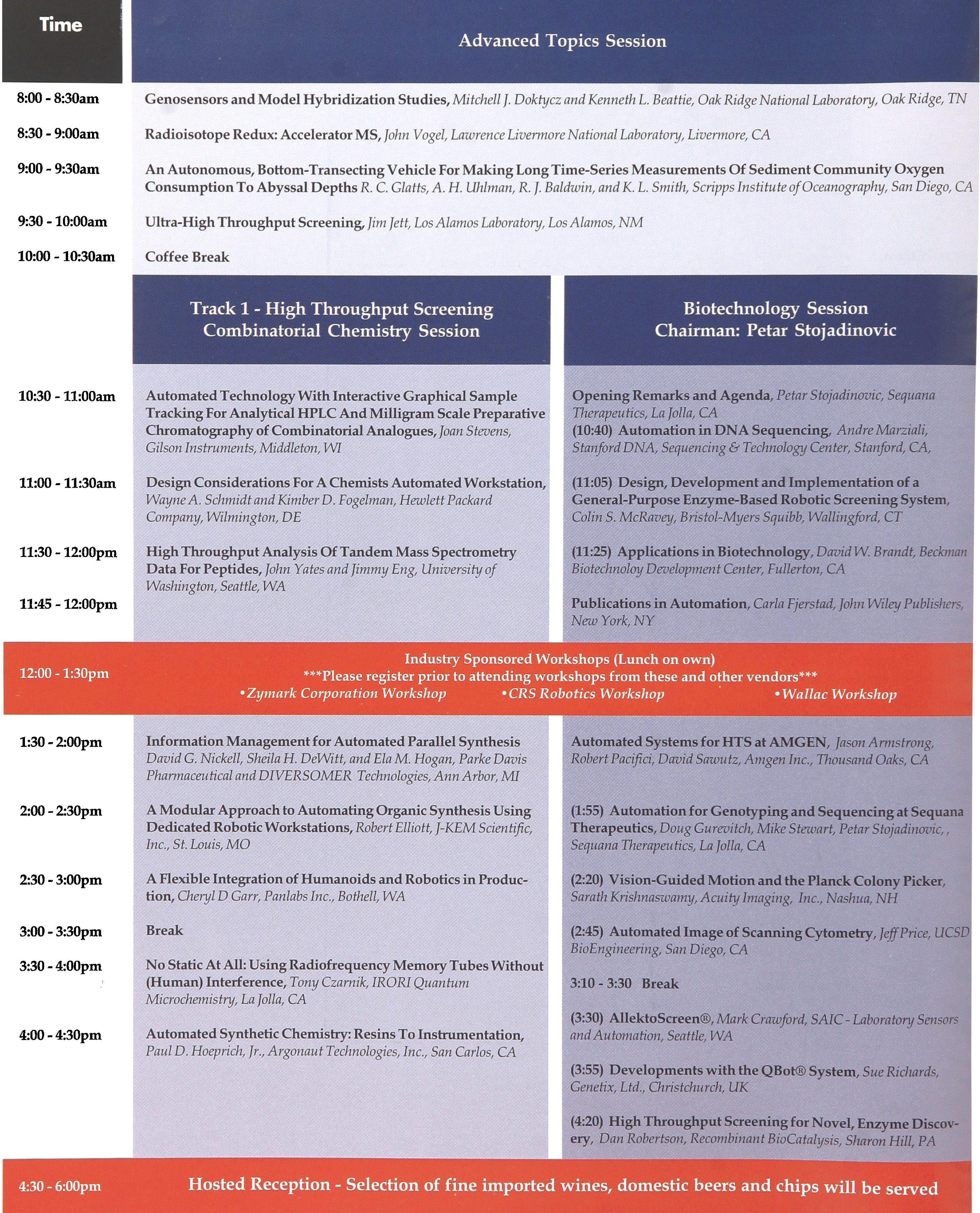
Time
Advanced Topics Session
8:00 – 8:30am
Genosensors and Model Hybridization Studies, Mitchell J. Doktycz and Kenneth L. Beattie, Oak Ridge National Laboratory, Oak Ridge, TN
8:30 – 9:00am
Radioisotope Redux: Accelerator MS, John Vogel, Lawrence Livermore National Laboratory, Livermore, CA
9:00 – 9:30am
An Autonomous, Bottom-Transecting Vehicle For Making Long Time-Series Measurements Of Sediment Community Oxygen Consumption To Abyssal DepthsR. C. Glatts, A. H. Uhlman, R. J. Baldwin, and K. L. Smith, Scripps Institute of Oceanography, San Diego, CA
9:30 – 10:00am
Ultra-High Throughput Screening, Jim Jett, Los Alamos Laboratory, Los Alamos, NM
10:00 – 10:30am
Coffee Break
Track 1 - High Throughput Screening Combinatorial Chemistry Session
Biotechnology Session Chairman: Petar Stojadinovic
10:30 – 11:00am
Automated Technology With Interactive Graphical Sample Tracking For Analytical HPLC And Milligram Scale Preparative Chromatography of Combinatorial Analogues, Joan Stevens, Gilson Instruments, Middleton, WI
Opening Remarks and Agenda, Petar Stojadinovic, Sequana Therapeutics, La Jolla, CA(10:40) Automation in DNA Sequencing, Andre Marziali, Stanford DNA, Sequencing & Technology Center, Stanford, CA,
11:00 – 11:30am
Design Considerations For A Chemists Automated Workstation, Wayne A. Schmidt and Kimber D. Fogelman, Hewlett Packard Company, Wilmington, DE
(11:05) Design, Development and Implementation of a General-Purpose Enzyme-Based Robotic Screening System, Colin S. McRavey, Bristol-Myers Squibb, Wallingford, CT
11:30 – 12:00pm
High Throughput Analysis Of Tandem Mass Spectrometry Data For Peptides, John Yates and Jimmy Eng, University of Washington, Seattle, WA
(11:25) Applications in Biotechnology, David W. Brandt, Beckman Biotechnoloy Development Center, Fullerton, CA
11:45 – 12:00pm
Publications in Automation, Carla Fjerstad, John Wiley Publishers, New York, NY
12:00 – 1:30pm
Industry Sponsored Workshops (Lunch on own)***Please register prior to attending workshops from these and other vendors***•Zymark Corporation Workshop •CRS Robotics Workshop • Wallac Workshop
1:30 – 2:00pm
Information Management for Automated Parallel SynthesisDavid G. Nickell, Sheila H. DeWitt, and Ela M. Hogan, Parke Davis Pharmaceutical and DIVERSOMER Technologies, Ann Arbor, MI
Automated Systems for HTS at AMGEN, Jason Armstrong, Robert Pacifici, David Sawutz, Amgen Inc., Thousand Oaks, CA
2:00 – 2:30pm
A Modular Approach to Automating Organic Synthesis Using Dedicated Robotic Workstations, Robert Elliott, J-KEM Scientific, Inc., St. Louis, MO
(1:55) Automation for Genotyping and Sequencing at Sequana Therapeutics, Doug Gurevitch, Mike Stewart, Petar Stojadinovic., Sequana Therapeutics, La Jolla, CA
2:30 – 3:00pm
A Flexible Integration of Humanoids and Robotics in Production, Cheryl D Garr, Panlabs Inc., Bothell, WA
(2:20) Vision-Guided Motion and the Planck Colony Picker, Sarath Krishnaswamy, Acuity Imaging, Inc., Nashua, NH
3:00 – 3:30pm
Break
(2:45) Automated Image of Scanning Cytometry, Jeff Price, UCSD BioEngineering, San Diego, CA
3:30 – 4:00pm
No Static At All: Using Radiofrequency Memory Tubes Without (Human) Interference, Tony Czarnik, IRORI Quantum Microchemistry, La Jolla, CA
3:10 – 3:30 Break
4:00 – 4:30pm
Automated Synthetic Chemistry: Resins To Instrumentation, Paul D. Hoeprich, Jr., Argonaut Technologies, Inc., San Carlos, CA
(3:30) AllektoScreen®, Mark Crawford, SAIC-Laboratory Sensors and Automation, Seattle, WA
(3:55) Developments with the QBot® System, Sue Richards, Genetix, Ltd., Christchurch, UK
(4:20) High Throughput Screening for Novel, Enzyme Discovery, Dan Robertson, Recombinant BioCatalysis, Sharon Hill, PA
4:30 – 6:00pm
Hosted Reception - Selection of fine imported wines, domestic beers and chips will be served
POSTERS
All posters will be located in the Exhibition Hall at the Sheraton San Diego Hotel and Marina.
The Swiss Blood Testing Unit (STU), an innovative project to prevent transfusion transmitted diseasesP. Bachmann, ZLB Central Laboratory Blood Transfusion Service SRC, Berne, Switzerland, M. Oberli, Hamilton Bonaduz AG, Bonaduz, Switzerland, J.J. Burckhardt, ZLB Central Laboratory Blood Transfusion Service SRC, Berne, Switzerland
Studies on Contamination Risk of PCR by a New Automation ConceptGerhard Bienhaus, P. Wenzig, G. Haberhausen, J. Kleiber, Ch. Markert-Hahn, J. Schwab, and U. Kolb Boehringer Mannheim GmbH, Tützing, Germany
Custom Engineered Automation for Scientific ResearchC. E. Ball, M. F. Fischer, and D. P. McCampbell, Midwest Research Institute, Kansas City, KS, USA
Artificial Neural Tree Model for Predicting Protein Structural ClassesYu-Dong Cai and Kuo-Chen Chou Shanghai Research Centre of Biotechnology, Chinese Academy of Sciences, Shanghai, China and Upjohn Laboratories, Kalamazoo, Michigan, USA
Learning Association Self-Organization Neural Network Model for Predicting the Specificity of GaINAc-transferaseYu-Dong Cai and Kuo-Chen Chou Shanghai Research Centre of Biotechnology, Chinese Academy of Sciences, Shanghai, China and Upjohn Laboratories, Kalamazoo, Michigan, USA
Genetic Programming Method for Predicting HIV Protease Cleavage SitesYu-Dong Cai and Kuo-Chen Chou Shanghai Research Centre of Biotechnology, Chinese Academy of Sciences, Shanghai, China and Upjohn Laboratories, Kalamazoo, Michigan, USA
Generic Hardware-Independent User Interface for Laboratory AutomationAndrew Corkan and Nader Donzel, Scitec, Inc., Wilmington, DE, USA
Automated Solution Preparation and Distribution of Chemical Compounds at Merck using the Packard MultiPROBE®Collette S. DeChard, Merck and Company, Rahway, NJ, USA and Craig Cardella, Packard Instrument Company, Meriden, CT, USA
The Implementation of Matrix Codes in the Clinical LaboratoryChristopher A. Estey, Robin A. Felder, The University of Virginia Health Sciences Center, Charlottesville, VA
The Amgen Boulder Sample Bank: Data Handling, Automated Sample Handling, and Storage FunctionsBurt Goodman, Joel Boymel, Tiff Kramer, Mark Deiparine, Paula McMahon, and Jennifer Williams Amgen, Inc., Boulder, CO, USA
High Throughput Automated Plasmid Purification on the Biomek® 2000Diana Gonzalez, Beckman Instruments, Fullerton, CA, USA
An Inexpensive Multiplexer of Video Signals for Automated Detection of Abnormal Events in Laboratory SystemsPeter J. Grandsard and Gary W. Kramer, National Institute of Standards and Technology, Chemical Science and Technology Laboratory, Analytical Chemistry Division, Gaithersburg, MD 20899
A Custom User Interface for Packard MultiPROBE® RobotsDouglas N. Gurevitch, Gary V. Millard, Andy R. Watson Sequana Therapeutics, San Diego, CA, USA
Architectural Considerations for Laboratory Automation System Integration, Michael K. Hagemeier. Gary W. Kramer, Analytical Chemistry Division, Chemical Science and Technology Laboratory, National Institute of Standards and Technology, Gaithersburg, MD 20899, USA and Reinhold Schafer, Fachbereich Informatik, Fachhochschule Wiesbaden, Wiesbaden, Deutschland
Automation of Multiple Kinase Assays on an ORCA Rail SystemBecky G. Laskody, Anne S. Howe, Ann M. Edison, Peter Leitner, Jeremy Roth, Al Smith, Gaochao Tian, Paul Domanico Glaxo Wellcome Inc., RTP, NC, USA
Automated Extraction of Antisense Oligonucleotides from Animal Tissues in the 96-Well Format, Stephen R Owens, LoAnne Truong, Jon Fitchett and Lendell L Cummins
Glass and Chemically Resistant Polymer Plates and Closures for HTS, David Root, Greg Mathus, Thierry Dannoux, Isabelle Geahel, Corning Costar
Off-the-Shelf Robotics for Nucleic Acid Sequencing and Selection, Peter Rudolph, Jean Gehlhausen, R.C. Conrad, and A.D. Ellington, Department of Chemistry, Indiana University
Expert System for Dynamic Scheduling Supporting Sample Preparation Constraints, Reinhold Schaefer, Bernd Stiehl Fachhochschule Wiesbaden, Kurt-Schumacher-Ring 18, D-65197 Wiesbaden, Germany
The Flexchem® Solid Phase Chemistry System: A Modular System For High Throughput SynthesisJames E. Stanchfield, Christopher Bailey, David Wright, David Batey Robbins Scientific Corporation, Sunnyvale, CA, USA
Microdevices for a New DNA Test Platform Utilizing Existing Lab EquipmentMarilyn J. Stapleton, Gene Tec Corporation, 205 Winterberry Ridge Drive, Durham, NC, USA
Modular Automation for Filtration Receptor Binding AssaysPhilip Tagari, Nathalie Tremblay and Kathleen Metters. Department of Biochemistry and Molecular Biology, the Merck Frosst Centre for Therapeutic Research, PO Box 1005, Pointe Claire, Quebec, Canada H9R 4P8
Competition Binding Assay for Evaluation of SELEX Derived Oligonucleotides to Human L-Selectin, Chris Tucker, Larry Dihel, and Stanley C. Gill, NeXstar Pharmaceuticals, Inc., 2860 Wilderness Place, Boulder, CO 80301
Fully Automated PCR Using the Packard MultiPROBE®Randy Turner, Chris Estey, Robin Felder, The University of Virginia Health Sciences Center, Charlottesville, VA
Automated HDL (Automated High-Density Lipoproteins)Randy Turner, Bill Holman, Robin Felder, The University of Virginia Health Sciences Center, Charlottesville, VA
The Use Of Reactive Fragment Structure Transformations For Automated Structure Generation In Automated Combinatorial Chemistry With Applications To Diversity AnalysisFrancisco Velazquez, Allan Klickstein, Deborah Bartholomew, Silvia Catizone, and Giselle Bousquet Boston University Medical Center, Boston, MA, USA Deborah Taylor Taylor and Taylor Company, Boston, MA, USA
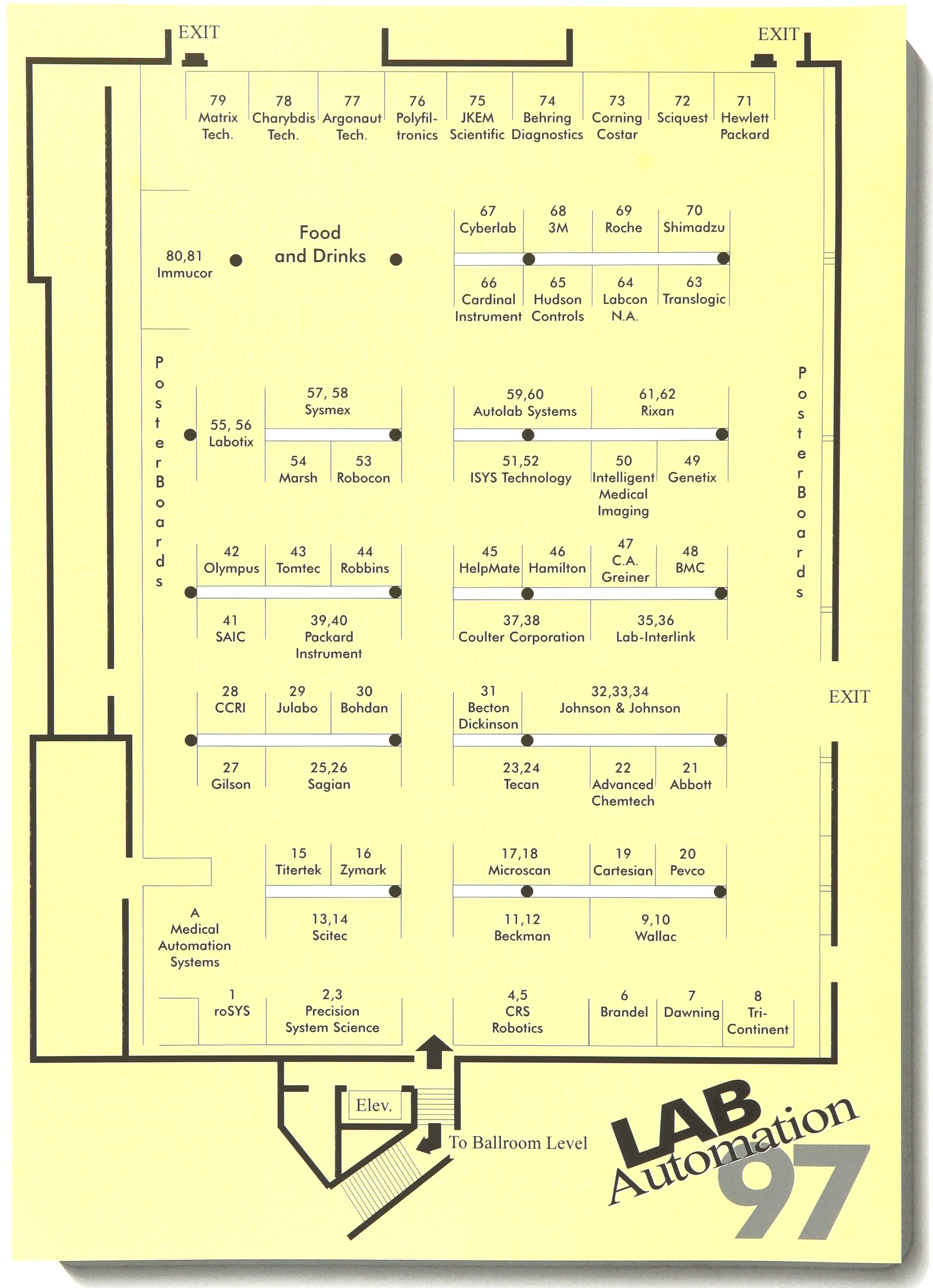
EXHIBITORS
3M will showcase the Empore™ High Performance Extraction Disk Cartridges and Plates for high efficiency solid phase extraction. Booth 68
Abbott Diagnostics personnel will be on hand to discuss Abbott's lab automation philosophy. They will also discuss the ability current Abbott instruments have to interface with any LAS vendor. 100 Abbott Park Road, Abbott Park, IL 60064, USA, Tel: (847) 937-9558, Fax: (847) 935-2440. Booth 21
Advanced ChemTech is the recognized leader in automated synthesis technology, pioneering the development of the world's first automated systems for multiple peptide, combinatorial peptide & multiple organic synthesis. Now Advanced ChemTech offers the BenchMark series, the world's first series of systems for combinatorial organic and ultra high throughput organic synthesis. 5609 Fern Valley Road, Louisville, KY 40228, USA, Tel: (502) 969-0000; Fax: (502) 968-1000. Booth 22
American Clinical Laboratory is a tabloid publication that serves the field of clinical testing in the U.S. Subscribers are laboratorians working in independent and hospital laboratories, private laboratories, and physicians offices. The editorial covers a broad range of topics relating to advances in instrumental and diagnostic technology and has a special focus on the interests of laboratory managers. Table
Argonaut Technologies, Inc. believes that you should. “Do the chemistries you design, not those to which you are limited.” The Nautilus 2400 enables the automation of the widest range of chemical synthesis, while maintaining high purity and control through individual temperature regulation and solution / solid phase reactions. ArgoGel is the highest loading commercial resin used for solid phase synthesis. 887 Industrial Rd. Suite G, San Carlos, CA 94070, USA, Tel: (415) 598-1350 X234, Fax: (415) 598-1359. Booth 77
AutoLab Systems provides modular laboratory automation technologies from loading, centrifuging, aliquotting, and sorting. Offering hardware and software technology, as well as process refinement, AutoLab Systems allows you to focus on delivering efficient and cost effective laboratory services - with improved quality and safety. 100 International Blvd., Etobicoke, Ontario M9W 6J6, Canada, Tel: (416) 675-6777, Fax: (416) 213-4086. Booth 59,60
Beckman Instruments, Inc. displays the Biomek Integrated Laboratory Automation System for ELISA applications. This High Throughput Screening (HTS) system can be configured for Receptor Binding and Cell-Based Assays, as well. It is a turnkey solution that combines the Biomek® 2000 Laboratory Automation Workstation with robotics and systems integration expertise of SAGIAN, Inc. Beckman will also show a video highlighting the AccelNet Laboratory Automation Network, which represents the new symbol for laboratory efficiency. It automates the most labor intensive part of any clinical laboratory-sample handling, and combines two SYNCHRON CX7 DELTA clinical analyzers with an automated sample processor and a self-balancing centrifuge 2500 N. Harbor Boulevard, P. O. Box 3100, Fullerton, CA 92834-3100, USA, Tel: (714) 871-4848, Fax: (714) 773-6652. Booth 11,12
Becton Dickinson Vacutainer Systems (BDVS) is the world wide leader in specimen collection and transport devices, BDVS is committed to delivering innovative solutions to challenges in pre-analytical through post-analytical operations, Rooted in BD's excellence as a high volume manufacturer of quality medical devices, these product and service solutions will translate into improvements in safety, work flow, and TAT of clinical information. 1 Becton Drive, Franklin Lakes, NJ 07417, USA, Tel: (201) 847-4598, Fax: (201) 847-4862. Booth 31
Behring Diagnostics presents a paperless inventory tracking system that improves the efficiency of your laboratory by automatically tracking patient reportable results. The Behring Universal Interface provides a cost-per-reportable program so that your laboratory pays only for the number of patient results you report, not the amount of reagents that are in your inventory. P.O.B. 49013Y MIS El-228, San Jose, CA 95161-9013, USA, Tel: (800) 227-9948, Fax: (408) 239-2206. Booth 74
Boehringer Mannheim Corporation, Inc. (BMC), the world leader in total laboratory integration, invites you to explore our wide range of options to meet your reengineering needs. From simple robotics to comprehensive workstation consolidation and integration, BMC will partner with you to determine the best fit for your business. 9115 Hague Road, Indianapolis, IN 46256, USA, Tel: (317) 845-7071, Fax: (317) 845-7129. Booth 48
Bohdan Automation, Inc. will display Automated Laboratory Workstation Solutions for Sample Preparation. Workstations to be displayed include an Automated Organic Synthesis Workstation, Dilution Workstation, Chromatography Sample Preparation Workstation, Capping/Decapping Workstation with optional Bar-Code Labelling, and an Automated Weighing Workstation. Representatives will be on hand to discuss your particular sample handling needs in areas including solid-phase extraction, filtration, powder dispensing, pH measurement, liquid dispensing, and many other common laboratory practices. 1500 McCormick Boulevard, Mundelein, Illinois 60060, USA, Tel: (847) 680-3939, Fax: (847) 680-1199. Booth 30
Brandel is exhibiting its fully robotic harvesting system and high-capacity plate carousels. Further, Brandel is able to integrate your equipment into a fully robotic workstation and provide any ancillary equipment your workstation may require. All Brandel systems are available with machine vision to monitor your samples through every step. 8561 Atlas Drive, Gaithersburg, MD 20877, Tel: (301) 948-6506, Fax: (301) 869-5570. Booth 6
California Computer Research, Inc., will display the CCRI RoboCart which is used for material transfer in a hospital environment. The task of moving material around the laboratories occupies 25−35% of a technologist's time. Designed to increase productivity, the RoboCart transports materials to and from various locations. P.O. Box 1772, Lake Arrowhead, CA 92352, USA, Tel: (909) 336-5000, Fax: (909) 336-4367. Booth 28
Cardinal Instrument Company will display the Autochem® Workstation which easily integrates the instruments and computer systems in your laboratory. The powerful Prep Ware software makes processing laboratory methods fast and easy. First rate results are achieved without extensive product training. Methods can be easily moved from any Windows workstation to another and it can even be programmed off-line. Application chemists are available at the exhibit. 901 Canal Street, Suite 1205, Bristol, PA 19007, USA, Tel: (215) 781-2232, Fax: (215) 781-2247. Booth 66
Cartesian Engineering will be demonstrating the A/D3000 sub-microliter dispensing system. This System can aspirate a programmed amount of fluid (as low as 100 nanoliters) and quantitatively dispense onto target substrates. Drop volumes as low as 8 nanoliters can be dispensed in lines or dot arrays. Multiple head arrays are also available 17781 Sky Park Circle, Irvine, CA 92714, Tel: 714-440-3680, Fax: 714-440-3694. Booth 19
Charybdis Technologies, Inc. will debut the Calypso System for high throughput organic synthesis. Featuring the Calypso 96 Reaction Block which utilizes disposable microplate technology, the Calypso System provides an economical solution for rapid chemical discovery Calypso is a versatile platform capable of solution/solid phase synthesis, controlled reaction conditions, and is adaptable to integrated automation. 2131 Palomar Airport Rd. Suite 300, Carlsbad, CA 92009, tel: 619.431.5160, fax: 619.431.5163. Booth 78
Corning Costar Corporation will be exhibiting a complete line of plastic laboratory ware for the Life Science Market. Featured will be new and innovative products for use in the areas of Cell Culture, Assay, Molecular Biology, Liquid Handling and Laboratory Filtration. In addition, Coming Costar will feature products for use in the High Throughput Screening environment. Booth 73
Coulter Corporation is the worldwide leader in total laboratory automation. Coulter designs flexible systems to meet the needs of laboratories of all sizes. Functions include, sorting, self balancing centrifugation, decapping, serum measurement, aliquoting, secondary tube labeling, recapping, positive sample tracking, analyzer loading, refrigerated storage, reflex testing, and sample retrieval. 11800 S.W. 147th Avenue, P.O. Box 169015, Miami, FL 33116-2500, Tel: 1-800 944-3333 Fax: (305) 380-5177. Booth 37,38
CRS Robotics Corporation is fully integrated, ISO 9001 certified supplier of robots and turnkey robot systems which automate a variety of processes in the drug discovery laboratory (automated storage and retrieval, combinatorial chemistry, compound dissolution and high throughput screening), the food quality control laboratory and the clinical laboratory. 5344 John Lucas Drive, Burlington, Ontario, L7L 6A6, Canada, Tel: (905) 332-2000, Fax: (905) 332-1114. Booth 4,5
Cyberlab sells robotic workstations for sample preparation and liquid handling, among other uses. The patented Cyberlab design features up to 5 Z-axis tools. The working surface can include stations for bar code reading, bar code labeling, uncapping/recapping, mixing heating, cooling, plate reading, etc. Applications programs are easily written for specific methods and protocols. Cyberlab has standard workstations for microwell plate handling, urine pipetting and protein crystallization, to name a few. 36 Del Mar Drive, Brookfield, CT 06804, USA, Tel: (203) 740-3565, Fax:(203)740-3566. Booth 67
Dawning Technologies, Inc. provides interface components and systems. The Dawning software library currently boasts more than 300 applications. Dawning will feature current interface products, and introduce a new interface product capable of secure encrypted interface communications to an interconnected device over public and private networks. 409 Mason Road, Fairport, NY, 14450-9542, USA, Tel: (716) 223-6006, Fax: (716) 223-8615. Booth 7
Genetix provides hardware and consumables for high throughput genome research including the Q-Bot-a colony picking and gridding robot, the Q Fill-2™ 384-well/96 plate filler and 384 well plates and systems. Booth 49
Gilson will exhibit their Model 215 Liquid Handler for automation of sample handling procedures to improve accuracy and increase throughput over manual techniques. Fully, programmable, the 215 is easily adaptable to a wide variety of applications in pharmaceutical high throughput screening, clinical laboratory medicine, combinatorial chemistry, and environmental analysis. 3000 W. Beltline Hwy., P. O. Box 620027, Middleton, WI 53562, USA, Tel: (800) 445-7661, Fax: (608) 831-4451. Booth 27
C. A. Greiner und Söhne, GmbH manufactures an extensive line of high quality products for automated systems and robotics in the clinical and research laboratories. Greiner will exhibit Vacuette®-evacuated blood collection system, EasyLoad® pipette refill system, disposable and conductive tips, Microtiter plates, 384-well plates and Thermoquick PCR plates. Bad Haller Str. 32, Kremsmünster, Austria A-45502, Tel: (43) 7583-6791, Fax: (43) 7583-6318. Booth 47
Hamilton Company will demonstrate the fully automated microplate processor, Microlab F.A.M.E. and the ultra low volume, high throughput pipettor, Microlab Low Volume MPH. Information on these products and other robotic microplate and solid phase extraction instrumentation will be available. P.O. Box 10030, Reno, NE 89520-0012, USA, Tel: (702) 858 3000, Fax: (702) 856 3227. Booth 46
HelpMate Robotics Inc. will display the HelpMate, a trackless robotic courier designed to perform material transport tasks throughout the hospital environment. Available on a rental basis, HelpMate can be put to work immediately improving productivity while at the same time reducing your operating costs. Shelter Rock Lane, Danbury, CT 06810, USA, Tel: (800) 733-4872, Fax (203) 791-1082. Booth 45
Hewlett Packard will display the Hewlett Packard PrepStation System. Hewlett Packard Company, 2850 Centerville Road, Wilmington, DE 19808, Tel: 302-633-8264, Fax: 302-633-8916. Booth 71
Hudson Control Group, Inc. is a leading supplier of automated products and integrated automation systems using highly reliable industrial quality robots in pharmaceutical and chemical laboratory applications. Hudson's workcell control software, Total Control® for Windows® (TCW) enables a user to control and monitor the operations of every device and instrument in a workcell with one computer. TCW's multi-tasking capability supports simultaneous dispensing, pipetting, vortexing, centrifuging and other processes along with real time sample tracking and data management required in all sample preparation and screening procedures. 44 Commerce Street, Springfield, NJ 07081, USA, Tel: (201) 376 7400, Fax: (201) 376 8265. Booth 65
Immucor, Inc. markets a complete family of automated, walkaway systems for hospital blood banks, reference laboratories, and donor centers. The AB2000 and ABSHV utilize Immucor's patented Capture® technology to perform antibody screen, RBC crossmatch, platelet screening/cross match, CMV, syphilis, and ABO/Rh. 3130 Gateway Drive, P.O. Box 5625, Norcross, GA 30091, USA, Tel: 800-829-2553, Fax: 770 441-3807. Booth 80-81
Intelligent Medical Imaging Inc. will be highlighting the latest version of the MICRO21 automated walk away microscopy system designed to provide improved image quality, faster sample processing and increased flexibility of the user interface and hardware options. The combination of state-of-the-art imaging hardware technology and enhanced software algorithms has led to major image quality refinements. 4360 Northdale Blvd., Palm Beach Gardens, FL, 33410, USA, Tel: (561) 627-0344, Fax: (561) 627-0409. Booth 50
ISYS/Biovation is now beta-testing a revolutionary Laboratory Operating System and API called Messenger®. Messenger® is a fully CORBA and OLE compliant implementation of HL7 and all relevant ASTM standards. All Messenger® data access will be implemented using SQL. The result of our strict design initiative to comply with all relevant standards has resulted in an open system which scales in both size and price, and embraces almost all third party ancillary and robotic systems. Messenger® supports multiple facilities and has the most robust security architecture available today. Additionally Messenger® is being developed in accordance with FDA and GMP. 40 Vreeland Ave., Totowa, NJ 07512, USA, Tel: (201) 256 5858, Fax: (201) 256-5506. Booth 51-52
J-KEM will be introducing a line of custom robotic work stations starting at $10,000. J-KEM is a manufacturer of combinatorial synthesis equipment including programmable syringe pumps, heated reaction blocks which heat (or cool) and stir 100 reactions in parallel. Data acquisition system logs 96 sensors to computer hard drive. Digital temperature controllers regulate the temperature of any volume or instrument to 0.1 C. 6970 Olive Blvd., St. Louis, MO 63130, USA, Tel: (314) 863-5536, Fax: (314) 863-6070. Booth 75
Johnson & Johnson Clinical Diagnostics will showcase how VITROS Chemistry and Immunodiagnostic Systems can fit into your lab automation strategy. VITROS Systems feature direct sampling and open architecture providing maximum flexibility to interface with any major automation vendor. 100 Indigo Creek Drive, Rochester, NY 14650, USA. Tel: (800) 555-5234, Fax: (716) 543-3537. Booth 32-34
John Wiley & Sons is a publisher of quality chemistry educational materials, professional references, and journals. Titles on display include the Laboratory Robotics and Automation journal. The journal covers the latest developments in the automation of analytical, environmental, synthetic, and clinical laboratories. Also on display will be the books in the Wiley Series in Laboratory Automation, including Laboratory Scientific Computing, by Joe Liscouski; Handbook of Clinical Automation, Robotics, and Optimization, edited by Gerald J. Kost; and information about ordering the upcoming book, Automation Technologies for Genome Characterization, edited by Tony Beugelsdijk. 605 Third Avenue, New York, NY 10158-0012, USA, Tel: (212) 850-6505, Fax: (212) 850-6264. Table
Julabo USA, Inc. will exhibit its full line of “TopTech,” “HighTech,” and “LowCost” series of heating and refrigerated circulators. The product lines offers modern features designed to make work easier while maintaining the highest standards of quality and performance. Units cover temperature ranges of −90 C to +350 C, and are suitable for all constant temperature applications. 600 D Noble Street, Kutztown, PA 19530, USA, Tel: (610) 683-6310, Fax: (610) 683-6316. Booth 29
Labcon will display a family of disposable pipet tips in cartridges for automated liquid handling stations as well as methods to quickly re-load pipet tip racks. Also being shown are new methods to deliver pre-loaded pipet tip racks to automated pipettors. Labcon, North America, 700 Du Bois Street, San Rafael, CA 94901, (415) 456-2815, 1-800-227-1466, Fax: 415-457-7041. Booth 64
LAB-Interlink, Inc. offers a comprehensive automation solution for the clinical laboratory. We develop, install and support Specimen Transportation Systems, Automated WorkCells, Expert Software Systems and system interfaces to most instruments and major LIS providers. Our transportation system is installed overhead, out of the way, and requires virtually no structural modifications to your laboratory. Our LAB-Frame(r) Product Line provides you with the flexibility to automate the entire laboratory or one section at a time, we offer custom systems and islands of automation. As part of our service we have developed a computer simulation model. This very comprehensive study allows you to evaluate Laboratory Automation by WorkCell and will assist you in making valuable purchase decisions to avoid costly mistakes. 1011 S. Saddle Creek Rd., Omaha, NE 68106, USA, Tel: (402) 595-3767, Fax: (402) 595-2951. Booth 35,36
Labotix manufactures pre and post analytical specimen tube automation modules for clinical laboratories. These stand-alone automated workstations include specimen transportation, routing and sorting, aliquoting, robotic centrifuge storage and retrieval and instrument interface (mechanical and software). These integrated modules are a cost-effective solution for laboratories of all sizes. 2015 Fisher Drive, P.O. Box 897, Peterborough, ON K9J 7A2, Canada, Tel: (705) 876-1220, Fax: (705) 876-1499, Booth 55,56
Marsh Biomedical Products, Inc. offers a variety of products intended for the life science research laboratory. We specialize in the design and fabrication of racking and storage systems. We will display a variety of robotics-compatible tube and vial racks. We also will introduce our new 250 ml pipet tip designed for use with 96 well automated liquid handling systems, 565 Blossom Rd., Rochester, NY 14618, USA, Tel: (800) 445-2812 Fax: (716) 6544810. Booth 54
Matrix Technologies Corp.'s unique manual and portable electronic Single and Multi-channel pipettors. An automated pipettor for use with 96 and/or 384 well plates. Sealers, cap mats and various plates and tubes for High Throughput Screening. High quality filter tips. 44 Stedman Street, Lowell, MA 01851, tel: 1-800-345-0206. Booth 79
Medical Automation Systems, Inc. will display the RALS system - the solution for managing critical care testing outside the laboratory. Compatible with a wide range of commercial analyzers, the RALS software system is network based providing the ability to tie multiple sites and analyzers back to the main lab. The system monitors instrument analyses as well as maintenance and QC data, all in real time. Results are automatically uploaded to the patient record in the LIS ensuring complete capture of data. 1224 W. Main Street, Suite 777, Charlottesville, VA 22903, USA, Tel: (804) 971-7953, Fax: (804) 971-7954. Booth A
Microscan Systems, Inc. designs and manufactures laser scanners providing automatic data capture solutions for clinical diagnostic systems and automated laboratory equipment. The company works directly with the OEM modifying Microscan products so that they will accommodate specific application requirements. 1201 SW 7th Street, Renton, WA 98055, USA, Tel: (206) 226-5700, Fax: (206) 226-8250. Booth 17,18
The Packard Instrument Company MultiPROBE® Automated Liquid Handling Systems with VersaTip are capable of automatically changing from fixed, washable sampling tips to a variety of disposable tip sizes or types. Robotic-compatible TopCount® microplate scintillation and luminescence counters analyze up to 12 samples at a time using beta, gamma and luminescence labels in 24-, 96-, and 384-well microplates. The FluoroCount® is the only research grade microplate fluorimeter that provides ultrahigh sensitivity at an affordable price. 800 Research Parkway, Meriden, CT 06450, USA, Tel: (800) 323-1891, Fax: (203) 639-2172. Booth 39,40
PEVCO Systems, Inc. designs, manufactures and services state-of-the-art pneumatic tube transport systems for healthcare. Founded in Baltimore in 1978, the company offers the industry's most technologically advanced and flexible product line, ranging from basic systems to advanced networks, all tailored to meet clients specific needs. 9610 Pulaski Park Drive, Baltimore, MD 21220, USA, Tel: (410) 574-2800, Fax: (410) 574-6377. Booth 20
Polyfiltronics will display intelligent microplates and filter devices. Polyfiltronics, Inc., 100 Weymouth St., Rockland, MA 02370, Tel: 617-878-1133, Fax: 617-878-0822. Booth 76
Precision System Science will display the following products: Compact DNA Sampling System SX-2G, and Robotic Select Dispenser RX-500.341-1, Nakawakura, Matsudo-City, Chiba Pref, Japan 270, Tel: +81 473 49 4004, Fax: +81 473 49 4931. Booth 2,3
Rixan is the North American Distributor of Mitsubishi Robots. These robots are widely used in laboratories to do sample preparation, dissolutions, machine tending and material movement. Programming is simple using Rixan's Roboware® Windows® programming software. Complete robots/parts are in stock along with the industry's best engineering support. 7560 Paragon Road, Dayton, OH 45459, USA, Tel: (937) 222-0011, Fax: (937) 278-1233. Booth 61,62
Robbins Scientific will highlight the Hydra®-96, a high-speed precision 96 channel microdispenser and Plate Positioners for innovative “split well” 384 and 192 CyclePlates® for high throughput PCR and DNA sequencing. Also shown will be the Microscreen® Trays with 50 ul well volume for microvolume assays and microcell culture. 814 San Aleso Avenue, Sunnyvale, CA, USA 94086, Tel: (408) 734-8500, Fax: (408) 734-0300. Booth 44
Robocon presents the Fully Automated Robolab 9600 Microplate Laboratories: Robolab 9600 is directed by an automated scheduler and programmed by an “iconic browser” in Windows. Its work stations for HTS (1000 microplates per week) and combinatorial synthesis include microwave reactors, evaporators, incubators, microplate replicators, filterplate harvesters (receptor binding), microplate centrifuges, pipetting robots, washers, photometers, luminometers, fluorometers and scintillation counters. Geiselbergstrasse 26-32, A-1110 Vienna, Austria, Tel: +43 1 748 1420, Fax.: +43 1 748 1419. Booth 53
Roche Diagnostic Systems is pleased to announce the availability of the COBAS Integra Clinical Laboratory and advanced PCR Systems. The COBAS Integra will be on display featuring a patented internal robotic system that will allow over 100 Chemistry, Drugs of Abuse, TDM, Specific Protein, and Diabetes assays to be performed all on one integrated platform. 1080 US Highway 202, Branchburg, NJ 08876-3771, USA, Tel: (800) 526-1247, Fax: (800)-544-6130. Booth 69
roSYS will exhibit the PLATO series of robotic liquid handling and robotic microplate instruments. The PLATO 3XXX includes modules for positive sample ID, stacker/incubator for up to 30 plates, robotic arm for transfer of plates to/from the worksurface, plate washing/reading and precision sample prep. The PLATO 1000 is designed for lower throughput/price sensitive markets. The PLATO 1000 mimics its senior relative as a complete microplate analyzer. Rosys will also introduce a stand-alone reader, washer, 96-well pipetting station, the ACCESSIONER (serum splitting or aliquotting) and the new Robotic DNA Thermal Cycler for PCR technology. 1309 Veale Road, Suite 21, Wilmington, DE 19810, USA, Tel: (302) 479-5227, Fax: (302) 479 5223. Booth 1
SAGIAN will be showing the ORCA Robot System along with the graphical user interface for Windows 3,x-95 SAMI Software System. 5601 West 74th Street, Indianapolis, IN 46278, USA, Tel: (317) 328-3588 ext 288, Fax: (317) 328-3589. Booth 25,26
SAIC will feature the ALLEKTO line of laboratory automated products for clinical testing, high-throughput screening, DNA preparation for sequencing, and combinatorial chemistry. These high-performance robotic systems use three robust robotic arms and a sophisticated software that allow rapid sample preparation and analysis. 130 Fifth Avenue North, Seattle, WA 96109, USA, Tel: (206) 728-1455, Fax: (206) 728-2440. Booth 41
SciQuest The key feature of the SciQuestSM interactive World Wide Web site is our search engine and SciMail (a smart email system) which saves you time by allowing you to find, qualify, and communicate with multiple vendors in just a few minutes. Our database has over 13,000 domestic and international suppliers of analytical, biotechnology, biomedical, clinical, and critical environment equipment, supplies, software, and other services. Win a SciQuest Hourglass by visiting out booth, and test driving this new exciting productivity tool! PO Box 12156, Research Triangle Park, NC 27709, Tel: 919-786-1770, Fax: 919-782-3123. Booth 72
SCITEC provides laboratory automation and robotic systems including High Throughput Screening and Combinatorial systems for pharmaceutical, chemical, environmental, clinical, food, cosmetic, and biotechnology; CLARA and WinCLARA software tools for design, simulation, scheduling, and management of real-time robotics systems: incubators, plate sealers, harvesters, shakers, filtration units, carousels, and accessories for lab automation. 5161 W. Woodmill Drive, Suite 14, Wilmington, DE 19808, USA, Tel: (302) 998-2280, Fax: (302) 998-2580. Booth 13,14
Shimadzu Scientific Instruments, offers a full line of analytical instrumentation. Our unique fiber optically interfaced HPLC lends itself to laboratory automation by offering features such as robotic autosampling, advanced sample preparation functions, flexibility in sampling from various sources including 2 titre plates (micro or deep well), integrated fraction collection and valving to allow automated switching between analytical and preparative configurations. Inc., 7102 Riverwood Dr., Columbia, MD, 21046, 800-477-1227. Booth 70
Sysmex, a pioneer and leader in clinical automation since 1981, will display a fourth generation integrated system, the SE-Alpha II. Sysmex employs cutting edge technology in each of our automation platforms, and backs up our claims of proven performance with greater than 300 placements worldwide. Gilmer Road 6699 RFD, Long Grove, IL, USA 60047, Tel: (800) 779-7639, Fax: (847) 726-3505. Booth 57,58
Tecan offers laboratory automation solutions such as the Tecan TRAC robotic system with new dynamic scheduling software. The Genesis, with a second arm to move microplates to other devices, provides a flexible standalone workstation solution. Tecan, with several years of liquid handling experience, offers expert system design, implementation and training. Booth 23,24
Titertek Instruments, Inc. will exhibit a variety of equipment for processing microplates and 384 well plates. These include readers, washers and dispensers. All equipment is compatible with the S20 stacker for batch processing of plates. The addition of a robotic arm yields higher throughput. P.O. Box 1799, Huntsville, AL 35807, USA, Tel: (205) 859-8680, Fax: (205) 859-8698. Booth 15
Tomtec will demonstrate the Quadra 422, a 96-well pipetting system with double plate stacking for microplate automation. A new 384-well pipetting system will be demonstrated along with a variety of automated peripherals for high throughput screening. Incubators, Hotel, BarCode Labeler, Plate Sealer, 96-well Harvester. 1010 Sherman Avenue, Hamden, CT 06514, USA, Tel: (203) 281-6790, Fax: (203) 248-5724. Booth 43
TransLogic Corporation designs, manufactures, and installs automated transport systems for laboratory specimens, pharmaceuticals and supplies. The Computerized Tube System (CTS) is used for delivery of laboratory specimens to the testing area and the Electronic Track Vehicle (ETV) is used for delivery of specimen batches within the laboratory. 10825 E. 47th Avenue, Denver, CO 80239, USA, Tel: (800) 525-1841, Fax: (303) 373-7932. Booth 63
Tri-Continent, “World Class Liquid Handling”, presents affordable and complete lines of robotics compatible products for single tube and microplate (96 and 384 well) dispensing, washing and sample handling MultiWash, microplate washers, and BenchMark Series, syringe pumps. All products exhibited are robotics compatible via RS 232. 12555 Loma Rica Drive, Grass Valley, CA 95945, USA, Tel: (916) 274-4291, Fax: (916) 273-2586. Booth 8
Wallac will feature the NEW Victor multilabel counting instrument. The most versatile plate reader available anywhere, Victor allows rapid processing of 24, 48, 96 and 384 well assays and can measure fluorescence, luminescence, colorimetric and DELFIAR applications. Also the Microbeta® TriLux with ParaLux can improve SPA counting efficiency more than 500%. 9238 Gaither Rd., Gaithersburg, MD 20877, USA, Tel: (800) 638-6692, Fax: (301) 963-3200. Booth 9,10
Zymark Corporation will be exhibiting state-of-the-art laboratory automation robotic systems, workstation and software for pharmaceutical, biotechnology and chemical industries. Using video conferencing, the display will feature live demonstrations from Hopkinton, MA. Zymark Center, Hopkinton, MA 01757, USA, Tel: (508) 435-9500, Fax: (508) 435-3439. Booth 16