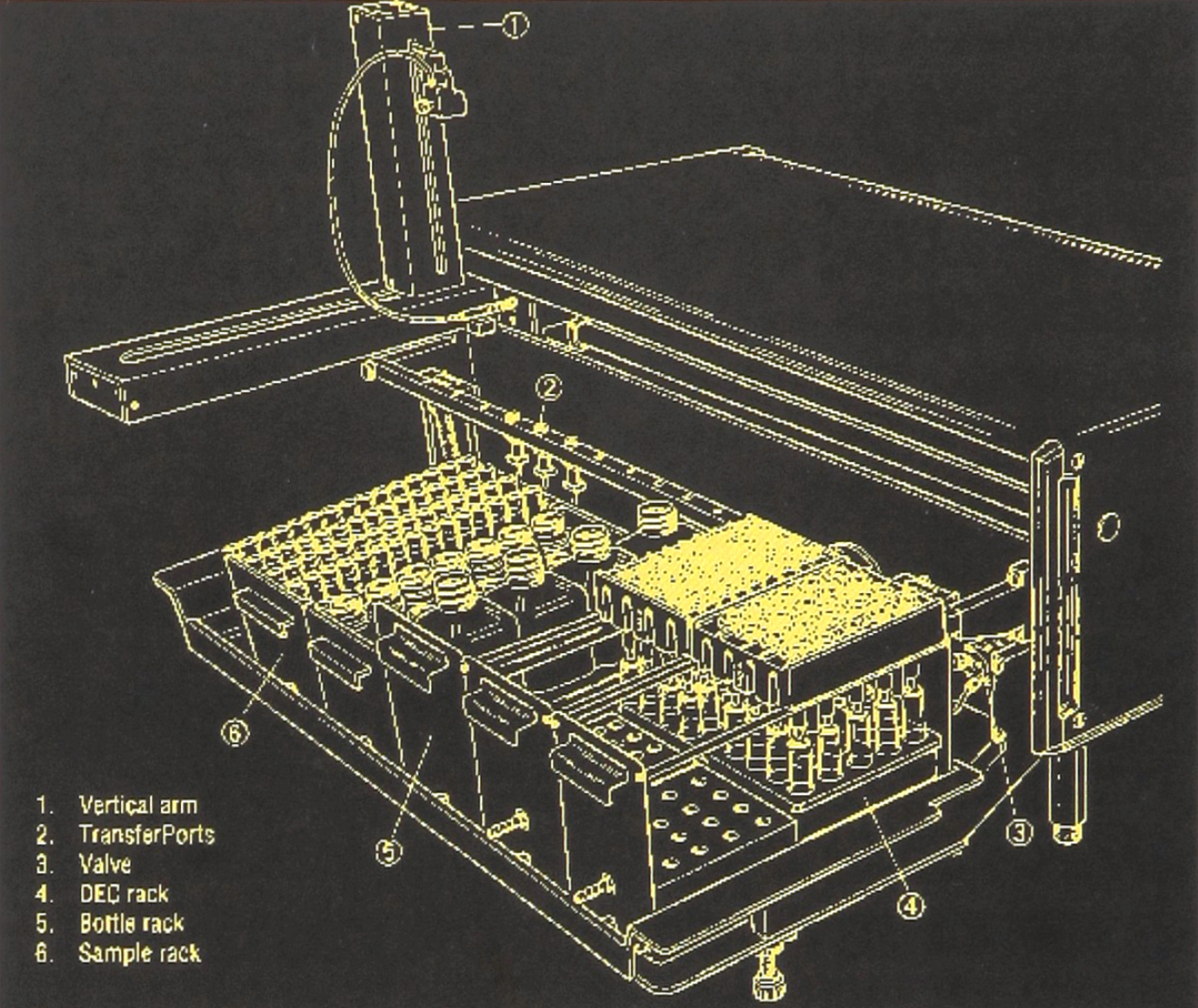
Carryover, contamination, and interference are caused by poor sample preparation, poor solvent handling, or poor HPLC maintenance. Automation, along with GLP compliance, can decrease carryover problems by minimizing sample manipulation. Gilson liquid handlers and sampling injectors are equipped with the following features to minimize carry-over:
Liquid level detection (LLD)
One liquid transfer line
Two needle rinse stations
Automatic needle rinsing
Transfer ports
Needle wiping kit
This report explains each of the above, and details the purpose, design and application considerations of LLD.
Liquid Level Detection
Liquid level detection (LLD) is a feature offered on all XL samplers (221, 222, 231, 232, 233, ASTED™ and ASPEC™), the 215 Liquid Handler and the 223 Sample Changer. LLD minimizes contamination by controlling needle depth below the liquid surface during aspirate and dispense operations.* By controlling the immersion depth of the needle, exposure of the outside of the needle is kept to a minimum, and potential contamination is reduced.
LLD in Gilson samplers operates on the basis of a material's electric conductivity. A LLD cable connects the injector needle to the LLD circuitry in the sampler. The LLD circuit monitors the conductivity of the “liquid” surrounding the needle. When the needle moves from air into a liquid, a signal is sent to the processor that a difference in conductivity has been sensed. The processor then adjusts the vertical speed of the needle as a function of the flowrate and cross-sectional area of the tube to keep the tip of the needle at the user-set distance below the liquid surface (immersion depth) while aspirating or dispensing the desired volume.
The LLD circuit in the XL samplers detects liquids with a dielectric constant greater than 18. Liquids with a higher dielectric constant (for example, most polar and water-soluble solvents) are conductors and so are detectable by LLD. Liquids with a lower dielectric constant are insulators; they have few or no free electrons to support electrostatic stress and thus are not detectable by LLD. Hydrocarbons such as hexane, cyclohexane, benzene and chlorinated solvents such as chloroform and dichloromethane cannot be detected by LLD. Table 1 lists common solvents and their dielectric constant values.
Dielectric Constants of some common solvents:
Compound
ε at 20° C
ε at 25° C
Acetonitrile
38.3
NA
Benzene
2.284
2.274
Carbon Tetrachloride
2.238
2.228
Chlorobenzene
5.708
5.621
Cyclohexane
2.023
2.015
Methanol
33.62
33.63
Nitrobenzene
35.74
34.82
Water
80.37
78.54
Compound
°C
ε
Acetic acid
20
6.15
Acetic anhydride
1
22.0
Acetone
25
20.7
Benzaldehyde
0
19.0
1-Butanol
20
17.8
2-Butanol
25
15.8
2-Butanone
20
18.5
Butyric acid
20
2.97
Chloroform
20
4.806
Dichloromethane
20
9.08
Ethanol
25
24.3
Ethyl acetate
25
6.02
Ethyl ether
20
4.34
Formamide
20
109
Glycerol
25
42.5
Glycol
0
6.32
2-Methyl-1-Propanol
25
17.7
Piperidine
22
5.88
1,2-Propandiol
20
32.0
1,3-Propandiol
20
35.0
1-Propanol
25
20.1
2-Propanol
25
18.3
Pyridine
25
12.3
Triethylamine
25
2.42
Trimethylamine
25
2.44
Toluene
0
2.438
Compiled from the Handbook of Chemistry and Physics; CRC Press, 62nd edition and the Merck Index, eleventh edition.
Liquid level detection is also influenced by environmental factors such as humidity, temperature and electric fields emitted from other instruments. Plus, each sampler contains components which contribute to its specific electrical field. Therefore, LLD can vary from country to country, from building to building, from room to room and from instrument to instrument. So an ASPEC XL set to a LLD sensitivity of 2 may work the same as another ASPEC XL in another lab set to a sensitivity of 4.
Application Considerations
Other instrument features should be optimized for a LLD application
LLD Sensitivity: The sensitivity of the liquid level detection circuit on XL samplers is set on a scale from 1 (the most sensitive) to 9 (the least sensitive). XL samplers are preset to a LLD sensitivity setting of 3, which corresponds to a dielectric constant of approximately 18. If the LLD sensitivity setting is modified and the sampler is “rebooted,” the software defaults to the previously saved sensitivity setting. It is a good idea to double check the LLD setting before running your application. The factory default setting on the 215 and 223 are 6% and 3%, respectively. These settings can be readily changed in the utility programs, set_215.exe and set_223.exe. Lowering the percentage will increase the sensitivity. Raising the percentage will decrease sensitivity, reducing false liquid detection.
Vial Diameter: Vial inner diameter has a marked influence on capacitive level sensing. The smaller the diameter of the vessel, the less the shift in capacitance between the needle and the liquid. On XL samplers, the vial diameter must be measured with an accuracy of one tenth of a millimeter. The needle descends or rises in the vial as a function of the inner diameter of the vial. Gilson recommends using the default values for vial diameter. The % sensitivity setting may need to be decreased on the 215 or 223 when using small diameter vials (less than 13 mm ID).
Immersion Depth: The distance of the needle tip below the surface of the liquid is the immersion depth. Depth settings can be adjusted on all samplers. On XL samplers, depth is defaulted to 2 mm but can be optimized at different settings. A depth setting of 3 or 4 mm is recommended when using a side-entry needle on the 215; use a depth of 2 mm for other types of needles on the 215. Refer to the Gilson 709 Sampler Manager User's Guide for instructions on programming level sensing on the 215 and 223.
Flow Rates: The maximum aspiration flow rates for XL samplers are 7 ml/min for small vials, 10 ml/min for open tubes, and 20 ml/min for 20 ml vials to avoid immersion errors.
Solutions: LLD can be selected within each zone of the XL sampler tray. However, the sensitivity level is set for the complete protocol and is not zone dependent. LLD may work better on some solutions (see Table 1) than others. Consider adding and mixing reagents to sample prior to automation. This will help optimize LLD on each sample, rather than trying to use LLD on every zone.
Sample Vials: Gilson recommends that LLD not be used when piercing sealed vials on XL samplers since matrix clinging to the underside of the septa could lead to a false positive LLD signal. Bubbles on the matrix surface could also result in false positive LLD signals. The 215 is designed to level sense with septa sealed vials. However, occasional false positive LLD has occurred on the 215 with whole blood applications. This is due to occasional clot formation on the underside of the rubber stopper. Some clinical tube manufacturers now make tubes to decrease clot formation at the top of the tube. Tests with the 223 indicate that level sensing can be used with septa sealed 20 ml scintillation vials on a code 24 rack. Water, methanol, 0.25M phosphate buffer and DMSO were all sensed down to 750 ml with a sensitivity setting of 2%.
Solvents: Highly concentrated solutions or aromatic reagents can give a false positive LLD signal. This is due to the concentrated fumes within the solvent bottle void space.
Sample racks: Tests have shown a difference in LLD sensitivity when using polypropylene vs. aluminum racks. Aluminum seems to cast an electrical field while polypropylene racks are inert. For example, the LLD circuit will readily detect 500 μl of liquid in a code 23W rack but will not detect any at a volume less than 2 ml in a code 29 rack.
Insufficient Liquid in a Vial: XL samplers stop running and display the message “Not enough liquid in vial” if the LLD circuit does not detect liquid in a vial. The 215 Liquid Handler and 223 Sample Changer will continue to operate if liquid is not detected. The needle moves to the default height in a vial; if liquid is not detected the message “LLD: Possibly not enough liquid in vial” is sent to the log file and the sampler continues to the next step of the program.
LLD Cable installation
Ensure the cable is in working condition by checking that both ends are secure (refer to drawing). Fully install the coax type connector into the sampler; insert the contact ring within the needle holder and secure the spring connection. Please call the Gilson Service Department for further details or cable replacement. Without LLD, the needle penetrates the liquid until it reaches the bottom of the vial, test tube, or bottle. The outside of the needle becomes coated with liquid as it is lowered into samples or solutions. Depending on the amount of liquid within each container, the needle may become coated at a height greater than the depth of the rinsing well. As the sampler proceeds with the protocol and the needle moves from container to container, cross-contamination can occur. Therefore, it is important to identify the critical steps within each application, utilize the correct hardware, and understand each instrument's capabilities. In addition to using LLD contamination can also be minimized by utilizing the following features of the Gilson samplers.
Transfer Tubing: Samplers move solvents and sample matrix through a needle and transfer tubing. The instrument can be programmed to surround each portion of liquid with air gaps. This prevents dispersion and cross-contamination. Transfer tubing should correspond to the size of the dilutor syringe and is available in a range of volumes from 95 μl to 25 ml.
Rinsing stations: Gilson samplers are configured with one or two rinsing stations. They allow a customer to rinse the inside and outside of the needle separately with solvent from the reservoir or with another solvent from a position in a rack. Rinsing wells for rinsing the outside of the needle on XL samplers are available in 45 and 85 mm sizes for use with 123 and 183 mm vertical arms respectively. Three styles of rinsing stations (deep pocket for non-level sensing, shallow pocket for level sensing applications and flowing rinse) are available on the 215 Liquid Handler.
Needle rinsing: Gilson samplers can be programmed to rinse the needle at any time in the protocol, with user-set volumes. Different combinations of solvents can be used to rinse the needle at flow rates of 0.18 to 96.0ml/min.
‘Rinse Needle’ Task: XL samplers running Version 2.0 or higher of the keypad software (720, 721 and 722) can be configured to automatically rinse the needle between tasks by setting a ‘Rinsing Volume’ within the CONFIGURATION menu. When the automatic rinse is not used, the user must set up the ‘Rinse Needle’ task to rinse the inside and outside of the needle between critical aspiration steps. The ‘Rinse Needle’ task is performed by washing the inside of the needle first. The needle then descends into the rinsing well to rinse the outside of the needle. The following tasks can be set up to rinse the outside of the needle first:
RINSE NEEDLE: Inside 0.0 μl; Outside 500 μl
RINSE NEEDLE: Inside 500 μl: Outside 0.0 μl
(Note: The 85 mm rinsing well has a volume of 1.25ml; the outside of the needle must be rinsed with a minimum of 1.50 ml to completely clean it. The 45 mm rinsing well has a volume of 0.40 ml; the minimum outside needle rinse volume is 0.70ml.)
Reservoir: Does the reservoir solution thoroughly clean the needle? Test the solubility of the analyte and other solutions in reservoir solvent. Using a test tube for each analyte, matrix and solvent, pour a small amount of the reservoir solution into each tube. If the analyte does not dissolve, if the matrix precipitates, or if the solvents are immiscible, a use a different solvent to thoroughly clean the needle.
Transfer ports: Minimize carry-over on the outside of the needle by aspirating solvents through transfer ports. These ports are mounted on the injection port bar and act as miniature inlet valves to access solvents located off the sampler tray.
Needle wiping kit: A needle wiping kit is available for rack codes 21, 28 and 29. The principle is very simple. Holders suspend two pieces of filter paper above the test tubes. As the needle descends into each test tube the outside is wiped clean. After the liquid has been aspirated, the needle is extracted, and wiped again with filter paper.
Footnotes
*
The sampler has a circuit board in it which contains an oscillator circuit. This oscillator generates a stream of pulses at a frequency which is affected by the total capacitance of the liquid handling needle. When the needle makes contact with a conductive liquid, a change in frequency occurs.