



Abstract
This paper presents a Shapes Constraint Language (SHACL)-based framework for validating the Time Ontology (https://www.w3.org/TR/owl-time). The Time Ontology, currently a W3C Candidate Recommendation, is widely recognized as the ‘de facto’ standard for representing temporal data in the Semantic Web. However, its current OWL axiomatization cannot enforce several validation constraints on temporal knowledge that can be expressed using the Time Ontology vocabulary. These constraints are instead captured by the SHACL formalization proposed in this paper. Nevertheless, we show that SHACL shapes are insufficient to validate even simple knowledge graphs that can be encoded using this vocabulary. This limitation arises because validation must be performed on the inferred knowledge graph, which SHACL shapes alone cannot derive internally. To address this, our framework first computes the inferred knowledge graph using SHACL-SPARQL rules and then validates it through SHACL shapes. We argue that our findings extend beyond the Time Ontology and have broader implications for SHACL and knowledge graph reasoning. We therefore view our work as a call to action for the Semantic Web community to systematically investigate the interplay between validation and inference. Specifically, there is a need to study the representational requirements of different use cases to identify the minimal set of SHACL shapes and inference rules for data validation in each context. These efforts could ultimately lead to the definition of distinct SHACL dialects, analogous to how OWL Lite, OWL DL, and other profiles were defined for OWL. The shapes and rules that define the proposed framework are available at https://github.com/liviorobaldo/TimeOntologyInSHACL.
Keywords
Introduction
Time is a fundamental aspect of reality and the representation of dynamic phenomena. These appear in many application domains, for example, planning, robotics, compliance checking, real-time systems, computer aided engineering, and any other application that requires to model actions, changes, or behaviours.
There are various aspects of time that need to be taken into account when providing definitions of temporal elements (Ermolayev et al., 2014): Time can be bounded or not, discrete or continuous, fuzzy or non-fuzzy, periodic, absolute or relative, linear or branching. In addition, temporal representations can be focussed on points or intervals, which in turn can be crisp or fuzzy, bounded or unbounded, convex or non-convex, open or closed.
These aspects have been extensively studied over the past decades in the literature on Temporal Logics (Gabbay et al., 1994, 2000; Shoham, 1987), and widely applied to tasks such as modelling the behaviour and properties of state transition systems (e.g., model checking) (Rozier, 2011). This has led to the development of model checkers such as NuSMV (Cavada et al., 2014; Cimatti et al., 2002), among others.
The Semantic Web also requires an explicit representation of time (Antoniou & Van Harmelen, 2004). Its standards are grounded in the Resource Description Framework (RDF) (Manola et al., 2004), which provides a basis for representing interconnected data on the Web. However, RDF is only a data model, not a full logical language, as it lacks inference rules for deriving new triples from the asserted ones. To address this, several languages have been proposed, beginning with RDF Schema (RDFS), which introduces basic inference rules, for example to support is-a reasoning. The most widely used language for inference over RDF knowledge graphs is the Web Ontology Language (OWL) (McGuinness & Van Harmelen, 2004), rooted in Description Logics (Baader et al., 2017). Among its variants, OWL 2 (Hitzler et al., 2009) has become the most widely adopted.
Some proposals for extending Description Logics and OWL with the expressiveness of Temporal Logics have been investigated, although they have not been incorporated into the family of Semantic Web standards. For instance, Lutz et al. (2008) and Artale and Franconi (2000) provide surveys of Temporal Description Logics as a formal approach for representing time in Description Logics. Along these lines, Artale et al. (2013) proposed an extension of OWL2-QL for ontology-based data access. Nevertheless, these and other similar initiatives have only been developed at the theoretical level, with the primary aim of addressing computational complexity and decidability issues, and they lack implementations.
More recently, the Semantic Web community has also emphasized the importance of distinguishing between validation and inference in knowledge graphs. Inference languages such as OWL and its extensions primarily focus on deriving new facts and checking logical consistency, whereas validation serves a broader purpose. Validation goes beyond detecting contradictions: It also enforces data quality, integrity, and domain-specific constraints that are not captured by purely logical reasoning. Formally, validation is the process of ensuring that the data in a knowledge graph complies with expected rules, formats, or external requirements. Its goal is to verify that each data element satisfies predefined criteria, such as schema constraints, datatypes, or permitted values, thereby ensuring that the data is accurate and well-formed according to the given specifications.
Logical consistency, by contrast, addresses a narrower concern: Verifying that all facts in the knowledge graph do not contradict one another under the semantics of the chosen logical formalism. In this sense, logical consistency can be regarded as a specific type of validation, under the (reasonable) assumption that anything inconsistent is also invalid. Nevertheless, although this assumption is indeed reasonable in many use cases, it should also be noted that the explicit representation of inconsistencies, fallacies, and other abnormalities, fit to reason about them, has been identified as a critical gap in current logical frameworks for Artificial Intelligence (Steen & Benzmuller, 2024). A recent RDF-based proposal in this direction is Robaldo and Pozzato (2025), which introduces a novel deontic logic encoded in RDF and SPARQL, where inconsistencies, conflicts, violations, and other abnormalities are explicitly represented and may therefore exist within the knowledge graph. In other words, in Robaldo and Pozzato (2025), inconsistent knowledge graphs are not invalid.
To address the recognized need for validation in knowledge graphs, which goes beyond merely checking for inconsistencies, the Shapes Constraint Language (SHACL) was released in 2017 as a W3C Recommendation (Knublauch & Kontokostas, 2017).
SHACL consists of two main components: SHACL Core 1 and SHACL-SPARQL. 2 SHACL Core defines a standard set of built-in constraints for validating RDF data, including predefined constraint types such as cardinality, value ranges, and datatype restrictions. SHACL-SPARQL extends SHACL Core by allowing users to define custom constraints through SPARQL queries. By leveraging SPARQL, it offers greater flexibility and expressiveness, enabling the definition of more complex validation rules.
Since its release, SHACL adoption has steadily increased in both academia and industry (see Pareti & Konstantinidis, 2021 for an overview). The literature includes several foundational works that propose formal semantics for SHACL (e.g., Bogaerts et al., 2022), also addressing recursive SHACL shapes; these are shapes that may reference themselves, possibly through cycles involving multiple shapes, which can in principle lead to infinite loops during validation (Andresel et al., 2020; Corman et al., 2018). These theoretical works primarily focus on SHACL Core; however, as we show below, SHACL Core alone is not sufficient to represent several validation constraints that require the additional expressivity of SHACL-SPARQL.
More recent studies have explored practical applications of SHACL in applicative scenarios with potential industrial relevance (Anim et al., 2024; Ferranti et al., 2024; Robaldo, 2021; Şimşek et al., 2020). This paper further contributes to this growing body of work, particularly to the strand concerned with the applicative uses of SHACL.
This paper focusses on the validation of the Time Ontology 3 as a case study for SHACL. Currently a W3C Candidate Recommendation Draft, the Time Ontology is widely regarded as a ‘de facto’ standard to represent temporal knowledge in the Semantic Web. Several ontologies in different domains import the Time Ontology to model time. 4
The vocabulary of the Time Ontology provides RDF resources for representing both the quantitative and qualitative aspects of temporal instants and intervals across a variety of reference systems, including the standard Gregorian calendar, non-Gregorian calendars, Unix time, and geologic time (Cox, 2016). Notably, the Time Ontology includes properties corresponding to the well-known 13 basic Allen temporal relations (Allen, 1984). However, the full version of Allen’s interval algebra is not currently covered by the ontology. The complete algebra also supports vectors of these 13 relations (Vilain et al., 1990), which enable the expression of more complex temporal constraints. Nonetheless, the current Time Ontology vocabulary does not provide RDF resources for representing such vectors.
The Time Ontology is currently implemented in OWL 2 DL. However, its existing OWL axioms support only a limited set of consistency checks, most of which are not directly relevant for temporal reasoning. As a result, it is currently possible to encode clearly nonsensical temporal data, such as intervals that end before they start. The OWL axioms in the Time Ontology cannot detect these cases as logically inconsistent or, more generally, as invalid, which considerably limits the ontology’s practical utility in real-world applications.
This paper presents a set of SHACL shapes to validate the RDF resources in the Time Ontology. However, we do not consider all RDF resources within the Time Ontology, but instead focus on a specific fragment, discussed below in Section 3: The fragment of the ontology related to the xsd:dateTime datatype. This is the single datatype for which SPARQL v1.1 defines operators for comparison. 5
This paper also demonstrates that SHACL shapes alone are insufficient to validate certain RDF knowledge graphs, even when only a few of the Time Ontology’s RDF resources are employed. While we illustrate this point using the fragment of the Time Ontology discussed below in Section 3, it seems apparent that the implications are broader: If SHACL shapes cannot adequately validate relatively simple knowledge graphs built with the Time Ontology vocabulary, similar limitations can reasonably be expected in more complex cases.
To detect the identified invalid knowledge graphs, it is necessary to infer specific additional triples from the explicitly asserted ones. These triples cannot be derived internally by SHACL shapes. Once the inferred triples are available, SHACL shapes can then be used to identify invalid patterns within the inferred knowledge graph. In this sense, the inferred triples serve as ‘intermediate results’ required for the final validation, which cannot be accomplished by SHACL shapes in a single step.
In principle, the inferred knowledge graph could be computed using OWL or any other formalism designed for inference over knowledge graphs, such as Semantic Web Rule Language (SWRL) (Horrocks et al., 2004). However, in this paper, we chose to use SHACL rules, as defined in the W3C Working Group Note of 8 June 2017. 6
Specifically, we used SHACL-SPARQL rules, 7 which are also based on SPARQL and thus appear to be the natural choice for this task because they integrate seamlessly with SHACL-SPARQL shapes: Both rely on SPARQL, with inference rules expressed as CONSTRUCT-WHERE queries to generate inferred triples, and shapes expressed as SELECT-WHERE queries to identify invalid patterns.
Using alternative logical formalisms, such as OWL or SWRL, would, in our view, hinder comprehension and make editing and debugging more cumbersome, without offering any significant benefit. In addition, as will be discussed below, it remains unclear whether OWL or other formalisms have sufficient expressivity to represent the same inference rules that we can implemented using SHACL-SPARQL.
Similar to standard OWL reasoners such as HermiT (Glimm et al., 2014), which repeatedly apply OWL axioms until no further triples can be inferred, our approach also iteratively applies SHACL-SPARQL rules until the inferred graph reaches closure, prior to validation. This iterative process is not prescribed in the aforementioned Working Group Note, nor is it implemented in existing SHACL libraries such as the TopBraid SHACL Java library v.1.3.2, 8 which we used in our implementation. These libraries execute SHACL rules only once. Consequently, the software available on our GitHub repository programmatically re-executes the SHACL-SPARQL rules until no new triples are produced, and then validates the resulting knowledge graph against the SHACL shapes. We believe this two-step approach should be adopted by any software for validating knowledge graphs using SHACL. In other words, what our implementation currently achieves programmatically should, in our view, be formalized and standardized by the W3C.
The rest of the paper is organized as follows. The next section provides a brief review of the literature on representing time in the Semantic Web. Section 3 is then dedicated to the Time Ontology, focussing specifically on the fragment relevant to our proposed formalization, namely the RDF resources associated with the xsd:dateTime datatype. Section 4 presents the semantic characterization of the Time Ontology, as originally proposed by its proponents and initial editors, Jerry R. Hobbs and Feng Pan, and axiomatized in first-order logic in Hobbs and Pan (2004). While we base our discussion on their work, we do not follow their axiomatization strictly, as we disagree with some of its technical choices. This section also explains the rationale behind our decisions and introduces the variant of Hobbs and Pan (2004)’s axiomatization that we adopt in this work.
Sections 5 and 7 form the core of this paper. The former demonstrates that SHACL shapes alone are insufficient to detect even some simple knowledge graphs that can be constructed with the Time Ontology vocabulary, while the latter presents the SHACL axiomatization corresponding to the first-order logic axiomatization from Section 4. Section 7 discusses possible extensions of both the proposed SHACL axiomatization and the Time Ontology vocabulary, while Section 8 provides broader reflections on the challenges and risks of using SHACL to validate RDF knowledge graphs, based on the lessons learned from our work on the Time Ontology. Finally, Section 9 summarizes the main findings and advocates the definition of distinct SHACL dialects, as mentioned in the abstract.
Background: Representing Temporal Data in the Semantic Web
Time is not inherently integrated into Semantic Web standards, and maintaining compatibility with these standards requires representations that incorporate reasoning rules into existing ontologies, rather than relying on specialized reasoning software. There are two main components for representing time, as needed for application use: The representation of temporal concepts such as time points and intervals. The representation of dynamic properties (fluent properties) of objects and events using the above mentioned temporal concepts.
Core temporal concepts, their properties, and constraints are defined using temporal ontologies, while the application of these properties in specific domains is an orthogonal dimension. Temporal ontologies include definitions of temporal intervals and points, among others, and these definitions can be used to represent temporal properties in various ways, such as through four-dimensional (4D)-fluents or reification.
Although the focus of this paper is on (a), specifically the representation of temporal concepts based on the definitions in the Time Ontology, the next two subsections will briefly survey past literature on representing both aspects of temporal representation in the Semantic Web, that is, (a) and (b) above, respectively.
Time is a fundamental aspect of the world and temporal concepts are involved on almost all knowledge representation tasks since many properties of objects are dynamic. Thus, many temporal ontologies have been proposed in the literature (Ermolayev et al., 2014). Among these, the Time Ontology in OWL, also know as OWL-Time, 9 is the most widely used. A recent survey on the representation and management of temporal data is provided in Wu et al. (2024).
The Time Ontology is a temporal ontology and currently a W3C Candidate Recommendation Draft that provides definitions of temporal points, intervals, and their relationships. Having the status of a W3C candidate recommendation draft, it is widely used, but since the adoption of the Time Ontology as a standard is an ongoing work, several alternative temporal ontologies have also been proposed. Since the essence of the Semantic Web is the definition of common vocabularies, this work focusses on enhancing the Time Ontology thus contributing to the standardization effort rather than proposing yet another temporal ontology.
Other temporal ontologies include Resusable Time Ontology (Fikes & Zhou, 2002), TimeML (Pustejovsky et al., 2005), which offers a translation to DAML-OIL, the predecessor of OWL, GFO-Time (Baumann et al., 2012), which is part of the upper ontology GFO, TOWL (Milea et al., 2011), which extends OWL with temporal constructs but is not compliant with standard Semantic Web tools, and TL-OWL (Kim et al., 2008), which also extends Semantic Web standards with temporal concepts, similarly to OWL-Met (Keberle et al., 2007). In PSI-ULO (Ermolayev et al., 2008b) temporal concepts are part of an upper ontology defined in PSI-Time (Ermolayev et al., 2008a) while in TimeLine ontology (Raimond et al., 2007) definitions for temporal concepts for digital music are provided. Temporal RDF (Gutierrez et al., 2005) proposes extending RDF with temporal annotations while SWRL-Time (O’Connor & Das, 2010), CNTRO (Tao et al., 2010) and SOWL (Batsakis & Petrakis, 2011) define reasoning mechanisms based on SWRL (Horrocks et al., 2004).
This paper proposes using SHACL-SPARQL rules as an alternative to SWRL, OWL, or other logical formalisms for the Semantic Web to enhance the current version of the Time Ontology. As noted in the introduction, SHACL-SPARQL rules were chosen because they integrate seamlessly with SHACL-SPARQL shapes. The potential use of SWRL, OWL, or other formalisms as alternatives warrants further investigation.
While SHACL has been an official W3C recommendation since 2017, 10 neither SWRL nor SHACL-SPARQL rules have (yet?) achieved standard status. In other words, currently both are only proposals for W3C recommendations. SWRL has been a proposal since 2004, 11 while SHACL-SPARQL rules have been a proposal since 2017. 12
Representation of Dynamic/Fluent Properties
Almost all conceivable application domains involve objects with dynamic properties, also known as fluent properties, that change over time. The definitions of the temporal concepts involved (e.g., the temporal instant when an event occurs or the temporal interval during which a dynamic property holds) are provided by temporal ontologies. However, their application in specific domains is not straightforward, as fluent properties are not binary (e.g., they involve a subject, an object, and a temporal instant or interval). As a result, they cannot be directly represented as object or datatype properties of a class, leading to many different approaches in practice for using temporal concepts.
Integrating temporal concepts defined in temporal ontologies with representations of fluent properties in the Semantic Web can be achieved in various ways such as extending repositories with support for ternary relations (Krieger, 2010) (standard RDF is based on triple stores), versioning (Klein et al., 2002), which is based on creating a new copy of the knowledge base when a property is modified, named graphs (Tappolet & Bernstein, 2009), the generic method of reification, and the 4D fluents approach proposed in Welty et al. (2006). Various methods are presented and compared in Batsakis, Petrakis, et al. (2017) and they have been extended to cover spacial properties of objects in Batsakis, Tachmazidis, et al. (2017). The work in Batsakis, Petrakis, et al. (2017) retains compatibility with OWL/RDFS and offers integrated reasoning capabilities which is not the case of other approaches such as versioning and temporal annotated named graphs. Temporal reasoning in Batsakis, Petrakis, et al. (2017), as well as in SWRL-Time (O’Connor & Das, 2010) and CNTRO (Tao et al., 2010), is achieved through SWRL.
In Preventis et al. (2014), the CHRONOS ED tool was proposed, offering enhanced performance compared to the work in Batsakis, Petrakis, et al. (2017). However, this approach was somewhat ad-hoc, as it relied on specialized reasoning software that was compatible with specific ontologies, rather than using generic semantic OWL reasoners such as HermiT (Glimm et al., 2014) or Pellet (Sirin et al., 2007), which limited its overall applicability.
It is important to note that temporal ontologies, which provide definitions for temporal instances and intervals, can be used in the approaches discussed above by importing them into the corresponding formal frameworks. Several alternatives exist for defining temporal concepts, but the Time Ontology has emerged as the ‘de facto’ standard, even though it is not yet an official W3C recommendation. As the most significant proposal in this area, it is the focus of the present work and will be described in more detail in the next section.
The Time Ontology
The Time Ontology is currently a W3C candidate recommendation draft 13 publicly available online and downloadable in Turtle format. Its IRI is ‘http://www.w3.org/2006/time#’; in this paper, as well as in the associated GitHub repository, we will refer to this IRI with the prefix ‘time:’. The version of the Time Ontology used in this paper is the one retrieved on September 10, 2025; of course, subsequent versions of the Time Ontology could not be compatible with the implementation proposed in this paper.
While the full formal definitions of the ontology’s resources (classes, individuals, and properties) are available at the Time Ontology’s homepage, this section will focus on the resources that may be processed via SHACL, namely the ones associated with the xsd:dateTime datatype. As pointed out in the Introduction, xsd:dateTime is the single temporal datatype for which SPARQL 1.1 defines comparison operators, 14 therefore it is the single one for which it is currently possible to assert SHACL shapes and rules. These resources are shown in Figure 1.

Classes and properties of the Time Ontology considered in this paper. This figure is a modified version of the one available at https://www.w3.org/TR/owl-time/#topology (retrieved on September 10, 2025).
The top-level class TemporalEntity has two subclasses: Interval and Instant. Instances of Interval represent temporal entities with duration, bounded by a start and an end specified through hasBeginning and hasEnd. Instances of Instant denote temporal entities with zero duration, conceived as limiting cases of intervals where the start and end coincide. ProperInterval, a subclass of Interval, is defined as an interval whose beginning and end are distinct. ProperInterval and Instant are declared disjoint in the Time Ontology.
Regarding properties, this paper considers a single datatype property, inXSDDateTime, which links instances of Instant to values of the datatype xsd:dateTime. hasBeginning and hasEnd specify the start and end points of temporal entities. inside links intervals to instants that occur properly within them; in other words, the beginning and end instants of an interval are not considered to occur ‘inside’ the interval. equals, after, and before encode temporal orderings between temporal entities: equals connects two temporal entities that start and end at the same time; if a temporal entity comes after another, then the latter precedes the former; if a temporal entity comes before another, then the former precedes the latter.
Finally, the 13 properties shown in Figure 1 within the ProperInterval box correspond to Allen’s temporal relations, each linking a pair of ProperInterval instances. Allen’s temporal algebra (Allen, 1984) is a cornerstone of temporal logic research. However, as noted earlier in the Introduction, the full version of Allen’s algebra is defined over vectors of the basic Allen temporal relations, whereas the current Time Ontology vocabulary can represent only individual relations (i.e., single-element vectors). Extending the ontology to cover the full algebra is a possible direction for future work, but it should be noted that the constraint propagation algorithm introduced by Allen (1984) for computing the closure of the algebra has exponential complexity (Vilain et al., 1990). Consequently, such an extension could result in an ontology that is impractical for real-world applications. To mitigate this issue, several tractable sub-algebras with polynomial-time reasoning have been identified (e.g., Nebel & Bürckert, 1995). More practical extensions of the Time Ontology could therefore restrict their vocabulary to the constructs supported by these sub-algebras.
One of the 13 basic 15 temporal relations in Allen’s temporal algebra is Equal, represented in the Time Ontology by the property intervalEquals. If two intervals are related by Equal, then their beginnings and ends coincide. Six of the remaining relations, namely Before, During, Meets, Starts, Finishes, and Overlaps, are often regarded as the ‘primary’ ones and correspond to the Time Ontology properties intervalBefore, intervalDuring, intervalMeets, intervalStarts, intervalFinishes, and intervalOverlaps, respectively. The other six, that is, After, Contains, MetBy, StartedBy, FinishedBy, and OverlappedBy, are their inverse properties, and are represented in the Time Ontology by the properties intervalAfter, intervalContains, intervalMetBy, intervalStartedBy, intervalFinishedBy, and intervalOverlappedBy.
The definitions of Equal and the six ‘primary’ relations are as follows:

In addition to the RDF resources shown in Figure 1, the Time Ontology includes several RDFS and OWL axioms that define class hierarchies, property domains and ranges, and inverse relationships. The semantics of these axioms is incorporated into the axiomatization proposed in this paper, as explained in the next section. The ontology also contains various owl:allValuesFrom, owl:hasValue, and owl:cardinality restrictions, which are not relevant to temporal modelling and are therefore excluded from consideration in this work.
It should be observed, on the other hand, that when the Time Ontology was originally proposed, about 20 years ago, its proponents and editors, Jerry R. Hobbs and Feng Pan, postulated in Hobbs and Pan (2004) a formal semantics for the ontology in the form of a first-order logic axiomatization establishing a topological ordering among instants and intervals. Most of these first-order logic axioms, however, were never implemented, possibly because it proved difficult to identify the specific RDFS or OWL constructs needed to capture the intended topological ordering.
By contrast, as we will show below, implementing our variant of the first-order logic axioms from Hobbs and Pan (2004) in SHACL is relatively straightforward. As noted earlier, we do not follow Hobbs and Pan’s axiomatization strictly, as we disagree with two of its fundamental technical choices. The next section explains our reasoning and presents the variant of Hobbs and Pan (2004)’s axiomatization that we adopt in this work.
In the previous section, the RDF resources in Figure 1 were described in plain text, along with some of the constraints imposed on them by the RDFS and OWL axioms in the official version of the Time Ontology. In this subsection, we provide a rigorous and comprehensive semantic characterization of these resources by adapting the first-order logic axiomatization originally proposed by Hobbs and Pan (2004).
As noted at the end of the previous section, we disagree with two fundamental technical choices made in Hobbs and Pan (2004). First, Hobbs and Pan (2004) represents infinite intervals as intervals in which either the beginning or the end (or both) is explicitly missing. Second, Hobbs and Pan (2004) does not explicitly encode or axiomatize the relation equals; instead, it uses the operator ‘
Regarding the representation of infinite intervals, Hobbs and Pan (2004) states that ‘a positively infinite interval has no end, and a negatively infinite interval has no beginning’. In other words, Hobbs and Pan (2004) treats infinite intervals as those that never appear as the subject of hasBeginning (so that their beginning is interpreted as
This choice affects the formulation of several axioms in Hobbs and Pan (2004), such as the one defining ProperInterval (here, the symbol ‘

Suppose the knowledge graph only includes the triple ‘T a time:Interval’, corresponding to Interval(T), in first-order logic. Since T’s beginning and end are missing, the axiom in (HobbsAndPanDefinitionOfProperInterval) infers that it is an instance of ProperInterval. That is because the nested universal quantification holds even if the knowledge graph contains no individuals satisfying the universally quantified formula when substituted for the associated variables.
In Hobbs and Pan’s framework, this is correct because if the beginning and end of T are missing, then T is interpreted as the interval
Other axioms from Hobbs and Pan (2004) whose formulation is affected by this technical choice are those defining Allen’s temporal relations. For example, the axiom defining intervalStart:

This axiom stipulates that if intervalStart holds between T1 and T2, then the end of T1 must exist; therefore, it cannot be
We do not endorse (Hobbs & Pan, 2004)’s assumption that if an interval’s endpoints are missing, they should be interpreted as
Indeed, the assumption of treating missing endpoints as infinite is, more broadly, connected to another gap in Hobbs and Pan’s formalization, which we examine in further detail in the next section. In Hobbs and Pan (2004), endpoints cannot be associated with specific values, whereas in the fragment of the Time Ontology shown in Figure 1, the datatype property inXSDDateTime does associate instants with specific xsd:dateTime values. Explicitly representing
The following subsection presents our alternative first-order logic axiomatization for the RDF resources shown in Figure 1. In addition to adhering to the Open World Assumption, as explained above, our first-order logic axiomatization also includes axioms explicitly defining the semantics of equals, which in Hobbs and Pan (2004) is represented using the mathematical operator ‘
A First-Order Logic Axiomatization for the Semantics of the RDF Resources in Figure 1
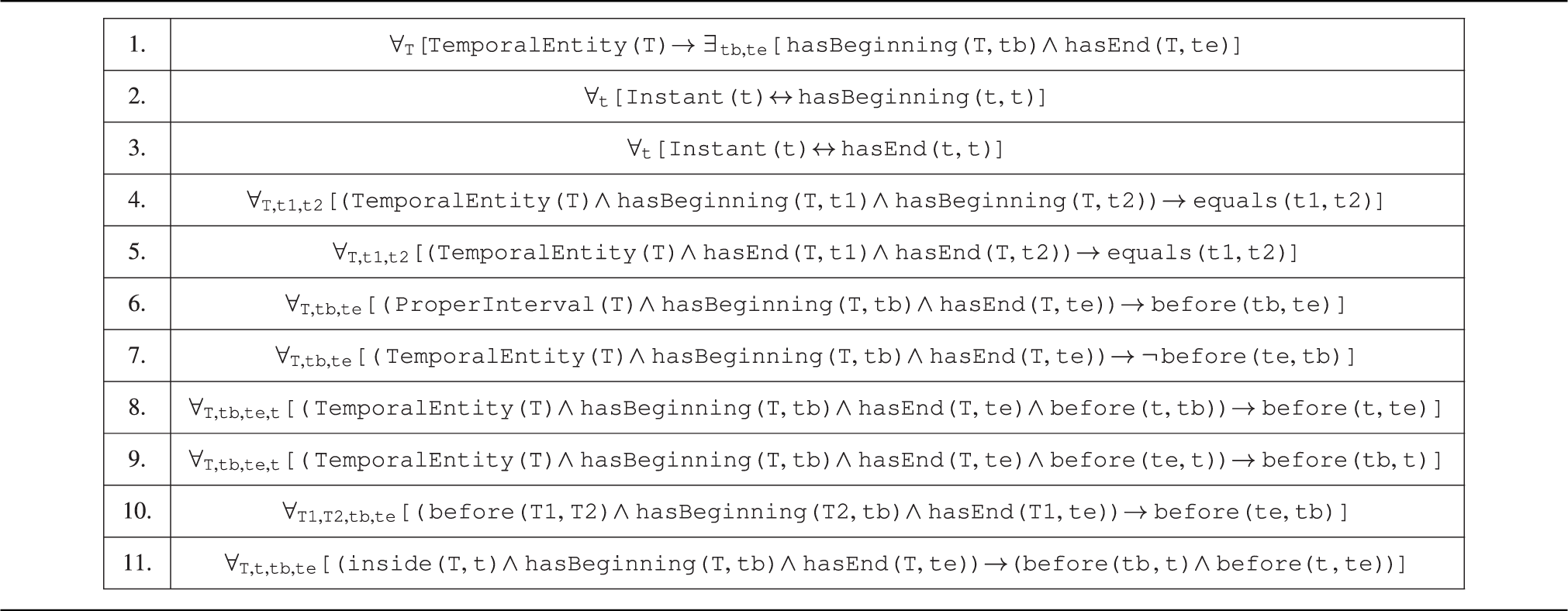
This section presents the first-order logic axiomatization adopted in this paper. We begin with the first-order logic axioms that are formalized as RDFS or OWL axioms in the current official version of the Time Ontology. These are listed in Table 1; for readability, the prefix ‘time:’ has been omitted from the RDF resource names in the table.
First-Order Logic Axioms Implemented as Resource Description Framework Schema (RDFS) and OWL Axioms in the Time Ontology.

First-Order Logic Axioms Implemented as Resource Description Framework Schema (RDFS) and OWL Axioms in the Time Ontology.
The axiomatization in Hobbs and Pan (2004) includes all axioms listed in Table 1, except for 8, 9, and 10, which specify domain and range of the three predicates equals, before, and after. These three predicates are intended to define a basic temporal algebra that closely mirrors those of the familiar mathematical operators ‘
As noted above, Hobbs and Pan (2004) does not use equals but instead the corresponding mathematical operator ‘

However, in our view, this axiom only indirectly encodes the anti-reflexivity of before, which should instead be formalized as in axiom ‘1’ in Table 2: a temporal entity cannot be related to itself via before. The transitivity of before is instead formalized in Hobbs and Pan (2004) as in axiom ‘2’, and we add a corresponding axiom to enforce the transitivity of equals (axiom ‘4’). We chose not to import the axiom from Hobbs and Pan (2004) enforcing before to be anti-symmetric, since this property can now be derived
16
from axioms ‘1’ and ‘2.’. Similarly, we omit an axiom asserting the reflexivity of equals (i.e., that every temporal entity is equal to itself), as it would only introduce unnecessary triples into the knowledge graph. Finally, we add axioms ‘5’–‘8’ to assert that the properties before, hasBeginning, hasEnd, and inside are preserved under substitution of equals in either of their arguments. For example, under the parallel between equals and before with the mathematical operators ‘
The remaining first-order logic axioms defining our semantics are shown in Tables 3 and 4, with the latter specifying the axioms of Allen’s temporal relations.
Axiom ‘1’ in Table 3 represents the key difference between (Hobbs & Pan, 2004)’s axiomatization and the one adopted in this paper. As explained above, in our axiomatization we do not represent infinite endpoints as missing endpoints; instead, we require that every temporal entity always has endpoints. These endpoints can be associated with a specific xsd:dateTime value via the datatype property inXSDDateTime, or with
Axiomatization of before and equals. before is anti-reflexive while equals is symmetric (axioms “1.” and “3.”). Both are transitive (axioms “2.” and “4.”). All properties are preserved under substitution of equals in either argument (axioms “5.”-“8.”).

First-order logic axioms employed in this paper, adapted from [32].
First-Order Logic Axioms Representing the Semantics of intervalEquals and the Six ‘primary’ allen’s Temporal Relations.

Axioms ‘2’–‘5’ in Table 3 are imported from Hobbs and Pan (2004) as they are: If a temporal entity is an instant, its beginning and end are the instant itself; if a temporal entity has multiple beginnings/ends, these beginnings/ends are required to be equal. Axiom ‘6’ is also imported from Hobbs and Pan (2004) as it is: Every proper interval begins before it ends.
Axiom ‘7’, by contrast, is only slightly modified from Hobbs and Pan (2004): In the original, it is defined for the class Interval, but since Interval is not disjoint from Instant (instants are treated in the ontology as intervals of zero duration), we decided to generalize it to the broader class TemporalEntity. Axiom ‘7’ therefore states that a temporal entity cannot end before it begins. In addition, we introduce axioms ‘8’ and ‘9’, which state, respectively, that for every temporal entity with beginning tb and end te, if another temporal entity t occurs before tb, then it also occurs before te; symmetrically, if te occurs before t, then tb also occurs before t. These two axioms are not included in Hobbs and Pan (2004)’s axiomatization; however, as we will show later in Subsection 6.1, they are necessary to detect certain invalid knowledge graphs that are, therefore, not recognized as inconsistent in Hobbs and Pan (2004)’s axiomatization.
Axiom ‘10’ is our variant of the following axiom from Hobbs and Pan (2004):

This axiom states that if two temporal entities are related by the property before, then the beginning of the first entity and the end of the second entity must exist (hence, according to the representational choice in Hobbs and Pan (2004), they are not infinite), and the former occurs before the latter. In our framework, however, the beginning and end of every temporal entity always exist, as guaranteed by axiom ‘1’ in Table 3. Therefore, the existential quantifiers in (5) can be replaced with corresponding universal quantifiers in the antecedent, yielding axiom ‘10’ in Table 3. Finally, the axiom in ‘11.’, for the property inside, is imported from Hobbs and Pan (2004) as it is.
Table 4 presents the final axioms of our first-order logic axiomatization; these axioms define the semantics of the property intervalEquals and the six ‘primary’ Allen temporal relations. All axioms, except the one for intervalBefore, have been modified 17 compared to their formulation in Hobbs and Pan (2004), based on the assumption that every temporal entity always has both endpoints, even if the values of these endpoints may be unknown. Additional axioms, similar to axiom ‘11’ in Table 1, which states that before and after are inverse relations, enforce that intervalAfter is the inverse of intervalBefore, intervalMetBy is the inverse of intervalMeets, and so on; these axioms are omitted from Table 4 for brevity but are available in the GitHub repository.
To summarize, this section has shown that the current version of the Time Ontology implements only a small subset of the original axiomatization defined in Hobbs and Pan (2004). Specifically, while all axioms listed in Table 1 have been implemented as RDFS or OWL axioms, those corresponding to the axioms in Tables 2, 3, and 4 remain unimplemented.
Moreover, it is not immediately clear how the unimplemented axioms from Hobbs and Pan (2004), or their versions in Tables 2, 3, and 4, could be formalized in RDFS or OWL, if at all. This, as noted above, may explain their absence from the current official version of the Time Ontology.
In this paper, we propose formalizing all axioms from the four tables in SHACL; as will be shown below, this translation is both intuitive and straightforward.
Before presenting the SHACL counterparts of the first-order logic axioms in the four tables, however, the next section will illustrate how to associate xsd:dateTime datatypes with instances of the class Instant. Datatypes are essential for practical use, as applications rely on standard types such as integers, strings, or, in the case of the Time Ontology, xsd:dateTime. This is the sole datatype considered in Figure 1; it is associated with instances of Instant through the datatype property inXSDDateTime.
The next section also introduces initial SHACL shapes for validating knowledge graphs involving the inXSDDateTime property. Crucially, it demonstrates that SHACL shapes alone are insufficient for this task. To achieve the intended validations, most of the first-order logic axioms from the four tables will be implemented as SHACL-SPARQL rules in the subsequent sections.
This section focusses on the validation of the datatype property inXSDDateTime, which, as noted at the end of the previous section, enables the use of the Time Ontology in practical applications, which requires working with standard datatypes such as xsd:dateTime, the range of inXSDDateTime.
Therefore, the very first SHACL shape to be imposed is the one in (6), which flags as invalid any object of inXSDDateTime that does not conform to the xsd:dateTime datatype.

Furthermore, since, as mentioned in footnote 14 above, the timezone is optional for xsd:dateTime, for practical reasons we also added the SHACL shape in (7), which requires the objects of inXSDDateTime to specify the timezone. (7) checks whether the timezone is unspecified by using the SHACL Core property sh:pattern. 18

Next, a SHACL shape is introduced to ensure that only a single xsd:dateTime value is assigned to each instant via inXSDDateTime. SHACL Core provides the property sh:maxCount, 19 which allows setting an upper limit on the number of values that can be assigned to an RDF resource. This enables the implementation of the desired shape, as any additional assignments of the property will violate the constraint.

The three SHACL shapes in (6), (7), and (8) are written in SHACL Core. As noted in the introduction, SHACL Core defines a set of built-in constraints for validating RDF data, for example, predefined constraint types such as datatype restrictions and cardinality. However, it lacks the expressiveness required for more advanced validation checks.
One example illustrating the expressivity limitations of SHACL Core is the validation of instants that are associated with specific xsd:dateTime values and are connected via the properties equals, before, or after. For equals, the two xsd:dateTime values must be identical; for before and after, they must respect the corresponding temporal order. For instance, the following triples are invalid:

It is not possible in SHACL Core to verify that the xsd:dateTime values associated with two nodes connected by equals are identical, nor to check the temporal ordering required by before or after. SHACL Core was deliberately designed to support only local constraints on a single focus node. It does not define a general-purpose query language or a graph navigation mechanism for traversing links or comparing values on related nodes. In other words, SHACL Core supports checks only between values of properties defined on the same focus node. 20
In contrast, SHACL-SPARQL can naturally handle such cases. The two SHACL-SPARQL shapes that validate pairs of instants connected by either equals or before and each associated with an xsd:dateTime value via the property inXSDDateTime, are shown in (10). A similar shape can also be defined for after

SHACL-SPARQL shapes incorporate SPARQL queries using the SELECT-WHERE structure. Consequently, these shapes tend to be more verbose than SHACL Core shapes. To enhance readability and maintain focus, we will specify only the four key components of SHACL-SPARQL shapes throughout this paper: sh:target*, SELECT, WHERE, and sh:message. The shapes in the GitHub repository, being executable, are instead provided in full. For example, the shape in (10) will be represented in a more compact form as:

Let us now consider more complex knowledge graphs that also include the properties hasBeginning and hasEnd. These properties have TemporalEntity as their domain and Instant as their range; therefore, any RDF resource occurring as their object can be inferred to be an instance of Instant. Moreover, since Instant is a subclass of TemporalEntity, instances of Instant may themselves occur as subjects of hasBeginning and hasEnd. Thus, we can obtain paths of hasBeginning and hasEnd properties of arbitrary length, that is, chains of instants connected by these two properties. If two of these instants are associated with an xsd:dateTime value, these values must, of course, be identical.
An example of such a chain of instants is shown in Figure 1. The knowledge graph in the figure should be detected as invalid because te1, te2, te3, and te4 are all inferred to be instances of Instant; consequently, te1 and te4 can only be associated with the same xsd:dateTime value, yet in Figure 1 they are not. This validation check can be enforced by the SHACL-SPARQL shape in (12), which is capable, more generally, of detecting paths involving an arbitrary number of hasBeginning and hasEnd properties and ending with an instant associated with an xsd:dateTime value. SPARQL 1.1 provides nine operators for defining regular expressions over properties, known as ‘SPARQL 1.1 Property Paths’. 21 Thus, an arbitrary path of hasBeginning and hasEnd properties ending with an instant associated with an xsd:dateTime value can be represented by the regular expression (time:hasBeginning|time:hasEnd)+/time:inXSDDateTime.

Nevertheless, it was indeed quite straightforward to write a SHACL-SPARQL shape that invalidates knowledge graphs such as the one in Figure 2, that is, graphs that contain only arbitrary paths of hasBeginning and hasEnd properties oriented in the same direction. This ensures that each temporal entity along the path is an instance of Instant, since it occurs as the object of either hasBeginning or hasEnd.

Invalid temporal entities, inferred as instants, connected by a path of hasBeginning and hasEnd properties.
Conversely, let us now consider the pattern in Figure 3, which depicts a knowledge graph containing an arbitrary number of temporal entities connected by a ‘zig-zag’ path of hasEnd properties. By ‘zig-zag’ we mean that the hasEnd properties alternate in direction, that is, they can be traversed both forward and backward along the path. Unlike the previous case, in Figure 3 it is unknown whether all temporal entities along the path are instances of Instant. In particular, we cannot determine whether te3 and te5 are instants, since they occur as the subject of hasEnd rather than as the object, and the domain of hasEnd is the more general class TemporalEntity.

Temporal entities connected by a ‘zig-zag’ path of hasEnd properties. The knowledge graph is invalid only if all entities along the path are instances of Instant.
However, if all temporal entities in the path, including te3 and te5, are indeed instances of Instant, either because this is explicitly asserted or because it can be inferred (for example, from their occurrence as objects of other hasBeginning or hasEnd properties), then the knowledge graph is invalid. In this case, all these instants must share the same xsd:dateTime value, yet in Figure 3 they do not.
It is not possible to define a SHACL-SPARQL shape that detects this invalid pattern for an arbitrary number of nodes using SPARQL 1.1 Property Path operators, even though one such operator (‘^’) allows traversal in the reverse direction. SPARQL 1.1 Property Paths only permit the composition of regular expressions over the properties in the path but do not allow posing additional constraints on the nodes of the path, that is, the RDF resources connected by those properties, which, in the pattern under scrutiny, must all be verified as instances of Instant.
To implement the required validation check, the expressivity of the SPARQL 1.1 Property Path operators would need to be extended to allow constraints to be imposed on the RDF resources traversed by the property path. Such an extension could be considered for future versions of SPARQL.
With the current SPARQL 1.1 recommendation, instead, a practical solution for validating the pattern in Figure 3 is to first add inference rules ensuring that, if all temporal entities in the path are instants, they are all inferred to be equal. This can be achieved by adding SHACL-SPARQL rules that implement axioms ‘3’ and ‘5’ in Table 3. Once these inferences are applied, the first SHACL shape in (11) can detect that the knowledge graph is invalid, since te1 and ten would be asserted as equal while being associated with two distinct xsd:dateTime values.
This approach is applied in the following sections, where we implement the axioms in the four tables from the previous section as SHACL-SPARQL shapes and SHACL-SPARQL rules. Executing the shapes on the knowledge graphs inferred through the rules yields the intended validation.
In addition, it is worth noting that even when a SHACL-SPARQL shape can be written directly, as in the case of Figure 2, doing so is not always desirable. Regular expressions constructed using SPARQL 1.1 Property Paths operators can quickly become long and complex, making SHACL shapes difficult to read, debug, and maintain, which may hinder the practical adoption of the SHACL standard. For example, the regular expression in (12), although used to validate a relatively simple pattern in knowledge graphs, is already somewhat complex as it involves three properties combined with three SPARQL 1.1 Property Paths operators.
Decoupling validation into two sequential steps (first inference, then validation using simple SHACL shapes) is therefore not only necessary in some cases but also advantageous in many others. This approach results in clearer and more modular validations, improves maintainability, and thus facilitates the rapid development and adaptation of SHACL shapes for evolving knowledge graphs.
The previous section demonstrated that SHACL-SPARQL shapes alone are insufficient to validate arbitrary property paths when additional constraints on the RDF resources along the path must also be enforced. This limitation was illustrated using a ‘zig-zag’ pattern of hasEnd properties: If all RDF resources along the pattern are instances of the class Instant, they must all be associated with the same xsd:dateTime value. However, it is not possible to validate such patterns because the SPARQL 1.1 Property Path operators only define regular expressions over the properties in the path, while they do not allow constraining the nodes of the path, that is, the RDF resources connected by those properties. As a result, these nodes remain unconstrained. Thus, in the investigated ‘zig-zag’ pattern, it cannot be verified whether they are all instances of the class Instant.
To address the expressivity limitations of SHACL shapes, the validation of knowledge graphs is decoupled into two sequential 22 steps: (1) Inference and (2) validation.
In this paper, SHACL-SPARQL rules are employed for the inference step. However, in general, the inferences could be performed using any other reasoning language for knowledge graphs, for example, OWL. In other words, while SHACL-SPARQL rules provide a convenient means to represent the first-order logic axioms presented above in Subsection 4.1, we do not claim that they should always be used. In some cases, OWL may provide a simpler yet effective solution, while in other cases, even SHACL-SPARQL rules may prove insufficient, necessitating the use of alternative, more expressive reasoning languages.
Let us now illustrate how the semantic characterization presented in Subsection 4.1 is implemented as SHACL-SPARQL rules and SHACL shapes.
It is evident that the properties equals, before, and after define a basic temporal algebra on the class Instant. This algebra is straightforward to understand because the semantics of these three properties closely correspond to those of the well-known mathematical operators ‘
Indeed, this basic temporal algebra can be defined solely in terms of the properties equals and before, because, thanks to axiom ‘11’ in Table 1, every triple involving the property after can be transformed into a corresponding triple involving before. Without axiom ‘11’, it would be necessary to define, for after, axioms analogous to those for equals and before.
In light of this, the first SHACL-SPARQL rule presented in this paper is shown in (13). SHACL-SPARQL rules are similar to SHACL-SPARQL shapes, but instead of using SELECT, they employ CONSTRUCT to generate triples that are added to the knowledge graph, rather than producing error messages. The rule in (13) identifies pairs of RDF resources, $this and ?te, connected by after, and adds a triple linking ?te to $this via before.
Note that (13) implements only the implication from after to before in axiom ‘11’ of Table 1, not the full bi-implication. The reverse implication is unnecessary, since, as explained above, the basic temporal algebra relies only on the properties equals and before.

All first-order logic axioms in Table 1, with the exception of axiom ‘3’, can be readily converted into SHACL-SPARQL rules that capture the inferences implied by RDF Schema. For instance, the rules implementing the rdfs:domain and rdfs:range properties are shown below. Rules for the other RDF Schema properties are implemented similarly and are available in the GitHub repository.

The SHACL-SPARQL rules implementing the properties of RDF Schema are, of course, not specific to the Time Ontology and can be reused in any ontology that employs the rdfs prefix. Similarly, one could re-implement any OWL property; for example, (13) could be expressed as a general SHACL rule on the property owl:inverseOf. However, while we accept re-implementing as SHACL-SPARQL rules the few RDFS properties that enable inferences, in the formalization presented in this paper we deliberately avoid defining SHACL-SPARQL rules over OWL properties, so as to maintain a clear separation between SHACL and OWL.
Concerning axiom ‘3’ in Table 1, we decided not to implement it because it only adds information that is irrelevant for validating the resources in Figure 1. The axiom asserts that a temporal entity can only be an instant or an interval (or both). Such an assertion would only be invalid if it contradicted a statement that the temporal entity is not an instant or an interval; for example, if it were an instance of a class disjoint with them. However, with the four classes in Figure 1, that is, TemporalEntity and its subclasses, it is not possible to make such a negated assertion.
Let us now illustrate how the axioms in Table 2 have been implemented in SHACL. The first axiom is the only one that entails a negated literal. Consequently, this axiom concerns logical consistency, as it infers a triple that does not hold; if the triple is instead present in the knowledge graph, a logical inconsistency must be reported.
As noted in the Introduction, logical consistency can be regarded as a form of validation under the assumption that anything inconsistent is also invalid. This assumption is reasonable in many use cases, although not in all (see, e.g., Robaldo & Pozzato, 2025, where inconsistencies can be explicitly represented and thus are not considered invalid).
Accordingly, axiom ‘1’ in Table 2 is implemented as a SHACL-SPARQL shape, as follows:

All other first-order logic axioms in Table 2 are implemented as SHACL-SPARQL rules. For example, axiom ‘2’, which establishes the transitivity of before, corresponds to the rule in (16). Axioms ‘3’ and ‘4’, which capture the symmetry and transitivity of equals, are implemented in a similar manner. These are omitted here for brevity, but the reader can find them in the GitHub repository.

The remaining four axioms in Table 2, which enforce the preservation of the properties before, hasBeginning, hasEnd, and inside under substitution of equals in either argument, can be implemented with a single SHACL-SPARQL rule, as follows:

The SPARQL 1.1 VALUES clause is used to range over the four properties with the variable ?P. The UNION clause allows representing the disjunction in the antecedent; however, since the variable ?this occurs in different arguments of ?P in each disjunct, it must be bound to a separate variable using the SPARQL 1.1 BIND operator.
We now illustrate how the axioms in Table 3 have been implemented in SHACL. Table 3 also includes an axiom that entails a negated literal, namely axiom ‘7.’. This axiom states that the end of a temporal entity cannot occur before its beginning. In terms of the Time Ontology vocabulary, this means not only that the triple corresponding to before(te, tb) cannot be asserted in the knowledge graph, but also that te, the temporal entity’s end, cannot be associated with an xsd:dateTime value that is lower than the xsd:dateTime value of its beginning tb. This latter constraint is enforced by the following SHACL-SPARQL shape:

On the other hand, there is no need to define an additional SHACL shape to check whether the triple corresponding to before(te, tb) occurs in the graph. If such a triple were present, axiom ‘8’ would derive before(te, te), while axiom ‘9’ would derive before(tb, tb), both of which would contradict axiom ‘1’ in Table 2.
All other first-order logic axioms in Table 3 have been implemented as SHACL-SPARQL rules. Axiom ‘1’ differs from the other remaining axioms in Table 3 in that it involves existential quantifiers, which appear in the consequent of the implication. To translate existential quantifiers occurring in the consequent of an implication, SHACL-SPARQL, like other well-known logic programming languages whose syntax does not include existential quantifiers, such as Prolog, typically requires Skolemization of these quantifiers into new, explicit individuals of the domain. In SHACL-SPARQL, these are represented as new anonymous RDF resources, also known as ‘blank nodes’, which can be created in the WHERE clause using the function BNode.
Nevertheless, it is clear that creating two new nodes would be redundant when the beginning and end of a temporal entity already exist in the knowledge graph. Similarly, if the temporal entity is an instance of the class Instant, there is no need to create new blank nodes, since axioms ‘2’ and ‘3’ in Table 3 stipulate that the beginning and end of an instant are the instant itself.
This is actually a common situation when working with knowledge graphs: it is frequently necessary to check whether certain triples already exist in the knowledge graph and to create new blank nodes only if they do not. SPARQL supports this conditional logic through a combination of: the OPTIONAL clause, which attempts to match existing triples without failing the query if they are absent; the IF function, which enables if-else branches in the WHERE clause; and the EXISTS and BOUND predicates, which test whether certain triples exist and whether a variable is bound, respectively.
Using these operators, the rule corresponding to axiom ‘1’ in Table 3 can be encoded in SHACL-SPARQL as shown below. Note that this rule also incorporates axioms ‘2’ and ‘3’, specifically the implications that if t is an instant, then its beginning and end are t.

In (19), the OPTIONAL clauses attempt to match the beginning and end of $this. If these triples exist, the corresponding variables ?tbopt and ?teopt are bound to them; otherwise, they remain unbound. The first BIND statements implement a three-branch conditional logic using IF, EXISTS, and BOUND. Specifically, for ?tb, the query first checks whether $this is an instance of Instant using EXISTS; if so, ?tb is bound directly to $this. If not, it checks whether ?tbopt was bound by the preceding OPTIONAL clause; if it was, ?tb is bound to that existing beginning. If neither condition holds, a new blank node is created via BNode and bound to ?tb. The same logic applies to ?te. In all cases, the CONSTRUCT clause asserts ?tb and ?te as the beginning and end of $this (note that if ?tb and ?te already exist, the corresponding triples are simply reasserted) and as instances of Instant. As it will be explained in Section 8 below, asserting them as instances of Instant ensures that the SHACL-SPARQL rule in (19) does not loop infinitely.
All remaining axioms in Table 3, as well as those in Table 4, do not differ significantly from the axioms already discussed. Their translation into SHACL-SPARQL rules is therefore implemented in a similar way. For example, the SHACL-SPARQL rule corresponding to axiom ‘11’ in Table 3 is the following:

The axiom associated with intervalDuring in Table 4 is instead implemented as follows:

The SHACL-SPARQL rules for all other axioms can be found in the GitHub repository associated with this paper.
Examples
This section has shown how the semantic characterization axiomatized in first-order logic in Subsection 4.1 can be implemented in SHACL. Before proceeding, it is useful to present some examples of the execution of SHACL-SPARQL rules followed by SHACL shapes, to enhance understanding.
We begin with the ‘zig-zag’ pattern shown in Figure 3, which illustrates that SHACL shapes alone are insufficient to capture the semantics of the target first-order logic axiomatization. While Figure 3 depicts an abstract ‘zig-zag’ pattern with an arbitrary number of temporal entities te1

The temporal entities te1, te2, te4, te6, and te7 are all inferred as instances of Instant by the SHACL-SPARQL rule defined on rdfs:domain and rdfs:range shown above in (14). All these temporal entities occur either as the subject of inXSDDateTime or as the object of hasEnd. The two remaining temporal entities, te3 and te5, are instead explicitly asserted as instances of Instant in (22). Since te1,

Next, the SHACL-SPARQL rule implementing axiom ‘5’ in Table 3, not shown in the paper but available on GitHub, infers that the instants are pairwise equal, that is, it adds the following triples to the knowledge graph:

Then, since equals is a symmetric and transitive relation, as enforced by the SHACL-SPARQL rules corresponding to axioms ‘3’ and ‘4’ in Table 2, all seven instants are inferred to be equal to one another. Finally, since te1 is associated with 1st January 2026 while te7 is associated with 1st January 2025 in (22), the first SHACL shape in (11) detects that the knowledge graph is invalid.
The second example of an invalid knowledge graph is shown in Figure 4. In the figure, i2 and i3 are, respectively, the beginning and the end of the temporal entity te1. However, it is not specified whether te1 is an instant or a proper interval. All that can be inferred, given axiom ‘7’ in Table 3, is that i3 cannot occur before i2: either the two instants are equal, or i2 occurs before i3.

Invalid knowledge graph.
The SHACL shape associated with axiom ‘7’ in Table 3 is unable to invalidate the knowledge graph, since only i3 is associated with an xsd:dateTime value. Nevertheless, the graph is indeed invalid because i2 occurs after another instant, i1, which is associated with an xsd:dateTime value greater than the one associated with i3.
Once again, the SHACL-SPARQL rules make it possible to compute an inferred graph that is subsequently invalidated by the SHACL shapes. Specifically, axiom ‘8’ in Table 3 derives that, since i1 occurs before i2, it must also occur before i3. The second SHACL shape presented above in (11) then identifies the knowledge graph in Figure 4 as invalid, since the xsd:dateTime values associated with the two instants contradict the inferred before property, which is directed from i1 to i3.
A similar, though more complex, example of an invalid knowledge graph, which nonetheless does not involve xsd:dateTime values, is shown in Figure 5.

Invalid knowledge graph.
Again, it is unknown whether the temporal entities te1 and te2 are instants rather than temporal intervals. However, since te1 occurs before te2, in light of axiom ‘10’ in Table 3, it is inferred that te1’s end instant occurs before te2’s start instant. On the other hand, the SHACL-SPARQL rule in (17), enforcing the preservation of before under the substitution of equals in either of its arguments, infers that i1 occurs before i3. The following triples are therefore added to the knowledge graph in Figure 5.

The SHACL-SPARQL rules corresponding to axioms ‘8’ and ‘9’ in Table 3 then infer that i4 occurs before i6, i5 occurs before i1, i1 occurs before i4, and i3 occurs before i5. Thus, a cyclic path of before properties is inferred among i1, i4, and i5. From this, the SHACL-SPARQL rule in (16), which enforces the transitivity of before, infers that i1, i4, and i5 occur before themselves; this is detected as invalid by the SHACL shape in (15), which enforces the anti-reflexivity of before.
Note that the original first-order logic axiomatization in Hobbs and Pan (2004) is incapable of detecting the knowledge graph in Figure 5 as invalid (or, more precisely, inconsistent), even though it should, since the graph, as noted above, does not associate any instant with specific xsd:dateTime values and thus falls within the intended scope of Hobbs and Pan (2004)’s axiomatization. This limitation arises because (Hobbs & Pan, 2004) does not include axioms corresponding to axioms ‘8’ and ‘9’ in Table 3, which we added specifically to propagate the before assertions from the temporal entities’ beginnings to their ends, and vice versa. As will also be explained in the next section, when dealing with abstract temporal entities, that is, entities for which it is unknown whether they are instants or proper intervals, it is not sufficient to verify that their ends do not occur before their beginnings, as stated in axiom ‘7’ in Table 3 (taken from Hobbs & Pan, 2004) prescribes; it is also necessary to check whether a path of before, and possibly equals, properties exists from their ends to their beginnings, since such a path would create a cycle, as illustrated in Figure 5. Axioms ‘8’ and ‘9’ have been introduced precisely for this purpose, namely to propagate assertions from the beginnings to the ends and vice versa, without directly linking these beginnings to the ends.
The final example of an invalid knowledge graph is shown in Figure 6. The graph in the figure involves only properties representing Allen’s temporal relations.

Invalid knowledge graph involving properties representing Allen’s temporal relations.
First, the SHACL-SPARQL rule in (19) creates two instants for each of the four proper intervals involved, one corresponding to the beginning and one to the end of the interval. The triples in (27) are added to the knowledge graph. _:b11, _:b12, etc., are the blank nodes created by the rule in (19); to improve readability, their indices have been adjusted only to correspond to the associated proper intervals. The rule also asserts these nodes as instances of Instant and, when re-applied to them, infers that their beginnings and ends are themselves; however, the additional triples resulting from this re-application are omitted from (27).

The property intervalMetBy, from pi3 to pi4, and the property intervalContains, from pi4 to pi1, are respectively converted into their inverse properties: intervalMeets, from pi4 to pi3, and intervalDuring, from pi1 to pi4.
Now, the SHACL-SPARQL rules corresponding to the axioms in Table 4 can be applied. The rule for intervalOverlaps infers that _:b11 occurs before _:b21, that _:b21 occurs before _:b12, and that _:b12 occurs before _:b22. The rule for intervalFinishes infers that _:b22 is equal to _:b32 and that _:b31 occurs before _:b21. The rule for intervalMeets infers that _:b42 is equal to _:b31. Finally, the rule for intervalDuring infers that _:b41 occurs before _:b11 and that _:b12 occurs before _:b42. These triples are listed below, with each line showing the triples inferred by one of the four rules.

The triples in (27) form a cycle, which can be described as follows (the mathematical symbols ‘

Then, the SHACL-SPARQL rules enforcing anti-reflexivity, transitivity, and the preservation of before under substitution of equals in either argument are once again able to infer that the knowledge graph is invalid.
The previous sections presented a SHACL axiomatization for validating the RDF resources shown in Figure 1, adapted from the original first-order logic axiomatization in Hobbs and Pan (2004).
The rationale for this validation is straightforward: as outlined at the beginning of Section 6, the properties equals, before, and after define a basic temporal algebra over the class Instant, which resemble closely the semantics of the mathematical operators ‘
Once all before (<) and equals (
When two instants are connected by before or equals and are associated with xsd:dateTime values, the ordering of these values must be consistent with the temporal ordering denoted by the property. This is enforced via the SHACL shapes in (11). The property before is anti-reflexive. This is enforced by the SHACL shape in (15). Instant: the beginning of the instance must be equal ( ProperInterval: the beginning of the instance must precede (<) its end.
As explained above, the remaining RDF resources in Figure 1 impose only constraints within this basic temporal algebra. For instances, for the classes Instant and ProperInterval, the following holds:
Concerning the 13 properties representing Allen’s temporal relations, they impose additional ‘<’ and ‘
The class TemporalEntity, on the other hand, poses some challenges, as it subsumes both Instant and ProperInterval. Consequently, if an RDF resource is known only to belong to TemporalEntity, it is not possible to infer constraints between its beginning and end using before (<) or equals (
However, we chose not to extend the Time Ontology vocabulary with such a property. Instead, we added axioms ‘8’ and ‘9’ in Table 3 to propagate before assertions across endpoints. In terms of ‘
Therefore, compared to Hobbs and Pan (2004), our SHACL formalization indeed provides a more comprehensive and effective validation of the before, equals, and inside properties, the classes TemporalEntity, Instant, and ProperInterval, and the 13 properties representing Allen’s temporal relations.
Building on this foundation, although our focus in this paper has been limited to validating the RDF resources in Figure 1, additional rules could be introduced to enable further inferences. For example, two SHACL-SPARQL rules could be added to implement the following first-order logic axioms:

These two axioms were not included in the axiomatization presented in the previous sections because they are not relevant to the validation task. As explained above, to validate the RDF resources in Figure 1, only the constraints on the basic temporal algebra for equals (
These two rules may therefore be useful in applications that require categorizing temporal entities; otherwise, their inclusion merely enriches the knowledge graph for the sake of completeness, without providing any practical benefit in the present context. For this reason, they were not included in the previous sections, where the primary focus was on validating the knowledge graphs constructed from the resources shown in Figure 1.
A more concrete example comes from the RDF-based framework recently proposed in Robaldo, Batsakis, et al. (2023) for reasoning about obligations, permissions, and other deontic statements. Incorporating the Time Ontology into the framework described in Robaldo, Batsakis, et al. (2023) is left for future work, with the aim of enabling inferences such as determining that, in (30.a-b), John violated the prohibition on entering the park, but only from 4pm to 5pm.

To draw this inference, we need to introduce an additional SHACL-SPARQL rule that, given two proper intervals that overlap, creates a new instance of ProperInterval representing the interval shared by the two overlapping intervals (unless this proper interval already exists). This rule could be:
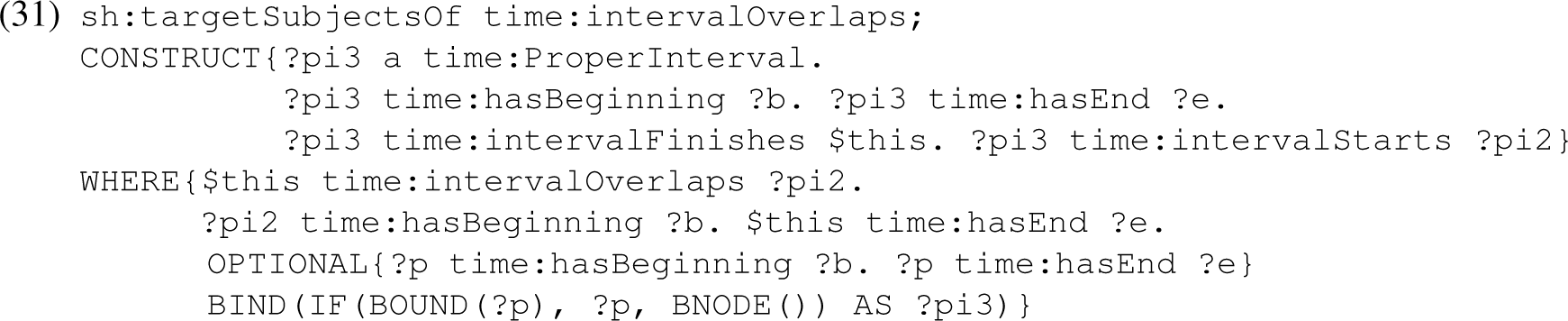
Given the two proper intervals [3pm, 5pm] and [4pm, 6pm], the rule in (31) infers and generates the new proper interval [4pm, 5pm], which is the interval to be associated with the violation. Naturally, adding the rule in (31) to the axiomatization from the previous section would also be irrelevant for the purpose of validating the RDF resources in Figure 1; this rule is required only in the proposed extension of the framework in Robaldo, Batsakis, et al. (2023).
The discussions made so far in this section suggest that SHACL-SPARQL rules should be task-oriented. In other words, we should not attempt to include every possible rule to derive all conceivable knowledge. Striving for exhaustiveness would only increase computational costs and make updates and debugging more difficult, since a larger number of rules would need to be maintained and monitored. Instead, we should focus on the specific task at hand, such as validating the semantics ascribed to a given set of RDF resources, as done in this paper, rather than inferring additional intervals as in the example in (30); we should define only the minimal number of SHACL-SPARQL rules necessary for that task.
Adding further rules is not the only possible way to broaden the scope of the axiomatization presented above. Another possible direction is to extend the vocabulary of the Time Ontology with new RDF resources.
For example, one could introduce RDF resources capable of representing vectors of Allen’s temporal relations and complement them with inference rules that implement Allen’s propagation algorithm. However, as noted in Section 3, this may not always be advisable, since Allen’s propagation algorithm for the full temporal algebra has exponential complexity. A more pragmatic approach would therefore be to restrict the extension to a tractable sub-algebra, such as the one proposed in Nebel and Bürckert (1995), where reasoning can be performed in polynomial time. However, this direction requires substantial further research, which we may address in future work.
Another possible extension of the Time Ontology’s vocabulary, which we have actually advocated above, concerns the representation of infinite intervals. As previously discussed, Hobbs and Pan (2004) model infinite intervals as those in which one or both endpoints are explicitly omitted. In that approach, if the beginning of an interval is missing, it is assumed to be
Since
Additionally, SHACL shapes are introduced to invalidate knowledge graphs that contain instants with values

The shapes implementing (32.a) are shown in (33); the UNION clause captures both options described in (32.a).

(32.b) is implemented by the following two SHACL shapes; the FILTER clause ensures that the case where an infinite instant both begins and ends at itself, as enforced by axioms ‘2’ and ‘3’ in Table 3, is not reported as invalid by the shapes, since these triples are considered acceptable.

Finally, (32.c) is implemented by the following two SHACL shapes; as in the SHACL shape in (33), the UNION clauses allow to account for all possible cases.

The classes minusInfinite and plusInfinite, together with the shapes in (33), (34), and (35), extend the basic temporal algebra defined in the previous sections for the properties equals (
An example of invalid knowledge graph is the following:

These triples are invalid for two reasons. First, the instant tb, whose value is
This paper has demonstrated the high expressivity of SHACL, and in particular of SPARQL, which is embedded within SHACL. This expressivity enables the implementation, within the Time Ontology, of inferences that are significantly more advanced than those currently supported in the ontology’s official OWL-encoded version.
However, the expressive power of SPARQL also introduces potential challenges and risks. Although the SHACL-SPARQL rules proposed above for the Time Ontology are not affected by these issues, as will be explained below, this final section discusses them more generally to caution readers about the potential pitfalls of using SHACL-SPARQL rules on RDF ontologies.
Specifically, the use of SHACL-SPARQL rules involves two main risks: (1) The potential for infinite loops, and (2) the possibility of non-deterministic outcomes. The following subsections examine these issues in detail and explain why, in the set of SHACL-SPARQL rules presented above, they either do not occur or have no practical effect.
SHACL-SPARQL Rules May Generate Infinite Loops
As explained at the end of the Introduction, in this paper inference is performed in the same way as standard OWL reasoners, such as HermiT, where OWL axioms are repeatedly applied until no further triples can be inferred.
On a fixed set R of RDF resources, of which P
However, SHACL-SPARQL rules can also create new individuals in the CONSTRUCT clause, thereby expanding the set of resources R. As a result, re-executing these rules may indeed lead to an infinite loop.
A simple illustrative example of a SPARQL rule in CONSTRUCT-WHERE form that triggers an infinite loop via repeated execution is the following:

Consider an initial knowledge graph containing a single man. The WHERE clause in (37) creates a new anonymous individual, binds it to the variable ?f, and asserts that it is both a man and a friend of the first man. Therefore, after the first execution of the rule, the knowledge graph contains two men. Re-executing the rule adds two more men as friends of the two existing ones, then four, then eight, and so on, resulting in exponential growth that ultimately generates an infinite number of men.
Of course, more complex patterns of SHACL-SPARQL rules that generate infinite loops are possible. For instance, we could have a set of n rules, where the first rule produces a new individual that matches the WHERE clause of the second rule, the second rule produces a new individual matching the WHERE clause of the third rule, and so on, until the last rule, which then produces a new individual matching the WHERE clause of the first rule.
It is therefore evident that rules creating new anonymous individuals must be carefully checked. It is the responsibility of the knowledge engineer, when such rules are included in the axiomatization, to ensure that they do not generate infinite loops, for example by including conditions in their WHERE clauses that prevent such loops.
In the SHACL axiomatization of the Time Ontology described above, only a single SHACL-SPARQL rule generates new anonymous individuals. This is the rule in (19) above, which is associated with the first-order logic axiom ‘1’ in Table 3. For the reader’s convenience, both the rule and the first-order logic axiom are repeated here:

If the first-order logic axiom in (38) were implemented in SHACL-SPARQL exactly as written, the rule would result in an infinite loop: For each temporal entity T, two new temporal entities, tb and te, would be generated. These new entities would re-enter the rule, producing two additional temporal entities, then four, then eight, and so on, as in the previous example in (37).
To avoid this infinite loop, we observed that: (1) The two new individuals tb and te must be instances of Instant, since they are asserted in the CONSTRUCT clause as objects of hasBeginning and hasEnd; and (2) the beginning and the end of an instant are the instant itself, as stipulated by axioms ‘2’ and ‘3’ in Table 3. Based on these observations, we were able to expand the rule as shown in (38) without altering the intended semantics. The version in (38) does not generate infinite loops, because all newly created anonymous individuals are asserted as instances of Instant; therefore, when they re-enter the same rule, they satisfy the first branch of the IF condition, and thus no additional individuals are generated.
Nevertheless, the mechanism used in (38) to prevent infinite loops is, of course, an ad-hoc and non-generalizable solution. It was easy to implement due to the specific semantics we wish to ascribe to the Time Ontology, and the fact that (38) is the only rule in the axiomatization that creates anonymous individuals.
For other RDF ontologies or alternative semantics, the SHACL axiomatization may involve a larger number of SHACL-SPARQL rules that create anonymous individuals. In such cases, the knowledge engineer must demonstrate that these rules, when executed together, never result in infinite loops. When the interaction patterns become more complex, this may require supplementing the axiomatization with formal proofs to guarantee termination.
SHACL-SPARQL Rules May Lead to Non-deterministic Outcomes
SHACL-SPARQL rules behave like a standard rule-production system. However, not all sets of SHACL-SPARQL rules behave as a monotonic rule-production system, in which adding new information does not invalidate previous conclusions and, consequently, the set of inferred triples does not depend on the execution order of the rules.
In fact, the SPARQL vocabulary contains non-deterministic operators that vary their outcome based on the presence of certain triples in the knowledge graph, which may be produced by other rules. Examples of such operators include EXISTS, IF, and OPTIONAL. These operators can lead to non-deterministic behaviour, depending on whether the rules that generate the triples they test are executed before or after them. A simple example is the following pair of SHACL-SPARQL rules:

The WHERE clause of the first rule in (39) is satisfied by every individual who has no friends; the rule infers that each such individual is an instance of the class Lonely. The second rule in (39), on the other hand, searches the knowledge graph for pairs of men and, for each pair, asserts that the two men are friends.
It is easy to see that the two rules in (39) may produce different outcomes depending on the order in which they are executed. Consider, for example, a knowledge graph containing two men: John and Jack. If the first rule in (39) is executed first, both John and Jack are inferred to be lonely men. If the second rule is executed first, John and Jack are inferred to be friends, which prevents the first rule from applying; in other words, if the second rule is executed first, John and Jack are not inferred to be lonely men.
The non-deterministic behaviour of the two rules in (39) is due to the NOT EXISTS clause, which is the SPARQL operator used to implement negation-as-failure. As is well known, negation-as-failure is a non-monotonic operator; therefore, if the triples specified within the NOT EXISTS clause do not exist in the knowledge graph, that is, if they are unknown, the clause evaluates to true.
Other SPARQL operators can produce similar effects, thereby emulating negation-as-failure. For instance, the IF operator, used to create if-else conditions in the WHERE clause, yields one outcome if certain conditions are met and another outcome otherwise. However, these conditions might be entailed by other rules, which may be executed before or after the rule containing the IF clause. The same considerations apply to the OPTIONAL operator, which binds variables to certain RDF resources when the corresponding triples exist; again, these triples may be entailed by other rules, which may be executed before or after the rule containing the OPTIONAL clause.
As with the problem of infinite loops, it is again the responsibility of the knowledge engineer to ensure that the set of SHACL-SPARQL rules produces a single inferred graph, or, in cases where multiple graphs are produced, that the intended semantics is preserved in all of them. Such verification again requires an ad-hoc formal analysis of the specific axiomatization, the results of which are not always generalizable.
To address non-determinism, the SHACL-SPARQL vocabulary provides the property sh:order, which enables prioritization of rules. By defining a specific execution order, non-deterministic behaviour can be avoided. This strategy has been applied, for example, in Robaldo, Pacenza, et al. (2023).
In the axiomatization proposed above for the Time Ontology, it was not necessary to prioritize the rules using sh:order, because only a single SHACL-SPARQL rule includes non-deterministic operators. Although this rule may indeed produce different outcomes in a few cases, none of these outcomes affects the intended semantics or, more generally, the task of validating the Time Ontology resources shown in Figure 1.
This rule, again, is the one in (38). As explained in the previous subsection, it may or may not create new instants and assign them as the beginning and end of a temporal entity, depending on whether the temporal entity is itself an instant or already specifies its beginning or end. However, the classification of a temporal entity as an instant, or the specification of its beginning or end, may be entailed by other rules; consequently, depending on whether these rules are executed before or after (38), the latter may or may not create new anonymous individuals.
In particular, the proposed axiomatization includes three rules that may interfere with (38) in this way. These are the rules corresponding to axioms ‘4’, ‘5’, and ‘6’ in Table 1, which infer a temporal entity to be an instance of Instant if the entity occurs as the object of the properties hasBeginning, hasEnd, or inside.
An example of a knowledge graph that may yield two different inferred graphs, depending on the execution order of the aforementioned rules, is the following:

Since tb occurs as the object of hasBeginning, and the range of hasBeginning is the class Instant, if the second rule in (14) above, defined on rdfs:range, executes first, tb is inferred as an instance of the class Instant. Therefore, when (38) executes on tb, it is set as both the beginning and the end of itself. With this rule execution order, the inferred knowledge graph is then the following:

By contrast, if (38) executes on tb before (14), two new anonymous individuals are created and then inferred as instances of Instant, as well as as the beginning and end of tb. Then, tb is also inferred as instance of Instant by the second rule in (14) and its beginning and end sets to tb itself. Finally, the SHACL-SPARQL rules corresponding to axioms ‘4’ and ‘5’ in Table 3 set tb equal to the two anonymous individuals, which are then inferred to be equal to each other. The inferred knowledge graph is then the following:

Since all instants are inferred to be equal, it is easy to see that the SHACL shapes presented in the previous sections yield the same results on both (41) and (42). According to the basic temporal algebra implemented by these shapes on the properties equals (
Again, it was relatively straightforward to explain that the potential non-deterministic behaviour of the proposed axiomatization does not affect the validation of the Time Ontology resources shown in Figure 1: only a single, and rather simple, rule had to be examined, the same that could potentially engender infinite loops. This rule is the only one that both creates new anonymous individuals and utilizes non-deterministic SPARQL operators.
Nevertheless, it is clear that investigating more complex axiomatizations, which include multiple rules that create anonymous individuals and/or employ non-deterministic SPARQL operators such as EXISTS, IF, or OPTIONAL, requires considerably more care and should ideally be accompanied by detailed formal proofs.
Conclusions and Future Works
This paper introduced a novel SHACL axiomatization for the Time Ontology. Effective time management is crucial in both academia and industry, as it underpins a wide range of real-world applications. The Time Ontology is widely recognized as the ‘de facto’ standard for representing temporal data in the Semantic Web. However, its current OWL-based version primarily serves as a terminological vocabulary, providing standardized symbols to label instants, intervals, and other temporal concepts. While harmonizing and standardizing these symbols is essential for interoperability and data sharing, the ontology itself offers only limited inferencing capabilities, which can lead to inconsistencies such as intervals that end before they start.
The SHACL axiomatization we proposed is inspired by and built upon the first-order logic axiomatization defined by Jerry R. Hobbs and Feng Pan, the original proponents of the Time Ontology, in Hobbs and Pan (2004). Although their axiomatization was introduced about 20 years ago, it has never been fully implemented in OWL or other Semantic Web formalisms such as SWRL, perhaps due to the limited expressivity of these formalisms to capture its complexity. By contrast, using SHACL, the implementation of these axioms becomes relatively straightforward.
However, rather than adopting Hobbs and Pan’s axiomatization verbatim, we defined a variant that retains most of the original axioms while introducing several key extensions. Three main reasons underpin this choice:

The extended first-order logic axiomatization incorporating (43.a–c) constitutes a further contribution of this paper. Overall, we believe our work opens new opportunities for temporal data validation and AI-driven reasoning over temporal knowledge in the Semantic Web.
In addition, our research journey on defining the SHACL axiomatization of the Time Ontology helped us identify broader insights into SHACL itself, particularly regarding the interplay between validation and inference. In other words, the SHACL axiomatization of the Time Ontology that we developed has actually served as a case study for SHACL, illustrating how the W3C standard can be applied effectively.
First, we demonstrated that SHACL shapes alone are insufficient to detect certain invalid knowledge graphs that can be constructed using the Time Ontology vocabulary. A notable example is the ‘zig-zag’ pattern shown in Figure 3, which is particularly illustrative, as it can arise using only the RDF class Instant and the properties inXSDDateTime and hasEnd. Therefore, simply put, SHACL shapes cannot fully validate knowledge graphs built from even a single class and two properties of the Time Ontology vocabulary. This limitation stems from the fact that SPARQL 1.1 Property Paths, the only SHACL construct for examining subgraphs of arbitrary length, can define regular expressions over properties but cannot simultaneously impose constraints on the RDF nodes connected by these properties. Although this empirical finding pertains specifically to the Time Ontology, its implications appear broader: if SHACL shapes cannot adequately validate relatively simple knowledge graphs built with this vocabulary, similar limitations can reasonably be expected in more complex scenarios.
To overcome this limitation, we argue that validation should be performed on the fully inferred knowledge graph, that is, the graph obtained by iteratively applying inference rules until no new triples are derived. This two-step procedure is not prescribed by the W3C Working Group Note (08 June 2017), 23 which, in fact, even appears to suggest the reverse sequence: first validate the graph, then apply the rules. 24
More broadly, our work highlights the general need to balance inference and constraint validation in SHACL. One possible solution is the definition of SHACL dialects or profiles, similar to the profiles defined for OWL (OWL Lite, OWL DL, OWL2 EL, etc.). 25 Defining different profiles would allow practitioners to select an appropriate level of expressivity while managing computational complexity. The current W3C SHACL recommendation already mentions support for different entailment regimes, 26 but only the SPARQL 1.1 entailment regimes 27 are listed, and their support is even indicated as optional.
Defining additional profiles or entailment regimes that accept only specific patterns of SHACL-SPARQL rules poses a significant research challenge and demands substantial effort from the Semantic Web research community.
As discussed in the previous section, two main risks must be considered when iterating SHACL-SPARQL rules until no further triples are inferred: SHACL-SPARQL rules can produce infinite loops when creating new anonymous individuals or non-deterministic outcomes when using SPARQL operators such as EXISTS, IF, and OPTIONAL. To ensure termination and either deterministic or harmless non-deterministic outcomes, different profiles or entailment regimes could restrict the creation of new individuals and the use of these non-deterministic operators, allowing them only in patterns that avoid infinite loops and harmful non-determinism.
However, it should be noted that this paper does not claim that SHACL-SPARQL rules must always be used for reasoning over knowledge graphs. In some cases, OWL or other reasoning languages provide simpler or more cost-effective solutions, while in others, even SHACL-SPARQL may lack sufficient expressivity. For example, implementing Allen’s propagation algorithm to realize the full version of Allen’s temporal algebra requires cycles over intervals (Allen, 1984), which SHACL-SPARQL cannot handle. In such cases, SHACL-X, 28 which integrates SHACL with JavaScript, appears to provide the necessary expressive power.
More generally, the choice of the inference language, whether OWL, SHACL-SPARQL, SHACL-X, or a dialect of these, should be guided by the expressivity required for a given use case, while avoiding unnecessary complexity. Defining dialects and entailment regimes for SHACL, similar to what has been done with OWL profiles over the past decades, could enable targeted implementations and specialized reasoners optimized for each regime.
In sum, this paper not only proposes a SHACL axiomatization for the Time Ontology but also contributes to a broader understanding of the interplay between inference and validation in the Semantic Web, paving the way for more systematic exploration and practical tooling in this area.
Footnotes
Acknowledgements
The authors sincerely thank Maxime Jakubowski, Jose Emilio Labra Gayo, Francesco Compagno, and three anonymous reviewers for their insightful feedback and valuable suggestions.
Funding
The authors received no financial support for the research, authorship, and/or publication of this article.
Declaration of Conflicting Interests
The authors declared no potential conflicts of interest with respect to the research, authorship, and/or publication of this article.