




Abstract
The process of news digitalization over the past decades has released massive amounts of news content, revolutionizing consumer access to news and disrupting traditional business models. These radical changes have also introduced new opportunities for media content analysis, opening up new scenarios for ambitious large-scale media analytics initiatives, which can go well beyond the relatively small-scale studies currently carried out by media scholars and practitioners. However, take-up of computational methods to support media content analysis activities has been rather modest, reflecting a degree of disconnect between the needs of scholars and practitioners for task-specific and usable software solutions and the state of the art in computational techniques for news media analysis. In this article, we perform an initial step toward bridging this gap, by looking in detail at the task of fine-grained news classification. In particular, we propose a typology of news topics, which is formally specified and realized into a family of reusable ontologies. The proposed model has been validated empirically, through an analysis of a multilingual news corpus, as well as formally, in terms of the functional and logical properties of the ontologies. Our analysis brings together the media and computer science literature, connecting the formal definitions provided in this article to the concepts used by media scholars.
Keywords
Introduction
The process of news digitalization over the past decades has released massive amounts of news content, revolutionizing consumer access to news and disrupting traditional business models (Abramson, 2019). For example, in the old age of print media, accessing multiple newspaper sources was relatively costly for consumers; hence, most readers were essentially locked in the particular bundle of articles associated with a single newspaper. In the internet age, consumers can easily hop from one source to another, selecting the articles they wish to read from a variety of sources, which include both the digital versions of traditional newspapers, as well as offerings from digital-only news outlets. At the same time, control over distribution and access to users has shifted from news producers to platform owners, weakening the link between readers and news sources and making it easier for rogue players to spread disinformation (Martens et al., 2018).
This explosion in news content availability has also introduced new opportunities for large-scale scholarly investigations (Jacobi et al., 2016). In particular, both commercial and open-access services are available, such as Quantexa News Intelligence (www.aylien.com) and GDELT (www.gdeltproject.org). These services index and provide access to tens of thousands of news sources, thus enabling new solutions for large-scale news monitoring and intelligence gathering.
Nonetheless, current solutions for automated news content analysis have enjoyed limited take-up by domain experts, such as political and media scientists (Boumans & Trilling, 2016). As pointed out by Sjøvaag and Kvalheim (2019), current approaches to news classification suffer from either low granularity or high noise, thus reflecting a degree of disconnect between the needs of scholars for task-specific and usable software and the state of the art in advanced computational techniques for news media analysis (Hamborg et al., 2019). Naturally, we agree with the aforementioned authors that there are issues related to both the usability and the performance of current computational solutions for news classification and, more generally, news analytics. However, we would also argue that a more fundamental problem concerns the lack of a strong epistemological foundation to the problem of classifying news items. In other words, we believe that, as a precondition to the development of effective computational solutions for fine-grained news classification, 1 it is first necessary to characterize this task more precisely. To this purpose, in this article, we analyze the notion of news topic. In contrast with the topic modeling literature (Harrando et al., 2021), where this concept defines a technical term denoting a vectorial representation of a set of documents, here we characterize it informally as “a matter dealt with in a text, discourse, or conversation; a subject.” 2 In particular, this article provides the following contributions: we propose a conceptual framework covering the different types of news topics; we provide a specification of the framework in formal logic, which is then realized as a reusable ontology; and we validate the proposed approach both empirically, through an analysis of a multilingual news corpus, as well as formally, by verifying the functional and logical properties of the ontology.
The rest of the article is organized as follows: in the next section, we articulate the motivation for this work, highlighting the limitations of current computational approaches to news classification and the existing gap between the needs of media scholars and practitioners and the solutions available to them. In Section “A Framework for News Classification,” we illustrate the components of the proposed framework, which is then formalized in Section “A Formal Model of News Classification.” In Section “The News Classification Ontology,” we present a family of ontologies that instantiate the formal specification provided in Section “A Formal Model of News Classification.” In Section “Empirical Validation of the Framework,” we illustrate an initial validation of the framework on a news corpus comprising both Norwegian and British news. Finally, in Section “Related Work,” we discuss the relevant literature, while in the concluding section, we reiterate the main contributions of this article and discuss the next steps of this research.
Approaches to News Classification
An established solution to classifying very large document collections, including news corpora, is provided by topic modeling approaches (Harrando et al., 2021). Their popularity is due to two main features of these algorithms: (i) they can effectively scale up to very large document collections, and (ii) they do not require training data. However, there is also a broad consensus in the research community that such approaches suffer from an “interpretability problem” (Chang et al., 2009): while their stated objective is to group documents into coherent topics (expressed as probability distributions over terms used in the document corpus), in reality it is not at all clear which notion of “topic” these approaches actually capture. Indeed, researchers have shown both that (i) the outputs generated by topic modeling algorithms are not necessarily meaningful to humans (Chang et al., 2009) and also that (ii) the evaluation metrics used in the topic modeling literature are neither robust across application scenarios (Harrando et al., 2021), nor they correlate with human judgement (Doogan & Buntine, 2021).
An approach to addressing the issue concerning the semantic opaqueness of topic modeling algorithms focuses on generating succinct labels that are meaningful for humans (Bhatia et al., 2016; Alokaili et al., 2020). For example, the article by Alokaili et al. (2020) presents a state-of-the-art topic labelling algorithm that is able to generate labels, such as “biofuel” from vectors, such as <oil energy gas water power fuel global price plant natural>. Analogously, the article by Bhatia et al. (2016) includes a number of examples, such as generating the label “criminal investigation” from the vector <investigation fbi official department federal agent investigator charge attorney evidence>. However, the issue here is that while these labels may be correct, they tend to have relatively little discriminatory power. For instance, in the latter example, the generic label “criminal investigation” identifies a broad topic rather than the specific one being discussed in the news, which ought to be characterized more concretely in terms of a specific investigative event, carried out by a specific investigative agency, etc.
An alternative to the traditional topic modeling approaches is provided by modern neural network solutions, such as transformer-based language models, which have been shown to improve the state of the art in a variety of natural language processing tasks (Devlin et al., 2019) However, in order to produce high-quality results, these approaches have to be trained or fine-tuned on annotated news corpora, and unfortunately current datasets are not granular enough to support fine-grained news classification. For example, the widely used AG's news corpus 3 only classifies news items with respect to very high-level categories, such as Sports, Business and Sci/Tech.
The same granularity issue also applies to current vocabularies for news classification, which, while providing broad coverage across a wide variety of topics, are rather coarse-grained—i.e., only focus on rather generic categories. For instance, the IPTC Media Topic NewsCodes 4 taxonomy provides about 1300 concepts, starting from top-level nodes, such as “politics,” “science and technology,” and “crime, law and justice,” and expanding down through six levels to leaf nodes, such as “capital punishment” and “suspended sentence.” However, the primary purpose of these vocabularies is to provide a certain level of coarse-grained interoperability among news providers, and they do not address our goal of supporting the identification of the fine-grained topics (e.g., specific entities, events, situations, and other types of topics) that a news item may focus on.
Other approaches have instead focused on identifying specific types of concepts inside the body of news items, such as named entities (Wadden et al., 2019; Sevgili et al., 2022) and events (Huang et al., 2018). Indeed, because news coverage tends to be event-centric (Sjøvaag & Kvalheim, 2019), event extraction is a key capability that is required to support any approach to fine-grained news classification. However, while these techniques are essential to support effective solutions for this task, they do not provide a complete solution, as not all news items necessarily center on a particular event or entity. For instance, a news item may discuss an issue, such as the refugee crisis, without necessarily focusing on a particular event or entity. Indeed, even when a news item focuses on a particular entity—e.g., Italy, the discussion would usually center on a particular aspect of the entity in question—e.g., its financial or political situation, or its natural attractions.
Given this state of affairs, it is not surprising that, as already pointed out, current solutions for automated news content analysis have enjoyed limited take-up by domain experts (Boumans & Trilling, 2016; Hamborg et al., 2019): in addition to the issues of performance and usability mentioned earlier, they also lack granularity and completeness.
Hence, we believe that there is a need to investigate the task of fine-grained news classification more comprehensively than it has been done so far in the literature. As already pointed out, the Computer Science literature by and large focuses on specific computational methods for individual elements of the overall puzzle—e.g., through extensive research on event extraction (Lai, 2022). However, it has failed to provide a comprehensive analysis of the typology of concepts that can play the role of topic in news items, a key precondition for developing more robust and complete solutions for media analytics. Taxonomies, such as IPTC, provide a valuable resource for content interoperability, but they are mere vocabularies and, therefore, do not shed much light on the types of concepts that may need to be identified by computational engines attempting to perform automatic news classification. Hence, the work presented in this article aims to provide both a fundamental (i.e., epistemological) and pragmatic (i.e., computational) value. In particular, a formal characterization of the types of concepts that can play the topic role in a news item provides a principled way to identify the current gaps in computational support for news classification.
A Framework for News Classification
In this section, we discuss the types of concepts that provide the subject matter for news items. To this purpose, we define the task of fine-grained news classification as the identification of the salient elements in a news story—i.e., the relevant news topics. This definition has commonalities with the notion of agenda setting in the media literature (McCombs et al., 2018), which is also concerned with the salience of issues in the media. However, agenda setting focuses primarily on the impact of the media agenda on the public, and of course, characterizations of this notion do not include the kind of epistemological analysis that is the focus of this article.
In particular, our framework for fine-grained news classification distinguishes five generic types of news topics: Entities, Events, Situations, Categorical Topics, and the Commentary. These are discussed in the following sections.
Entities
Many news items focus on a particular entity. In principle, this can be anything, including a person, an animal, a plant, 5 a mineral, 6 an organization, a country, a fictitious entity, 7 a geographical place, and several others. Named Entity Recognition (Wadden et al., 2019) and Entity Linking (Sevgili et al., 2022) are well-understood tasks, for which highly performant off-the-shelf methods are available and are in routine use in commercial data services. For example, the aforementioned Quantexa news service automatically links entities in a news item to the relevant Wikidata entries (Vrandečić & Krötzsch, 2014).
However, to say that a news item is about an entity does not necessarily provide the most granular classification, as news may focus on a particular aspect of an entity. For example, while it would be correct to classify the topic of the news item at http://tinyurl.com/mu6h6nuv as “Donald Trump,” a more accurate classification would indicate that the actual topic is “Donald Trump's wealth” or “Donald Trump's financial status.” Analogously, as already pointed out, a news article about Italy is unlikely to focus on all aspects of this country, but most likely will focus on its economic or political situation, or its natural resources, or its artistic heritage, etc. The notion of entity aspect discussed here is related to the second level of agenda setting theory, which deals with the salience of the attributes of the entities that are the focus of attention in the media (McCombs et al., 2018).
Entities can also be related to other entities, and such relations can themselves be the focus of a news item. A typical case happens when a newspaper investigates the relationship between a politician and a businessman in the context of a corruption enquiry. A more unusual example concerns the story about the “Honduran Maradona,” 8 whose core subject is actually the relationship between the writer and a Honduran football player.
In sum, while entities can be the focus of a news item, an entity aspect or a relation between entities can also play this role. Hence, while methods for Named Entity Recognition and Entity Linking play an important role in supporting fine-grained news classification, they do not necessarily provide the complete solution, even if we only focus on the subtask of entity-centric classification. Here, additional computational techniques are needed—e.g., methods for relation extraction (Gangemi et al., 2017; Martinez-Rodriguez et al., 2018; Wadden et al., 2019).
Events
As already mentioned, news coverage focuses to a large extent on events (Sjøvaag & Kvalheim, 2019); hence, these play a key role in any news classification framework. To identify occurrences of events in textual content, the research community has, over the years, developed domain-independent event extraction solutions (Huang et al., 2018; Liu et al., 2020), which can achieve good performance, especially in the sub-task of event detection. 9 In addition, extensive event taxonomies (Windisch Brown et al., 2017) are also available, which can be used to support general-purpose event extraction solutions. While such solutions are essential to enable computational approaches to news classification, here we abstract from specific computational methods and domains to focus instead on the generic types of events that provide the focus of a news story. These are described in what follows.
Individual Events
These provide the basic building blocks for a discussion about events. An individual event is simply something that is believed to have happened, such as a car crash, a bank robbery, a football match, an election, etc. Here, we use the formulation “believed to have happened” to include events that may not have actually taken place but are discussed as if they were real—e.g., because they are associated with specific entities and have spatiotemporal coordinates. A well-known historical example of false reporting in a newspaper is the 1948 headline of the Chicago Daily Tribune, “Dewey defeats Truman.” This headline mistakenly declared Republican candidate Thomas Dewey as the winner of the 1948 U.S. presidential election when, in fact, incumbent President Harry Truman had won. 10 Other common examples come from novels, movies, and the theater, where fictitious events are presented as if they were real. Hence, while detecting fake news and fake events are very important tasks covered by a vast literature—see, e.g., (Helmstetter & Paulheim, 2018), in the context of this discussion the notion of “individual event” comprises both real and imaginary events, as its purpose is to characterize any event that is discussed in the news, independently of its grounding in the real world. 11
Individual events are normally composite events—i.e., they have sub-events. For instance, a bank robbery would include a variety of more specific events, such as the robbers entering and exiting the bank, threatening the staff in the bank, grabbing the money, etc. However, a journalist may decide that these more granular events are not salient enough to warrant too much attention, and the story itself should instead center on the bank robbery as a whole. That is, while a specific individual event may ontologically comprise a variety of sub-events, a journalist may decide that the more granular sub-events are not interesting enough and therefore ignore them—in this example, treating the bank robbery event effectively as an atomic event.
Collections of Events
Often, news stories focus on collections of events, rather than individual ones. For instance, let's consider a story that discusses sightings of unidentified drones near oil and gas fields in Norway. 12 From a journalistic point of view, it makes sense to group all these events together because (i) they are obviously of the same type and (ii) doing so increases the importance of the story. This aspect is related to the Impact news angle, 13 sometimes also called Prominence (Shoemaker & Reese, 1991), which emphasizes that the value of a news item depends on the size or impact of an event. For instance, one person getting food poisoning at a wedding party is unlikely to make the news, while 100 people getting food poisoning is much more newsworthy. As Shoemaker and Reese point out, “the importance of a story is measured in its impact: how many lives it affects” (Shoemaker & Reese, 1991). Hence, analogously to the earlier discussion about individual vs composite events, also in the case of a collection of events the key classification criterion is journalistic rather than ontological. That is, while a variety of different events may exhibit significant commonalities, we talk about a collection of events only when a journalist has grouped a number of events together, either to enhance the impact of a news story or because the events naturally form a collection for reporting purposes—e.g., when we talk about all the football matches played in a particular round of the football league.
When talking about a collection of events, a key element is what Carriero et al. (2021) refer to as the unifying factor, the criterion that determines membership of the collection. For instance, when grouping together multiple drone sightings, the unifying factor may abstract from the specific sighting modality—e.g., detection through a radar screen vs direct sightings by humans.
Here, it is important to emphasize that an event involving multiple agents does not necessarily define a collection of events. For example, an individual terrorist attack may injure or kill many people; however, this can be treated as an individual event, if we are talking about an individual attack in a specific spatiotemporal location, regardless of the size of the casualties.
Negative Events
When talking about events, intuitively we are inclined to think of actual events, which involve a certain number of agents, and take place in a specific location at a specific time. Hence, the notion of negative event—i.e., something that has not happened–is somewhat counterintuitive and has been much debated in philosophy.
In particular, as discussed in (Payton, 2018), “if one's doing of something is an event, then surely one's not doing it is the absence of an event.” However, as also pointed out by Payton (2018), the problem with characterizing negative events as absences is that in reality “we can manifest our agency just as much by not doing things as by doing them.” For instance, a situation in which mutinying soldiers omit to fire at the enemy cannot be characterized simply as the absence of an event, but itself defines an important event that may warrant journalistic coverage. Therefore, our typology also includes this class of events. Like ordinary (i.e., positive) events, these can be characterized in terms of the relevant agents, although it is often tricky to locate negative events spatiotemporally. For instance, if a person decides not to cast their vote in the local elections, it is clear enough that they are expressing agency by not voting. However, it is more tricky to decide where and when this event of non-voting is situated—see (Payton, 2018) for a detailed discussion of these issues.
Naturally, just like positive events, not all negative events are necessarily newsworthy–indeed, the vast majority are not. However, in contrast with positive events, it is also the case that not all negative events necessarily make sense. For instance, if one of the authors of this article is currently writing this page, they are also not doing an infinite number of other plausible things, such as playing the saxophone or riding a bicycle. However, they are also trivially not doing a variety of other far less plausible actions, such as standing upside down in Puerto Rico or talking to the Prime Minister of Papua New Guinea in Tok Pisin. Hence, while there are relatively few things that happen, there are practically an infinite number of things that don't happen. For this reason, as pointed out in (Payton, 2018), when talking about negative actions, we are primarily interested in omissions, either deliberate decisions of not doing something or simply failing to do something that is expected to happen. This characterization limits negative events to a meaningful subset of all conceivable negative actions, from which a journalist would then choose the ones that are newsworthy.
Dependent Events
These are events that journalistically only make sense in the context of some other event. For instance, an event associated with a jury producing a verdict in a criminal trial only makes sense in the context of the broader set of events that together constitute a trial. A fundamental issue here is that, at least in the physical world, no event is independent in an ontological sense—see also Borgo et al. (2022) for a discussion about dependent entities in ontology engineering. For instance, a criminal trial trivially depends on a defendant being born. However, as in the case discussed earlier of collective events, the viewpoint here has less to do with ontology than with journalistic practice. Hence, while the accused in a trial can only be a person who was involved in a birth event, this particular event is usually not relevant to the discussion. The notion of dependency here is related to the notion of background or context in journalistic guidelines 14 : if the main event of a story is predicated on other events, which are essential to understand the event in question, then we say that this is a dependent event. Dependencies can be taxonomic, as in the case of the verdict event depending on a super-event (the trial), but can also be based on other principles, such as causality or preconditions—e.g., a trial took place only because a referral to trial was issued.
Predictions
A special type of meta-event that occurs regularly in the news is Prediction, as in the headline “Pupil numbers in England set to shrink by almost 1 million in 10 years.” 15 Here, it is useful to distinguish this type of event, because usually events in the news refer to things that are claimed to have happened (even when such events turn out to be fabricated) or to negative events where some agent or group of agents have expressed agency by not doing something. Hence, this type of event is distinguished from the other types discussed earlier both because of its metalevel nature, and also because it is the only type that does not focus on events that have or have not happened in the past.
Situations
A situation can be characterized as a state of affairs, typically resulting from one or more events. As such, events and situations are closely linked, and indeed, the definitions of these notions in the philosophical literature emphasize this close coupling. For instance, in (Riker, 1957), situations are defined as boundaries between events, with the latter characterized as “motions and actions” that engender a transition from one situation to another (Riker, 1957). As an example, if railway workers are striking (an event), there may be no public transport options between certain cities affected by the strike (a situation).
Situations play an important role in news classification, given that news items often focus on the consequences of major events. For instance, as a result of an earthquake, a city may be without power, and depending on whether the focus of a news item is on the earthquake or its consequences, we could characterize it as either focusing on an event or a situation. An interesting case here concerns scenarios in which situations are expressed in negative terms—e.g., as the inability to do something. For instance, let's consider the news item entitled “Third of young women and girls in UK can't access free period products.” 16 One could consider whether this story should be characterized in terms of a negative event (young women in UK are not accessing free period products) or a situation characterized by the impossibility for young women in UK to access free period products. Our view is that a negative event implies an element of agency (Payton, 2018): either a deliberate choice of not carrying out an action or a failure to do so—e.g., because the agent in question has simply forgotten about the action. However, in this case we are not talking about young women expressing agency, but simply about a situation where it is not possible for them to access free period products. Hence, we prefer to use the notion of situation, rather than event, to characterize this type of scenarios.
Categorical Topics
As discussed in the previous section, situations define state of affairs, which normally can be directly linked to one or more events, which have led to the state of affairs in question. For instance, the UK's exit from the European Union (an event) has led to a 4% drop in the UK's overall GDP (a situation). However, while such 4% drop in UK's GDP can be characterized as a specific situation, the country's GDP or, more in general, its financial profile can be seen as a categorical topic, that is a topic for discussion and journalistic analysis that tends to be relevant and newsworthy regardless of any contingent situation. Such topics include social, economic and political issues, such as crime, poverty, taxation, finances, economic, foreign and defense policies, immigration, party politics, and many others. Indeed, many of these topics are captured by existing taxonomies, such as the aforementioned IPTC Media Topic NewsCodes, which cover generic categories in science, politics, arts and entertainment, education, health and other fields. While the role of these “categorical topics” is to provide coarse-grained aggregations of news items that cover the same domain, in contrast with the focus in this article on fine-grained news classification, we nonetheless include them in our framework, as indeed it is useful to be able to connect fine-grained and coarse-grained news classification mechanisms. For example, we may want to associate the IPTC news code “politics” to a news item which focuses on a political figure or to specify that the topic of a news item that talks about a particular individual's approach to maintaining a healthy work-life balance is an example of a more generic “work-life balance” topic. The latter can be seen as a sub-topic of more generic topics, such as “lifestyle” or “wellness,” which are covered in the IPTC taxonomy.
The Commentary Element: Viewpoints
A key aspect of the news universe is the commentary—i.e., the set of viewpoints expressed on a particular issue or topic, which are covered by the media. Indeed, the acid test for a democratic media landscape is related to viewpoint diversity (Baden & Springer, 2017), namely the extent to which media sources provide citizens with a robust range of alternative interpretations on a given issue. Viewpoint diversity, in turn, is closely related to actor diversity, in the sense that “the representation of a plurality of active actors in a news article seems to go hand in hand with a more diverse range of viewpoints” (Masini & van Aelst, 2017). Accordingly, Masini et al. (2018) show that the debate on immigration rarely includes the voices of the immigrants themselves, and therefore this key element of the debate is heavily under-represented in news coverage. Hence, the ability to identify viewpoints in the news is essential in order to develop robust computational approaches to assessing whether individual media sources or a media landscape as a whole—e.g., the set of the UK's mainstream media sources—fulfill their democratic role to inform readers about alternative views on a particular issue. In addition, in the context of a fine-grained news classification framework, it is essential to consider viewpoints for two main reasons: (i) a viewpoint on a topic can itself be the main focus of a news article and (ii) it is appropriate to extend the classification framework to include not just topics but also the topic-viewpoint dynamics, as a necessary precondition to enable automatic approaches to analyzing viewpoint diversity in the media.
While fine-grained frameworks for analysing argumentation networks have been available in the scientific community for a long time (Buckingham Shum et al., 2000), these are not necessarily appropriate to the context of analysing the dynamics of topics and viewpoints. In this scenario, the goal is less to try and capture the fine-grained distinctions between the different positions than to abstract from these to capture the main viewpoints associated with a topic and assess to what extent these are covered by media sources. As pointed out in Baden and Springer (2017), when analysing the news discourse, we are interested in identifying viewpoints that “open up different perspectives” and “construct different meaning.” Analogously, Masini et al. (2018) cluster the variety of fine-grained positions on the topic of immigration around four main distinct viewpoints. For instance, they abstract a “victimization” viewpoint out of a number of positions reported in the media, which characterize immigrants as victims. These individual positions may be articulated differently—e.g., immigrants may be victims because of racism, traffickers, or unjust government policies, but they all share an emphasis on the difficulties experienced by immigrants in different EU countries, which ought to elicit a sympathetic rather than hostile approach to the issue.
Consistent with these proposals, in this article, we characterize the notion of viewpoint as an abstraction of a number of fine-grained positions about a topic. Here, we adopt the same approach that we used to characterize the notion of “collection of events” and define a viewpoint as the result of clustering together a number of positions expressed in the media about an issue, which satisfy the same unifying factor. Such a unifying factor defines a viewpoint-specific criterion—see Section “Characterising Viewpoints” for details on how viewpoints are formally characterized in our framework.
Finally, we should also point out that viewpoints are expressed not only by people whose opinion is presented in the news—e.g., when journalists report on a politician who expresses their view on an issue, but also by journalists who write opinion pieces and even by the news sources themselves — e.g., in the traditional editorials published by many newspapers, which are attributed to the news outlet itself, rather than to a specific journalist. 17
A Formal Model of News Classification
In this section, we provide a formal specification of the concepts introduced in the previous section to provide a more robust characterization of our framework for fine-grained news classification. In particular, we model definitions as First Order Logic (FOL) statements, using a notation which mirrors standard representations for knowledge graphs, such as RDF. 18 Hence, we limit ourselves to binary relations and we also make use of the standard taxonomic relations, type (?instance ?class) and subclassOf (?class1 ?class2). Question marks are used to represent logic variables. Unless otherwise stated, free variables are universally quantified. Atomic statements are reified by assigning an identifier to them and then using the relations subject, object, and predicate to retrieve the components of the statement, following standard RDF notation. In terms of naming convention, classes are capitalized, individuals are expressed in lowercase, and we usually prefix relations with a verb—e.g., hasTopic. Rare exceptions to this rule are made for (i) relations that are borrowed from the RDF vocabulary—e.g., subject, predicate, object and type, (ii) a few relations where the verb and the directionality of the relation are obvious and the verb can be omitted without creating an ambiguity—e.g., TopicInNewsItem, and (iii) relation topicRole, which corresponds to the T operator, which will be introduced in Section “Entities as News Topics.” Because the T operator defines a bijective function, we prefer to use a function-like naming style for this relation.
Formally, a news classification function takes as input a news item and generates the set of topics associated with it. Hence, given a set N of news items and a space T of topics, a news classification function NC can be specified as follows:

In what follows, we will formally define the space of news topics, following up from the informal characterization provided in Section “A Framework for News Classification.” A synoptic view of the main relations and classes in our formal model is shown in Figure 1. The solid lines, labeled with relation topicRole, connect the class Topic to the other classes in our model that can play the role of topic in a news item. To minimize cluttering, some classes have been duplicated in the figure. These are shown in italics.
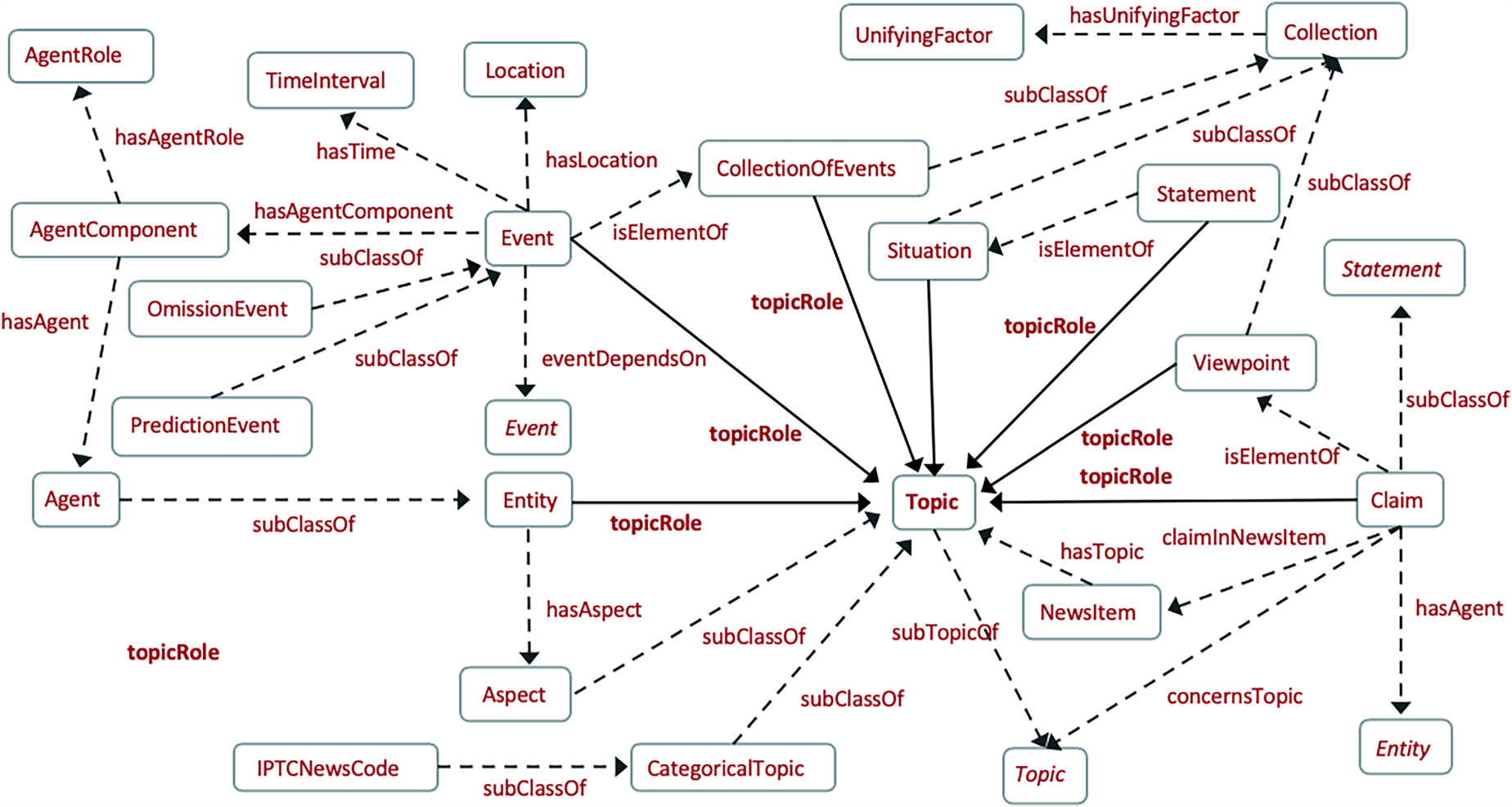
Synoptic view of the main classes and relations in our formal model of news classification.
Entities as News Topics
We assume a knowledge base, kb, which contains a vast range of entities of different types, including people, organizations, countries, etc. For instance, we may have an entity, jf_kennedy, belonging to kb, of type Person. Let's also assume that we have a news item, ni12345, which talks about this entity. Hence, we want to say that jf_kennedy is one of the (possibly multiple) news topics associated with ni12345. In order to do this, we introduce a relation, hasTopic (NewsItem Topic), and its inverse, topicInNewsItem (Topic NewsItem), and we state:
s1: hasTopic (ni12345 T(jf_kennedy))
The notation “id: statement” indicates both that statement is asserted in our knowledge base—i.e., the statement hasTopic (ni12345 T(jf_kennedy) in the example, and also that id, s1 in the example, is the identifier reifying statement. Hence, the notation in the above example provides us with a concise way to add to our knowledge base both a domain-level statement instantiating relation hasTopic and also the following (meta-)statements
19
:
type (s1 Statement)
subject (s1 ni12345)
object (s1 T(jf_kennedy))
predicate (s1 hasTopic)
More in general, the T operator is needed every time an individual in our knowledge base, which is not ontologically a topic (e.g., a person, an event, a statement, etc.) plays the role of a topic in a logical expression. To this purpose, we include the following axioms:
T(?e) = ?t → type (?t Topic)
T(?e) = ?t ↔ topicRole (?e ?t)
sameAs (?e1 ?e2) ↔ sameAs (T(?e1) T(?e2))
Characterizing Entity Aspects and Relations as News Topics
Let's consider first the case in which a relation between entities (e.g., business links between a politician and a business person) is the focus of a news item. This situation can be handled as shown below, where we use a domain relation to express the business connection between the two people, and then we take advantage of our reification mechanism.
s2: hasBusinessConnection
(politician1 businessperson1)
s3: hasTopic (ni55342 T(s2))
Let's now consider the news item discussed in Section “Entities,” which concerns Donald Trump's financial status. This can be represented as follows:
hasAspect (donald_trump dt_financial_status)
hasTopic (ni37239 T(dt_financial_status))
subTopicOf
(T(dt_financial_status) T(financial_status))
Finally, we add the following axioms to our model to indicate that if an entity's aspect or a relation between entities is a topic in a news item, then both the entities in question and the predicate are also topics of the same news item. In particular, including the predicate as a topic makes it possible to easily retrieve all relation topics typed through the same predicate.
hasAspect (?e ?a)
hasTopic (?ni T(?st))
Events as News Topics
Given the broad scope of our model, which is not restricted to a particular class of events, we want our characterization to be generic enough to cover all types of events. For this reason, we base our formalization on the one used by the News Angle Ontology (Motta et al., 2020), which is in turn based on the Simple Event Model (van Hage et al., 2011). Essentially, an event in this model is characterized in terms of time, location, and the agents involved in the event. The relation between events and agents is mediated by agent components, which specify the roles played by the agents involved in the event. Multiple views are possible for the same event—e.g., an invading army can be seen as liberators or oppressors depending on whose viewpoint is being represented (van Hage et al., 2011).
As discussed in Section “Dependent Events,” from a journalistic point of view, certain events only make sense in the context of other events. In our model, we represent such dependencies by introducing the relation dependsOn (?e_or_s1 ?e_or_s2), which specifies that an event (or situation) depends on another event (or situation). In the context of events, we consider two types of dependencies, those brought in by subEventOf relations and those that are associated with nonhierarchical relations between events—e.g., causal dependencies between events. Accordingly, we add the following axioms to our model:
subEventOf (?ev1 ?ev2)
→ eventDependsOn (?ev1 ?ev2)
eventDependsOn (?e ?e_or_s) → dependsOn (?e ?e_or_s)
dependsOn (?e_or_s1 ?e_or_s2)
↔ preconditionFor (?e_or_s2 ?e_or_s1)
preconditionForEvent (?e_or_s ?e) ↔ eventDependsOn (?e ?e_or_s)
Needless to say, this rather minimalist characterization of event dependencies is only meant to highlight the important role played by event dependencies in journalistic scenarios, as discussed in Section “Dependent Events,” and to provide an initial set of relations. More comprehensive characterizations of event relations can be found in the literature, including the work by Mirza et al. (2014), which focuses on causal relations, and that by Rebboud et al. (2022), which provides a rich set of event relations, including both causal relations and other types.
Representing Collection of Events
As discussed in Section “Collections of Events,” a collection of events is a set of distinct events that are brought together by some unifying factor. To this purpose, we introduce a class Collection in our model, which corresponds to the class dul:Collection in the DOLCE Ultralite
22
ontology (DUL). This characterizes collections as “any container of entities that share one or more properties.” Accordingly, we formally specify that membership of a Collection is predicated on meeting the conditions associated with the associated unifying factor (Carriero et al., 2021). The following axioms capture these notions:
type (?x Collection)
→ ∃ ?uf hasUnifyingFactor (?x ?uf)
type (?c Collection)
type (?c Collection)
The above definitions specify that all and only the elements that satisfy the relevant unifying factor are members of a collection.
We can now define the class CollectionofEvents simply as a collection whose members are events:
subclassOf (CollectionofEvents Collection)
type (?x CollectionofEvents)
As an example, we can now represent the collection of events associated with the multiple drone sightings in Norway in September and October 2022. In particular, we introduce an axiom specifying the criteria for including an event, ?e, in the collection of events drone_sightingsNorwaySeptOct2023. The axiom specifies that ?e has to be a DroneSightingEvent, that the location of the event has to be in Norway and that the event must have taken place in September or October 2022. Here, we make use of the appropriate temporal relations from the OWL Time Ontology,
23
and we also use the general-purpose dul:hasLocation predicate,
24
which is provided by the DUL ontology.
type (drone_sightingsNorwaySeptOct2023 CollectionOfEvents)
hasUnifyingFactor (drone_sightingsNorwaySeptOct2023 UFDroneSightingsNorwaySeptOct2023)
satisfiesUF (?x UFDroneSightingsNorwaySeptOct2023) ↔
type (?x DroneSightingEvent)
Representing Predictions
Predictions are events that are associated with another event or situation, which is predicted to happen in the future. Hence, we can simply model this class by defining the appropriate subclass of class Event and adding to it a slot pointing to the predicted event or situation.
subclassOf (PredictionEvent Event)
type (?x PredictionEvent)
→ ∃ ?ev_or_sit hasPrediction (?x ?ev_or_sit)
type (?ev1 PredictionEvent)
→ ∃ ?ev_or_sit
hasPrediction (?ev1 ?ev_or_sit)
The above axiom states that each PredictionEvent is associated with a predicted event or situation and that the time associated with the PredictionEvent must be earlier than the time associated with the predicted event or situation.
Representing Negative Events
Following (Payton, 2018), here we focus on omissions—i.e., negative events that are expressions of agency. Hence, we introduce a class, OmissionEvent, and we state that each OmissionEvent is associated with another event (the omitted event) through the relation hasOmittedEvent.
subclassOf (OmissionEvent Event)
type (?ev1 OmissionEvent) → ∃ ?ev2 hasOmittedEvent (?ev1 ?ev2)
Payton also argues that if an agent omits to carry out an action that was supposed to be executed during a time interval, t, then such omission is also situated in the same time interval. We can therefore formalize this constraint by means of the following axiom:
hasOmittedEvent (?ev1 ?ev2)
Situations as News Topics
Situations can be represented in terms of a set of logical statements. For instance, let's assume a situation where a number of key executives are leaving a company, say company1. This is represented by the following three statements:
s4: quitsJob (executive1 company1)
s5: quitsJob (executive2 company1)
s6: quitsJob (executive3 company1)
type (situation1 Situation)
isElementOf (s4 situation1)
isElementOf (s5 situation1)
isElementOf (s6 situation1)
subclassOf (Situation Collection)
type (?x Situation)
As pointed out by Gangemi and Mika (2003), situations are a collection of statements that are subject to an interpretation process. For instance, in this case, an external observer may infer that company1 is in a bleak situation, because several key people have left. Hence, analogously to the model proposed by Gangemi and Mika, we introduce the notion of Description to support such interpretation process and we introduce a relation, characterizes,
25
which connects a description to the relevant situation. In particular, we can represent our example as follows:
s7: hasFutureProspects (company1 bleak)
type (d1 Description)
hasElement (d1 s7)
characterises (d1 situation1)
subclassOf (Description Collection)
type (?x Description)
Representing Categorical Topics
Let's consider a news item, ni34265, which discusses poverty in Italy. Consistent with the discussion in Section “Entities,” we can model this scenario as a case where a particular aspect (poverty) of a particular entity (Italy) is the topic of the news item in question. In addition, as discussed in Section “Categorical Topics,” we consider “poverty” to be a categorical topic, and indeed, this category is included in the IPTC taxonomy. Hence, analogously to the way we modeled entity aspects in Section “Characterizing Entity Aspects and Relations as News Topics,” we can represent the fact that a news item discusses poverty in Italy as follows:
hasTopic (ni34265 T(poverty_in_italy))
hasAspect (italy poverty_in_italy)
subTopicOf (T(poverty_in_italy) IPTC:poverty)
hasTopic (?ni T(?ev))
hasTopic (?ni T(?e))
Characterising Viewpoints
Viewpoints as Coherent Collections of Claims
As pointed out in Section “The Commentary Element: Viewpoints,” when modeling viewpoints in the news we can distinguish between a micro level characterized by individual claims and positions about a topic and a macro level where we aggregate individual claims into meaningful alternative perspectives on an issue, consistently with standard practice in media analytics (Baden & Springer, 2017; Masini et al., 2018).
Following the approach by Buckingham Shum et al. (2000), a claim can be characterized as a statement expressed by an agent with some justification. We also associate a claim with the news item where the claim has been stated. In practice, a justification is an optional component, as claims in the media are not necessarily articulated with supporting evidence, in contrast with common practice in the scientific literature. Hence, we can characterize claims as follows:
subclassOf (Claim Statement)
type (?c Claim) → ∃ ?c hasAgent (?c ?a)
type (?c Claim) → ∃ ?c concernsTopic (?c ?t)
type (?c Claim) → ∃ ?n claimInNewsItem (?c ?n)
type (?c Claim)
s5: isEffectiveAgainst (pfizer_vaccine covid19_delta_variant)
hasAgent (s5 scientist1)
concernsTopic (s5 T(covid19_vaccination))
hasJustification (s5 pfizer_trials_db)
claimInNewsItem (s5 ni_reuters_pfizer_vaccine_240621)
We first define the class Viewpoint:
subclassOf (Viewpoint Collection)
type (?v Viewpoint)
type (pro_Pfizer_vaccine_viewpoint Viewpoint)
hasUnifyingFactor
(pro_Pfizer_vaccine_viewpoint pro_Pfizer_vaccine_viewpoint_uf)
satisfiesUF (?x pro_Pfizer_vaccine_viewpoint_uf) ↔
type (?x Claim)
Viewpoints as News Topics
The relations hasClaim and hasViewpoint connect a news item to a claim or viewpoint that is mentioned in the news item in question. The following axiom states that if a news item includes a claim, then it also includes any viewpoint the claim belongs to:
hasClaim (?ni ?c)
hasTopic (?ni T(?c))
hasTopic (ni_reuters_pfizer_vaccine_240621 T(s5))
hasTopic (ni_reuters_pfizer_vaccine_240621 T(pro_Pfizer_vaccine_viewpoint))
The News Classification Ontology
The model discussed in the previous section has been realized as an OWL vocabulary (Cuenca Grau et al., 2008). The resulting News Classification Ontology (NCO) follows Linked Data principles (Bizer et al., 2023) and uses the namespace http://data.open.ac.uk/ontology/newsclassification# , which also provides the Web address of the ontology document. Because the structure of NCO follows closely the model presented in Section “A Formal Model of News Classification,” there is no need here to provide a complete description of the ontology, and we will instead focus the discussion on the key technical design elements relevant to the realization of the formal model in an OWL ontology.
In addition to the nco namespace, in the course of the discussion, we will also refer to the namespace http://data.open.ac.uk/ontology/ncoexamples#, with prefix nco_ex, which provides a suite of test cases to validate the NCO ontology.
Relation to Other Ontologies
NCO imports both the OWL Time Ontology and the SKOS model. 28 The former is needed to allow us to characterize time-indexed entities, such as events, while the latter provides the foundation for representing topics. In particular, we characterize (i) the class nco:Topic as a specialization of skos:Concept and (ii) the properties nco:hasSubTopic and nco:subTopicOf as specializations of skos:narrowerTransitive and skos:broaderTransitive. We also reuse the representation of events which is provided by the News Angle Ontology, as discussed in Section “Events as News Topics.”
In addition, we also provide two extended versions of the NCO ontology, which align with other relevant ontologies. The first one is NCO-IPTC, accessible at http://data.open.ac.uk/ontology/nco-iptc# . This version integrates the full IPTC taxonomy into NCO. It is provided as a distinct ontology from NCO, as we recognize that not all users of NCO may wish to import the rather large IPTC taxonomy. The second one, News2D0, provides a full alignment with the DOLCE-Zero ontology 29 and can be accessed at http://www.ontologydesignpatterns.org/ont/news/news2d0.owl .
NCO-IPTC classifies each IPTC news code as an instance of class nco:CategoricalTopic and models the hierarchy of news codes by means of the appropriate nco:subTopicOf property assertions. No other extensions to NCO are realized in this ontology; hence, it is not necessary to describe it further in this article. News2D0 is instead described in Section “Aligning NCO With DOLCE.”
In what follows, we discuss the design of NCO.
OWL Representation of the Main Concepts in NCO
A key requirement from the specification presented earlier is that the ontology needs to support statement reification, both to enable the correct modeling of claims, situations, and descriptions, and also to make it possible to characterize relations between individuals as topics, in accordance with the example provided in Section “Characterizing Entity Aspects and Relations as News Topics.” To this purpose, NCO includes a class nco:Statement, whose instances are reifications of statements included in the ontology. The object properties nco:object, nco:predicate, and nco:subject are provided to connect an instance of class nco:Statement to the elements of the relevant triple in the knowledge base. Here we take advantage of the punning capability provided by OWL 2 (Cuenca Grau et al., 2008) and, in particular, we define an individual of type nco:Predicate for each predicate included in a triple that has been reified. As an example, in Figure 2, we represent the case discussed in Section “Characterizing Entity Aspects and Relations as News Topics,” where the business connection between a politician and a business person is itself a news topic. That is, the triple <nco_ex:p1 nco_ex:hasBConn nco_ex:b1> is added to our knowledge base, and we use the punning feature to define an individual, nco_ex:hasBConn, of type nco:Predicate. Having done this, we can then reify the triple by defining an instance of class nco:Statement and adding the relevant property assertions, as shown in Figure 2. The figure also shows examples of the use of property nco:topicRole. As discussed in Section “Entities as News Topics,” this property is needed to characterize correctly the role an entity plays when it becomes a news topic, in particular by distinguishing an entity from its associated topic. The property nco:topicRole is defined as both functional and inverse functional in the NCO ontology.
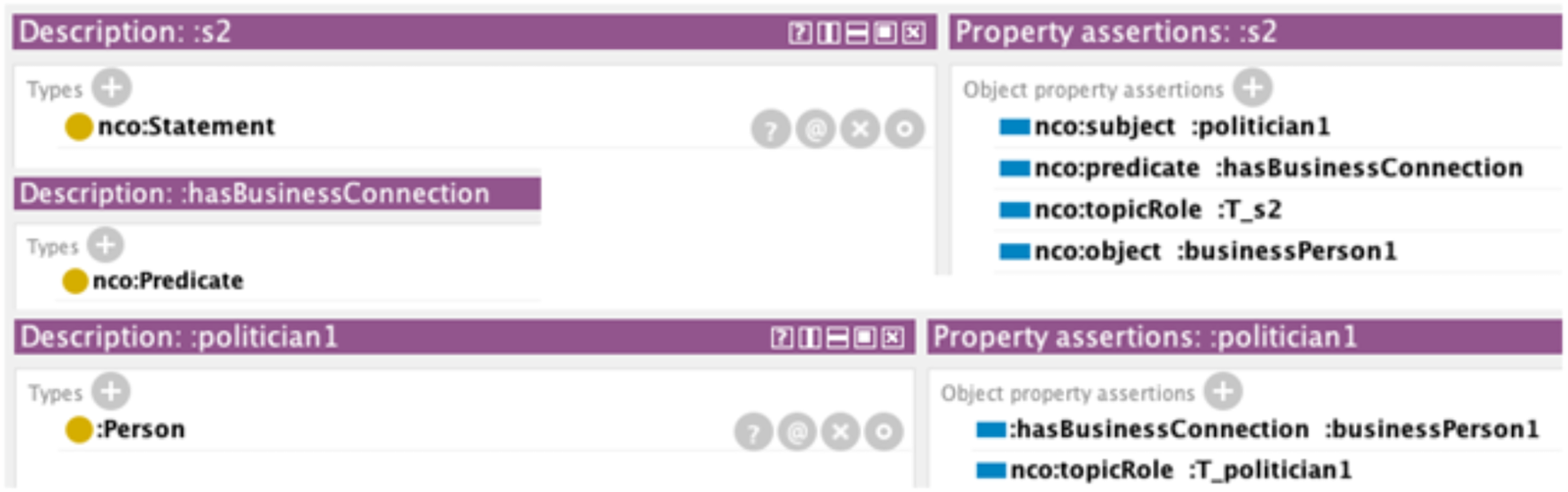
Coverage with respect to the different categories in the framework.
The class nco:Statement is also needed to model correctly claims, situations and descriptions. In particular, claims are represented in the ontology as instances of class nco:Claim, which in turn is a subclass of nco:Statement, while descriptions and situations are represented as collections of statements. To this purpose, NCO introduces class nco:Collection, whose subclasses include nco:CollectionOfEvents, nco:Situation, nco:Description and nco:Viewpoint.
Finally, aspects are represented as instances of class nco:Aspect, while the object property nco:hasAspect, with domain nco:Entity and range nco:Aspect, connects entities to their associated aspects.
In NCO, we make extensive use of OWL property chains to represent several axioms that are included in the model. These are presented in what follows.
Characterizing Membership of a Collection
As discussed in Section “Representing Collection of Events,” an entity can be a member of a collection if and only if it satisfies the relevant unifying factor. This constraint is represented in NCO through the following property chains:
ObjectProperty: nco:hasElement SubPropertyChain: nco:hasUnifyingFactor
ObjectProperty: nco: satisfiesUF SubPropertyChain: nco:isElementOf
Using Property Chains to Ensure Correct Propagation of nco:hasTopic Rules
As discussed in Section “Characterizing Entity Aspects and Relations as News Topics,” if an entity aspect or a relation between entities is the topic of a news item, then also the entity associated with the aspect and the constituent entities of the relation are topics of the news item in question. These requirements are captured through the following property chains:
ObjectProperty: nco:hasTopic SubPropertyChain: nco:hasTopic
ObjectProperty: nco:hasTopic SubPropertyChain: nco:hasTopic
ObjectProperty: nco:hasTopic SubPropertyChain: nco:hasTopic
ObjectProperty: nco:hasTopic SubPropertyChain: nco:hasTopic
In addition, if a news item, say ni, has been associated to a topic, say T1, and T1 is a nco:subTopicOf T2, then we also want to associate ni with T2. To this purpose, the property chain below is also included in our model:
ObjectProperty: nco:hasTopic SubPropertyChain: nco:hasTopic
ObjectProperty: nco:hasTopic SubPropertyChain: nco:hasTopic
Other Property Chains Included in the NCO Ontology
Another property chain models the situation where a claim, say c, appears in a news item (without necessarily being a topic of the news item), and therefore, we also want to associate the news item in question with any viewpoint to which c belongs. This is shown below:
ObjectProperty: nco:hasViewpoint SubPropertyChain: nco:hasClaim
ObjectProperty: time:intervalBefore SubPropertyChain: nco:isTimeOf
ObjectProperty: nco:hasTime SubPropertyChain: nco:isOmittedEventOf
Ontology Evaluation
The logical and structural consistency of the NCO ontology was checked by means of the HermiT 1.4.3.456 reasoner running in Protégé 5.6.3. The reasoner classifies all classes and object properties without reporting any errors. In total, the NCO ontology includes 50 classes and 1622 axioms. In addition, we also tested the ontology against the set of formal requirements expressed in the formal specification provided in Section “A Formal Model of News Classification.” In particular, these include (but are not limited to):
Correct propagation of topic classification assignment from aspects to associated entities. Correct propagation of topic classification assignment from reified statements to the components of the relevant triple, in accordance with the requirement specified in Section “Characterizing Entity Aspects and Relations as News Topics.” Correct propagation of topic classification assignment through the topic hierarchy. Correct propagation of topic classification assignment from claims to relevant viewpoints. Correct modeling of the axioms characterizing collections, as for specification in Section “Representing Collection of Events.” Correct enforcement of constraints about the time indexing of prediction and omission events. Correct realization of meta-modeling machinery supporting the representation of reified statements, claims, situations, descriptions, and viewpoints. Correct importing of IPTC news codes. PREFIX rdf:
http://www.w3.org/1999/02/22-rdf-syntax-ns
# PREFIX owl:
http://www.w3.org/2002/07/owl
# PREFIX rdfs:
http://www.w3.org/2000/01/rdf-schema
# PREFIX xsd:
http://www.w3.org/2001/XMLSchema
# PREFIX nco:
http://data.open.ac.uk/ontology/newsclassification
#
PREFIX ncoex:
http://data.open.ac.uk/ontology/ncoexamples
#
SELECT ?st ?sub ?p ?obj
WHERE
?p a owl:ObjectProperty .
?sub ?p ?obj .
?st a nco:Statement .
?st nco:subject ?sub .
?st nco:predicate ?p .
?st nco:object ?obj
To this purpose, we defined a suite of test cases, comprising the ncoex OWL knowledge base, which allowed us to check that the aforementioned requirements were correctly realized. In addition, we also carried out additional checks to ensure that, for instance, the ontology correctly supports generic queries about the metamodeling framework. Hence, we defined SPARQL queries able to retrieve both all triples in the ncoex knowledge base that had been reified and also the ones that hadn't. For instance, through these queries we are able to check that the knowledge base provides a correct and complete representation, at both object and meta level, of all triples expressing relations between entities, which are themselves news topics, regardless of whether they have been asserted or inferred through an OWL reasoner. More broadly, through this set of test queries, we also checked that the NCO ontology correctly supports queries that encompass both domain triples and their reified representation. As an example, we provide below the SPARQL representation of a query that retrieves all triples in ncoex that are both statements in the knowledge base and have also been reified.
Aligning NCO with DOLCE
As mentioned earlier, we have also produced a separate version of the NCO ontology that imports and is fully aligned with the DOLCE-Zero foundational ontology (D0). D0 is built on top of the DOLCE Ultralite ontology (DUL) and is designed to deal effectively with the systematic polysemy of many lexical items, whose multiple senses may create problems when used as OWL classes. To this purpose, it provides a more relaxed semantics for a number of key definitions—e.g., by allowing the modeling of lexical items that can carry a sense of physical or abstract location, event or event type, etc.
In what follows, we provide a brief outline of the way the top classes and properties of NCO have been aligned to the relevant entities in D0. 31
First of all, a number of classes in NCO are equivalent 32 to or direct subclasses of homonymous classes in D0. These include nco:Entity, nco:Situation, nco:Agent, nco:AgentRole (subclass of dul:Role), nco:Location, nco:Collection, nco:Description. For instance, nco:Collection is defined as equivalent to dul:Collection and therefore its subclasses, including nco:Viewpoint, nco: Description and nco:Situation all become subclasses of dul:Collection.
Other classes are instead interpreted according to the specific semantics they bear in NCO. For instance, nco:NewsItem is a subclass of dul:InformationEntity, while nco:Statement and its subclass nco:Claim are subclasses of dul:Situation. Here we consider a statement as denoting a situation, rather than considering it as an information item. The class nco:AgentComponent is also a subclass of dul:Situation, since it reifies the n-ary relation between an agent, its role in a context, time, etc. The class nco:UnifyingFactor is instead a subclass of dul:Description, following the collection semantics of DUL.
A special case is nco:Aspect, which can be any entity, and is aligned as a subclass of dul:Entity.
The alignment of properties follows from the class alignment. For instance, nco:characterizes is a sub property of dul:isSatisfiedBy; nco:concernsTopic is a sub property of d0:hasFocus; nco:dependsOn is interpretable as a sub property of dul:isPreconditionOf; nco:hasClaim is semiotically interpretable as a sub property of dul:expresses; nco:hasElement is equivalent 33 to dul:hasMember; nco:hasJustification is a sub property of dul:hasInScope, as it associates a claim situation to its justifying situation.
The result of the alignment can be seen as providing a different semantics for NCO, in terms of the foundational entities defined by D0. In addition, the alignment has been validated by showing that the resulting ontology, News2D0, remains coherent and its reasoning capabilities can be safely applied to news annotation.
Empirical Validation of the Framework
An initial validation of the framework was carried out by an MSc student at the University of Bergen, in the context of her master's project in Information and Media Studies. In particular, she manually classified a corpus of 224 news articles, which were retrieved from two news outlets, Aftenposten, a Norwegian newspaper, and The Guardian, a British newspaper. The articles were collected by visiting the news outlets’ websites on different days and collecting links for all the stories published on that particular day. This was done to maximize diversity in the corpus, under the assumption that the news on a particular day tends to be dominated by events that have occurred in the previous 24 hr. Because of an imbalance in the number of articles published each day in the two news outlets, the collection of Aftenposten news articles required more days than The Guardian, as the aim was to produce a reasonably balanced corpus. In total, 100 news items were collected from the Aftenposten and 124 from The Guardian.
As shown in Table 1, all categories in the framework were represented in the news corpus, hence providing an initial confirmation that the framework appears to cover all the topics that news items focus on. The only category that was sparsely represented was “Collection of Events,” which did not appear in any AftenPosten story and only appeared in a couple of Guardian stories, even though we have additional evidence of the value of this category from other contexts—e.g., see the sample story mentioned in Section “Collection of Events.”
Coverage With Respect to the Different Categories in the Framework.
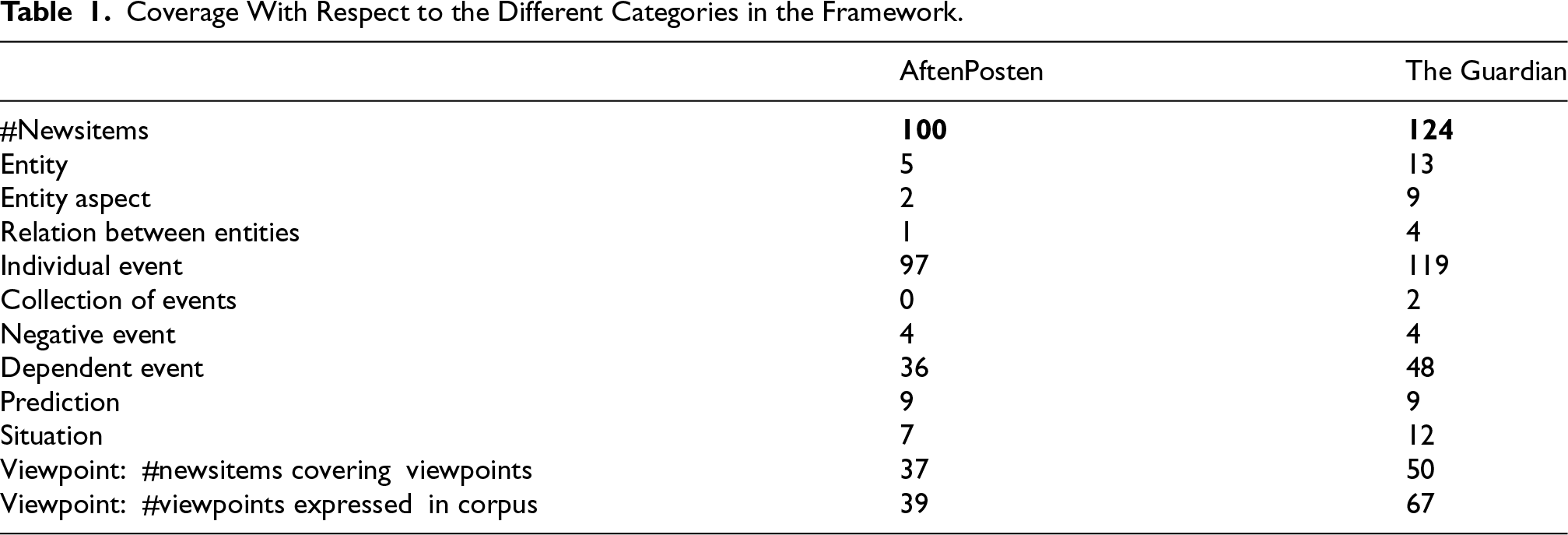
Coverage With Respect to the Different Categories in the Framework.
The annotated corpus is publicly available at https://bit.ly/newscorpus2023.
To our knowledge, there has not been any attempt in the literature at mapping out a comprehensive model of what types of concepts provide the main subject matter for news items. Indeed, the vast majority of relevant computational research has focused on developing formal representations and information extraction methods for specific classes of relevant concepts, such as named entities and events, without necessarily addressing the broader picture.
Research in media science has instead focused on notions such as news values (Harcup & O'Neill, 2016), news angles (Motta et al., 2020), and news frames (De Vreese, 2005), which help to characterize the types of stories that tend to be newsworthy (e.g., stories about celebrities) and the way journalists frame them. Hence, these analyses are somehow orthogonal to the work presented in this article, which focuses not on the style of communication in the news domain but on characterizing the generic types of concepts that provide the subject matter for news items. As already mentioned, the exception here is the notion of agenda setting, which is also concerned with the salience of issues in the media. However, this notion primarily focuses on the impact of this topic selection process on the public, rather than on the epistemology of news topics.
Entities, Events, and Situations
As discussed in Section “Entities,” highly performant methods for Named Entity Recognition and Entity Linking are already in routine commercial use, even though this is still a very active area of research—e.g., see recent zero-shot approaches based on neural architectures (Wu et al., 2020). In addition, methods for relation extraction (Gangemi et al., 2017; Martinez-Rodrigues et al., 2018; Wadden et al., 2019) are also available. Here, a very promising approach entails the adoption of large-scale language models, based on the transformer architecture, such as GPT-4 (OpenAI, 2023), LaMDA (Thoppilan et al., 2022), and LLaMA 2 (Touvron et al., 2023), among others. These models have demonstrated efficacy in extracting entities and relationships to generate knowledge graphs from textual corpora (Peng et al., 2023). This is typically achieved either through task-specific fine-tuning or by employing a few-shot learning approach (Mihindukulasooriya et al., 2023). However, more research in this area is needed to reach the level of performance and usability required for effective fine-grained news classification, in particular with respect to relation extraction.
Researchers in open domain event extraction have, in recent years, taken advantage of large-scale semantic resources, such as FrameNet (Baker et al., 2003) and Wikidata events (Rudnik et al., 2019), which provide generically applicable schemas that can support the event extraction process. In particular, Huang et al. (2018) have developed a state-of-the-art technique, showing that it is possible to take advantage of the semantic structure of known events to learn the extraction of new event schemas, using a zero-shot transfer learning approach. More recently, Fincke et al. (2022) have shown that by reframing event extraction as a question-answering task and by “priming” a language model depending on the question being asked, they were able to improve the performance of an event extraction module in a zero-shot cross-lingual setting.
These improvements in event extraction have gone hand in hand with the development of formal models for event representation. The Simple Event Model provides a foundational ontology for events, which is independent of any particular domain and is “designed with a minimum of semantic commitment” (van Hage et al., 2011). Thanks to its simplicity and flexibility, this model has been very successful, providing the basis for a variety of large-scale event extraction initiatives in the news domain, such as (among others) the NewsReader project (Rospocher et al., 2016) and EventKG (Gottschalk & Demidova, 2018), a large-scale knowledge base that includes about 700K events and over 2.3 million temporal relations. The EventKG model extends SEM by supporting the specification of temporal relations between entities and between entities and events, and also by providing mechanisms to state the provenance of event information—e.g., by linking an event to the source from which the event has been extracted. EventKG also provides the foundation for a more recent large-scale event knowledge base, the Open Event Knowledge Graph (OEKG), which augments EventKG with a variety of other datasets (Gottschalk et al., 2023). Another initiative developing a comprehensive, large-scale ontology for events is the Rich Event Ontology (Windisch Brown et al., 2017), which builds on DOLCE (Borgo et al., 2022), integrates a variety of semantic resources, including FrameNet (Baker et al., 2003) and VerbNet (Schuler, 2005), and provides thousands of event classes.
However, in the context of the framework proposed in this article, it is important to emphasize that current event ontologies tend to focus on events as “things that have happened,” while very little attention has been given to negative events, intended as occurrences that have not happened as a result of an agent's deliberate decision of not performing an action. Hence, more work is needed to improve our ability to identify this type of event in the news domain and other contexts. Analogously, while there is much work in the literature on formal representations of situations—e.g., see the work by Gangemi and Mika cited earlier (Gangemi & Mika, 2003), the information extraction field has not traditionally considered situations as a separate epistemological entity from events and therefore research in this area is lacking. The only exception is the work on situational awareness in domains such as smart cities (Neshenko et al., 2020) and cybersecurity (Nikoloudakis et al., 2021), where situations, however, tend to be characterized in a domain-dependent way—e.g., as a set of relevant data points in a smart city system.
Categorical Topics in News Classification
Approaches to classifying news in terms of generic categories, such as the ones provided by the IPTC news codes, have been available for several years (Bacan et al., 2005), and indeed, commercial services, such as Quantexa News Intelligence, already classify news items automatically in terms of the relevant IPTC categories. However, these taxonomies are manually generated and therefore evolve rather slowly. Hence, there is a need for accurate computational solutions, which can speed up the evolution process and ensure that these taxonomies are able to keep up with the variety of generic topics that regularly emerge in the media. This type of algorithm is now available to support the automatic evolution of taxonomies of research areas (Osborne & Motta, 2015)] and, in principle, could provide the basis for analogous solutions for automatically generating comprehensive taxonomies of media topics.
Another issue we have already mentioned concerns the need to integrate coarse-grained and fine-grained classification mechanisms, taking as a starting point the work by De Clercq et al. (2020), which associates IPTC codes with event data.
Characterisations of Viewpoints in the Literature
As discussed in Sections “The Commentary Element: Viewpoints” and “Characterising Viewpoints,” we consider viewpoints as positions expressed in the media that open up different perspectives on an issue. This leads to the formal definition expressed in Section “Characterising Viewpoints,” where a viewpoint is characterized as a collection of claims that subscribe to the same position—i.e., a set of claims that do not “construct different meanings,” according to the theoretical framework proposed by Baden and Springer (2017).
Argumentation frameworks for characterizing networks of claims have been available for a long time (Toulmin, 2003)—the first edition of the influential book by Stephen Toulmin cited here was published in 1958—and have formed the basis for a number of formal representations for modeling arguments (Buckingham Shum et al., 2000; Peroni et al., 2012). Compared to the extensive set of relations defined in the framework of Rhetorical Structure Theory (Mann & Thompson, 1988), both these formal models and argument-mining tools (Cabrio & Villata, 2018) tend to focus on a small set of key relations, such as those that link a claim to its premise and the attacks/supports relations between claims. However, while in principle supports relations between claims can be used to identify congruent claims that belong to the same viewpoint, to our knowledge our recent experiment on capturing the viewpoint dynamics in the news (Motta et al., 2024) provides the only example in the literature that, consistently with the framework presented in this article, connects the notion of viewpoint expressed in the media literature to a concrete computational approach, able to identify the viewpoints relevant to a specific topic and characterize them with respect to a set of congruent claims.
In addition, research on argument mining tends to focus on claim and relation identification in a rather context-independent way, while the news domain is characterized by a degree of redundancy, where multiple news sources often discuss the same topic at the same time, expressing converging or diverging viewpoints. This feature of the news domain is exploited in the work by Park et al. (2010), who observe that initial news items about an event or issue tend to be similar, while later articles from different sources are more likely to introduce diverse viewpoints. They also take advantage of the structure of a news item, giving more weight to the head of the article in question. However, despite introducing these interesting heuristics and realizing the approach into a concrete news browser, NewsCube, their approach is keyword-based and therefore prone to noise. Vilares and He (2017) go beyond the solution proposed by Park et al. by adopting an unsupervised LDA-based approach that attempts to jointly identify topics and viewpoints. They also generate readable summaries of the main viewpoints by identifying sentences associated with the most discriminative words in the relevant topic-viewpoint model. However, as with the approach by Park et al., they also use a rather syntactic (i.e., keyword-based) approach to modeling, and moreover, the quality of the generated summaries tends to vary significantly, often highlighting sentences that do not necessarily express a viewpoint, in the sense of providing a contrastive opinion. The approach by Trabelsi and Zaïane (2019) exhibits a performance improvement by taking advantage of the dialectic structure of posts in a forum. They also use effective heuristics for summarizing viewpoints, such as focusing on verbal expressions and choosing expressive summaries out of a clustering process of candidate phrases. However, their approach capitalizes on interactions between different post creators on social media and therefore is not directly applicable to our news scenario. Indeed, as pointed out by Doan and Gulla (2022) in the context of identifying political viewpoints, “the current state of the art falls somewhat short of our goal with automatic political viewpoint identification” (Doan & Gulla, 2022). We believe that the same remark can be made about the state of the art concerning viewpoint identification in the news domain. Our aforementioned work on capturing the viewpoint dynamics in the news (Motta et al., 2024) provides an initial step towards tackling the challenge of developing effective solutions for this task.
Another research area that is relevant here is stance detection (Allaway & McKeown, 2023), which focuses on identifying the attitude (stance) expressed by an agent towards a target. While stance detection has originally focused on rather restricted scenarios (e.g., identifying positive and negative reviews for a product), more recent work is tackling scenarios that are closer to the one described in this article—in particular, by considering claims expressed in a news item or social media posts as targets for a stance detection method and including both a topic classifier and a Topic-Guided Stance Detection module in the architecture (Arakelyan et al., 2023). However, more work is needed to customize and extend these techniques to support effective viewpoint identification in the news domain.
Related Work in Ontology Engineering
A variety of ontologies in the literature cover the notions of events and situations, including both upper-level ontologies (Borgo et al., 2022) and also more specific proposals that focus on these concepts (Attard et al., 2013; van Hage et al., 2011; Scherp et al., 2012; Windisch Brown et al., 2017). As already pointed out, our characterization of events is based on our earlier work on the News Angle Ontology (Motta et al., 2020), which describes events in terms of agents, location, and time. As far as situations are concerned, here we subscribe to the design proposed by Gangemi and Mika (2003), which distinguishes between descriptions and situations and is compatible with a representation of these concepts as collections of statements. The article by Gangemi and Presutti (2022) is relevant to our formalization of viewpoints, as it models a perspective as a cognitive device that makes it possible to impose multiple lenses on an event or situation by taking a particular cut over the event or situation in question. In contrast with our characterization of viewpoints as collections of semantically congruent claims, this definition focuses on characterizing the narrative-centric process of constructing a perspective. The notion of viewpoint is also implicitly tackled in argumentation ontologies (Buckingham Shum et al., 2000; Tempich et al., 2005), which model positions or claims concerning an issue and then provide relations to state which positions/claims are in agreement or disagreement. In contrast with these approaches, we identify the group of claims that constitute a viewpoint through a unifying factor associated with a viewpoint, rather than by stating agree/disagree relations between claims. Our approach, which follows the model proposed by Carriero et al. (2021), has the advantage of making explicit the criterion associated with a viewpoint. In addition, it can also be easily integrated with representations where agree/disagree relations are asserted between claims.
As far as the news domain is concerned, ontologies for annotating news content have been developed by major media organizations, such as the BBC. In particular, the BBC Storyline Ontology 34 centers on the notion of storyline, which groups together the various elements of a journalistic narrative. Thus, a storyline may include a number of news items and also cover different but related events. This ontology also covers the notion of topic; however, it limits it only to entities, such as people and organizations, and themes. Our earlier work on the News Angle Ontology (Motta et al., 2020) has instead focused on characterizing news angles, which can be seen as design templates that can be used to shape the narrative around an event or set of events. The ontology engineering literature also comprises broader multimedia ontologies (Arndt et al., 2007); however, these focus primarily on the process of annotating digital content—e.g., a JPEG image, rather than topic classification.
Conclusions
In this article, we have discussed the limitations of current solutions for news classification and highlighted the gap between the current state of the art in computational solutions for news content analysis and the needs of media scholars and practitioners. Crucially, we have also argued that in order to address this gap, it is necessary to develop a better understanding of the task of fine-grained news classification, in particular by identifying the various categories of entities that can be the focus of news items. To this purpose, in this article, we have presented a formal framework that characterizes news topics in terms of a typology comprising entities, events, situations, categorical topics, and viewpoints. The framework has been realized into a family of open-source ontologies and empirically validated by manually annotating a corpus of news items randomly drawn from Norwegian and British newspapers.
Having developed the framework, the next step of this research will focus on applying it to support effective computational methods for fine-grained news classification. In particular, while a variety of information extraction methods already exist for certain types of news topics, in particular entities and events, much novel work is needed to develop effective techniques to recognize other elements of our framework, such as negative events, situations, and viewpoints. To tackle this challenge, we plan to capitalize on recent advances in large language models, which have paved the way for new opportunities in information extraction. Crucially, these techniques need to be guided by robust domain representations in order to yield verifiable and high-quality outcomes (Emelin et al., 2022; Yang et al., 2024) while avoiding hallucinations (Beutel et al., 2023). Hence, a key research hypothesis underpinning this work is that the formal framework presented in this article may play an effective role in enabling novel model-driven information extraction solutions, tailored to the task of fine-grained news classification.
Another challenge in this context concerns the development of an effective solution able to identify correctly the news topic—that is, able not only to extract, for example, the correct representation of an event reported in a news item, but also to conclude accurately that the event in question is indeed the correct focus of the news item. Here, we expect to be able to take advantage of the writing style used by journalists, which typically uses the title, byline, and lead paragraph of a news item to emphasize the focus of a story.
While the key goal of our research is to support better news analytics, it would also be interesting to examine whether the combination of this framework and appropriate computational linguistics methods can be used in news synthesis—e.g., to generate news summaries that take advantage of the structured representation proposed in our framework. This is indeed an important challenge in the media industry, where effective methods for reformulating and summarizing content in different contexts (e.g., social media, news feeds) define essential capabilities in the modern, highly heterogeneous media landscape. In particular, our hypothesis (yet to be tested) is that, by explicitly capturing the variety of key constituent elements in a news item, such as, topics, actors, events, and viewpoints, it may be possible to generate more effective alternative formulations or summaries of news content compared to current methods (Oliveira & Lins, 2024).
In conclusion, the proposed conceptual framework for news classification defines the first step of our research agenda, whose ultimate goal is to develop better solutions to enable a variety of user audiences, including media scholars and practitioners, commercial media companies, and policy makers and regulators, to effectively make sense of the dynamics of topics and viewpoints in the media. We are very much looking forward to the next phases of this work.
Footnotes
Funding
The author(s) received no financial support for the research, authorship, and/or publication of this article.
Declaration of Conflicting Interests
The author(s) declared no potential conflicts of interest with respect to the research, authorship, and/or publication of this article.
