




Abstract
Introduction
Previously, prior to 1970s, the preliminary studies considered the rehabilitation methods on flexor tendon injury postsurgical repair focused on keeping the flexor tendon immobilized for the first 3 weeks. 1 However, as shown in the previous studies, the tendon's tensile strength will be low at this stage. The purpose of this rehabilitation methods after surgical repair is to yield normal function and tendon gliding movement, yet, to avoid the tendon rerupture, flexion contracture and scar adherence.2,3 Flexor tendon injury can be a challenging process for most hand surgeon due to several clinical problems, for example; flexor tendon injury should be managed with operative treatments. Flexor tendon will not heal spontaneously without surgery because the end of tendon should bring together to promote healing. On the other hand, postsurgical problem may result in rerupture and stiffness and postsurgical rehabilitation should be meticulously planned.4–6 The rehabilitation postsurgery has a function to prevent tendon adhesion and improve the gliding movement, even tough, if the rehabilitation managed too aggressively, the postrepair tendon has tendency to rupture or become stiff.7–9 Addressing injury in zone II flexor tendon may also become problematic, it needs to sustain the anatomic connection between flexor digitorum superficialis (FDS) and flexor digitorum profundus (FDP) tendon. FDS tendon has two slips that it has to roll around the FDP tendon, to permit FDP pass through FDS and lie down in the superficial champers chiasma. When the hand surgeon fails to remake this anatomical relationship, it will restrain tendon to glide and increase the risk of adhesion and restrict the digital movement.10,11
In the middle of 1970s, Duran and Houser, 12 delineate their method which involved “controlled passive motion” and reported that the restrictive adhesions tendon may be prevented with 3 until 5 mm length of tendon excursions. Concomitantly, Kleinert et al. 13 investigated the promising outcome using direct passive motion postsurgical with a rubber band as an orthosis to pull back the finger and permit active finger extension, with producing passive flexion movement of finger. His study revealed that the mobilized tendon postoperative showed less adhesion and faster healing rate than prolonged immobilized tendon.
The progression of modification rehabilitation protocols following flexor tendon injury grows rapidly since then, accompanying with furtherance in surgical methods and materials. On the other hand, there is still a debatable area to determine the ideal rehabilitation methods to achieve a functional outcome of post-tendon repair, although, many previous publishing reports have declared a novel rehabilitation protocol.14,15
There are many varieties of rehabilitation methods regarding flexor tendon injury, yet the principal methods are “active extension-passive flexion” by Kleinert et al. 13 using rubber band orthosis. In the second place, “controlled passive movement” (Duran and Houser protocol) used a passive motion within range 3 to 5 mm of the involved digits followed by active digit flexion. The last protocol is the combination between Kleinert and Duran protocol. Chesney et al. 16 in their study has compared those three protocols’ overview following postsurgical repair in zone II flexor tendon injury and generated that the combined technique resulted less incidence of tendon rerupture and more tolerable range of motions. 17
Formerly, there has been several published systematic review and meta-analysis which has been compared, one of them is published by Thien et al. 18 in Cochrane library. However, this study has only included the randomized controlled trial (RCT) report. There were three full-text reports of RCT and the other three were just abstract. It concluded that the best regimen method may not be defined due to insufficient verification of trial studies.
Our review comprehensively included RCT and observational reports of the past 20 years published data, we specified our search filtered on to rehabilitation methods in flexor zone II injury “no man's land.” This review is deliberately pursuing the answer of “which rehabilitation protocols in ‘no man's land’ injury can generate the best functional outcome post-surgical repair.”
Materials and methods
Search strategy
The author seeks the relevant articles according to the Preferred Reporting Items for Systematic Reviews and Meta-Analyses (PRISMA) guidelines. We used this guideline as a set of evidence-based items to improve our systematic reviews and meta-analysis. At first, the database reports were collected through fastidious search within range 1990 until 2020, using PubMed, Cochrane library database, Ovid, Medline, and the other several published trial registries. We included all the studies with evidence based ranging from levels I to IV. The criteria of this review's study emphasized on clinical assessment, with the subject matter of the tendon rupture prevalence, flexion contracture, and functional outcome scoring using Strickland Criteria, The Buck-Gramcko Classification and Disabilities of the Arm, Shoulder, and Hand (DASH) Questionnaire following the early phase rehabilitation protocol (3 weeks) postsurgical repair in zone II flexor injury, categorized as a passive motion (Kleinert and Duran type protocol), controlled active motions (CAMs), and combination of those protocols. We analyzed each study for odds ratio (OR) for dichotomous models with 95% confidence interval (CI) and further measured using Review Manager (RevMan) (Computer program, Version 5.3. Copenhagen: The Nordic Cochrane Centre, the Cochrane Collaboration, 2014). The result's heterogenicity was elaborated as a fixed effect model if heterogeneity was <50% and the random effect model if heterogeneity was >50%.
Our initial search keywords are using “rehabilitation” and “flexor tendon” resulted in 263 articles. Furthermore, we add more keywords following the Boolean operators: Kleinert protocol OR controlled active motion OR modified kleinert rehabilitation AND duran protocol OR duran houser rehabilitation OR early passive mobilization OR early passive motion OR combination active-passive motion AND flexor tendon injury zone 2 OR hand flexor tendon rupture zone 2. Sixteen articles were included, and the total sample is 1.321 populations (Figure 1).
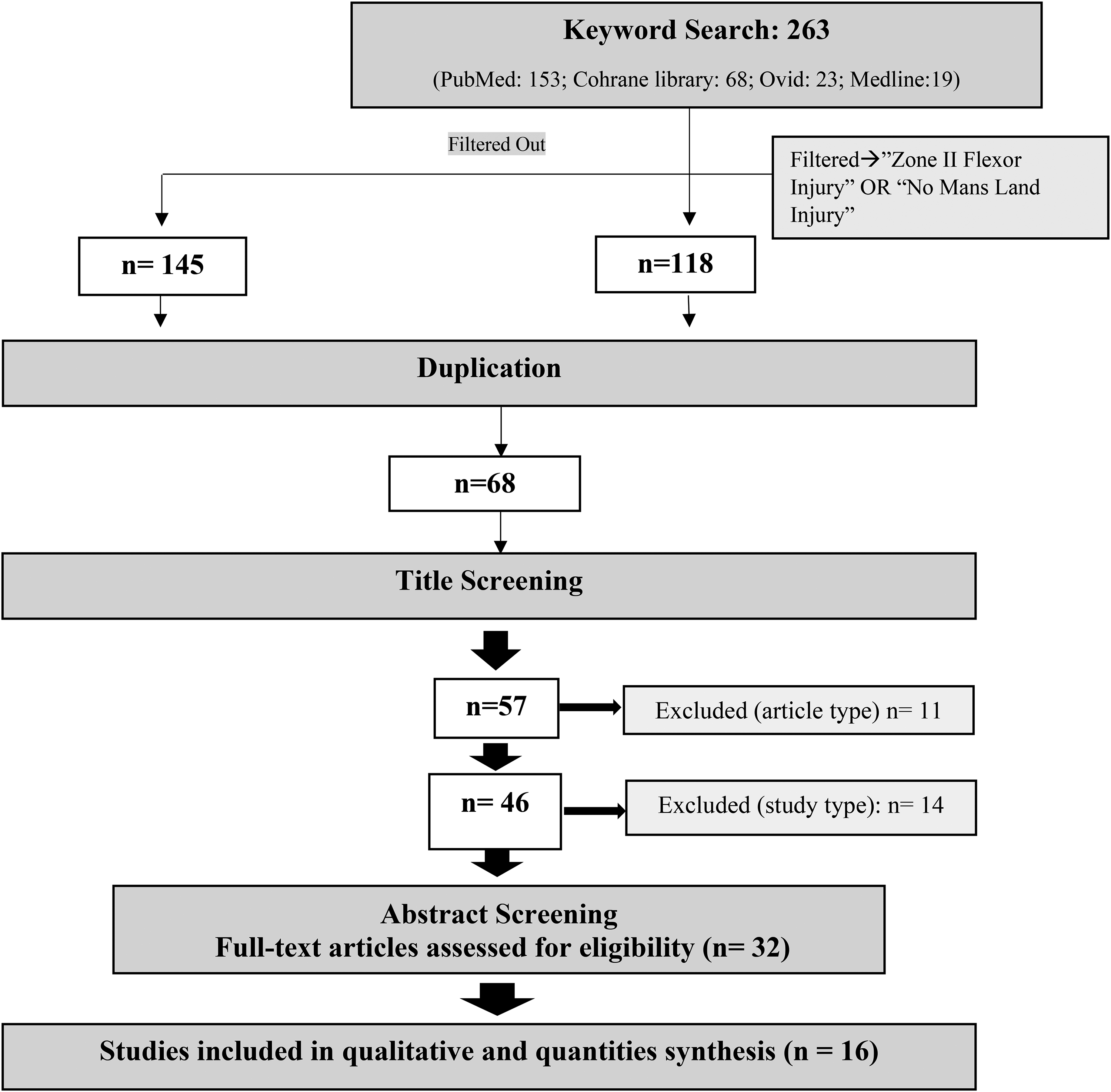
Article selection scheme.
All of the literature's component including the report's eligibility, qualification, critical appraisal, the selection studies, and trial object, also bias risk assessment, were judged by independent authors. Critical appraisal of literature is using Critical Appraisal Skill Program (CASP) question checklist on each included study. 19
Statistical analysis
The author also measured mean difference for continuous outcome and OR for dichotomous outcome, using 95% CI. It was enumerated using RevMan (Computer program, Version 5.3. Copenhagen: The Nordic Cochrane Centre, the Cochrane Collaboration, 2014). A heterogenicity interstudy was assessed by χ2 test, each study heterogenicity will be assumed if I2 > 50% and p value <0.1. The result data will be categorized as a significant if p value <0.05. To create the threshold in our meta-analysis, yet, to determine the reliable significance-based result and this review's impact of the information amount due to small sample size and low study's quality, we used trial sequential analysis by the statistical software, Trial Sequential Analysis (TSA) version 0.9 beta (User Manual for TSA, Copenhagen Trial Unit 2011). The reports will be considered to have sufficient level evidence if the Z-curve cross the upper and lower boundaries or futility line. However, if the Z-curve does not cross the boundaries, the required information size had not been reached and there will be insufficient evidence to have the conclusion.
Methods
The specification criteria for this review
Types of studies
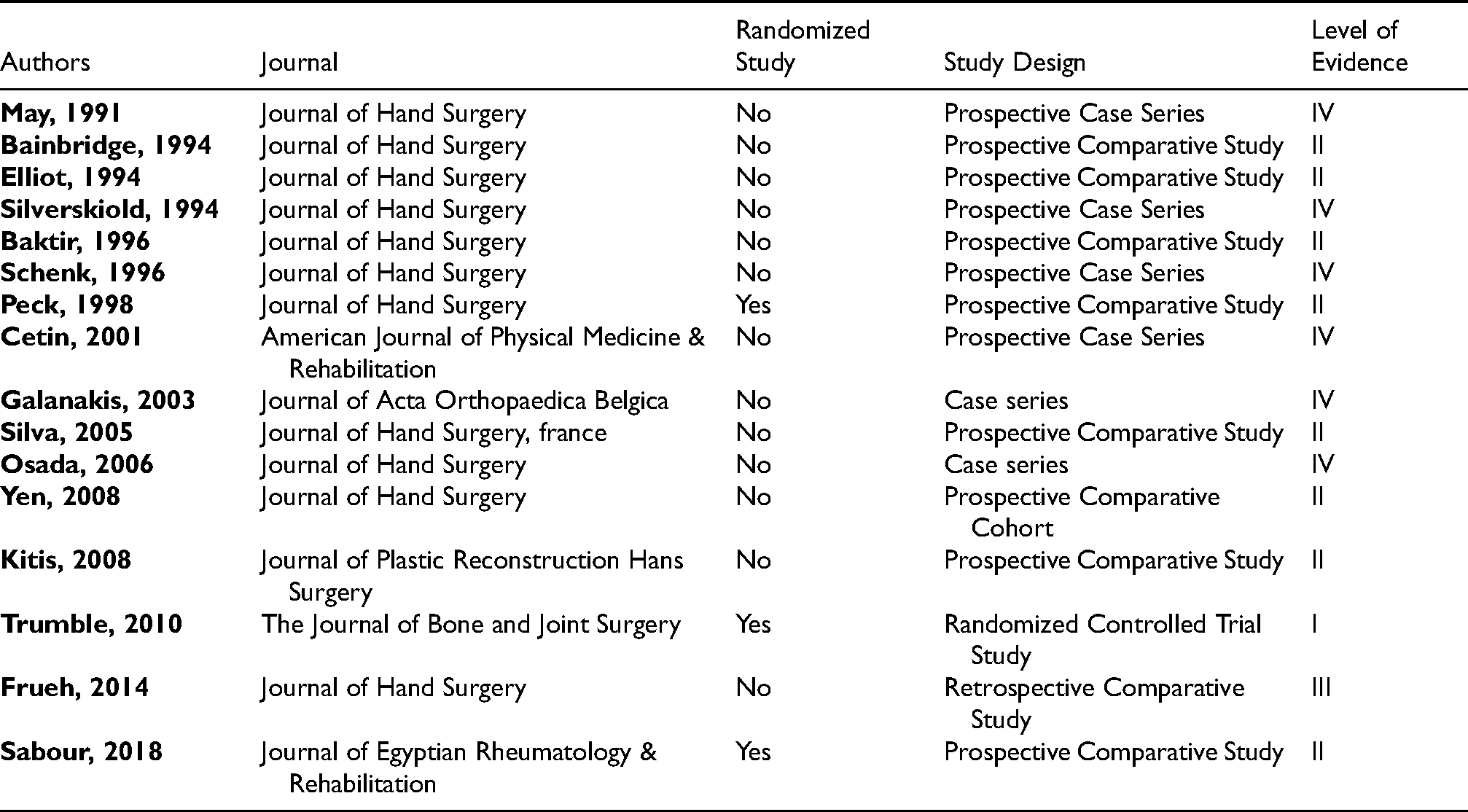
The author incorporated all type studies; included case series, cohort studies, quasi-randomized and nonrandomized study, RCT with range of evidence level varies from levels I to IV (Table 1).
Validity search methods.
Type of populations
The author particularizes the literature on human study related to early stage rehabilitation postsurgical repair in zone II flexor tendon injury.
Type of interventions
The variation of surgical method regarding zone II flexor tendon injury is well accepted on included studies followed by early stage rehabilitation:
Active extension-passive flexion (Kleinert method) Controlled passive movement (Duran Houser protocol) Controlled active movement Combination technique (Kleinert, Duran Houser and controlled active movement)
The time duration regarding injury to surgical repair and rehabilitation duration may vary on each literature.
Type of result assessment:
Post-treatment complication
- Rerupture incidence - Flexion contracture
Functional outcome assessment
- Strickland criteria - The Buck-Gramcko classification - DASH questionnaire.
20
Study quality assessments
All of the published studies were assessed and analyzed for its title and abstract as it were matched with this study's specifications. Furthermore, all of the filtered studies will be extracted to the inclusion basis. We did the critical appraisal study using checklist of CASP, then it will be finalized with the high qualification and study eligibility reviewed. All of the literature's section, comprising a study's methodological, the data variables, and risk of bias has been reviewed by the author.
Results
Study descriptions
Our electronic database summed several inclusion studies with total 16 literatures and 1.321 participants, it was divided into 4 meta-analysis and descriptive. Studies level varies from level IV evidence in 6 case series, 8 prospective cohort studies (level II evidence), 1 retrospective comparative study (level III evidence), and 1 RCT study (level I evidence) (Table 1). None of the included studies were compared altogether of those included protocols. There were 6 studies which outlined only one specific rehabilitation protocol and 10 other studies compared between Kleinert, Duran, CAM, and the combined rehabilitation protocol.
Surgical technique
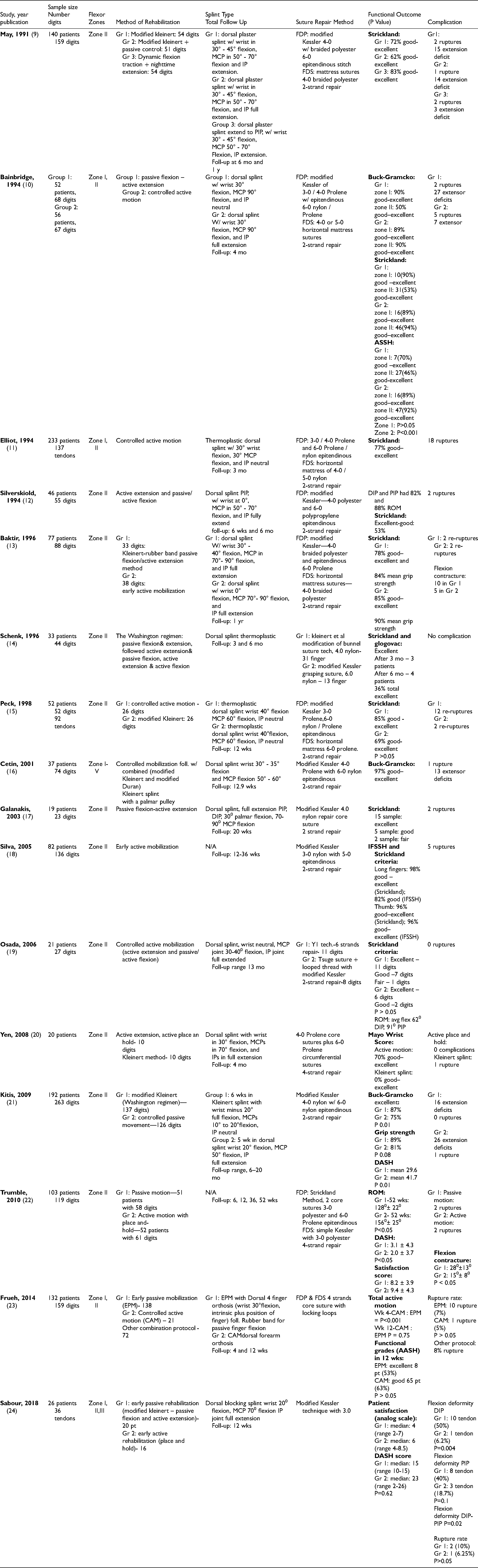
Most of the studies (10 reports) used a tendon repair technique which involved two-strands suture across the tendon. Two studies used a four-strand suture and one study used six-strand core suture. Two studies did not explain the repair tendon technique. In this review, we did not identify the correlation between suture strands number and the rerupture rate (Table 2).
Study's characteristic.
Primary outcome: Rerupture rate
We summarized the average rate of rerupture per rehabilitation protocol with the highest mean of rerupture rate is the CAM protocol at 8% (n = 48, N = 593). The mean range of rerupture is 3.3% to 8% across all of the studies. The lowest of mean rate followed by the combination protocol (Kleinert and Duran type) at 3.3% (n = 8, N = 241) (Table 2). From the meta-analysis calculation between the comparison of Kleinert rehabilitation protocol versus CAM which used fixed effect model for dichotomous outcome, it was found that there was no significant difference in terms of rerupture rate between those two rehabilitation models (heterogeneity, I2 = 40%; OR = 1.64 95% CI, 0.55 to 4.92; p = 0.37). It was also found that there was no statistically difference between Duran and CAM protocol in rerupture rate (heterogeneity, I2 = 0%; OR = 1.37 95% CI, 0.40 to 4.74; p = 0.62). In trial sequential analysis, the Z-curve does not cross both of the trial sequential boundaries, the calculation of required information size was 169, yet, a further trial with larger sample will be required (Figure 2).
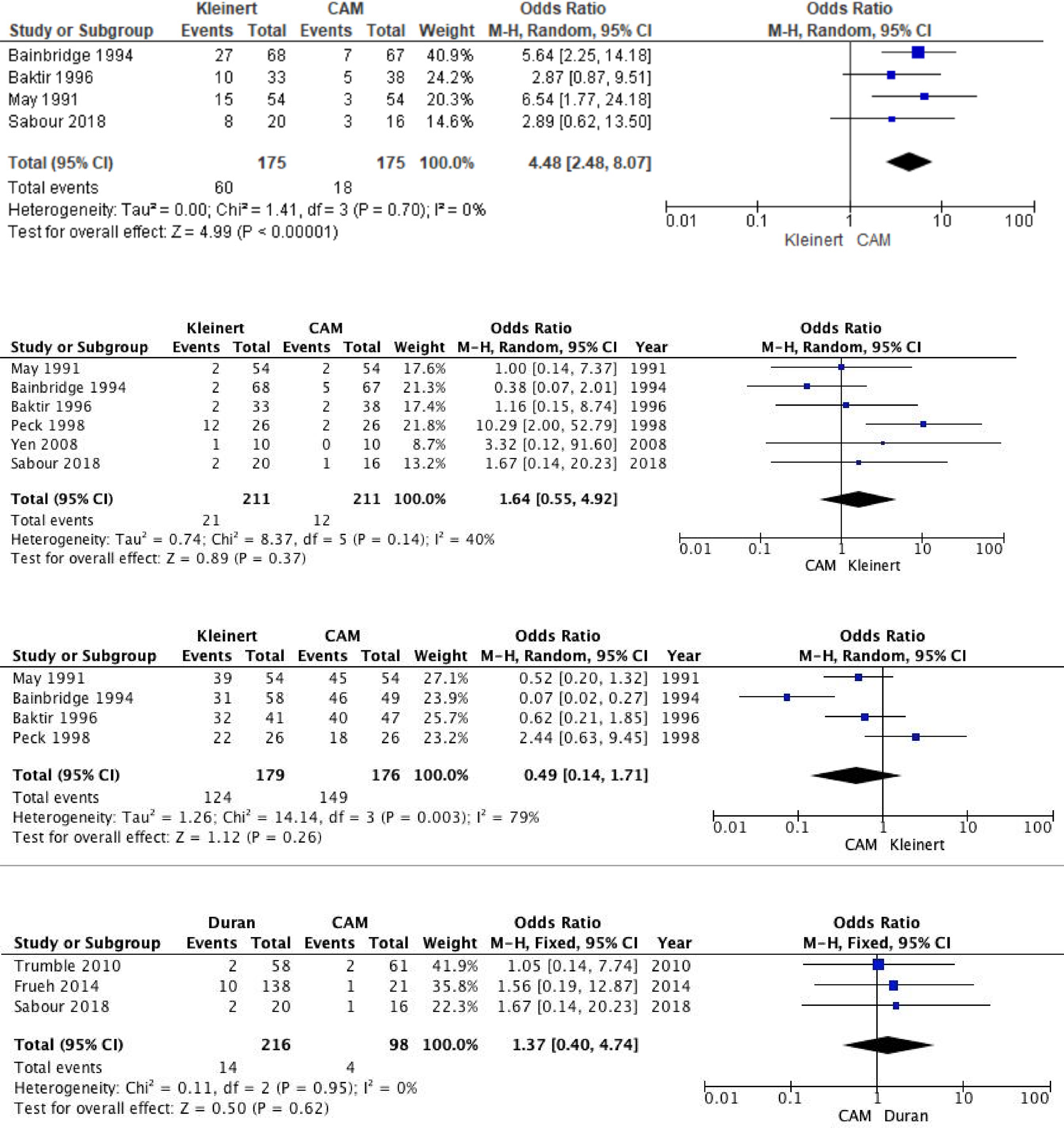
Comparison: Kleinert rehabilitation protocol versus CAM; outcome: rerupture (digits); Duran rehabilitation protocol versus CAM; outcome: rerupture (digits); Kleinert rehabilitation protocol versus CAM; outcome: flexion contracture (digits); Kleinert rehabilitation protocol versus CAM; outcome: Strickland criteria (excellent–good). CAM: controlled active motion; CI: confidence interval.
Primary outcome: Flexion contracture
The range mean of flexion contracture is 6.6% to 23.6%, with the highest mean of flexion contracture rate is Kleinert protocol at 23.6% (n = 76, N = 322) and the lowest mean rate is CAM at 6.6% (n = 18, N = 273). The meta-analysis between Kleinert and CAM used random effect model for dichotomous outcome and was found statistically significant in flexion contracture rate (heterogeneity, I2 = 0%; OR = 4.48 95% CI, 2.48 to 8.07; p < 0.00001) (Figure 2). For trial sequential analysis in term of flexion contracture between CAM and Kleinert was illustrated that the Z-score crossed the upper boundary line indicated that CAM protocol may be superior than Kleinert to reduce the incidence rate of flexion contracture (Figure 2).
Secondary outcome: Functional outcome
The functional outcome for this review was divided into three outcomes. First, we identified the comparative between Kleinert, modified Kleinert type, Duran type, combination protocol (Kleinert, Duran, and CAM), and CAM based on the Original Strickland Criteria. Eleven studies had used the Strickland criteria. For meta-analyses between Kleinert rehabilitation protocol and CAM used random effect model for dichotomous outcome, found no significant difference in Strickland score (heterogeneity, I2 = 79%; OR = 0.49 95% CI, 0.14 to 1.71; p = 0.26) (Figure 2).
For Strickland criteria's sum average on each study was found the highest excellent–good score (%) at the combination technique with mean 80% (n = 167), the lowest mean excellent–good score (%) is 53% (n = 138) in Duran type. The average of Strickland criteria in all protocols is 53% to 80%. Three studies had been used the Buck-Gramcko criteria. The highest excellent–good score in Buck-Gramcko criteria was found 97% (n = 74) in combination type protocol. The lowest mean is Kleinert-modified Kleinert type at 69% (n = 205). The mean of Buck-Gramcko outcome is 69% to 97%. The third outcome is DASH questionnaire, only three studies analyzed the DASH outcome which only compared Kleinert-modified Kleinert, Duran type, and CAM protocol. The highest mean score is 53.8 (n = 184) at Duran type, the lowest mean value is CAM at 36.7 (n = 77). The mean of DASH questionnaire is 36.7 to 53.8.
Discussion
Kleinert et al. 13 introduced the first protocol method with passive flexion and active extension. Since then, there were plentiful published experimental studies about rehabilitation novel protocol. There are many hypotheses regarding to this rehabilitation protocol in flexor zone II injury appear to be questionable. 21 One of the hardest challenges to assess this rehabilitation program is not only due to the technique of rehabilitation itself, yet it also depends on the variation of surgical technique and the functional outcome of the patient. In this review, we reveal most studies (10 reports) were using two-strand suture technique compared to the four and six strands. 22
Hung et al. 2 analyzed that he has used early active mobilization on zone II and other zone flexor tendon injury and achieved good–excellent result in 71% zone II repairs and 77% zone with statistically significant result. Riaz et al. 3 who has also evaluated using Kleinert methods on his prospective comparative study and found that 75% digits were graded excellent using american society for surgery of the hand scoring. According to Thien et al. 18 on his meta-analyses using 6 RCT, there were no significant difference between the comparison on early active motion, continuous passive motion (CPM), Kleinert and Duran protocol. He also stated that early mobilization protocol is well accepted in flexor tendon injury, yet the best regiment has not been concluded. On the other hand, Khan et al. 23 used Kleinert method on his prospective study, he analyzed 50 populations with statistically significant result that 94% patients had excellent result. Trumble et al. 24 reported his analysis through active motion protocol compared to passive motion. They reported the flexion contracture and range of motion were better achieved than passive protocol. On the other terms, patients with more improved joint movement stated a higher satisfaction than immobilized joint postsurgical. However, article by Peck et al. 25 compared the active motion protocol and modified Kleinert, 46% tendon ruptures were achieved by active motion protocol. 13
This meta-analysis has been made to overcome the complication rate postsurgical flexor tendon injury zone II. Thus, we met some challenge of the long interval on report's trends, the repair technique may vary on each study and multitude report's variable including sample populations, the tendon injury pattern and length of rehabilitation protocol. As we know, none of the recent study did the comparative study which used all of the rehabilitation method protocols. Nevertheless, through this review and meta-analysis, our expectation is to answer the question of “what type of rehabilitation is the most suitable for no man's land injury.” We analyzed that the combination protocol which combined active and passive technique is the best protocol. Through our review, the lowest rate of rerupture incidence was achieved by the combination technique, yet, the flexion contracture is minimal on the digits which were treated by CAM.
Footnotes
Acknowledgments
We would like to thank all the people who helped us with this study.
Declaration of conflicting interests
The authors declared no potential conflicts of interest with respect to the research, authorship, and/or publication of this article.
Funding
The authors received no financial support for the research, authorship, and/or publication of this article.
