



Abstract
The purpose of this review is to describe how a curriculum for minimally invasive spine surgery (MISS) was developed and implemented. The authors discuss the curriculum roadmap, its target audience, and the educational process for teaching general skills and specific procedures in MISS. Initiated by AOSpine, a panel of experts within spinal surgery from multiple centers formed the minimally invasive spine surgery task force. Together, task force members redefined the standards and milestones of the MISS education and training. Therefore, we conclude that the MISS task force created a structured curriculum which will have a positive influence on daily practice for surgeons and patients worldwide.
Introduction
This article provides a detailed report of the work conducted by the AOSpine minimally invasive spine surgery (MISS) curriculum task force. With the progressive growth of minimally invasive surgery techniques in the spine, the AOSpine Education Commission (AOSEC) conducted a global needs assessment in 2017. This confirmed a high need for education in MISS and a curriculum task force was formed to address the different needs of surgeons on a global scale. The task force consists of orthopedic and neurosurgical leaders in spinal surgery from Europe and southern Africa, Middle East, and northern Africa, Asia Pacific, North America, and Latin America. The curriculum development started in May 2018 during the Global Spine Congress in Singapore. The overall goals of the task force were to define MISS, to identify competencies to be addressed in a curriculum, describe the target audiences, and to design and implement educational activities.
MISS Curriculum Development
During the first task force meeting, 8 experts in the field presented their ideas and goals to establish the MISS curriculum and applied a structured planning process to create an educational pathway for surgeons. They strived to create a pathway that would be independent of a surgeon’s background, training level, and location of practice and therefore, be applicable to all surgeons world-wide. In addition, the MISS framework would be independent of the available types of resources a surgeon may have access to (ie, operating tools, resources, etc). As in many other surgical specialties, the best way to teach technology is to go from “simple” to “complex.” Therefore, “simple” includes the indications for surgeries, tools and technologies and can proceed into the “complex” level, which includes the teaching of surgical techniques. The curriculum would support faculty members and their focus on utilizing teaching standards that follow a “simple” to more “complex” approach of MISS techniques. Minimally invasive spine surgery (MISS) is a suite of technology-dependent techniques and procedures that reduces local operative tissue damage and systemic surgical stress enabling earlier return to function striving for better outcomes than traditional techniques (AOSpine MISS Curriculum Task Force, May 3, 2018; Singapore)
Target Audiences
The curriculum is geared toward educating surgeons who perform open surgery but have little or no MISS experience, surgeons with some experience with the microscope and tubes but not for complex MISS, surgeons with experience in MISS who use the microscope and burr even for complex cases, and surgeons of any level without any experience with the endoscope.
The task force identified the following competencies to be used as the basis for learning objectives for all educational events.
Diagnose the patient problem by correlating the clinical finding with imaging and workup
Recognize appropriate indications based on your skill set, case experience, and outcomes
Select the appropriate MISS procedure for the pathology and indication, and recognize when MISS is not the appropriate option
Correctly set up the technology, operating room, and the team of the procedure
Perform microscopic MISS procedures: posterior cervical foraminotomy, interlaminar lumbar discectomy, lumbar extraforaminal discectomy, and unilateral laminotomy for bilateral decompression
Perform endoscopic MISS procedures: interlaminar lumbar discectomy, transforaminal lumbar foraminotomy and discectomy, and unilateral laminotomy for bilateral decompression
Perform the fusion MISS procedures (percutaneous screws and rod placement, [transforaminal lumbar interbody fusion] TLIF, and lateral lumbar interbody fusion [LLIF]) and apply strategies to optimize arthrodesis
Manage complications and apply a backup plan
Use MISS techniques for revision surgery
Education for General Skills and Specific Procedures
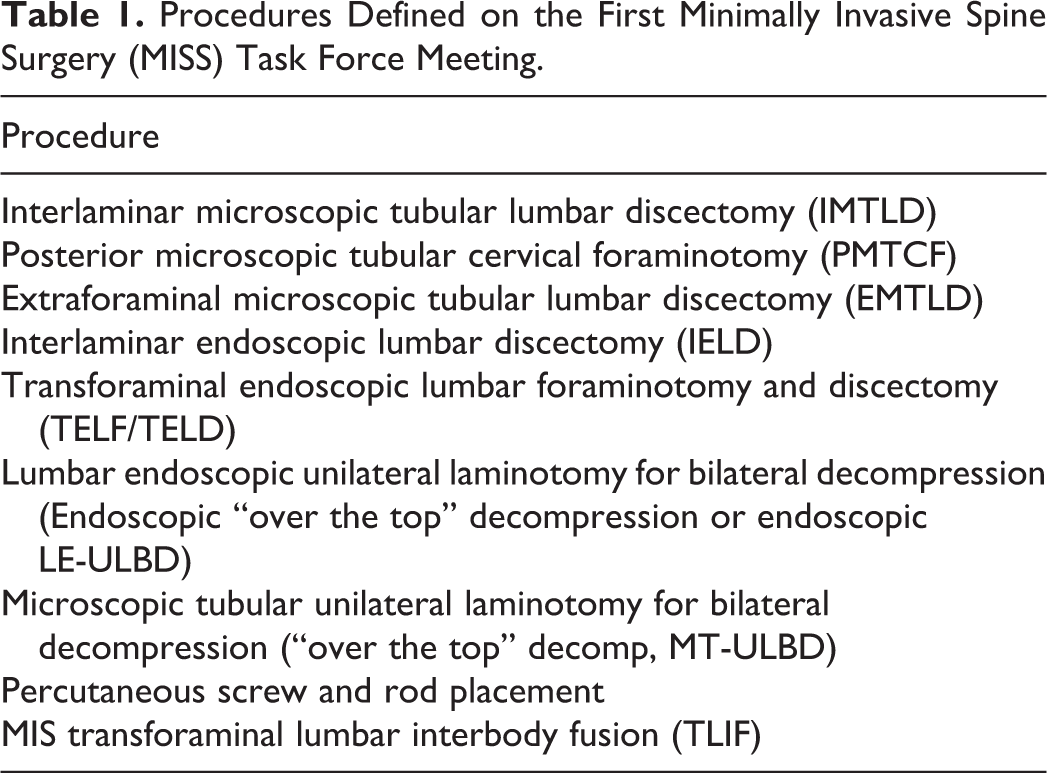
The overarching goal of the MISS course is to provide an event that participants leave being able to perform key steps in some simple MISS procedures and specific procedures safely. The taskforce would like to address surgeons and trainees at any stage of their career who want to start or to develop their skills in MISS. Therefore, the courses are built in modules and all skills are structured in steps (Tables 1 and 2).
Procedures Defined on the First Minimally Invasive Spine Surgery (MISS) Task Force Meeting.
General Skills.a
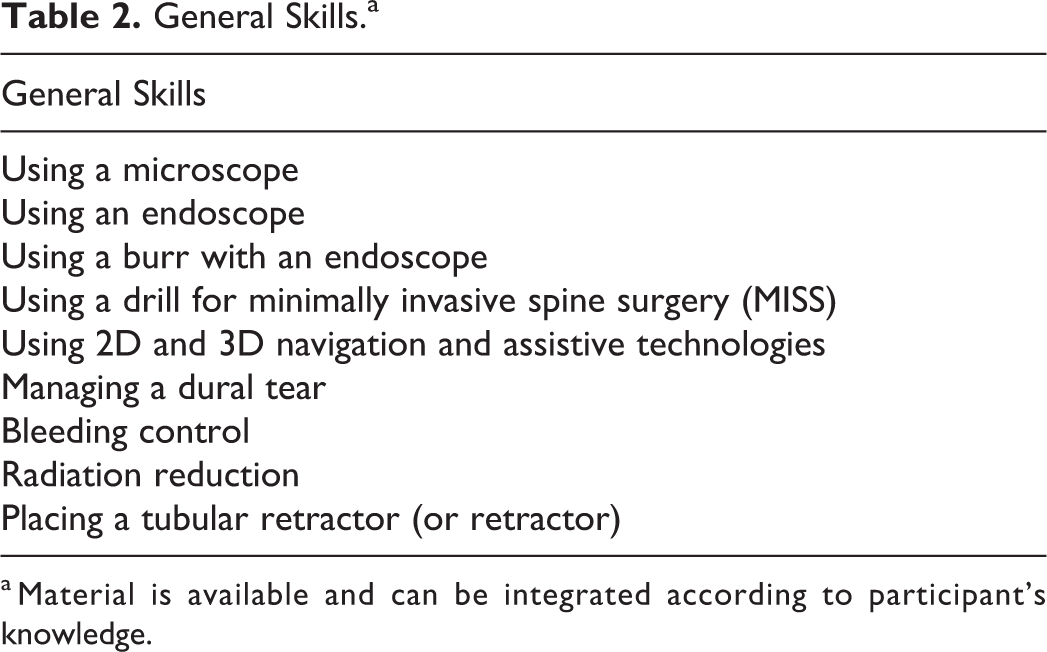
a Material is available and can be integrated according to participant’s knowledge.
Specific Procedures Identified by the Task Force
Interlaminar microscopic tubular lumbar discectomy (IMTLD)
Posterior microscopic tubular cervical foraminotomy (PMTCF)
Extraforaminal microscopic tubular lumbar discectomy (EMTLD)
Interlaminar endoscopic lumbar discectomy (IELD)
Transforaminal endoscopic lumbar foraminotomy and discectomy (TELF/TELD)
Lumbar endoscopic unilateral laminotomy for bilateral decompression (Endoscopic “over the top” decompression or endoscopic LE-ULBD)
Microscopic tubular unilateral laminotomy for bilateral decompression (“over the top” decomp, MT-ULBD)
Percutaneous screw and rod placement
MIS TLIF
Implementation of the MISS Curriculum
The first goal of the task force was to implement the new definition and nomenclature for all procedures and skills with the intention to integrate these globally. The task force has now created educational materials including presentations, cases, exercises and guides, videos, and assessments, all of which will be evaluated at educational events and then adjusted when necessary in order to maintain excellent teaching standards. The next goal is to define and engage new faculty and collaborate with other groups.
The curriculum will be implemented in all AOSpine MISS courses and integrated as modules in courses where the topic is included. These courses will be evaluated with adjustments made to the curriculum when necessary. In addition, the task force will characterize deformity procedures for combined approaches and explore the integration of MISS into other forms of education, such as the AO Surgery Reference and an updated version of the AOSpine MISS book, to include all efforts made within the past 3 years—updates to definitions and nomenclature, instrumented procedures, evidence-based research, and so on (Figures 1 and 2).
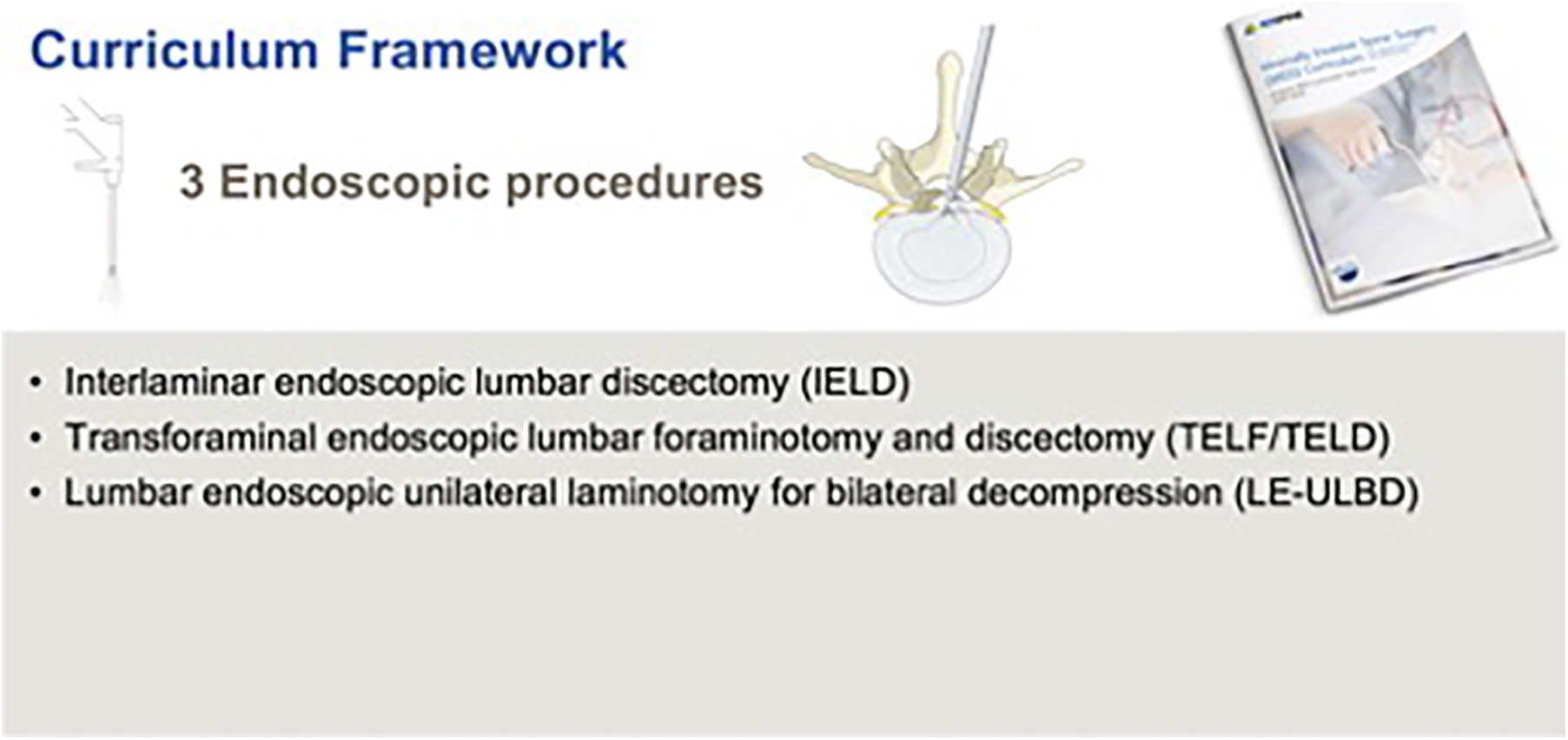
Picture showing example for educational material for endoscopic procedures.
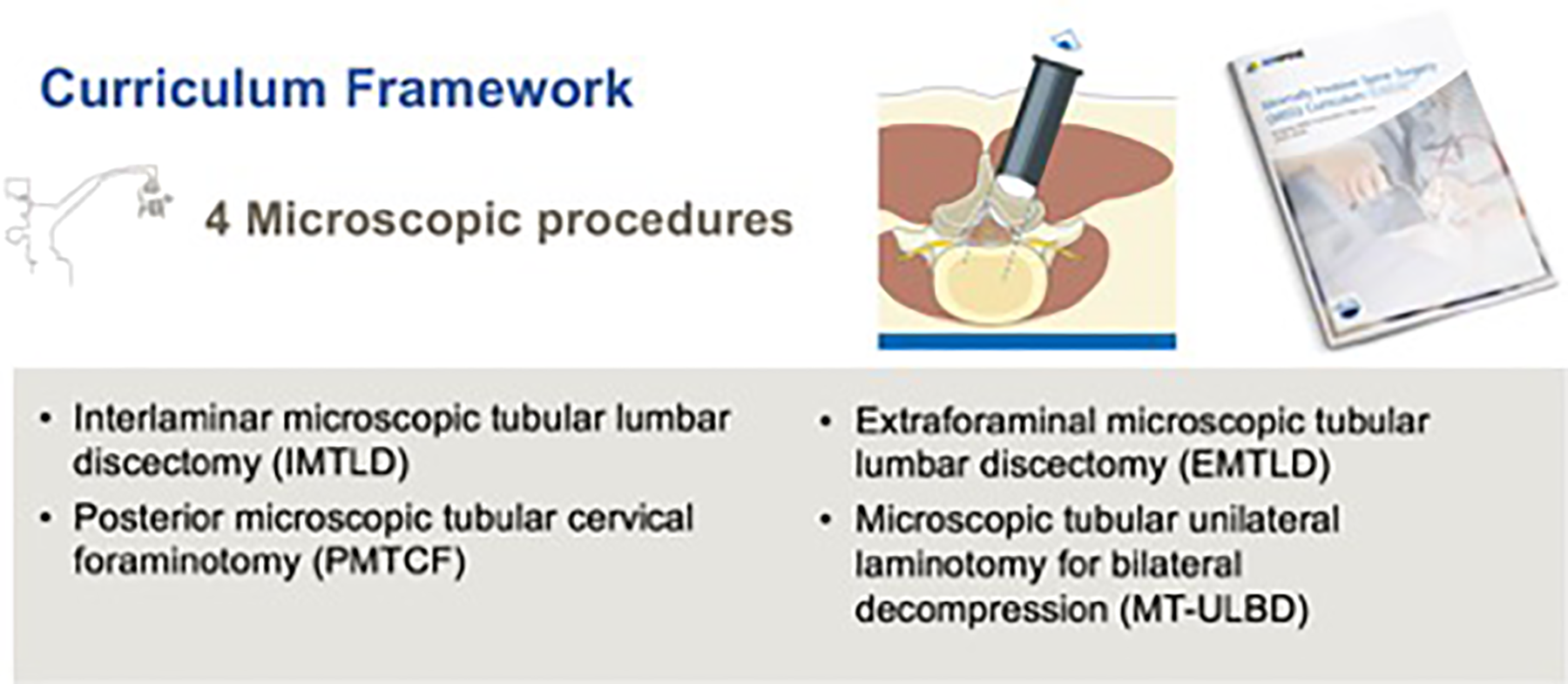
Picture showing example for educational material for microscopic procedures.
Conclusion
The MISS task force brought together a panel of highly qualified surgeons interested in addressing the need for a structured curriculum. The task force has future goals focused on creating standardized MISS courses. The goal will be to integrate the curriculum in different topics like trauma, degenerative disease, deformity, tumors, metabolic diseases, and infectious diseases. The MISS curriculum intends to have a positive influence on daily practice for surgeons and patients worldwide. Futures studies on the impact of the education are required and patient outcome data through registries can be collected and analyzed.
Footnotes
Acknowledgments
Melanie Schatz and Staffan Källbäck (AOSpine), Michael Cunningham (AO Education Institute).
Declaration of Conflicting Interests
The author(s) disclosed receipt of the following financial support for the research, authorship, and/or publication of this article: RH has received funding from AOSpine, Brainlab, DePuy Synthes, Lanx.
Funding
The author(s) disclosed receipt of the following financial support for the research, authorship, and/or publication of this article: This supplement was supported by funding from the Carl Zeiss Meditec Group.
