




Abstract
This study investigates how a prosocial propensity, an inherent human attribute characterized by the willingness to incur personal costs for the benefit of others, functions as the foundation of water-conservation behaviour in Jordan and Germany — countries with starkly different water availability. We utilized survey data from university students and applied item response theory and linear regression. The prosocial propensity was indicated in line with previous studies via Honesty-Humility. However, against our expectations, the relationship between prosocial propensity and water-saving behaviour was not observed in Jordan (N = 428), a nation facing severe water scarcity. In contrast, in Germany (N = 540), where water is relatively abundant, our findings demonstrate a weak but clear relation between prosocial propensity and water-saving behaviour. The results suggest that a prosocial propensity manifests itself under some circumstances in water-saving behaviour but that this relation might depend on the local and cultural context. Thus, the study underscores the complexity of behaviours towards natural resources as they intersect with personality, cultural backgrounds and resource availability.
Previous research has indicated that various prosocial behaviours might be rooted in a fundamental prosocial propensity (Neef et al., 2024). This propensity is commonly understood as the basis of humanitarian prosocial behaviour but may also be the basis of behaviour profiting nature as a whole, i.e., ecological behaviour. Indeed, Otto et al. (2021) were able to demonstrate that a prosocial propensity underlies general ecological behaviour. In other words, they showed that the prosocial propensity promotes behaviour protecting a globally threatened natural resource (i.e., a healthy environment). Building on this foundation, this study seeks to refine and extend this understanding by investigating whether a prosocial propensity manifests in ecological behaviours that help protect local natural resources. This shift in focus introduces two key research questions (RQ):
RQ1: Does a prosocial propensity manifest itself in behaviours protecting local natural resources?
RQ2: Does a potential manifestation depend on the local availability of said resource?
To address RQ1 (and RQ2), we focus on the influence of a prosocial propensity on water-conservation behaviours in private settings (e.g., turning off the tap while brushing teeth). Unlike other forms of ecological behaviour (e.g., reducing one’s CO2 emissions), water-saving behaviours have a more immediate and localized impact (e.g., alleviating regional droughts or maintaining local ecosystems) — although we acknowledge that water conservation has broader environmental effects beyond the local level too.
Importantly, water availability varies significantly across different regions, making its conservation behaviour a valid focus for addressing RQ2. For example, Germany is considered a water-rich country (BMU/UBA, 2018). In contrast, Jordan faces severe water scarcity (Al-Addous et al., 2023). By comparing water-saving behaviours in these two countries, we aim to address RQ2.
Theory
Prosocial propensity and water-saving behaviour
Humans are an ultrasocial species (Henrich & Muthukrishna, 2021). Evolutionary scientists contend that human prosociality has coevolved in that it is a product of our genetic makeup, complemented by a gradually establishing culture of prosociality and cooperation (Richerson & Boyd, 2006). The product of this coevolution is what we refer to as the prosocial propensity and define as being characterized by one’s general willingness to incur personal costs for the benefit of others (Neef et al., 2024). Note that this understanding assumes that the prosocial propensity is not directed towards a specific behavioural goal. In contrast, it functions like a prosocial behavioural potential that individuals deploy towards various prosocial goals (e.g., ecological or humanitarian goals) depending on how relevant said goals are to the individual (Neef et al., 2024; Otto et al., 2021).
One way to indicate the strength of one’s prosocial propensity is the Honesty-Humility dimension of the HEXACO personality model (Angelis & Pensini, 2023; Ashton et al., 2014; Otto et al., 2021). This dimension is characterized by engaging in fair, modest, genuine and cooperative behaviour that is carried out even at personal costs and against repression. Being honest-humble means to act selflessly, meeting our definition of the prosocial propensity well. 1 It is known that Honesty-Humility exhibits a correlation with humanitarian behaviours. Individuals with a profound Honesty-Humility show proactive cooperation, that is, choosing to cooperate even when presented with opportunities to take advantage of others (Ashton et al., 2014), tend to collaborate in the Prisoner’s Dilemma (Zettler et al., 2013) and act cooperatively in a Dictator Game and a Public Goods Game (Nielsen et al., 2022). Zettler et al. (2013) contend that Honesty-Humility shows promise as an important variable in predicting behaviour in social dilemmas.
There are several reasons to believe that Honesty-Humility is related to ecological behaviour, as shown in previous studies (e.g., Panno et al., 2021). First, similar to directly cooperating with other humans, acting ecologically can also be seen as a prosocial act within a social dilemma (Klein et al., 2017). Second, ecological behaviour can be classified as a humanitarian behaviour since it benefits other humans directly, now and into the future. Third, previous studies have argued that humans may perceive non-human entities (i.e., other animals, plants or nature) as valid beneficiaries of prosocial actions (Otto et al., 2021). When water conservation is viewed not only as an ecological act but also as a humanitarian behaviour within a social dilemma, it suggests that this behaviour may also depend on a person’s Honesty-Humility (i.e., prosocial propensity).
As previously noted, the manifestation of the prosocial propensity in specific behaviours depends on how important the goal achievable through those behaviours is to an individual (Neef et al., 2024). One factor shaping the strength or even the existence of this importance may be the perceived need for action to conserve specific resources (Landon et al., 2017). A resource must be perceived as worthy of preservation. Hence, the degree to which the prosocial propensity translates into water-conservation behaviours may depend on the presence and severity of actual or anticipated water scarcity.
Saving water under scarcity and abundance
Jordan’s water shortage has been exacerbated by multiple factors including drought, depletion of groundwater reserves and climate change, along with steady population growth (Al-Addous et al., 2023). Thus, people should be and are inclined to save water (Zietlow et al., 2016). The limited availability positions water-saving as an ecological and humanitarian social dilemma, since overuse would impact both human communities and natural ecosystems. We thus assume that water-conservation behaviour should be dependent on the prosocial propensity (Honesty-Humility).
H1: Honesty-Humility predicts water-saving behaviour in Jordan.
Contrastingly, Germany is a water-rich country (BMU/UBA, 2018). Nevertheless, it has been shown that Germans engage in water-saving behaviour too (Zietlow, 2016). Daily water consumption has fallen by around 15% per capita per day in Germany since 1991 (UBA, 2023). Although water might not yet be a threatened resource, conserving water still holds value from an ecological perspective as treatment and heating of water require chemicals and energy (Wang et al., 2016). Further, frequent news coverage of droughts in other countries by Germany’s biggest news outlets imbued water with an ethical value in Germany (e.g., Tagesschau, 2022), rendering it somewhat unethical to overuse water. Therefore, we suspect that water-saving behaviour should be dependent on the prosocial propensity in Germany too.
H2: Honesty-Humility predicts water-saving behaviour in Germany.
In terms of the strength of the relationship between Honesty-Humility and water-saving behaviour concerning the two comparison countries, we assume that water-saving behaviour should be related to Honesty-Humility, especially in Jordan. In Jordan, there appear to be stronger humanitarian and ecological goals (since water is a more threatened resource) compared to Germany.
H3: Honesty-Humility is a stronger predictor of water-saving behaviour in Jordan than in Germany.
Methods
In this study, we examine data from Germany (2012) and Jordan (2013). The data, originally compiled by Zietlow (2016), are partially repurposed for our analysis. They have not been analysed or published in this way before. We focus only on variables pertinent to our research question. Thus, for this study, we did not consult any ethics committee, nor did we conduct a power analysis. This study was not preregistered. Data and R-code are available (Neef et al., 2026). The exact item formulation and the items used for analysis can also be determined via the uploaded files (including the codebook). R-packages used are mentioned in Supplementary Material B.
Sample and procedure
Germany
Raw data consist of 760 undergraduate students. One class was randomly chosen from each of the five university faculties of Humboldt University in Berlin. Participation was voluntary and there were no incentives. The surveys were distributed in the classroom. Participants took 15–30 minutes to complete the questionnaire. After excluding participants with more than 20% missing data in the crucial variables (water-saving behaviour [n = 177] and Honesty-Humility [n = 18]) and excluding participants misfitting the Rasch model (n = 25), the final dataset consisted of N = 540 participants — students of law (n = 249, 46.1%), business (n = 132, 24.4%), agricultural sciences (n = 88, 16.3%), mathematics (n = 43, 8.0%) and American studies (n = 28, 5.2%), and n = 306 females (56.7%). Age was not assessed.
Jordan
Raw data consist of 725 undergraduate students at the University of Jordan, Amman. Participants were randomly selected from multiple classes of four faculties: medicine, business, foreign language and agriculture. Questionnaires were translated into Arabic by two experienced academics, then back-translated into English and matched with the original version. Participants had 30 minutes to complete the survey in their classroom. The same exclusion criteria as in Germany were used (water-saving behaviour [n = 272], Honesty-Humility [n = 9], misfitting the Rasch model [n = 16]) yielding a final sample of n = 428 participants. The mean age was Mage = 18.9 (SDage = 4.3), and 29.4% were female. 2
Measures
Water-saving behaviour was measured via 18 items based on existing water-conservation scales (Dolnicar et al., 2012; Mondéjar-Jiménez et al., 2011) and included six dichotomous (‘yes’/‘no’, NA option) and 12 polytomous items (1 = ‘Never’ to 5 = ‘Very often’; NA option). An example item is: ‘I turn off the water while brushing teeth or soaping up in the shower’. When measuring a person’s behaviour via self-report in a specific domain, one can simply use a mean score over all items. However, this may result in an unfair assessment, since this approach overlooks the fact that some behaviours are considerably more difficult to perform than others (e.g., turning off the tap while brushing your teeth is easier than showering less frequently to save water; Frank et al., 2024; Kaiser et al., 2010; Saile et al., 2025). Thus, to account for these differences in difficulties, we used a Rasch (1960) model to achieve a more valid person estimate. The models were calculated separately for Germany and Jordan. For the (successful) calibration results, see Supplementary Material A.
To assess the prosocial propensity, we utilized the short version of the Honesty-Humility inventory (10 items; 1 = ‘Strongly disagree’ to 5 = ‘Strongly agree’; NA option), which exhibits a strong correlation with the long version (Ashton & Lee, 2009). An example item is ‘If I knew that I could never get caught, I would be willing to steal a million dollars’. Standardized Cronbach’s alpha for the Honesty-Humility scale in Germany was α = .69 (M = 3.40; SD = .56), in Jordan α = .66 (M = 3.45; SD = .60). Analysis was conducted in RStudio (version 2023.03.0, build 386).
Results
To test our hypotheses, a linear regression analysis was used with the country as a moderator. The model significantly predicted water-saving behaviour, F(3, 966) = 7.60, p < .001, accounting for approximately 3% of the variance (see Table 1). Given the significant interaction, we ran separate analyses of each country.
Regression table for Honesty-Humility regressed on water-saving behaviour in both Germany and Jordan.
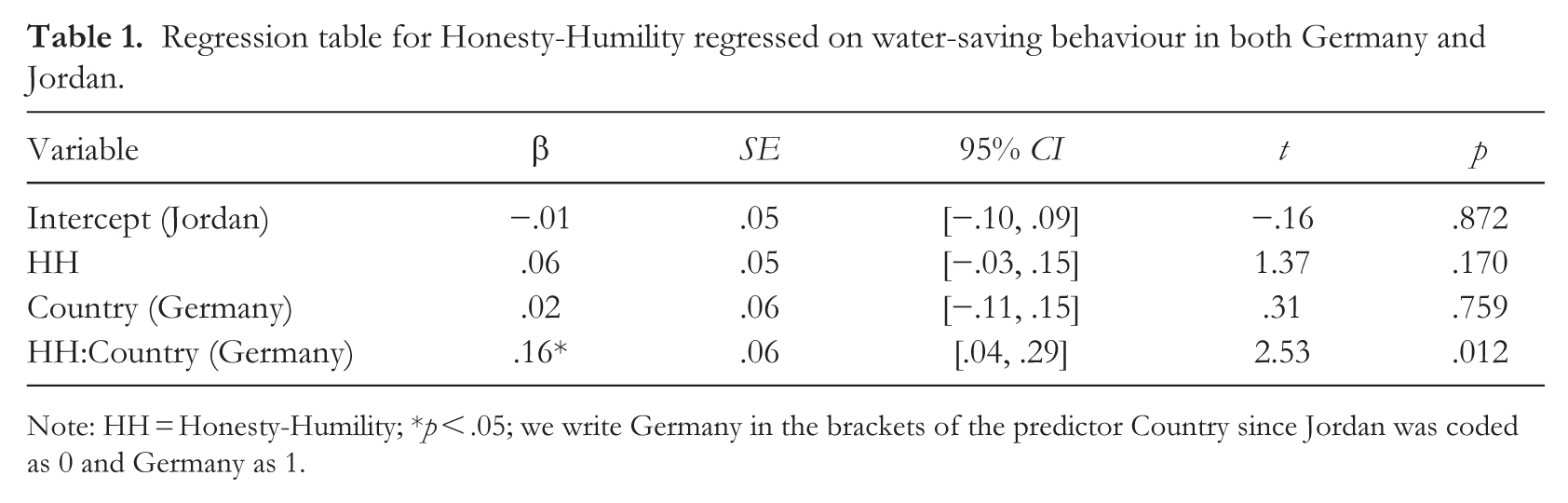
Note: HH = Honesty-Humility; *p < .05; we write Germany in the brackets of the predictor Country since Jordan was coded as 0 and Germany as 1.
In Germany, Honesty-Humility significantly predicted water-saving behaviour (β = .22, p < .001, 95% CI [.13, .30]), and the model predicted ~ 4% of the variance (the correlation between Honesty-Humility and water-saving behaviour was r = .22). These results are in support of Hypothesis 2. However, in the Jordanian model, we could not find support for Hypothesis 1 since Honesty-Humility did not predict water-saving behaviour (β = .07, p = .179, 95% CI [−.03, .16]), the correlation being r = .07. Given these results, Hypothesis 3 was also not confirmed.
Discussion
In this study, we investigated whether prosocial propensity manifests itself in water-saving behaviour. We conducted research in countries where water is a scarce or readily available resource. Regarding our hypotheses, we could only find that a prosocial propensity — measured through Honesty-Humility — manifests itself in water-conservation behaviour in Germany, not in Jordan. Consequently, it also follows that the relation between water-conservation behaviour and the prosocial propensity is not stronger in Jordan than in Germany. We will discuss Hypotheses 1 and 2, since the discussion of Hypothesis 3 has become obsolete due to the non-confirmation of Hypothesis 1.
Hypothesis 1 — Jordan
Our findings in Jordan were surprising to us and stand in contrast to findings in the literature. Honesty-Humility has been shown to predict self-reported ecological behaviour in several studies (e.g., Otto et al., 2021), and Dolnicar et al. (2012) found a perceived moral obligation to act to be positively associated specifically with water-saving behaviour. One reason could be that public awareness of the gravity of the water issue is not prominent. Al-Addous et al. (2023) highlight the normalization of water scarcity, inadequate dissemination of information, a false sense of security due to water management efforts, more pressing concerns taking priority, psychological detachment and the ineffectiveness of communication and education campaigns as factors contributing to this problem. However, for a behaviour to be influenced by a prosocial propensity, it must be recognized as both an ecological and/or humanitarian issue. This prerequisite might not be met in Jordan. Nevertheless, it is important to note that there is some measurable goal to conserve water in Jordan; otherwise, Rasch modelling would not have been feasible. In addition to social-ecological motives, served by a prosocial propensity, there may, of course, be other, non-selfless reasons to save water in Jordan. As well as financial reasons, it was shown, for example, that there is a certain religious influence on water-saving behaviour in Jordan (Burger, 2019). Behaviour motivated by non-selfless goals would less likely be based on a prosocial propensity. Unfortunately, with our sample, we cannot provide any further insight into the origins of the water-saving behaviour in Jordan. However, we may affirm, based on the data, that prosocial propensity is not the origin of this behaviour.
Yet the reason why we find no relation between water-saving and Honesty-Humility might also be of methodological origin. It is worth considering that in Jordan, compared to the countries where the HEXACO model has been validated, the Honesty-Humility dimension might not easily be translatable to the Jordanian context. For a discussion on the measurement insecurities when directly adopting common personality trait questionnaires validated in WEIRD countries to capture personality traits in non-WEIRD countries, refer to Laajaj et al. (2019). Nevertheless, Zeinoun et al. (2017, 2018) analysed the personality structure of individuals in Jordan, Lebanon, Syria and the West Bank, uncovering evidence for an Honesty-Integrity personality factor. Since we employed the original Honesty-Humility questionnaire, it is possible that we did not accurately measure what Zeinoun et al. (2017, 2018) define as Honesty-Integrity. Nevertheless, the moderate reliability points towards the interpretation that the scale distributed indeed measured a construct resembling Honesty-Humility. Thus, we believe that the non-significant result is less likely a measurement issue but indeed that a prosocial propensity does not translate to water-saving behaviour in Jordan.
Hypothesis 2 — Germany
In contrast to Jordan, we were able to predict water-conservation behaviour in Germany through Honesty-Humility. In other words, saving water is dependent partially on a prosocial propensity in Germany. This is in line with previous studies from Germany, the US, Chile, Canada, Russia and Romania that found a relation between Honesty-Humility and ecological attitude(s) and behaviour(s) (Brick & Lewis, 2016; Hilbig et al., 2013; Lee et al., 2015; Markowitz et al., 2012; Neaman et al., 2022; Otto et al., 2021; Pavalache-Ilie & Cazan, 2018; Soutter et al., 2020).
However, the findings specifically related to water represent a new insight. Unlike the environment as a whole, fresh water is still a rather abundant resource in Germany (BMU/UBA, 2018). People with a pronounced prosocial propensity are nevertheless more willing to protect this resource. On the one hand, this might stem from the belief among Germans that saving water is ecologically beneficial, because, for example, it reduces the need for chemicals used in purification. On the other hand, this might be because individuals with an honest-humble personality might recognize the interconnectedness of various ecological and social issues. Individuals in our German sample might feel overusing a resource that is scarce somewhere else might be considered unethical, even if their actions do not directly alleviate water poverty for others. In this regard, it has been shown that feelings of guilt lead to ecological behaviour (Hurst & Sintov, 2022). Finally, prosocial (German) participants might understand that abundant resources can become scarce for everyone if not managed responsibly. Their behaviour may be driven by a long-term desire to prevent future resource scarcity or ecological damage, rather than in response to current availability.
Theoretical and practical implications
Theoretically, the findings suggest that prosocial propensity, as indicated by Honesty-Humility, does not universally predict self-reported ecological behaviours. Instead, its manifestation might be dependent on how behaviour is perceived within specific cultural contexts. In Jordan, public awareness and framing of water scarcity as a prosocial issue may be insufficient for a prosocial propensity to influence behaviour. This underscores the need to integrate cultural and contextual nuances into ecological behaviour models.
Practically, our results have implications for designing interventions promoting water conservation, if one wants to leverage people’s prosocial propensity. In Jordan, interventions should prioritize raising awareness about the ecological and humanitarian implications of water scarcity. Tailoring messaging to align with local cultural and motivational drivers, such as religious values, may also enhance effectiveness. In Germany, campaigns could leverage the ethical and long-term benefits and foster a sense of moral responsibility towards water conservation.
Limitations and future research
The reliance on older data may restrict the transferability of the findings to the current context. However, in the present case, the older data set for Germany holds certain advantages due to its date. This is because the perception of water has changed in recent years within the social discourse, since in Germany water has also become a somewhat scarce resource for short periods in local areas (UBA, 2023). Thus, we might expect an increase in the importance of prosocial goals to save water in Germany, potentially strengthening the link between Honesty-Humility and water-saving behaviour. In Jordan, the situation has also not improved. Jordanians face ongoing water scarcity and deteriorating water quantity and quality (Al-Addous et al., 2023). It would thus be interesting if the non-existing relation in our sample between Honesty-Humility and water-saving behaviour is still what would be found today. Another important consideration is the samples used in this study, which exclusively comprised students. Consequently, the generalizability of the findings to broader society is questionable. Future research could investigate the identified associations in representative samples. Finally, our study only looked at two countries. Further cross-cultural studies could examine how local values and especially locally diverse cultural and moral norms interact with the relationship between Honesty-Humility and water-saving — and also other forms of ecological behaviour. Expanding the scope of research to include diverse cultural contexts and other ecological behaviours could enrich the understanding of how Honesty-Humility (i.e., a prosocial propensity) drives ecological behaviour.
Conclusions
This study examined whether a prosocial propensity, operationalized through Honesty-Humility, predicts water-conservation behaviour in contrasting contexts: water-rich Germany and water-scarce Jordan. Our findings revealed a significant relationship in Germany but, surprisingly, not in Jordan, suggesting that the manifestation of the prosocial propensity in ecological behaviours might be context dependent. In Germany, honest-humble individuals may act out of ecological goals, ethical considerations and long-term considerations, even in the absence of immediate water scarcity. In Jordan, the lack of a relationship may reflect limited public awareness of water scarcity as a pressing societal issue, cultural influences or measurement challenges in capturing Honesty-Humility in non-WEIRD populations. In terms of our research questions, we cannot ascertain that the prosocial propensity manifests itself in water-conservation behaviour necessarily, but that the local and cultural context must be considered (RQ1). Further, the objective availability of a resource seems to have played less of a role in our samples (RQ2).
Footnotes
Notes
Supplementary Material
Please find the following supplemental material available below.
For Open Access articles published under a Creative Commons License, all supplemental material carries the same license as the article it is associated with.
For non-Open Access articles published, all supplemental material carries a non-exclusive license, and permission requests for re-use of supplemental material or any part of supplemental material shall be sent directly to the copyright owner as specified in the copyright notice associated with the article.
