




Abstract
Climate change increasingly stresses global water availability and reliability via either too much (e.g., floods) or too little (e.g., droughts). To ensure safe and equitable water access and management, significant behaviour changes are needed among both water consumers and decision-makers. Yet discussing water vulnerabilities can be existentially threatening because these water crises involve considering potential physical harm or death from a life-sustaining resource. According to Terror Management Theory (TMT), implicit or explicit awareness of existential threats may result in contradictory identity reinforcements that may actually limit positive water solutions. We examined how three life-threatening water messages — specifically drowning, contaminated water consumption, dehydration — influenced environmental identity compared to a standard mortality threat and a control among 455 Canadian and American adults. Our results indicated that existentially threatening messages significantly increased environmental identity polarization (p < .05). Given these findings, we discuss implications for sustainable water management within an increasingly threatening global environment.
Increasing climate stressors will continue to undermine water security and confidence in the continued safe water access necessary for life (Powell et al., 2017; United Nations Water, 2010). Climate change will disrupt water availability, leading to regional droughts and flooding (Hirabayashi et al., 2008; Pascale et al., 2020). Individual and policy-level change is urgently required to both mitigate and respond to these changes (Kenis & Mathijs, 2012; Klein et al., 2022). However, researchers have shown that how climate dangers are communicated may be counter-productive to reinforcing positive environmental identities and generating the behavioural responses needed to effectively address these crises. Existentially threatening messaging activates psychological defences that can impede pro-environmental solutions (Akil et al., 2018; Fritsche & Häfner, 2012; Fritsche et al., 2010; Smith et al., 2022; Vess & Arndt, 2008; Wolfe & Tubi, 2019).
New insights from Terror Management Theory (TMT) can help design more effective pro-environmental messaging. Terror management researchers have found that communicating life-threatening scenarios can have incongruous results, depending on audience values and norms (Barth et al., 2018; Fritsche & Häfner, 2012; Greenberg et al., 2000; Harrison & Mallett, 2013; Smith et al., 2022; Stollberg & Jonas, 2021; Wolfe & Tubi, 2019). The importance of effective water crises communications — one of many climate hazards worth exploring — is explicated, followed by our operationalization of these communications, and key TMT concept descriptions.
Water crises and communications
Everyone requires accessible and reliable water for myriad essential uses: drinking, sanitation, agriculture, waste management, production, energy (United Nations Water, 2010; US Environmental Protection Agency, 2021). Water crises are multi-layered, with diverse actors, temporal uncertainties and competing demands; different regions will face differing water crises with climate change (Beevers et al., 2022; He et al., 2021). Due to anticipated increase in climate and water crises and their communications (Boykoff et al., 2022; Stoddart et al., 2016), understanding human responses to these life-threatening reminders is vital. According to TMT, reminding individuals of water loss or precarity could be a mortality reminder (MR), could trigger mortality defences and could subsequently influence environmental outcomes (Smith & Wolfe, 2023; Smith et al., 2022)
To investigate this hypothesis, we explicitly tested life-threatening water reminders’ influence on environmental identity (EID), in comparison to a conventional MR. Environmental psychologists have found that those who score higher on EID measures — individuals who more strongly identify as environmentally minded — are also more likely to adopt additional pro-environmental behaviours (Clayton, 2003; Vesely et al., 2021), making EID a particularly important individual factor to consider. We sought to determine whether life-threatening water hazards could be existentially threatening, reaffirming prior findings and TMT climate studies (summarized in Smith et al., 2022), and thus influence EID in polarizing ways as a distal defence mechanism, explained in detail below. A literature overview follows, first explaining our focus on individual (rather than group) features, the theoretical underpinnings of TMT and then Environmental Identity before describing this study.
Understanding individual-level climate response
While many variables may influence an individual’s choices (e.g., socio-economic class, power, ability, etc.) about resource use and management, we focus on the relationships between threatening climate communications and the consequent psychosocial responses relating to one’s sense of meaning and identity. Resource governance structures have substantial power over water policy and decisions, but we focused on the individual rather than governance systems for three reasons. First, while individual actions alone may not be the most significant regarding climate change adaptation or mitigation, cumulatively they are impactful (IPCC, 2018; Newell et al., 2021). Understanding how an individual’s EID is influenced by threatening water messaging is useful for pro-environmental campaigns looking to maximize their outcomes. Second, we focused on individuals because, ultimately, water management decisions are made by individuals with their unique identities, values and influences (Morelli et al., 2022; Staerklé, 2015). While systemic and interpersonal forces certainly influence management decisions (e.g., through power dynamics or through desire to be liked by other group members; Mukherjee et al., 2016), individual factors such as values or identity are essential components that require examination. Individual factors are so essential due to their influence on decision outcomes, recognized by social psychologists and environmental scholars (Ehret et al., 2022; Morelli et al., 2022; Mukherjee et al., 2018; Rose et al., 2018). Since climate, water and environmental work are particularly value-laden fields, wrought with complexity and moral themes regarding what should be prioritized (Jia et al., 2017; Krettenauer & Lefebvre, 2021), understanding changes in values and identity when considering potentially life-threatening scenarios (e.g., water crises) is paramount (Mackay et al., 2021; Vesely et al., 2021).
One’s identity — environmental or otherwise — can encompass numerous potential behaviours (Fritsche et al., 2018; van der Werff et al., 2014; Whitmarsh & O’Neill, 2010). As such, identity-focused campaigns are particularly powerful: identity is malleable and researchers have shown EID can be fostered via education, contact with nature (real or virtual), ingroup modelling of climate-friendly behaviour and social comparison on environmental behaviours (Schmitt et al., 2019; Vesely et al., 2021). If a behaviour-change campaign successfully promotes EID, it can have substantial impact since several pro-environmental behaviours (PEBs) may increase in tandem. Identity-focused interventions are also unlikely to harm emotional well-being (Vesely et al., 2021); rather, they may promote positive group identity, improving self-esteem via strengthening close relationships (Plusnin et al., 2018).
Terror Management Theory
Over 30 years, social psychology researchers have identified predictable human responses to reminders of our own demise (Burke et al., 2010; Pyszczynski et al., 2015). Humans are uniquely aware life is finite, but we experience existential discomfort when reminded of this reality. Terror Management Theory (TMT) scholars have shown existential anxiety, stemming from MRs, influences identity, beliefs, self-esteem and, ultimately, behaviours (Greenberg et al., 1990; Schimel et al., 2019). Mortality reminders increase death-thought accessibility (DTA) — the explicit (cognitively accessible) or implicit (cognitively inaccessible) awareness of death-related thoughts (Hayes et al., 2008, 2010; Schimel et al., 2019). Mortality reminders can lead to increased resource consumption (Kasser & Sheldon, 2000), stricter sentencing for socially transgressive offenders (e.g., sex workers; Florian & Mikulincer, 1997; Rachlinski & Wistrich, 2017) and preferences for those of similar race, gender or background, and increased distance from those that are different (Harmon-Jones et al., 1996; Uenal et al., 2021). These responses strengthen sense of identity and connection to culture, allowing symbolic immortality beyond physical demise.
Dual-process defence model
Mortality reminders can be explicit (e.g., asking someone to think of their own death) and evoke immediate, proximal responses, or reminders can be subtle (e.g., walking past a cemetery, the word ‘death’ flashed quickly as a subliminal message) and evoke subconscious, distal responses. Figure 1 (from Smith et al., 2022) displays proximal responses (denial, distraction and rationalization) and distal (self-esteem bolstering and worldview reinforcement; Kosloff et al., 2019; Pyszczynski et al., 1999; Wolfe & Tubi, 2019) responses.
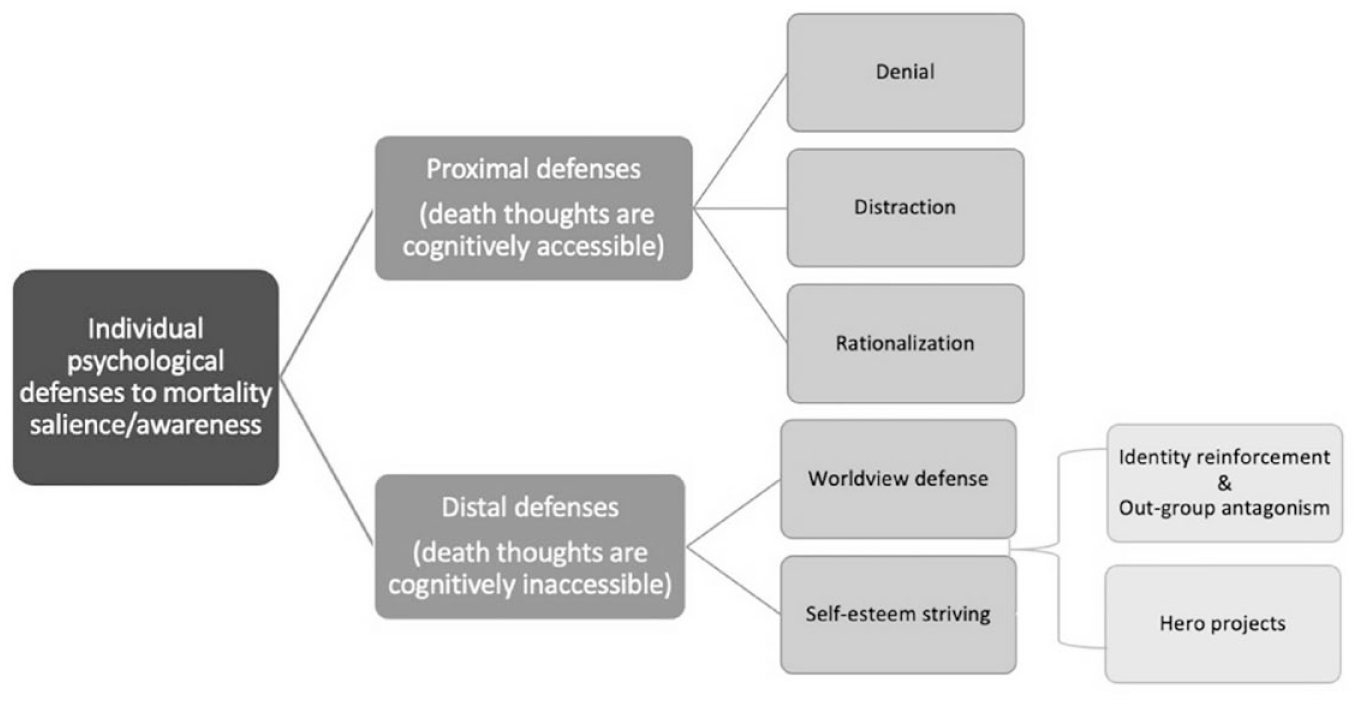
Dual-process model of mortality reminder defence mechanisms (Smith et al., 2022).
Terror Management Theory researchers posit that bolstering self-esteem defends against existential anxiety evoked by MRs — by strengthening cultural, societal identity, existential anxiety is offset via symbolic immortality. Our focus lies in distal defences involving identity and worldview defence.
Distal mortality-related defences are particularly significant since they can influence identity reinforcement, PEBs and one’s support for or against climate policy and solutions. Distal defences may result in strengthened beliefs and identities (Barth et al., 2018; Castano et al., 2002; Harmon-Jones et al., 1996; Stollberg & Jonas, 2021). Concerning EID, discussed in more detail below, those who already self-identify as highly environmental may even more strongly support these values in response to existential threats to reinforce identity and protect self-esteem. For individuals who do not identify as environmental, mortality threats may elicit behaviours aligned with dominant cultural identities. In a Western context, these include individualism, consumerism and capitalism, all of which are problematic for climate solutions that require collective action, reduced resource consumption and significant social changes (Metz, 2015). Climate-related water threats will only increase with predicted environmental changes, requiring urgent attention on human response to life-threatening water crisis communication, especially about EID, explained below.
Environmental identity
We all hold multiple identities that help us to understand our relationships with others and varied information about ourselves (Clayton, 2003). Environmental identity (EID) specifically incorporates our relationship and connection with nature within our self-concept (Clayton, 2003). Just as someone can be more or less pro-environmental, they may have higher or lower EID. Empirically, EID is measured by a validated scale (described in the Methods section) developed by Clayton (2003). EID can be a predictor of environmental behaviours: environmental psychologists found those who identify more strongly as environmental also engage in more PEBs (Clayton, 2003; Dono et al., 2010; Vesely et al., 2021; Whitmarsh & O’Neill, 2010). Vesely et al. (2021) conducted large-scale meta-analyses to determine the relationship between identity and PEBs: EID held strong relations to pro-environmental intentions (r = .62) and behaviours (r = .56). In an earlier study, Clayton (2003) noted moderate-to-strong relationships between EID and collectivism (r = .37) and PEB (r = .64). As such, when PEB cannot be measured directly, because of remote study, sample size or study design, EID is a useful, reliable indicator measure (Clayton, 2003; van der Werff et al., 2014).
Environmental identity also warrants investigation since there is opportunity for any one PEB to contribute to increase in another with greater EID — in part due to positive spillover effects — thereby enhancing overall PEBs and impact (Vesely et al., 2021). Further, identity persists beyond traditional incentives typically provided in environmental behaviour change programmes — which could potentially conserve scarce budgetary resources (Vesely et al., 2021). However, if efforts to increase EID are threatening, the opposite effect may occur (Stollberg & Jonas, 2021). Recall the paradoxical responses to mortality threats: threatening messages may discourage desired environmental behaviours by othering those with the biggest changes to make — those who are non-environmental. Although EID has been studied as a moderator for mortality salience (MS) effects (Fritsche & Häfner, 2012), explicit testing of how MRs — or life-threatening water-reminders — affect EID has yet to occur.
Since distal defences related to worldview and identity reinforcement are our focus, we discuss the specific social and cultural connections of EID below, clarifying its importance within environmental and water response studies.
EID and sociocultural connections
Since climate problems are rarely an individual’s sole responsibility and solutions require collective responses (Clayton, 2003), individual and socio-cultural concepts have been linked to EID and PEB (Dono et al., 2010; van der Werff et al., 2014; Vesely et al., 2021; Whitmarsh & O’Neill, 2010). Collective, cultural connection is particularly relevant since TMT researchers have emphasized the significance of self-esteem derived from society, culture and relationships as a mortality anxiety defence (Castano et al., 2002; Greenberg et al., 1990; Kosloff et al., 2019; Plusnin et al., 2018). These defences can exacerbate intergroup biases, potentially barring successful collective action efforts that require cooperation amongst diverse actors who do not necessarily hold similar worldviews. With increased life-threatening climate communications, this may be particularly true since MRs result in stronger adherence to one’s worldviews and identity (Greenberg et al., 1990; Pyszczynski et al., 2015; Schimel et al., 2019), perhaps making it even more difficult to convince low-EID individuals that action is needed. Moreover, identity’s role within social identity and collective action is important to understand from a TMT perspective: human responses to existential threats involve clinging more strongly to one’s ingroup and distancing from outgroups (Castano et al., 2002; Harmon-Jones et al., 1996). In these ways, the collective action required to address climate changes will necessitate an understanding of one’s social identity and working with those in — and adjacent to — one’s ingroups to achieve a mutual goal (Barth et al., 2018; Fritsche & Masson, 2021).
An individual’s EID is connected to their identified social group, including as characterized by political ideologies around environmental interests that may be linked to sense-of-self (Clayton, 2003, 2012). For example, someone who identifies as right wing or more politically conservative is less likely to support climate policies compared to left-wing or more liberal-identifying people (Currie & Choma, 2018; Huber, 2020; Unsworth & Fielding, 2014). Just as a person may reinforce their existing connections to other social groups following an MR (Barth et al., 2018; Castano et al., 2002; Harmon-Jones et al., 1996), they may also more strongly reinforce their EID — or lack thereof if they do not identify as pro-environmental (Stollberg & Jonas, 2021; Uenal et al., 2021; Uhl et al., 2018). While some TMT researchers have found greater death anxiety can increase negative nature evaluations due to creatureliness reminders — connections to our animal natures and, thus, mortality — these researchers did not differentiate participants’ responses according to pre-existing EIDs or values (Fritsche & Hoppe, 2019; Koole & Van Den Berg, 2005). It is possible that EID could have an unidentified moderating role in these analyses (Fritsche & Häfner, 2012).
Overall, attitudes, norms, values and identity are integrally involved in increased environmentalism (Li et al., 2019; Newell et al., 2021). The persistence of these features illustrates where TMT connects and how existential threats can influence EID, in both environmentally positive and negative ways.
The present study
We hypothesized that, since MS triggers distal defences that strengthen ingroup identity and boost self-esteem (thereby mitigating mortality anxieties), we would find broader EID score distributions in experimental conditions than as compared to a control. We expected a more extreme EID score spread in experimental conditions since those with low EID would score lower following existential threats — in this case, mortality and water threats — and those with high EID would score even higher following the same threats as a worldview-supporting distal defence.
To test this idea, water crises as potential mortality reminders (MR) were operationalized in three ways: (1) drowning; (2) extreme thirst; and (3) contaminated water consumption. These were compared to two separate participant groups who were asked to think about a traditional MR or a control. Environmental identity (EID) was measured in all groups after a delay.
Since water crises have been shown to be existentially threatening (Smith & Wolfe, 2023), we expected life-threatening water reminders would reinforce identity in the same ways as the traditional MR; we expected to see more extreme EID scores in water variable groups compared to a control. All groups and methodologies are explained below; materials and study design were approved by the University of Waterloo Office of Research Ethics.
Methods
Participants
Six hundred American and Canadian adult participants were recruited in 2020 via Amazon’s Mechanical Turk (MTurk) — a crowd-sourcing online platform frequently used in social psychology studies (Anderson et al., 2019; Crump et al., 2013). Details on MTurk and screening processes can be found in Appendix 1. For completing the ~30-minute study, participants received $2.50 USD — comparable remuneration to studies of similar length and format.
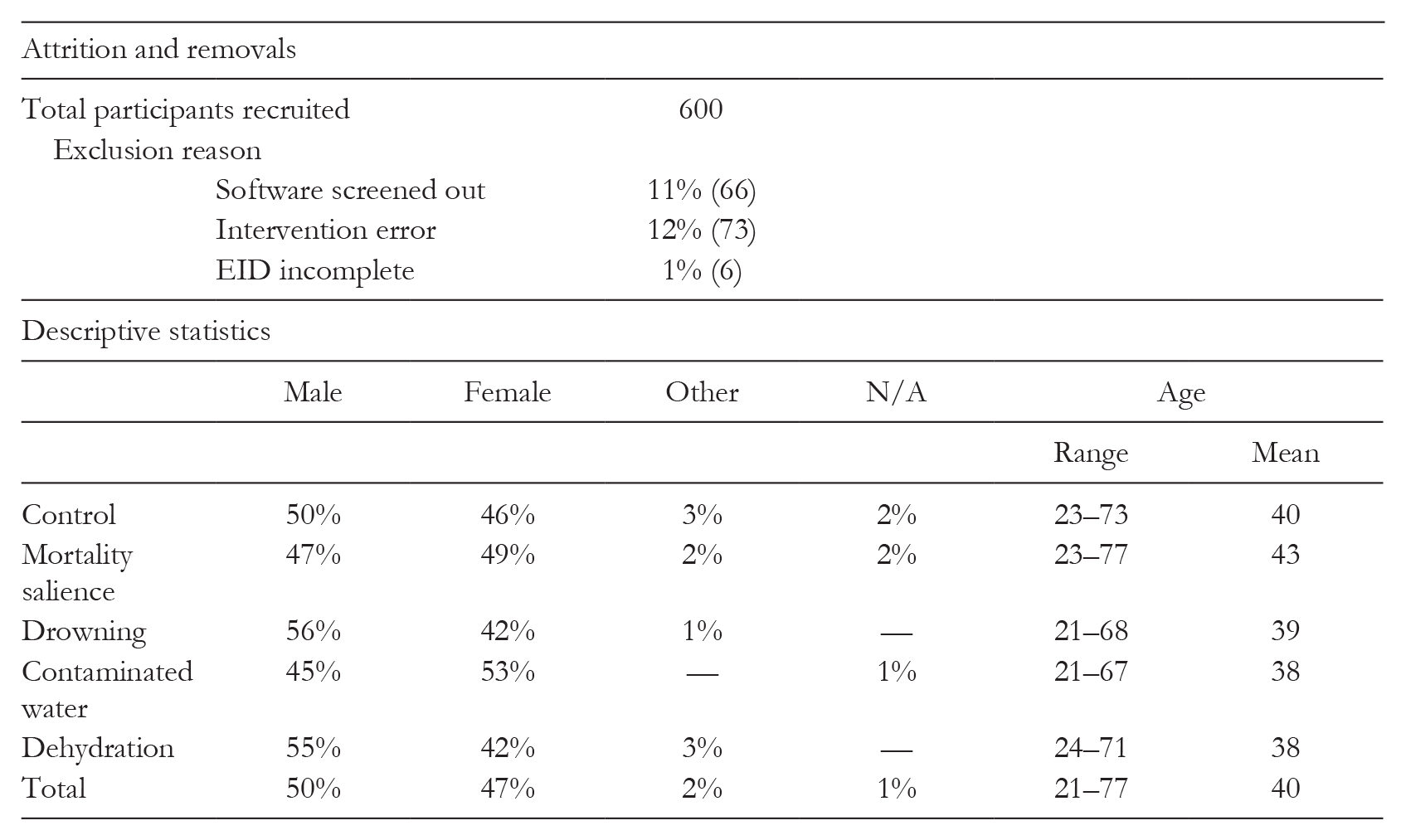
After incomplete or erroneous response removals, total N was 455 (attrition details in Appendix 2). The 23% attrition rate was within expected and acceptable range for an MTurk study (15–30%; Aguinis et al., 2021).
Procedure
Participants were recruited in the fall of 2020 (potential pandemic implications presented in the Discussion section) and informed they would be completing a study on ‘personality and sustainability’. We disguised full study purpose to avoid priming participants with mortality or confounding concepts. As part of the deception, participants were first asked to complete a 22-item personality inventory (Eysenck & Eysenck, 1964), a typical cover in TMT research (Cox et al., 2018). The subsequent study procedure was consistent with conventional TMT study design (Figure 2).

Visual procedural flow diagram of study design.
Participants were randomly assigned to one of five experimental conditions (i.e., control, mortality salience, drowning, dehydration or contaminated water), where they were asked to respond to two open-ended questions about their own death (Mortality Attitudes Personality Survey; see Appendix 3). The water-specific conditions replaced the mortality salience version’s ‘death’ with either drowning, extreme thirst or contaminated water consumption (Appendix 3). The control condition was asked about a painful dental visit as an anxiety-inducing but non-life-threatening prompt — a well-established control used in approximately two-thirds of previous TMT research (Burke et al., 2010; Cox et al., 2018).
Next, two delay tasks were presented — the Positive and Negative Affect Schedule (PANAS; Watson et al., 1988) and the Rosenberg Self-Esteem Measure (Rosenberg, 1965), allowing MRs to reach subconscious levels, activating distal defences (Greenberg et al., 2000).
After delays, the Environmental Identity Scale — short version (EID; Clayton, 2003; Clayton et al., 2021) was presented. This 11-item, seven-point Likert scale (full scale in Appendix 4) includes items such as ‘I think of myself as a part of nature, not separate from it’ and ‘Behaving responsibly towards the earth — living a sustainable lifestyle — is part of my moral code’. The EID was chosen because we were not able to measure environmental behaviours remotely and the EID has been frequently used in PEB research (Balundė et al., 2019) and widely validated (Clayton et al., 2021; Olivos & Aragonés, 2011). The short version was used to avoid participant fatigue and shows reliable, consistent results compared with the full version (Chew, 2019; Clayton, 2012).
Finally, demographic information was collected, followed by a deception check and debriefing materials.
Descriptive statistics and results
Descriptive statistics
Environmental Identity means and distribution were analysed via SPSS v.28 software to compare the experimental conditions’ responses spread to that of the control (data visualizations in Appendix 5). Descriptive statistics are displayed in Table 1, below.
Descriptive statistics for each group’s environmental identity responses.
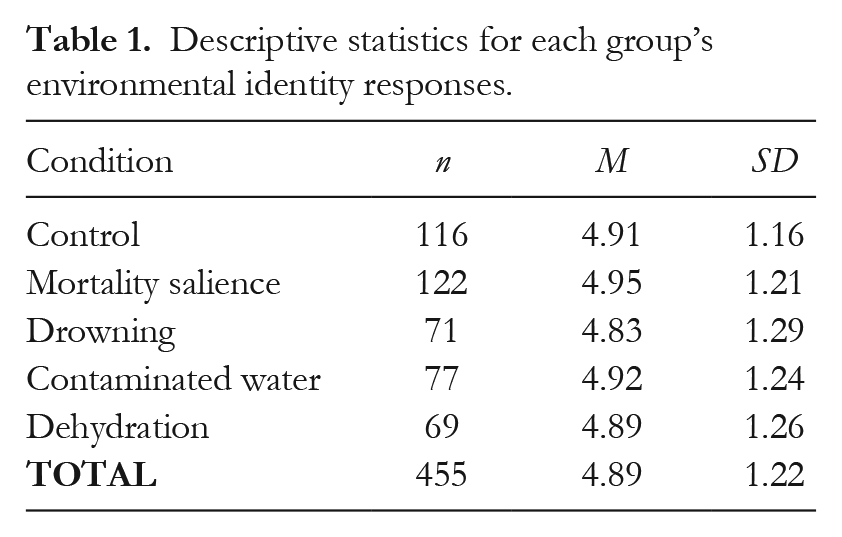
Cronbach’s alpha indicated high internal consistency across EID responses (11 items; α = .90). Levene’s tests of homogeneity of variance indicated overall distributions were not statistically significant when comparing experimental conditions (e.g., typical mortality salience or water mortality salience) to control condition. Results are shown in Table 2. To statistically determine whether responses were more drastically spread in experimental conditions, indicating stronger responses compared to control, the Moses Extreme Reactions Test was used (Table 2). Where Levene’s tests determine homogeneity of variance between conditions, Moses Extreme Reactions tests explicitly for response extremity. Typical means comparison statistical tests were not relevant to our main hypothesis; group means could be similar while maintaining different response spread and distribution, blurring effects. The Moses test determines difference in response extremity — in either direction — between two independent groups, designed intentionally to determine experimental variable influences when extreme reactions in opposing directions might be expected (e.g., an experimental condition compared to a control; Arnold & Briley, 1973; Colman, 2015). In this test, both groups’ scores are combined and become ranks (Moses, 1952). The test statistic is one group’s range plus one; the group is chosen at random. Span probability is calculated and then recalculated after removing a certain number of extreme scores from each end, before one-tailed probability is determined (Moses, 1952).
Levene’s and Moses Extreme Reactions Test outcomes: comparing experimental condition response spread to control.
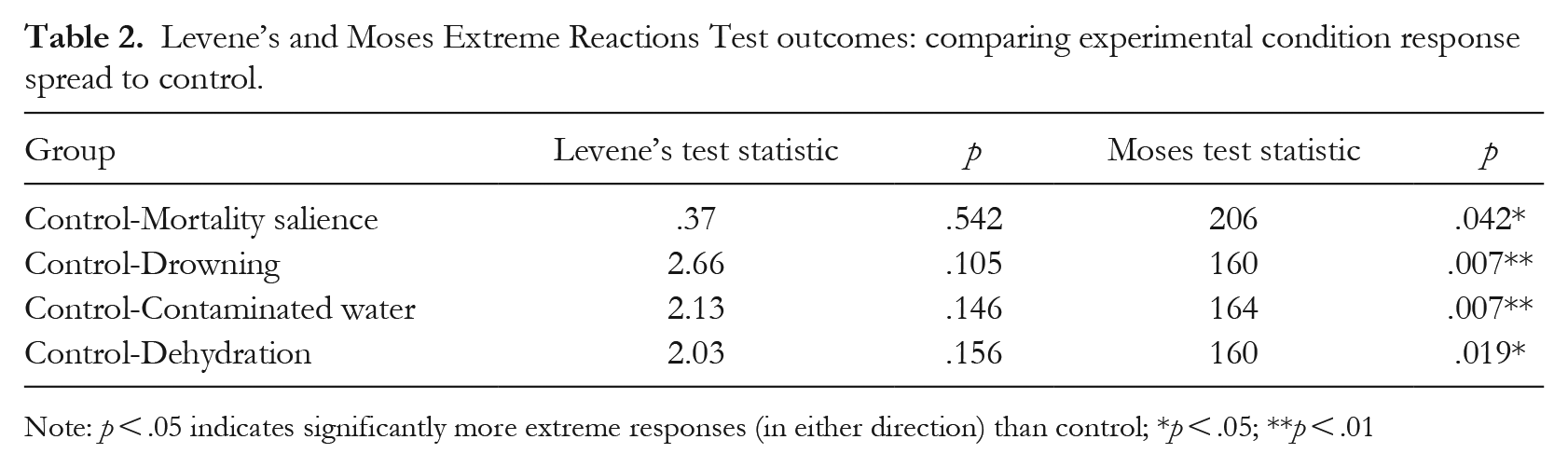
Note: p < .05 indicates significantly more extreme responses (in either direction) than control; *p < .05; **p < .01
Response distributions and results
Response distributions were statistically compared via the Levene’s and Moses Extreme Reactions tests, displayed in Table 2.
Results indicate all conditions had responses significantly more extreme than the control (p < .05).
Discussion
Through this research, we have shown that both typical MRs and life-threatening water reminders increased extremes for EID scores. Existential threats led participants to support their environmental identity — or lack thereof — more strongly. Our discoveries offer crucial new perspectives on how individuals may undergo EID changes in response to life-threatening communications related to water crises specifically and climate crises more generally. Our work offers an important first step towards deeper understandings of the influence of often dire environmental messaging. Below, we first discuss the specific timing context of our study before we explain our findings compared to other empirical research, followed by anticipated implications for PEB and water-specific behaviour change strategies. We explore both individual behaviour and water management or policy-level decision-making implications related to our findings. Limitations and recommendations for future research are described in relevant sections.
COVID-19 potential implications
Before discussing the implications of our findings, we should acknowledge the context in which this research was completed. The COVID-19 pandemic brought frequent worldwide MRs and initially impacted US and Canadian populations around March 2020 (Courtney et al., 2020; Pyszczynski et al., 2021). The non-stop media and government COVID-19 information persisted throughout the spring and summer and our recruitment occurred in fall 2020, prior to widespread COVID-19 vaccine availability. Recurrent pandemic-related MRs in this time could have subdued observed effects’ strength since our control may have had above-average mortality awareness. To our knowledge, an average mortality anxiety score for the pandemic period has not been empirically established, but this information would be useful for future research.
Research results in empirical context
Overall, we found MS and all water crises conditions significantly increased polarization of the participants’ EID compared to the control. This was particularly true for the drowning and contaminated water conditions, both at p = .007 significances. Our findings support prior work by Vess and Arndt (2008) and Fritsche and Häfner (2012), who tested environmental concern and/or identity in the context of MS and TMT. Vess and Arndt (2008) found that for people who derived self-esteem from pro-environmental behaviours, MS increased their concern for the environment; for people who did not derive self-esteem from pro-environmental behaviour, the reverse relationship presented. While Vess and Arndt (2008) utilized the Environmental Contingencies of Self-Worth scale as a measure of self-esteem derived from environmental behaviour, rather than EID, the trend was replicated within our findings. Fritsche and Häfner (2012) noted that MS decreased motivations for participants to protect the environment for intrinsic reasons and investigated EID as a potential moderating variable. They found that when people did not define themselves as part of nature or an environmentalist group — thus having low EID — they had less motivation and concern for the environment as something to value for intrinsic reasons (Fritsche & Häfner, 2012).
While we did not have a pre-existing EID measure for our participants, groups can be assumed to have a normative mix of pro-environmental individuals. Although American and Canadian studies indicate growing awareness and concern regarding climate change, this awareness is not the population majority, nor is awareness equivalent to EID or, critically, nor does it translate to pro-environmental action (Leiserowitz et al., 2021; Mildenberger et al., 2016). Americans are increasingly identifying as ‘Alarmed’ about climate change — up to 24% of the population according to Yale’s Global Warming’s Six Americas (Leiserowitz et al., 2021). While encouraging for potential climate solutions, even within this segmentation, 20% are ‘Inactive’ — potentially less likely to engage in PEBs. Compared to the US, a greater proportion of Canadians believe climate change is happening, but belief that humans are responsible is mixed. Researchers have shown that only ~20% of people in the Prairies and Western provinces’ oil-economy areas believe humans are responsible for climate changes while ~70% of Canadians take responsibility on the East and West Coasts (Mildenberger et al., 2016).
Given these baseline findings, it is likely that some of our participants identified as pro-environmental, but for others who did not, EID would not be a self-esteem source. For those participants with low EID, their identity and self-esteem were likely more strongly linked to traditional consumerist values, which remain dominant in Western society (Metz, 2015).
While it could be worthwhile for future studies to include an initial EID measure before a mortality reminder occurs, it would be essential to do so carefully since this could prime participants with environmentalism, potentially blurring and undermining results. A measure obtained in a pre-screening study could provide this specific insight, rather than assuming a normative mix of environmental identities. This would allow for a fuller understanding of effects and implications of existential threats. Smith et al. (2022) provide additional environmental operationalizations worth considering in future environmental-TMT research.
Implications for environmental change and water management
Our findings inform future water crises communications for those who aim to increase pro-environmental identities and behaviours. On an individual level, it would be valuable to understand individuals’ values, worldviews and identity related to water and environmentalism before implementing a communication strategy; such context is important to consider when seeking to understand PEBs. For a more widespread campaign, it may be beneficial to know the audience’s majority EID, as has been aptly exemplified via consumer segmentation efforts by industry and academia. For example, Yale’s Global Warming’s Six Americas assesses awareness and concern among the public, and Słupik et al.’s (2021) European energy-user analysis based on behavioural and socioeconomic factors, although many other examples exist. A campaign designed around the majority’s worldview would admittedly result in some individuals not receiving messages that would most effectively increase their EID, pro-environmental values and potentially behaviours, but it may be the best option given budgetary constraints that are common in governments’ and non-governmental organizations’ environmental efforts.
But while individual behaviour change can offset some forecasted water insecurities (IPCC, 2018), various structural barriers such as class, gender and race will often prevent individual actions from having more powerful or sustained change impacts (Kenis & Mathijs, 2012; Newell et al., 2021; Uzzell & Räthzel, 2009). Given this reality, significant water management power remains with government and policymakers; also considering how existential threats may influence these expert decision-makers is crucial.
Whether working in a group or alone, we consider decision-makers as individuals and recognize that they are all influenced by their own implicit and explicit values, worldviews and identities (Staerklé, 2015; van der Werff et al., 2014), as explicated above through TMT perspectives (Pyszczynski et al., 2015). Despite what historical economics espouse, humans are not merely rational machines (Johnson, 2021; Staerklé, 2015); it is necessary to consider these individualized factors that influence decisions — particularly in water-related contexts (Wolfe, 2017). These individual factors are not the only influences, but they are important to recognize to understand how they are changed by existentially threatening scenarios or communications and what that means for desired outcomes. In environmental efforts these desired outcomes are often increased PEB. While some economists have argued that groups can exercise more rational decision-making than individuals (Kugler et al., 2012), we must remember that these groups consist of individuals with their own backgrounds, beliefs, worldviews and values.
Further, recent environmental scholars have found that identity-diverse groups (e.g., diverse genders, races and/or classes) make more ethical, environmentally protective and equitable decisions (Craft, 2013; Glover et al., 2002; Vollan & Henry, 2019). Time and again, researchers have argued that environmentally responsible decisions are best made when processes involve diverse members affected by the issue, are open, transparent and built on trust, and are participatory, collaborative and flexible (Bolderdijk & Jans, 2021; Decaro et al., 2017; Henshaw, 2018; Powell et al., 2017; Vollan & Henry, 2019). However, when discussing life-threatening crises, MRs that arise may evoke worldview and group identity reinforcement as defences against death anxieties (Castano et al., 2002; Harmon-Jones et al., 1996; Uhl et al., 2018), as we observed with EID.
Future research opportunities
Our findings provide important and novel insights into (1) how individuals may experience EID changes following life-threatening communication and (2) represent a necessary first step to understanding how these messages could also influence powerful decision-makers. Future research on life-threatening communication among water experts specifically would be essential. Through our findings, we further show that inquiry with specific sub-populations (e.g., among water decision-makers) would be worthwhile to help determine how water crisis decisions are impacted by life-threatening communications. Future research with a collectivist lens would provide a more extensive understanding of the influence of both EID and threatening messaging on pro-environmental outcomes. Emerging social science research has highlighted the need for collectivist perspectives, and social identity theory notes usefulness in embedding EID within these views (Fritsche & Masson, 2021; Kenis & Mathijs, 2012; Klein et al., 2022). It would also be valuable to replicate our research in different social contexts and with participants who have the power to directly influence environmental and climate outcomes.
Conclusions
Climate and water crises require swift and impactful action to ensure effective solutions. Efforts to cultivate pro-environmental identities may increase support for such solutions when campaigns are constructed with mortality messaging — and defences — in mind. Should existential threats in climate messaging be used arbitrarily, we risk opportunities to motivate broader population segments to adopt climate solutions, and we may also inadvertently encourage behaviours that hasten irreversible climate disaster — as evidenced by the increased polarization observed following existential threats in the present study. Failure to heed these reminders in decision-making contexts could lead to loss of effective, equitable and powerful water solutions, perpetuating the persistence of water crises.
Footnotes
Appendix 1
Appendix 2. Participant removal reasons and descriptive statistics by group
| Attrition and removals | ||||||
|---|---|---|---|---|---|---|
| Total participants recruited | 600 | |||||
| Exclusion reason | ||||||
| Software screened out | 11% (66) | |||||
| Intervention error | 12% (73) | |||||
| EID incomplete | 1% (6) | |||||
| Descriptive statistics | ||||||
| Male | Female | Other | N/A | Age | ||
| Range | Mean | |||||
| Control | 50% | 46% | 3% | 2% | 23–73 | 40 |
| Mortality salience | 47% | 49% | 2% | 2% | 23–77 | 43 |
| Drowning | 56% | 42% | 1% | — | 21–68 | 39 |
| Contaminated water | 45% | 53% | — | 1% | 21–67 | 38 |
| Dehydration | 55% | 42% | 3% | — | 24–71 | 38 |
| Total | 50% | 47% | 2% | 1% | 21–77 | 40 |
Appendix 3. Intervention questions adapted from Mortality Attitudes Personality Survey (MAPS;Rosenblatt,1989 )
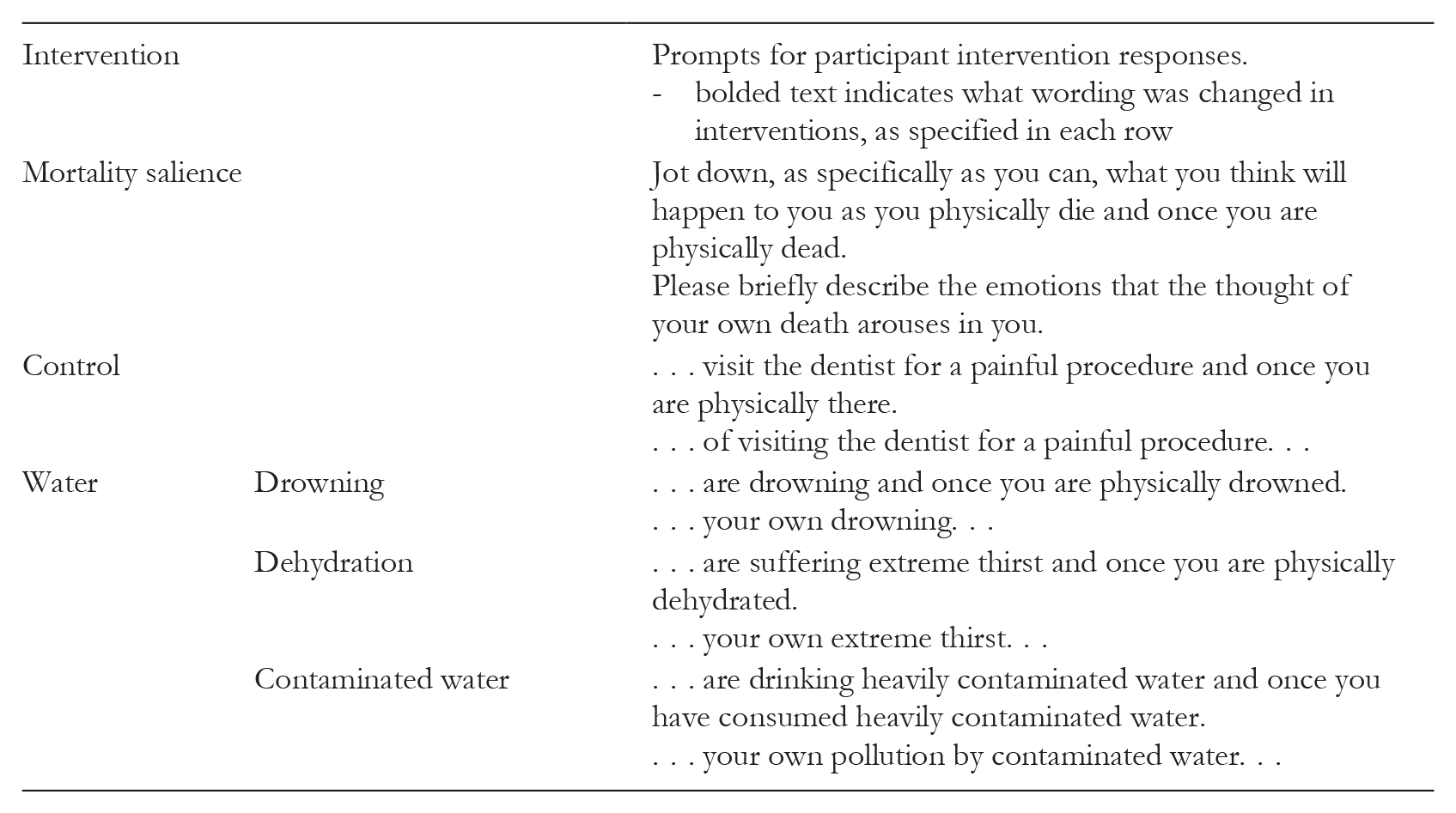
| Intervention | Prompts for participant intervention responses. - bolded text indicates what wording was changed in interventions, as specified in each row |
|
| Mortality salience | Jot down, as specifically as you can, what you think will happen to you as you physically die and once you are physically dead. Please briefly describe the emotions that the thought of your own death arouses in you. |
|
| Control | . . . visit the dentist for a painful procedure and once you are physically there. . . . of visiting the dentist for a painful procedure. . . |
|
| Water | Drowning | . . . are drowning and once you are physically drowned. . . . your own drowning. . . |
| Dehydration | . . . are suffering extreme thirst and once you are physically dehydrated. . . . your own extreme thirst. . . |
|
| Contaminated water | . . . are drinking heavily contaminated water and once you have consumed heavily contaminated water. . . . your own pollution by contaminated water. . . |
|
Appendix 4. Environmental Identity (EID) scale — short version
________________________________________________________________________
Please indicate the extent to which each of the following statements describes you by using the appropriate number from the scale below.
1 2 3 4 5 6 7
Not at all Neither true Completely
true of me nor untrue true of me