




Abstract
People with lower subjective socioeconomic status are more prone to experiencing anxiety and poorer subjective well-being. Nature’s restorative ability can play an important role among this group, given that spending time outdoors is often associated with better overall mental health and well-being. In this study, we aim to explore the moderating effect of recent visits to green and blue natural spaces on the mediated relationship between subjective socioeconomic status, anxiety and subjective well-being. A nationally representative sample of 946 Portuguese respondents was recruited. Results showed that anxiety mediated the relationship between subjective socioeconomic status and subjective well-being. In addition, the mediation effect was weaker for those who visited natural spaces more frequently, suggesting that spending time in nature buffers against the anxiety associated with lower subjective socioeconomic status from translating into poorer subjective well-being. These findings highlight the importance of using nature as a cost-effective strategy to assist in mitigating the negative effects of low subjective socioeconomic status.
Good mental health is necessary so that people can think, express emotion, communicate and connect, work, cope and thrive, and enjoy life on an individual and social level (World Health Organization [WHO], 2021, 2022). The worldwide state of mental health, however, has been worsening over time. For decades, mental health issues have been one of the primary causes of global health-related burdens, with anxiety being one of the most common and disabling mental disorders (WHO, 2022). In 2020, the COVID-19 pandemic aggravated this problem, with anxiety disorders increasing 25.6% globally, from 298 million cases to 374 million (COVID-19 Mental Disorders Collaborators, 2021). This growing tendency was observed in several European countries, including Portugal (OECD, 2021a, 2021b).
Among other determinants, poor mental health is shaped by inequalities, with some groups more likely to be affected than others. Studies show that low subjective socioeconomic status (SSES) is associated with a higher risk for mental health disability and psychiatric hospitalization (Hudson, 2005). Even nowadays, despite the significant advances in society, economically disadvantaged groups continue to be more susceptible to mental health issues due to their challenging social and living conditions (OECD, 2021a, 2021b). Individuals with lower SSES are more likely to encounter negative environmental demands and stressful events, which continuously challenge their ability to cope (Gallo & Matthews, 1999). In turn, these demands are likely to initiate negative emotional responses such as anxiety, which in turn affect other, broader health outcomes (e.g., immune functioning; Gallo & Matthews, 1999, 2003). Here, by anxiety, we refer to the response that occurs when events or conditions are perceived as highly threatening because they are volatile and unmanageable and have the potential to compromise vital aspects of the individual (Clark & Beck, 2010). Socioeconomic inequality is a prominent problem in Portugal. As early as 2009, Portugal was deemed one of the most unequal countries in terms of income and other social concerns among 23 intercontinental countries (Wilkinson & Pickett, 2010), a trend that is still observed nowadays (OECD, 2022).
Both SSES and mental health are directly associated with subjective well-being (SWB), described as the level of well-being that people experience based on the subjective evaluations, whether positive or negative, they make of several aspects of their lives (e.g., satisfaction with life, relationships, health and others; Diener & Ryan, 2009). These relationships follow the same directional trend; that is, lower levels of SWB are associated with poorer perceptions of one’s socioeconomic standing (Tan et al., 2020) and worse mental health outcomes (e.g., anxiety; Malone & Wachholtz, 2018). Seeing that anxiety can be particularly debilitating for individuals with lower SSES, which impacts their SWB, it is essential that they can employ strategies that allow them to emotionally recover from negative experiences and to better deal with life’s challenges.
A growing body of work has suggested that greater contact with nature may be able to reduce well-being disparities arising from socioeconomic inequalities (e.g., Garrett et al., 2019; Mitchell & Popham, 2008; Rigolon et al., 2021). Congruently, it has been demonstrated that spending time in and/or living close to green and blue natural spaces is associated with better mental health (e.g., Geneshka et al., 2021; White et al., 2021) and higher levels of SWB (White et al., 2017), resulting in more positive social interactions, a greater sense of purpose in life and, at the restorative level, increased positive affect and decreased negative affect (Bratman et al., 2019). The concept that nature has a relaxing and emotionally restorative effect follows Ulrich’s (1983) Stress Recovery (SRT) and Kaplan and Kaplan’s (1989) Attention Restoration (ART) theories. First, the SRT states that spending time outdoors in nature, due to its unique and pleasurable properties, allows people to achieve an overall positive-affect state (e.g., calmness) after a stressful, negative event (Ulrich, 1983). These benefits are thought to be the result of increased interest in and favourable assessments of natural spaces that entail adaptive features (e.g., aesthetic features; Ulrich, 1983). Second, the ART defends that contact with nature can ease attentional fatigue by only capturing people’s involuntary attention (e.g., effortless and automatic attention), thus providing time to restore directed attention (e.g., attention deployed voluntarily to a specific stimulus; Kaplan & Kaplan, 1989). These restorative, stress- or fatigue-reducing effects of natural environments have also been detected in studies where participants have not experienced an experimental preceding stressor intervention, referred to as instorative effects (Hartig et al., 1996; Korpela & Ratcliffe, 2021). These instorative effects are resource-building benefits, akin to those observed in restoration but exhibiting a lesser magnitude (Stevenson et al., 2018), and are attained without necessitating the preceding depletion of adaptive or attentional resources. Nevertheless, it is important to note that instoration studies omit the deliberate introduction of experimental stress, so it is possible that certain stress levels are inevitably present prior to conducting such experiments (Korpela & Ratcliffe, 2021). In this study, we consider the ecological (as opposed to experimental) effects of SSES introducing anxiety.
Though the relationships between SSES, SWB and mental health have been established in the literature, the impact of nature on this association remains underexplored. In 2022 alone, Portugal registered a little over 390,000 visits to its natural protected areas (Instituto da Conservação da Natureza e das Florestas, 2023). Besides, the country is known for its large variety of green and blue natural spaces, with the majority of the mainland territory being forest land (69.4%, totalling around 6.2 million hectares; Instituto da Conservação da Natureza e das Florestas, 2015) and with an extensive coastline of 943 kilometres, making it easier for people to spend more time engaging in outdoor recreation activities if they wish to do so. As such, we found it important to distinguish between both types of natural spaces. Most research has been focused on the health benefits of green spaces, and only recently did the health benefits of blue spaces start to be studied more systematically (e.g., Gascon et al., 2017). In addition, it has been argued that even though green and blue spaces share many features, they should still be considered inherently different (White et al., 2020, 2021). By way of example, in Völker and Kistemann’s (2015) study, the authors found that blue spaces generate distinct health-enhancing effects from green spaces, such as greater contemplation and restorative effects, emotional bonding, social participation and physical activity. Hence, in this study, we aim to examine the moderating effect of recent visits to green and blue natural spaces on the indirect effect of SSES and SWB through anxiety. Firstly, we anticipate that anxiety mediates the relationship between SSES and SWB (H1). Secondly, we posit that visiting green (e.g., forests) and blue (e.g., beaches) natural spaces moderates the relationship between anxiety brought about by lower SSES and SWB (H2).
Method
Participants
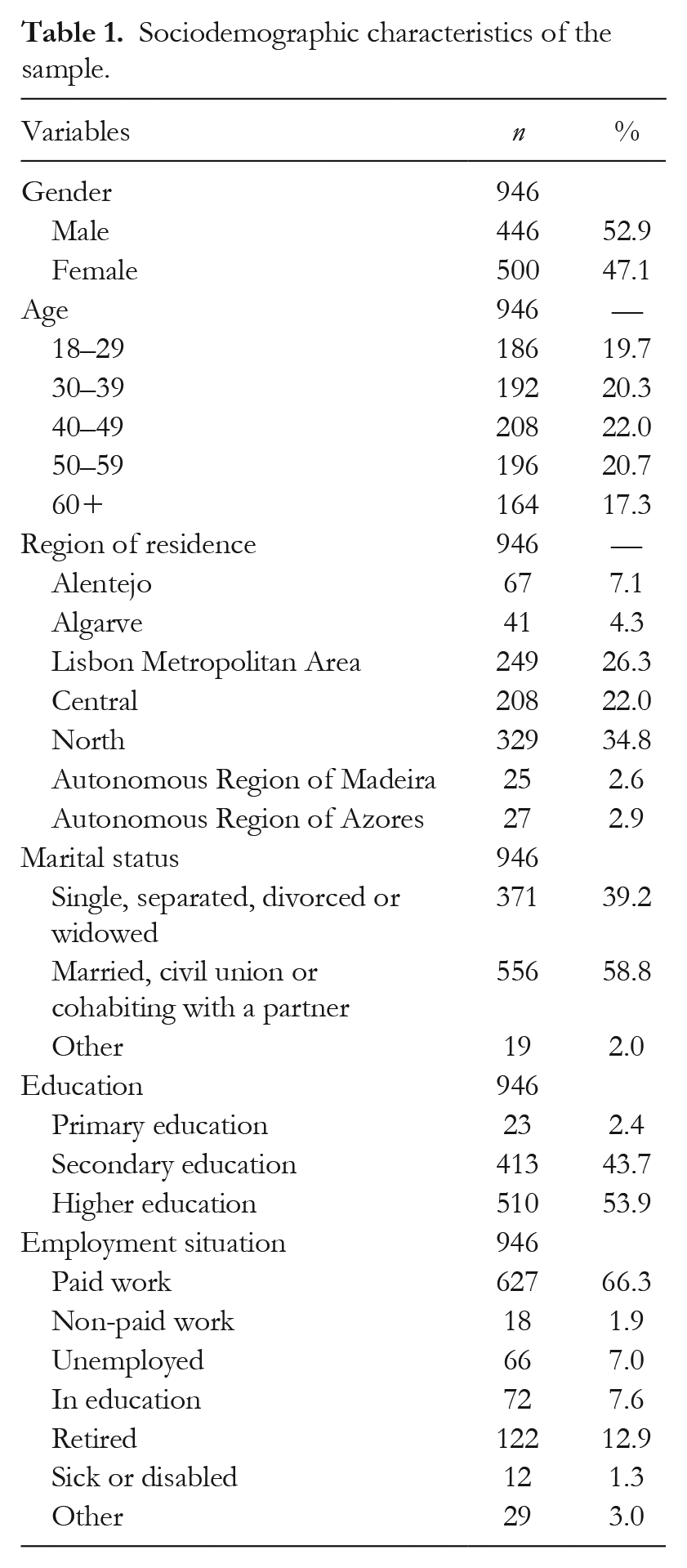
A representative sample of 946 Portuguese participants was recruited. The sample was first stratified based on the Nomenclature of Territorial Units for Statistics 2 (NUTS 2) and then separately by each possible combination of sex (male, female) and age group (18–29, 30–39, 40–49, 50–59, 60+). Of the total, 62% of respondents were between 18 and 49 years old and 52.9% were male. Participants were recruited from different parts of Portugal, with the majority living in the north (34.8%), central (22%) and Lisbon Metropolitan (26.3%) areas. Most participants were either married, in a civil union or cohabiting with their partner (58.8%) and did not self-identify as belonging to a minority ethnic group (93.2%). The majority were working at the time of the study (66.3%) and had a higher education degree (53.9%). See Table 1 for more details.
Sociodemographic characteristics of the sample.
Measures
Subjective well-being
SWB was measured with five items representing global life satisfaction (‘All things considered, how satisfied are you with your life as a whole nowadays?’), satisfaction with living standards, health, what is being achieved and relationships (e.g., ‘How satisfied are you with your standard of living?’). The first item was from the OECD well-being measurement guidelines (OECD, 2013) and rated on an 11-point scale, ranging from 0 — ‘Extremely dissatisfied’ to 10 — ‘Extremely satisfied’. The remaining items were from the Personal Well-Being Index (International Wellbeing Group, 2013) and rated on an 11-point scale, ranging from 0 — ‘Not at all satisfied’ to 10 — ‘Completely satisfied’. A subjective well-being index was composed by averaging the five items (α = .86).
Subjective socioeconomic status
Satisfaction with income was used to operationalize SSES, measured with one item (‘Which of these descriptions comes closest to how you feel about your household’s income nowadays?’), adapted from the European Social Survey (ESS, 2016). Responses were rated based on five categories, namely: 1 — ‘Finding it very difficult on present income’, 2 — ‘Finding it difficult on present income’, 3 — ‘Coping on present income’, 4 — ‘Living comfortably on present income’, and 5 — ‘Do not know’ (such responses were considered missing values).
Anxiety
Anxiety was measured with one item (‘Overall, how anxious did you feel yesterday?’), adapted from OECD well-being measurement guidelines (OECD, 2013) rated on an 11-point response scale, ranging from 0 — ‘Not at all’ to 10 — ‘Completely’.
Frequency of recent visits to natural spaces
A list of 26 natural spaces and corresponding archetypical pictures were presented to assess how often people visited each type of location for recreational purposes in the last four weeks before answering the survey. These items were based on the Monitor of Engagement with the Natural Environment Survey (Natural England, 2017) and the Welsh Outdoor Recreational Survey (Natural Resources Wales, 2014). The natural spaces were divided into two lists, and 11 were categorized as green spaces (e.g., parks, forests) and 15 as blue spaces (e.g., beaches, rivers). Responses were rated on a four-point rating scale, ranging from 1 — ‘Not at all in the last four weeks’ to 4 — ‘Several times a week’. The final score was obtained by summing the items for each list.
Design and procedure
The data used in this correlational and cross-sectional study were collected as part of a larger EU project, BlueHealth 2016–2020 (Grellier et al., 2017), through an online self-report questionnaire distributed by a market research company, in four seasonal waves between June 2017 and April 2018. The questionnaire took, on average, 20 to 25 minutes to complete.
Methods were approved by the University of Exeter Medical School’s Research Ethics Committee (Ref: Aug16/B/099). All participants read and gave their informed consent to participate in the study and were informed of the anonymous and confidential nature of their answers. After completing the questionnaire, participants were debriefed on the nature of the project and given access to the contact details of the lead researcher in case they had any questions or concerns about the study or wanted to know more about the results. Full methodological details on the questionnaire are available online (see Elliott & White, 2022).
Data analysis
Missing data were treated by the listwise deletion method, and data were analyaed using the IBM SPSS program (version 28.0). Firstly, descriptive analyses were conducted, namely means, standard deviations, frequencies and correlations. Secondly, conditional indirect effects models were fitted to test the main hypotheses. A bootstrapping approach was used to assess the significance of the indirect effect of SSES on SWB through anxiety at differing levels of green and blue space visit frequency (Hayes, 2013). The PROCESS macro, model 14 (version 4.0), was used to fit these models; a 95% confidence level was applied and 10,000 bootstrap resamples were used. An index of moderated mediation was used to test the significance of the conditional indirect effects (Hayes, 2015). Gender and age were controlled for in both models.
Results
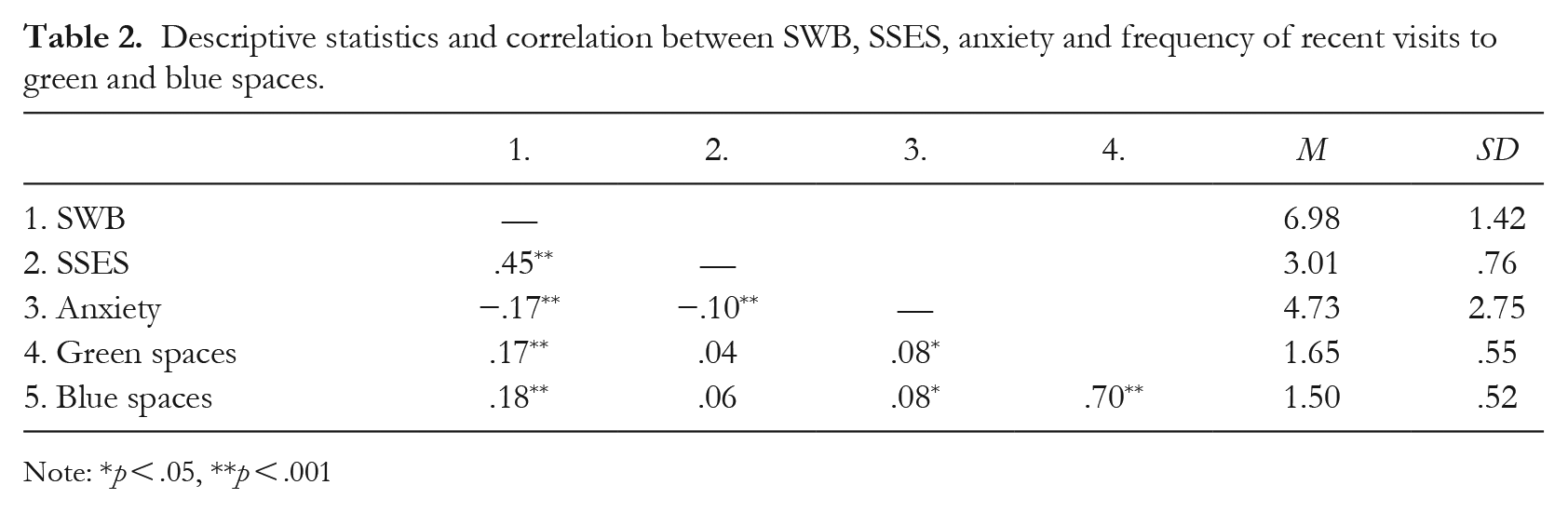
Correlations and descriptive statistics are presented in Table 2. As expected, SSES and frequency of recent visits to green and blue natural spaces are positively correlated with SWB, whereas anxiety is negatively correlated with SWB.
Descriptive statistics and correlation between SWB, SSES, anxiety and frequency of recent visits to green and blue spaces.
Note: *p < .05, **p < .001
The first-order mediated moderation models yielded non-significant results (see Supplemental Material for more details). However, the second-order conditional indirect effects models did yield significant estimates of conditional indirect effects. SSES predicted SWB, and this relationship was fully mediated by anxiety, −.07, p < .001, 95% CI [−.10, −.09], thus corroborating H1.
In particular, the Green model tested whether the frequency of recent visits to green spaces moderates the mediation effect of anxiety on the relationship between SSES and SWB (Figure 1; Hayes, 2013). The model was significant F(6, 939) = 52.23, p ⩽ .001, R2 = .25. Lower SSES was associated with greater anxiety levels, B = −.35, Bse = .12, t = −2.98, p = .003, and frequency of recent visits to green spaces was found to moderate the association between anxiety and SWB (Anxiety x Green spaces B = .05, Bse = .02, t = 2.21, p = .027). The overall moderated mediation model was supported by the index of moderated mediation = −.02, 95% CI [−.04; −.00]. As zero is not within the CI; there is a significant moderating effect of the frequency of visits to green spaces on anxiety on the indirect effect via SWB (Hayes, 2015). The conditional indirect effect was stronger for those whose frequency of recent visits to green spaces was lower (1 SD above the mean of green space recent visit frequency, effect = −.04, SE = .02, 95% CI = −.08; −.01) and weaker for those whose frequency of recent visits to green spaces was higher (1 SD below the mean, effect = −.10, SE = .02, 95% CI = −.15; −.06). Tests of simple slopes (i.e., conditional effects on path a) found a weaker but significant association between anxiety and SWB for those with a higher frequency of recent visits to green spaces, B = −.06, Bse = .02, t = −2.69, p = .007, than for those with lower frequency of recent visits to green spaces, B = −.14, Bse = .02, t = −6.04, p < .001. This result means that the negative association between anxiety and SWB is weaker for participants who had recently visited green spaces more frequently. These results were held while controlling for age and gender.
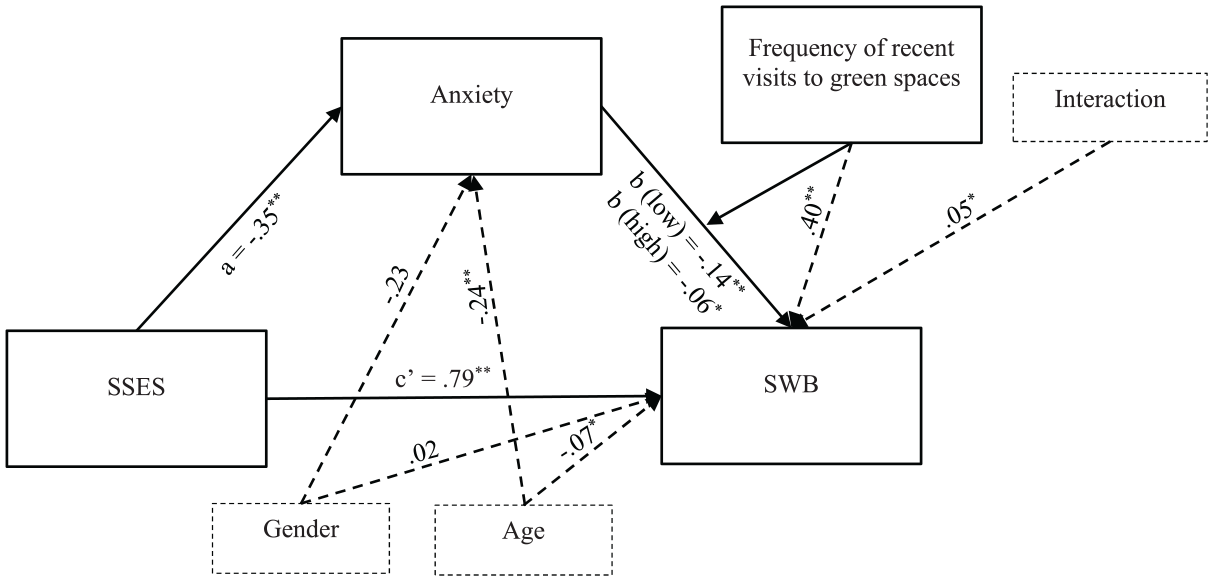
Conditional indirect effects of SSES and SWB via anxiety, at high (+1 SD) and low (−1 SD) frequency of visits to green spaces.
The Blue model similarly tested whether the frequency of recent visits to blue spaces moderates the mediation effect of anxiety on the relationship between SSES and SWB (Figure 2; Hayes, 2013). The model was significant F(6, 939) = 52.65, p ⩽ .001, R2 = .25. Results regarding the association between SSES and anxiety were similar to those obtained in the Green model. The frequency of recent visits to blue spaces moderated the association between anxiety and SWB (Anxiety x Blue spaces B = .07, Bse = .03, t = 2.60, p = .009). The overall moderated mediation model was corroborated by the index of moderated mediation = −.02, 95% CI [−.05; −.00], as zero is not within the CI. The conditional indirect effect was stronger for those with a lower frequency of recent visits to blue spaces (1 SD above the mean of blue space visit frequency; effect = .01, SE = .01, 95% CI = .00; 0.03) and weaker for those with a higher frequency of recent visits to blue spaces (1 SD below the mean, effect = .04, SE = .02, 95% CI = .01; 0.07). Tests of simple slopes (i.e., conditional effects on path a) found a weaker, albeit significant association between anxiety and SWB for those whose frequency of recent visits to blue spaces was higher (B = −.06, Bse = .02, t = −2.73, p = .006) in relation to those whose frequency of recent visits to blue spaces was lower (B = −.13, Bse = .02, t = −5.99, p < .001). This result means that the negative association between anxiety and SWB is weaker for participants who recently visited blue spaces more frequently. Again, these results held while controlling for age and gender. Overall, findings from both models corroborated H2.
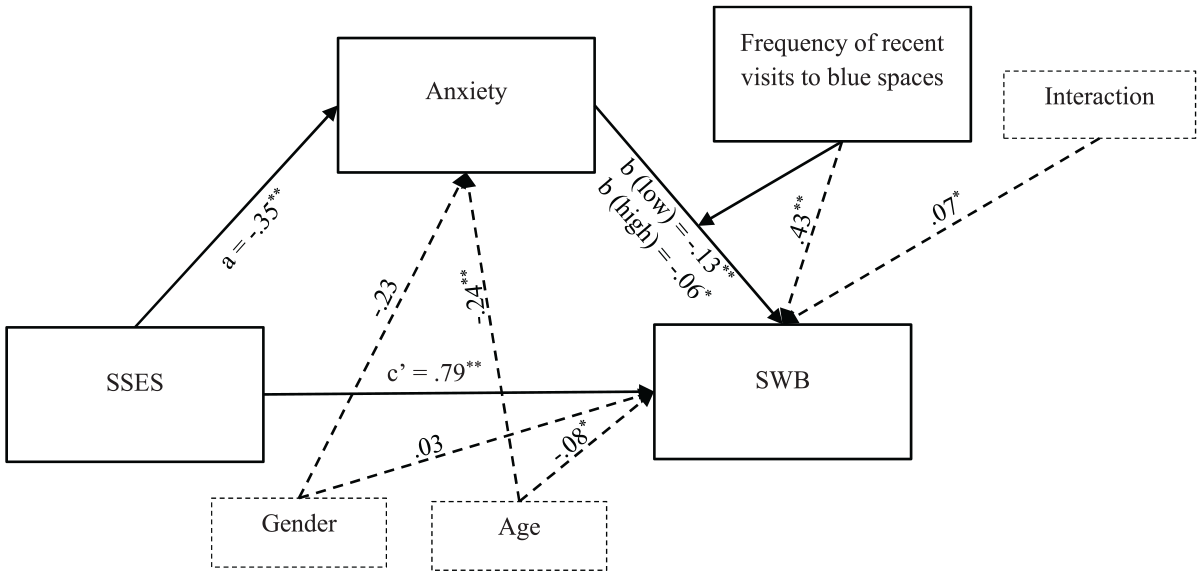
Conditional indirect effects of SSES and SWB via anxiety, at high (+1 SD) and low (−1 SD) frequency of visits to blue spaces.
Discussion
The current study provides a deeper understanding of the relationship between SSES, anxiety and SWB, and explores, as an innovative component, the impact of nature exposure in this relationship. As such, two important results have emerged. Firstly, it was corroborated that anxiety partially mediates the relationship between SSES and SWB (H1), which indicates that individuals with lower SSES are more likely to experience poorer SWB in part because they tend to experience higher levels of anxiety. This result endorses the notion that living in uncertain financial conditions poses challenges (e.g., coping with acute episodes of stress) that have a profound impact on people’s lives, which then reflects on their mental health (e.g., Hudson, 2005) and SWB (e.g., Tan et al., 2020). A substantial body of research has already supported that SSES and well-being are positively correlated, although the strength of this relationship varies (Tan et al., 2020). This study contributes to the understanding of this relation by illustrating that it is mediated by anxiety. Nevertheless, it should be mentioned that anxiety does not fully mediate the relationship between SSES and well-being, and, therefore, other variables should also be of importance.
Secondly, the frequency of recent visits to natural spaces moderates the relationship between anxiety and SWB (H2). One interpretation of this finding is that people might first feel anxious and then visit nature to regulate how they are feeling. Moreover, nature can buffer against the anxiety, caused by lower SSES, from translating into lower overall SWB. Thus, spending time in natural spaces may be particularly important for this group. It is, however, important to note that this contact is made based on people’s willingness, meaning that to benefit from the positive effect of nature, they must voluntarily spend time in natural spaces. This distinction is relevant in a Portuguese sample because a substantial portion of the population has relatively easy access to natural spaces. Yet, this does not mean that they are willing to visit these spaces frequently and potentially benefit from exposure to nature. Nevertheless, a recent study shows that people experiencing anxiety voluntarily visit nature more often (Tester-Jones et al., 2020). Overall, our finding is congruent with a recent study conducted by White et al. (2021) that found that each extra visit to green and blue spaces in multiple countries, including Portugal, was associated with a higher level of SWB, measured by the WHO-5 Well-Being Index (WHO, 1998).
The nature of the present study does not allow us to explore through which processes nature is providing a buffering effect, but one possible avenue concerns its emotional regulatory function (Bratman et al., 2021). Few studies have focused on this matter, but their results are promising. In particular, Johnsen and Rydstedt (2013) found that the use of nature (via exposure to photos) for emotion regulation is beneficial (e.g., higher positive mood), and Korpela et al. (2018) found that this use is somewhat frequent and moderately effective, even when compared to other well-established strategies, like positive thinking (Speer & Delgado, 2017). The underlying rationale is that people tend to avoid places that trigger negative affective states and instead choose places that foster positive ones (Gross, 1998), thus using disengagement regulatory strategies (e.g., distraction and withdrawal). These strategies can be recommended when there are not enough cognitive resources to deal with an emotional event and/or when the emotional burden is high. Literature on emotion regulation has consistently shown that when the emotional impact is too strong, immediate or uncontrollable, using distraction or withdrawal may be a more adaptive initial response than trying to reappraise or resolve the issue (McRae, 2016). These findings, as well as our results, are aligned with the premise of the STR (Ulrich, 1983) and ART (Kaplan & Kaplan, 1989). Given the emotional difficulties and daily concerns experienced by individuals with lower SSES (e.g., anxiety; Malone & Wachholtz, 2018), it is possible that they actively choose to spend time outdoors as a way to change their focus of attention and return to a more neutral and/or manageable emotional baseline and restore the necessary cognitive resources to effectively deal with the problem, which is congruent with ART. We could also assume that these positively appraise nature, which, in turn, reduces the level of arousal and intensity of negative affect, ultimately leading to recovery from stress associated with their anxious state, as proposed by Ulrich (1983). Furthermore, these effects of nature appear to be instorative (Hartig et al., 1996). They emerged not following the preceding experimental depletion of resources but when considering the correlational effects of SSES inducing anxiety. Therefore, increasing the frequency of visits to natural spaces might be an effective strategy to help individuals with lower SSES address and overcome poorer SWB and mental health outcomes.
Interestingly, we found no differences in the buffering effect of green or blue spaces, suggesting that when it comes to the relationship between anxiety and SWB, visiting these natural spaces might have the same effect. We were expecting such differences since recent literature has been stressing that green and blue natural spaces have distinctive features (e.g., White et al., 2020, 2021) and, as such, may result in different health outcomes. Again, the lack of differences found in this study may be related to Portugal’s geographical characteristics, since there is a large variety of both green and blue spaces that can be easily accessed.
This study has limitations that should be accounted for. Due to its correlational nature and the restricted use of self-report measures, no casual inferences between variables can be established. Longitudinal studies could be useful to assess the effects of nature exposure on emotion regulation and mental health outcomes, especially considering the frameworks of SRT and ART. Another limitation concerns the anxiety measure with only one item since a more comprehensive measure could have provided additional insightful information. For a better understanding of nature’s role, future research should focus on exploring in greater detail the processes (including the regulatory processes) by which nature might produce the buffering effect observed in this study and whether these results hold for other mental health disorders (e.g., depression). A recent scoping review suggests that 10 minutes of contemplating or walking in nature is sufficient to positively impact physio- and psychological markers of well-being (e.g., slower heart rate and better mood; Meredith et al., 2020). Yet, another recent study shows that people who spend more than 120 minutes (and up to 300 minutes) in nature in a week report higher levels of well-being in comparison to a lesser time, regardless of whether it was one long visit or multiple shorter visits (White et al., 2019). As such, future studies should aim to explore the role of ‘nature dose’ (i.e., time spent visiting natural spaces) in these conceptual models. Nevertheless, these findings are of the utmost importance. Considering that the evidence of such effects has been accumulating over the last decades, it is time to systematically incorporate them into public mental health policies. The amount of time people spend in nature has been declining, resulting in a decrease in the range of benefits related to overall health. This loss of contact with nature starts early, during childhood (e.g., Collado & Corraliza, 2016; Hartig et al., 2014; Luís et al., 2020), and is more likely to occur among individuals with lower SSES (e.g., Delisle Nyström et al., 2019). Therefore, there is a pressing need to continue to promote more nature contact in the future.
Footnotes
Notes
Supplementary Material
Please find the following supplemental material available below.
For Open Access articles published under a Creative Commons License, all supplemental material carries the same license as the article it is associated with.
For non-Open Access articles published, all supplemental material carries a non-exclusive license, and permission requests for re-use of supplemental material or any part of supplemental material shall be sent directly to the copyright owner as specified in the copyright notice associated with the article.
