




Abstract
Employees’ pro-environmental behaviours at work can contribute to reducing organizations’ environmental impacts through the integration of environmental practices into daily routines. This study explored how a green climate at the organizational and co-worker level and supervisor support help predict employees’ voluntary green behaviours at work, particularly regarding waste separation. Organizational identification’s mediating role in these relationships was also examined. Cross-sectional, correlational research was conducted at a Portuguese higher education institution in which 164 employees responded to an online survey. The results reveal a significant positive association between workers’ perceptions of a green organizational climate and their reported pro-environmental behaviours, but organizational identification does not mediate the green climate–pro-environmental behaviours relationship. In addition, supervisor support’s effect on pro-environmental behaviours was only marginally significant. These findings underline the importance of organizational-level initiatives as a way to promote green behaviours at work, but a better understanding of the processes generating these relationships is still needed. The practical implications include the need for more investment in initiatives that focus on making environmental concerns part of organizations’ daily procedures and routines.
Organizations’ focus on achieving better performance in terms of sustainable development has been intensifying in recent years. Corporate social responsibility (CSR) has become increasingly important within the sustainable development agendas, and many companies have made an effort to translate CSR into more responsible social practices (Duarte et al., 2010), including addressing social, economic and environmental concerns. However, tackling climate change and environmental issues requires firms to mobilize substantial resources and capacities in order to achieve a fast transition to sustainability, so this transformation presents major challenges to societies and contemporary businesses (Andersson et al., 2013; Dahlmann et al., 2019).
Environmental issues’ origins are mostly anthropogenic, and organizations are considered one of the most significant contributors. Many organizations, including higher education institutions (HEIs), have begun to adopt environmental management systems (Robertson & Barling, 2015). Merely implementing these systems is, nonetheless, insufficient given that these programmes’ success largely depends on workers’ adoption of pro-environmental behaviours (PEBs) (Yuriev et al., 2018). Recent reviews suggest that a weak green organizational climate and lack of supervisor support are important barriers to PEBs at work and stress the need for exploring the processes connecting these factors to PEBs (Yuriev et al., 2018; Zacher et al., 2023).
The present study departs from theoretical contributions of social influence literature, namely the social norms approach (Cialdini et al., 1990; Norton et al., 2014) and social learning theory (Bandura, 1969, 1991), to examine predictors of PEBs in the workplace at different levels (Zacher et al., 2023). More specifically, this research focused on perceived green climate — norms vehiculated at the organization and co-worker level — and supervisor support for environmental practices. In addition, analyses were conducted to determine whether the relationships between these predictors and PEBs at work are mediated by organizational identification (OI). This implies that social norms and social models can promote new behaviours when they elicit identification with the group/entity defining the new norms and role models (Haslam et al., 2000; Spears, 2021). Thus, workers who identify more with their organization would be the ones accepting its goals and values and internalizing them, which in turn leads them to adopt behaviours that help their organization achieve these objectives (Afsar et al., 2018; Duarte & Mouro, 2022). The current study thus examined how employees’ perceptions of green organizational climate and supervisor support are related to more reported PEBs at work and how organizational identification mediates these links.
PEBs in the workplace
Workers’ PEBs can be defined as all activities that directly protect the environment or improve organizational practices (Boiral et al., 2015). PEBs can involve adopting varied actions such as turning off the lights when leaving the office, printing in two-sided mode or separating waste for recycling (Cantor et al., 2015; Saeed et al., 2019). PEBs can be divided into task-related and proactive behaviours. The former refers to activities performed as part of tasks assigned to individual workers (i.e., conserving resources). The second category comprises voluntary behaviours that exceed the organization’s expectations regarding environmental sustainability and entail personal initiative (Norton et al., 2014). These voluntary behaviours are sometimes referred to as organizational citizenship behaviours (OCBs) related to the environment (Boiral & Paillé, 2012), which employees can engage in but which will not be explicitly recognized by any formal reward system.
Voluntary PEBs are important for organizations’ environmental sustainability for several reasons. First, much of employees’ environmentally friendly behaviour is voluntary and difficult to integrate into formal work roles. Second, formal management practices’ effectiveness often depends on OCBs, so they are needed to overcome formal systems and practices’ limitations. Third, these behaviours have a minimum associated cost. Last, although they may appear to be insignificant, voluntary PEBs accumulate over time and generate a substantial impact on organizational environmental performance (Boiral & Paillé, 2012).
Due to their importance, the present study focused on voluntary PEBs at work. PEBs have already been researched in domestic contexts, but predictors of these behaviours in the workplace are still understudied (Carmeli et al., 2017; Yuriev et al., 2018). The findings of studies on PEBs in domestic settings may not apply to organizational contexts since different barriers to and facilitators of their adoption can emerge (Yuriev et al., 2018). For instance, at home, utility costs are borne more directly by family members, which increases their concerns about overusing resources such as energy or water.
Therefore, more research is needed to understand better workplace barriers to PEBs and predictors of employees’ support for these behaviours (Yuriev et al., 2018). The present study, therefore, explored the role of three PEB predictors at work: perceived green climate at the organization and co-worker levels and supervisor support for environmental sustainability practices. The choice of these factors aimed at examining the role of social influence, and concretely of different levels of sources of influence (Zacher et al., 2023), in adopting these behaviours.
Perceptions of green organizational climate
Organizational climate comprises workers’ shared perceptions of their workplace environment (James et al., 2008), namely how they perceive formal organizational policies, procedures and practices that are supported and rewarded, as well as what these individuals see as co-workers’ typical behaviour (Schneider et al., 2013). Workers are thus expected to engage in behaviours that conform to the socially constructed pressures present in their company’s climate (Chou, 2014).
A green organizational climate is present when firms promote the implementation of environmental policies and measures, and employees associate these with shared organizational values (Chou, 2014). Thus, a green climate at work consists of staff members’ perceptions of organizational attributes and behavioural norms related to environmental sustainability within their company. Perceived green organizational climate has a positive association with both task-related and proactive PEBs (Norton et al., 2014).
Perceived green climate can be examined at two levels: the organization and co-workers (Norton et al., 2014). According to the Focus Theory of Normative Conduct (Cialdini et al., 1990), social norms are important sources of social influence, both at the injunctive (what is expected by the organization) and the descriptive (what is observed by the employee) levels. If workers perceive that their firm is concerned about environmental sustainability, that organization can be expected to approve of behaviours that benefit the environment. Concurrently, if employees notice that their co-workers are generally environmentally friendly in the workplace, they also behave in ways that favour the environment (Norton et al., 2014).
Research on green organizational climate at the co-worker level is still scarce, but several studies of non-work contexts have highlighted social norms’ important role in fostering PEBs (Mertens & Schultz, 2021; Schultz et al., 2007). Studies in the organizational context showed that perceptions of a green organizational climate at the co-worker level are also positively associated with voluntary PEBs (Blok et al., 2015; Mouro & Duarte, 2021; Mouro et al., 2021; Norton et al., 2014).
The present study sought to contribute to clarifying green organizational climate’s role by testing the following hypotheses:
Supervisor support for environmental sustainability practices
Supervisors shape many of workers’ attitudes and behaviours such as organizational commitment or OCB (Robertson & Barling, 2015). The supervisor–subordinate relationship is an important factor in employees’ adoption of these voluntary behaviours (Yuriev et al., 2018) since, in addition to intense interactions between them related to various aspects of work, supervisors control employees’ rewards and organizational benefits (Sluss & Ashforth, 2008). Supervisors act as representatives of their organization, and they are responsible for directing and evaluating employees’ performance, so workers see supervisors’ encouragement as indicative of organizational support (Kurtessis et al., 2017; Rhoades & Eisenberger, 2002). As mentioned previously, PEBs are often not included in workers’ required tasks (Norton et al., 2014; Yuriev et al., 2018), which means supervisors can play a key part in encouraging PEBs through recognition, communication of organizational expectations or role-modelling (Bandura, 1969, 1991; Robertson & Barling, 2015).
The literature on PEBs at work identifies two types of supervisor encouragement: general support and specific support for environmental practices. Supervisors’ general encouragement is the degree to which employees believe their managers value what they do, care about their well-being and engage in supportive behaviours involving them (Eisenberger et al., 2002). Specific support for environmental practices comprises how much leaders support their subordinates’ PEBs and provide them with the necessary resources to adopt these behaviours (Cantor et al., 2015; Luís & Silva, 2022; Priyankara et al., 2018).
Supervisor support is associated with employees’ adoption of PEBs at work (Blok et al., 2015; Ramus & Steger, 2000), but the results reported in the literature do not always converge (Paillé & Francoeur, 2022). Paillé et al. (2013) verified that perceived supervisor support can have a negative impact on OCBs related to the environment possibly due to weak overall organizational support for managers or to their own lack of concern about the environment. The current research, however, adopted the most frequently found findings in the literature, namely that supervisor support for environmental sustainability practices is a facilitator of PEBs (e.g., Luís & Silva, 2022; Priyankara et al., 2018). Thus, the third hypothesis tested is as follows:
Mediating role of organizational identification
Organizational identification (OI) can be understood as the individuals’ perception of belonging to a given organization so that they define themselves in terms of that organization’s characteristics (Mael & Ashforth, 1992). OI has been utilized to demonstrate how organizations and their leaders interpret matters (Dutton & Dukerich, 1991), recognize potential challenges (Elsbach & Kramer, 1996), perceive and manage conflicts (Golden-Biddle & Rao, 1997) or establish a competitive edge (Fiol, 1991). This concept grew out of Tajfel and Turner’s (1985) theory of social identity, which postulates that people identify with a particular group for two main reasons. These are a need for (1) self-categorization, which reduces insecurity and uncertainty, and (2) self-enhancement, which contributes to an improved collective self-esteem (Ashforth et al., 2008; Haslam et al., 2000). Therefore, social identity theory allows understanding the processes through which individuals associate themselves with organizations (Pratt, 1998). Researchers have employed the links between identity and identification to elucidate various organizational processes and behaviours, including collaboration and civic engagement (Dutton et al., 1994), commitment to change (Zappalà et al, 2019) and extra-role performances (Costa et al., 2022).
Individuals who identify with their organization’s objectives and values see the organization’s success and failure as their own (Mael & Ashforth, 1992). This identification has important consequences at different levels of analysis (i.e., individual, group and organizational) and has been correlated with involvement, satisfaction and motivation at work, as well as with extra-role behaviours (Uzun, 2018; van Dick et al., 2006), including voluntary PEBs (Russell & Griffiths, 2008; Yuriev et al., 2018).When employees identify with their employer, they feel more closely connected to the organization’s environmental goals, which in turn affects these workers’ behaviour, for example, by adopting more PEBs (Afsar et al., 2018; Duarte & Mouro, 2022; Peng et al., 2020). Workers are also more likely to identify with their organization when they believe that collective interests (e.g., a green organizational climate) overlap with personal objectives (Afsar et al., 2018; Duarte & Mouro, 2022).
The present study examined the evidence for OI’s mediating role in the relationship between green organizational climate and PEBs at work. When an organization actively participates in socially and environmentally responsible activities and contributes to society and the environment, they will be perceived as desirable for workers (Duarte et al., 2014; Kuo et al., 2012), which causes them to identify more closely with their employer. Greater OI, in turn, contributes to more non-mandatory behaviours, such as PEBs (Cheema et al., 2020; Peng et al., 2020).
The psychological bonds established in conjunction with OI are also generally developed through subordinate–supervisor relationships as managers act as organizational representatives. In addition, evidence has been found that supervisor support has a positive impact on workers’ OI (Van Knippenberg et al., 2007). Employees most likely perceive their organization as environmentally responsible through supervisors’ support of green practices, which makes workers more inclined to identify with their employer (Tian & Robertson, 2019).
The current investigation tested the following hypotheses regarding OI’s mediating role:
Methods
Research context
This study was part of a sustainability research project at a Portuguese HEI with nearly 10,000 students and 1,000 workers (i.e., teachers, researchers and non-teaching staff). This HEI acknowledges its institutional responsibility to promote sustainability in its strategic action plan. The university already has an environmental certification under ISO 14001:2015 confirming its compliance and implementation of environmental practices, including recently implemented waste separation measures on campus. Therefore, the study focused on waste separation as a measure of voluntary PEBs.
Procedures and participants
Data were collected via an online survey including various variables of interest to the aforementioned sustainability project. After being approved by the HEI’s ethics committee, the questionnaire was distributed through the institution’s email system to all students and workers. Social media and posters were used to appeal for participation. The survey was made available between mid-January and the end of March 2020, that is, before the first COVID-19 lockdown was imposed in Portugal.
In view of the study’s aims, only the responses of workers with a direct supervisor were analysed. Screening for inclusion criteria resulted in 164 valid questionnaires. The participants were mostly females (62.7%) aged between 24 and 64 years old (M = 43.1, SD = 9.2), working as faculty or researchers (64%). In terms of formal education, 52.1% had a doctorate. Their tenure in the organization varied between six months and 39 years (M = 12.4; SD = 9.5), and 16.8% had a management position.
Instrument and measures
Perceived green climate at the organization level
Five items were adapted from Norton et al. (2014) (e.g., ‘This university strives to use environmentally friendly products and materials.’) to measure this variable on a five-point scale (1 = ‘Totally disagree’; 5 = ‘Totally agree’; α = .86).
Perceived green climate at the co-worker level
Four items were adapted from Norton et al.’s (2014) scale (e.g., ‘Most members of the organization with whom I identify behave in an environmentally friendly way.’) to measure this predictor on a seven-point scale (1 = ‘Strongly disagree’; 7 = ‘Totally agree’; α = .83).
Supervisor support
Three items based on Priyankara et al.’s (2018) and Ramus’s (2001) research were used (e.g., ‘My supervisor provides feedback to workers on ideas and suggestions regarding environmental initiatives.’) to measure supervisor support on a five-point scale (1 = ‘Never’; 5 = ‘Almost always or always’; α = .92).
Organizational identification
Three items from Mael and Ashforth (1992) (e.g., ‘When I speak of this organization, I say more times ‘we’ than ‘they’.’) were used to assess OI on a seven-point scale (1 = ‘Totally disagree’; 7 = ‘Totally agree’; α = .77).
PEBs at work
Three items related to waste separation were included to measure PEBs at work. These statements were developed based on Robertson and Barling (2015) and Greaves et al. (2013) (i.e., ‘During the past month I have separated . . .’ ‘plastics for recycling’, ‘paper for recycling’ and ‘glass for recycling’) and measured on a five-point scale (1 = ‘Never’; 5 = ‘Always’; α = .86).
All items were translated into Portuguese by the authors and revised by independent reviewers. The questionnaire was pre-tested for clarity and comprehension.
Control variables
Two additional variables were included as covariates because of their consistency as PEB predictors: PEBs at home (Auzoult, 2022) and environmental identity (Vesely et al., 2021; Whitmarsh et al., 2018). PEBs at home were assessed using the same measures as PEBs at work, but the participants were instructed to respond with reference to their behaviours at home (α = .94). Environmental identity was evaluated with three items from Whitmarsh et al. (2018) (e.g., ‘I like to think of myself as someone with ecological concerns.’). All the responses used a seven-point scale (1 = ‘Totally disagree’; 7 = ‘Totally agree’; α = .88).
Common Method Variance (CMV)
CMV is not usually found in single-source studies (Bozionelos & Simmering, 2022), but the literature recommends taking steps to prevent CMV’s occurrence. The present research’s questionnaire thus used different rating scales, and respondents’ anonymity and their answers’ confidentiality were guaranteed in the informed consent form. In addition, the participants’ evaluation apprehension was diminished by assuring them that no right or wrong answers existed (Podsakoff et al., 2003). After the data collection, Harman’s one-factor test was run, and the results show that the first factor accounts for 28.98% of the total variance (76.03%), which indicates that no serious CMV is present (Kaiser-Meyer-Olkin test = .801; Bartlett’s test = 2139.78; p < .001).
Results
Descriptive measures and intercorrelations
The data were analysed using IBM’s SPSS software. On average, the respondents reported frequently separating waste at work (M = 4.42; SD = .98) and consider that their university invests to some degree in promoting environmental practices and policies, slightly above the scale’s mid-point (M = 3.41; SD = .84; t(164) = 13.86; p < .001). The participants also feel that their co-workers engage in a moderate level of green practices (M = 4.50; SD = 1.02; t(163) = 12.60; p < .001). These employees, however, tend to disagree that their supervisors support environmental sustainability in their organization (M = 2.63; SD = 1.12; t(164) = 1.44; p = .15). Finally, the HEI’s workers strongly identify with their organization, with responses on average falling above the scale’s mid-point (M = 4.97; SD = 1.38; t(164) = 13.64; p < .001) (Table 1).
Descriptive measures and intercorrelations.
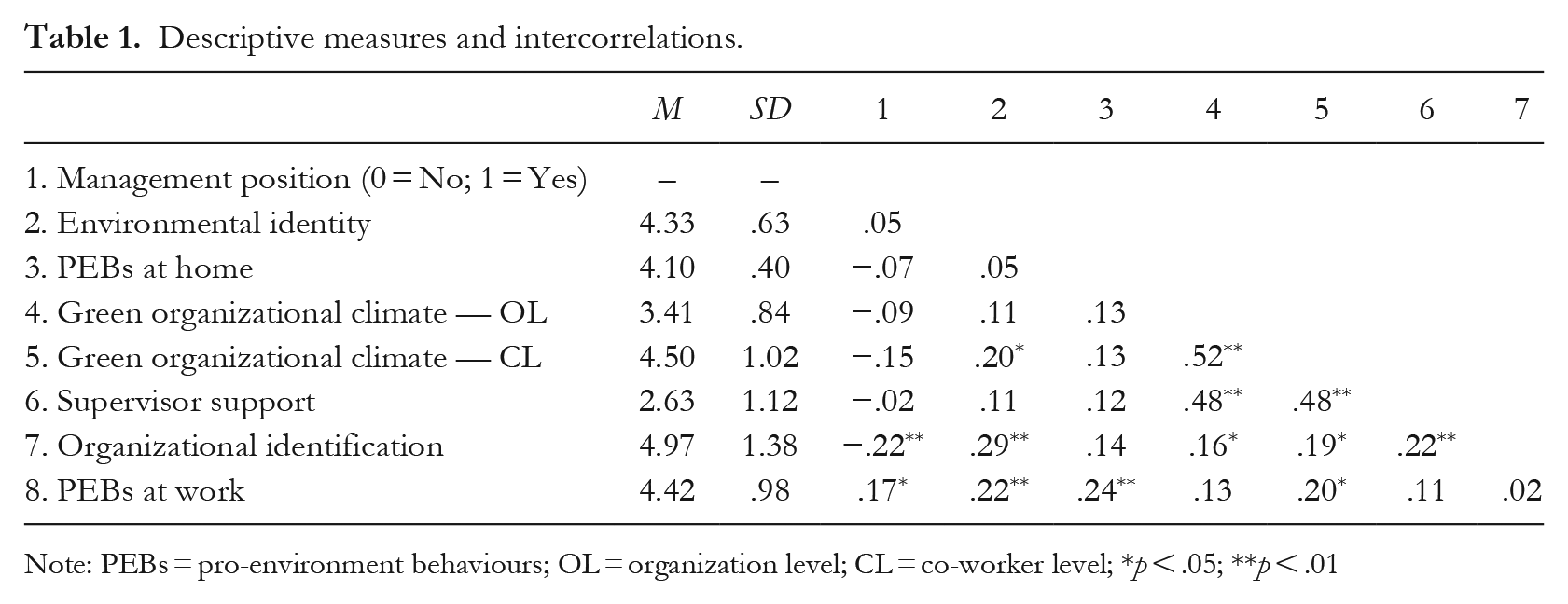
Note: PEBs = pro-environment behaviours; OL = organization level; CL = co-worker level; *p < .05; **p < .01
The correlation results reveal that perceived green climate at the organization level is not significantly correlated with PEBs (rho = .13, p = .11), but perceptions of a green climate at the co-worker level are significantly associated (rho = .20; p < .05) with these behaviours. Supervisor support is, in turn, not significantly connected with PEBs (rho = .11, p = .14). The three predictor variables are significantly correlated with OI (rho = .16; p < .05; rho = .19; p < .05; rho = .22; p ⩽ .01, respectively), but the latter variable is not associated with PEBs (rho = .02, p = .78).
The results further show that only one of the sociodemographic variables — holding a management position (rho = −.17; p < .05) — is significantly correlated with PEBs. This variable was thus included as a covariate in the regression analyses. Finally, both environmental identity and PEBs at home are significantly related to PEBs at work (rho = .22, rho = .24, respectively; both p < .01; Table 1).
Hypothesis testing
Three regression analyses using PROCESS macro’s (Hayes, 2018) Model 4 were conducted to test the hypotheses (Table 2). The findings indicate that green climate at the organization level has a significant effect on PEBs (B = .18; p < .05), thereby confirming H1. A similar effect was found for green climate at the co-worker level (B = .16; p < .05), which supports H2. Therefore, individuals who more strongly perceived a green organizational climate reported engaging in more PEBs at work. The results for supervisor support reveal that this encouragement has only a marginally significant effect on PEBs (B = .12; p = .08), thereby providing insufficient support for H3.
Regression analysis results.
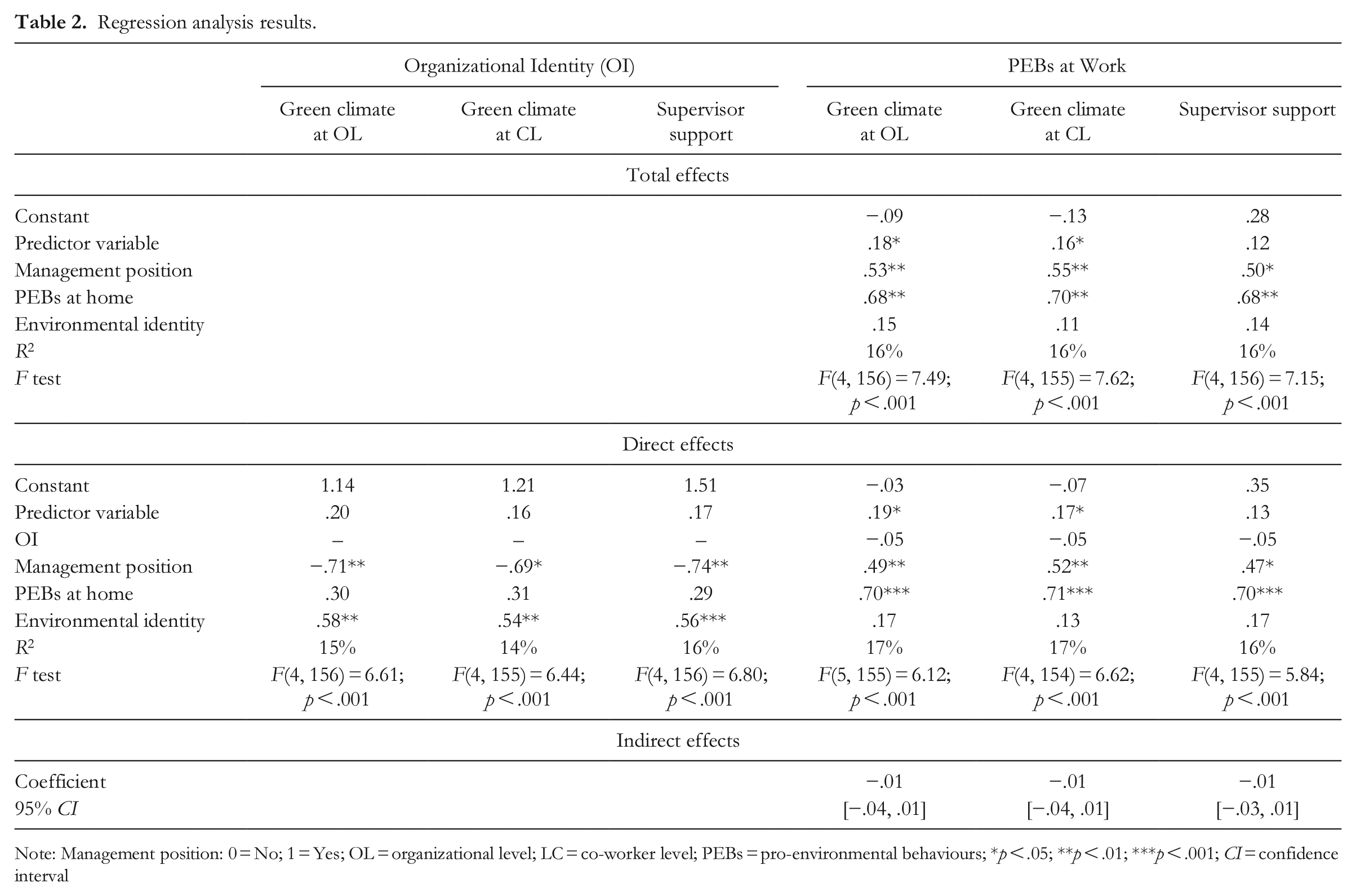
Note: Management position: 0 = No; 1 = Yes; OL = organizational level; LC = co-worker level; PEBs = pro-environmental behaviours; *p < .05; **p < .01; ***p < .001; CI = confidence interval
The data did not support the three hypotheses regarding OI as a mediating variable in the relationship between each predictor variable and employees’ PEBs at work. None of the indirect effects are statistically significant, so H4a, H4b and H4c were not verified. Finally, the results for the control variables show that only PEBs at home were significantly correlated with these behaviours at work.
Discussion
This study analysed the process through which predictors at different levels (i.e., organization, supervisor and co-worker) foster PEBs at work, as well as whether identification with the organization contributes to explaining these relationships. The results show, in line with the extant literature (Norton et al., 2014), that perceived green climate at the organization and co-worker levels predicts PEBs at work. Thus, organizations’ investment in environmental practices and policies is associated with more environmentally friendly behaviours in the workplace (Tian & Robertson, 2019). These social influence factors significantly increase the likelihood of PEBs at work even when the strong influence of engaging in the same behaviours in domestic contexts is considered (Auzoult, 2022).
However, the hypothesis concerning supervisor support’s role was not supported as the connection to PEBs is only marginally statistically significant. Previous research has indicated that supervisors’ encouragement is important to their subordinates’ adoption of PEBs at work (Blok et al., 2015; Luís & Silva, 2022; Ramus & Steger, 2000), but this relationship was not confirmed by the data collected for the present study (Paillé & Francoeur, 2022). This finding could be related to HEIs having diffuse hierarchical structures, with faculty and researchers reporting to various supervisors at the same time (e.g., deans and coordinators of different curricular units and degree programmes). Furthermore, the perceived supervisor support for environmental sustainability in this study was quite low, which may indicate that this type of support was not well established in supervisors’ practices in the studied organization. This result also supports the relevance of independently examining different sources of social influence (Bandura, 1991; Cialdini et al., 1990; Mertens & Schultz, 2021; Spears, 2021), as suggested by recent literature reviews in the field (cf. Zacher et al., 2023).
In addition, none of the hypotheses about OI as a mediator of the links between the three predictors and PEBs at work were confirmed. The participants reported strongly identifying with their employer organization, yet their OI is not affected by the three organizational variables, nor is it associated with stronger adherence to voluntary PEBs at work. The expectation was that stronger perceptions of a green climate (Afsar et al., 2018; Duarte & Mouro, 2022) and supervisor support (Tian & Robertson, 2019; Van Knippenberg et al., 2007) would increase employees’ OI. Instead, the current results suggest that workers acknowledge their HEI’s investment in environmentally friendly practices but have not integrated the corresponding norms and values into their OI. Their identification consequently does not motivate them to engage in behaviours consistent with their organization’s green goals. One possible reason for this would be that environmental policies were relatively new in the organization and more time is required for these policies to be considered part of its core values. Future research could also focus on clarifying OI’s role in promoting PEBs by considering the possibility of a moderating role (Spears, 2021) that amplifies other organizational factors’ effect on PEBs.
This study’s findings should be interpreted with caution due to its limitations. These include the non-probabilistic sample, which may have introduced self-selection bias, and the sample’s modest size given that less than 17% of the HEI’s workers took part in the survey. To overcome these limitations, further research needs to replicate the results in different HEIs and business contexts. Another restriction was PEBs’ operationalization, as only waste separation behaviours were considered. Future studies may want to include a more diverse selection of voluntary PEBs, including environmental advocacy and resource reduction (Yuriev et al., 2018).
Conclusion
In conclusion, the present results contribute to broadening the existing research on PEBs at work, which is an essential part of dealing with the enormous challenge of improving organizations’ environmental performance in the face of climate change (Dahlmann et al., 2019). The current study’s theoretical implications include confirming green climate’s predictive role at both the organization and co-worker levels with regard to PEBs, thereby providing a deeper understanding of how organizational factors affect these extra-role behaviours. The findings also have practical implications because they stress the importance of organizations’ investment in environmental practices as a way to generate a green organizational climate. For instance, companies can implement environmental CSR initiatives and define training programmes that promote managers’ support for greater sustainability (Tian & Robertson, 2019). In addition, the present results suggest that organizations must effectively communicate their existing and potential green policies and environmental values to their employees so that they can develop an informed perception of their organization. Organizations can in this way foster their workers’ and managers’ involvement in environmental sustainability practices and policies, which is crucial to achieving a sustainable future.