




Abstract
An online survey was distributed to a national sample of the Norwegian public (N = 699) to investigate factors associated with the extent to which people worry about microplastics. Respondents were asked about their familiarity with and the extent to which they worry about the issue, after which they answered a battery of questions about their perceptions of risk and personal values. Microplastics were judged to be moderately known, somewhat uncontrollable, very threatening to humankind, and even more so to plants and animals. Perceived personal threat was lower than that to plants, animals and humankind. Regression analyses predicted worry about microplastics from sociodemographic variables and personal values, and from different aspects of people’s risk perceptions. Gender, age group, education level, and endorsing self-transcendence over self-enhancement values predicted greater worry, yet these variables were not significantly associated when risk perceptions were included in the regression model. These findings shed further light on how individual risk judgements can explain self-reported levels of worry about microplastics, beyond individual differences in personal values.
A growing number of studies have suggested that the public has become increasingly aware of the problem of plastic pollution, including microplastics (for reviews, see Catarino et al., 2021; Heidbreder et al., 2019). Along with increasing public awareness, attention towards some of the more specific impacts of microplastics has been growing. Recent research has found that laypeople report being worried about microplastics for a variety of different reasons, such as marine pollution, food contamination, microplastics in drinking water, soil pollution and air pollution (Thiele & Hudson, 2021). These findings are aligned with exploratory studies in which people predominantly associated microplastics with negative impacts (Anderson et al., 2016; Felipe-Rodriguez et al., 2022; Henderson & Green, 2020; Raab & Bogner, 2021). In the present study, we aimed to investigate the relative importance of personal values and individual risk judgements in explaining self-reported worry about microplastics.
Personal values are defined as ‘desirable trans-situational goals of varying importance that serve as guiding principles in the life of one or other social entities’ (Schwartz, 1994, p. 21). Values highlight what people find important when interpreting events and shape people’s judgements of the world around them (Liobikienė & Juknys, 2016). Individuals are argued to be more likely to worry when an event threatens the values they prioritize (Bouman et al., 2020). It is assumed that prioritized values influence worry by focusing attention on threats to important goals (Schwartz et al., 2000) and that worry may arise when one feels that valued goals are being threatened (Ojala, 2007). Environmental risks may pose a threat to some or several of such valued goals; for instance, people with specific value orientations may focus on the unfair distribution of the negative impacts of environmental risk (Ojala, 2007). Accordingly, personal values have been argued to be an important component of the basis of environmental worry, as well as of attitudes and beliefs (Milfont et al., 2015).
Schwartz’s (1992, 1994) value theory postulates that there are 10 clusters of basic human values falling along two dimensions: one from conservation (security, tradition and conformity) to openness to change (hedonism, self-direction and stimulation) and another from self-transcendence (universalism and benevolence) to self-enhancement (achievement and power). The literature on the subject has shown that the degree to which individuals endorse self-transcendence values as guiding principles in their lives can be linked to greater concern about the environment (Steg et al., 2014). Regarding specific environmental issues, self-transcendence values have been linked with higher concern for climate change (Poortinga et al., 2019) but with lower perceived risk of nuclear power (Siegrist & Árvai, 2020). More recent studies have further demonstrated that people who endorse self-transcendence over self-enhancement values tend to be more concerned about plastic litter (Hartley et al., 2018) and more likely to think about microplastics in terms of their consequences and possible mitigation actions (Felipe-Rodriguez et al., 2022). Taken together, these findings give rise to assuming a positive association between endorsing self-transcendence rather than self-enhancement values and expressing worry about microplastics.
The extent to which people worry about microplastics may also depend on their risk perception. The psychometric paradigm maintains that risk perception is fundamentally subjective (Slovic, 1987). In this paradigm, individuals are asked to rank hazards concerning common qualitative and subjective risk features identified in previous studies (e.g., Jenkins et al., 2021; Luís et al., 2020; Valente et al., 2021). Afterward, a principal component analysis (PCA) can be used to reduce the features into their underlying components. Conducting such PCAs, prior studies have found two principal factors which are frequently referred to as Dread Risk and Unknown Risk (e.g., Alrawad et al., 2022; Luís et al., 2020; Wong & Yang, 2022). Features associated with Dread Risk may be alarming, catastrophic, uncontrollable, inequitable from a global perspective and difficult to ameliorate, whereas features linked to Unknown Risk tend to correspond to risks that are unobservable, not understood by science, new and accompanied by delayed effects (Fischhoff et al., 1978; Renn & Rohrmann, 2000).
The psychometric paradigm has been widely used to understand risk perception in the context of environmental hazards. Luís et al. (2020) observed that the factors Dread and Unknown Risk explained most of the variance in perceived risk regarding hazards related to pharmaceuticals in the environment in Southern Europe. Rambonilaza et al. (2016) revealed that flood-risk perception among European landowners could be characterized by three components, named Evaluation of Degree of Risk, Appreciation of Levels of Knowledge of Risk and Sense of Control Over the Risk. Aragonés et al. (2017) showed that some of the characteristics underlying Dread and Unknown Risk partly explained perceived risk from a heavy mineral spill that produced severe pollution in a river in Mexico. Bostrom, Böhm, Hayes, et al. (2020) compared the dimensional structure of risk perceptions concerning climate change and pandemic influenza using data from the US. Their analysis revealed that the components Dread and Unknown Risk yielded an acceptable fit and could be used to predict support for different policy measures. Further, Mumpower et al. (2016) found that a combination of psychometric components (Dread, Scientific Understanding, Public Understanding, Number Affected and Likelihood of Consequences) could be used to predict individual variation in perceived risk of climate change among another sample from the US.
Aims
The present study analysed survey data from a sample of Norwegian adults who were asked about their familiarity with the term ‘microplastics’, the degree to which they personally worried about microplastics and additional questions about personal values and individual risk judgements. Our aims were twofold: to explore the dimensional structure of specific risk judgements about microplastics and to assess whether the extent to which people are worried about microplastics can be predicted from these judgements while controlling for personal values and sociodemographic variables.
Method
Sample
Participants were recruited from an online panel (Norstat panel Norway) of the adult population in Norway, which aims to provide a national sample that closely resembles a probability sample of the Norwegian population. Gender, age and geographic location were used for sampling. The final sample consisted of N = 699 participants, aged from 18 to 91 years (M = 46.30, SD = 17.52; 372 women, 327 men). For highest level of education, 28 had completed only primary school, 199 had completed high school, 195 had completed up to three years of university or college, 82 had completed up to four years, 128 had completed more than four years, and 21 selected the option ‘other’. Participants were informed about the aims and topic of the study, the anonymity of their responses and their right to withdraw their participation at any time. They gave their consent to take part in the study by clicking a button when following the link to the survey.
Materials
The data were collected as part of a larger questionnaire on perceptions of microplastics; yet, the current study focused on worry about microplastics, individual risk judgements, personal values and sociodemographic variables. 1 At the start of the questionnaire, they responded to the following question: ‘Have you heard of microplastics before?’ with the answer categories 1 (‘Yes’) and 2 (‘No’); for a similar approach, see Kramm et al. (2022). Most participants claimed to have heard about microplastics before participating in this study (n = 674).
Sociodemographic variables
We considered gender (1 = male, 2 = female), age group (1 = below 30 years, 2 = 30–39 years, 3 = 40–49 years, 4 = 50–99 years), education (1 = completed primary school or below, 2 = completed high school, 3 = completed up to three years of university, 4 = completed up to four years of university, 5 = completed more than four years of university). We included these variables as covariates on the basis of previous research addressing risk perceptions of plastic-related hazards (Felipe-Rodriguez et al., 2022; Kramm et al., 2022).
Worry about microplastics
Microplastics worry was measured with the question ‘How worried, if at all, are you about microplastics?’ rated on a five-point scale with the labels 1 (‘not worried at all’), 2 (‘a little worried’), 3 (‘somewhat worried’), 4 (‘worried’) and 5 (‘very worried’). On average, participants reported to be moderately worried about microplastics (M = 3.58, SD = .94).
Risk judgements
Fifteen items were used to assess risk judgements about microplastics (see Table 1). The items were adapted from Bostrom, Böhm, Hayes, et al. (2020), who used them to assess risk perceptions about climate change and pandemic influenza. The items were rated on a seven-point scale with endpoints that varied across items. The items corresponded to judgements traditionally used in the psychometric paradigm and covered five aspects of risk perception: threat and dread, known risk, morality, controllability and efficacy, and human benefits (Bostrom, Böhm, Hayes, et al., 2020).
Means, standard deviations and principal component analysis of psychometric judgements.
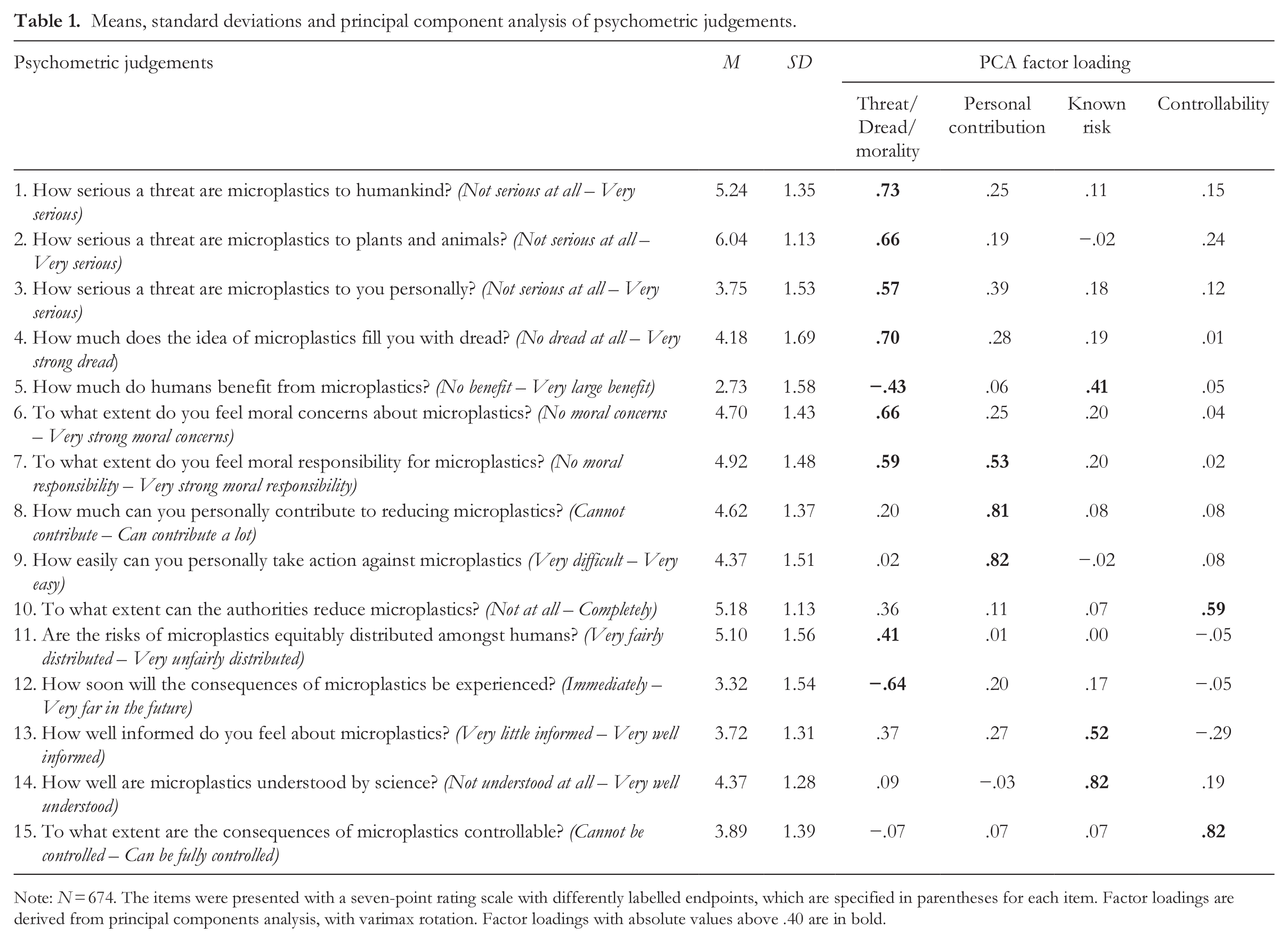
Note: N = 674. The items were presented with a seven-point rating scale with differently labelled endpoints, which are specified in parentheses for each item. Factor loadings are derived from principal components analysis, with varimax rotation. Factor loadings with absolute values above .40 are in bold.
Personal values
We measured personal values with the Ten-Item Value Inventory (TIVI; Sandy et al., 2017), which is a shortened adaptation of the Portrait Values Questionnaire (PVQ; Schwartz, 2003). The TIVI measures a total of 10 values: conformity, tradition, benevolence, universalism, self-direction, stimulation, hedonism, achievement, power and security. Items were presented in randomized order to each participant. The self-transcendence versus self-enhancement dimension was created by combining universalism, benevolence, achievement (reversed) and power (reversed). Accordingly, the conservation versus openness to change dimension was created by combining conformity, tradition, security, stimulation (reversed), self-direction (reversed) and hedonism (reversed). Higher values indicated higher endorsements of self-transcendence and conservation values than self-enhancement and openness to change, respectively. Each participant’s mean response to all items was treated as a covariate to reduce the effect of individual differences in general endorsement tendency (Schwartz, 1992).
Analyses
In a first step, an exploratory PCA with varimax rotation was applied to tap into the dimensional structure of the risk judgements. In a second step, we computed a hierarchical regression analysis to assess the extent to which the focal variables included in this study can predict worry. Worry about microplastics was first regressed on the sociodemographic variables and personal values, after which the components from the PCA were added to the model. This was done to scrutinize the robustness of the anticipated association between personal values and worry. In a third step, we calculated bivariate correlations between socio-demographics, personal values, risk judgement components and worry. All analyses were carried out with IBM SPSS Statistics for Windows, Version 27.
Results
We report the results in two sections. The first section concerns the risk judgements, in which a description of the general profile is followed by the PCA undertaken to inspect the dimensional structure of the items. The next section focuses on the extent to which the sociodemographic variables, personal values and risk components are associated with worry about microplastics.
Risk judgements
Risk perception profile
Table 1 presents descriptive statistics for the risk judgements, excluding participants who had not heard of microplastics before participating in this study. Participants rated microplastics as very threatening to plants and animals, threatening to humankind and as a moderate but not serious threat to them personally. They furthermore rated the idea of microplastics as moderately dreadful and thought that humans do not generally benefit from microplastics. They felt quite high degrees of both moral responsibility and moral concern about microplastics, and they judged that they could fairly well contribute to reducing microplastics personally, comparable to how easy they deemed taking action against microplastics to be. They believed that the authorities could reduce microplastics to a large extent and that the risks of microplastics were inequitably distributed across humans. They also judged that the consequences of microplastics might be experienced quite soon, and considered microplastics to be moderately understood by science, whereas they reported feeling moderately uninformed about microplastics themselves. Last, they rated the consequences to be moderately uncontrollable.
Dimensional structure
We conducted a PCA with varimax rotation, following the procedures commonly employed in the psychometric paradigm (e.g., Slovic, 1987). Based on the scree test and Kaiser criterion (eigenvalue equal to or higher than 1.0), the analysis revealed a clearly interpretable four-factor solution (see Table 1). A first component could be interpreted as a Threat/Dread/Morality component, which also included items referring to delay of consequences, equity and human benefit. The second component could be interpreted as a Personal Contribution component, as it was formed by items referring to the perceived ease of personally taking action against microplastics and the perceived extent to which one can personally contribute to reducing microplastics. A third Known Risk component was formed by items addressing how well-informed one feels about microplastics and how well microplastics are understood by science. A fourth component could be interpreted as a Controllability component, formed by items referring to the extent to which the consequences of microplastics are controllable and the degree to which authorities can reduce microplastics.
Predicting worry about microplastics
A hierarchical linear regression analysis was conducted to examine variables associated with worry about microplastics (see Table 2), part of which included the risk components yielded by the PCA of the risk judgement items (see Table 1). Model 1 indicated that women (vs. men), older (vs. younger) age groups, and those with higher education worried more about microplastics, as did people who endorsed self-transcendence (vs. self-enhancement) values. There was no significant association with conservation (vs. openness to change) values. Model 2 showed that gender, age group, education level, and self-transcendence values were not significant as predictors when the risk perception components were added to the model. Instead, three out of four risk perception components yielded significant associations with worry about microplastics. More specifically, the more people worried about microplastics, the higher they scored on Threat/Dread/Morality, on Personal Contribution, as well as on Known Risk. The Controllability component showed no significant association, however. Table 2 shows that Threat/Dread/Morality was the strongest predictor, followed by Personal Contribution and Known Risk. The explained variance showed an increase from 12% in Model 1, F(6, 602) = 13.63, p < .001, to 50% in Model 2, F(10, 598) = 60.32, p < .001.
Regression coefficients predicting worry about microplastics.
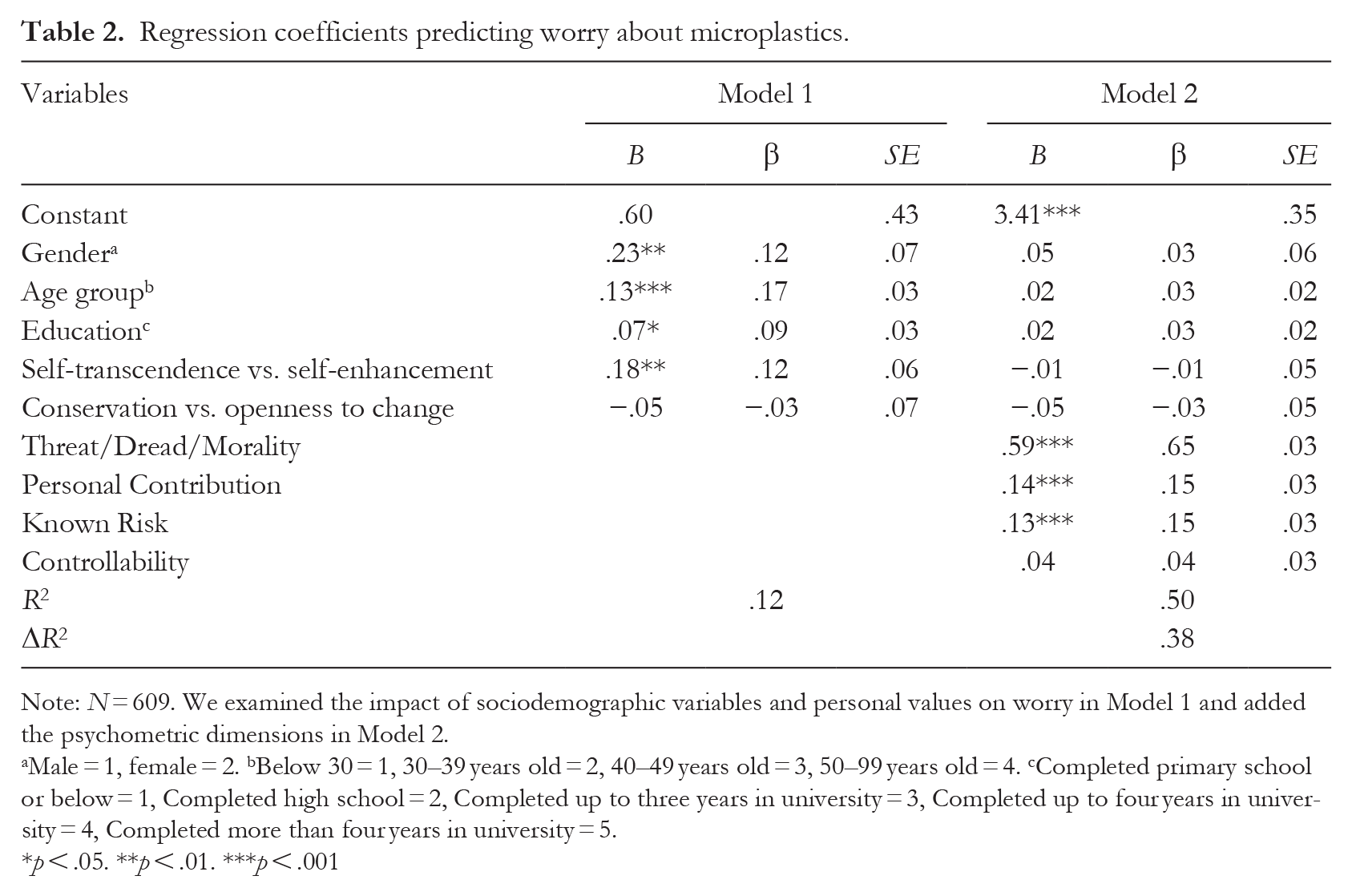
Note: N = 609. We examined the impact of sociodemographic variables and personal values on worry in Model 1 and added the psychometric dimensions in Model 2.
Male = 1, female = 2. bBelow 30 = 1, 30–39 years old = 2, 40–49 years old = 3, 50–99 years old = 4. cCompleted primary school or below = 1, Completed high school = 2, Completed up to three years in university = 3, Completed up to four years in university = 4, Completed more than four years in university = 5.
p < .05. **p < .01. ***p < .001
Table 3 presents correlations between the focal variables in this study. Most of the measured correlations were below r = .20, except for the correlation between worry and Threat/Dread/Morality at r = .67. The endorsement of self-transcendence (vs. self-enhancement) values correlated significantly with gender, age group, higher scores on Threat/Dread/Morality and Personal Contribution, as well as with worry about microplastics. The endorsement of conservation (vs. openness to change) values was significantly correlated with gender, age group, and Personal Contribution. Further significant correlations were found from Threat/Dread/Morality to gender, age group, and education, and from Personal Contribution to gender, age group and worry, and from Known Risk to age group, educational level, and worry. Worry was significantly related to gender, age group, and education level, and the two value orientations showed a small but significant correlation. A complete overview, including non-significant correlations, can be found in Table 3.
Intercorrelations among socio-demographics, personal values, risk perception components and worry.
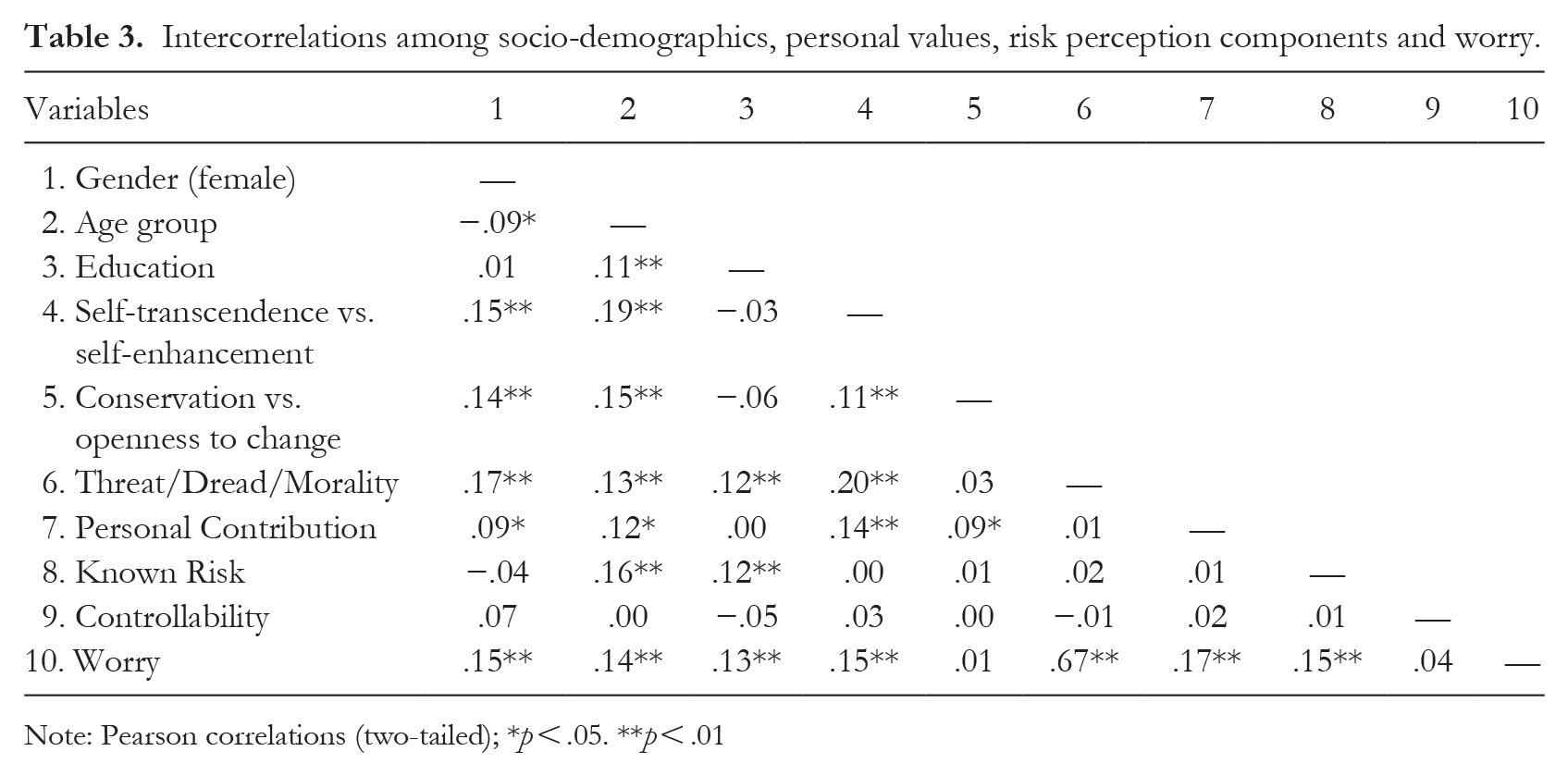
Note: Pearson correlations (two-tailed); *p < .05. **p < .01
Discussion
Microplastics are a human-caused problem at a global scale that can affect animals and plants in all sorts of ecosystems (Duis & Coors, 2016), but they are often impossible to detect by human senses (Tong et al., 2020). Based on an analysis of survey data from Norway, we found evidence to suggest that even though there appears to be some understanding that microplastics are to be considered a serious environmental hazard, different aspects of risk are evaluated quite differently. While microplastics were perceived as seriously threatening to humankind and very seriously threatening to plants and animals, they were not viewed as posing a very severe personal threat. The perception that microplastics pose a particular threat to plants and animals might be shaped by the main media narratives, which commonly emphasize the potential harmful impacts from microplastics (Völker et al., 2020; Welzenbach-Vogel et al., 2022), which in turn have been associated with increased risk perception among those exposed to these narratives (Kramm et al., 2022).
Our respondents reported that microplastics made them feel quite strong moral concerns and moral responsibility, possibly implying that microplastics are acknowledged as an (artificial) human-caused environmental hazard. Bearth et al. (2017) argue that the perceived artificiality of a risk source enhances concern, and that this tends to be the case for microplastics. Research from other domains supports this line of argumentation insofar that radon radiation has been shown to be perceived as less risky than other sources of radiation (Halpern & Warner, 1994), which could be because radon is viewed as being of natural origin (Cori et al., 2022). The perception of microplastics as being artificial and human-caused might offer an explanation of why microplastics were seen as having a strong moral component in the current sample. This interpretation draws upon the notion that the perception of human causation constitutes a prerequisite of moral concern about environmental risks (Böhm & Pfister, 2017).
As for the scientific evidence on microplastics, there is a great variability and uncertainty associated with the available data on exposure and risks (see Thiele & Hudson, 2021; Wardman et al., 2021). The respondents expressed that they did not feel well informed about the topic when considering themselves; they nevertheless believed that microplastics are moderately understood by science. This is noteworthy not just because it implies a need to share available evidence about microplastics with the broader public, but it also suggests that people are unaware of the uncertainty associated with microplastics risks. Our findings thus support the bulk of literature that has suggested that there is an apparent gap between what experts indicate they know about microplastics and what the public perceives (see Thiele & Hudson, 2021).
Whereas the respondents deemed it fairly easy to take action and contribute to reducing microplastics, they also felt that authorities could stop microplastics to a large extent. A possible interpretation is that people think that authorities and they themselves could potentially address the issue effectively, but because they might not know how, they continue to view microplastics as uncontrollable. This perceived uncontrollability could perhaps reflect an unawareness of concrete actions that may contribute to mitigating the problem, as suggested elsewhere (Felipe-Rodriguez et al., 2022). It thus appears plausible that communication campaigns could benefit from highlighting specific actions people may take that would contribute to reducing the purchase of synthetic clothing, reducing the number of possessed pieces of clothing, etc.
After individual risk judgements were added to the regression analysis, neither sociodemographic variables nor personal values explained any unique variance in worry about microplastics. At the same time, we found correlations between the endorsement of self-transcendence over self-enhancement values, on the one hand, and the Threat/Dread/Morality and Personal Contribution risk components, on the other hand. One possible interpretation is that valuing others or the environment over the self makes people focus more on the potential threatening and dreadful consequences of microplastics and how people might work to address the problem (see also Mumpower et al., 2016). On a further note, the finding that personal values were no longer a significant predictor of worry when more proximate risk judgements were considered hints that educational and awareness campaigns may be more effective by highlighting knowledge about microplastics than by appealing to people’s values.
The extent to which people were worried about microplastics was especially predicted by thinking about microplastics as more threatening, dreadful and morally concerning. This suggests that the reason why people are concerned about microplastics can partly be found in the threatening and dreadful characteristics of microplastics. Supporting evidence stems from studies in which it was shown that microplastics are primarily associated with concepts such as ‘dangerous’ and ‘bad’ (Dilkes-Hoffman et al., 2019; Felipe-Rodriguez et al., 2022; Henderson & Green, 2020; Raab & Bogner, 2021). There is also literature showing that media narratives tend to frame microplastics as alarming, dangerous and involuntarily toxic for animals (Völker et al., 2020) and that knowledge about media narratives such as these is an important predictor of individual risk judgements of microplastics (Kramm et al., 2022).
Our results show that the more people thought they could personally contribute to reducing microplastics, and the more easily they felt they could personally act to reduce microplastics, the more worried they felt. A possible explanation is that those who are aware of different mitigation actions may also be more aware of the sources and potentially harmful consequences of microplastics, which in turn may contribute to higher levels of worry. Previous studies have indeed shown that greater knowledge about microplastics tends to be associated with enhanced risk perception (Deng et al., 2020; Kramm et al., 2022) and that more experience with microplastics tends to be linked to higher worry (Thiele & Hudson, 2021). Another study demonstrated that acquiring knowledge about microplastics elevates perceptions of microplastics as a risk: knowledge about the amount of waste per year, the flow of microplastics into the oceans, the accumulation of microplastics in the food chain and marine microplastics pollution increased together with perceptions of economic, social, physical and environmental risk (Yoon et al., 2021).
Perceiving microplastics as a known risk was associated with higher levels of worry, yet there was no evidence that worry was associated with beliefs that the consequences of microplastics are controllable or that governments can reduce microplastics. This finding is interesting because one might expect that perceiving microplastics as more controllable and reducible would be linked to (reduced) worry. Whereas controllability is usually considered among the characteristics that may drive risk-related feelings (e.g., Bellamy et al., 2017; Loewenstein et al., 2001), it has also been found to be a strong predictor of worry about technologies used to remediate polluted environments (Prior et al., 2017).
Limitations
This study is not without limitations. First, our participants reported to be very familiar with the topic of microplastics. Future research is needed to confirm the dimensional structure of the obtained risk perceptions in contexts where people are less familiar with the topic. Even though there appears to be increasing awareness of microplastics (Catarino et al., 2021), there are regions where few people seem to be familiar with the term (Deng et al., 2020). Second, it remains to be addressed whether targeting worry (e.g., by emphasizing its potentially harmful consequences for animals and humans) can result in actual behaviour change. Research has shown that even when people view microplastics as a problem, they might not be aware of specific types of behaviour that can help with its mitigation (Anderson et al., 2016; Henderson & Green, 2020). Third, we lack a systematic comparison of participants’ responses to the risk perception questions about microplastics with other threats. 2 Future research could use the included measures to compare different threats in order to tap into the relative importance that people assign to microplastics in comparison to other risks. Fourth, it needs to be highlighted that the reported analyses are correlational in nature. Further experimental research is needed before any causal conclusions can be drawn.
Conclusions
The present study suggests that many people have heard about microplastics and that this is something they are worried about. In addition to exploring the prevalence across different sociodemographic variables, we investigated psychological factors that can explain individual differences in self-reported worry about microplastics. We were particularly interested in exploring the relative importance of personal values and individual risk judgements, both of which have been associated with worry about environmental issues in previous studies (see e.g., Bouman et al., 2020). Microplastics risk perceptions could be empirically distinguished based on four components, three of which were in turn more strongly associated with worry about microplastics than either sociodemographics or personal values.
Footnotes
Correction (June 2025):
Article updated online to correct statistical results in Table 2 and Table 3.