




Abstract
High-speed rail might be a solution to reduce energy usage and carbon emissions as rail transport consumes less energy than airplanes. However, in choosing a transport system, time is an important factor in making many passengers choose air travel. This paper studies the reasons why passengers choose a transport mode, and compares the comfort of aircraft and train seats. This study shows that time and costs are the most mentioned factors, but comfort and sustainability can play a deciding role between trains and airplanes on time and cost-competitive travel routes. The train seat is evaluated as the most comfortable, but still, part of the passengers choose the aircraft as the length of sitting on the seat is limited.
Introduction
According to Strauss et al. (2021) for travel distances of 300–2000 km, high-speed rail (HSR) is a solution to mitigate energy usage and carbon emissions as rail transport consumes less energy than airplanes. Also, Zhang et al. (2019) state that rail is regarded as an energy-efficient mode of transport. Baumeister et al. (2020) calculated that for a situation in Finland, a jet produces 186g CO2-eq/pkm, a turboprop 147g, and a high-speed train around 12g. A future electric airplane might produce 77 g CO2-eq/pkm. However, this is under the assumption that the electric airplane would mainly rely on electricity produced from fossil fuels. When electricity from renewable sources is used, the emissions produced by electric airplanes would reach those of the train. The HSR seems the most sustainable choice at the moment and maybe it will change the coming decennia. Besides this, the shift from air to rail is largely discussed in the current European politics given color by the European year of the rail in 2021 and Transport and Environment reports, discussing what’s best: trains or planes (European Environment Agency, 2021).
Bäckström (2021) describes some factors influencing the choice between airplane and train. These are costs, environmental impact, safety, comfort, and time. Vink et al. (2022) found that from the users’ perspective, the choice is influenced by (in order of importance) ‘point-to-point’, comfort, efficiency, and sustainability. With ‘point-to-point’ is meant for instance starting close by the house and ending close to the destination with the least transfers between vehicles as possible. Train stations have the advantage that they are located in closer vicinity to city centers, which might ease the choice for ‘point-to-point’ travel. However, often train transfers might still be needed, causing disruptions.
The question is, what are the reasons for users to choose the train or the airplane? This question might be useful in the design and the choice of transportation systems. As described above, some factors influencing the choice are already known: costs, environmental impact, safety, comfort, time/efficiency, and ‘point-to-point’. This paper will focus more on the user experience of the comfort/convenience in the transport mode rail and airplane. The research question is: which factors influence the choice for a trip by a high-speed train compared to a short airplane trip with special attention to comfort factors?
Method
To study the reasons why passengers choose to travel by train or jet aircraft and what should be changed regarding comfort to promote using the train more often, a questionnaire was developed and an experimental setup was made of a train interior and an airplane interior (see fig.1). 130 participants were asked to complete the questionnaire and have a seat in the aircraft seat and the train seat. In addition, anthropometric data were gathered regarding hip width, stature, weight, popliteal height, buttock-popliteal height, shoulder width, and elbow-to-elbow width, according to the procedure described by Molenbroek et al. (2017). A power analysis prior to the test was used to define the number of participants. The advice of 128 subjects was established with the input parameters: one-tailed, effect size 0.3, alpha 0.05, power 0.95.
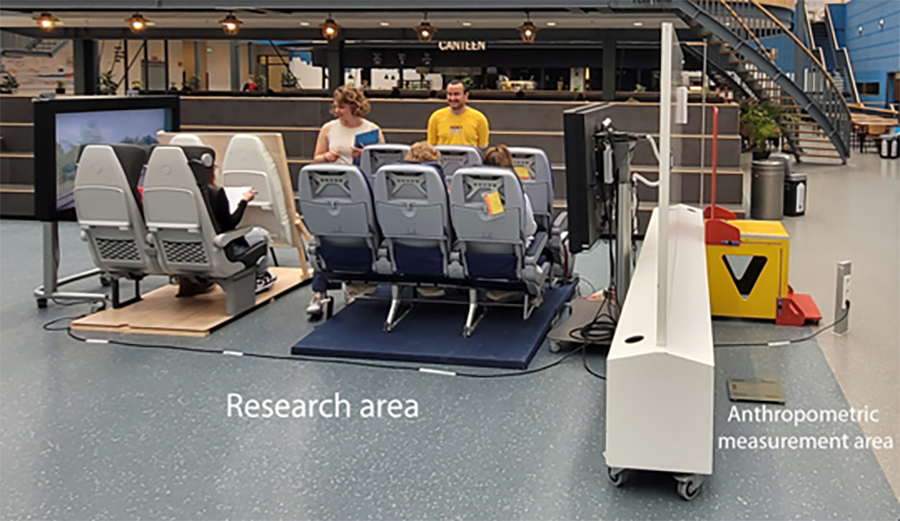
Overview of the test set-up with 2x2 participants seated (2 in the train seat (left) and 2 in the aircraft seat (right).
The questionnaire consisted of questions regarding the characteristics of the seats (can you point out something you like and something you dislike about the seat?) and general questions like ‘would you take the train or airplane from Amsterdam to Düsseldorf?’ and ‘why do you choose this?’. A train trip from Amsterdam to Düsseldorf is 2h 22minutes, the same trip by airplane (excluding time to travel to the gate and boarding) is 50 minutes. The research was approved by the ethical committee of the Delft university of Technology. The protocol started by completing an informed consent. Half of the participants were asked to take a seat in the second row of the aircraft seat in groups of two followed by the train seat (see fig. 1). The other half started in the second row of the train seat. The participants spend 5 minutes in each seat. During each 5 min. the participant filled out the questionnaire.
Participants were seated in a window seat and in the seat next to that. When they took the window seat on the train they had to take the same seat in the airplane. The train seats were from Grammar AG, ICE 3000. For the aircraft seats, Recaro Boeing 737 seats were used. A row was placed in front of the participants’ seats at the distance as in the real vehicle. Figure 2 shows the seat dimensions. While seated, questions were asked on the comfort score (0-10, 0 = no comfort at all and 10 = extreme comfort) of the total seat and parts of the seat and after experiencing both seats a preference was asked. Descriptive statistics (percentages) were used to see what the preferences are for different transport modes, and what the reasons are behind those preferences. Significant differences between the comfort scores were calculated using the Wilcoxon paired sample test (p<.05). Also, open-end questions were asked for general comments.
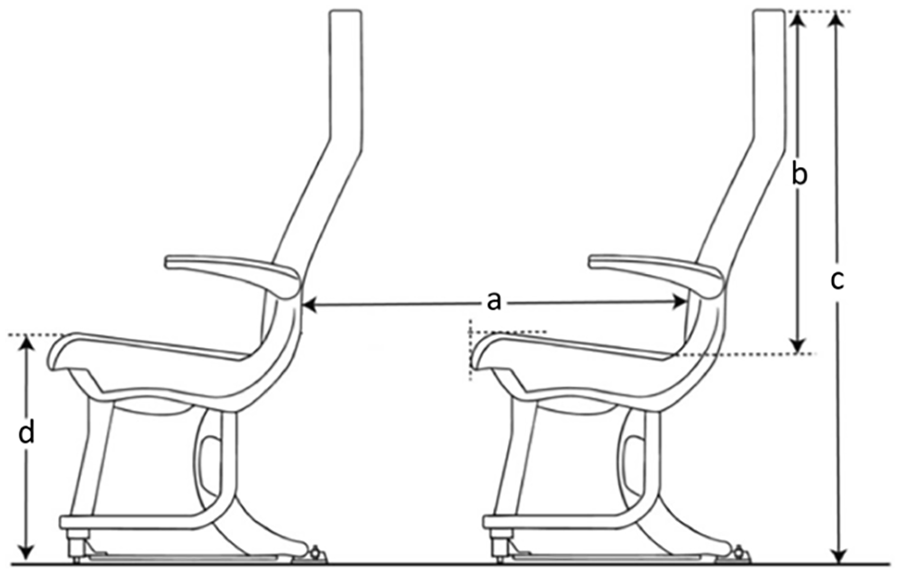
Dimensions of seats used (the train seat was placed on a platform with a 3-degree angle).
Results
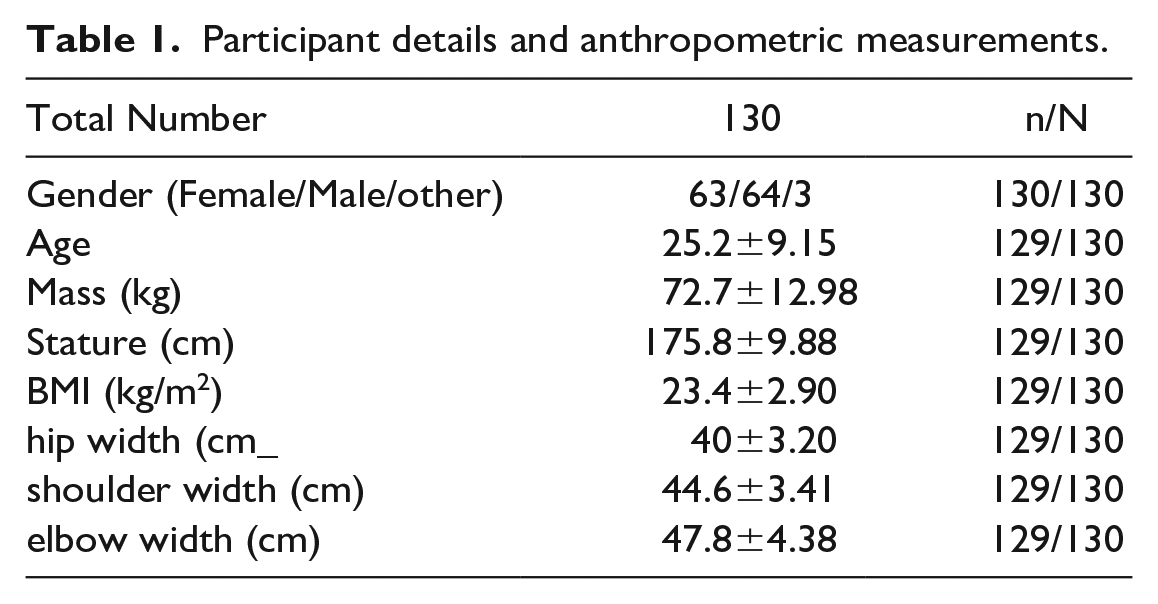
The anthropometrics of the group (see Table 1) was comparable to young students’ data described by Molenbroek et al. (2017). For instance, the stature in this research was 175.8 cm on average, while in the study of Molenbroek et al. (2017), the stature was 175.9 on average.
Participant details and anthropometric measurements.
The questionnaire showed that 64 preferred to travel from Amsterdam to Düsseldorf (approx. 250 km) by train and 63 by airplane. Three did not give a preference. Factors influencing the choice for a certain transport mode (shown in Fig. 3) that was mentioned most were time/duration followed by costs and comfort. Just under half of the participants mention sustainability as a reason for choosing the transport system and is followed by convenience/stress-free travel.
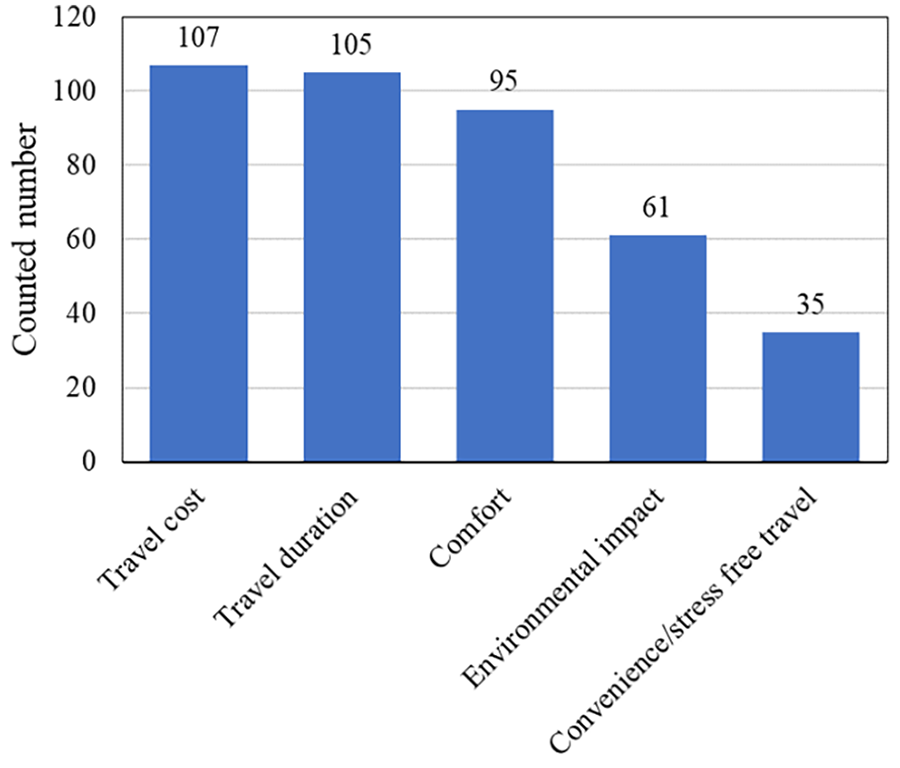
Factors influencing transport choice and how much times they were mentiond by 130 participants (they were asked to mention 5 reasons).
For comfort, the seat plays an important role. However, sometimes travelers score the aircraft seat lower in comfort and then still choose the airplane as they have to sit shorter on the aircraft seat than on the train seat. Without context 74 participants preferred the train seat over 52 who preferred the airplane seat. With context added, this was almost the same for trains (64) and airplanes (63).
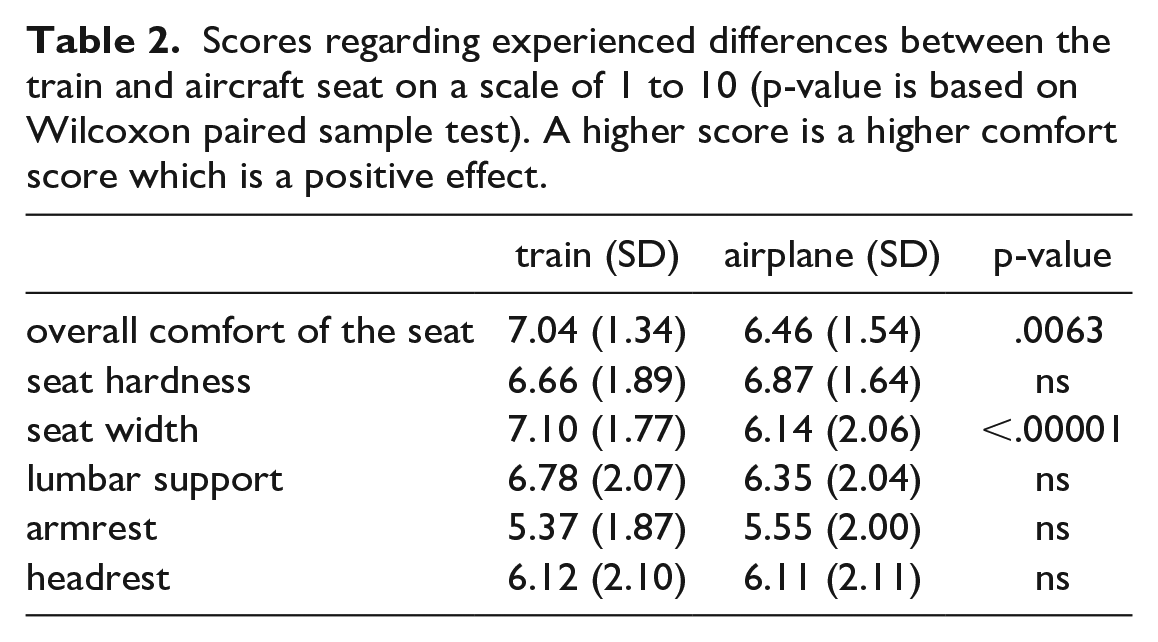
Table 2 shows that the overall seat comfort and experienced seat width are significantly better for the train seat. Other differences were not significant. In the open questions many times the hardness was mentioned as a negative point. The train seat was experienced harder. The comfort score in table 2 is also higher for the airplane seat regarding hardness, but not significantly different.
Scores regarding experienced differences between the train and aircraft seat on a scale of 1 to 10 (p-value is based on Wilcoxon paired sample test). A higher score is a higher comfort score which is a positive effect.
In the open questions, the fabric looks and hygiene of the train seat were mentioned 11 times positively and zero times negatively. For the airplane seat, this was two times positive and three times negative.
Discussion
The study shows that the most mentioned reason for choosing a transport system was time/duration followed by costs and comfort. This is in alignment with other studies. Bäckström (2021) also describes that costs and time are important factors influencing the choice for a mode of transport and Vink et al. (2022) also describe ‘point-to-point’ and efficiency as important factors.
Both studies mention comfort and sustainability, not as the most important factor, but as comfort is the 3rd and sustainability is the 4th factor, this shows that it is something passengers are considering. This might mean that comfort and sustainability are more important factors on travel routes where time and cost-competitive options are offered.
In the case of comfort, the train seat is scored higher by the participants. However, it should be taken into account that some travelers prefer airplanes as they state that the duration of seating is shorter in airplanes. Duration is an important factor for comfort, which has been studied before. Smulders et al. (2016) described this phenomenon, even in a business class aircraft seat the comfort reduces over the course of time.
Sustainability is seen by a large portion of the participants (61) as an important factor, this shows that it is something passengers are considering. If enough sustainable options are offered, this could form a deciding factor. This is corresponding with findings from Vink et al. (2022), who concluded that the most sustainable transport does not have the priority of participants, but is an influencing factor and should be presented to passengers as the environment-friendly option. On the other hand, 7 out of 10 Dutch citizens worry about the climate, but the ‘flight shame’ in 2022 (15%) did not increase compared to 2019 (18%) (van der Schelde & Kanne, 2022).
As train transport in the future on longer distances will be promoted because of sustainability reasons, the train seat characteristics: hardness (in comparison to airplanes), and the armrests (overall low score) should be improved in the future.
Besides the choice factors mentioned above, it is worth mentioning that there are strong signals that promoting train travel should start with better booking services and accommodating stress-free travel (van Kuijk et al., 2023). This could be related to the fifth factor mentioned in our results convenience/stress-free travel. An example of this is represented in an Austrian study, where one-third of the participants did not succeed in booking an international train trip (Preslmayr et al., 2022). The absence of clear booking platforms strongly influences the stress level during trips e.g. in case of delays during trips and problems with layover train connections.
This study also has limitations. The length of the sitting test was short, so only gives a first impression of the comfort experience. Seat discomfort cannot be evaluated in such a short time as fatigue and long-term sitting have not been included enough (Sammonds et al., 2016). Also in first-impression comfort experiences, the aesthetics of the seats can play a large role (Mansfield et al., 2020). The train seat and airplane seat looked very different. The airplane seat had a blue fabric upholstery while the train seat was covered with brown leather, the latter might give a more luxurious and hygienic feeling. Our results show that the train seat fabric looks were mentioned more positively than the airplane seat fabric. Additionally, the passengers did not sit in a real vehicle. The movements and view outside could certainly have influenced the passenger experience. Finally, participants were recruited at the Delft University of Technology and mainly consisted of students. Which might give a limited view on how travel choices are made. On the other hand these will be the travellers of the future. Finally, in our research, when discussing the participant’s preference, it was mentioned to the participants to leave out the cost from the equation and the proposed travel time was excluding time to travel to the gate and boarding. In future research, these factors should be taken into account.
Future research could compare more train and airplane seat models to create a bigger comparison sample, to see if train seats in general are harder and why.
Sustainability alone is not (yet) a crucial factor in why passengers choose a transport mode. Therefore, attention to interior comfort is important and it may play a role in attracting more passengers to sustainable modes of transport. In choosing a more sustainable turboprop airplane or airplane, noise will be an issue (Vink et al., 2022) (Mansfield et al., 2021) (Vledder et al., 2023). Another study could focus on seat or environment characteristics in long-distance trains, facilitating activities that can best reduce the experienced travel time, help passengers spend the travel time useful and more comfortably. For instance, research is needed into speed difference/jerk, temperature, humidity, noise difference, and the seat influence on sleep comfort during a sleeper train trip (Vledder et al., 2023) and on privacy in sleeper trains (Heufke Kantelaar et al., 2022). Additionally, the napping comfort while charging an electric car can improve the attractiveness of electric cars. In this case, the best backrest angle (Caballero-Bruno et al., 2022), neck support, footrest, and environmental conditions light, noise and temperature are needed for a good nap (Vink et al., 2023).
Conclusion
In this study, time and costs are the most frequently mentioned factors influencing travel mode choice, as described in the literature. Comfort and sustainability rank as the third and fourth most mentioned factors. They can play a decisive role in choosing between trains and airplanes for time and cost-competitive travel routes. Additionally, according to the literature, the fifth factor influencing travel choice is ‘convenient/stress-free travel,’ which should be taken into consideration.
Regarding comfort, the train seat is evaluated as the most comfortable. However, given the option, some passengers still choose the aircraft seat as the sitting time is limited. Furthermore, the train seat characteristics, such as ‘hardness’, ‘armrests’, and napping facilitation of the seat could be improved in the future to gain a competitive advantage in terms of comfort.
