




Abstract
Brain-computer interfaces (BCIs) are a rapidly developing technology with the potential for a wide range of applications, yet the technology and its possible risks are poorly understood. The aim of this study was to develop and analyse an abstraction hierarchy model of a hypothetical, advanced invasive BCI system lifecycle to identify potential design lifecycle risks. Ten subject matter experts participated in a workshop to validate a BCI lifecycle abstraction hierarchy, which was subsequently analysed using the Sociotechnical Systems-Design Toolkit (STS-DT) prompts. The analysis identified the system purpose of generating wealth for companies and shareholders conflicted with other system purposes relating to health and wellbeing. Findings also identified poorly supported system functions, such as the regulation of BCI technologies, and potentially unreliable system objects. In conclusion, it is recommended that the identified issues be addressed through a sociotechnical systems approach focusing on joint optimisation across the system.
Keywords
Introduction
Brain-computer interfaces (BCI) are devices which read brain signals, decode them into usable signals, and transmit them to control electronic technologies (Hramov et al., 2021). Invasive BCIs read brain signals via sensors embedded in or on the brain while non-invasive BCIs use sensors external to the scalp, albeit generally with reduced signal fidelity (Hramov et al., 2021). BCIs primarily have a therapeutic purpose, such as to help people with impaired motor control communicate and utilise the internet (Hramov et al., 2021), and to bypass spinal damage (Nishimura et al., 2013). As such, they have the potential to greatly improve quality of life for people with disabilities or neurological conditions. BCIs may also be used for enhancement purposes, such as for improving decision making and memory (Racine et al., 2021), and increasing immersion with technologies such as virtual reality. Considering these purposes, it is anticipated that BCI technologies will become widely utilised in the future. However, a number of potential risks have been identified, including mental and physical health impacts related to device implantation and use, and adverse impacts related to shifting societal norms (King et al., 2022).
With such a large potential for societal disruption, prospective analyses are required to inform the design of BCIs and supporting systems to protect user health and wellbeing and ensure optimal performance. Systems Human Factors and Ergonomics (HFE) methods have a key role to play in informing the design of safe, ethical, and usable advanced future technologies (Salmon, Carden et al., 2021). In particular, systems HFE methods such as Cognitive Work Analysis (CWA; Vicente, 1999) are useful as they enable an analysis of both the technology itself and the broader sociotechnical system in which the technology will be embedded. In the case of BCIs, prospective analyses must have an appropriately wide scope to encapsulate the lifecycle of the BCI system, from early business processes (e.g., business case development), to BCI development, through to BCI decommissioning. This scope enables the broad consideration of all system functions that must be developed and designed to ensure system safety and performance. The aim of the current study was to apply the first phase of CWA, Work Domain Analysis (WDA) and prompts from the Sociotechnical Systems Design Toolkit (STS-DT; Read et al., 2018), to develop and analyse a model of a BCI system lifecycle. The intention was to provide insights to inform the design of safe, ethical, and usable future BCI systems.
Methods
Cognitive Work Analysis and Work Domain Analysis
CWA is a framework of methods that can be applied to model complex sociotechnical systems (Vicente, 1999). Applying this framework is useful for identifying the constraints within a system that shape behavior. The framework consists of five interrelated phases, including WDA, control task analysis, strategies analysis, social organisation and cooperation analysis, and worker competencies analysis (Vicente, 1999). CWA takes a formative approach, which is a key strength as it can be used to model and analyse future systems that do not yet exist.
The first phase of CWA, WDA, involves the development of an actor-independent abstraction hierarchy (AH). The AH models a system based on five levels of abstraction, from the abstract purposes of a system at the top level moving down to the systems values and priority measures, the purpose-related functions, the object-related processes, and the physical objects at the bottom level (Vicente, 1999). Means-ends links are used to represent relationships between nodes at adjacent levels, where a link to a node at the level immediately above denotes why a node is undertaken and a link to a node at the level below denotes how a node is supported or undertaken. Altogether, an AH represents what the purpose/s of a system is, how it measures progress to its purpose/s, and the mechanisms and objects involved in undertaking tasks to achieve these purposes.
Sociotechnical Systems – Design Toolkit
The STS-DT (Read et al., 2018) provides guidance and a set of templates to support system design in line with insights gained from systems HFE analysis, and STS principles and values. Included within the toolkit is a set of 30 prompt questions that can be applied to an AH to identify issues that may impact system functioning as well as opportunities for redesign (Read et al., 2016). The findings from this evaluative process can be used to inform system design changes that seek to improve safety and efficiency. To date, the STS-DT prompts have been used to support the in-depth analyses of AH models in areas such as railway level crossing design (Read et al., 2016), pandemic response (Salmon, Stevens et al., 2021), and elite sports clubs (McLean et al., 2021).
Abstraction Hierarchy development and validation
The model boundary was set to reflect the lifecycle of an invasive, bidirectional, and commercially available hypothetical BCI system that is a realization of BCI technologies under development, such as the BrainGate (Rubin et al., 2023), Stentrode (Mitchell et al., 2023), and Neuralink (Musk, 2019).
The draft AH model was initially developed by the first-author through a review of peer-reviewed journal articles, government reports, regulations, and grey literature. Components of the BCI lifecycle were extracted from the texts and placed as nodes at the appropriate level of an AH model using Microsoft Visio. This process started with the purpose-related functions, working down through the levels of abstraction. Means-end links were then added, as well as additional nodes identified during this process. The initial draft AH model was refined during a 2-hr workshop involving the co-authors before being validated during an 80-minute subject matter expert workshop held online via the Zoom video conferencing software. The study had ethics approval (Approval number: S211677) from the Human Research Ethics Committee of the University of the Sunshine Coast.
Potential participants were identified via their published works and previous experience and recruited through direct emails and LinkedIn messages. Social media posts and snowballing of emails were also used. This resulted in the recruitment of 10 subject matter experts.
The participants completed a demographics survey and were provided with the draft AH model and a ‘data dictionary’ describing each of the AH nodes prior to the workshop. During the workshop, participants were introduced to systems thinking and WDA through a worked example which included guidance for the identification of nodes and means-end links. The draft AH model was then presented and reviewed, with participants encouraged to provide verbal or written feedback on model nodes or links, or to identify any missed nodes or links. The review started with the functional purposes of the BCI system and progressed down the levels of the AH to the physical objects. Two means-end link pathways stemming from two separate purpose-related functions were then reviewed. Due to time constraints the nodes at the object-related process level and the remainder of the means-end links were not reviewed during the workshop but were instead reviewed during a follow-up email-based validation process.
The workshop feedback was recorded, transcribed, and tabulated, with simple feedback being actioned directly within the AH model during the workshop and the tabulated feedback being actioned post-workshop. The updated AH model was then sent for a final review by the participants over a two-week period. This final feedback was reviewed and used to finalize the model, as seen in King et al. (2023).
STS-DT prompts analysis
A two-hour in-person workshop was conducted with the authors to apply the STS-DT prompt questions (Read et al., 2016). Each of the 30 WDA analysis prompt questions were applied to the BCI AH model and the results were tabulated. Key findings and insights were extracted from the tabulated output and represented on the final AH model. Due to constraints on manuscript length, the following prompt questions are comprehensively reported on in this paper, alongside an overall summary of the findings:
Are there multiple purposes specified for the system?
Do these conflict? Could they potentially conflict and under what circumstances?
What functions are well supported and poorly supported by the object-related processes? (As quantified by the number of means-end links)
Are any physical objects unreliable in their ability to support the object-related processes?
What influence does this have on the system?
How are the physical objects related to one another? Do they suffer common mode failures? Do any objects have the potential to conflict with, or affect the functioning of another object?
Results and Discussion
The AH model validation workshop participants (age M = 45.40, SD = 15.48; eight males, 2 females) had a mean of 5.2 years of experience (SD = 3.91) with BCIs. Participants had self-reported expertise across the areas of invasive BCIs, non-invasive BCIs, system modelling, medical device development, medical device regulation, and cybersecurity. The validated BCI AH with superimposed STS-DT analysis findings and themed physical objects is presented in Figure 1. The findings from each of the three AH levels reflected in the analysis output are discussed below.
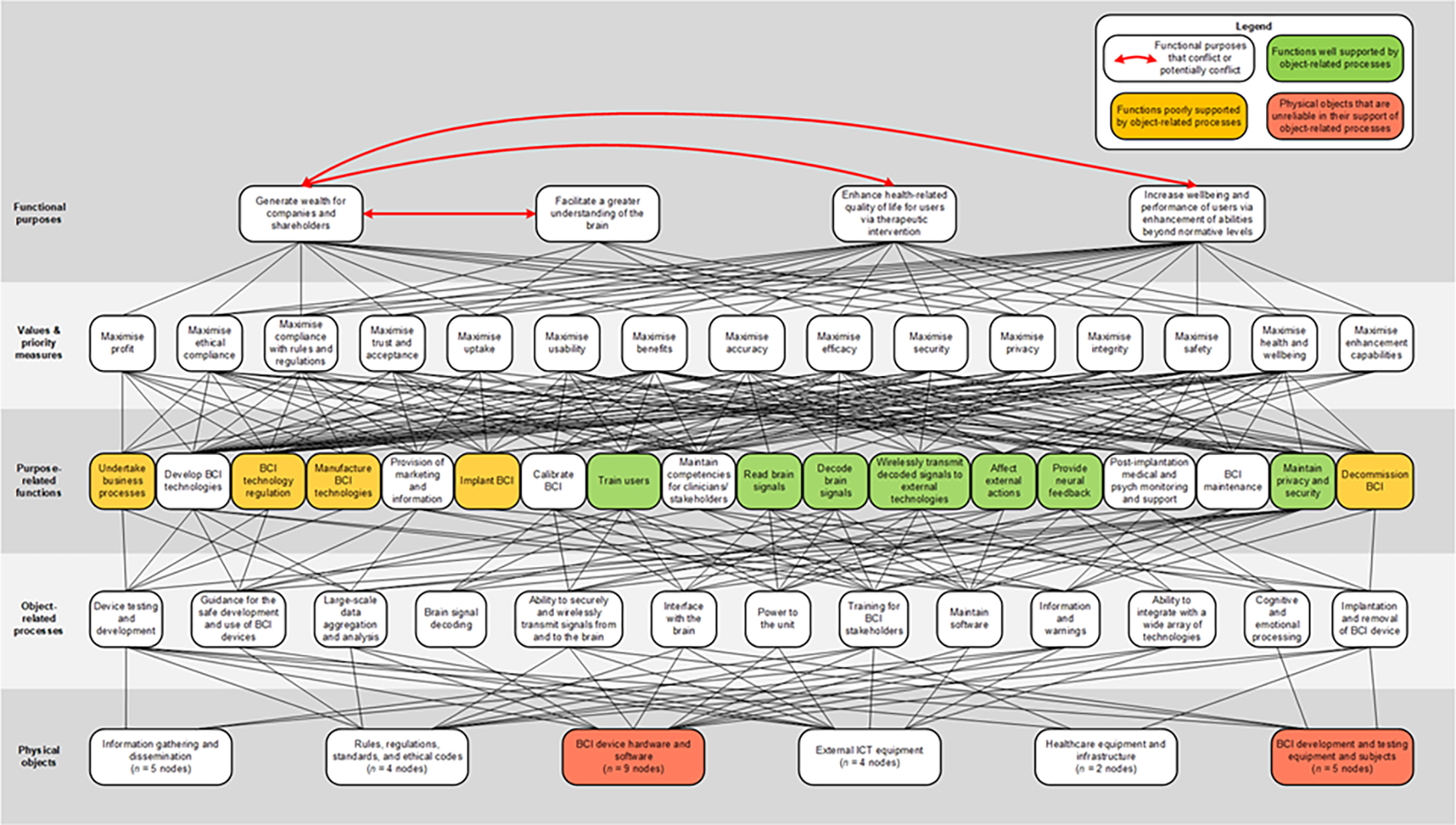
Abstraction Hierarchy of an Advanced Brain-Computer Interface System Lifecycle with Highlighted Analysis Findings (Adapted from King et al., 2023).
Conflicting system purposes
The analysis revealed that the BCI system lifecycle has multiple conflicting purposes originating from the functional purpose of generating wealth for companies and shareholders. During the STS-DT prompt analysis it was noted that economic imperatives may lead to companies being incentivized to over-charge for BCI devices or market BCI devices with low efficacy, impacting the ability of the system to meet its purposes of providing therapeutic and enhancement benefits to users. Further, in the interest of having a financial advantage over competitors, proprietary data may not be shared with researchers and other BCI organizations, inhibiting achievement of the functional purpose to gain a greater understanding of the brain and those relating to providing therapeutic and enhancement benefits to users. A key finding then is the potential for conflict between economic imperatives and the purposes of enhancing user health and wellbeing and generating new knowledge regarding brain functioning.
These system conflicts may be influenced by funding schedules. For example, heath care funding subsidies may drive the development and marketing of therapeutic BCIs at the expense of BCI devices that increase user wellbeing and performance or research using BCIs to develop a more comprehensive understanding of the brain. Several of these concerns may be addressed at least in part by the addition of new functions within the system, including the free sharing of brain data, research and development collaborations across BCI companies and universities, and the introduction of funding models for equitable access to BCIs.
Support for purpose-related functions
A second key finding from the STS-DT analysis related to identifying BCI system functions that are poorly supported by the physical objects in the system and their processes. These functions may be more at risk of being undertaken inadequately or not at all, constituting an important design consideration. The poorly supported functions identified included the manufacture of BCI technologies, decommissioning of BCI devices, undertaking business processes, and BCI technology regulation. Taking regulation as an example, it is possible that linking regulators with more of the object-related processes could further support this function. For example, regulation is currently linked to the processes of providing guidance for, and the undertaking of, BCI device testing, development and use. The system may benefit from regulators being linked closer to the monitoring of BCI information and warnings, BCI stakeholder training processes and programs, and the integration of BCIs with a wide array of external technologies.
Comparatively, the analysis revealed many well supported purpose-related functions. These include the maintenance of BCI user privacy and security, the training of BCI users, and all BCI device operations (i.e., reading and decoding brain signals, transmitting decoded brain signals, affecting external actions, and providing neural feedback).
Physical object reliability and relationships
The 29 objects within the BCI system lifecycle were identified and themed according to their relationships as seen in Figure 1. A third key finding of the STS-DT was that BCI device hardware and software were identified as being potentially unreliable (such as through hardware degradation) with follow-on impacts on their ability to support system processes. BCI device chargers were noted as being a potential risk, as they may be easily misplaced or forgotten, such as when travelling, and the BCI will not be able to function without them. This leads to the question of what will happen to the BCI user if their device runs out of charge as they may become accustomed to the capabilities that the device provides. The consequences may range from users not being able to engage in recreational activities to users not being able to undertake medically necessary BCI-mediated functions. BCI development and testing subjects were also identified as a potentially ‘unreliable’ object within the system. This related to assumptions made by researchers and developers regarding the representativeness of individual brain structures and functions, which may not be representative of the broader population. This is particularly the case regarding use of animal test subjects as models for BCIs intended for human use.
Regarding potential relationships between physical objects, it was identified that adverse event reporting systems could be used to inform the development and application of external rules and regulations. These adverse event reporting systems were also identified as a potential common mode failure that could cascade and prevent the system from achieving its purposes. For example, failures in reporting adverse events may lead to uninformed BCI stakeholder training, BCI development and maintenance, and support for BCI users, which in turn reduces BCI users’ quality of life and wellbeing and potential financial losses for companies and shareholders. An additional question raised is what the threshold of adverse events should be that halts the development and use of BCI technologies? This threshold should be defined prior to the introduction of BCI devices as the potential for harm to users and society is vast (King et al., 2022). Finally, the theme of healthcare equipment and infrastructure was identified as a potential common mode failure. For example, BCI devices will be rejected by regulators and the public if BCI device implantation is undertaken in inadequate facilities or with unsafe equipment, resulting in harm to users.
Overall analysis findings
Overall, the STS-DT analysis found that subjects focused on the BCI technology itself instead of the BCI interface with other system elements. While understandable, this does not reflect the totality of the risks external to the technology that are introduced within the BCI system, such as psychological risks to users (Keskinbora & Keskinbora, 2018) and shifting societal norms (Attiah & Farah, 2014). Additionally, discussions prompted by the STS-DT process identified the irony of implanting BCI devices into brains to help understand the brain, rather than developing a comprehensive understanding of the brain prior to performing invasive procedures.
Another broad theme was the potential adverse impacts of the financial component of the BCI system, especially concerning considering the current development occurring within commercial environments. Adverse financial influences were identified not only at the functional purpose level but throughout the system, including the potential impacts of the profit value on regulatory compliance, privacy, and uptake, while the cost of functions may also impact the system purposes, such as through exorbitant costs of post-implantation support and device maintenance. This could create inequities in access to the technology, particularly for therapeutic purposes in initial devices brought to market. The impact of these system characteristics may in part be addressed through reducing costs of BCI development, such as through collaborative development of BCI technologies and applications, sharing of deidentified brain data, and implementing funding models for equitable access to BCIs.
Overall, The STS-DT prompts process identified system design concerns and risks that have not yet been identified. For example, in our recent systematic review of known BCI risks (King et al., 2022) the risks around economic imperatives for BCI companies were not identified. It is therefore concluded that the STS-DT’s WDA prompts provide a useful method for assessing the potential risks of future advanced technologies.
Limitations and future research
This study was limited by its focus on an envisioned system, although this is a requirement to proactively identify and control risks of unrealized future systems. The validity of the developed model may also be enhanced through the participation of a larger number of subject matter experts. Future research could extend on this work by applying formal risk assessment methods such as System-Theoretic Process Analysis (Leveson, 2011), Event Analysis of Systemic Teamwork – Broken Links (Stanton & Harvey, 2017), and the Networked Hazard Analysis and Risk Management System (Dallat et al., 2018).
Conclusion
This analysis demonstrates the application of WDA and STS-DT prompt questions to identify potential issues in future BCI systems. Multiple issues across the system were identified requiring proactive actions to mitigate or eliminate potential system issues. It is recommended that future research be undertaken to address the identified issues with the BCI system as the window of opportunity is closing fast.
