



Abstract
Trigger warnings, content warnings, or content notes are alerts about upcoming content that may contain themes related to past negative experiences. Advocates claim that warnings help people to emotionally prepare for or completely avoid distressing material. Critics argue that warnings both contribute to a culture of avoidance at odds with evidence-based treatment practices and instill fear about upcoming content. A body of psychological research has recently begun to empirically investigate these claims. We present the results of a meta-analysis of all empirical studies on the effects of these warnings. Overall, we found that warnings had no effect on affective responses to negative material or on educational outcomes. However, warnings reliably increased anticipatory affect. Findings on avoidance were mixed, suggesting either that warnings have no effect on engagement with material or that they increased engagement with negative material under specific circumstances. Limitations and implications for policy and therapeutic practice are discussed.
A trigger warning, content warning, or content note refers to a statement intended to help individuals prepare for or avoid content. These warnings differ from other, older types of content labeling (e.g., Motion Picture Association ratings intended to provide guidance for parents regarding content appropriacy for children; Motion Picture Association, Inc., 2023) in that they aim to protect individuals whose unique experiences have left them emotionally vulnerable to specific material. Advocates argue that trigger warnings help people by emotionally preparing them to view or completely avoid content they may not want to see (Bentley, 2017; Cares et al., 2017; DeBonis, 2019; George & Hovey, 2020). However, critics argue that warnings may instead exacerbate negative reactions (Filipovic, 2014; Lesh, 2016; Waldman, 2016) and that encouraging avoidance might be harmful rather than beneficial (Lukianoff & Haidt, 2015; McNally, 2014). In response to continued widespread use and fervid debate about the efficacy of trigger warnings, a handful of empirical studies have emerged since 2018 that have focused on four primary lines of questioning. First, do trigger warnings change emotional reactions in response to material? Second, do trigger warnings increase the avoidance of warned-of material? Third, do trigger warnings have any effects on anticipatory emotions before seeing material (e.g., anxiety)? And fourth, do trigger warnings change educational outcomes (i.e., the comprehension of warned-of material)? Here, we present a meta-analysis of all current empirical studies on the effects of trigger warnings, focusing on these four main lines of inquiry.
Trigger Warnings: A Brief History
Trigger warnings emerged in the early days of the Internet on feminist message forums (e.g., Ms Magazine) and were attached to posts to help readers prepare for or avoid material likely to remind them of memories of trauma (e.g., sexual assault; Vingiano, 2014). The use of trigger warnings has since expanded to the university classroom (Bentley, 2017; National Coalition Against Censorship, 2015) and media writ large (Wyatt, 2016). The types of experiences that may warrant a trigger warning have also expanded past canonical traumatic events to include a wide array of experiences, including being a member of a historically marginalized group or having experienced less severe events such as microaggressions or teasing (Lukianoff & Haidt, 2015; Wilson, 2015).
Trigger Warnings: What Do They Look Like?
Although no formal analysis has been conducted to document the various forms of trigger warnings, it is not hard to observe an abundance of different manifestations across news media, social media, educational settings, and beyond (e.g., art galleries). In addition to demarcating specific types of content (e.g., “Trigger warning: sexual assault and harassment”; University of New South Wales Law Society, 2017), trigger warnings may also include warnings about potential emotional reactions (e.g., “Warning: This article contains details that some readers may find distressing”; Marozzi & Taylor, 2022), specify which specific groups of people might be particularly affected by the content (e.g., “This article discusses sexual assault. If you are a survivor of sexual misconduct, BYU has extensive resources to help”; Allen, 2022), or specify recommendations for the best course of action to take (e.g., “If you do not wish to view these works, you may exit through the video gallery at right”). As trigger warnings have become a standard in the cultural lexicon, these accompanying messages are often tacitly assumed and hence completely omitted, and the purpose of warnings is commonly understood even when abbreviated (e.g., TW, CW). Thus, warnings can take many different forms, making it difficult to delineate a tight definition based on the actual text used within a warning. Indeed, there are many practices that function as trigger warnings without including the word “warning” itself (e.g., “content notes,” “sensitivity screens” on Instagram). Thus, our working definition of trigger warnings is predicated on the intent of the statement: any statement that intends to help individuals prepare for or avoid content likely to trigger memories or emotions relevant to past experiences.
Trigger Warnings: The Debate
Since their arrival on the university campus, trigger warnings have been at the center of fervid debate. Some areas of this debate have covered ethical and legal territory, with trigger-warning advocates seeing them as a show of pedagogical solidarity with historically marginalized minorities (Carter, 2015) and detractors citing concerns about challenges to freedom of speech and unhindered academic inquiry (Lukianoff & Haidt, 2015).
The impacts of trigger warnings on clinical populations have also been hotly debated. Proponents of trigger warnings argue that they are a necessary form of disability accommodation for psychologically vulnerable students (Carter, 2015). First, they may allow vulnerable students to manage distress by opting out of seeing content altogether. Critics argue that avoidance behavior (i.e., “opting out”) is at odds with evidence-based practices for treating posttraumatic stress disorder (PTSD) and anxiety disorders (McNally, 2014). However, whether trigger warnings will increase avoidance behaviors at all is theoretically contentious. One possibility is that trigger warnings increase anxiety and apprehension about upcoming content and therefore promote the avoidance of warned-of material. For instance, a trauma survivor may see a trigger warning relating to their traumatic experience and avoid the warned-of content the same way they would avoid other trauma-related stimuli (e.g., people, places, or objects associated with the original trauma; Ehlers & Clark, 2000). However, other research suggests that warnings might increase rather than decrease the attractiveness of content. Psychological reactance, “boomerang effects,” or the “forbidden-fruit effect” occurs when people’s freedom to engage in an experience is restricted (e.g., with a warning label), making the experience more attractive (Ringold, 2002). Particularly relevant for trigger warnings, warning labels about graphic content increase the desire to watch violent television shows (Bushman & Stack, 1996) and play violent video games (Bijvank et al., 2009). Moreover, in an effort to resolve uncertainty people will often metaphorically open a sealed box even if the contents of the box are expectedly negative (known as the “Pandora effect”). Therefore, although both critics and advocates argue that warnings should lead to avoidance, adjacent psychological literature suggests that they may instead increase the attractiveness of material.
Aside from avoidance, advocates also argue trigger warnings allow students who wish to remain in the classroom to anticipate and emotionally prepare for distressing content (e.g., George & Hovey, 2020). For example, Manne (2015) argued trigger warnings are to “allow those who are sensitive to these subjects to prepare themselves for reading about them, and better manage their reactions” (p. 1). However, trigger warnings do not typically describe how to prepare oneself or manage reactions and instead usually describe potential negative emotional reactions that will likely occur when viewing the material (e.g., distress, anxiety). Indeed, some detractors argue that trigger warnings may instead cause “nocebo effects” and ironically increase the very anxiety responses they warn against (Bellet et al., 2018). Indeed, extant literature on expectancy effects (Kirsch, 1985) demonstrates that setting up an expectation of negative physical-health symptoms such as pain, itch, and other side effects can cause or exacerbate those very outcomes (Benedetti et al., 2007).
Trigger Warnings: The Evidence So Far
Although some of the arguments for and against trigger warnings are based on subjective moral, legal, and theoretical premises, the arguments concerning clinical phenomena such as avoidance behaviors and anxiety are empirically falsifiable and therefore tractable in an experimental framework. The clinical impact of trigger warnings provides hope for consensus on at least one aspect of the debate. A growing body of experimental work has examined how trigger warnings affect avoidance behavior and emotional responses in response to trigger warnings.
Response affect
Most of the empirical inquiry into the efficacy of trigger warnings has focused on emotional responses toward material accompanied by warnings (e.g., ratings of anxiety while reading passages; Bellet et al., 2018). These studies have reached mixed conclusions. Most studies (Bellet et al., 2020; Boysen et al., 2021; Bridgland et al., 2019; Gavac, 2020; Sanson et al., 2019) have concluded that trigger warnings have a trivial impact on emotional responses. Two studies found that warnings increase negative emotional reactions toward material (Bellet et al., 2018; Jones et al., 2020). Only one study concluded that warnings may reduce emotional reactions toward material (Gainsburg & Earl, 2018).
Avoidance
Several previous studies have examined behavioral avoidance of material accompanied by a warning (e.g., choosing a video title presented with or without a trigger warning; Gainsburg & Earl, 2018). Several studies have found that warnings have a negligible effect on avoidance toward material (Jones et al., 2020; Sanson et al., 2019). Other studies have concluded that warnings may lead to small increases in avoidance behaviors (Gainsburg & Earl, 2018) or small increases in engagement with material (Bruce & Roberts, 2020).
Anticipatory affect
A small handful of previous studies have experimentally tested emotional reactions (e.g., state anxiety; Bridgland et al., 2019) in the anticipatory period after giving a warning but prior to exposure to the warned-about content. This literature consistently demonstrates that viewing a trigger warning appears to increase anticipatory anxiety prior to viewing content (Boysen et al., 2021; Bridgland et al., 2019; Bridgland & Takarangi, 2021; Bruce et al., 2023; Gainsburg & Earl, 2018).
Comprehension
Finally, other studies have investigated the way that warnings might enhance or reduce the comprehension of stimuli (e.g., scores on a multiple-choice test for factual content; e.g., Boysen et al., 2021). These studies have found that trigger warnings do not seem to impair or enhance the comprehension of educational material (Boysen et al., 2021; Gavac, 2020; Sanson et al., 2019).
Current Study
Despite the rapid growth of trigger-warning research and the considerable variation in the materials and measures used across studies, no study to date has meta-analyzed this literature to determine what these effects look like in the aggregate. Because of somewhat mixed conclusions in the current literature, discussions of controversial subjects such as trigger warnings are often vulnerable to cherry-picking of specific studies that serve either side of the debate, stymying public understanding. Indeed, despite most articles concluding trigger warnings are not helpful, they continue to be widely used by the public. Therefore, determining an aggregate effect size for each of these clinical concerns is critical. Here, we present a meta-analysis of all current empirical studies on the effects of trigger warnings, focusing on response affect, avoidance, anticipatory affect, and educational outcomes (i.e., comprehension).
Method
Preregistration, transparency, and openness
The design and inclusion criteria for this study were preregistered prior to any data collection on OSF following the AsPredicted template. Any deviations from the preregistration are noted in this article as such. We adhered to the PRISMA 2020 guidelines for systematic reviews (Page et al., 2021). Data were analyzed using the metafor package in the R programming language (Konstantopoulos, 2011; Version 4.2.1; R Core Team, 2013; Viechtbauer, 2010).
Inclusion and exclusion criteria
To be included in the present meta-analysis, a study was required to satisfy the following preregistered criteria:
The study gave a warning to participants.
The study measured one or more of the following outcomes: Participant psychological or psychophysiological reactions (e.g., positive or negative emotions, anxiety, intrusions, heart rate) to either the warning itself (anticipatory) or the warned-about content (response) Participant behavior (e.g., avoidance of content)
The warning, as conceptualized by the authors of the relevant publication, was intended to notify participants that forthcoming content may trigger memories or emotions relevant to past experiences. Notably, this excludes warnings intended to signal lack of appropriateness for a general audience (e.g., PG-13 warnings) or situational appropriateness (e.g., not-safe-for-work warnings). Warnings were considered suitable even if the text of the warning was vague (e.g., “warning: sexual content”) contingent that, in context, the intention of the warning aligned with the above definition.
The results of the study were presented in such a way that a standardized mean difference between a test condition (warning given) and control condition could be calculated with a reasonable degree of accuracy.
After an initial review of the abstracts, we discovered that several articles also included comprehension of stimulus material as a primary outcome. Thus, we added this outcome to the list of valid psychological outcomes required for inclusion. This did not result in any change to the eventual articles included because all articles including comprehension outcomes also included other outcomes mentioned in the preregistered criteria. In cases in which a standardized effect size could not be calculated from the information contained in the article, the corresponding author was contacted to attempt to gather additional data. In each case, the author responded with relevant information, allowing us to disambiguate whether and how a standardized mean difference could be computed.
Search strategy
To identify relevant studies, we first searched PsycINFO and MEDLINE on March 1, 2022, for titles and abstracts with exact matches to any of any of the following key phrases: “trigger warning(s),” “content warning(s),” and “content note(s).” The text words in the title and abstract and the index terms used to describe the articles of retrieved articles were then analyzed to determine any additional useful index terms. No additional terms emerged. A search again on March 1, 2022, using all identified keywords, was then undertaken across all included databases: PsycINFO, MEDLINE, PubMed, ProQuest, and Web of Science (for a full search breakdown, see https://osf.io/bhvqx).
After searching the five databases, 407 records were uploaded to EndNote X9, and duplicates were removed by the lead author (n = 171). All authors then assessed the remaining titles and abstracts (n = 236) against the specified eligibility criteria. A total of 216 articles were excluded because they did not give participants a warning (Inclusion Criterion #1). In cases in which eligibility could not be determined using the title and abstract alone, the texts of the articles were inspected (n = 20). One additional article was excluded because it contained an imagined scenario rather than showing participants an actual trigger warning (Inclusion Criterion #1), four were excluded because a warning was given but it was not a trigger warning (Inclusion Criterion #3), and four were excluded that included a trigger warning but were missing relevant outcome measures (Inclusion Criterion #4). The reference sections of the final 11 included studies that were further inspected for articles that might have been overlooked in the initial search. No additional studies were identified. To reduce file-drawer effects, corresponding authors from the final list of publications were then contacted to retrieve unpublished studies that may fit the eligibility criteria. Three additional articles were identified, two of which were excluded because relevant outcome measures were missing (Inclusion Criterion #4). See Figure 1 for the full selection process.
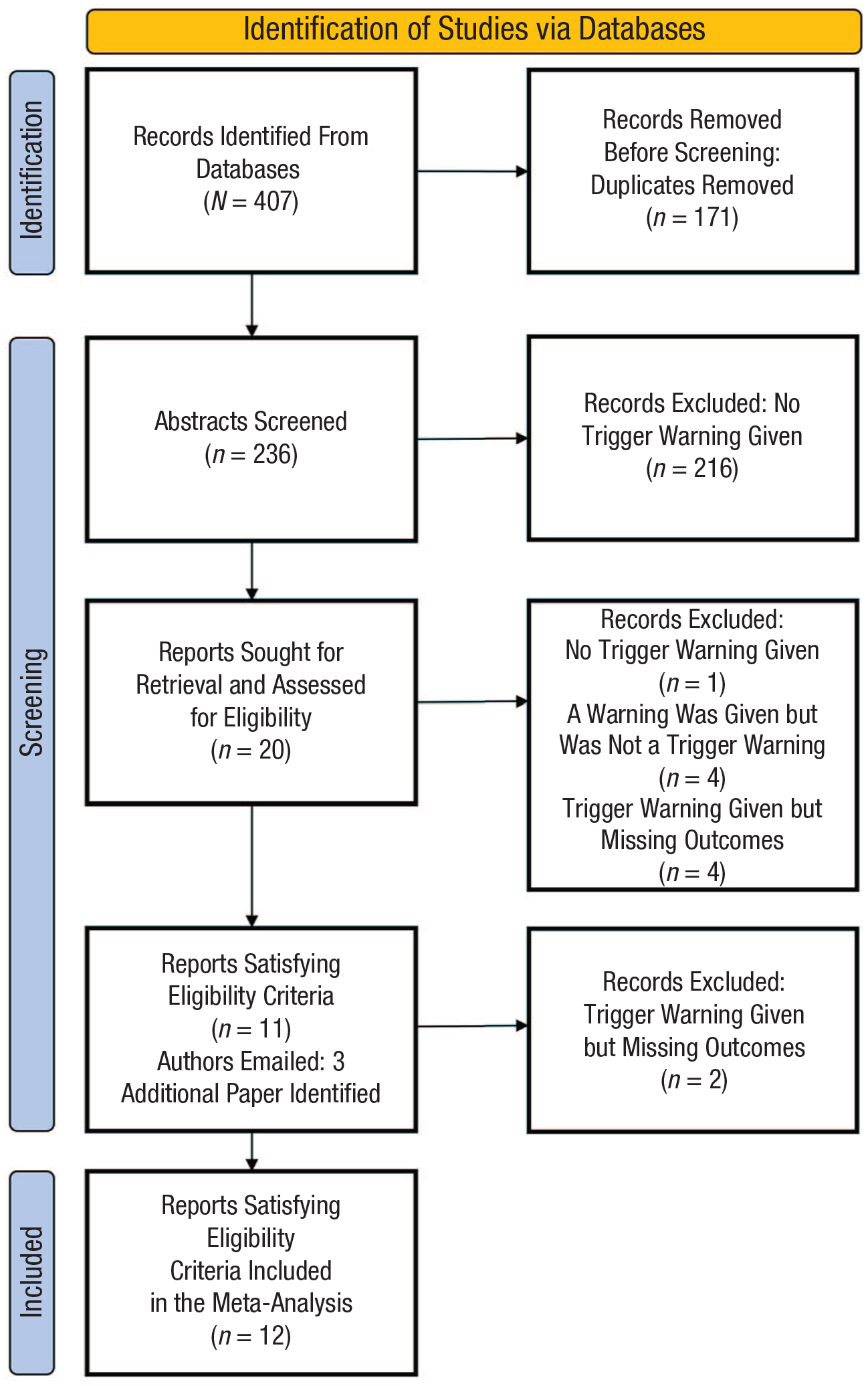
Identification, screening, and inclusion process for the meta-analysis.
Data extraction
After completing the review of all articles, all authors jointly grouped the extracted psychological and behavioral outcomes into four main types. For the data-extraction table used for the meta-analysis, see https://osf.io/wybgc.
Meta-analytic strategy
To address the nonindependence of gathered effect sizes we conducted a three-level meta-analysis with nested effects. More specifically, we included random effects to account for the statistical dependence from the source article, the particular sample from which the effect size was derived (nested within the source article; for experiments conducted across five separate samples, see, e.g., Bridgland et al., 2019), and the particular measurement instrument used. In the metafor syntax, the nesting structure can be written as “~ 1 | manuscript_id/sample_id, ~ 1 | measurement_id, with manuscript_id/sample_id,” indicating that samples were nested within articles.
For each outcome, we produced a meta-analytic effect-size estimate and confidence interval based on the random-effects model outlined above. We examined the variance components of each random effect and used the Q statistic from the model to serve as a statistical test of whether the effect sizes displayed greater heterogeneity than expected assuming the null hypothesis. We also produced and interpreted funnel plots.
Results
Overview of included studies
For a summary of all studies included in the meta-analysis, see Table 1. All studies meeting inclusion criteria were relatively recent publications, with the oldest articles published in 2018. Most studies used a straightforward single-session experimental paradigm in which participants were randomized to a warning condition or a control condition. Most measured outcomes either directly after giving the warning, directly after exposure to a stimulus, or at both time points.
Characteristics of the Studies Included in the Meta-Analysis
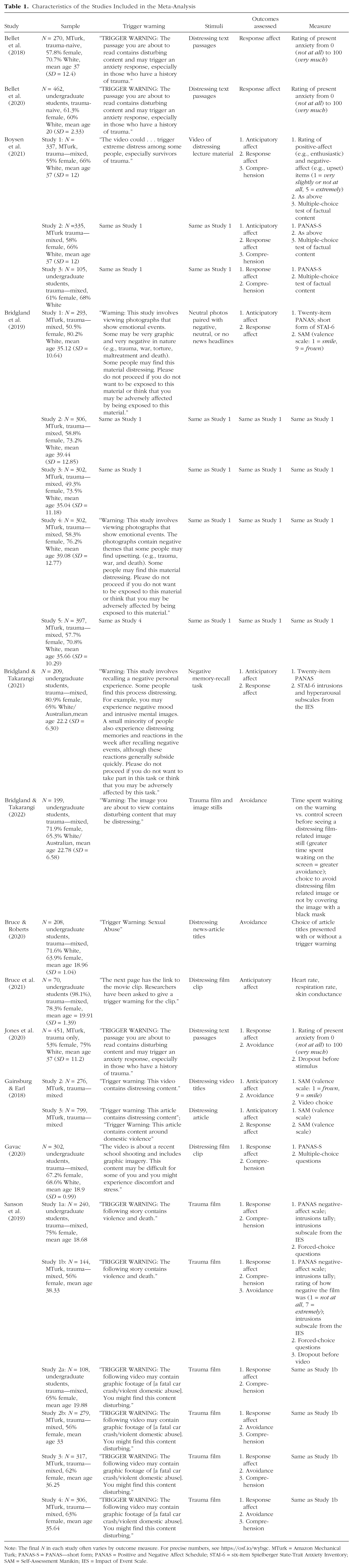
Note: The final N in each study often varies by outcome measure. For precise numbers, see https://osf.io/wybgc. MTurk = Amazon Mechanical Turk; PANAS-S = PANAS—short form; PANAS = Positive and Negative Affect Schedule; STAI-6 = six-item Spielberger State-Trait Anxiety Inventory; SAM = Self-Assessment Manikin; IES = Impact of Event Scale.
Overall, there was a strong tendency toward open science and replication: Two articles included direct, preregistered replications of a previous study (Bellet et al., 2020; Jones et al., 2020), and two articles included multiple internal replications with internal meta-analyses performed across samples (Bridgland et al., 2019; Sanson et al., 2019). Eight articles provided open access to their data and/or code through OSF or a similar repository.
In terms of authors’ interpretation of their work, 11 of the 12 articles concluded that warnings were ineffective at their proposed goals. The exception was Gainsburg and Earl (2018), who ambiguously concluded that warnings “introduce difficult-to-weigh trade-offs” (p. 79). Although some authors suggested that warnings might be actively counterproductive (e.g., Bellet et al., 2018; Jones et al., 2020), most articles tended toward a characterization of warnings as inert (e.g., Sanson et al., 2019).
Overview of participants
Because trigger warnings were originally designed for survivors of trauma, we examined our included studies for the inclusion of this subgroup. In Table 1, we refer to these studies as “trauma—mixed,” which specifies samples of mixed trauma survivors and nontraumatized individuals (some of which measured trauma exposure and others that did not). Overall, these samples contain a high proportion of trauma survivors—indeed, the fifth edition of the Diagnostic and Statistical Manual of Mental Disorders (American Psychiatric Association, 2013) rate of lifetime exposure to Criterion A trauma in the general population of the United States is approximately 89.7% (Kilpatrick et al., 2013). Overall, 142 of the 144 effect sizes meta-analyzed (98.6%) included trauma survivors in their sample. Indeed, only two effect sizes in the meta-analysis excluded trauma survivors (referred to as “trauma-naive” in Table 1; i.e., Bellet et al., 2018, 2020), but several others exclusively studied trauma survivors (referred to as “trauma only” in Table 1; e.g., Jones et al., 2020) or examined subsamples of trauma survivors (e.g., Bruce & Roberts, 2020).
All samples in our selected studies were participants from Western, educated, industrialized, rich, and democratic, or WEIRD, societies (Henrich et al., 2010). This may be of particular concern for trigger-warning research because we know that affective reactions toward emotional stimuli often differ between Western and non-Western samples (e.g., Huang et al., 2015). Therefore, caution should be exercised when considering the generalizability of the results beyond Western contexts.
Overview of outcome measures
Response affect
Response affect was defined as a participant’s affective state after encountering a potentially distressing stimulus. As with other outcomes in this meta-analysis, the variable was defined as a difference score depending on whether participants received a warning (warning condition) or not (control condition). In other words, this outcome measured whether warnings were successful in their goal of helping participants emotionally brace to face distressing content. Most studies used established instruments to measure affect, including the Positive Affect Negative Affect Schedule (PANAS; e.g., “Indicate how you feel right now . . . in the present moment”: positive-affect item—“interested,” negative-affect item—“upset”; 1 = very slightly or not at all, 5 = extremely; Watson et al., 1988; e.g., Sanson et al., 2019), State-Trait Anxiety Inventory (STAI; e.g., “Indicate how you feel right now, at this moment”: example item—“I am worried”; 1 = not at all, 4 = very much; Marteau & Bekker, 1992; e.g., Bridgland et al., 2019), and the Self-Assessment Manikin (SAM; five figures along a continuum ranging from a smile to a frown that allows for ratings that fall between each figure; Bradley & Lang, 1994; e.g., Gainsburg & Earl, 2018). Other studies used simple “homegrown” measures of affect, including single-item measurements (e.g., rating of present anxiety from 0 = not at all to 100 = very much; e.g., Bellet et al., 2018; Jones et al., 2020). Two studies also used subscales from the Impact of Events Scale (Weiss, 2007) to measure symptoms of distress/negative affect (e.g., intrusions and hyperarousal) associated with study stimuli (e.g., “Pictures about it popped into my mind”; 0 = not at all, 5 = often; e.g., Bridgland & Takarangi, 2021; Sanson et al., 2019). Finally, Sanson et al. (2019) also took a tally of intrusions participants experienced after being exposed to study stimuli as a signifier of distress/negative affect.
Avoidance
Avoidance was defined as the behavioral action of bypassing or otherwise blocking exposure to content. Studies measured avoidance using a range of approaches. In two studies, participants were given the choice to pick news headlines (Bruce & Roberts, 2020) or film titles (Gainsburg & Earl, 2018) accompanied with or without trigger warnings (avoidance was therefore defined as picking the title without the accompanying warning). Two studies measured avoidance as dropout from the experiment in any phase after the warning (compared with dropout in the same phase in a control condition; e.g., Jones et al., 2020; Sanson et al., 2019). One study examined how long participants spent waiting on a warning message or a control message screen before advancing to see a distressing image still (avoidance defined as time spent on each screen type) and gave participants the option to avoid content by blocking exposure with a black mask once stimuli appeared on screen (avoidance defined as choosing to use the mask; Bridgland & Takarangi, 2022).
Anticipatory affect
Anticipatory affect was defined as participant affect that was measured after receiving a warning but before being exposed to the warned-about stimulus. In other words, this outcome regards changes in affect while anticipating warned-about material. Anticipatory affect in warning conditions was compared with control conditions in which affect was measured before stimulus exposure but with no warning about the forthcoming stimulus. Much like response affect, most studies used established measures of affect such as the PANAS (Boysen et al., 2021), STAI (Bridgland et al., 2019), and SAM (Gainsburg & Earl, 2018). Only one study used physiological measures to signify anticipatory affect, including heart rate and skin conductance (Bruce et al., 2023).
Comprehension
Because trigger warnings are often used in educational settings, several studies measured comprehension of the presented stimulus material. We meta-analyzed differences in comprehension between those randomly assigned to receive a warning versus control conditions. Comprehension was typically measured by custom questionnaires (e.g., factual multiple-choice questions about the stimuli seen by participants; Boysen et al., 2021) regarding the content. In this meta-analysis, we did not regard simple attention checks used to screen participants from studies (e.g., “If you are reading this question, select 5”) as valid measures of comprehension.
Additional outcomes
Several articles included psychological or behavioral outcomes that could not be grouped into one of these four outcome types. These included perceived vulnerability to future events (Bellet et al., 2018, 2020; Jones et al., 2020), the centrality of trauma to identity (Jones et al., 2020), attention-related variables (Gainsburg & Earl, 2018), and threat appraisal (Gavac, 2020). Although the reported effect sizes for these outcomes were not numerous enough to merit meta-analysis at the current time, they may be useful targets for future investigation.
Main analyses
Response affect
A total of 86 effect sizes across nine articles measured the effect of trigger warnings on affective response to material presented after the warning. Effects were coded such that a greater effect size signified that warnings increased negative affect (e.g., distress, fear, anxiety) relative to the control condition. Overall, our random-effects omnibus analysis suggested that warnings had a trivial effect on response affect, d = 0.02, 95% confidence interval (CI) = [−0.05, 0.1]. The tight 95% CI around zero suggested that a meaningful effect in either direction is very unlikely.
Figure 2 displays a forest plot of the effect sizes aggregated across each article reporting response affect. Forest plots are used to summarize effects across studies. Each study’s point estimate is represented with a black box scaled to the study’s sample size. Lines extending from each box represent the 95% CI. For cases in which a study included multiple effects, the box and lines represent an aggregate of effects within that study. The diamond at the bottom represents the meta-analytic effect size for all studies. The diamond is centered at the meta-analytic point estimate and spans the 95% CI.
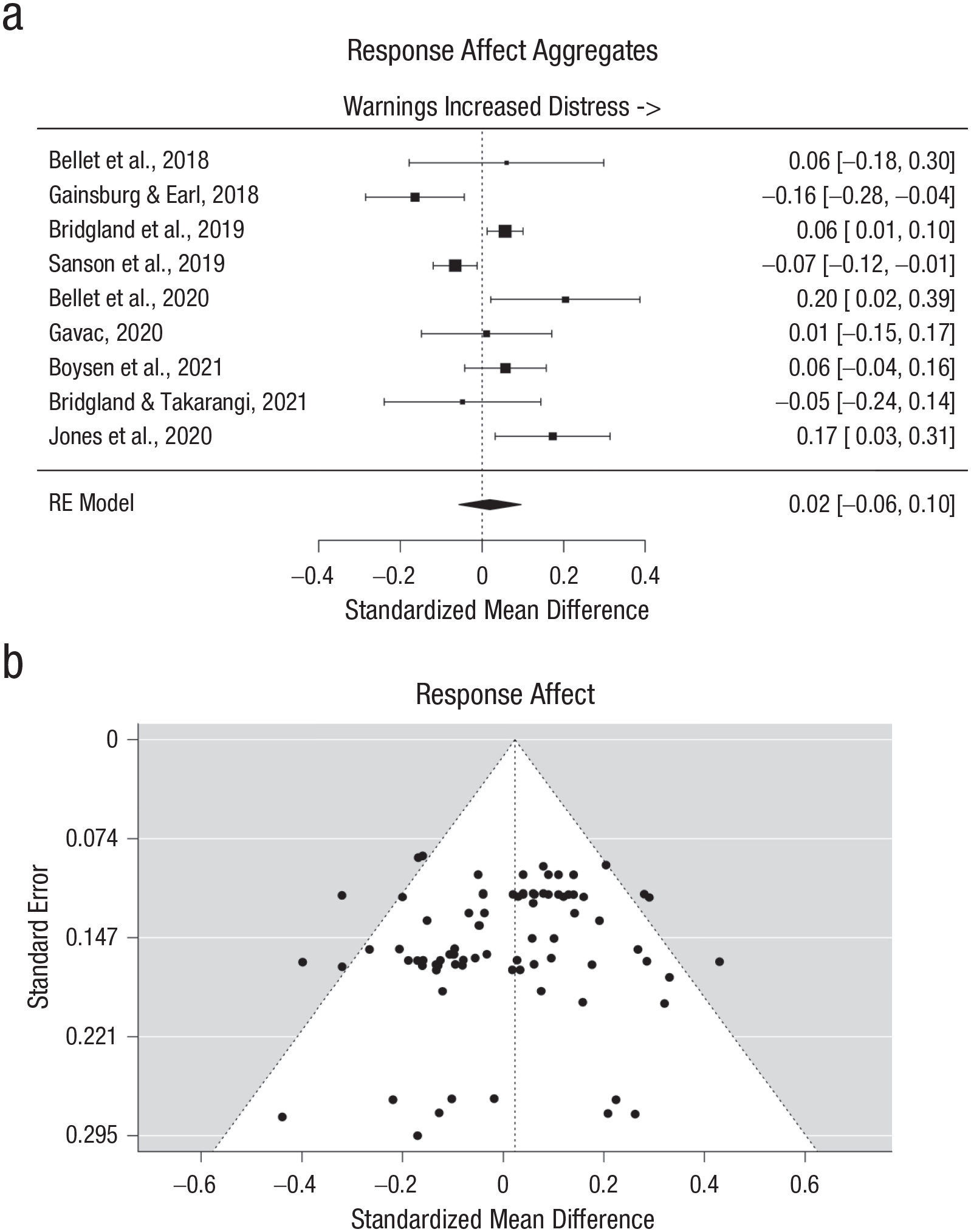
Forest and funnel plot of response-affect meta-analysis.
Figure 2 also shows a funnel plot of the individual effect sizes. Funnel plots are useful for gauging the variance of individual effect sizes and checking for any suspiciously missing effects. The x-axis indicates the standard mean difference. The y-axis indicates the standard error of an individual effect size, with larger standard errors near the bottom. That is, points higher on the y-axis are more trustworthy than those at the bottom. Horizontal asymmetry in a funnel plot—especially with an absence of points near zero—can be a red flag for publication bias. Asymmetry can result naturally when there are few points, and thus heterogeneity tests such as the Q statistic are often used to back a visual interpretation. The funnel itself is drawn for convenience: In the absence of bias and with an infinite amount of points, the plot should resemble the shape of a funnel centered on the meta-analytic effect size. Not all missing points are suspicious, however. For example, many points near the top could signify a literature that prefers large sample sizes regardless of outcome.
The overall symmetry of the funnel plot shown in Figure 2 indicates a lack of evidence for publication bias in either direction. A file-drawer effect of null results also appears unlikely because many points appear near zero. Indeed, as noted earlier, a majority of published articles concluded that warnings had a null or trivial effect—the opposite of what we would expect in the case of a file-drawer problem. The funnel plot suggests some degree of heterogeneity, although the Q statistic was not significant (Q = 105.39, p = .07).
Interestingly, visible clusters can be seen on the funnel plot. On further inspection, the clusters on the left and right correspond to effect sizes derived from the multistudy articles published by Sanson et al. (2019) and Bridgland et al. (2019), respectively. These articles examined multiple dependent variables within multiple samples, leading to an abundance of individual effect sizes. This clustering reinforces the importance of our multilevel-analysis strategy that fully accounted for that statistical dependence.
Avoidance
Compared with response affect, avoidance was measured across fewer articles and with fewer distinct measurement strategies. A total of five articles analyzed avoidance for a total of 11 unique effect sizes. Of these effect sizes, six actively provided an option for participants to avoid stimuli, whereas the remaining five used dropout as an avoidance analogue. In either case, the effect size of interest here is not the absolute amount of avoidance (which should be expected to differ notably across measurement and stimulus types) but the difference in avoidance with a warning compared with a control condition.
Overall, our random-effects omnibus analysis suggested that warnings had a negligible effect on avoidance, d = 0.06, 95% CI = [−0.09, 0.21]. Figure 3 displays a forest plot of the effect sizes aggregated across each article reporting avoidance. Figure 3 also shows a funnel plot of the individual effect sizes. The heterogeneity is visible and is indeed statistically significant (Q = 40.59, p = 1.33 × 10⁻⁵). The visible outliers on the left can be attributed to Bruce and Roberts (2020). This article operationalized avoidance in a slightly different way compared with other articles: Rather than randomizing to a single-warning or no-warning condition, in this study, participants were asked to choose between four article titles, two with trigger warnings and two without. Although this experimental strategy was distinct, standard mean differences could still be computed between participants who received a warning for Article A vs. no warning for Article A and so forth. Bruce and Roberts (2020) found that a given article was selected more often when it carried a warning (a decrease in avoidance).
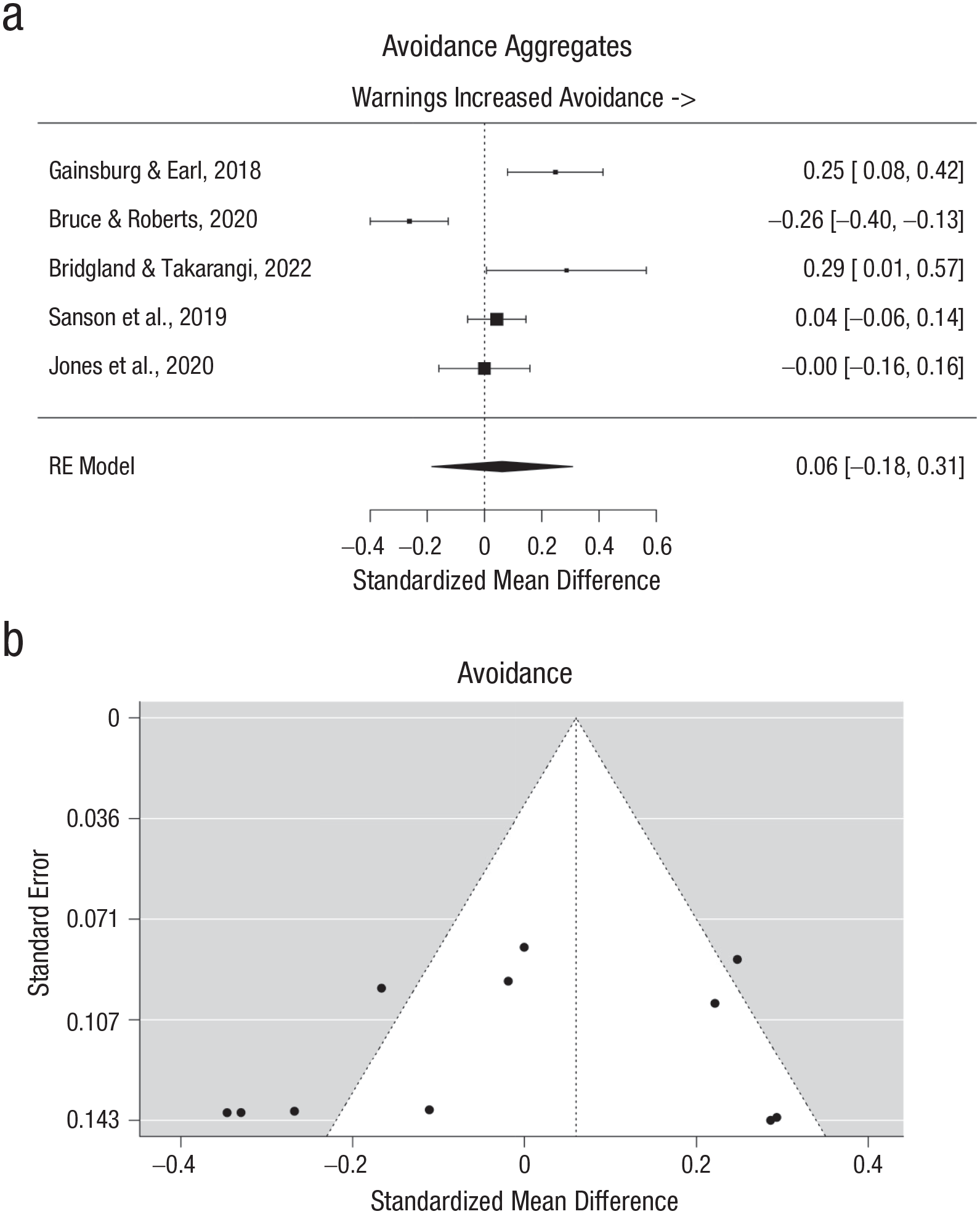
Forest and funnel plot of avoidance meta-analysis.
Our preregistration indicated that all outliers would be retained. In addition, the random effects in our primary analysis helped protect the omnibus estimate from single-article outliers. However, for thoroughness, we removed this article from the effect-size pool as a supplemental analysis. This removal slightly shifted the estimate toward more avoidance, d = 0.13, 95% CI = [−0.03, 0.3], although the estimate remained below the threshold for a small effect, and the confidence bound continued to cross zero. Heterogeneity remained significant even after removing these effect sizes (Q = 18.87, p < .001).
Anticipatory affect
Anticipatory affect measured increases in distress after receiving a warning but before viewing a stimulus. A total of five articles analyzed anticipatory affect for a total of 32 unique effect sizes. In contrast with other meta-analyzed effects, our random-effects omnibus analysis suggested that warnings increased anticipatory affect, with effects ranging from very small to medium to large, d = 0.43, 95% CI = [0.09, 0.77]. Figure 4 displays a forest plot of the effect sizes aggregated across each relevant article.
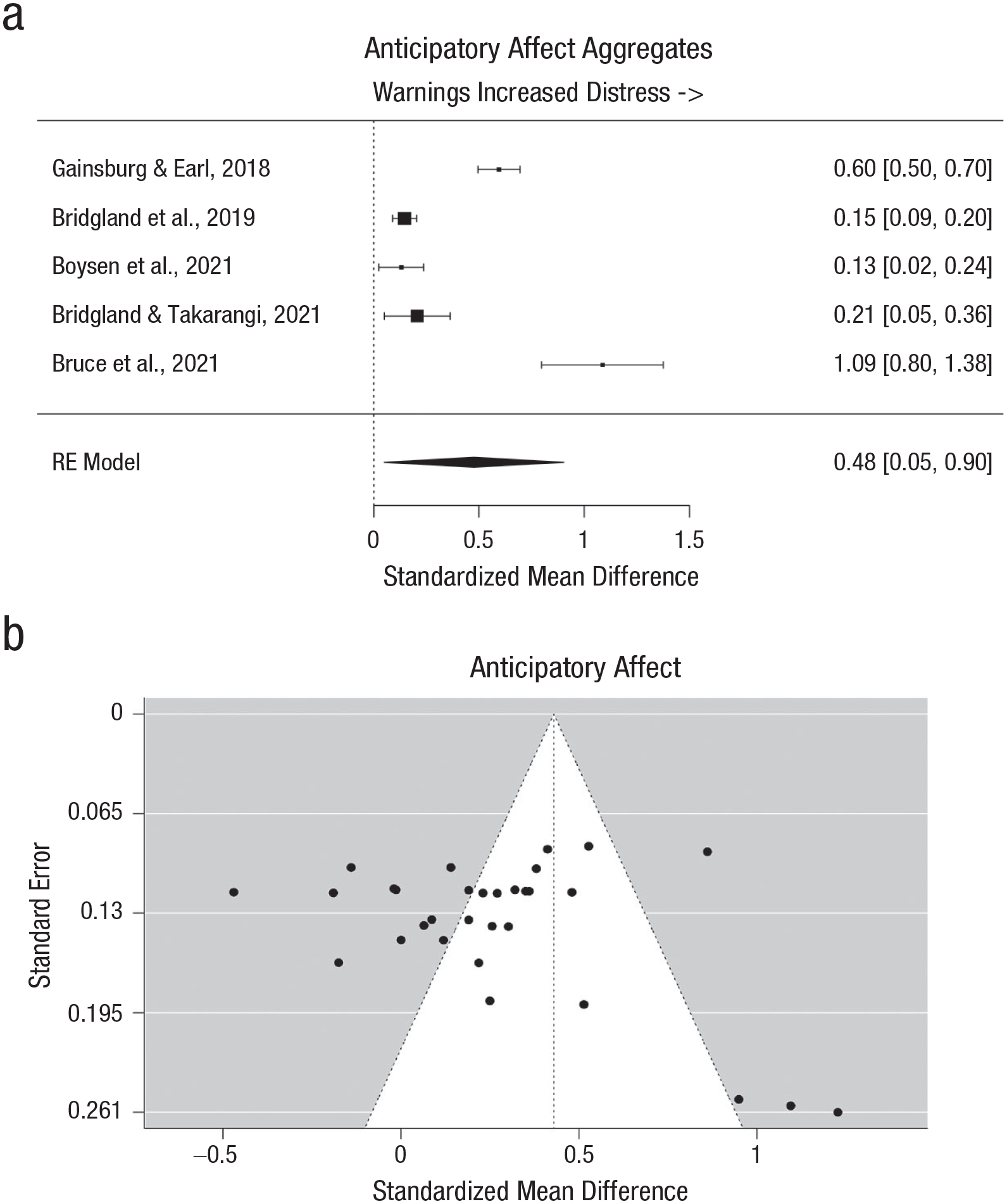
Forest and funnel plot of anticipatory affect meta-analysis.
Figure 4 also shows a funnel plot of the individual effect sizes. The heterogeneity is clear and statistically significant (Q = 195.56, p = 8.66 × 10⁻²⁶). The outliers on the right of the funnel plot are attributable to Bruce et al. (2023), who used psychophysiological markers of distress (heart rate, respiratory rate, skin conductance). This contrasts with the self-reported distress measures used in other studies. Thus, it is quite possible that this represents a genuine difference in effect. A supplemental analysis of only self-report psychological variables suggests a small-to-medium effect with continued significant heterogeneity, d = 0.29, 95% CI = [0.07, 0.51], Q = 162.3, p = 7.21 × 10⁻²¹. A funnel plot of this supplemental analysis (see https://osf.io/y7x89) displays this heterogeneity, although it reveals little asymmetry.
Comprehension
Several studies measured whether participants’ comprehension was impeded or improved by receiving a warning before viewing an educational stimulus. A total of three articles analyzed comprehension for a total of 14 unique effect sizes. The omnibus analysis suggested that warnings had a trivial or null effect on comprehension, d = 0.06, 95% CI = [−0.02, 0.14]. Figure 5 displays a forest plot of the effect sizes aggregated across each relevant article.
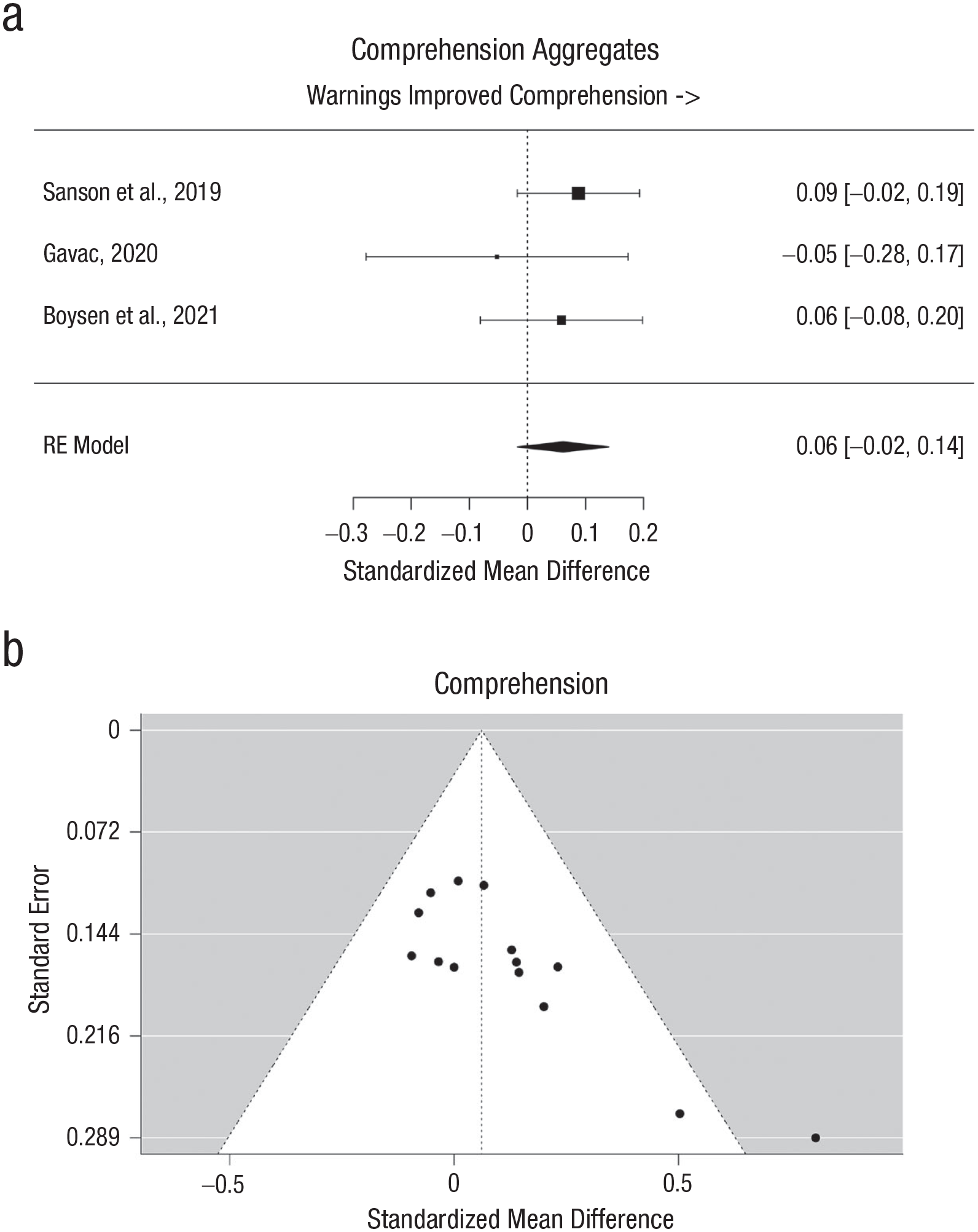
Forest and funnel plot of comprehension meta-analysis.
Figure 5 also shows a funnel plot of the individual effect sizes. Heterogeneity was nonsignificant (Q = 15.3, p = .29). The low-confidence outliers on the right of the plot are from Sanson et al. (2019) Study #2A. The remaining eight effect sizes from Sanson et al. (2019) fell within the larger cluster.
Discussion
Advocates of trigger warnings claim that they help people to emotionally prepare for or completely avoid distressing material (e.g., Gust, 2016). Critics argue that warnings contribute to a culture of avoidance at odds with evidence-based treatment practices or instill fear about upcoming content (e.g., Lukianoff & Haidt, 2015). Overall, we found that trigger warnings had no meaningful effect on response affect, avoidance, or educational outcomes (i.e., comprehension). However, trigger warnings reliably increased anticipatory distress before viewing material. We now turn to a discussion of how our findings for each outcome reflect on the body of trigger-warning research to date, as well as limitations and implications for policy and therapeutic practice.
Response affect
Most clinical discussion of trigger warnings has focused on response affect. Advocates assume that trigger warnings help people control or cope with their negative emotional reactions to material, whereas critics claim that warnings will only exacerbate negative reactions. Contrary to both views, we found that warnings had no effect on emotional reactions to material. That is, existing published research almost unanimously suggests that trigger warnings do not mitigate distress.
Why do trigger warnings fail to change emotional reactions? One explanation might be that individuals simply ignore the warnings altogether. However, this explanation is contradicted by the strong consensus, discussed later, that trigger warnings generate negative emotions during the anticipatory period. Thus, trigger warnings do initially affect emotional experience, but once presented with the actual material in question, emotional experiences equalize between those who were warned and those who were not.
One possibility is that most people are not skilled at emotional preparation (e.g., reappraising emotional content or using coping strategies). Thus, the uncomfortable anticipatory period is unlikely to reflect any form of helpful action. This conclusion is supported by Bridgland et al. (2022), who asked participants to explain what they would do when they came across a trigger warning; only a minority of participants mentioned some form of approach coping strategy (e.g., reappraisal strategies, such as reminding themselves to focus on nonemotional aspects of the situation; Shiota & Levenson, 2009). Indeed, trigger warnings (including those used in the current studies) typically warn people about the distressing reactions they may have but do not explain how to reduce these reactions.
This pattern of results is consistent with a Bayesian cognitive framework. The warning provides individuals with a weak, negative prior expectation of the content. In the anticipatory period, individuals’ response closely mirrors this prior because it represents their only source of information. After exposure to the stimulus itself, participants gain complete information that makes the prior information mostly irrelevant. Indeed, this same pattern is consistent with how humans apply many biases and heuristics—these biases are relevant in situations in which information is sparse but become irrelevant as soon as more complete information becomes available (e.g., Jussim, 2017).
Avoidance
In contrast to the claims of both advocates and critics, we found that trigger warnings did not seem to increase the avoidance of warned-of material. This fits with research showing that participants are extraordinarily unlikely to avoid distressing study stimuli. For instance, in a study by Kimble and colleagues (2021), when participants were given the option to avoid reading “triggering” text, less than 6% took the option. Similarly, when given the option, many people deliberately and repeatedly uncover potentially distressing graphic photographs marked with a trigger warning (Bridgland et al., 2023). In fact, our results suggest that in studies in which individuals are given a direct choice between options with and without warnings, options with warnings may garner more engagement. These findings likely reflect the Pandora effect, which suggests that people have a general tendency to approach rather than avoid stimuli that has been marked aversive and uncertain (Hsee & Ruan, 2016; Oosterwijk, 2017). Furthermore, these results also raise the possibility that trigger warnings foster a forbidden-fruit effect in which warnings actually increase rather than decrease attraction to potentially negative material. In fact, the possibility that trigger warnings might increase rather than decrease attraction has already been used by advertisers to draw attention toward unhealthy food products such as fast food and alcohol (the “teasing effect”; Ruan et al., 2018). Furthermore, there is some evidence that these types of effects are stronger among those who are most vulnerable (Bellet et al., 2020; Bridgland et al., 2023). Taken together, the current study and other research suggest that trigger warnings do not seem to be an effective method of preventing vulnerable populations from engaging with distressing stimuli.
Anticipatory anxiety
We found that trigger warnings reliably increased anticipatory anxiety about upcoming content, consistent with the concerns of critics. This finding is supported by both subjective (e.g., rating scales) and objective (e.g., psychophysiological measures) markers of distress. Moreover, this finding appears to be consistent across the different trigger warning types used across studies, attesting to the robustness of this effect.
To reduce the disconnect between standardized effect sizes and practical implications (Otgaar et al., 2022), it may be useful to note the raw mean differences in anticipatory affect between warned and unwarned groups. First, it is necessary to establish what we might consider to be the smallest effect of interest or practical significance within this context. Anvari and Lakens (2021) asked participants to complete the PANAS twice (2–5 days apart)—at Time 2, they were asked to rate how much more/less negative/positive they felt at Time 1. For PANAS negative affect, they found that there was a mean difference of −0.11 for participants who said they felt “the same” as Time 1, 0.22 for participants who felt “a little more” negative, and 0.88 for participants who felt “much more” negative. In another example, studies that have used the PANAS to assess responses to highly distressing stimuli such as the trauma–film paradigm have found mean differences in negative affect from before to after viewing between 0.31 and 0.98 (Ehring et al., 2009; Guzey et al., 2021; Morina et al., 2013; Nagulendran et al., 2020; Stirling et al., 2023). Using Bridgland et al. (2019) and Boysen et al. (2021) as examples that also used the PANAS to measure negative affect, we can see that the mean difference in negative affect between warned and unwarned groups ranges from 0.09 (Boysen et al., 2021) to 0.14 (Bridgland et al., 2019). Therefore, we can see that seeing a trigger warning does not elicit “much more” negative affect—or anything akin to viewing a trauma stimulus. However, it does appear to lead to small increases in negative affect that are not completely trivial in nature.
In theory, this anticipatory period could indicate that forewarned individuals are bracing themselves for a negative emotional experience. However, as discussed in the section on response affect, whatever bracing might occur during this anticipatory period is apparently completely ineffective. In other words, according to the current literature, this small increase in negative emotions induced by trigger warnings serves no productive purpose.
Comprehension
Last, we found that warnings had little to no effect on the comprehension of warned material. These findings have implications for debates surrounding the potential benefits and harms of trigger warnings used in educational spaces. Advocates claim that warnings in the classroom help to foster a safe environment for trauma survivors, allowing them to prepare for distressing material and therefore enhancing their learning outcomes (DeBonis, 2019; George & Hovey, 2020). However, we found that, at best, warnings have no effect on the comprehension of material. At worst—because trigger warnings seem to reliably increase anticipatory anxiety responses—trigger warnings have the potential to increase apprehension and anxiousness about attending class. Indeed, this idea is supported anecdotally in interviews with students about the use of trigger warnings in the college classroom (Bentley, 2017).
Limitations
With few exceptions, the extant work on trigger warnings uses single-timepoint designs and focuses on the short-term reactions immediately following stimuli (see Bridgland et al., 2022). It is possible that, over time, small effects accumulate and have more potent emotional consequences (Funder & Ozer, 2019). This consideration may be especially important for warnings that are becoming increasingly prevalent in everyday life across both formal (e.g., educational) and casual (e.g., entertainment) contexts. This possibility thus presents an important avenue for future research efforts. First, it would be useful to conduct a field or diary study to track the frequency of encountering trigger warnings in daily life. Second, more trigger-warning research should measure participants’ emotional responses to warned-of material over more than one experimental session.
Although the current study provides evidence that trigger warnings are broadly inert as applied writ large, it does not provide information on whether trigger warnings have differing effects in specific subpopulations, contexts, or cultures. For example, some might argue that trigger warnings are most helpful for individuals with a past traumatic event that matches the content presented (e.g., a survivor of sexual assault reading a passage about sexual assault). Still others might contend that trigger warnings are truly helpful only for those with psychological vulnerabilities (e.g., those with more pronounced symptoms of PTSD). The current literature suggests otherwise, however. Trigger warnings do not attenuate anxiety responses, even when participants’ traumatic events are similar to presented content, and may increase anxiety for those with more severe symptoms of PTSD (Jones et al., 2020). Further meta-analytic research is needed to substantiate the function of trigger warnings in psychologically vulnerable populations. Future research should also focus on the cross-cultural validation of these results to examine how these findings may or may not apply to other non-Western populations.
Because of their ambiguous usage, we defined trigger warnings by their intent: to help individuals prepare for or avoid content likely to trigger memories or emotions relevant to past experiences. This decision reflects the reality that trigger warnings are not a static intervention but rather a shared cultural concept that can meaningfully shift over time. The effects of trigger warnings—especially minimal warnings (e.g., CW)—depend on that shared cultural understanding. Thus, there may be benefits or costs of using trigger warnings that are completely detached from the original clinical motivation. For instance, trigger warnings might helpfully signal that an instructor is part of the same sociocultural clique as their students (Suk Gersen, 2021). Conversely, offering trigger warnings may signal the validity of a broader cultural narrative that is ultimately harmful (“safetyism”; Lukianoff & Haidt, 2015).
Notably, our definition of trigger-warning messages also excluded other content-warning systems such as the Motion Picture Association ratings, which are by design intended to help parents make informed viewing choices for their children and are based on age appropriacy of material (e.g., “PG-13: Parents are urged to be cautious. Some material may be inappropriate to pre-teenagers”; Motion Picture Association, Inc., 2023). Accordingly, available research about these labels typically focuses on parents’ perceptions of the film-rating system (e.g., Longacre et al., 2009) or children’s desire to engage with material with age-restrictive labels (i.e., explorations of the forbidden-fruit effect; Gosselt et al., 2012). Although these research interests were beyond the scope of the current investigation, it is nevertheless worthwhile acknowledging the exclusion of these other related warning types as a limitation of the current review.
Conclusion
Existing research on content warnings, content notes, and trigger warnings suggests that they are fruitless, although they do reliably induce a period of uncomfortable anticipation. Although many questions warrant further investigation, trigger warnings should not be used as a mental-health tool.
Footnotes
Transparency
Action Editor: Vina Goghari
Editor: Jennifer L. Tackett
Author Contribution(s)
All authors jointly developed the study design. VMEB wrote the extraction protocol with critical feedback from PJJ and BWB. VMEB conducted the database search and removed duplicates. All authors screened abstracts for final inclusion criteria. All authors jointly grouped the extracted psychological and behavioral outcomes into four main types. PJJ performed and the data analysis with critical feedback from VMEB and BWB. VMEB drafted the manuscript with critical revisions from PJJ and BWB. All of the authors approved the final version of the manuscript for submission.
