



Abstract
Well-being and cognition are linked in adulthood, but how the two domains interact during development is currently unclear. Using a complex systems approach, we preregistered and modeled the relationship between well-being and cognition in a prospective cohort of 1,136 children between the ages of 6 to 7 years and 15 years. We found bidirectional interactions between well-being and cognition that unfold dynamically over time. Higher externalizing symptoms in childhood predicted fewer gains in planning over time (standardized estimate [β] = −0.14, p = .019), whereas higher childhood vocabulary predicted smaller increases in loneliness over time (β = −0.34, p ≤ .001). These interactions were characterized by modifiable risk and resilience factors: Relationships to parents, friendship quality, socioeconomic status, and puberty onset were all linked to both cognitive and well-being outcomes. Thus, cognition and well-being are inextricably intertwined during development and may be malleable to social and biological factors.
Keywords
Well-being and cognitive ability are key to healthy development (Der et al., 2009; Feinstein & Bynner, 2004). Cognitive ability allows people to engage with the world around them: to reason, learn, and remember (Flavell, 1999). Performance on standardized tests of cognitive ability increases steeply during childhood and adolescence (Chaku & Hoyt, 2019; Kail et al., 2015) and is predictive of a wide range of valued life outcomes, including education and job success, physical health, and mortality (Batty et al., 2007; Murtza et al., 2020). Well-being reflects a global assessment of life satisfaction and feelings ranging from depression to happiness. Childhood and adolescence are a period of change in well-being. Individuals can experience high levels of loneliness during this time (Office for National Statistics, 2018), and mental health issues often first emerge between late childhood and adolescence (Jones, 2013). This has implications for life-span health because well-being is associated with outcomes like physical health and longevity (Steptoe et al., 2015; Trudel-Fitzgerald et al., 2019).
Well-being and cognitive ability traditionally occupy separate scientific and practical spheres. However, emerging evidence suggests that the two domains may be more closely linked than previously thought. Recent meta-analyses have shown consistent links between cognition and well-being with large to very large effect sizes in adults (e.g., r range = .32–.46; Irie et al., 2019; Rock et al., 2014). However, the directionality of this relationship is still unclear, and different theoretical frameworks make opposing predictions. The interference hypothesis (Stawski et al., 2006) suggests that psychological distress disrupts cognitive processes. Conversely, the cognitive reserve hypothesis (Barnett et al., 2006) suggests that good cognitive functioning (e.g., high intelligence) helps avoid or cope with stressful situations, which protects well-being. Some emerging empirical studies support the interference hypothesis (Llewellyn et al., 2008), whereas other studies support the cognitive reserve hypothesis (Askelund et al., 2019; Gooch et al., 2019). Others still have reported bidirectional effects in the same sample (Masten et al., 2005).
Heterogeneity within populations further adds complexity to these relations. Clinical practice and emerging empirical research suggest that children and adolescents differ in their developmental trajectories (Boogert et al., 2018). Risk and resilience factors are associated with differential cognitive and well-being trajectories. In particular, early puberty (Chaku & Hoyt, 2019) and social risk factors such as lower socioeconomic status and poorer relationships to parents and peers are all linked to poorer cognitive and well-being outcomes (Hackman et al., 2015; Laursen & Collins, 2009; Ybarra et al., 2010).
These seemingly complex and contradictory empirical findings can be accommodated by modern complex system approaches. Rather than predicting linear effects of one domain on another, complex system approaches conceptualize development in terms of dynamic processes in which different domains interact over time (Borsboom, 2017; Burger et al., 2020; Ioannidis et al., 2020; Kievit et al., 2017; Lunansky et al., 2020; Van Der Maas et al., 2006). In the mental health domain, for instance, network models, as a complex systems approach, have been used to show that mental health disorders can arise from direct interactions between symptoms and the feedback generated by these interactions (Borsboom, 2017; Burger et al., 2020; Lunansky et al., 2020; McElroy et al., 2018). In the cognitive domain, the complex systems approach has been used to capture mutualistic relationships between different cognitive abilities strengthening one another over time (Kievit et al., 2017; Van Der Maas et al., 2006).
Here, we leverage analytic frameworks used in complex systems science (Grimm et al., 2011; Ram & Grimm, 2009) to capture the coupling between well-being and cognition and to model heterogeneity in these relationships. Using latent growth models (LGMs), we provide rigorous, longitudinal tests of the relationship between well-being and cognition in a large, uniquely rich, longitudinal cohort: the Study of Early Childcare and Youth Development (SECCYD; National Institute of Child Health and Human Development, 2006). The study followed 1,136 children and adolescents between the ages of 6 to 7 years and 15 years. Using growth mixture models (GMMs), we also studied heterogeneity in SECCYD and characterized risk and resilience profiles to guide applied and intervention research.
We modeled three core cognitive domains (vocabulary, math, and planning) and three well-being domains (loneliness, internalizing, and externalizing). Math, vocabulary, and planning were chosen as cognitive domains to cover both crystallized (vocabulary) and fluid abilities (planning; Schneider & McGrew, 2018; Simpson-Kent et al., 2020) and both applied (vocabulary and math) and abstract cognitive measures (planning; Sesma et al., 2009). Internalizing, externalizing, and loneliness were chosen as well-being domains to capture both traditional mental health indicators (internalizing and externalizing symptoms) as well as an indicator of psychosocial functioning (loneliness; Achenbach et al., 2016; Keller, 2020; Trudel-Fitzgerald et al., 2019). We modeled the influence of one biological (puberty) and three social risk and resilience factors (socioeconomic status, friendship quality, and parental closeness). These risk and resilience factors were chosen to capture a range of well-established societal (socioeconomic stats), familial (parental engagement), and peer-level (friendship quality) moderators (Hackman et al., 2015; Laursen & Collins, 2009; van Harmelen et al., 2017). We also modeled gender differences to account for well-known gender differences in well-being (Kessler et al., 2005, 2007).
We tested five hypotheses preregistered before data access:
Hypothesis 1: Well-being remains stable or decreases over time, and well-being trajectories show individual differences.
Hypothesis 2: Cognitive abilities increase over time, and trajectories show individual differences.
Hypothesis 3: Well-being and cognitive trajectories are linked cross-sectionally and longitudinally.
Hypothesis 4: Initial well-being predicts changes in cognitive trajectories and vice versa.
Hypothesis 5: The coupling between well-being and cognition changes with puberty onset.
Method
Cohort
We analyzed data from the longitudinal SECCYD sample (National Institute of Child Health and Human Development, 2006, 2018a, 2018b, 2018c, 2018d). The aim of SECCYD was to provide information on early environments and long-term developmental outcomes. Thus, a comprehensive developmental data set was collected between 1991 and 2007 at 10 locations across the United States; participants were followed from birth (N = 1,365; 51.7% male, 48.3% female) to ninth grade (ages 14–15). SECCYD was designed to be representative of families with children born in 1991 at one of the 24 hospitals across the United States selected for the study. Eighteen percent of families were in receipt of public assistance. Seventy-six percent of children were non-Hispanic White, 10% were non-Hispanic Black, and 6% were Hispanic (National Institute of Child Health and Human Development, 2006). Attrition was generally low. The sample sizes for our data were 1,078 (Wave 1), 1,064 (Wave 2), 1,054 (Wave 3), and 1,004 (Wave 4). For a detailed breakdown of missingness in the sample used here, see Figures S1 through S7 in the Supplemental Material available online. As per our preregistration (https://aspredicted.org/wf7e5.pdf), we analyzed data from waves that included relevant cognitive and well-being data: Grade 1 (ages 6–7; referred to hereafter as Wave 1), Grade 3 (ages 8–9; referred to hereafter as Wave 2), Grade 5 (ages 10–11; referred to hereafter as Wave 3), and age 15 (referred to hereafter as Wave 4). The final sample analyzed here included 1,136 participants.
Measures
SECCYD contains “gold-standard” measures of core cognitive and well-being constructs. As preregistered, we modeled cognitive development using participants’ scores in the Woodcock–Johnson Test of Cognitive Abilities–Revised (Woodcock, 1997) and Towers of Hanoi task. We modeled W scores on the two subscales available for all waves: Applied Problems (covering math problems, referred to hereafter as math) and Picture Vocabulary (referred to hereafter as vocabulary). For the Towers of Hanoi task, we modeled the total planning-efficiency score (referred to hereafter as planning) for the first three waves. This measure was not available for the last wave. The Woodcock–Johnson tests have been shown to have good test–retest reliabilities (test–retest correlations for speeded tests ranged mostly from .80 to .90) and to correlate highly with other measures of achievement (correlations between general intelligence scores were mostly in the .80s; Madle, 2017). Before revisions in the 2000s, the Towers of Hanoi task showed only satisfactory levels of reliability (correlations between Towers of Hanoi and Towers of London tasks ranged from .35 to .60). However, it was still considered a gold-standard measure of executive function and known to be sensitive to frontal lobe damage and clinical differences (Welsh & Huizinga, 2001)
For the well-being domain, we modeled, as preregistered, mother-rated sores on the Child Behavior Checklist (Achenbach, 1991) and the child-rated scores on the Loneliness and Social Dissatisfaction Questionnaire (Asher et al., 1984). For the Child Behavior Checklist, we analyzed the internalizing and externalizing t scores (referred to hereafter as internalizing and externalizing). For the Loneliness and Social Dissatisfaction Questionnaire, we analyzed loneliness scores (referred to hereafter loneliness). The internalizing subscale shows a very high effect size (Hedges’s d = 1.55) for discrimination between youths with and without an anxiety disorder, for instance (Seligman et al., 2004). The Child Behavior Checklist is a “gold-standard” measure of mental health in developmental populations. It has been extensively validated and has shown good discrimination between refereed and nonreferred children and associations with analogous scales and Diagnostic and Statistical Manual of Mental Disorders criteria (Achenbach & Rescorla, 2001). The Loneliness and Social Dissatisfaction Questionnaire has been shown to have excellent internal reliability (Cronbach’s α range = .79–.90; Asher et al., 1984). We had also preregistered analyzing the Child Depression Inventory (Kovacs & Beck, 1977) but found that the data were unsuitable because they were available only for the last two waves. Future studies of cohorts with data on depression at a minimum of three waves will be necessary to estimate depression trajectories using latent growth models. We also did not analyze the Center for Epidemiologic Studies Depression Scale (Lewinsohn et al., 1997) or the Spielberger State–Trait Anger Expression Inventory (Spielberger & Sydeman, 1994) because the data pertained to parental well-being rather than the child’s well-being.
To assess potential risk and resilience factors, we included, as preregistered, socioeconomic status (total family income divided by the total household size at ages 6–7), friendship quality (child-rated friendship quality at ages 8–9; SECCYD-provided score, according to SECCYD friendship interview), and parental engagement (in SECCYD structured interaction task with mother at ages 6–7; SECCYD-provided score). For details on all SECCYD measures, see National Institute of Child Health and Human Development (2018a, 2018b, 2018c, 2018d).
Finally, and again in line with our preregistration, we investigated puberty as a potential moderator of the relationship between cognition and well-being by modeling nurse-rated Tanner stages at Wave 3, ages 10–11 (supplemented by mother-rated Tanner stages if nurses’ ratings were not available), correlation: r = .72, t(705) = 27.31, p < .001. Deviating from our preregistration, we did not assess age as a potential moderator because age did not vary sufficiently between participants at each wave.
Data processing
As preregistered, we treated absolute univariate z score greater than 5 as missing. This affected a maximum of four values for any given variable (for a detailed breakdown, see Table S1 in the Supplemental Material). Otherwise, we imposed no exclusion criteria.
We transformed data to the percentage of the maximum possible score on each measure at each wave (similar to Cohen et al., 1999). This resulted in easily interpretable scores that ranged from 0 to 100 and were amenable to longitudinal modeling. This step was not preregistered but was implemented to facilitate relating scores across domains and to support model convergence.
LGMs
Our analysis scripts can be obtained at https://osf.io/9x86t/. Access to the full data set can be requested at https://www.icpsr.umich.edu/icpsrweb/ICPSR/series/00233. We modeled longitudinal changes in cognition and well-being using the lavaan package (Version 0.6-5; Rosseel, 2012) for the R software environment (Version 3.1.9; R Core Team, 2019) for LGMs and Mplus (Version 8; Muthén & Muthén, 1998) for GMMs. All models were fit using maximum likelihood estimation with robust Huber-White standard errors and a scaled test statistic. Missing data were modeled using full information maximum likelihood estimation.
The model syntax for the bivariate LGMs was preregistered (see https://aspredicted.org/wf7e5.pdf), but we had to implement the following changes to achieve model convergence. First, we switched from linear growth factors (with fixed loadings of 0, 2, 4, 8) to an estimated basis function (fixing the first loading to 0 and the last to 1) while estimating the loadings for the intermittent waves for all measures except internalizing, for which a linear model provided better fit. Estimated basis functions facilitated convergence for most models by allowing for nonlinear changes between waves (Grimm et al., 2011). To further facilitate convergence, we did not impose equality constraints on the residual variances of the manifest variables over time but instead estimated them freely for most models. Finally, for the model assessing couplings between planning and loneliness only, we also allowed for a residual covariance between manifest variables of loneliness at Waves 2 and 3. This step was implemented to achieve acceptable model fit and was based on modification indices.
GMMs
We fit GMMs to test for the presence of different cognitive and well-being trajectories in the cohort. These models were estimated using Mplus (Version 8; Muthén & Muthén, 1998). GMMs are an exploratory tool that can be used to identify subpopulations in a cohort and to compare longitudinal trajectories between these subpopulations (Muthén & Muthén, 1998; Ram & Grimm, 2009). The number of subpopulations in a GMM is not predetermined. Instead, GMMs are fit iteratively with an increasing number of subpopulations. GMMs are a powerful and flexible technique but are also known to be vulnerable to overfitting and overinterpretation (Bauer, 2007). To ensure the robustness of our GMM findings, at each iteration, five criteria (Ram & Grimm, 2009) were evaluated to decide whether to test a GMM with more subpopulations:
Did the model converge and yield a proper solution?
Is the bootstrap likelihood ratio (BLR) test comparing models with different classes significant?
Is the entropy high (e.g., > 0.8)?
Is there a reasonable proportion of the total population in each subpopulation (i.e., > 1%)?
Are the resulting trajectories qualitatively different from one another?
We then regressed subpopulation membership on risk and resilience factors (e.g., socioeconomic status) using GLMs (for variables with two subpopulations) or multinomial logistic regression (for variables with more than two subpopulations). Note that we had preregistered to investigate the effect of puberty using structural equation modeling trees. This novel tool yielded improper solutions, however, and was therefore not used at this time.
Results
To understand the interaction between well-being and cognition over developmental time, we employed LGMs in a preregistered, multistep process. We started by building univariate LGMs, capturing changes in a single domain over time. We then used bivariate LGMs to capture interactions between the two domains over time. At each of these steps, we inspected the χ2 test, root mean square error of approximation (RMSEA), comparative fit index (CFI), and standardized root mean square residual (SRMR) to evaluate model fit. Good fit was defined as CFI > .97 and SRMR < .05; acceptable fit was defined as CFI = .95–.97, SRMR = .05–.10 (Schermelleh-Engel et al., 2003). Note that LGMs are generally prone to showing relatively poor absolute model fit even when the true model is estimated (DeRoche, 2009). We also inspected parameter estimates of each model to understand the directionality, statistical significance, and strength of relationships between well-being and cognition. Following recommendations by Gignac and Szodorai (2016), we consider standardized path estimates of 0.10, 0.20, and 0.30 as relatively small, typical, and relatively large, respectively.
Trajectories of well-being and cognition
Well-being
To understand changes in well-being over time, we first modeled the well-being variables (externalizing, internalizing, and loneliness) as separate univariate LGMs. We examined individual differences in slopes to understand children’s well-being trajectories over time. To understand what drives this heterogeneity, we tested for the presence of subpopulations showing different well-being trajectories using GMMs. Using regression models, we then tested whether subpopulations differed in terms of social risk and resilience factors (parental closeness, friendship quality, socioeconomic status) and a biological predictor (puberty).
Univariate LGMs of well-being showed acceptable model fit for externalizing and internalizing (see Table S2 in the Supplemental Material). Scores in both decreased slightly over time, as indicated by significant, negative, slope intercepts (Fig. 1; Table S2 in the Supplemental Material). Because these scores were based on normed t scores, all changes were relative to the general population. The directionality observed was not in line with our preregistered Hypothesis 1 and instead highlighted increases in well-being over time. Loneliness showed poor model fit, likely because of the existence of subpopulations showing diverging loneliness trajectories (see Fig. 2).
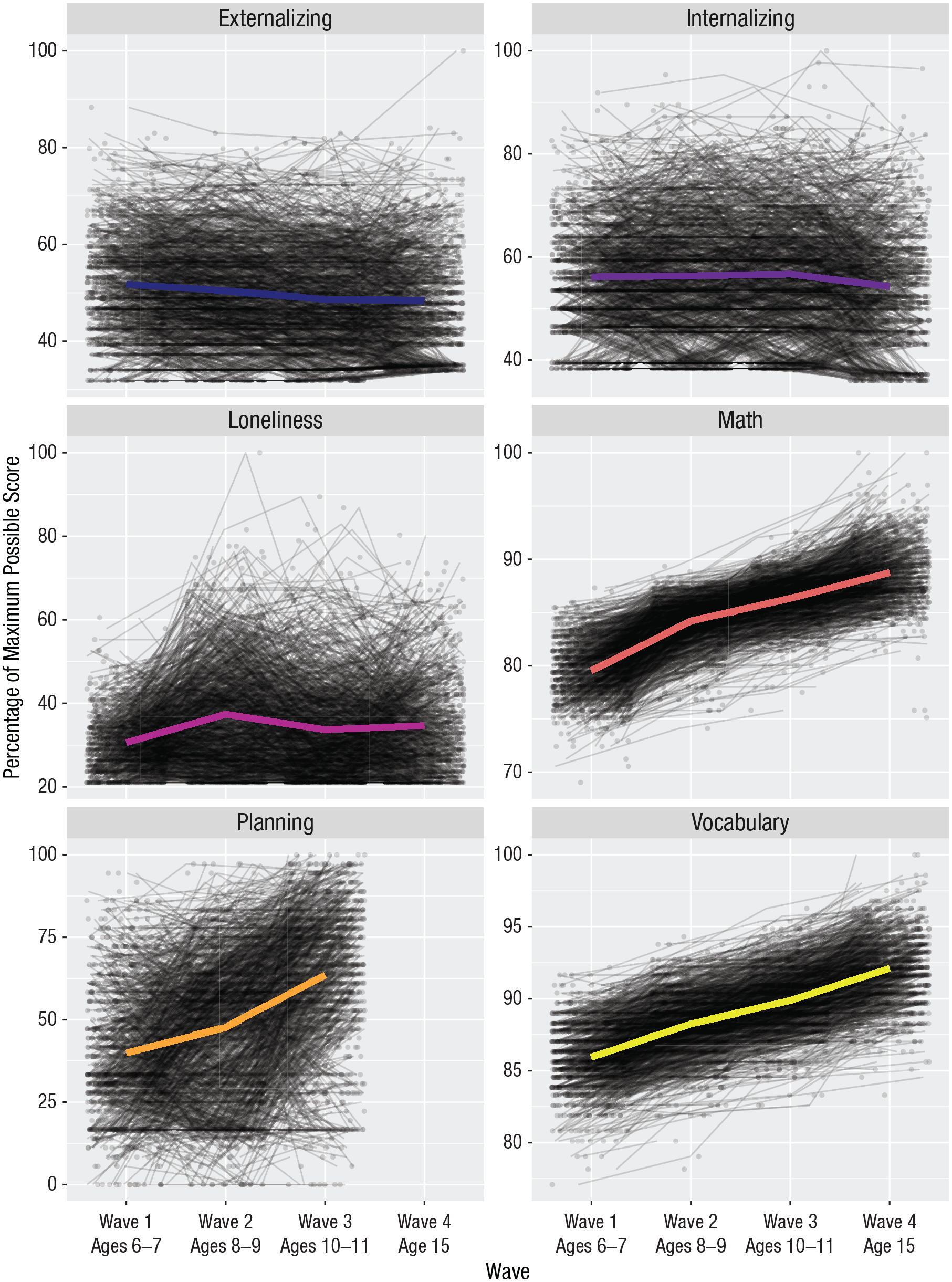
Changes in well-being and cognition over time. Spaghetti plots of participants’ scores (shown as percentage of maximum possible scores) over time and mean trajectories. There was no suitable data for planning at G9.
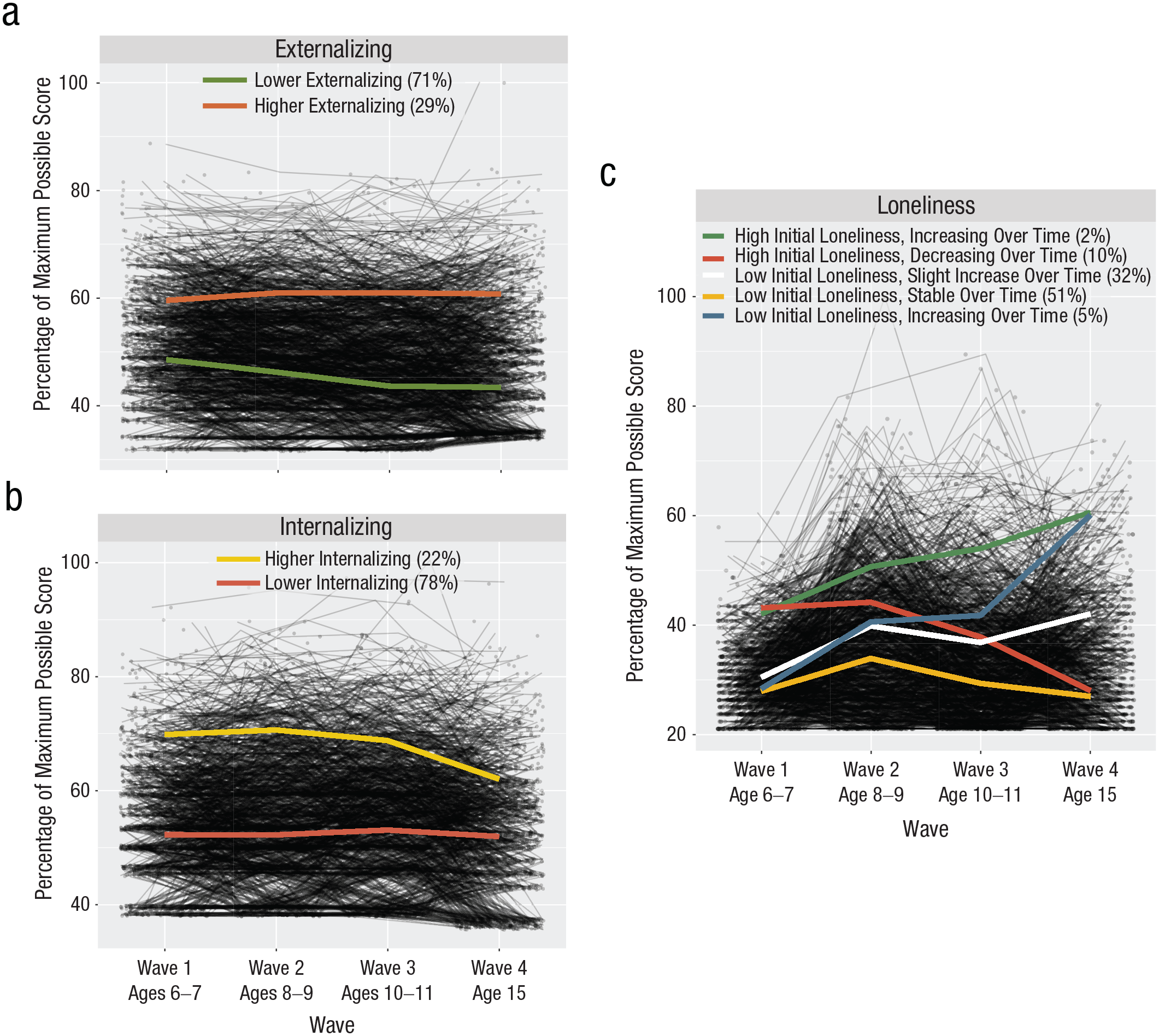
Trajectories of well-being in subpopulations. Spaghetti plots of participants’ scores (shown as percentage of maximum possible scores) over time and mean trajectories in different subpopulations as identified by growth mixture models. The percentage of participants estimated to belong to the subpopulation is shown in parentheses.
All well-being domains showed individual differences in trajectories, as indicated by significant slope variances (see Table S2 in the Supplemental Material) and in line with Hypothesis 1. GMMs further extended this finding by providing evidence for the existence of subpopulations in the cohort: two for externalizing (Fig. 2a), entropy = 0.59, BLR(3) = 55.09, p < .001, and internalizing (Fig. 2b), entropy = 0.55, BLR(3) = 33.55, p < .001, and five for loneliness (Fig. 2c) entropy = 0.70, BLR(3) = 17.91, p < .001. For a detailed breakdown of model fit, see Table S3 in the Supplemental Material.
The two subpopulations for externalizing showed different levels of symptoms at ages 6 to 7 (higher vs. lower externalizing) and slightly diverging trajectories over time (Fig. 2a). The subpopulation with low externalizing symptoms at ages 6 to 7 showed a slight decrease in symptoms over time, whereas symptoms in the subpopulation with high externalizing symptoms at ages 6 to 7 remained stable until age 15. Regressing externalizing subpopulation membership on risk and resilience factors showed that the subpopulation with high and stable externalizing scores (see Fig. 2a) was characterized by lower socioeconomic status, χ2(1) = 11.41, p < .001, and lower parental closeness, χ2(1) = 9.26, p = .002, whereas friendship quality did not differ significantly between subpopulations, χ2(1) = 1.94, p = .163. In an exploratory analysis suggested by a reviewer, we tested whether externalizing trajectories were related to diagnoses of neurodevelopmental conditions. We found that attention-deficit/hyperactivity disorder (ADHD) diagnosis predicted subpopulation membership, χ2(1) = 47.60, p < .001, such that teenagers with an ADHD diagnosis were more likely to be in the group showing higher externalizing symptoms. Autism spectrum disorder diagnosis did not predict subpopulation membership, χ2(1) = 0.36, p = .548.
The two subpopulations for internalizing showed different levels at ages 6 to 7 (higher vs. lower internalizing) and slightly converging trajectories over time (Fig. 2b). The subpopulation with low internalizing symptoms at ages 6 to 7 remained stable over time, whereas the subpopulation with higher internalizing symptoms at ages 6 to 7 showed a reduction in symptoms over time. These subpopulations did not differ significantly in socioeconomic status, χ2(1) = 1.72, p = .189; parental closeness, χ2(1) = 0.56, p = .455; or friendship quality, χ2(1) = 2.76, p = .096.
Loneliness was characterized by five subpopulations with strikingly dissimilar trajectories. The largest subpopulation (51% of the sample) reported low and stable loneliness (Fig. 2c, yellow line). This subpopulation served as the reference group to which all other subpopulations were compared. Three of the other subpopulations showed increases in loneliness over time, whereas one subpopulation showed decreases in loneliness (see Fig. 2c). Subpopulations differed in socioeconomic status overall, χ2(4) = 9.69, p = .046, although none of the specific comparisons between subpopulations were significant (see Table S4 in the Supplemental Material). Parental closeness showed no effect overall, χ2(4) = 3.55, p = .470, whereas friendship quality differed significantly between subpopulations, χ2(4) = 19.76, p < .001. Comparisons between the subpopulations showed that the three subpopulations in which loneliness increased over time also reported lower friendship quality than the reference group (Table S4 in the Supplemental Material).
Overall, we found mixed evidence for Hypothesis 1. Internalizing and externalizing decreased over time. As predicted, trajectories of well-being showed individual differences and were related to social risk and resilience factors: Lower socioeconomic status and parental closeness were related to less favorable trajectories of externalizing. Lower friendship quality was associated with increases in loneliness over time.
Cognition
Univariate LGMs of cognition showed acceptable fit overall (see Table S2 in the Supplemental Material). Scores of math, vocabulary, and planning showed a clear increase over time as indicated by their significant, positive, slope intercepts (Fig. 1; Table S2 in the Supplemental Material). This finding was in line with the previous literature (Kail et al., 2015) and our preregistered Hypothesis 2. Only vocabulary showed a significant slope variance, which indicated that there were individual differences for this measure only (see Table S2 in the Supplemental Material) and thus provided only partial support for Hypothesis 2. None of the trajectories showed evidence for the existence of subpopulations (see Table S3 in the Supplemental Material).
Overall, these results provide partial support for our preregistered Hypothesis 2. We found strong evidence that cognitive performance increased over time. Contrary to our hypothesis, however, individual differences in development were evident only for vocabulary.
Couplings between well-being and cognition
We used bivariate LGMs to examine the relationships between the intercepts and slopes of well-being and cognition (Fig. 3). This allowed us to assess Hypotheses 3 and 4, that well-being and cognition are linked cross-sectionally and longitudinally and show bidirectional coupling over time.
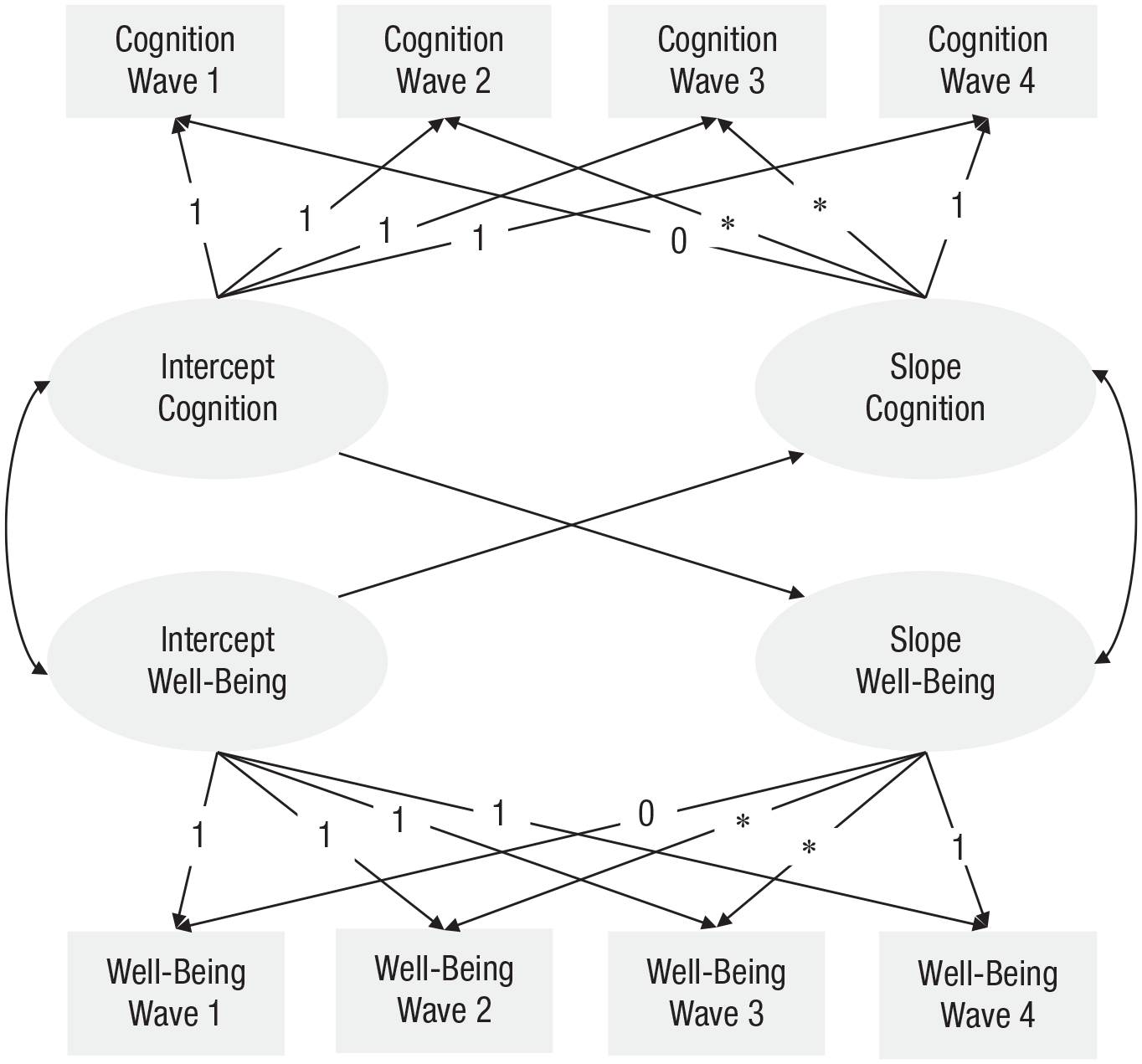
Schematic path diagram of the bivariate latent growth models. Numbers indicate factor loadings; asterisks indicate that factor loadings were freely estimated.
All bivariate LGMs showed good or acceptable fit except for the bivariate LGMs modeling the relationships between math and the three well-being domains (see Table S5 in the Supplemental Material). The latter models should be interpreted with caution, therefore.
Intercepts showed significant small to large negative correlations for most domains, which indicated that well-being and cognition were associated at baseline (6–7 years of age; see Table S5 in the Supplemental Material). This finding is consistent with the notion that lower well-being was cross-sectionally associated with lower cognitive ability (Hypothesis 3).
For vocabulary and loneliness, slopes were also significantly correlated, which indicated that changes in loneliness were related to changes in vocabulary over time. This correlation was positive, however, and not in line with the direction of the other paths in the model. None of the other models showed correlated slopes. Overall, we found little evidence for longitudinal correlations between well-being and cognition (Hypothesis 3).
Next, we investigated our main hypothesis (Hypothesis 4): Is there bidirectional longitudinal coupling between well-being and cognition? To answer this question, we inspected regression path estimates to understand the relationship between intercepts in one domain and slopes in the other domain. We found that higher levels of externalizing at ages 6 to 7 predicted fewer improvements in planning and showed a small to medium effect size (standardized estimate [β] = −0.14, p = .019; see Table S5 in the Supplemental Material). Conversely, higher levels of vocabulary at ages 6 to 7 longitudinally predicted fewer increases in loneliness with a large effect size (β = −0.34, p < .001; see Table S5 in the Supplemental Material). Loneliness and math showed an unexpected, positive longitudinal coupling (see Table S5 in the Supplemental Material) between baseline levels of loneliness and changes in math. This unexpected directionality may be explained by poor model fit. Overall, these findings highlighted the existence of complex, bidirectional, and domain-specific longitudinal relationships between cognition and well-being. This provides partial support for Hypothesis 4.
Risk and resilience factors
We characterized heterogeneity in the coupling between cognition and well-being. Specifically, we used GMMs to identify subpopulations with distinct trajectories over time for bivariate LGMs with significant regressions paths. We then investigated whether subpopulation membership was predicted by pubertal maturation (Hypothesis 5). We also carried out exploratory, nonpreregistered analyses to investigate whether social risk and resilience factors (socioeconomic status, parental closeness, and/or friendship quality) predicted subpopulation membership.
GMMs showed that the longitudinal coupling between externalizing and planning was characterized by heterogeneity: Two distinct subpopulations were identified (Fig. 4), entropy = 0.81, BLR(5) = 147.45, p < .001. For a detailed breakdown of model fit, see Table S6 in the Supplemental Material. One subpopulation showed higher externalizing and lower planning, and the other showed lower externalizing and higher planning (Fig. 4). Trajectories for planning diverged visibly after ages 8 to 9. Contrary to our hypothesis, subpopulations did not differ in pubertal maturation, χ2(1) = 0.64, p = .423. Subpopulations did, however, differ in parental closeness: The subpopulation with higher externalizing and shallower improvements in planning was more distant from their parents, χ2(1) = 5.23, p = .022. There was no difference between subpopulations in socioeconomic status, χ2(1) = 2.21, p = .137, or friendship quality, χ2(1) = 1.25, p = .264.
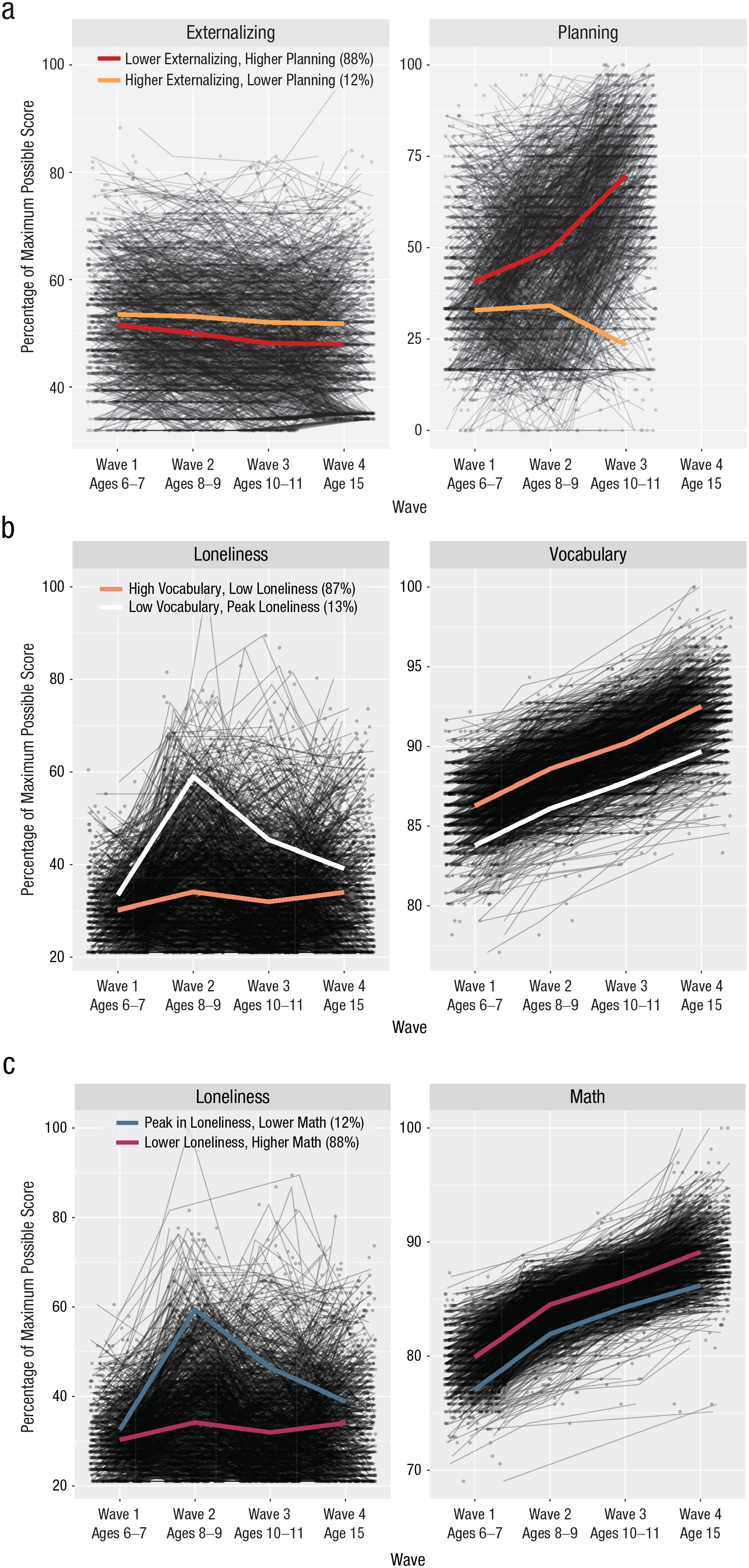
Bivariate coupling of trajectories in subpopulations. Spaghetti plots of participants’ scores (shown as percentage of maximum possible scores) over time as well as mean trajectories in different subpopulations as identified by growth mixture models. The percentage of participants estimated to belong to the subpopulation is shown in parentheses.
We identified two subpopulations for the coupling between loneliness and math (Fig. 4; see Table S6 in the Supplemental Material), entropy = 0.78, BLR(5) = 108.27, p < .001. One showed higher math skills combined with consistently low loneliness, whereas the other showed lower math skills together with a pronounced spike in loneliness around Wave 2 (ages 8–9; Fig. 4). This subpopulation showed higher pubertal status, χ2(1) = 5.54, p = .019; less parental closeness, χ2(1) = 7.85, p = .005; lower socioeconomic status, χ2(1) = 57.39, p < .001; and lower friendship quality, χ2(1) = 12.94, p < .001.
We identified two subpopulations for the coupling between loneliness and vocabulary (Fig. 4; see Table S6 in the Supplemental Material), entropy = 0.79, BLR(5) = 131.15, p < .001, which were visually similar to the subpopulations for loneliness and math: One showed a peak in loneliness at ages 8 to 9 and low vocabulary scores, whereas the other has lower and stable loneliness levels and higher vocabulary scores (Fig. 4). Subpopulations were characterized by differences in pubertal status, χ2(1) = 8.53, p = .003, such that the subpopulation with low vocabulary and a peak in loneliness showed higher puberty status. Subpopulations also differed in parental closeness, χ2(1) = 16.88, p = .001; socioeconomic status, χ2(1) = 69.55, p < .001; and friendship quality, χ2(1) = 15.38, p < .001. The subpopulations with a peak in loneliness showed lower socioeconomic status, friendship quality, and parental closeness. The subpopulation with intermediate vocabulary and a peak in loneliness also showed lower parental closeness.
Overall, these findings provide partial support for Hypothesis 5: The coupling between well-being and cognition changes with puberty such that earlier maturation is related to poorer outcomes. Higher socioeconomic status, a closer relationship to parents, and better friendship quality were each linked to more favorable trajectories of well-being and cognitive development.
Discussion
We investigated the interactions between cognition and well-being in a large longitudinal cohort of 1,136 children and adolescents. Replicating previous, and largely cross-sectional, work (Irie et al., 2019; Rock et al., 2014), we showed pervasive cross-sectional links between cognition and well-being that indicated that cognition and well-being were already linked at 6 to 7 years of age. After we modeled longitudinal changes over time, however, a more subtle pattern emerged. Longitudinal links existed only for very specific domains and showed evidence of dynamic coupling.
Lower externalizing symptoms in childhood predicted more favorable planning trajectories. Externalizing symptoms include overactivity, poor impulse control, noncompliance, and aggression. Externalizing symptoms are linked to deficits in planning and similar executive function tasks in children with ADHD (Kuja-Halkola et al., 2015). We here show that ADHD in our study, too, predicts externalizing trajectories. Our findings extend this literature by showing similar associations in the general population. Our findings further indicate that behavioral symptoms may precede cognitive problems. Speculatively, behavioral problems may lead to social issues in school (Timmons & Margolin, 2015), which, in turn, may hamper academic attainment and cognitive development (Okano et al., 2020).
The opposite directionality emerged for the link between vocabulary and loneliness: Higher vocabulary in childhood predicted less loneliness in adolescence. The link is intuitive: Better verbal skills may allow children to relate better to others and protect against loneliness (Fritz et al., 2018). However, there is currently surprisingly little research investigating longitudinal links between vocabulary and loneliness, let alone longitudinal links in the general population (but see Forrest et al., 2018). We know that loneliness is linked to physical and mental health (Eccles et al., 2020; Matthews et al., 2016). Self-reported loneliness has been shown to be predictive of sleep (Eccles et al., 2020) and depression (Matthews et al., 2016)—and more so than more objective measures of social isolation (Matthews et al., 2016).
The complexity of our models required several statistical decisions that were not anticipated at the time of preregistration. For instance, we preregistered using linear latent growth curve models but found universally poor fit for these models. We therefore used a latent basis function approach that allowed us to freely estimate growth shapes and significantly improved model fit. Some statistical issues persisted even after attempts to improve model fit. The models to assess interactions between math and well-being showed poor model fit, for instance. These models, therefore, need to be interpreted with caution. For transparency, we clearly highlight deviations from our preregistration throughout the article.
Our findings suggest that interventions aimed at addressing behavioral problems and fostering verbal skills could be promising for improving cognition and well-being outcomes. Past research has shown that behavioral problems can be targeted by interventions, including measures such as parent training, family support, and school-based programs. However, long-term effectiveness has been studied little so far (Smedler et al., 2015), and little is known about possible effects on cognitive development. There is comparatively good evidence that loneliness is malleable to interventions. Most loneliness interventions have targeted older adults (Cattan et al., 2005) and used strategies such as improving social skills, enhancing social support, increasing opportunities for social contact, and addressing maladaptive social cognition (Masi et al., 2011). A meta-analysis showed that these are generally effective for reducing loneliness, particularly when targeting social cognition (Masi et al., 2011). Fewer interventions exist for young people, and of those available, most target loneliness as a side effect of physical health conditions. Because of the potential ramifications of loneliness for physical and mental health, we recommend replicating and extending our findings in future research to better understand how vocabulary relates to loneliness and test whether interventions improving vocabulary have positive effects on loneliness.
On a theoretical level, our findings of bidirectional relations between specific domains of cognition and well-being in childhood and adolescence provide evidence for mutualistic relationships between cognition and well-being that unfold dynamically over development. Small individual differences in externalizing in childhood may set children on different planning trajectories. Small differences in vocabulary may predict different trajectories of loneliness. This supports the complex systems account of mental health problems and cognitive development (Borsboom, 2017; Burger et al., 2020; Fritz et al., 2018; Kievit et al., 2017; Lunansky et al., 2020; McElroy et al., 2018; Van Der Maas et al., 2006). Our study shows that not only are cognition and well-being complex systems in and of themselves, but they also interact with one another during development, generating yet further dynamic processes.
Risk and resilience factors explain heterogeneity in trajectories
Relationships between well-being and cognition were highly heterogeneous, particularly for loneliness and its relationship with cognition. Lower vocabulary was associated with a spike in loneliness around 8 to 9 years for 12% of the sample. Around ages 10 to 11, adolescents in the United States transition from elementary to middle school. However, there are no obvious school transitions around ages 8 to 9 in the United States, which makes it more likely that spikes in loneliness around this age reflect a more intrinsic developmental pattern. Previous work suggests that the period between late childhood and early adolescence represents a time of biological and social change (Andersen & Teicher, 2008; Blakemore & Mills, 2014; Fuhrmann et al., 2019). This may lead to increases in loneliness and reduced well-being for a subset of young people.
In our sample, a subset of young people was characterized by risk factors including earlier puberty, lower socioeconomic status, lower friendship quality, and poorer relationships with parents. This is in line with previous work highlighting the links between early physical maturation and mental health (Lewis et al., 2018; Sequeira et al., 2017). Early puberty onset has also been associated with lower performance, particularly on self-control and risk-taking tasks (Laube et al., 2020), and lower academic attainment (Cavanagh et al., 2007). Developmental theories suggest that early puberty may accentuate preexisting differences in childhood (Caspi & Moffitt, 1991) or impair plasticity and learning (Schulz et al., 2009). Note, however, that several empirical (Chaku & Hoyt, 2019; Koerselman & Pekkarinen, 2017) and theoretical studies (Belsky et al., 2007; Laube & Fuhrmann, 2020) now suggest that in supportive environments, early puberty can be linked to more positive cognitive outcomes, too. Chaku and Hoyt (2019) showed that early maturation may be associated with lower self-control but also better attention. The social context also shapes outcomes after early puberty (Belsky et al., 2007). Preliminary evidence suggests that supportive contexts may allow early maturers to benefit from new learning opportunities in adolescence (Klopack et al., 2020).
Overall, these findings underline that biological factors intersect with social risk and resilience factors such as socioeconomic status, parental closeness, and friendship quality. All three were here found to be independently linked to poorer cognitive and well-being outcomes (after controlling for the other two social risk factors). This finding is in line with an emerging body of literature highlighting that socioeconomic status (Hackman et al., 2015), friendship quality (van Harmelen et al., 2016, 2017; Ybarra et al., 2010), and relationships to parents (Laursen & Collins, 2009) are linked to cognitive, well-being, and mental health outcomes. This underscores the importance of social support in schools to improve well-being.
These findings highlight several promising avenues for future research. For this study, we used a rich longitudinal data set with high-quality measures of cognition and well-being that covered major aspects of each domain. Future studies could explore other interesting aspects of cognition (e.g., working memory) and well-being (e.g., life satisfaction and depression). Although SECCYD allowed us to assess developmental sequences and identify potential risk and resilience factors in a large and diverse cohort, the observational nature of the sample precludes any assessments of causality. Future experimental and intervention research will therefore need to establish cause and effect in the development of cognition and well-being. The heterogeneity in loneliness trajectories observed here using exploratory methods also invites further study. Future studies of heterogeneity are needed to confirm which young people are most at risk of loneliness and at what point in their life. We will need to test candidate mechanisms (e.g., pubertal changes) and later life outcomes (e.g., mental health). Loneliness itself is a heterogeneous experience: It may be experienced as neutral or even positive depending on the individual and circumstances. Better understanding and more specific measurement of negative and positive experiences of loneliness in adolescence, as well as the relationship between loneliness, social dissatisfaction, and social isolation, will allow us to better tease apart the underlying mechanisms. Finally, alternative analytic approaches may yield complementary insights into developmental processes. Cross-lagged panel models, for instance, could isolate effects from one wave to the next, which could be particularly interesting for the study of developmental transitions.
Conclusion
We characterized the relationship between cognition and well-being trajectories across developmentally sensitive periods between childhood and adolescence. We found pervasive cross-sectional links and two robust longitudinal effects: Externalizing symptoms predicted changes in planning, and vocabulary predicted changes in loneliness. Less favorable trajectories in both domains were related to earlier puberty, lower socioeconomic status, a more distant relationship to parents, and lower friendship quality. This work highlights the complex longitudinal dynamics of cognition and well-being in childhood and underlines the need to support both peer and parent relationships to foster cognitive health and well-being across the life span.
Supplemental Material
sj-pdf-1-cpx-10.1177_21677026211030211 – Supplemental material for Well-Being and Cognition Are Coupled During Development: A Preregistered Longitudinal Study of 1,136 Children and Adolescents
Supplemental material, sj-pdf-1-cpx-10.1177_21677026211030211 for Well-Being and Cognition Are Coupled During Development: A Preregistered Longitudinal Study of 1,136 Children and Adolescents by Delia Fuhrmann, Anne-Laura van Harmelen and Rogier A. Kievit in Clinical Psychological Science
Footnotes
Acknowledgements
We thank the volunteers and researchers involved in the NICHD Study of Early Child Care and Youth Development. We are also grateful to Louise Arseneault for helpful comments on the findings.
Transparency
Action Editor: Colin MacLeod
Editor: Kenneth J. Sher
Author Contributions
D. Fuhrmann conceived the study. D. Fuhrmann and R. A. Kievit designed the study and analyzed the data. All of the authors contributed to the writing of the manuscript and approved the final manuscript for submission.

References
Supplementary Material
Please find the following supplemental material available below.
For Open Access articles published under a Creative Commons License, all supplemental material carries the same license as the article it is associated with.
For non-Open Access articles published, all supplemental material carries a non-exclusive license, and permission requests for re-use of supplemental material or any part of supplemental material shall be sent directly to the copyright owner as specified in the copyright notice associated with the article.
