




Abstract
Children differ considerably in the social-information-processing (SIP) patterns underlying their aggressive behavior. To clarify these individual differences, we propose a dual-mode SIP model that predicts which processing steps children will take, which children will take them, and under which circumstances, and how this may lead to aggression. This dual-mode SIP model distinguishes between an automatic and reflective processing mode. The automatic mode is characterized by fast automatic processing and impulsive behavioral responses, whereas the reflective mode is characterized by deliberate processing and controlled behavioral responses. Whether children use the automatic or reflective processing mode is moderated by their level of arousal, which depends on an interplay between child-specific factors (i.e., emotional dispositions, motivational dispositions, and executive functioning) and dynamic factors (i.e., internal state and type of situation). The dual-mode SIP model provides new insights into children’s unique SIP styles and provides possibilities to tailor treatment to children’s individual needs.
Aggressive-behavior problems in childhood have a detrimental impact on children, their environment, and society at large and are among the most prevalent psychological problems in children (Dodge et al., 2006; Polanczyk et al., 2015; Romeo et al., 2006). Research has identified cumulative contextual and dispositional risk factors that predict the development of aggressive-behavior problems (Lochman & Matthys, 2018). These distal risk factors may shape the way in which children process social information so that aggressive-behavior patterns will be maintained even when these risk factors are no longer present (Dodge & Pettit, 2003). For instance, children who are repeatedly victimized may generalize the expectation that others will victimize them to future, nonhostile contexts, and this generalized expectation will maintain their aggressive-behavior patterns (Perren et al., 2013). Furthermore, empirical work has demonstrated that children’s deviant social-information-processing (SIP) patterns explain meaningful variance in their aggressive behavior, are associated with disruptive behavior disorders, and predict the development of future aggressive-behavior patterns (e.g., de Castro & Van Dijk, 2017; Dodge et al., 1986; Lansford et al., 2006; Verhoef et al., 2019). Thus, research suggests that children’s SIP plays a key role in the development and maintenance of their aggressive behavior.
Nonetheless, how well children’s SIP explains their aggressive behavior varies considerably between children and studies. These divergent findings may reflect that relatively few empirical studies on children’s SIP have considered automatic processes (Anderson & Bushman, 2002). Previous work has predominantly assessed reflective SIP in children by explicitly asking them to reflect on hypothetical social events. Yet many children may act aggressively without such reflection: When they are in a state of high arousal, an apparently hostile gesture of a peer may trigger a direct automatic aggressive response while children have minimal cognitive control to guide this process reflectively. Distinct models have been developed that predict children’s aggressive behavior on the basis of their emotional dispositions (e.g., temperament), motivational dispositions (e.g., punishment and reward insensitivity), executive-functioning capacities, or database of social experiences (e.g., Dodge, 2006; Guo & Mrug, 2017; Jarret & Hilton, 2017; Matthys et al., 2013). However, none of these models explain how these factors then actually contribute to children’s aggressive behavior through their automatic and reflective SIP. Therefore, we propose an overarching dual-mode SIP model that predicts which processing steps children will take, which children will take them, and under which circumstances, and how this may lead to aggression.
The Current SIP Model
The current SIP model (Crick & Dodge, 1994) proposes that several SIP steps take place between children’s encounter with a social stimulus and their behavioral response: (a) encoding of social cues, (b) interpretation and mental representation of these cues, (c) setting of interactional goals, (d) generation of possible behavioral responses, (e) evaluation of these responses, and (f) enactment of the selected response. For each of these steps, children draw from their database of social knowledge to process the present situation (Crick & Dodge, 1994). Aggressive behavior may result from deviancies in each step of the SIP model. Research has shown that children with aggressive-behavior problems encode more hostile cues and less nonhostile cues, make more hostile interpretations of other people’s behavior, set more interaction goals directed at revenge or instrumental gain, generate more aggressive responses, and evaluate aggressive responses and their outcomes less negatively than their less aggressive peers (for reviews, see de Castro & Van Dijk, 2017; Dodge, 2011).
The current SIP model accommodates individual differences in the specific processing steps leading up to aggression. For instance, in some children, aggressive behavior may primarily stem from excessive anger and a tendency to attribute hostile intent to others, but in other children, it may stem from the tendency to pursue instrumental goals and to have positive outcome expectancies of aggression (Arsenio et al., 2009; Crick & Dodge, 1996; de Castro et al., 2005). From the onset, the model has also suggested that aggressive behaviors may be a consequence of skipping part of these deliberate SIP steps (Crick & Dodge, 1994). In everyday life, many children may not have the time or mental resources or feel the need to engage in reflective processing of all SIP steps (Anderson & Bushman, 2002; de Castro, 2004). However, the SIP model does not describe how children who skip parts of these processing steps would actually engage in automatic processing or what would make children skip parts of the deliberate SIP steps. Our dual-mode SIP model aims to explain what determines whether children process social information automatically or reflectively and how these processes take place.
Evidence for Automatic SIP
Several empirical findings support the necessity of incorporating automatic processing into the SIP model. Research has found a direct link between children’s emotion-regulation deficits and aggressive behavior that could not be explained by their self-reported SIP (de Castro et al., 2005; Helmsen et al., 2012). This suggests that strong emotions, such as anger or frustration, may directly lead to aggression without intermediate reflection or decision processes. Likewise, self-reports by children with aggressive-behavior problems have revealed that they primarily explain their aggressive responses to peer provocations as being driven by strong emotions and seldom refer to goals or evaluations underlying their behavior (de Castro et al., 2012). Furthermore, in a detective game in which children were asked to evaluate whether a peer acted with hostile intent, children with aggressive-behavior problems made faster judgments, which suggests that they spent less time reflecting on the peer’s intentions (Dodge & Newman, 1981). Moreover, in a social-problem-solving task, aggressive-rejected children generated more conflict-escalating solutions (e.g., verbal or physical aggression) than their nonaggressive peers, but only when they were instructed to respond as quickly as possible with the first solution that came to mind—not when they were instructed to wait for 20 s and consider alternative solutions (Rabiner et al., 1990). These findings suggest that aggressive-rejected children may generate different responses under automatic conditions compared with reflective conditions.
Further indications for automatic SIP may stem from empirical studies using eye-tracking technology, which aimed to capture children’s automatic encoding of social cues by assessing their eye movements. For instance, one study showed that children with aggressive-behavior problems attended more to nonhostile cues than their nonaggressive peers but nonetheless recalled less nonhostile information (Horsley et al., 2010). The authors suggested that these children may have automatically encoded nonhostile cues—which are salient because they conflict with children’s preexisting hostile ideas—without further reflecting on them. Another study also explained their seemingly contradictory findings by adopting a dual-mode perspective. This study found that children who paid less attention to social threat cues were more likely to attribute hostile intent and exhibit aggressive behavior (Schippell et al., 2003). The authors proposed post hoc that children’s encoding of social cues may consist of two steps instead of one: (a) automatic encoding of cues, occurring before cues come into conscious awareness, and (b) deliberate encoding of cues, occurring after cues come into conscious awareness. Supporting this idea of deliberate encoding, another eye-tracking study in young adults revealed that the number of attentional fixations on social cues was positively associated with the quality of moral decision-making justification (Garon et al., 2018). Thus, empirical evidence suggests that children’s encoding of social cues may be automatic as well as reflective.
More support for automatic SIP stems from studies that have used experimental paradigms known to tap into automatic processes. For instance, research using a cued-recall paradigm has shown that individuals high on self-reported aggression spontaneously encoded and interpreted behavioral sentences as more aggressive than nonaggressive individuals, but this difference disappeared when they were asked to deliberately reflect on the motives of the actor in these sentences (Zelli et al., 1996). Relatedly, empirical work indicates that subliminal priming with aggressive concepts may predict aggressive behavioral tendencies in subsequent unrelated tasks (for a review, see Todorov & Bargh, 2002). In addition, one study using an implicit association task has demonstrated that children’s implicit aggressive tendencies explained additional variance in their aggressive behavior above and beyond their explicit aggressive tendencies, which suggests that automatic processes form a unique route to aggressive behavior in children (Grumm et al., 2011). Together, these findings illustrate that aggressive behavior may result from automatic processes. An adapted SIP model is therefore needed that incorporates both reflective and automatic SIP and provides a fine-grained and testable description of which processing steps children will take, which children will take them, and under which circumstances, and how this may lead to aggression.
The Dual-Mode SIP Model
We propose a dual-mode SIP model that distinguishes between a reflective and automatic processing mode underlying children’s social behavior (Fig. 1). Our model is in line with a more general shift in cognitive psychology in which a distinction is made between a reflective and automatic processing mode in so-called dual-mode processing models (e.g., Chaiken & Trope, 1999; Kahneman, 2011). Our dual-mode SIP model combines insights from current SIP models (Crick & Dodge, 1994; Lemerise & Arsenio, 2000), the general aggression model (Anderson & Bushman, 2002), and dual-mode processing theory (e.g., Frijda, 1993; Smith & DeCoster, 2000). Both modes may lead children to respond with aggressive behavior: an automatically enacted aggressive action tendency or a deliberately selected aggressive response strategy. However, although all children may use both processing modes, some children may predominantly engage in aggression that derives from automatic SIP, and other children may engage more frequently in aggression that derives from reflective SIP. Distinguishing between processing modes may thus have important implications for intervention: Intervening on reflective SIP would not help children whose aggression is predominantly driven by automatic SIP. Conversely, intervening on automatic SIP would not help children whose aggression is predominantly driven by reflective SIP.
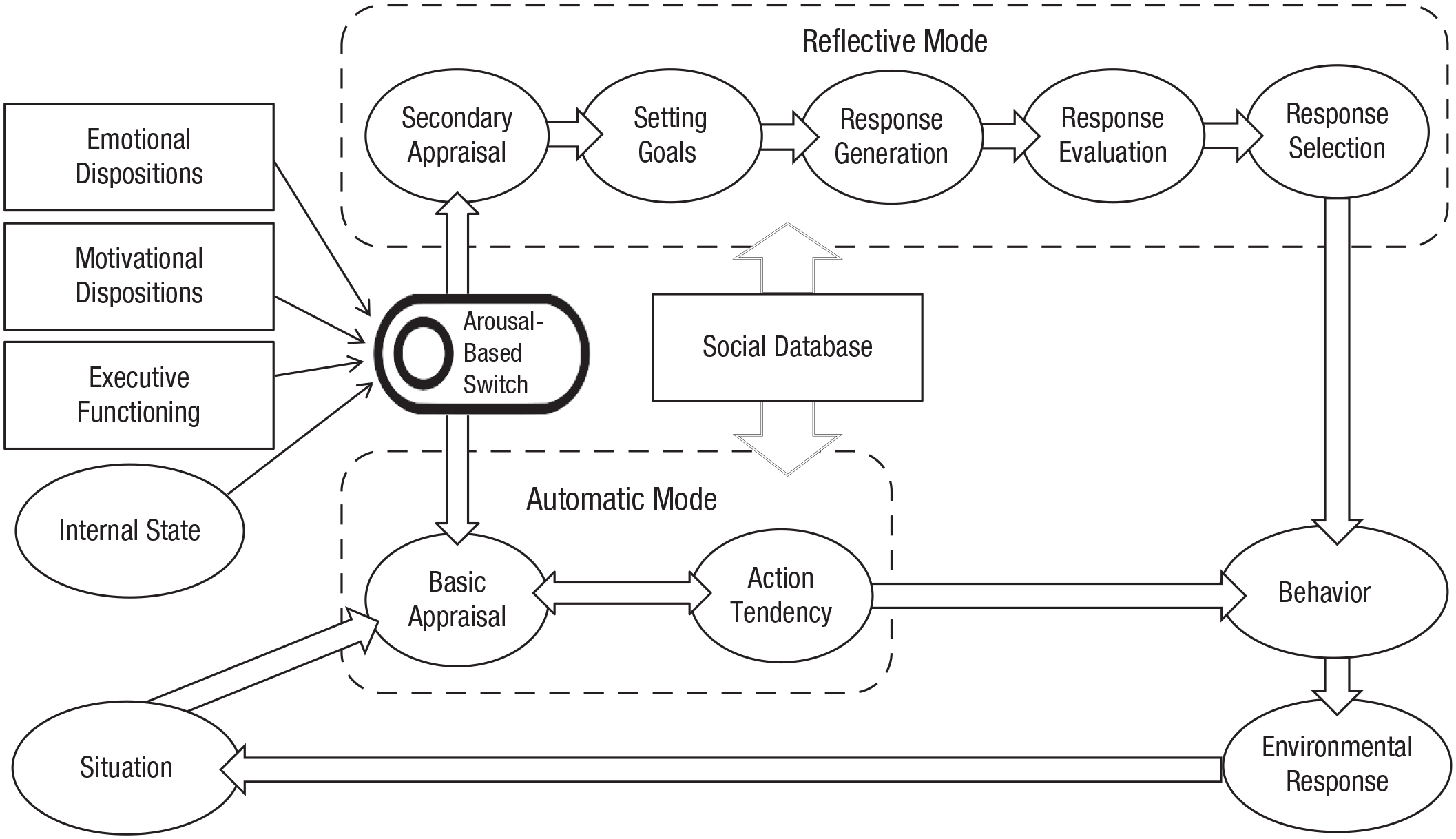
The dual-mode social-information-processing (SIP) model. The figure depicts one SIP cycle: A situation activates the automatic and/or reflective mode, resulting in behavior, responded to by the environment, thereby creating a new situation. Circles represent dynamic processes that may differ between SIP cycles. Rectangles represent dispositions that are relatively stable across SIP cycles.
The dual-mode SIP model incorporates several factors to explain which children will use which processing mode under which circumstances. We derived these factors from previous research on correlates of children’s aggressive SIP and behavior (e.g., Bookhout et al., 2018; de Castro & Van Dijk, 2017; Jarret & Hilton, 2017; Moore, Hubbard, & Bookhout, 2018). As can be seen in Figure 1, we propose that whether children use the automatic or reflective processing mode is determined by an interplay between child-specific factors (i.e., children’s emotional dispositions, motivational dispositions, and executive functioning) and dynamic factors (i.e., children’s internal state and the type of situation). Moreover, similar to previous SIP models, we further propose that aggressive SIP patterns—in either processing mode—are explained by children’s adverse learning histories stored in the social database.
The Automatic and Reflective Modes
The dual-mode SIP model proposes that during any social interaction, children will process social information in either the automatic or the reflective mode. The automatic mode is characterized by fast implicit processing and consists of a basic appraisal and a dominant action tendency. Both derive from an associative network in memory that is part of children’s social database. This network links specific situational triggers (e.g., a child’s goal is blocked) to specific affective reactions (e.g., frustration) and behavioral responses (e.g., fight) through automatic if–then contingencies (e.g., if frustrated, then fight). Note that this fast process does not involve any deliberate thought but, rather, is a direct emotional response to specific situational cues (Frijda, 1993). Thus, children in the automatic mode solely use their database of automated contingencies without further consideration of situational cues or decision processes. This allows them to quickly process and respond to situational triggers while saving cognitive resources but occurs at the cost of careful decision-making (Anderson & Bushman, 2002). The if–then contingencies in the automatic mode differ between children depending on their learning histories stored in the social database, which is in line with the original SIP model (Crick & Dodge, 1994). We propose, however, that, in contrast to the original model, the automatic mode bypasses all SIP steps except the encoding of cues (i.e., it does not include representation of intent, goal setting, and response decision processes; see Fig. 1).
The reflective mode is characterized by slower explicit processing and consists of several sequential mental steps that result in a deliberate behavioral response. In contrast to the automatic mode, the reflective mode integrates information from the social database with situational cues (Huesmann & Guerra, 1997; Zelli et al., 1999). In the reflective mode, children reconsider their basic appraisal by allocating their attention to the situation and reappraising the encoded cues, which may include attributions of intent or causality (e.g., “His face shows that he has harmed me on purpose”). Next, given this secondary appraisal, children generate possible responses and evaluate those responses on the basis of, for instance, potential outcomes (e.g., “If I punch him now, he won’t bother me anymore”), their self-efficacy to enact the response (e.g., “I am stronger than him”), and moral considerations (e.g., “Someone who provokes me deserves a beating”). Last, children select the response evaluated most positively to be enacted. The reflective mode has the benefit of better problem-solving but depletes cognitive resources and takes more processing time (Anderson & Bushman, 2002). This reflective mode includes all processing steps formulated in the original SIP model (Crick & Dodge, 1994).
The dual-mode SIP model thus extends current SIP models by explaining not only deliberate, controlled aggression preceded by reflective processing but also fast, emotion-driven aggression preceded by automatic processing. According to the dual-mode SIP model, children will typically process social information in the automatic mode. From an evolutionary perspective, it is plausible that children will engage in reflective processing only when it is necessary. It would be maladaptive to spend cognitive resources to correct basic appraisals of situations that are familiar, satisfactory, or concern irrelevant stimuli (Aron et al., 2012; Barlett & Anderson, 2011). Thus, our dual-mode SIP model assumes that children will switch to the reflective mode only in situations that are unfamiliar, potentially threatening, or otherwise personally relevant (Frijda, 1993). For instance, children may use the automatic mode when they are engaging in small talk with the bus driver (i.e., a personally irrelevant situation) or when they are routinely playing with their sibling (i.e., a familiar and nonthreatening situation). Yet children may switch to the reflective mode when they encounter an unfamiliar peer at the schoolyard (i.e., an unfamiliar and potentially relevant or threatening situation). Our dual-mode model further assumes that children who are using the reflective mode may switch back to the automatic mode if the situation becomes excessively threatening and requires a direct response (Kunimatsu & Marsee, 2012). For instance, children may reflectively process the encounter with an unfamiliar peer but immediately switch to the automatic mode when they feel threatened.
How do children switch between modes? The dual-mode SIP model proposes that children’s basic appraisal evokes a certain level of arousal that determines which processing mode they will use. This relation follows an inverted U-shaped function (Obradović, 2016; Yerkes & Dodson, 1908) such that the reflective mode will be used only when arousal levels are moderate, rather than too low or too high (see “window of tolerance” as an optimal state of arousal to process information reflectively; Siegel, 1999). Thus, in situations of low arousal, children will use the automatic mode, which saves cognitive resources. In situations of moderate arousal, children will use the reflective mode, which allows them to deliberately process and carefully respond to the situation. In situations of excessive arousal, children are forced to use the automatic mode, which allows them to quickly process and respond to the situation (Frijda, 1993). Whether a situation evokes low, moderate, or excessive arousal will differ between children and situations, depending on their dispositions and dynamic factors (to be discussed later). These factors together determine children’s basic appraisal. Thus, children’s basic appraisal can be seen as an unconscious motivational heuristic that works as the “switch” between the automatic and reflective processing modes by changing children’s level of arousal.
The biological underpinnings of children’s arousal-based switch between the automatic and reflective modes may be found within the autonomic nervous system (ANS). When children encounter a social stimulus, the thalamus processes the stimulus, and information is sent to the amygdala, which leads to an initial appraisal in terms of emotional relevance. Next, the amygdala sends a signal to the hypothalamus, which in turn activates the ANS (Cunningham et al., 2007). The ANS has two branches. The sympathetic nervous system (SNS) incites physiological processes to prepare children for fight-or-flight responses (e.g., by increasing heart rate, blood pressure) through the release of neurotransmitters such as norepinephrine (McCorry, 2007). In contrast, the parasympathetic nervous system (PNS) enables children’s physiology to recover to a calm state (e.g., by decreasing heart rate, blood pressure) through the release of neurotransmitters such as acetylcholine (McCorry, 2007). The SNS and PNS generally operate simultaneously and have opposing functions: The SNS increases physiological arousal and prepares for action in the face of threat, whereas the PNS decreases physiological arousal and allows for greater attentional and cognitive capacity (Beauchaine, 2001). Thus, a well-performing ANS allows for a flexible physiological response to diverse social situations. In terms of our model, this allows children to switch between the automatic and reflective modes, enabling them to adequately respond to social demands. Conversely, a dysfunctional ANS may trigger maladjusted behavior (Branje & Koot, 2018). For instance, high SNS reactivity in conjunction with PNS withdrawal may lead to high arousal levels and trigger exaggerated fight-or-flight responses (Branje & Koot, 2018). Indeed, autonomic processes such as increased heart rate have been linked to more hostile-intent attributions and aggressive behavior in children (Crozier et al., 2008; Williams et al., 2003). Thus, research suggests that children’s arousal levels modulate their SIP—as we propose, through triggering their automatic mode or their reflective mode.
The Social Database
In line with previous SIP models, our dual-mode SIP model proposes that aggressive SIP patterns—in both processing modes—are determined by children’s social database. This database is built from children’s social experiences, which accumulate into memory structures consisting of specific affective, cognitive, and behavioral tendencies, which, in turn, guide children’s SIP in future social contexts (Anderson & Bushman, 2002; Crick & Dodge, 1994). For instance, children who grow up in harsh environments may develop hostile memory structures that predispose them to process social interactions in a hostile manner (e.g., by attributing hostile intent or having access to aggressive response options; Dodge, 2006; Dodge et al., 1997; Lansford et al., 2010), whereas children who grow up in supportive environments may develop memory structures that allow them to trust and cooperate with others (Frankenhuis et al., 2016). Thus, memory structures, or schemas, guide children’s perception, encoding, storage, and retrieval of social information (Beck et al., 2004). They may also guide behavior, prompting children with action plans or scripts of how to react to schema-relevant events (Beck et al., 2004). In this way, memory structures allow children to quickly process and respond to relevant situational triggers but may also induce errors or biases—especially in schema-relevant situations (Crick & Dodge, 1994).
Empirical work has identified several memory structures related to aggressive SIP (for a review, see de Castro & Van Dijk, 2017). Longitudinal research has shown that children are more likely to display aggressive SIP and behavior if they hold hostile schemas (e.g., “Other people cannot be trusted”; Burks et al., 1999; Calvete & Orue, 2012) or believe that aggression is morally acceptable and instrumentally useful (e.g., “Sometimes you need to fight to get what you want”; Calvete, 2008; Calvete & Orue, 2012; Huesmann & Guerra, 1997; Zelli et al., 1999). Moreover, research has shown that narcissistic memory structures, including beliefs about grandiosity, self-entitlement, and being superior to others (e.g., “Children like me deserve something extra”), are associated with aggressive SIP and behavior (Calvete & Orue, 2010, 2012). Thus, empirical research suggests that children’s social database may shape their aggressive SIP.
Our dual-mode SIP model extends previous scientific work and proposes that both automatic and reflective SIP rely on children’s social database, but in different ways. The automatic mode—being fast and implicit—fully relies on the database. Any situational input activates an associative memory network in which this input is directly linked to fully automatized affective and behavioral tendencies (Anderson & Bushman, 2002; Smith & DeCoster, 2000). A high- or low-arousal basic appraisal will directly trigger an associated emotional response and dominant action tendency. In low-arousal situations, children’s associative memory structures will trigger action tendencies for familiar and habitual situations, which will often be nonaggressive (e.g., routinely playing with a sibling) but may also be aggressive (e.g., routinely bullying a classmate). Likewise, in high-arousal situations (e.g., being provoked by a peer), individual differences in children’s associative memory structures will predict whether they respond in a nonaggressive or aggressive way (e.g., walking off vs. starting a fight). Thus, children’s social database directly determines their automatic SIP, which leads them to respond without reflecting on the situation (e.g., by considering other people’s intentions or the consequences of their response).
The reflective mode, in contrast, does not solely rely on the social database but explicitly integrates situational input with preexisting memory structures. Thus, children will use knowledge from their database to consider situational cues and evaluate possible response options. In the reflective mode, children may use both associative memory structures (which are also used in the automatic mode) and rule-based memory structures. Associative memory structures may influence children’s reflections because they trigger dominant emotional and behavioral tendencies (e.g., children may be more likely to consider aggressive responses when a hostile schema is activated; Anderson & Bushman, 2002). Rule-based memory structures are more complex and include reasoning heuristics that require children to integrate situational input with preexisting knowledge (Smith & DeCoster, 2000). Examples include “When someone frustrates me, I first need to check his height, weight, and reputation before I hit him,” and “I first need to check his body language to evaluate whether his intentions are hostile or not.” Individual differences in children’s rule-based memory structures will predict whether they respond with aggression. Thus, children’s social database indirectly influences their reflective SIP, triggering dominant tendencies and rule-based heuristics that may steer but will not fully determine how they process situational input and reflect on their response options.
In sum, children’s social database determines whether their SIP is aggressive. The dual-mode SIP model further proposes that some children are prone to use the automatic mode, whereas others are prone to use the reflective mode. Although both modes may predict aggressive behavior, it is important to understand what determines children’s “predominant” mode to help explain how their aggressive behavior typically originates. This has implications for intervention. Children whose aggressive SIP is predominantly automatic would require a different intervention approach (e.g., intervening on arousal regulation) than children whose aggressive SIP is predominantly reflective (e.g., changing deviant cognitions). The dual-mode SIP model therefore describes factors that influence children’s predominant processing mode.
Explaining Individual Differences in Children’s Predominant SIP Mode
To our knowledge, no empirical research has been conducted on factors that influence whether children are prone to process social information in the automatic mode compared with the reflective mode. We considered work on reactive and proactive aggression (e.g., Dodge, 1991; Hubbard et al., 2010; Kempes et al., 2005; Merk et al., 2007) but found that this work may not directly concern our dual-mode SIP model because the reactive-proactive and automatic-reflective distinctions are not interchangeable (Bushman & Anderson, 2001). It may seem intuitive to assume that reactive aggression, which is described as emotional and impulsive (Dodge, 1991), should derive from automatic SIP and that proactive aggression, described as unemotional and controlled (Dodge, 1991), should derive from reflective SIP. Yet our dual-mode SIP model predicts differently: Reactive aggression may result from automatic SIP (e.g., impulsively hitting back) as well as reflective SIP (e.g., deciding to take revenge), just as proactive aggression may result from automatic SIP (e.g., routinely bullying) as well as reflective SIP (e.g., planning to steal). There is empirical work to support this notion. Research examined children’s in-the-moment physiology and aggression during a game in which a virtual peer provoked them and found that children’s reactive aggression may be accompanied by high arousal and weak regulation as well as by low arousal and strong regulation (Moore, Hubbard, et al., 2018).
Likewise, a review on physiological predictors of children’s aggressive behavior illustrated that both reactive aggression and proactive aggression can be related to low physiological arousal as well as high physiological arousal (Fanti, 2018). This work suggests that there are both automatic and reflective routes to both reactive and proactive aggression. Finally, there is a host of SIP research to support that reactive aggression is predominantly associated with early SIP deviancies (i.e., hostile encoding, hostile intent attributions), whereas proactive aggression is predominantly associated with late SIP deviancies (i.e., instrumental goals, positive evaluations of aggression; for reviews, see Hubbard et al., 2010; Vitaro et al., 2006). Yet because these studies assessed both early and late SIP by explicitly asking children to reflect on hypothetical social events, these findings may actually suggest that reflective SIP predicts both reactive and proactive aggression.
In sum, although the reactive-proactive distinction is important to explain individual differences in children’s aggression, empirical work on this distinction cannot be used as direct support for the automatic-reflective distinction made in our dual-mode SIP model or to select factors that may explain individual differences in children’s predominant SIP mode. We therefore selected factors for our dual-mode SIP mode using the following considerations: (a) whether previous research has shown that the factor is related to aggression, (b) whether the factor has been theoretically and empirically linked to children’s SIP, and (c) whether the factor is relevant for arousal regulation and thus may contribute to whether children predominantly engage in automatic or reflective SIP. In the next sections, we describe these factors to provide starting points for future research on individual differences underlying children’s aggressive behavior.
Emotional dispositions
A wealth of empirical research suggests that children’s aggressive SIP and behavior are associated with specific emotional dispositions, assessed through temperament questionnaires as well as their physiological reactivity (for reviews, see Bookhout et al., 2018; Branje & Koot, 2018; Frick & Morris, 2004; Moore, Hubbard, & Bookhout, 2018). Overall, this work suggests that both children who display high (hyper) emotional reactivity and children who display blunted (hypo) emotional reactivity are prone to aggressive SIP and behavior. The dual-mode SIP model proposes that children’s emotional dispositions modulate their arousal across social situations (Rothbart & Derryberry, 1981) and thereby directly influence whether they are prone to use the automatic or reflective processing mode. Hyperemotional children will be prone to experience excessive arousal levels in stressful situations, which forces them to use the automatic mode more often than other children would. This may, for example, make them instantly respond with excessive anger and aggression without any reflection such as making intent attributions or considering their response options. Conversely, hypoemotional children will experience lower arousal levels in the same situation. This may affect their SIP in two ways, depending on how stressful the situation is. In highly stressful situations, hypoemotional children’s lower arousal levels may enable them to use the reflective mode. They may, for example, exhibit moderate (instead of high) arousal levels when they are threatened, which allows them to reflect on the situation and carefully plan a retaliatory strike or reconciliatory attempt. However, in moderately stressful situations that would trigger the reflective mode in most children, hypoemotional children may still use the automatic mode. They may, for example, exhibit low levels of arousal when they are bullying someone, which prohibits them from reflecting on the potential harm caused by their behavior. Thus, children’s emotional dispositions may be an important determinant of their predominant processing mode, both for children who are hyperemotionally reactive and children who are hypoemotionally reactive.
Indirect support for the idea that children’s emotional dispositions affect their predominant processing mode stems from research on children’s temperament. This research demonstrated that children with a highly emotionally reactive temperament become highly aroused when confronted with peer provocation (Hessler & Fainsilber Katz, 2007), which suggests that they are prone to engage in automatic processing. In contrast, children with callous-unemotional (CU) traits have been shown to exhibit blunted physiological arousal in challenging social situations (i.e., lower skin-conductance reactivity, less heart rate change, and lower cortisol reactivity; for a review, see Frick et al., 2014a). These children reported feeling more alert and in control after a virtual fear induction (Thomson et al., 2020), which suggests that they indeed may use reflective SIP in highly stressful situations. Conversely, these children may use automatic SIP in situations that would trigger reflective SIP in others. For instance, research has shown that children with CU traits are insensitive to peers’ expressions of fear and distress or signs of potential punishment (for a review, see Frick et al., 2014b). Relatedly, empirical work demonstrated that children who exhibit low autonomic arousal during hypothetical moral transgressions reported lower levels of guilt and, in turn, displayed more aggressive behavior according to their caregivers (Colasante et al., 2021). The authors suggested that these children may aggress without reflecting on their moral transgressions or considering the other person’s discomfort.
The idea that children’s emotional dispositions affect their predominant mode is also indirectly supported on a biological level, in which the same distinction between hyper- and hypoemotional children is observed (e.g., Bookhout et al., 2018; Branje & Koot, 2018). Stress-regulating systems such as the hypothalamic-pituitary-adrenal (HPA) axis have been linked to aggression in children through both hyperactive and hypoactive HPA-axis functioning, leading to excessive or blunted stress responses, respectively (for reviews, see Branje & Koot, 2018; Van Goozen et al., 2007). Likewise, empirical research has linked respiratory sinus arrhythmia (RSA) functioning—a physiological marker of children’s emotion-regulation capacities—to aggressive behavior in children through both low and elevated resting RSA (for reviews, see Bookhout et al., 2018; Branje & Koot, 2018). These findings fit with the dual-mode SIP model, which proposes that hyperemotional children may be particularly prone to engage in aggression that derives from automatic SIP and that hypoemotional children may be prone to engage in aggression that derives from either automatic SIP (i.e., when confronted with relatively mild social stressors) or reflective SIP (i.e., when confronted with more severe social stressors).
Motivational dispositions
Children’s predominant SIP mode may also be influenced by their motivational dispositions. Empirical work suggests that children’s insensitivity to punishment and reward may predispose them to engage in aggressive behavior (for reviews, see Matthys et al., 2012, 2013; Weeland et al., 2015). Children who are insensitive to punishment and reward exhibit lower arousal levels when confronted with regular punishment and reward cues compared with other children (e.g., Matthys et al., 2013). The dual-mode SIP model therefore proposes that punishment and reward insensitivity may predispose children to use the automatic mode when other children would use the reflective mode and use the reflective mode when other children would use the automatic mode—in similar fashion as explained for children with CU traits (who are also prone to experiencing lower arousal levels in response to social stressors). In fact, there is emerging evidence to suggest that punishment and reward insensitivity may be specific characteristics of children with CU traits (Frick et al., 2014b).
Which mode these children will use depends on the severity of the punishment and reward cues. Relatively mild cues that would trigger the reflective mode in most children may activate the automatic mode in children who are insensitive to punishment and reward. For instance, these children may experience little arousal from being caught by their teacher and therefore continue bullying a peer from the automatic mode. However, more severe punishment and reward cues that would make most children switch to the automatic mode because of high arousal levels may activate the reflective mode in children who are insensitive to punishment and reward. For instance, these children may experience moderate arousal levels when they are caught for stealing a candy bar from the store, which allows them to carefully reflect on the situation and successfully get away with it.
In sum, our dual-mode model proposes that children who are insensitive to punishment and reward are prone to engage in aggression that derives from either automatic SIP (i.e., when they are confronted with relatively mild punishment and reward cues) or reflective SIP (i.e., when they are confronted with more severe punishment and reward cues).
Executive functioning
There is much empirical research to suggest that children’s capacities to consciously control thought and action, called executive functions (EFs; Zelazo & Müller, 2002), are associated with less aggressive SIP (e.g., M. L. Ellis et al., 2009; Goldweber et al., 2011; Van Nieuwenhuijzen et al., 2017) and less aggressive behavior (for reviews, see Jarret & Hilton, 2017; Morgan & Lilienfeld, 2000; Ogilvie et al., 2011). The dual-mode SIP model further proposes that children’s EF capacities may help them regulate their arousal by facilitating reflective skills such as perspective-taking, problem-solving, and judgment and thereby affect whether they are prone to using the automatic or reflective mode. If arousal levels determine children’s mode, how, then, can the reflective mode be used to regulate arousal? As mentioned, the relation between children’s arousal level and activated SIP mode is thought to follow an inverted U-shaped function by which nonarousing or highly arousing situations directly activate the automatic mode and moderately arousing situations activate the reflective mode. However, in many situations, children’s arousal levels will increase gradually (e.g., when they are waiting their turn to play), first residing with the automatic mode, then activating the reflective mode when arousal levels become moderate, and then again activating the automatic mode when arousal levels become excessively high.
We propose that EFs may determine whether children manage to remain in the reflective mode or are forced to switch to the automatic mode. For instance, children high in EFs may be able to make a secondary appraisal of their emotion (e.g., evaluating whether their anger is justified) and carry out a deliberately selected emotion-regulating response (e.g., counting to 10, taking multiple perspectives) that down-regulates their arousal, whereas children low in EFs will not be able to do so, causing arousal levels to further increase and forcing them to use automatic SIP. In support of this notion, empirical work has shown that children high in EFs exhibit greater regulation of their physiological arousal levels in emotionally demanding situations and have better emotion-regulation skills than children low in EFs (Obradović, 2016; Obradović & Finch, 2016).
Children’s EFs may not only affect their predominant processing mode but may also influence the quality of their reflective SIP. If children low in EFs use the reflective processing mode, they may exhibit more errors and biases compared with children high in EFs, who will be more accurate in their reflective processing. For instance, children low in EFs may have difficulties holding multiple response options and outcomes in mind and evaluating them adequately, which may steer their decision processes toward aggression in situations in which aggression is the most accessible response option. Or, as another example, these children may attribute hostile intent in clearly benign social interactions because they fail to inhibit a schema-driven tendency to assume others cannot be trusted. Indeed, research suggests that low EFs (i.e., low focused attention, working memory, and inhibition) are linked to SIP biases, such as the generation and positive evaluation of aggressive responses (Van Nieuwenhuijzen et al., 2017; Van Rest et al., 2017).
In sum, our dual-mode SIP model proposes that in social situations in which children’s arousal increases gradually, children low in EFs are particularly prone to switch to the automatic mode, whereas children high in EFs can remain in the reflective mode. Moreover, when using the reflective mode, children low in EFs are expected to produce errors or biases, whereas children high in EFs are expected to be more accurate in their processing.
Dynamic Factors Influencing Children’s SIP Mode
Internal state
We have just described how stable dispositions may predispose children to use either the automatic or reflective mode. In addition to these factors, children’s processing mode is affected by dynamic processes that may vary across situations and SIP cycles (see Fig. 1). The dual-mode SIP model proposes that children’s arousal level in any given situation is affected by their internal state—the arousal, affect, and cognitions that were already activated just before this situation. This internal state can be influenced both by preceding events and by physiological factors such as temperature, stress, frustration, fatigue, hunger, and pain (Anderson & Bushman, 2002). Obviously, children may be more likely to use the automatic mode when their level of arousal just before the social event was already high, for example when they were already moody or fatigued or when hostile memory structures were already activated. Conversely, children may be prone to use the reflective mode when they were concentrated or rested just before the social event or when goal-related memory structures were already activated. In line with this idea, research has shown that experimentally manipulating children’s mood exacerbates their aggressive SIP and behavior in subsequent provocative situations (de Castro et al., 2003; Dodge & Somberg, 1987). These findings illustrate that children’s internal state affects their subsequent SIP but do not show which mode was activated. Empirical work in adults suggests that hot temperatures or feeling hungry may activate the automatic mode: These internal states produced increases in arousal levels, hostile affect, hostile cognitions, and aggressive tendencies (Anderson et al., 1995; Bushman et al., 2014). In sum, the dual-mode SIP model proposes that children’s internal state affects the likelihood of using the automatic or reflective mode in forthcoming situations.
Type of situation
A second dynamic factor affecting whether children engage in automatic or reflective SIP is the type of situation. Some situations may be more arousing than others, which will make children prone to using the automatic mode. Empirical research has demonstrated that children may show aggressive behavior across various situations, such as being threatened, provoked, or disadvantaged; having to cope with competition; and dealing with authority figures (Dodge et al., 1985; Matthys et al., 2001). Which specific situations elicit high arousal levels differ between children, depending on their social database. That is, children may be sensitized to certain situations by their past experiences. For example, children who have been bullied in the past will likely experience high arousal levels when they encounter a group of unknown peers at the schoolyard, which will make them use the automatic mode. Conversely, children who have never been bullied would in the same situation experience a moderate level of arousal (because it is a personally relevant but not threatening situation), which will make them use the reflective mode. Thus, our dual-mode SIP model proposes that specific social situations affect whether children’s SIP and behavior are steered by the automatic or reflective processing mode.
Aggressive Behavior and Environmental Responding
Thus far, we have identified dispositional and dynamic factors that may affect whether children engage in aggression stemming from automatic or reflective SIP and have described how children’s social database may contribute to their aggressive SIP and behavior. Note that children’s aggressive SIP patterns (in either mode) are not just a product of their own dispositions but are also shaped by their environment (Dodge, 2009; Dodge & Pettit, 2003). Children’s aggressive behavior may, at least in some cases, evoke hostile responses from their social environment that may reinforce children’s aggressive SIP, which initiates a new cycle of aggressive behavior and environmental responding. Longitudinal research has supported this cyclical process, demonstrating that children’s tendency to attribute hostile intent to other people may not only be a result from peer rejection but also may contribute to future peer rejection (Lansford et al., 2010). The dual-mode SIP model proposes that this vicious cycle may be established through the automatic mode: Hostile responses from children’s social environment may strengthen certain memory structures (e.g., hostile schemas) for specific situations (e.g., provocation by peers), causing these situations to trigger automatic SIP faster and faster (e.g., in increasingly benign interactions), leading children to respond aggressively time and again, thereby creating a vicious cycle beyond children’s cognitive control.
Clinical Implications
Our dual-mode SIP model provides novel insights for the treatment of children’s aggressive SIP and behavior. It illustrates how clinicians may most effectively target aggressive SIP in which children, under which conditions, and through which factors. We have described that children’s aggressive behavior may derive from hyperaroused automatic SIP, hypoaroused automatic SIP, or reflective SIP. Each of these SIP styles may require a different intervention approach with a tailored combination of intervention techniques that may be presented within the context of applied effective intervention approaches such as cognitive behavior therapy (for a review, see Smeets et al., 2015) and behavioral parent training (for reviews, see Leijten et al., 2013; McCart et al., 2006).
For children whose aggressive behavior primarily derives from hyperaroused automatic SIP (i.e., highly emotional aggression), interventions may focus on arousal regulation by children themselves and their environment. These children could be taught cognitive and behavioral arousal-regulation skills, such as deep breathing, focusing on helpful or joyful thoughts, or taking a time-out. For the environment, it will be helpful to understand under which circumstances and in which internal state a child is more likely to “flip the switch” to automatic processing. This way, teachers and parents can foresee when a child is moody, tired, or frustrated and approach these situations differently than they would have if the child were calm or rested. For instance, instead of appealing to reason (e.g., “Why are you doing this?”), they could help the child calm down or prevent the situation from escalating.
For children whose aggressive behavior primarily derives from hypoaroused automatic SIP (i.e., automatic, callous aggression), interventions may focus on following social rules in the absence of emotional urges to do so. Because this population of children may be challenging to treat, interventions may include the entire system around the individual child to provide consequent guidance and supervision. An option could be to teach parents and teachers how they can repeatedly rehearse simple interactional rules (e.g., “Stop when others say no”) and practice prosocial behavior skills with these children in problematic situations so that prosocial behavioral strategies eventually become part of children’s automatic tendencies.
For children whose aggressive behavior primarily derives from reflective SIP (i.e., deliberately selected aggression), interventions may focus on changing the content of children’s reflective processing. This may prove challenging because these children consciously value the use of aggression to achieve their goals and may not see the benefit of replacing this behavior with prosocial response options. Nevertheless, it has been suggested that children’s moral disengagement may be influenced by other people: in younger children more so by the moral values of adults and in older children more so by the moral values of their peers (Caravita et al., 2014). An option may therefore be to identify specific role models (e.g., popular peers or adults) or other persons these children might look up to (e.g., famous athletes or musicians) and have them elaborate on the negative consequences of aggressive behavior on the basis of their personal experience. Another option may be to offer these children meaningful roles (e.g., representative of their school or class, captain of their football team) that may yield the same magnitude of rewards (e.g., material or social) as their aggressive behavior (B. J. Ellis et al., 2016).
Another implication of the dual-mode SIP model is that social-cognitive interventions may be most effective when children’s deviant SIP patterns are targeted in the processing mode that is also active when they actually engage in aggressive behavior. This implies that interventions should use techniques that elicit similar arousal levels as are present when children engage in aggression in real life. For instance, for children who engage in automatic aggressive behavior as a result of high arousal levels, it seems most effective to practice with social situations that also elicit high levels of arousal (e.g., being provoked by a peer in a real-time interaction or, possibly, in a virtual-reality environment). Likewise, for children who engage in deliberate aggression as a result of moderate arousal levels elicited by opportunities to obtain instrumental gain (e.g., cheating, stealing), it may be most effective to target their SIP in situations in which actual instrumental gain could be acquired.
The dual-mode SIP model also provides inroads to change children’s SIP indirectly through targeting factors that are expected to contribute to children’s dominant processing mode. For example, children who engage in aggressive behavior to counteract their hypoarousal could be taught more adaptive ways to seek stimulation (e.g., physical exercise or extreme sports), children who easily become hyperaroused when they are tired could improve their sleeping hygiene (Miadich et al., 2020), children who exhibit cognitive errors when reflecting on social situations could receive an executive-function training (Diamond & Ling, 2016), and children who display context-specific aggression could practice alternative nonaggressive behavioral responses in the specific contexts that are most problematic.
In sum, our dual-mode SIP model yields valuable opportunities to tailor treatment to the predominant SIP mode of individual children and illustrates which children may benefit most from which approaches under which conditions.
Future Research Directions
In this theoretical article, we have proposed a dual-mode SIP model to explain individual differences in children’s aggressive SIP and behavior. Our model yields new directions for future research.
First, more research is needed on children’s automatic SIP versus reflective SIP and behavior. Current research is limited simply because assessing automatic SIP is challenging. Children are unaware of their automatic SIP, and asking them about it will involuntary activate their reflective SIP. Nonetheless, future research may attempt to assess automatic SIP by including indirect indicators, such as physiological arousal (e.g., skin conductance, heart rate variability), reaction times, eye movements, and observation of children’s emotions and behavior. Such measures would allow to distinguish between automatic and reflective SIP (e.g., high vs. moderate physiological arousal, fast vs. slower reaction times, few vs. many eye movements, observation of strong vs. mild emotions, and observation of impulsive vs. deliberate behavior). Alternatively, researchers could examine children’s associative knowledge structures (e.g., using implicit association tasks or sentence completion tasks; see Burks et al., 1999; Grumm et al., 2011) and assess the extent to which children’s on-line SIP in various social situations resembles their off-line knowledge structures as an index of automaticity. Such measures would further the understanding of how children’s SIP contributes to their aggressive behavior.
Second, future research may examine our model’s prediction that children’s arousal levels determine whether their SIP derives from the automatic or reflective processing mode. To test this, researchers may assess children’s automatic and reflective SIP (e.g., using reaction times as indicator of SIP automaticity) after manipulating their arousal levels, for instance by using interactive virtual reality in which children play games with virtual peers that vary in stakes and time pressure. In addition, researchers may use physiological measures during such experiments to link children’s ANS functioning to their automatic patterns versus their reflective SIP patterns.
Third, more research is needed on executive functioning in relation to SIP. The dual-mode SIP model predicts that children’s executive functioning has two different functions: arousal regulation, which prevents children from switching to the automatic mode, and cognitive control, which prevents children from making SIP errors. To disentangle these functions, it seems valuable to assess children’s executive functioning under stressful conditions (arousal regulation) and nonstressful conditions (cognitive control). This issue is addressed by research on cool and hot executive functioning (e.g., Peterson & Welsh, 2014; Zelazo & Müller, 2002). Yet these studies often base the distinction between cool and hot executive functioning on the specific type of executive functioning or task, not on actual arousal levels (as noted by Schoorl et al., 2018). For example, working memory is often considered cool executive functioning, although it may affect children’s SIP differently when they are aroused. Thus, research is needed that tests each EF under hot conditions (e.g., by using incentives to motivate children to do well on the task or when they are frustrated by negative feedback) and cool conditions (e.g., when they are not).
Fourth, given the detrimental impact that childhood adversity may have on children’s SIP (e.g., Lansford et al., 2010), longitudinal research would be valuable to investigate how specific childhood adversities may shape children’s SIP styles. For instance, children who have been chronically victimized may develop an automatic aggressive SIP style because such aversive experiences may have impaired their executive functioning and emotion-regulation skills (for a review, see Pechtel & Pizzagalli, 2011) and facilitated the development of hostile memory structures (Dodge, 2006). Or, as another example, children who grew up in environments in which they frequently witnessed violence may develop a reflective aggressive SIP style because they may have developed memory structures linking aggression to positive outcomes (Bandura, 1978; Guerra et al., 2003).
Fifth, more research is needed on children’s automatic and reflective SIP in relation to their reactive and proactive motives for aggression. Our dual-mode SIP model predicts that both reactive and proactive aggression may be preceded by automatic as well as reflective SIP. It would be interesting to investigate how strongly the two dimensions are actually related and whether distinct subtypes of children may exist, such as children who tend to routinely bully others (automatic-proactive) or calmly plan their revenge (reflective-reactive).
Sixth, the dual-mode SIP model may provide researchers with an explanatory framework to investigate clinical syndromes such as intermittent explosive, mood, or anxiety disorders. Our dual-mode SIP model would predict that children who are predisposed toward hyperemotional reactivity are more likely to be diagnosed with such disorders, especially if they have limited executive-functioning capacities. Such children may frequently depend on the automatic mode in specific disorder-relevant contexts (e.g., social threat, personal failure, uncertainty), especially when they already were in a negative emotional state (e.g., depressed or irritable mood), triggering responses that can be recognized as clinical symptoms (e.g., tantrums, hostility, rumination, or anxiety). In addition, children who are predisposed toward hypoemotional reactivity may be more likely to be diagnosed with conduct disorder, especially if they are insensitive to punishment or other people’s distress cues. Such children may depend on the automatic mode in situations that would trigger the reflective mode in other people (e.g., victimizing others) or on the reflective mode in stressful situations that would trigger the automatic mode in other people (e.g., being pressured by peers to engage in criminal activities), triggering responses that can be recognized as clinical symptoms (e.g., callous bullying, calculated burglary).
Finally, future research may link children’s automatic SIP or reflective SIP to brain functioning (Beauchamp & Anderson, 2010). It may be that activity in specific brain structures contributes to the dominance of either the automatic or reflective processing mode. For instance, activation in the amygdala has been associated with the emotional salience of initial, automatic appraisals, which facilitate fight-or-flight tendencies, whereas activity in the prefrontal cortex (PFC) has been associated with the deliberate reprocessing of stimuli, which facilitates cognitive and behavioral control (Cunningham et al., 2007; Cunningham & Zelazo, 2007). We hypothesize that the interplay between the affective input from the amygdala and executive control of the PFC may determine whether children’s SIP is predominantly automatic or reflective. Likewise, researchers may examine how the interaction between activity in specific brain areas and ANS functioning may predict children’s automatic SIP compared with children’s reflective SIP. Although research linking SIP to brain and ANS functioning is still in its infancy, emerging evidence suggests that there is much to benefit from integrating these perspectives (for reviews, see Adolphs, 2009; Insel & Fernald, 2004; Krain et al., 2006).
Conclusion
In this article, we have presented a dual-mode SIP model that predicts which processing steps children will take, which children will take them, and under which circumstances, and how this may lead to aggression. This dual-mode SIP model distinguishes between children’s automatic and reflective SIP and describes how the dominance of either mode is determined by an interplay between child-specific factors (i.e., emotional dispositions, motivational dispositions, and executive functioning) and dynamic factors (i.e., internal state and type of situation). We hope this dual-mode SIP model may further the understanding of children’s deviant SIP underlying their aggressive behavior and will help to identify promising targets for theory development, empirical research, and intervention.
Footnotes
Transparency
Action Editor: Erin B. Tone
Editor: Kenneth J. Sher
Author Contributions
The first draft of the manuscript was written by R. E. J. Verhoef and edited by all of the authors. All of the authors commented on previous versions of the manuscript. All of the authors read and approved the final manuscript for submission.
