




Abstract
Making negative inferences for negative events, ruminating about them, and retrieving negative aspects of memories have all been associated with depression. However, the causal mechanisms that link negative inferences to negative mood and the interplay between inferences, rumination, and memory have not been explored. In the current study, we used a cognitive-bias modification (CBM) procedure to train causal inferences and assessed training effects on ruminative thinking, memory, and negative mood among people with varying levels of depression. Training had immediate effects on negative mood and rumination but not after recall of a negative autobiographical memory. Note that training affected memory: Participants falsely recalled inferences presented during the training in a training-congruent manner. Moreover, among participants with high levels of depression, training also affected causal inferences they made for an autobiographical memory retrieved after training. Our findings shed light on negative cognitive cycles that may contribute to depression.
The way people think about negative events in their lives can contribute to their risk for depression, and several unhelpful modes of thinking have been identified as possible precursors to depressed mood (LeMoult & Gotlib, 2019). One such thinking pattern is a negative inferential style that involves habitually making global, stable, and internal causal inferences about negative events and inferring negative consequences and negative personal characteristics from their occurrence (Abramson et al., 1989). Although more than 2 decades of research have documented the important role of negative inferential style in depression (for a review, see Liu et al., 2015), much is still unknown about the mechanisms through which inferential style exerts its effects on depression. Recently, there has been a growing appreciation for the joint effects of multiple vulnerabilities such as attention, interpretation, and memory on the generation and maintenance of depression (e.g., Everaert & Koster, 2020). Therefore, understanding the interplay between negative causal inferences and additional cognitive vulnerabilities is imperative. Inferences are similar to interpretations for events but are unique in providing personal causal explanations for events and, in doing so, put people at risk for depression when faced with negative events (Rubenstein et al., 2016). When people make inferences, they contemplate the meaning of an unambiguously negative event. Therefore, inferences are an essential link between negative contents (i.e., negative events) and cognitive processes (i.e., inferential style) that together make depressive cognition rigid and unmalleable (Vergara-Lopez et al., 2016). Recent advances in the experimental modification of causal inferences (Avirbach et al., 2019; Peters et al., 2011) make it possible to examine the causal mechanisms through which negative inferences contribute to negative mood and their interplay with other vulnerability factors in depression.
In the current study, using a training procedure designed to modify causal inferences, we examined the causal effects of modifying inferential style on other central vulnerability factors in depressed mood. Specifically, we focused on memory processes and rumination, a repetitive mode of thinking about one’s mood and symptoms, and assessed whether modifying inferential style would affect memory and ruminative thinking. Both have been implicated in depression (Nolen-Hoeksema et al., 2008) and have been linked to causal inferences.
Looking through the eyes of an individual who experienced a negative life event may clarify the causal pathways we propose. Following a negative event (e.g., being fired from one’s job), a person with a negative inferential style may make the following causal inferences for the event: “I was fired because I am not an outgoing person. I am a failure, and I will never be able to hold on to a job.” Generating such global and abstract explanations for the event may increase negative mood as well as ruminative thinking, which similarly involves self-focused and global thinking about negative events (e.g., “Why do things keep happening to me the way they do?” “Why can’t I do things differently?”). Furthermore, this person’s inferential style may affect his or her memory for the event and for additional similar events. Supporting the proposed link between negative inferences and ruminative thinking, cross-sectional and longitudinal work has demonstrated that a negative inferential style not only interacts with rumination in increasing depressive symptoms but also predicts later levels of rumination (Ciesla et al., 2011; Pössel & Winkeljohn Black, 2017; Pössel & Pittard, 2019). Negative inferences may directly facilitate ruminative thinking by “feeding” it with negative content but may also indirectly increase ruminative thinking by facilitating the more abstract cognition that characterizes ruminative thought (Moberly & Watkins, 2006).
Our thinking concerning the effect of inferential style emphasizes memory and is based on a long tradition of research on constructive and reconstructive memory (e.g., Bartlett, 1932; McClelland, 1995). This approach argues that memory is not just a cognitive system for remembering the past by binding together pieces of information. Instead, memory serves to fill gaps left by missing pieces and to flexibly combine encoded traces to construct plausible representations of past events (De Brigard, 2014; Schacter et al., 2007). Accordingly, inferential style may affect memory by influencing both the initial experience of the event and its later retrieval. Inferential style may also affect the retrieval of conceptually or episodically related events. Indeed, memory is reconstructed when people generate inferences that are subsequently incorporated into event recall (e.g., Chrobak & Zaragoza, 2013; Rindal et al., 2017). Thus, memory distortions and confabulations may occur when people reconstruct or misremember inferences for an event in line with their habitual inferential style. In our example, a person with a negative inferential style may recall the event as “I was fired from my job because I was not outgoing enough.” In doing so, this person misremembers the source of inference—internally generated when being fired. In the current research, we predicted that training people to hold a positive or a negative inferential style would lead them to misremember causes for events described in training scenarios in line with their newly established inferential habit and, thus, in a training-congruent manner.
Reconstructing information in line with one’s inferential habit may facilitate retrieval of other personal memories with similar inferences. Specifically, because for depressed people retrieval is strongly affected by contextual information (Hitchcock et al., 2018), thinking about negative events and making related negative inferences for these events may cue them to recall past events inferred in a similar style. Therefore, we argue that for depressed individuals, the memorial effects of making negative inferences about an event may extend to the recall of causal inferences of other past events. These memories may be similarly tainted by negative inferences, congruent with the inferences for the events that cued their recall. As a result, these memories may contribute to an increase in negative mood. In our example, people may recall past events in which they experienced failure and attributed the failure to not being outgoing enough, and, as a result, their negative mood will persist. Thus, in the current research, we predicted that among depressed participants, the training effects on memory (as observed in training-congruent confabulations in the negative training condition) would generalize to their retrieval of negative autobiographical memories. Therefore, we predicted that depressed participants would retrieve inferences for negative autobiographical memories that are aligned with their training condition.
The claims we make about the effects of inferences on memory partially mirror and extend previous work on the effects of interpretation biases on memory. When people interpret ambiguous events as negative, these negative interpretations are later remembered along with the event, and people misremember the event in a negative manner that is congruent with their initial interpretation (Hertel et al., 2008). Although inferences and interpretation biases are occasionally regarded as similar processes of assigning meaning to events (Hirsch et al., 2016), they are nevertheless distinct (Giuntoli et al., 2019). Interpretation biases focus on what has happened and often refer to systematically resolving ambiguity in a benign or a negative manner (Hirsch et al., 2016). In contrast, maladaptive negative causal inferences are activated in response to unequivocal negative or positive events (Abramson et al., 2002) and focus on why an event has happened, thus coloring it with additional meaning. Interpretations and causal inferences may overlap when an event is disambiguated by inferring causes and intentions for behavior (e.g., “Your friends come over and leave after a short while because they . . . are tired / find you boring”). This example illustrates the intersection of inference and interpretation but does not represent the full scope of either phenomenon.
Evidence for the effects of interpretation on memory was obtained in studies employing cognitive-bias modification for interpretation (CBM-I; e.g., Hertel et al., 2014). In these studies, participants trained to interpret ambiguous scenarios positively or negatively exhibited training-congruent memory biases that reflected their interpretations (Joormann et al., 2015; Tran et al., 2011). Thus, inducing an interpretation bias affects the way participants encode and later freely recall newly presented ambiguous events. The memory processes we assess in the current research are different. First, because the trained causal inferences are made for unambiguous events, memory confabulations do not refer to the valence of the event but to the causal inferences made about it. Thus, when training inferential habit, we expect to affect the recall of previously encoded inferences in line with the trained inferential style but not memory for the event itself. Second, in the current research, memory confabulations do not reflect interpretations generated and later recalled by the participants. Instead, we assess whether a newly trained inferential habit results in confabulations when recalling inferential statements presented along with the training scenarios. Such a training effect points to memory reconstruction (for a similar effect in interpretation training, see Salemink et al., 2010). Last, a particularly novel aspect of the current research is an examination of training effects on recalled inferences about autobiographical memories.
Note that this investigation goes beyond the training of inferential style to examine its effect on depressed symptoms and mood. A small number of studies have used CBM paradigms to test the causal role of negative inferences on mood (Avirbach et al., 2019; Peters et al., 2011). In these paradigms, participants are asked to imagine themselves as the main character in a series of scenarios. The scenarios depict various negative life events along with the main character’s causal inferences for these events. In the positive inferential style condition, participants are led to assign a cause that is unstable, specific, and unrelated to negative self-worth, whereas in the negative inferential style condition, the assigned causes are reversed. Inferences are reinforced by asking participants to complete word fragments and to answer comprehension questions regarding the causes for the events. Unlike CBM-I, the word fragments do not serve to disambiguate the event but to focus participants’ attention on the trained inference. Recently, using these procedures, we showed that participants made training-congruent inferences about their failure on a cognitive challenge (Avirbach et al., 2019). Moreover, in response to failure, participants’ mood declined more if they had been trained to make negative inferences than if training had been positive.
In the present research, we used the same CBM procedure to train participants to make positive or negative inferences (for a flow chart of the experiment, see Fig. 1). We predicted that the training would modify participants’ inferential style, replicating our previous work. Because in CBM for inferential style participants are presented with unambiguously negative events, we expected the training itself to affect mood and state rumination in line with the training condition (similar to Avirbach et al., 2019; Peters et al., 2011). We also expected training to affect the recall of inferential statements presented during training. Thus, participants should falsely remember inferences concerning the training scenarios in a training-congruent manner. Moreover, in line with recent work on the effects of affective context on retrieval of autobiographical memory in depression (Hitchcock et al., 2018), we expected that among depressed participants, the training effect would generalize to the retrieval of a personal memory. Thus, we predicted that depressed participants would retrieve inferences for a negative autobiographical memory in line with their training condition. Finally, this depression-related effect of the training on autobiographical memory recall is predicted to be reflected in similar effects on mood and rumination. We expected changes in inferential style to affect emotional vulnerability (Grafton et al., 2017). Thus, we predicted that among depressed participants, following the autobiographical memory recall, those in the negative training condition would report higher levels of negative mood and engage in more rumination than those in the positive training condition.
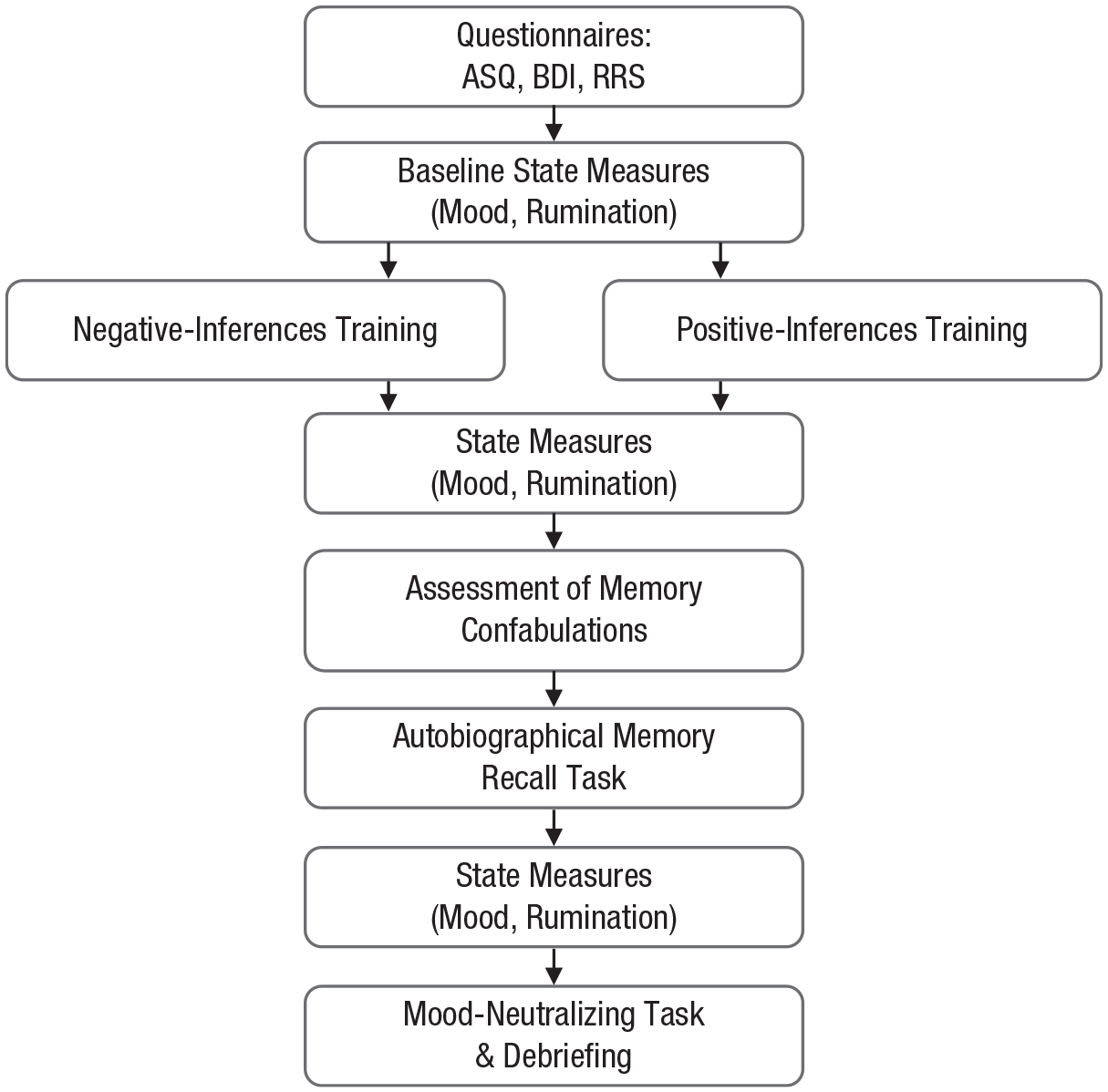
Flow chart of the experiment.
Method
Participants
Ninety-one undergraduate students 1 at the Hebrew University of Jerusalem (native Hebrew speakers) participated in the study in return for course credit or payment. Four participants were excluded as a result of high error rates (> 30%) on the training task and one as a result of incomplete data. Thus, the final sample consisted of 86 participants (65 women and 21 men; mean age = 23.57 years, SD = 2.26).
Materials
Training paradigm
The training was based on the procedure described by Avirbach et al. (2019), and there were several modifications designed to enable us to examine training effects on memory. The training paradigm included three types of items: training items, probe items, and critical items (for sample items, see the Supplemental Material available online).
The training items included 38 scenarios depicting negative events frequently experienced by college students (identical across the two training conditions); they were equally distributed across social, academic, and occupational domains (e.g., “During your freshman year in college, university representatives arrive in class to describe an interesting new study program. The program sounds extremely attractive, and you decide to go to the screening day. When the list of accepted students is published, you see you are not on it.”). Participants were asked to imagine themselves as the main character in the scenarios. Each scenario was presented along with a title and a causal inference about the event that was congruent with the training condition. In the negative-inferences training condition, the inferences were internal, stable, and global and facilitated inferred negative consequences and negative self-worth (e.g., “You think to yourself that if you were more intelligent, you would have gotten accepted. Now it will be harder for you to get your dream job.”). In contrast, in the positive-inferences training condition, they were external, unstable, and specific and did not facilitate inferred negative consequences and negative self-worth (e.g., “You think to yourself that all those who arrived at the screening were outstanding students and that you will probably have another opportunity to take part in a similar program.”). In each scenario, participants were instructed to complete two fragmented words. Unlike in CBM procedures for interpretation, the presented events were not ambiguous, and the fragmented words did not determine the valence of the event. Instead, fragmented words were designed to focus participants’ attention on the intended causal inference (e.g., “if y_u were more intelligent . . . ” vs. “ . . . all thos_ who arrived . . . ”). Following each scenario, participants were asked to respond to two yes/no comprehension questions pertaining to the causal inferences. These questions served as a reinforcement of the promoted inferential style and as a measure of training fidelity (e.g., “Based on the description, is it likely that the cause of the event affects other areas in your life?” yes/no).
Six probe scenarios (identical across the two conditions) were distributed throughout the training as a measure of training efficacy. These items presented negative events, but no causal inferences were included. Therefore, participants’ answers to the yes/no comprehension questions regarding the causal inference for the event reflected their spontaneous causal inference and were expected to be training congruent.
Fourteen items, similar in structure to the training items, served as critical items to be retrieved later in a memory test. To compare training-congruent errors in memory (confabulations) across conditions, we constructed these items so that they were the same in the two training conditions. Half of them consisted of a negative event followed by a positive causal inference (congruent with the positive-inferences training condition but incongruent with the negative-inferences training condition), and the other half consisted of a negative event followed by a negative causal inference (incongruent with the positive-inferences training condition and congruent with negative-inferences training condition).
All item types (training, probe, and critical) were followed by two yes/no comprehension questions. After each training item, the comprehension question was followed by accuracy feedback to enhance training. Feedback was provided on only 80% of the comprehension questions that followed the training items to mask differences between training, probe, and critical items.
Training commenced with two blocks of five training items each. Following these blocks, seven additional blocks were presented; each block consisted of four training items and two critical items (one training congruent and one training incongruent). The position of the probe items (17th, 24th, 31st, 38th, 45th, and 52nd items) was the same for all participants. The specific identity of training and critical items that were presented in each block was determined at random for each pair of participants, one assigned to the positive-inferences training condition and the other to the negative-inferences training condition. This randomization scheme ensured that the order of presentation of critical items did not differ across the training conditions and would not serve as a confounding variable.
Assessment of memory confabulations
Following the training, participants were presented with the title and the first sentence of each of the 14 critical items one at a time. Participants were asked to recall the event and write a description of it and then to recall the cause for the event and write it. Participants’ descriptions were rated by two independent raters (blind to training condition), and disagreements were resolved by a third rater. Although participants were prompted to write separate descriptions of the event and the inference, their actual descriptions were occasionally mixed. Therefore, raters coded the full text in several stages. They first compared the recalled event with the training scenario to determine whether the participant recalled the event, and misremembered events were not coded further. Then, they assessed whether an inference was described and whether it was the same as the originally presented inference. We were mainly interested in instances in which participants misremembered the original inference and provided confabulated inferences that were either congruent or incongruent with the inferences promoted in their training condition. Therefore, these inferences (i.e., confabulations) were further coded to indicate whether they included information consistent with positive and negative inferences. A confabulation was coded as negative if it contained any of the three features of a negative inference (global, stable, internal). Likewise, it was coded as positive if it contained any of the three features of a positive inference (specific, transient, external). Coding of positive and negative confabulations was separate; therefore, each item could have included both types of confabulations, and both were counted separately. To conclude, four measures were derived from this coding process: the number of correctly remembered events, the number of correctly remembered inferences, the number of events containing confabulated positive inferences, and the number of events containing confabulated negative inferences. For ratings of the causal inferences, κ was .95.
Autobiographical memory recall
Participants were asked to recall and write about a recent personal event that took place 2 to 4 weeks before the experiment and made them feel remorse or dejection (for a similar procedure, see Daches et al., 2019). Next, they were asked to think about and describe the causes of the event and its personal importance as well as the implications of the event for their future.
The causal inferences in the autobiographical reports were rated by two independent raters (blind to training condition) on the three dimensions of causal inferences (internality, stability, and globality) using the content analysis of verbatim explanations (CAVE) method (Schulman et al., 1989). Disagreements were resolved by a third rater. Higher scores reflect a more stable, global, and internal causal inference. For CAVE ratings, κ was .74, comparable with the original interrater reliability reported by Schulman et al. (1989).
Self-report measures
Trait measures
Participants completed a set of trait measures, including the Beck Depression Inventory–II (BDI-II; Beck et al., 1996; Cronbach’s α in the current study = .93), the Attributional Style Questionnaire 2 (ASQ; Peterson et al., 1982; Cronbach’s α in the current study = .82), and the Ruminative Responses Scale (RRS; Nolen-Hoeksema & Morrow, 1991; Cronbach’s α in the current study = .88). Because of our focus on inferences for negative events, only the six negative items from the ASQ were administered.
State measures
Participants completed state measures assessing mood and rumination. 3 Mood was assessed (as in Avirbach et al., 2019) with three items measuring happy mood and three items measuring sad mood (e.g., “Right now, I feel sad”; “Right now, I feel happy”). Adjectives were taken from the Positive and Negative Affect Schedule (PANAS-X; Watson & Clark, 1994). State rumination was assessed with four items from the Momentary Ruminative Self-Focus Inventory 4 (MRSI; Mor et al., 2013): “Right now, I wonder why I always feel the way I do.” “Right now, I am thinking: Why can’t I handle things better?” “Right now, it is hard for me to shut off negative thoughts about myself,” and “Right now, I dwell on negative aspects of myself that I wish I’d stop thinking about.” These items were selected because they do not probe for causal inferences. Mood and state rumination items were intermixed and rated using a 10-cm-long visual analogue scale ranging from 0 (not at all) to 100 (extremely). The internal reliability for the state measures in the current study was good (αs range = .87–.94).
Procedure
Participants completed the BDI-II, ASQ, and RRS online up to 9 days (M = 1.78 days, SD = 1.84) before the lab session. When they arrived at the lab, they completed a set of state measures of mood and rumination. Subsequently, participants were randomly assigned to one of two training conditions: a negative or a positive-inferences training condition. After the training, participants completed another set of state measures (mood and rumination), followed by the assessment of training-congruent memory confabulations and the autobiographical memory recall task. Then, participants completed a third set of state measures (mood and rumination). Finally, participants completed a mood-neutralizing task and were debriefed. On average, the experiment took 90 min to complete.
Results
Participant characteristics
For descriptive statistics, see Table 1. Participants in the two conditions did not differ in gender ratio or on any of the baseline trait and state measures. Although we predicted that depression levels would mostly moderate training effects on recalled inferences for the autobiographical memory and the subsequent change in mood and rumination, to keep analyses consistent, standardized BDI-II scores were included as a covariate in all analyses. Significant interactions with BDI-II scores were probed using a median split to define groups of lower BDI-II scores (M = 3.38, SD = 2.63, range = 0–8) and higher BDI-II scores (M = 17.51, SD = 8.52, range = 9–48). The mean score on the BDI-II was 10.37 (SD = 9.89, range = 0–48), and 29 participants had scores above 13, indicative of mild levels of depression or above.
Trait Measures and Outcome Variables
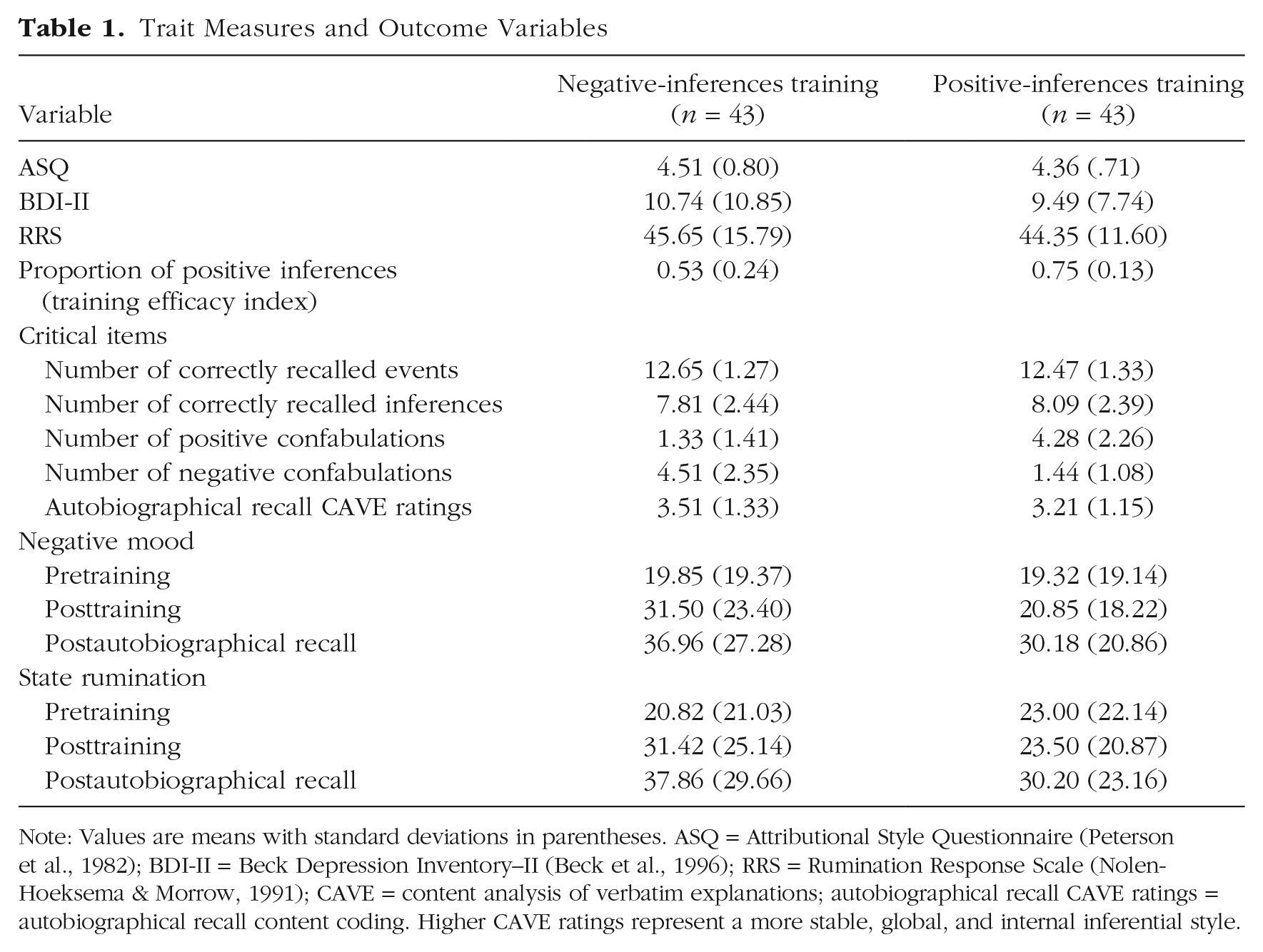
Note: Values are means with standard deviations in parentheses. ASQ = Attributional Style Questionnaire (Peterson et al., 1982); BDI-II = Beck Depression Inventory–II (Beck et al., 1996); RRS = Rumination Response Scale (Nolen-Hoeksema & Morrow, 1991); CAVE = content analysis of verbatim explanations; autobiographical recall CAVE ratings = autobiographical recall content coding. Higher CAVE ratings represent a more stable, global, and internal inferential style.
Training fidelity and efficacy
To measure training fidelity, we assessed accuracy levels on the comprehension questions for training scenarios. Accuracy rates on the comprehension questions were submitted to an analysis of covariance (ANCOVA) with condition as a between-subjects factor and standardized BDI-II scores entered as a covariate. High accuracy rates were found for both conditions (positive-inferences training condition: M = 83.79, SD = 4.49; negative-inferences training conditions: M = 85.77, SD = 5.28). The main effects of condition, BDI-II scores, and their interaction were not significant (all ps > .05). Thus, training fidelity was comparable across conditions.
We then examined whether the training was successful in promoting the intended inferential style. To do so, we assessed participants’ yes/no responses to the comprehension questions on the probe items, which reflected participants’ (positive vs. negative) spontaneous causal inferences for the events. For descriptive statistics, see Table 1. The proportion of positive causal inferences (or the reverse for negative) served as an index of training efficacy and was submitted to an ANCOVA with condition as a between-subjects factor and standardized BDI-II scores entered as a covariate. The interaction between condition and BDI-II scores was significant, 5 F(1, 82) = 11.65, p = .001, η p 2 = .13.
To explore the interaction, we used a median split to define groups of lower BDI-II scores (M = 3.38, SD = 2.63) and higher BDI-II scores (M = 17.51, SD = 8.52). Probing the interaction using a median split revealed that across depression groups, participants made more positive inferences in the positive-inferences training condition compared with the negative-inferences training condition, but this effect was larger among participants with higher BDI-II scores, t(39) = 6.02, p < .001, d = 1.95 (positive condition: M = 0.78, SD = 0.14; negative condition: M = 0.41, SD = 0.23), than among participants with lower BDI-II scores, t(43) = 2.02, p = .05, d = 0.59 (positive condition: M = 0.72, SD = 0.11; negative condition: M = 0.62, SD = 0.62). Moreover, whereas in the negative-inferences training condition participants with higher BDI-II scores made fewer positive inferences than did participants with lower BDI-II scores, t(41) = 3.19, p = .003, d = 0.98, the two depression groups did not differ in the positive-inferences training condition, t(41) = −1.52, p = .135, d = 0.47. Thus, although training efficacy was demonstrated in both groups, promoting a negative inferential style more strongly affected the performance of the more “depressed” participants.
Training effects on memory confabulations
We first assessed accuracy rates of recalled critical scenarios. As expected, all the effects were nonsignificant, including the main effects of condition, BDI-II scores, and their interaction (all ps > .05). We then assessed accuracy rates of recalled inferences. As expected, all the effects were nonsignificant, including the main effects of condition, BDI-II scores, and their interaction (all ps > .05). Thus, as expected, accuracy rates of recalling the critical items did not vary across the two conditions or by BDI-II scores. For descriptive statistics for the critical scenarios, including accuracy rates and memory confabulations, see Table 1.
To examine the effect of the training, we submitted the number of confabulated causal inferences across the 14 critical scenarios (both negative and positive, as presented) to a mixed-design ANCOVA with factors for training condition and judged valence of the recall error. Standardized BDI-II scores were entered as a covariate. The main effects were nonsignificant, but the predicted interaction between condition and valence of recall error was significant, F(1, 82) = 113.97, p < .001, η p 2 = .582. The three-way interaction was not significant, F(1, 82) = 2.15, p = .146, η p 2 = .026.
Aimed at understanding the Condition × Judged Confabulation Valence interaction, we ran t tests that revealed that as expected, compared with participants in the negative-inferences training condition, participants in the positive-inferences training condition produced more positive confabulations, t(84) = 7.27, p < .001, d = 1.57, and fewer negative confabulations, t(84) = −7.78, p < .001, d = 1.68.
To rule out the possibility that this effect can be attributed to the effects of training on negative mood, we ran the same model with negative mood after training included as a mediator. Although the direct effect of condition on both types of confabulations was significant, the indirect effect of training on the recall of inferences made for the autobiographical memory via negative mood was not. Thus, training effects on confabulations cannot be attributed to mood. For the full results, see the Supplemental Material.
Causal inferences for the recalled autobiographical memory
We examined the prediction that participants in the negative training condition would make more negative causal inferences for their autobiographical memories than would participants in the positive-inferences training condition. To do so, judges’ CAVE ratings of participants’ causal inferences for their negative autobiographical memory were submitted to an ANCOVA with condition as a between-subjects factor and standardized BDI-II scores entered as a covariate. For descriptive statistics for the CAVE ratings, see Table 1. Five participants did not describe a specific event, and their data were not considered in this analysis.
The only significant outcome was the interaction between condition and BDI-II scores, F(1, 77) = 7.18, p = .009, η p 2 = .085. Follow-up analyses revealed that as expected, participants with higher BDI-II scores in the positive-inferences training condition made fewer negative causal inferences about their autobiographical memory (M = 3.05, SD = 1.21) than did similar participants in the negative-inferences training condition (M = 4.03, SD = 1.32), t(37) = −2.42, p = .021, d = 0.78. In contrast, participants with lower BDI-II scores in the positive-inferences training condition and negative-inferences training condition did not differ in the negativity of causal inferences they made about their autobiographical memories, t(40) = 0.72, p = .477, d = 0.22 (positive-inferences training condition: M = 3.39, SD = 1.08; negative-inferences training condition: M = 3.13, SD = 1.23). Thus, recalled causal inferences for a past negative event were training congruent among participants with higher BDI-II scores but not among participants with lower BDI-II scores.
To rule out the possibility that this effect can be attributed to the effects of training on negative mood, we ran the same model with negative mood after the training included as a mediator. Whereas the direct effect of condition on CAVE ratings was still significantly moderated by levels of depression, the indirect effect of training on the recall of inferences for the autobiographical memory via negative mood was not. For the full results, see the Supplemental Material.
Negative mood
Negative mood scores were submitted to a mixed-design ANCOVA with training condition as a between-subjects factor, measurement time as a within-subjects factor (pretraining, posttraining, postautobiographical recall), and standardized BDI-II scores as a covariate. The interaction between condition and time was significant, F(2, 81) = 4.82, p = .010, η p 2 = .106, but the three-way interaction between condition, BDI-II scores, and time was not, F(2, 81) = 1.37, p = .260, η p 2 = .033 (see Fig. 2).
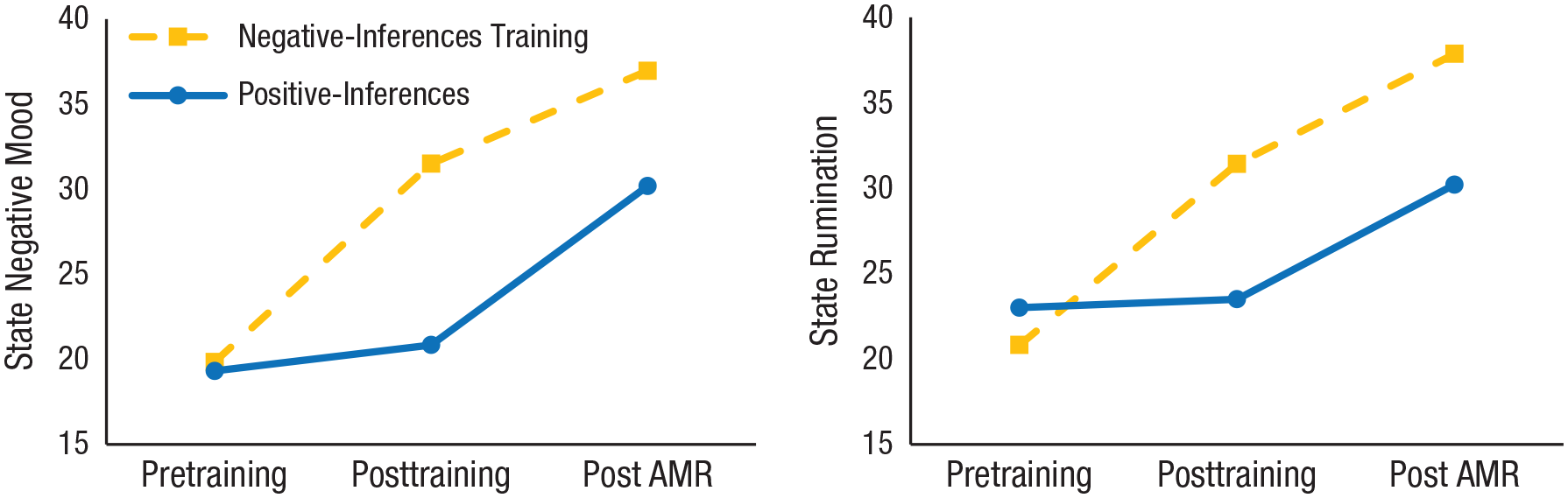
State negative mood (left) and state rumination (right) presented as a function of condition. Error bars represent ± 1 SE from the mean. Post AMR refers to postautobiographical memory recall.
Analyses within each training condition revealed an expected increase in negative mood ratings in the negative-inferences training condition following the training, t(42) = 4.63, p < .001, d = 0.71, and an additional increase from posttraining to postautobiographical memory recall, t(42) = 2.45, p = .019, d = 0.37. In the positive-inferences training condition, negative mood did not change following training, t(42) = 0.75, p = .454, d = 0.12, but as one might expect, there was a significant increase in negative mood from posttraining to postautobiographical memory recall, t(42) = 3.64, p = .001, d = 0.55. Between-groups analyses revealed a nonsignificant group difference at baseline, t(84) = 0.13, p = .899, d = 0.03. However, as expected, a significant group difference was found following training, t(84) = 2.36, p = .021, d = 0.51, indicative of lower levels of negative mood among participants in the positive-inferences training condition compared with participants in the negative-inferences training condition. Unexpectedly, no significant difference was found at postautobiographical memory recall, t(84) = 1.29, p = .199, d = 0.28. Thus, whereas in the positive-inferences training condition participants’ negative mood increased only at postautobiographical memory recall, participants’ negative mood in the negative-inferences training condition increased following both the training and the autobiographical recall.
State rumination
State rumination scores were submitted to a mixed-design ANCOVA with training condition as a between-subjects factor, measurement time as a within-subjects factor (pretraining, posttraining, and postautobiographical recall), and standardized BDI-II scores as a covariate. The predicted interaction between condition and time was significant, F(2, 81) = 4.43, p = .015, η p 2 = .10, but the three-way interaction between condition, BDI-II scores, and time was not, F(2, 81) = 0.48, p = .621, η p 2 = .012 (see Fig. 2).
In analyzing scores within each training condition—to understand the significant interaction—we found the expected posttraining increase in ruminative thinking in the negative training condition, t(42) = 3.68, p = .001, d = 0.56, and an additional increase from posttraining to postautobiographical recall, t(42) = 2.79, p = .008, d = 0.43. In the positive training condition, ruminative thinking did not change following training, t(42) = 0.26, p = .796, d = 0.04, but there was a significant increase in ruminative thinking from posttraining to postautobiographical recall, t(42) = 3.27, p = .002, d = 0.50. Other analyses revealed no differences between the two training groups at baseline, t(84) = 0.47, p = .641, d = 0.10; following the training, t(84) = −1.59, p = .116, d = 0.34; or at postautobiographical memory recall, t(84) = −1.33, p = .186, d = 0.29. Thus, whereas in the negative-inferences training condition state rumination increased following both the training and the autobiographical recall, in the positive-inferences training condition, it increased only at postautobiographical memory recall.
Associations among outcome measures
To examine whether the effect of training on inferences was related to training effects on the other outcomes, we examined correlations between training efficacy, memory confabulations, negative mood, rumination, and retrieved inferences on the autobiographical recall. Training efficacy (measured by the proportion of positive responses on the probe items) was negatively linked to negative memory confabulations and positively linked to positive confabulations (see Table 2). Likewise, positive confabulations were negatively correlated with negative mood and state rumination following the training.
Correlations Among Outcome Measures Following the Training
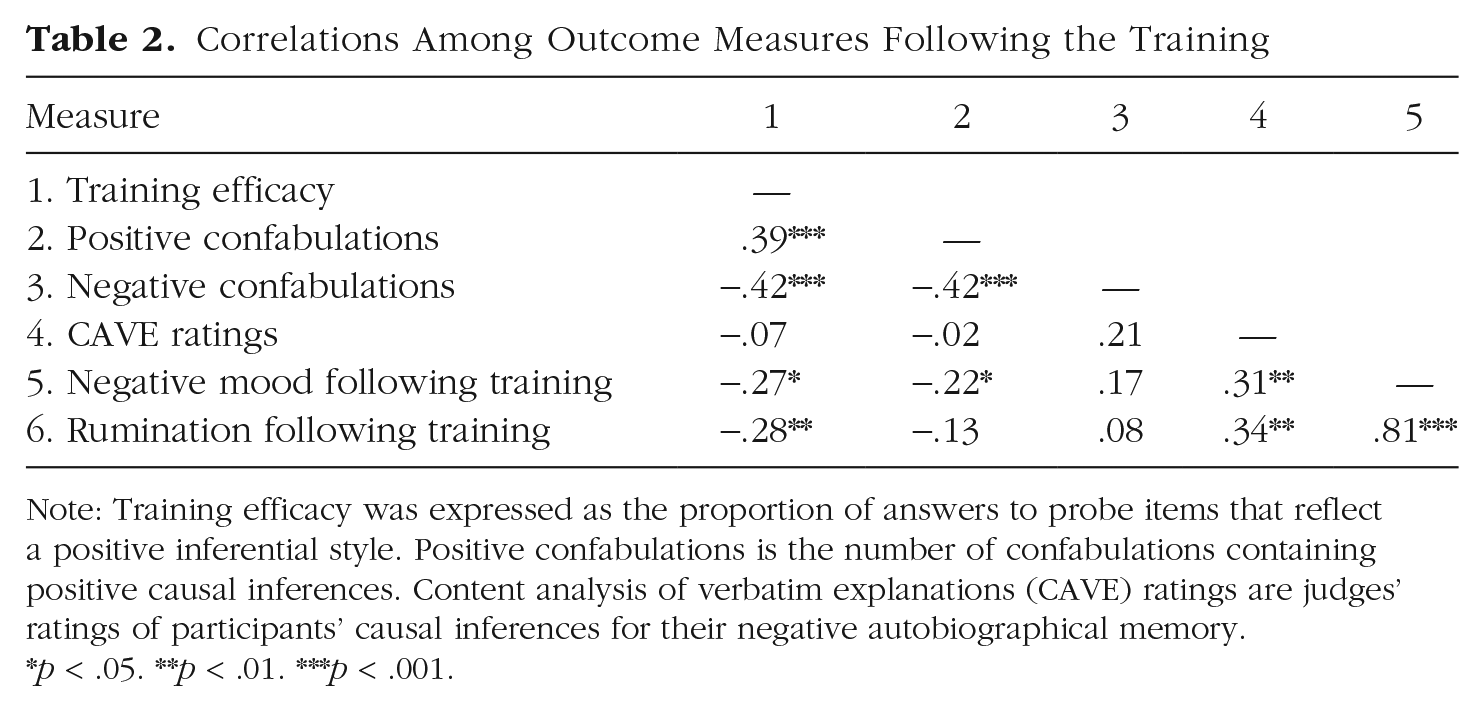
Note: Training efficacy was expressed as the proportion of answers to probe items that reflect a positive inferential style. Positive confabulations is the number of confabulations containing positive causal inferences. Content analysis of verbatim explanations (CAVE) ratings are judges’ ratings of participants’ causal inferences for their negative autobiographical memory.
p < .05. **p < .01. ***p < .001.
Discussion
The current study was designed to examine the effects of inference training on the recall of inferences in experimental scenarios, inferences for autobiographical memories, negative mood, and ruminative thinking. Participants’ spontaneous causal inferences for negative events (probe items) were congruent with their training condition. In addition, participants provided confabulated memories that consisted of causal inferences of events that were misremembered in line with their induced inferential style. As expected, differences in mood and rumination were found following the training phase. Unexpectedly, group differences in mood and rumination were not observed following the autobiographical recall procedure. Participants in the positive inferential style condition experienced a similar increase in negative mood and in ruminative thinking after recalling a negative personal event, as did participants in the negative inferential style condition. Note that levels of depression moderated the effect of training on recalled inferences for negative autobiographical memories. Thus, only participants with higher levels of depression recalled more negative inferences about their autobiographical memory in the negative compared with the positive-inferences training condition.
Findings from the current research replicate those in previous work (Avirbach et al., 2019; Peters et al., 2011) by demonstrating the effects of CBM on inferences and showing that CBM can target a negative cognitive style. These beneficial effects can pave the way for investigations involving clinical populations and for the assessment of long-term effects of the training. Indeed, despite the centrality of negative inferences to the understanding of depression, very few interventions to reduce such inferences are available (Marchetti et al., 2019). Furthermore, being able to manipulate causal inferences using an experimental design opens the gate to examining inferences as part of the appraisal process of events rather than as a trait-like cognitive style. The training effect on negative mood and on ruminative thinking supports the notion that causal inferences may play a role in emotion regulation (Peterson & Park, 2007).
The main contribution of the current work lies in the causal linking of inferential style with memory processes. The effects of causal inferences on memory processes are in line with previous theory and empirical findings concerning depression-related habits of thought (Hertel, 2004). Our results may be seen as an extension of the combined cognitive bias hypothesis of Hirsch et al. (2006) and its application to depression (Everaert et al., 2012) to the domain of inferences. Repeated experiences in making negative inferences lead people to generate habitual inferences and misremember the causes of events in line with their newly formed habit of thinking. Such memory errors may have significant effects on people’s emotional experiences by coloring already negative events in even darker colors. Thus, emotional events are reconstructed in memory via the inferences people make.
Note that although the habit that was formed among participants with lower levels of depression was restricted to scenario recall, the ramifications for participants with higher levels of depression were more substantial. For those participants, repeatedly making negative inferences carried over to new circumstances, such as when recalling inferences for a past autobiographical negative event. This interplay between inferences and memory retrieval may be seen as an example of the negative vicious cycle that characterizes the experience of depression. Although dynamic interactions among biases in attention, interpretation, and memory have been described as contributing to depression (Everaert et al., 2020), negative inferences have been typically examined in isolation.
People with depression are characterized by disturbances in autobiographical memory: They gravitate toward negative memories, have difficulty accessing positive memories, and have reduced access to specific details of past events (Dalgleish & Werner-Seidler, 2014). Our findings suggest that autobiographical memories of people with and without depression may differ in additional ways. Having established a habit of negative inferences, depressed participants retrieved negative inferences for past negative events.
Two possible mechanisms may have led to this retrieval pattern. One possibility is that the training affected the selective retrieval of events. Thus, creating a habit of assigning negative causal inferences may have facilitated the retrieval of events for which the person has previously made negative inferences. Although we did not assess whether the trained inferential habit contributes to depressed people’s preferential retrieval of negative (as opposed to positive) memories, such an effect would be consistent with the selective retrieval mechanism. Furthermore, because negative inferential style involves abstract thinking, which may impede retrieval of specific memories (Raes et al., 2008), the selective retrieval mechanism may be related to the reduced autobiographical memory specificity phenomenon. A second possibility is that the causal inference made for the autobiographical memory was reconstructed at the time of retrieval in a manner comparable with the temporary inferential habit generated by the training. This possibility suggests that although events may be encoded with a causal inference, the activation of a negative inferential style among individuals prone to depression may override this encoding, leading to retrieval of a different inference that fits the person’s present inferential style. This pattern may explain additional retrieval effects seen in depressed people, such as their inability to use positive memories as a means for mood repair (Joormann et al., 2007). Although we assessed only the recall of negative events, the current findings suggest that the additional meaning depressed individuals attach to recalled events may increase negative mood independently of the valence of the event. Clearly, additional research is needed to further the understanding of this causal link.
Our predictions concerning training effects on mood and state rumination were only partially supported. As predicted, repeated processing of events with a certain inferential style affected mood and ruminative thinking immediately following the training, but it did not carry over to changes following the recall of a negative autobiographical memory. Instead, following the autobiographical recall, participants in both training conditions experienced increases in negative mood and rumination. It is possible that the lack of a filler task to neutralize mood before the autobiographical recall has limited the ability to properly examine these changes. Moreover, training effects following an emotional challenge are not always observed (e.g., Joormann et al., 2015). Such effects depend on the nature of the emotional challenge (Menne-Lothmann et al., 2014), the training paradigm, and the assessment. In our previous work (Avirbach et al., 2019), we reported a training effect on mood following the emotional challenge of failing a cognitive task. As indicated by a recent synthesis of affect-induction procedures (Joseph et al., 2020), an autobiographical memory recall yields much stronger effects on mood than does a failure induction, perhaps limiting the training’s capacity to modify the emotional response. Furthermore, the timing of the assessment following a negative event may be critical given that powerful stressors are associated with delayed depressive responses (Abela, 2002). Thus, it is possible that emotional or cognitive depressogenic responses following the autobiographical recall may not emerge until later (Perlman & Mor, 2021).
A number of limitations of the current research should be noted. First, in Avirbach et al. (2019), we assessed training effects on inferential style (target engagement) via inferences participants made for new scenarios. In contrast, in the current study, we relied only on probe items for this purpose. We reasoned that the confabulations in recalling training scenarios serve as a proxy measure for this purpose, akin to the procedure used in Hertel et al. (2014). The lack of an independent measure that relies on new scenarios may limit the ability to gauge whether changes in inferential style mediate training effect on additional outcome measures. Second, participants were trained to adopt either a negative or a positive inferential style, and a no-training condition was not included in our design. Without a no-training control condition, the source of the training effect is undetermined—it can be the positive training, the negative training, or both, and further research should tease these apart. Third, we relied on mediational analyses to exclude the possibility that training effects on mood accounted for the effects on memory. However, allowing mood to dissipate before assessing memory, via the use of a filler task, may be a more powerful way to eliminate the possible effect of mood. Fourth, depression was assessed several days before the training session. Although the average interval was short, future research should aspire to further minimize the gap between questionnaire administration and the experimental session. Fifth, as a result of exclusions, the number of participants in the analyses pertaining to autobiographical memory fell slightly below that required to provide the desired power (i.e., power of 80% to reject a false null hypothesis). This underscores the importance of verifying in future research, ideally using a larger sample, that the presently observed pattern of findings is replicable. Finally, considering our promising and substantial findings with an unselected student sample in a single session design, future research should examine training causal inferences in a sample of individuals with clinical levels of depression as well as long-term effects of multiple session training.
Effective CBM procedures that target depression are still needed (Jones & Sharpe, 2017). Because the current training procedure targets cognitive processes central to depression, it may offer a promising avenue for intervention. Contributing to the potential of this CBM procedure is the fact that its training effects have generalized to the processing of an autobiographical memory as well as to causal inferences and emotional responses concerning a failure experience (Avirbach et al., 2019). In addition, changes to causal inferences may have ripple effects in decreasing ruminative thought and negative memory biases, suggesting that causal inferences may be a key point to intervene. Together, these effects may contribute to preventing or decreasing depression.
Supplemental Material
sj-pdf-1-cpx-10.1177_21677026211009886 – Supplemental material for Inferences Training Affects Memory, Rumination, and Mood
Supplemental material, sj-pdf-1-cpx-10.1177_21677026211009886 for Inferences Training Affects Memory, Rumination, and Mood by Baruch Perlman, Nilly Mor, Yael Wisney Jacobinski, Adi Doron Zakon, Noa Avirbach and Paula Hertel in Clinical Psychological Science
Footnotes
Transparency
Action Editor: Colin MacLeod
Editor: Kenneth J. Sher
Author Contributions
All authors contributed to the study concept and design. Preparation of study materials, conducting of pilot work, and data collection, analysis, and interpretation were performed by B. Perlman, A. D. Zakon, and Y. W. Jacobinski under the supervision of N. Mor. N. Avirbach drafted initial parts of the method and results. B. Perlman and N. Mor drafted the manuscript, and P. Hertel provided critical revisions. All of the authors approved the final manuscript for submission.

Notes
References
Supplementary Material
Please find the following supplemental material available below.
For Open Access articles published under a Creative Commons License, all supplemental material carries the same license as the article it is associated with.
For non-Open Access articles published, all supplemental material carries a non-exclusive license, and permission requests for re-use of supplemental material or any part of supplemental material shall be sent directly to the copyright owner as specified in the copyright notice associated with the article.
