



Abstract
For care-experienced youth, emerging adulthood is period of normative social and emotional experimentation, but disconnected from the supportive adult relationships available to their peers, particularly from family. To address this, formal child welfare services are increasingly interested in finding ways of avoiding rigid age-determined withdrawal of support by adopting various forms of extended care. This paper identifies continuous relationships between emerging adults and their previous foster carers as a source of relational informal extended care that has received little attention in practice, policy and research. Drawing on an expanded concept of family that recognises fostering as an underexplored iteration of kinship, the paper reports on a study of narrative accounts from 12 care-experienced emerging adults and their former foster carers (22 carers). Foster kinship normalised support as family practices, buffering the challenges of emerging adulthood, and offering an additional, informal, form of extended care for some care-experienced young people.
Introduction
During the liminal period of emerging adulthood young people tend to receive continued parental support (Arnett, 2000). While relational roles and patterns change to allow for increasing autonomy, families continue to offer a safety-net (Sting & Groinig, 2020) including opportunity to remain living with parents, perhaps intermittently (Goyette, 2019), allowing for an exploratory and experimental approach to finding individual paths into adulthood. The challenging features of emerging adulthood are accentuated for young people who age-out of foster care but who lack the extended and extensive parental support generally available to their peers. As Arnett (2019) notes, almost no-one outside of care is expected to be self-sufficient by the age of 18 or 21 years with little support from family. Care leavers tend to move from their out-of-home placements at a younger age than their peers leave home, over a shorter time frame and with restricted opportunity for returning to live with previous carers (Bengtsson et al., 2018). These features of care leaving both create and compound the challenges known to be associated with leaving care - housing insecurity, restricted employment, training and educational opportunities, and relationship instability (Mann-Feder, 2019), which can drive trajectories of disadvantage into early and later adulthood (Pryce et al., 2017). This disadvantaging and its outcomes are generating interest, under the umbrella term of ‘extended care’, in finding legal, service and practice developments to avoid the cliff-edge (Palmer et al., 2022) of rigid age-determined unsupported exits from out-of-home care (McGhee & Deeley, 2022; van Breda et al., 2020).
A recent review of approaches being taken to extended care in twenty-six countries noted a wide variation in how the term was being understood and used (OECD, 2022). In the United Kingdom (UK), where the current study is situated, care leavers up to age 25 have a statutory entitlement to a range of services to address their needs across the domains of “health, accommodation, education, training and employment, relationships, finance, and independent living skills” (Munro et al., 2024, p. 181), including formal arrangements for remaining in their foster placement beyond age 18. However, even within the single state of the United Kingdom, there are regional variations in how the term ‘extended care’ is used and what support it entails. The variation, seen internationally, in how extended care is constructed results from what an earlier seminal ten country review (van Breda et al., 2020) described as “definitional ambiguity” (p9). Teasing out this ambiguity not only requires recognition of the differences between legal reform and administrative practices within and across jurisdictions but also needs to take account of how out of home care placements can be “both relational (involving informal connections between caregivers and looked-after young persons) and legal (involving the state placing a young person in care) in character” (van Breda et al., 2020, p. 5). That analytical distinction between the relational and the legal brings into view informal extensions of care which are not officially sanctioned or funded by the authorities, but develop organically between young people and foster carers (van Breda et al., 2020).
As a contribution to better understanding informal extended care based on relational ties rather than legal or administrative requirements, this paper reports on research that explored the narrative accounts of care-experienced emerging adults and their former foster carers who were known to have remained connected in significant and supportive ways following the formal ending of their foster care placement. They described continuing foster family relationships involving a commitment to reciprocal care that extended beyond placement exits and was expected to endure into adulthood. While for some this involved prolonged living in or return to the foster home, coinciding with formal financial provision, ongoing supportive relationships were not contingent upon such living arrangements. Family-like relationships that last throughout care leaving transitions may protect youth from economic hardship and homelessness (Okpych et al., 2023), but little is known about the nature of such relational continuity or how it is achieved (Moran et al., 2020). The primary aim of the research was to formulate practice guidance for recognising and reinforcing this positive outcome across the continuum of the fostering journey, from first meetings into adulthood (MacDonald & Marshall, 2021).
In this paper, findings from the study will be used to illustrate the argument that in order to better understand informal extended care for care-experienced emerging adults, it is useful to approach it through an expanded understanding of family which is focused on social processes and relational activities. Attention is on ‘doing family’ through the activities of day-to-day life, rather than ‘being family’ through biological relatedness (Finch, 2007; Morgan, 1996, 2011). Family practices are embedded in cultural repertoires that generally understand families to be long-lasting and committed with a tenacious sense of responsibility to one another (Jallinoja, 2008), typified by an enduring exchange of unconditional support (Children’s Commissioner, 2022). Viewing foster families as constructed through active relational practices can be helpful for understanding the experiences of care-experienced youth who may have lived with and relate to both birth and non-birth families. They do family, including support for emerging adulthood, within circumstances which are multidimensional, and non-conforming to family norms or narrowly defined family structures (Boddy, 2019). In this way the care-experienced participants within the study being presented here attained membership status within the foster family. This shared family identity mobilised ongoing support normalised as an expected practice, enabling interdependence in the context of reciprocal intergenerational foster family networks. That informal extended care, within a particular set of family practices, offered a supported pathway through emerging adulthood. Because of the enduring and life-long nature of family (Hutchison, 2019), compared to other relationships, participants anticipated that their mutuality of support would continue with no age-related expiry date. While the findings are drawn from a small purposive sample, they reveal a form of family belonging that mobilised extended relational informal support for these participants, which may be available to care-experienced young people more widely than presently recognised.
Supporting Transitions from Out-Of-Home Care in Emerging Adulthood
While trajectories to adulthood become less standardised in European societies (Artamonova et al., 2020), transitions out of alternative care remain rigidly aligned to age. Care-experienced youth are not afforded the same opportunities for flexible, gradual transitions as their peers (Paulsen & Berg, 2016), or the same degree of interdependence with family or caregivers (Storø, 2018). Internationally, most care leavers cope on their own from age 18 (van Breda et al., 2020), imposing instant adulthood (McGhee & Deeley, 2022) with abrupt transitions that fail to take account of the young person’s psychosocial readiness or their individual developmental trajectory (Hutchison, 2019). Some care leavers have expressed the need for a period of safe experimentation during which they can make mistakes without jeopardising their future (Glynn, 2021), including the opportunity to leave, change their minds, and return when ready to re-engage in support (Mendes & Rogers, 2020). Acknowledging that emerging adulthood is characterised by experimentation, uncertainty and instability might normalise the need for ongoing flexible support as appropriate to this life stage for all care leavers (Mann-Feder, 2019).
In policy and practice terms, leaving care is strongly conceptualised as a move to independent living (McGhee & Deeley, 2022). This sets up a tension for youth who are encouraged toward independence but are still dependent on formal services for support (Bowen et al., 2021). An emphasis on independence can inhibit help-seeking (Hiles et al., 2013) as care-experienced young people are encouraged to prioritise self-reliance (Samuels & Pryce, 2008). It also contrasts with the reality that most people are engaged in mutual exchanges of support within social networks. The stated policy aim for care leavers in Northern Ireland (the UK region where the current study was conducted) is that they will ‘transition into independent living’ (Department of Health and Department of Education, 2021, p. 4.4, p16), while also acknowledging that ‘today, it is rare for a young person of 18 years to leave their home and be emotionally and financially independent of their parents’ (5.74, p47.). As this strategy document recognises, in emerging adulthood the drive for independence coincides with an ongoing need for support (Marion & Paulsen, 2019; Paulsen & Berg, 2016). These requirements are best met simultaneously through interdependent relationships (Hedin, 2017; Storø, 2018).
To conceive of themselves as interdependent, young people need access to caring relationships, opportunities to seek and give help, and get a positive response when they do so (Gundersen, 2021). Analyses of social support for care-experienced youth often distinguish between informal support offered by ‘naturally’ occurring social networks such as birth family, and formal services which are less flexible (Oterholm, 2018) and may not have the same capacity to provide emotional support (Paulsen & Thomas, 2018). Recognising the value of informal support to supplement, and eventually supplant, formal services, care-experienced young people should be helped to build relationships beyond the child welfare workforce (Goyette, 2019) and strengthen connections with birth family and informal community mentors (Mendes et al., 2022). The extent of informal support available from relatives can be limited, however, often undermined by the adversities that led to the placement (Teer, 2021) or become a source of stress (Häggman-Laitila et al., 2018). Placement in out-of-home care can significantly weaken young people’s ties to birth family (Boman, 2022), and although social services are mandated to preserve family links for children, reconfiguring those connections with relatives in emerging adulthood can be difficult.
Foster carers tend to be perceived as part of care leavers’ formal child welfare network, and placement exit brings foster relationships to a formal end. Foster family relationships tend to be seen as a bridge to relationships with birth relatives rather than a permanent goal in themselves (Singer et al., 2013). Positioning foster carers as part of a system of formal aftercare reflects the increasing professionalisation that shapes interpretations of their role (Kirton, 2022). This informs expectations of how their relationship with the young person will be continued, or not, after they formally leave their care (Moran et al., 2020).
Emerging adulthood is a time when youth explore, and then commit to, identities that will shape their adult lives, including decisions about whether, to what extent and in what ways they will align with or differentiate themselves from their family (Arnett, 2000), which for fostered youth may mean birth and foster family (Moran et al., 2020). The trajectory of their span of relationships is shaped by these identity choices (Hutchison, 2019). The influence of a predominant child welfare paradigm that prioritises independence, and positions foster carers exclusively within formal service provision is likely to mitigate against any expectation, on the part of either carers or youth, that caring foster relationships will continue beyond the ending of the placement (Storø, 2018).
In summary, emerging adults transitioning from out-of-home care need ongoing support that is flexible and tenacious enough to facilitate the simultaneous development of independence and interdependence in the context of supportive relationships (Storø, 2018). It needs to provide a safe period of normal developmental learning through a trial-and-error approach to maturation (Glynn, 2021). Since family relationships are commonly expected to endure across the life course, informed by cultural norms of commitment and obligation (Hutchison, 2019), support from relatives might, ideally, meet young people’s need for gradual, flexible transitions in a way that formal extended care provisions, with their rigidity and time-bounded nature, cannot (Mendes & Rogers, 2020). However, birth familial support can be complicated or unavailable for care-experienced youth. The question to be considered here is whether foster kin relationships that exist within and beyond the statutory frameworks that create them might be recognised as a form of informal relational extended care. With that aim, this paper reports on a study that explores the informal and interdependent supportive relationships that persisted between care-experienced emerging adults and extended foster families. In the findings section of this paper, the major themes from the sample as a whole (MacDonald & Marshall, 2021) are illustrated with quotation from four care-experienced emerging adults and their former foster carers, interviewed separately, selected as a range of relationship trajectories within the full sample.
The Relationships that Last Study - Methods
This paper draws on a research project that aimed to understand the enablers of relational continuity throughout childhood into adulthood for fostered youth. It analysed the narrative accounts of care-experienced emerging adults and their former foster carers who remained connected in significant and supportive ways following the formal ending of their foster care placement. This throws light on a particular form of informal extended care within foster kinship. From a critical best practice approach (Ferguson, 2008), the study aimed to identify the active ingredients of these lasting relationships between care-experienced people and their former foster carers, the practices that created and sustained their connections, and what worked well to create the conditions in which they could thrive. The project was undertaken in partnership with Barnardo’s Fostering NI who facilitated recruitment and helped with contextual sensitivity, and with a Peer Advisory Group of care-experienced emerging adults who engaged in co-research to develop the interview format and recruitment materials and identify key messages in the data.
Participants
Paired Care-experienced and Foster Carer Participants.
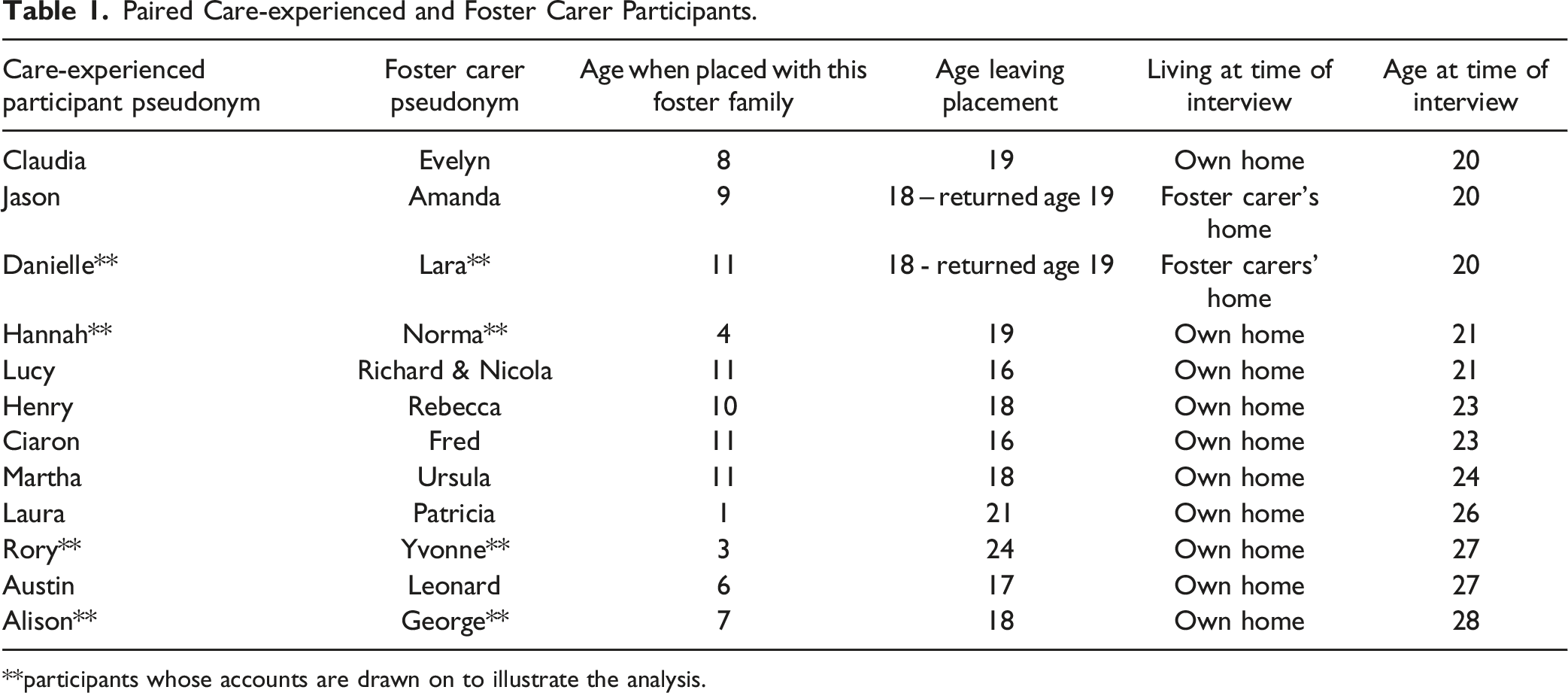
**participants whose accounts are drawn on to illustrate the analysis.
In total, data were collected in relation to 22 sets of relationships, all of which were continuing at the time of interview, with 12 of these sets of relationship reported on from both care-experienced and foster carer participant perspectives. All 22 placements had been long term, that is there was no active plan for young people to return home to birth parents. Of the 22 sets of relationships, 3 care-experienced participants moved to a semi-independent placement aged between 16-18 yrs; 11 formally left the placement at age 18yrs; and 8 remained living in the foster carers’ home beyond age 18 yrs financially supported via a formal extended care scheme. At the time of interviewing 5 of the 22 care-experienced emerging adults were living in the foster carers’ home with these arrangements financed by Going the Extra Mile, a government funded scheme which provides an allowance to foster carers to accommodate youth aged 18–21 yrs who they have fostered. All participants retained active supportive connections into adulthood and these relationships were ongoing at the time of interview, regardless of living situations. In this paper, findings across the entire sample are illustrated with data from four relationship pairs (indicated ** in Table 1) that reflect a range of care-leaving experiences among participants.
Data Collection and Analysis
Interviews were undertaken with care-experienced participants and foster carers separately but following the same format. Ethical protocols ensured that interviews were confidential so care-experienced participants and former foster carers would not know what was said. Participatory tools were used to facilitate discussion, supplemented by a semi-structured schedule of questions and prompts focused on: describing relationships - present, past and future; exploring what helps to build connections; exploring the place of foster family in social networks. Participants were asked to relate the story of their foster relationships in their own terms using a timeline diagram to help structure their narrative. A card sorting exercise facilitated talking about the ongoing nature of practical, emotional and guidance support received from/offered by foster family or others. Care-experienced participants were also asked to complete a visual relationship map and discuss the closeness/distance of their relationships with foster carers and other important people, and to recount typical interactions. Data was collected in a single interview which was audio recorded in its entirety, transcribed and input to Maxqda software to help manage and organise the data. Visual tools were reviewed alongside the transcript for that participant to enhance the identification of themes. Analysis involved reading and re-reading each transcript to identify themes in each individual’s narrative account and then comparing and contrasting themes across participants (Keats, 2009) to identify from these different perspectives a unifying representation of the factors that enabled relationships to be created and sustained. Themes of relational continuity are reported on if they appeared in the accounts of all participants. In the reporting it is not possible to present the nuance of all accounts in detail.
Two group interviews were held with social workers in the fostering agency to understand the policy and practice context and the implications of the data. In a series of online workshops, a summary of the findings was shared with foster care practitioners, managers and policy makers; care-experienced members of our Peer Advisory Group; foster carers; and fostering agency staff and managers to help formulate conclusions and suggestions for practice. Ethical approval for the study was given by Barnardo’s Research Ethics Committee, and by the Office for Research Ethics Committees Northern Ireland (ORECNI).
Limitations
This study purposively sampled care-experienced young adults and their former foster carers who have maintained a relationship into adulthood. In so doing, it cannot tell us about the prevalence of such lasting relationships. It also does not capture the experiences of those whose relationships with foster family are severed on the ending of the placement. All participants who were interviewed identified as care-experienced. In addition to the 12 who took part, a further 10 care-experienced youth were invited, but only their former foster carer/s agreed to be interviewed. The care-experienced young adults in these pairings mainly declined to participate because they did not think of themselves as care-experienced, preferred not to talk of their foster family relationships in those terms and indicated this via the foster carer. While their foster carers’ perspectives are included in the study, the analysis lacks the voice of care-experienced young people who identified as members of their foster family to the exclusion of the birth families.
Participant information indicated no expectation that ongoing relationships with foster family would be wholly positive, indeed most participants spoke of challenges in their relationships over time. It is possible, however, that some of the care-experienced emerging adults who chose not to take part did so because they had less favourable relationships with foster families and these accounts are missing from this analysis.
This study was designed to explore participants’ subjective accounts of relational experiences. There are other analyses that this qualitative method did not capture but are likely to be significant for the issue, in particular the relevance and influence of demographic or socio-economic factors. For example, all participants were of white British or Irish ethnicity. This echoes the lack of ethnic and religious diversity in the foster carer population across the UK (Ellis & Williams, 2024). It would be important for future research to explore these issues with a more culturally or racially diverse range of participants.
Findings
Analysis of the accounts of care-experienced participants and their former foster carers revealed how they had forged a shared sense of family membership and how this, in turn, enabled interdependence in shared networks of support. A foster family identity beyond that of a formally arranged and managed out of home care placement was mutually constructed. This conferred meaning on their relationships, informed by cultural understanding of families as committed, enduring and mutually caring. This meant that sustained connection with foster relatives was both permissible and normalised, mobilising ongoing support that was expected to last regardless of whether emerging adults were living with or had moved on from the foster carers’ home. Mutually caring interactions within extended foster family networks were sustained throughout transitions into emerging adulthood which, for some, enabled gradual flexible transitions out of placement. This reciprocal intergenerational support was normalised as a condition of family membership, with help-seeking and help-giving understood as normative family practices. Each of these themes is illustrated with detail from four selected relationship pairings that reflect a range of care-leaving experiences among participants (marked ** in Table 1). To protect their privacy, each participant is given a pseudonym. The quotations are in their own words.
Shared Family Identity and Membership
All care-experienced participants expressed a dual sense of membership of their foster and birth families. Some identified primarily with their birth family while others referred to their foster family as ‘my real family’. Foster carers accommodated this duality, explicitly affirming the young person’s status as ‘part of the family’ while simultaneously supporting their fundamental birth family identity. Naming practices reflected this - most care-experienced participants referred to foster carers as ‘mum and dad’, and were referred to as sons and daughters, but this was not exclusively the case, and using these kinship labels was not crucial for achieving a sense of belonging. Danielle identified with her birth family as her ‘real’ family, but her simultaneous daughter-like status with her foster carers provided a sense of security: “I am like their daughter, part of the family… I don’t call them mum and dad, I never have. I’m not weird with it, I just never did it… They just constantly reminded me that I was like a daughter to them, it was nice hearing those things.”
With multiple options for family membership, care-experienced participants exercised agency in making certain identity choices. They described exploring and then committing to one or more of their alternative options for family identity. As part of her identity exploration, Danielle moved to live with birth relatives, but when these relationships did not work out as expected, her foster carers welcomed her back. Throughout this time of flux, Lara (foster carer) supported Danielle’s efforts to deepen birth connections, while offering continued foster family membership: “Danielle feels very much a part of the family, but… sometimes she will say, well sure you are not my family, my family are in (town).”
Danielle’s account suggested that she had subsequently settled into dual family membership, maintaining close relationships with birth relatives while living as an integral part of her foster family.
On reaching adulthood, Rory debated whether to use his foster or birth surname. Reflecting on the inability of formal structures to accommodate ambiguous family identities when negotiating administrative tasks, such as getting a driving license, he decided to name himself “correctly”, but without relinquishing his informal status as a foster family member: “I thought it would be best to make it correct and it was better that I kept my actual name… but I am a part of the (foster) family and I still am.”
Participants’ choices about family identification were both pragmatic, expressed in terms of choosing certain value codes and the availability of support, and emotional, informed by feeling valued and cared for.
Hannah described a process of evaluating her options for membership and making a firm commitment to identify with her foster family, coinciding with a turning point in birth relationships. This option had explicitly been made available by her foster carers. For Hannah, the criteria for being a ‘real’ family was being shown tangible consistent expressions of love, care, and appreciation, and in this regard her foster family seemed more real than her birth family: “(my mum) started not coming to see me and didn’t show much appreciation because she didn’t really talk to me at contact so then I just made up my mind that I was put with a lovely caring family and that I didn’t have that with my real family, it didn’t feel like they really cared about me that much, or they didn’t love me that much, and… I wanted to be with a family that loved me and cared for me and like made me feel safe.”
Participants faced challenge to the legitimacy of their shared identity in social encounters outside of the family. Rory described how foster siblings validated his claiming of Yvonne as ‘mum’, but this choice was misconstrued outside of the foster family context: “he (foster brother) would never say ‘my mum’, he would say ‘mum’ as in ‘our mum’. When I say to people ‘my mum’, it’s like they won’t understand if it’s my actual mum or am I talking about Yvonne (foster carer)… I think that confuses people.”
George described the social markers of his family-like relationship with Alison, which was validated informally in their social networks, but not recognised in formal settings. As George said, with some frustration: “I get called grandad... I was over last year and gave her away at her wedding... but I am nothing to them (Alison and her brother) in their eyes (social services)… I have nothing to do with them legally.”
Relational Identities
While participants made conscious identity choices, their sense of self as a member of the foster family was constructed relationally through day-to-day interactions within extended intergenerational networks of foster relatives, and their stories and traditions. This in turn influenced expectations for the future. Participants knew that identity as a member of their foster family was a viable and acceptable identity choice. Danielle’s membership of two families was made possible because of an explicit guarantee of lasting support from her foster carers, and inclusion in practices that she understood to be ‘family’ times: “they constantly reminded you that this not just their home, it’s my home as well… that they are there no matter what… I am like their daughter, part of the family, wee silly things, family days out, family holidays, family dinners.”
Two repeatedly cited illustrations of family display (Finch, 2007) were the parity with birth children that foster carers insisted was shown to fostered young people, for example in terms of equal value of presents at Christmas, and their inclusion in family celebrations such as weddings, and, more potently, their place in the formal photographs of those events. The foster carers described parity and equity for all children in their home as part of their ‘rule’ for fostering, consciously reinforced and often insisted on in the context of challenge from family and friends. Key indicators of this included having the same age-related rights-of-passage. Yvonne described how when each of her children reached their 21st birthday she passed on her car to them, and Rory knew that he too would be included in this tradition: “you just treat them like your own, and sometimes that was hard, but that was my motto… growing up (son) knew that when he became 21 that I would give him my car… by that stage, it was an old car… and I said ‘now Rory, the same will happen to you’... and it was taken for granted… Rory got my old car... they knew it was the same pattern for everybody.”
Inclusion in longstanding, predictable foster family traditions and their intergenerational rituals created a sense of cohesiveness and connection and helped care-experienced participants to locate their place in wider foster family networks. Rory and Alison both described holidays at the foster family caravan or cottage as an anchor point of their childhoods, forging memories that continued to connect them to foster relatives and friends. For Rory these holidays meant inclusion in traditions that predated him and have continued into his adulthood: “everything that she (Yvonne) would have done years before I was born, she brought me up doing the same thing, so it was always a tradition… my whole life is just built around memories with them.”
Yvonne described the active inclusion of Rory in extended family life, as her friends and family invested time and interest in helping him thrive: “when I fostered, they (Yvonne’s parents) fostered, they didn’t have to, they could have said ‘we’re too old for this’, which was marvellous to have… they just welcomed them, and they became his granny and granda… my father would have taught Rory how to play football and things like that and sports, and how to use a hurley stick... and many of my friends really invested in him.”
Participants noted, however, that inclusion of the fostered young person was an optional choice for family and friends, and some foster relatives, while supportive, did not wholeheartedly recognise the young person’s status as a family member. This invalidation was expressed subtly but was felt as acutely undermining. Alison noted variance between different family members’ acceptance of her: “with my mum's mum it was just like she was my grandmother... but with my dad's mum I think it was a little bit more stand-offish, I think she was maybe a little bit judgemental about the fact that we weren't actually his kids and you could see that she very much favoured his sister's children.”
When asked how this was demonstrated Alison cited small gestures that conveyed a potent message about her perceived status in the family, for example when her brother mis-behaved he was referred to as “that boy”. George echoed Alison’s account saying that, while all relatives were willing to support the foster placement, some were more emotionally invested in ‘loving’ the children.
Into adulthood, participants were faced with choices about inclusion of foster relatives into their own rituals and emergent traditions. As care-experienced adults formed their own households, sense of foster family belonging was expanded to include new romantic partners. Kinship status was conferred on the next generation, with foster carers embracing their role as grandparent to participants’ children. As Norma said, “we are very much granny and granda to her (Hannah’s) children”.
As Rory was planning his own marriage, he faced quandaries over social conventions of who should be invited, or perform which roles, at his wedding. He faced strong cultural expectations from his partner’s parents that birth relatives should be involved in the ceremony, not appreciating the difficulties in these relationships. Contrary to convention, Rory wanted his foster family to be central at the wedding but was conflicted about breaking with the usual etiquette. Explaining this dilemma he said: “I would find them (foster family) a lot closer than I would do with my actual family, but I am still quite close to my own mum… I would choose her (fiancé’s) parents to meet Yvonne over my own mum because that’s who I see as my mum. She raised me and that’s just my decision… I’ve never really thought about it much to be honest until the wedding… so there just won’t be that official top table as such.”
Interdependence: Shared Relations of Support
The foster kinship identity shaped the forward trajectory of participants’ relationships. The relational identities of being ‘like’ a parent, son, or daughter to one another conferred meaning on relationships and influenced how participants imagined their future together. This in turn shaped their interactions, aligned to the expectations associated with these familial roles. When Danielle, for example, described herself as ‘like a daughter’ to Lara and Michael, this gave definition to, and established a set of expectations for, their relationship. The mutually agreed identity of the young person as a foster family member, therefore, established a presumption of longevity, making ongoing reciprocal care both permissible and expected through and beyond the transition out of formal placement and emerging adulthood, becoming a part of an anticipated later life course.
Help seeking by care-experienced participants was normalised as part of family life, with foster carers offering support as a parent would, based on familial connection and not formal role. Alison’s account typified an assumption of support in terms of small but significant mundane acts of care and connection. For example, she called on George for home maintenance as part of what she described as a normal familial relationship: “I lost my wedding ring down the sink, and I phoned him in a panic like, ‘is it lost?' and he was like ‘no, unscrew this bit, unscrew that bit and there you go’.”
Alison felt, however, that social workers did not acknowledge that she and George had a mutual family-like connection or expect them to still be exchanging support after the end of placement: “Alison: She (social worker) made comments to the effect of ‘aw, that’s lovely that he is doing that’, as in ‘he doesn’t have to do that’. Interviewer: So, what does he not have to do?” “Alison: Like, be like a father, basically.”
Care-experienced participants and their foster family had to negotiate the boundaries of support and protection, appropriate to the challenges of emerging adulthood. Lara’s description of her concern for Danielle illustrates the boundary tensions associated with Danielle being an autonomous adult but still needing a safe base: “She would be out until half four in the morning and all you can really do is say, Danielle please try and keep yourself safe, stay with your friends, be sensible. I have said to her, ‘if you ever need me to come and get you I will’ and there has been a couple of times that’s been tested at three in the morning.”
There were many examples of small but significant acts of mundane support and care, but foster families also provided some extensive assistance in relation to financial or housing instability, mental health difficulties and relationship challenges. Debt, turbulent relationships, and housing instability were closely linked, with difficulties in one leading to difficulties in the other, and most care-experienced participants had needed financial support at various stages. Rory acknowledged how financial support from Yvonne was optional, not required of her in her fostering role, but greatly appreciated and a catalyst for doing well: “I was getting into all this debt, and she paid it all off for me, and I didn’t expect her to... not a lot of people would do that. She was just like, right we will get rid of this, and you can start from scratch. It’s incredible, but that’s why I am trying to keep my head down now and sort of get in a straight line.”
Foster carers provided financial support from their perceived status as family, as part of “our role as normal parents”, but not expected of them in their role as a foster carer, and which therefore was given from their own pocket. This support was burdensome, required negotiation and created tension, but was felt to go unnoticed or unrecognised by formal agencies. While participants had aged-out of formal provision, they had not aged-out of all financial and social difficulties and foster carers expressed some frustration at the gap in support that they felt only they were prepared to fill – unrecognised, informal extended care.
Reciprocal Family Practices
An important feature of the post placement family practices between the care experienced young people and their former foster carers was its reciprocity which actively nurtured their relationships. While the forms of giving and taking varied, it was important that both recognised the other’s commitment and understood the relationship as a mutual project. Foster carers appreciated small gestures such as birthday cards, regular phone calls, and spending leisure time together, which might appear insignificant to outsiders but represented important displays that confirmed the mutual significance of the relationship. In the context of busy lives, Danielle spoke of prioritising shared “chill time with a cup of tea” and Lara valued her time and company: “Occasionally she will come and take the dog for a walk with us which is always really nice.”
Reciprocity of support was most evident in care-experienced participants’ contribution to routines of care for younger or older relatives within their foster families, for example helping foster grandparents, babysitting younger siblings or nieces and nephews, all of which was based on a shared sense of family obligation. Taking their place as a valued part of an intergenerational caring network was understood as a natural consequence of foster family membership and was expressed in positive terms. Yvonne described the value of Rory’s contribution to family caregiving for her mother: “he had a great relationship with my mother. He knew how to banter… when she got to the stage when she was in a wheelchair, he knew how to bring her to the toilet… Or if she rang down here and said ‘the television has gone off’ …. he would go up, and ‘Granny, you have done it again. Look you are not supposed to touch those buttons’. He was all chat, he did it with good grace, he did it naturally.”
Rory also took great pride and pleasure in being “uncle Rory“ to his foster sister’s children, a role that was similarly appreciated by Yvonne: “he’s great with the children, he knows how to handle them, you know, he would go in and carry on and tumble them upside down and whatever.”
Alison described helping to care for George’s mother to alleviate his stress: “she was an older lady and at that point she was starting to get a touch of dementia and stuff and I knew it was stressing my dad out.”
When asked about her motivation to offer care, she explained “they are my family”. However, just as George did not feel that social services legitimised his ongoing support for Alison and her brother, similarly Alison felt that social workers invalidated their sense of family obligation to one another: “She (social worker) was like ‘well that’s very good of you helping George out’, she would always use ‘George’, it would never be ‘your dad’”.
Staying Connected throughout Transition
Responsive support from the previously fostering family was important for buffering the relationship, residential and financial instability of emerging adulthood (Arnett, 2000). Participants spoke of a journey of finding their place in the adult world, which for some involved turbulence in their work lives, housing, and partner relationships. It enabled some to make unstructured and flexible transitions out of placement as they made trial moves to independence, leaving the foster family home, and having the option to change their minds, return home, and then try again. This flexibility was described as a natural feature of family membership. It should be noted, however, that care experienced participants’ option to remain in or return to the foster home was situated in the realities of fostering as a formal care placement. Foster carers had to balance the formal legal administrative aspects of their role, with the relational and ongoing familial practices, especially if they continued to foster younger children. Fostering agencies imposed restrictions on some participants visiting the foster home if there were concerns about risk of harm or disruption to younger children. These concerns related to care-experienced young people who had some of the most complex needs and yet they continued to be informally supported by their previous foster carers, albeit away from the family home.
For those who had the option to remain living in or return to the foster home, leaving care was described as a developmental process rather than a one-off point-in-time event. Danielle moved out of her foster carers’ home at age 18 to live closer to her birth family, but quickly realised that this move was not right for her. This was a time of turbulence, of not knowing who she was or what she wanted and of testing out relationships and ways of relating to her birth family: “I broke up with my boyfriend and quit my job... I dyed my hair red. I don’t know what was wrong with me... I thought… being near my family would be better. I got there and I was like, ‘why am I here?‘... As much as I love my family, we couldn’t live with each other, so I came back up here... I like living with Michael and Lara.”
Throughout this period of experimentation, her foster family continued to offer emotional support and guidance, and eventually practical support in the form of a return to their home. Lara recounted how she responded to Danielle’s distress at this time, welcoming her home but respecting her autonomy in adult life choices: “she left home to go and live with her sister… I didn’t hear from her for a while… Then I got the text messages, ‘Lara I can’t stop crying’, ‘Lara I’m so unhappy’… She said she just wanted to come home, so we literally got in the car… and came home. We are also very aware that she can take off tomorrow and chose never to see us again, you hope she won’t, but she could.”
Rory described a period of transition - moving out and moving back in with Yvonne - until he eventually got to a point where he “just started growing out of” needing to return: “if I moved out and things weren’t going well she always had me back”.
Rory finally made a more permanent move to his own accommodation at age 24 years, when in a stable relationship. Yvonne described how Rory was entitled to use the family home during this transition phase in the same way that her birth son had done. This was contrary to the expectations of social workers who started planning for his move out from age 16: “social services tended to do that, you know, the way they set you up in a flat and it sounds wonderful, and you have got your own place, and all the rest of it, and Rory said ‘I want to do what (foster brother) did, and he lives here’… and I said ‘that is perfectly alright, yes’.”
Participants felt that the family-like quality and tenacity of their relationships were not always recognised by social workers. Social work support was deemed most helpful when young people were given time, space, and guidance to think through their options, and when the mutual importance of foster family relationships was respected.
Discussion
A cliff-edge approach to care-leaving, with abrupt age-initiated moves to independent living, does not reflect the normative developmental journey of emerging adulthood (Palmer et al., 2022). It has been suggested (Cameron et al., 2018), that the transition to adulthood from alternative care should instead be a gradual process of ‘evolving qualities of social interdependencies’ (p.170). While interdependence requires some level of independence on the part of the individuals (Storø, 2018) it also involves reciprocal connection, mutuality of care and support, and a network of relationships on which one can depend (Gundersen, 2021). This form of transition would reflect many of the features of emerging adulthood as a normative stage of psycho-social development – not least the reciprocal relationships of family support. That is illustrated in the material presented above from this study exploring how care-experienced youth and their foster family sustained continuous supportive relationships through the dual transition out of foster care and into adulthood.
Given the status of foster care, none of these relationships were permanent in a legal sense, but as other research has similarly found (Ball et al., 2021), that did not preclude a subjective sense of belonging and relational continuity which lasted beyond the formal ending of the placement. For care-experienced and foster carer participants, their sense of being a family together was forged relationally in the practices of daily life that displayed (Finch, 2007) the family-like status of the relationship both privately within the home and publicly to external audiences. A shared foster family identity established a pattern for future interaction. Because of a sense of belonging to one another as kin, and the longevity and commitment associated with kinship, relationships had no anticipated end date and participants in the current study could realistically anticipate ongoing support, using this as a basis of choice and action. How foster families and care-experienced youth imagine their future relationships, however, is shaped by cultural repertoires that often miss or exclude the possibility of relational permanence (Moran et al., 2020) or underestimate the potential for lasting foster family support (Christiansen et al., 2013).
Theorising families as constructed through the practices of day-to-day care (Morgan, 1996, 2011) emphasises the importance of ordinary life events, elevates the significance of the mundane in young people’s lives (Boddy, 2019) and highlights the importance of gaining insight into these relational processes. For participants, foster family membership was in essence an interdependent identity that recognised reciprocity of care as a normal feature of intergenerational family life. In contrast to a sense of survivalist self-reliance (Samuels & Pryce, 2008), which can prevent care leavers from seeking the support they need (Hiles et al., 2013), interdependence was understood to be a core feature of foster kinship. The mutuality of care demonstrated in these accounts reveals the significance of care-experienced participants’ contribution to their foster families and highlights the importance of young people having the opportunity to be helpful and to receive recognition for these caring efforts.
The accounts highlight the ‘complex, dynamic, and relational identities’ (Boddy, 2019., p2234) of care-experienced youth. Care-experienced participants had to accommodate their sense of difference from and sameness to two families, foster and birth, to which they belonged simultaneously but in different ways. While membership of various socially constructed identity groups is commonplace (Hutchison, 2019), to have distinctively different options for family identity is particular to the care experience. Participants reflected on how they resolved the contradictions in their sense of self that can arise when these diverse relational identities come into conflict (Colaner et al., 2014) as they sought to locate themselves within either or both of their birth and foster families. For Danielle this entailed housing moves while Rory encountered social quandaries throughout emerging adulthood. Crucially, foster carers explicitly offered the option of foster family membership while simultaneously supporting young people’s belonging to their birth family. They facilitated the intensive identity exploration and re-evaluation of social ties characteristic of emerging adulthood (Arnett, 2000; Sting & Groinig, 2020), offering young people a safe base as they negotiated, tested out and renegotiated relationships with birth family or romantic partners. Young people’s informed choices about their family identity should be respected and supported. Similarly, foster carers should be supported to reflect on their own role identity, to welcome foster children while accommodating their duality of belonging.
When distinguishing between public and private relations of support (Oterholm, 2018), the literature positions former foster carers as part of a formal system of child welfare provision (Storø, 2018) and rarely includes them as part of care leavers’ natural networks, and less so extended foster relatives, and, therefore, overlooks foster family as a potential source of informal extended care. While the expertise of foster carers should receive the respect and recognition afforded other child welfare professionals, including foster families exclusively in the category of formal support could be seen as a challenge to the familial essence of fostering (Kirton, 2022). A distinctive feature of foster care is the opportunity for children and young people to have a positive experience of family life. Also, limiting foster care to its formal professional features is at odds with the way foster families are perceived by care-experienced participants in this and other studies (Singer et al., 2013): foster carers are formal providers of care, but youth participants categorised them as family. In the current study, some participants described flexibility and continuity of support commensurate with their status as kin, that was on a par with foster carers’ birth children and similar to what might be expected by their non care-experienced peers. That participants felt their reciprocal care went unacknowledged and unsupported by formal agencies suggests limited understanding of the potential of foster family relationships and that the journey of emerging adulthood is longer than our systems of care are designed for (McGhee & Deeley, 2022).
The foster carers in the current study normalised help-seeking and help-giving as part of their family life, an extension of family practices established during placement and carried through after the formal end of placement. They demonstrated that familial care and professional foster care are not opposing binaries during the in-care period but combine the personal and the professional (Kirton, 2022). Participants negotiated the hybrid nature of their work and home, foster care and family life, which in some cases such as the sample reported on here generates a dynamic and sustains the informal relational bonds beyond the point at which the formal statutory support has ended. They did not see themselves as replacement families (Boddy, 2019), but as a distinctive and nuanced iteration of family, perhaps best captured in a term like ‘foster kin’.
This analysis shows how some care-experienced youth and their foster families successfully navigated complex relational processes and identities as these develop over time. It should be noted that all placements were designated ‘long-term’ and were not planned to end during childhood. Across the sample, the time between entry to and exit from this placement ranged from 5 years to 21 years, so participants had a lengthy period of living together during which to forge a mutual sense of belonging. It is important to also stress that access to aftercare support should not be dependent upon access to such relationships or their quality. It is perhaps partly because of the complexity of establishing foster kinship that formal extended care provision does not serve all young people equally, as care leavers with the most complex needs are least likely to access these opportunities (Munro, 2019). In the study reported here, the complex needs of some participants precluded them remaining living in the foster home. Notwithstanding this challenge, they and their foster carers achieved a sense of belonging and commitment to a lasting connection. Not all young people, however, will see themselves as permanent members of their foster family, or indeed have this option. From a social justice perspective, therefore, all care leavers should receive parity of support into emerging adulthood by right (Munro, 2019; Rutman & Hubberstey, 2016), including those who cannot or do not wish to remain connected to foster carers, and those leaving residential care with no option of staying in the group home.
This paper reports the accounts of care-experienced emerging adults and their former foster carers who have been able to make and maintain strong connections and, while it is based on a small purposive sample, it shows the potential for lasting interdependent foster family relationships. Moving from a focus on self-sufficiency to interdependence requires a change of mind set (Paulsen & Berg, 2016) and an orientation to policy and practice that prioritises relationships as central to human flourishing (Moodley et al., 2020). As an expression of promoting extended support, policy and professional practice needs to value and enable the continued informal support of foster families where it is needed and wanted. In Ellis and Williams’ (2024) survey of over 3000 UK foster carers, 38% said they viewed former foster youth as part of their family and a quarter stayed in touch long term, but reported that fostering agencies and social workers tend not to encourage this practice. Expectations of and ambitions for the longevity of foster relationships may, therefore, be too low, and aspirations for lasting supportive relationships could align better with the experiential realities of foster family life reflected in these accounts. It needs to be acknowledged that interdependent relationships also involve extended foster families and that carers’ friends and relatives may need help to understand the significance of their role. Similarly, what care-experienced emerging adults bring to their foster families in reciprocal intergenerational relationships also seems to be generally under-recognised and undervalued. Recent research by Waugh et al. (2023) highlighted the value of care leavers’ reciprocal relationships, explored within the concept of social capital, and framed as a form of network that explicitly includes their former foster family. In the comprehensive international OECD (2022) report, however, there is little analysis of the role of, or relationships with, foster families post-placement.
Sustaining interdependent relationships in emerging adulthood involves negotiating a balance between autonomy and support (Paulsen & Berg, 2016) in the context of explicit and tenacious commitment, key elements of developmentally responsive care that foster families could be helped to anticipate. There is scope to consider how the relational and the legal might be integrated, and for leaving care policy to support family-forming processes. For example, pathway planning prior to leaving care should enable young people and foster carers to discuss expectations about and strategies for staying connected, while establishing or extending entitlement to financial benefits for care leavers might remove a potential a barrier to ongoing foster family connection (MacDonald & Marshall, 2021).
The current analysis highlights the importance of paying attention to the notion of ‘family’ in all its nuance and complexity in alternative care and care leaving policy and practice (Boddy, 2019). Further research is needed to understand the meaning and practices of foster kinship as a particular iteration of ‘family’ for care leavers, and how it is constructed as a mutual project by fostered youth, foster carers and their relatives. The current study was situated in the particular life stage of emerging adulthood, longitudinal research would be useful for exploring the longevity of such relationships. Participants described how foster family identity was being conferred on the next generation of partners and children. It would be useful, therefore, for intergenerational studies to explore the implications of dual family membership for care-experienced parents. Since we know that youth in care, in the UK at least, are more likely to originate from the most deprived neighbourhoods (Bywaters et al., 2020) and that financial concerns can deter foster carers from offering post-18 support (Ellis & Williams, 2024), research should explore the implications of socio-economic factors. Such insights might enable continued foster family connection throughout emerging adulthood, where appropriate, and inform better alignment and cooperation between formal services and informal extended care that is offered as a family practice.
Conclusion
Interdependent relationships are normal and necessary for care-experienced young people as they transition out of care during emerging adulthood (Storø, 2018). This paper reveals something of how reciprocal foster kin relationships might be sustained throughout and beyond the formal ending of the foster placement. It reports on research with 12 care-experienced emerging adults and 22 foster carers who described lasting foster relationships, 12 from both perspectives, with key themes illustrated by quotation from four sets of emerging adult/foster carer pairs. The analysis highlighted how doing family within the context of foster family membership can establish trajectories of lasting support which provided informal extended care that had no anticipated expiry date or age-related ending.
Care-experienced participants and foster carers made active identity choices to belong to one another as kin. This foster kinship developed relationally in day-to-day family practices, and the meaning conferred on these relationships established an expectation of longevity, commitment, and sustained connection. Categorising their connection as ‘family’ established a pattern for future interaction, permitting a set of supportive practices and releasing resources within foster kinship networks. Help-seeking and help-giving were normalised as part of family life. Foster carers and care-experienced adults both recognised, even if social services did not, their informal relationship as ongoing and valued, sustained by reciprocal practices. Flexible foster family support allowed for gradual and reversible transitions out of formal care, buffering the impact of the instability and uncertainty that can typify emerging adulthood.
There is a plethora of policy mandating formal aftercare supports. The foster families in this study, alongside their formal roles, achieved enduring supportive relationships not defined by policy but by expectations of kinship. The paper suggests the potential for informal extended care based on relational ties and sense of belonging to avoid the cliff edge withdrawal of support and reveals some of the family practices by which this was achieved. There is scope for greater recognition of the support that some foster carers offer care-experienced young people transitioning to adulthood, and of the contribution the young people themselves make to lasting reciprocal relationships within intergenerational foster families. These relational processes are complex and call for further exploration of the construction of foster kinship as a particular iteration of both foster care and of family. However, the status of foster kinship is not available or achievable for all young people. Increased attention to informal extended care provided by foster kin relationships should not distract from all care-experienced young people’s rights-based entitlement to appropriate aftercare. Rather, giving recognition, including further research attention, to this and other forms of informal support should be included in the wider discussion about extended care. In this way relationships and experiences hitherto overlooked or underestimated may be better enabled to offer additional supportive pathways through emerging adulthood for care-experienced young people.
Supplemental Material
Supplemental Material - Recognising Foster Family Practices as a Form of Extended Care for Emerging Adults Transitioning out of Long-Term Fostering
Supplemental Material for Recognising Foster Family Practices as a Form of Extended Care for Emerging Adults Transitioning out of Long-Term Fostering by Mandi MacDonald, Gerry Marshall and John Pinkerton in Emerging Adulthood.
Footnotes
Acknowledgements
This project was funded by a grant from the Sir Halley Stewart Trust. The views expressed in this paper are those of the authors and not necessarily those of the Trust.
Declaration of Conflicting Interests
The author(s) declared no potential conflicts of interest with respect to the research, authorship, and/or publication of this article.
Funding
The author(s) disclosed receipt of the following financial support for the research, authorship, and/or publication of this article: This study is supported by Sir Halley Stewart Trust.
Openness Transparency Statement
The list of questions and coding used in this study are not openly available but are available upon request to the corresponding author. The raw data contained in this manuscript are not openly available due to privacy restrictions set forth by the institutional ethics board. No aspects of the study were pre-registered.

Supplemental Material
Supplemental material for this article is available online.
Author Biographies
References
Supplementary Material
Please find the following supplemental material available below.
For Open Access articles published under a Creative Commons License, all supplemental material carries the same license as the article it is associated with.
For non-Open Access articles published, all supplemental material carries a non-exclusive license, and permission requests for re-use of supplemental material or any part of supplemental material shall be sent directly to the copyright owner as specified in the copyright notice associated with the article.
