



Abstract
This study examined income and educational outcomes of an evidence-based intervention for adolescents with a history in the juvenile justice (JJ) system using a randomized controlled trial design. The mediational effect of homework completion was also examined. The study used longitudinal data from 164 females who were recruited in adolescence (Mage = 15.32 years, SD = 1.16) based on severe and chronic involvement with the JJ system and placement in out-of-home care, and followed into emerging adulthood (Mage = 25.82, SD = 3.69). The intervention did not directly predict educational or income levels, but there were significant indirect paths through homework completion. Women in the intervention condition reported better educational attainment (β = .09, p = .05) and higher income (β = .11, p < .01) through daily homework completion in adolescence. Findings offer a positive framework for enhancing long-term outcomes for girls with a history of JJ system involvement.
Introduction
The developmental area of emerging adulthood (ages 18–29) is an important period of life marked by independence, identity development, and growth (Arnett, 2015). Emerging adulthood is also marked by instability and feeling in-between adolescence and adulthood, and adjudicated youth may be more likely to commit offenses during this transitional phase (e.g., Yang et al., 2017). Youth with a history in the juvenile justice (JJ) or child welfare system experience greater disadvantages including lower educational attainment and employment prospects (e.g., Ryan et al., 2007a). Furthermore, this transitional period may be especially challenging for JJ involved youth due to possible psychosocial consequences (e.g., behavioral problems, recidivism) of offending and/or prior foster care placements (Corrado & Freedman, 2011). Without adequate support, the transition from adolescence to adulthood may be especially challenging for girls with JJ involvement.
With nearly 1 million involved in the JJ system, females are the fastest growing justice population segment in the United States (Bureau of Justice Statistics, 2023). Notably, in 2022, the female population of persons in jail grew at a faster rate (9%) compared to the male population (3%) (Bureau of Justice Statistics, 2023). Although boys experience heavier involvement in the JJ system than girls, long-term problematic outcomes may be more prominent for girls, given that they experience higher rates and more forms of child abuse (Finkelhor et al., 2024; Ryan & Testa, 2004). Thus, girls with a history of JJ system involvement may have unique pathways to resilience compared to boys.
There has been little research examining the long-term effects of JJ involvement for females’ educational and income attainment, despite efforts to understand the unique risks for this population (Kerig, 2018; Leve et al., 2015). For instance, JJ involvement has been linked to increased risk for low academic performance and school failure (Lenssen et al., 2000) and to lower socioeconomic outcomes (Schweer-Collins et al., 2024), including barriers to employment and education (Dierkhising et al., 2023). Specifically, youth involved in the JJ system have reported reduced income levels (Taylor, 2016) and educational attainment (Aizer & Doyle, 2015) in emerging adulthood. Lower education could be linked to other consequences among emerging adults, such as reliance on welfare, job changes, and low occupational status (Cauffman, 2008). As educational attainment is linked with stable employment and better social standing, young women in this population might further experience prolonged involvement in the justice system as adults. Thus, it is important to understand how evidenced-based intervention efforts focusing on young women with JJ involvement can bolster resilience, including positive socioeconomic outcomes.
Prior work with children not involved in the JJ system suggests that completion of homework is related to better academic achievement (Valle et al., 2016), and possibly later educational attainment, and thus may be an important mediating factor. In examining the effectiveness of an evidence-based intervention designed to promote positive outcomes for JJ-involved youth (i.e., Treatment Foster Care Oregon; the same intervention examined in the current study), Leve and Chamberlain (2007) found that girls in the intervention condition spent around 150% more time on homework 12 months postbaseline, compared to the control intervention. Research examining the link between homework completion and educational attainment and/or income levels in emerging adulthood is nearly nonexistent. As time spent on homework is related to better academic achievement in adolescence (Leve & Chamberlain, 2007; Valle et al., 2016), examining the role of homework completion on education and income in emerging adulthood is an important avenue of investigation. Specifically, examining these associations using a longitudinal design is needed to identify the long-term implications of adolescent academic behaviors into adulthood.
Current Study
The present study draws from a randomized control trial of the Treatment Foster Care Oregon (TFCO; Chamberlain, 2003) program that was delivered to adolescent girls with JJ involvement. TFCO is rooted in social learning theory and is designed to be an alternative treatment for delinquent youth by focusing on positive family socialization influences. Prior results showed that TFCO girls had better outcomes related to delinquency, unplanned pregnancies, deviant peer relations, internalizing symptoms, and recidivism (Harold et al., 2013; Kerr et al., 2009; Leve & Chamberlain, 2005). Further, given the evidence that the TFCO intervention program had positive impacts on homework completion during adolescence (Leve & Chamberlain, 2007), an important next step is to investigate its role in promoting resilience on educational attainment and income level in emerging adulthood using a longitudinal design. The present study addressed two questions. First, is the TFCO intervention in adolescence effective at increasing education and income levels in emerging adulthood among girls with JJ involvement? Next, given the evidence that homework completion is associated with academic outcomes, the second question addressed whether homework completion in adolescence mediates the link between the intervention condition and income and educational attainment in emerging adulthood.
Method
Participants and Procedure
The sample (N = 166) was drawn from a study of TFCO (Chamberlain, 2003) for girls with chronic and severe JJ involvement, who were court-mandated to community-based out-of-home care. Original study recruitment occurred in Oregon between 1997 and 2003, following IRB approval and caregiver/guardian consent and youth assent. Study inclusion criteria required that girls had at least one criminal referral in the past 12 months, were not pregnant at the time of enrollment, and were placed in out-of-home care following juvenile court referral. Girls were randomly assigned to TFCO (49.4%) or group care (GC) (50.6%). Youth and caregivers were compensated for their participation in study surveys. Participants were assessed at baseline (T1), 3–6 months later (T2), and again in emerging adulthood (T3), between 2009 and 2012 (approximately 10 years after baseline assessment; 10-year post-baseline). The average age at baseline (e.g., T1) ranged from 12 to 17 years old (M = 15.32 years, SD = 1.16) and at T3 participants ranged from 21 to 34 years old (M = 27.34, SD = 3.13). Two girls were deceased prior to the T3 assessment and were removed from analyses, resulting in a final sample of n = 164. The racial/ethnic breakdown included 67.7% non-Hispanic White, 17.1% Multiracial, 11.6% Hispanic, 1.8% African American, and 1.8% Native American, Asian, and other or unknown. At baseline, 68% of girls were living in a single-parent home and 32% lived in families with incomes of less than $10,000 per year.
Intervention Conditions
In the TFCO condition, girls were individually placed in highly trained and supervised foster homes with state-certified parents. TFCO treatment elements included the following components: (a) daily telephone contact with the foster parent to monitor youth behavior; (b) weekly foster parent group training, supervision, and support meetings; (c) individual therapy for each girl; (d) family therapy (for the family of origin) focused on improving parent management strategies, (e) school functioning monitoring via a daily school card signed by teachers; (f) on call support for the youths and foster and biological parents; and, (g) psychiatric consultation. In the group care condition, girls received the state’s standard group care practice for youth referred to out-of-home care due to severe delinquency. This included placement in 1 of 19 community-based group care programs and receiving typical services; 70% of facilities reported delivering therapeutic services at least weekly. The mean length of stay in the randomized placement (TFCO or GC) was 174 days (SD = 144 days), which did not differ significantly by condition.
Measures
Intervention Condition (T1)
Condition was coded as 0 = GC and 1 = TFCO, using the original random assignment.
Homework Completion in Adolescence (T2)
Homework completion was assessed 3–6 months post-baseline (T2) when most youth were in their treatment setting (Mage = 15.57, SD = 1.16) by asking caregivers and youth to report how many days per week the youth spent at least 30 minutes working on homework outside of regular school hours. Responses ranged from 0 to 7 days, and an aggregate of caregiver and child report was created (r = .46, p < .001).
Educational Attainment in Emerging Adulthood (T3)
At each assessment from T1 to the T3 assessment, participants were asked to report their most recent educational attainment. Their highest reported education level was retained as the outcome (M age at highest report = 25.82, SD = 3.69). Responses ranged from 1 = 8th grade or less or working towards GED, to 10 = completed four-year college degree. On average, participants reported graduating high school and having taken some vocational classes (M = 4.76, SD = 2.28).
Income Level in Emerging Adulthood (T3)
T3 income was assessed by asking youth their current annual income during each emerging adult assessment. Responses ranged from $0 to $120,000 (M = $13,413.54, SD = $18,130.18). The highest level of income the participant reported was retained as the outcome variable.
Covariates
Time since the T1 assessment was controlled for to account for variability in the gap from T1 to the T3 emerging adult assessment (ranging from 2.8 years to 15.30 years, M = 7.21, SD = 3.03). Given that income levels do not always follow a linear or chronological, participants’ highest level of income earned may fluctuate across emerging adulthood. The aim of the current study is to understand highest level of income achieved, regardless of the age at which that occurred, and thus we chose to control for the age at which participants reported their highest level of income (ages ranged from 18 to 33; M age at highest report = 25.11, SD = 3.68).
Results
Descriptive Analyses
Correlations, Means, and Standard Deviations of Study Variables.
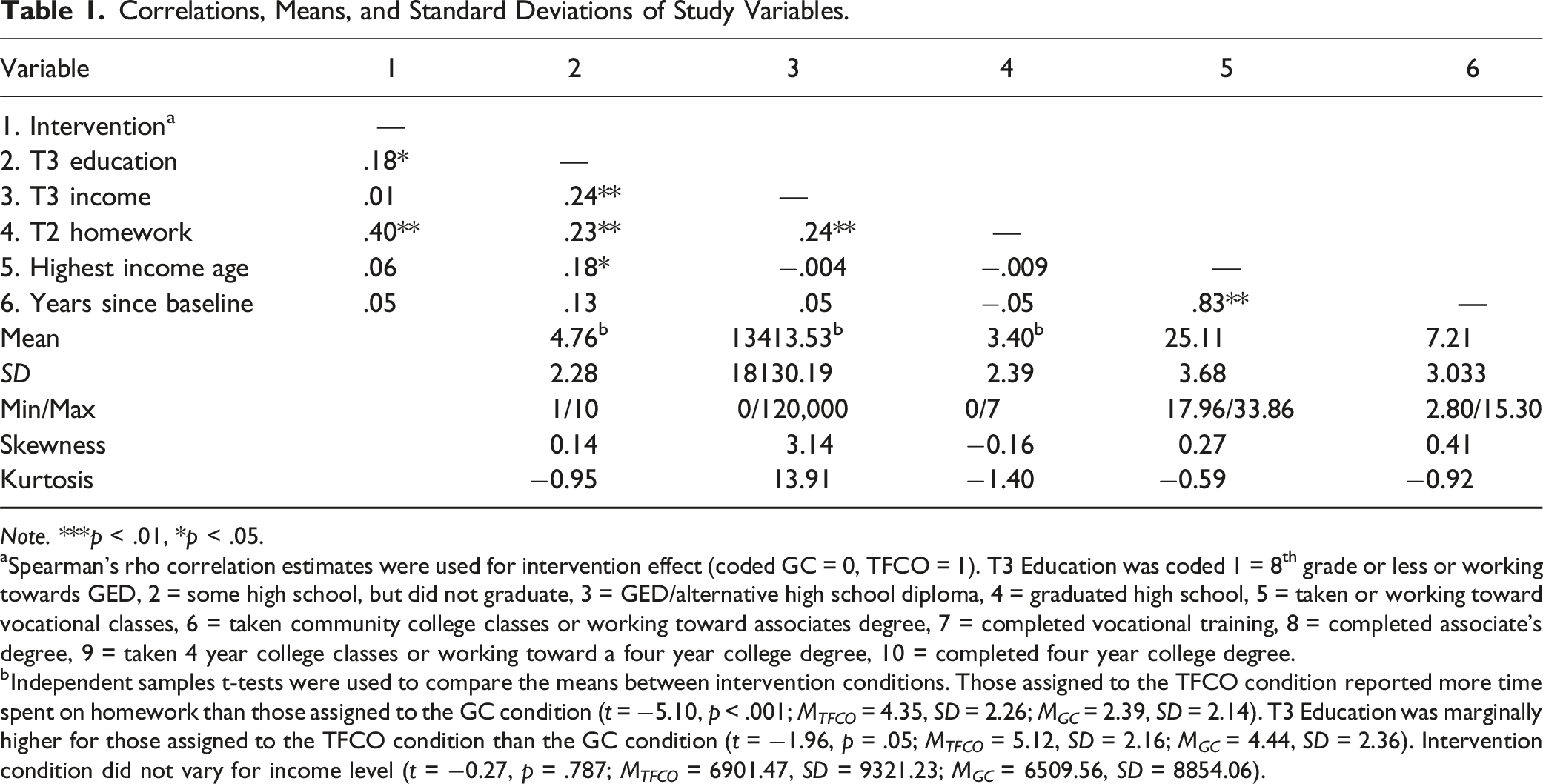
Note. ***p < .01, *p < .05.
aSpearman’s rho correlation estimates were used for intervention effect (coded GC = 0, TFCO = 1). T3 Education was coded 1 = 8th grade or less or working towards GED, 2 = some high school, but did not graduate, 3 = GED/alternative high school diploma, 4 = graduated high school, 5 = taken or working toward vocational classes, 6 = taken community college classes or working toward associates degree, 7 = completed vocational training, 8 = completed associate’s degree, 9 = taken 4 year college classes or working toward a four year college degree, 10 = completed four year college degree.
bIndependent samples t-tests were used to compare the means between intervention conditions. Those assigned to the TFCO condition reported more time spent on homework than those assigned to the GC condition (t = −5.10, p < .001; M TFCO = 4.35, SD = 2.26; M GC = 2.39, SD = 2.14). T3 Education was marginally higher for those assigned to the TFCO condition than the GC condition (t = −1.96, p = .05; M TFCO = 5.12, SD = 2.16; M GC = 4.44, SD = 2.36). Intervention condition did not vary for income level (t = −0.27, p = .787; M TFCO = 6901.47, SD = 9321.23; M GC = 6509.56, SD = 8854.06).
Hypothesis Testing
Main analyses (see Figure 1) were conducted in Mplus v 8.8 using a maximum likelihood estimator with 10,000 bootstrap samples which accounts for item-level missingness in the data (5.9% item-level missing). We tested a path analysis model whereby the T1 intervention condition (TFCO) predicted T2 time spent on homework, T2 homework predicted T3 income and T3 education level, and the residual variances of T3 education and income were correlated. After controlling for time since T1 and age at highest reported income, there was a significant main effect of TFCO on T2 time spent on homework (β = .40, 95% CI [.236, .543]), replicating prior results that used a subsample of the current participants (Leve et al., 2007). T2 homework completion predicted highest reported T3 education (β = .22, 95% CI [.021, .409]) and T3 income (β = .27, 95% CI [.088, .408]). The TFCO intervention did not significantly directly predict T3 educational attainment (β = .06, 95% CI [-.120, .230]) or T3 income (β = −.08, 95% CI [-.250, .088]). The total effect from intervention condition to T3 education trended toward significance, however the bias-corrected bootstrapping procedure 95% confidence interval (CI) suggested this pathway was nonsignificant (β = .15, 95% CI [-.006, .297]). The total effect of the intervention on T3 income was nonsignificant (β = .03, 95% CI [-.132, .176]). The indirect effect from the intervention condition to T3 education through T2 time spent on homework was significant at the .05 level (β = .09, 95% CI [.013, .194]) as was the indirect effect on T3 income level (β = .11, 95% CI [.039, .198]), suggesting that homework completion is an important mechanism. Path Coefficients for Mediation Model.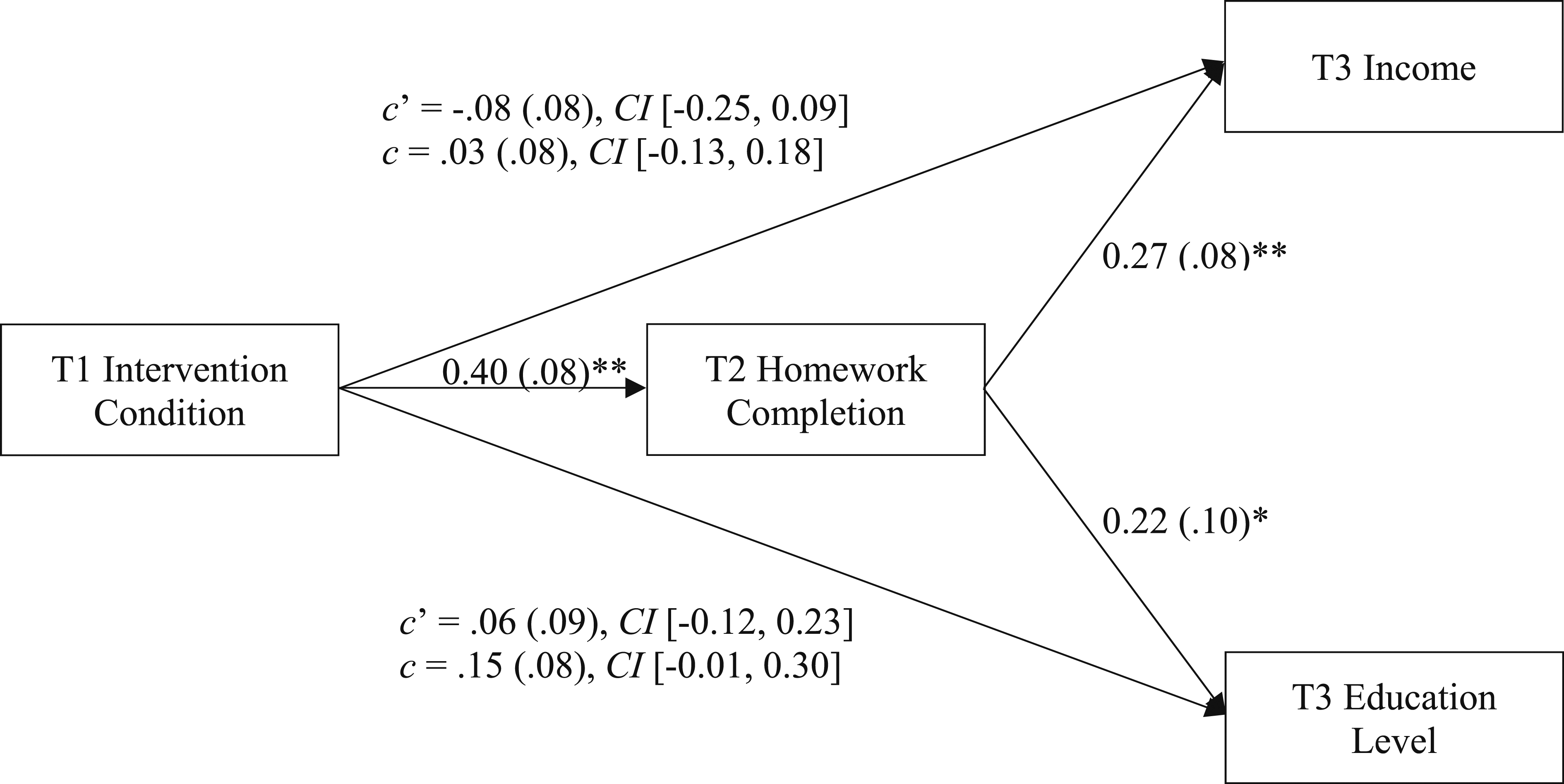
Discussion
This study examined the longitudinal outcomes of the TFCO intervention on later educational attainment and income level among young women with a history of juvenile justice system involvement. Entering emerging adulthood comes with new challenges (Arnett, 2015), but youth who have had prior involvement in the JJ system might experience heightened or unique challenges that hinder a successful transition. Findings did not support the first hypothesis, that the TFCO intervention would directly predict later education and income levels. The present study found support for the second hypothesis, that the TFCO intervention predicts better educational attainment and higher income in emerging adulthood indirectly, through time spent on homework.
The indirect effect of the TFCO intervention on education and income levels via homework completion suggests that time spent doing homework in adolescence is an important link to socioeconomic benefits in emerging adulthood. Our findings extend prior work done by Leve and Chamberlain (2007) who found that girls in the TFCO intervention had improved homework completion, and subsequently, had lower delinquency (i.e., spent fewer days in locked settings). Findings are also supported by work in the general population demonstrating that time spent on homework is linked to enhanced academic performance (Guo et al., 2024). Thus, it is unsurprising that we found an indirect path via homework completion on emerging adult education and income levels. More surprising was the lack of a main effect of the intervention on later income and educational attainment. It may be that the intervention alone does not predict emerging adulthood socioeconomic outcomes, but rather, that daily behaviors such as spending time on homework help promote resilience. The act of completing 30 minutes of homework on a continuous basis could instill positive behaviors and habits related to schoolwork and school engagement that girls in the group care condition did not experience. Constructive habits may extend into emerging adulthood and might improve the likelihood of continuing education or obtaining steady employment. School engagement might predict later income levels due to either higher educational attainment, or because it acts as a motivational driver for financial stability—possibilities to be explored in future research. Furthermore, participants in the TFCO condition may have received homework support from their caregivers and parent(s). Parental involvement with homework is important for later academic achievement (e.g., Núñez et al., 2023). Other factors that could promote resilience for JJ involved youth that were not examined in the present study include school connectedness, presence of a caring adult, positive social support systems, and feelings of psychological and physical safety (Hawkins et al., 2009; Kerig, 2018).
Limitations and Future Directions
The current study presented many strengths, including the use of a longitudinal design and examination of an understudied yet important area: homework completion and later income and educational attainment. This study, however, is not without limitations. A majority of our sample was non-Latine White and despite experiencing low family socioeconomic standing, does not represent all girls with JJ involvement. Future studies should explore the long-term effects of education and income among diverse samples, including racial/ethnic and LGBTQ + populations. We assessed income and education by using the highest reported levels, which resulted in a wide range in the age of report. Although we controlled for age at highest reported income, there was a vast age range. Further, homework was an aggregate of caregiver and youth report. It may be valuable to examine how youth experience or feel about homework and whether it adds to the long-term benefits. Teacher report of youth homework and/or teacher impressions would add an additional dimension to our understanding of the role of homework completion on later socioeconomic outcomes. Finally, there were approximately 10 years between the intervention and the T3 emerging adulthood assessment. There are likely many factors that could impact income level and/or educational attainment (e.g., starting a family, job changes, etc.), which are unaccounted for and beyond the scope of the current study.
Conclusions
Taken together, the findings provide a positive framework for improving long-term benefits of girls with a history in the JJ system. Promoting positive behaviors around school during adolescence could promote a successful transition into emerging adulthood, and possibly beyond, into middle and late adulthood. Encouraging girls with JJ involvement to continue their schoolwork and to engage in healthy homework habits are positive directions for interventionists, counselors, and parents to explore.
Supplemental Material
Supplemental Material - The Role of Homework Completion During Adolescence on Education and Income Levels in Emerging Adulthood: Results From a Randomized Controlled Trial With Females in Out-Of-Home Care
Supplemental Material for The Role of Homework Completion During Adolescence on Education and Income Levels in Emerging Adulthood: Results From a Randomized Controlled Trial With Females in Out-Of-Home Care by Diana L. Jenkins, Leslie D. Leve, and Veronica Oro in Emerging Adulthood
Footnotes
Declaration of Conflicting Interests
The author(s) declared no potential conflicts of interest with respect to the research, authorship, and/or publication of this article.
Funding
The author(s) disclosed receipt of the following financial support for the research, authorship, and/or publication of this article: This research received funding from the National Institute on Drug Abuse [R01 DA024672, R01 DA015208], the National Institute of Mental Health [R01 MH054257], and the Department of Justice [2020-JX-FX-0003]. This research was also partly funded by the Institute of Education Sciences [R32 4B180001].
Transparency and Openness Statement
The raw data is currently not openly available. The analysis code and materials used in this study are also not openly available but are available upon request to the corresponding author. No aspects of the study were pre-registered.

Supplemental Material
Supplemental material for this article is available online.
Author Biographies
References
Supplementary Material
Please find the following supplemental material available below.
For Open Access articles published under a Creative Commons License, all supplemental material carries the same license as the article it is associated with.
For non-Open Access articles published, all supplemental material carries a non-exclusive license, and permission requests for re-use of supplemental material or any part of supplemental material shall be sent directly to the copyright owner as specified in the copyright notice associated with the article.
