



Abstract
According to Arnett’s theory, emerging adulthood is a distinct developmental period. As Havighurst’s developmental theory suggests, specific tasks are assigned to different human life stages. The purpose of this study is to discover the developmental tasks of emerging adulthood. A sample of 129 students from diverse cultural backgrounds, including Spain, Portugal, Japan, Korea, Poland, and the USA, submitted reflective essays detailing their personal perceptions and the meaning of adulthood. Employing both directed and inductive analytical approaches, the study uncovered new developmental tasks such as social solidarity and openness to diversity, lifelong learning, development of thinking and knowledge, and building mental resilience. According to Havighurst, tasks were as follows: socially responsible behavior, emotional independence, getting started in an occupation, and managing a home. Comparative analysis revealed a predominance of tasks characteristic of adolescence compared to those indicative of adulthood and emerging adulthood.
Keywords
Introduction
The transition from adolescence to adulthood is crucial for an individual’s future functioning and well-being, and it currently follows diverse and individualized paths (Schulenberg et al., 2004; Shanahan, 2000). Arnett (2024) used the term emerging adulthood, referring to the ages of 18–25/29. Individuals in this phase are no longer adolescents but are not yet young adults; they are in a distinct developmental stage characterized by diverse paths in education, work, personal development, and relationships. This phase includes explorations in the realms of intimate relationships (seeking more permanent sexual or life partners than in adolescence), work (pursuing internships or acquiring skills with an eye toward a future career), and worldview (gaining knowledge, forming aspirations, and developing a lifestyle, life philosophy, or value system, often in the context of higher education). Young people in this stage experience identity exploration, instability (in areas such as work, love, and residence), self-focus, a sense of being in-between (in transition), and opportunities to pursue their plans and dreams (Arnett, 2004).
A central element of Arnett’s theory is the assumption that emerging adulthood is a distinct developmental period, different from the preceding stage of adolescence and the subsequent stage of adulthood (Tanner & Arnett, 2016), as confirmed by research conducted worldwide (Facio et al., 2007; Kuang et al., 2024; Macek et al., 2007; Sirsch et al., 2009; Zacarés et al., 2015). Much attention in the literature has been devoted to the cultural conditions of this life stage, focusing on the criteria for adulthood in different cultures (Arnett & Padilla-Walker, 2015; Facio et al., 2007; Kuang et al., 2024; Lo-oh, 2016; Macek et al., 2007; Mayseless & Scharf, 2003; Mitchell & Lennox, 2020; Obidoa et al., 2018; Sirsch et al., 2009; Zacarés et al., 2015), grounding the construct of emerging adulthood firmly within cultural theories. However, there is considerably less analysis referring to the concepts of developmental psychology. According to Nelson and Luster (2015), emerging adulthood requires further exploration in new conceptual areas. Drawing on developmental theories, these authors state: “However, for our understanding of the conceptions of adulthood to grow, we need to expand the work being done beyond just identifying whether young people feel like adults and the criteria for adulthood to broader areas of inquiry.”
The disparity between the criteria recognized by young people as defining adulthood and their personal sense of being adults is highlighted by research by Wright & Stumm (2024), which shows that achieving socio-demographic milestones such as marriage and parenthood predicts self-perception as an adult but is not regarded by young people as defining characteristics of adulthood. This clearly points to the need for expanding research with new conceptual and methodological frameworks to go beyond declarative responses that may result from commonly held beliefs or social stereotypes.
One of the classic theories describing human development is Robert Havighurst’s theory of developmental tasks. According to Havighurst’s, people go through a series of developmental stages throughout their life cycle, each consisting of a set of developmental tasks. Accomplishing these tasks leads to happiness and success in later tasks, while failure can result in unhappiness, social disapproval, and challenges with later tasks (Havighurst, 1972). A developmental task is a challenge that arises at a specific stage of life and is felt as tension (or even crisis) stemming from biological pressures (physical changes in the body), social pressures (societal expectations), and psychological pressures (individual needs and competencies). An individual seeks ways to reduce this tension by acquiring new skills (Havighurst, 1972), which enables further growth and development through the creation of new strategies for coping with life’s challenges. These strategies are responses to biological and social demands and expressions of individual talents and lifestyles (Newman & Newman, 2017).
Thus, developmental tasks result from the interaction of physical maturation, socio-cultural pressures, and emerging personality (psyche-soma-polis). For a developmental task to manifest, a specific readiness (not necessarily full maturity) is required from each of these three sources – biological, social, and psychological. All three sources act as imperatives, exerting pressure on the individual to confront a given task because the time has come (psychological, biological, and socio-cultural) (Havighurst, 1972). Despite these internal and external pressures, the individual, as an intentional agent, makes the final decision to undertake the task. Dynamic processes of internal psychological organization, using previously acquired competencies, including information processing, guide the individual’s actions.
Developmental tasks are both sociocultural, biological, and personal constructs (Havighurst, 1972). As a result, the achievement of developmental tasks may vary across different cultures but is also subject to changes with socio-economic development (Havighurst et al., 1975; Manning, 2002). Postmodernism challenges Havighurst’s view of the concept of developmental tasks in the face of continuous change (Bauman, 1995; Schachter, 2005). Today, due to social and cultural changes in areas such as intimate relationships and the evolving job market (Estes & Sirgy, 2019; Schulenberg & Schoon, 2012), there has been an attempt to deconstruct tasks related to adulthood. In general, performing these tasks should be considered in relation to adaptation and well-being (Melero et al., 2023; Salmela-Aro et al., 2012), and the greater the success and the fewer the setbacks in various domains of early adulthood developmental tasks, the greater the likelihood of maintaining or achieving a beneficial trajectory of well-being during the transition period (Shanahan, 2000). However, it is currently believed that achieving some of these tasks is not necessary for successful transition into adulthood (Schulenberg & Schoon, 2012).
The response to sociocultural changes are new psychological concepts, such as “emerging adulthood” by Jeffrey J. Arnett (2000). Arnett’s (1997) concept of entering adulthood is determined by the subjective sense of being responsible for oneself and others. Criticism of Arnett’s concept focuses precisely on the issue of overestimating the role of the individual. Researchers testing this concept emphasize that the determinants of adulthood lie between an individual’s own feelings and clearly defined social indicators, and the former should not be overestimated at the expense of the latter in studies of young adults’ biographies (Molgat, 2007). Research, for example by Hendry and Kloep (2010), also suggests that for young people, achieving adulthood is confirmed by others. Subjective feelings, for the majority of respondents, were not sufficient factors. Due to the typical focus on oneself during this developmental phase, searching for oneself, absolutizing one’s own experiences, observations, and thoughts, and gradually striving to achieve one’s own goals (Lipska & Zagórska, 2011), researchers of emerging adulthood write more about developmental goals than developmental tasks, for example finding the authentic self (Scharf & Mayseless, 2010). However, references to developmental tasks also appear in research on this phase. For example, it is examined which developmental tasks typical of adulthood determine the transition from emerging adulthood to the next developmental phase (Mannerström et al., 2019). Proposals for new developmental tasks typical of emerging adulthood also appear, such as finding a meaningful life (Mayseless & Keren, 2014), learning how to become comfortable with being in an uncomfortable developmental stage (Trible, 2015). For example, Schulenberg et al. (2004) distinguished seven domains of developmental tasks in the transition to adulthood: education, work, financial autonomy, romantic involvement, peer involvement, substance abuse avoidance, and citizenship which predict good adjustment and well-being to varying degrees.
It is worth noting that so far the assignment of specific tasks to development stages has been mainly speculative or based on already existing classifications (Havighurst, 1972, Fadjukoff, Kokko, & Pulkkinen, 2007), so intercultural research on the category of emerging adulthood in the context of developmental tasks seems necessary to bridge the gap between Havighurst’s and Arnett’s theories. The research aims to discover the developmental tasks of emerging adulthood by situating them within the developmental tasks of adolescence and adulthood in Havighurst’s classification, as well as examining what new tasks contemporary individuals in the phase of emerging adulthood describe.
Due to the socio-cultural changes mentioned by Havighurst, specific developmental tasks may no longer be relevant or at least insufficient. However, the concept of developmental tasks continues to be developed in the literature as a broader conceptual framework important for understanding human development throughout the life cycle (Hutteman et al., 2014; Mayseless & Keren, 2014; Schulenberg et al., 2004; Seiffge-Krenke & Gelhaar, 2008). In our research, we aim to use the idea of developmental tasks to advance the concept of emerging adulthood as a new developmental stage, which, in our opinion, will significantly enrich Arnett’s theory with insights from developmental psychology. This approach can provide new information about developmental processes in the emerging adulthood stage.
Furthermore, most studies conducted thus far have been quantitative and focused on adulthood criteria in individual countries. It is important to emphasize that qualitative research in this area is increasingly being called for in the literature. Our study is multicultural, encompassing young people from six countries, and uses a qualitative methodology (a qualitative method of data collection followed by both quantitative and inductive qualitative analysis) that directly addresses how young people experience themselves, without limiting their responses to researcher-determined options. The literature suggests that qualitative approaches should be used when the goals are descriptive, exploratory, and related to a novel area lacking established research (Terry & Braun, 2017), which we believe is the case with developmental tasks in emerging adulthood.
In our project, we posed the main research question: What are the developmental tasks of the emerging adulthood stage?
The specific research questions are as follows: 1) What developmental tasks according to the Havighurst’s theory do young people from different countries indicate in their statements about becoming an adult? 2) What other developmental tasks do young people from different countries refer to? 3) Which groups of developmental tasks are more frequent among participants? 4) Do countries differ in the intensity of any development task groups level? Does the distribution of task frequency depend on the country? To achieve the research goal and answer the research questions, we gave the floor to young people themselves to define what adulthood means to them.
Materials and Methods
Study Design
Our research is grounded in critical realism, which acknowledges the existence of an objective reality while recognizing that our understanding of it is inevitably influenced by social and cultural contexts. To achieve our dual research objectives—verification and exploration—we adopted a pragmatic orientation (Savin-Baden & Major, 2013), allowing flexibility in our methodological choices. Although we drew on pre-existing categories of developmental tasks, our approach aligns with post-positivist principles, emphasizing rigorous, yet fallible, inquiry. This combination enabled us to address complex research questions without being confined to a single epistemological framework. However, as we pursued the exploratory aim (identifying new developmental tasks), we shifted slightly from this stance, acknowledging that in identifying new tasks, we rely on researcher subjectivity as a resource for research. Similarly, by asking participants to write essays, we operated under a constructivist assumption, where individuals, through writing (and thus thinking, perceiving, and experiencing), reveal the construction of their personal and social worlds. By asking about adulthood, we tap into the meaning of the term within a social context and personal biography. Therefore, while our starting point was a post-positivist perspective, it was not extreme, but softened by constructivist assumptions.
Participants and Procedure
One hundred twenty-nine students of various fields of study from six countries (Spain, Portugal, Japan, Korea, Poland, the USA) in early adulthood participated in the brief internet survey. These six countries were chosen because, despite the theoretical controversy about whether emerging adulthood constitutes its own developmental stage (Arnett et al., 2011), Arnett argues that there is evidence supporting the view that emerging adulthood is a distinct developmental stage in OECD (Organisation for Economic Co-operation and Development) countries (Arnett, 2011). Therefore, we selected participants from countries that are members of this organization. We studied economically developed countries where young people engage in postsecondary education and delay marriage and parenthood, while also varying in cultural dimensions (e.g., individualism vs. collectivism). Data were collected in the participating countries in 2021 and 2022.
The first phase of the study was conducted in Poland. During this phase, a pilot analysis was also carried out to determine how well an open, free-form instruction would facilitate the analysis of developmental tasks (both those based on Havighurst’s framework and new ones identified from the participants’ responses). Subsequently, studies were initiated concurrently in other countries. The number of participants was determined to ensure that the collected data would not be too extensive for qualitative analysis (6 countries * number of participants) and to avoid hindering the analysis.
After the initial announcement of the survey, the university course lecturer sent a link to students willing to participate. However, writing the essay was not part of a university course assignment, and the students were aware of the project’s objective and knew which countries the research would be conducted in. Neither the information about who wished to participate in the study nor the content of the essays was known to the lecturer. Students were asked to write a short essay in response to the question “What does becoming an adult mean to you? Please write a short essay (150-200 words).” Such open-ended and free-flowing instruction allowed participants to present first-person accounts relating to their current, personally meaningful experiences.
In the qualitative data collection method used here, we deliberately did not ask direct questions but encouraged open expression to evoke a free-flowing articulation of the individual’s associations with the concept of “becoming adult” based on their own experiences. We assume that by receiving a completed essay, we are dealing with minimal researcher interruption and maximal personal identification with the content (e.g., Gibson, 2017). This approach allows us to rely less on researcher craft skills for data collection and more on participants’ individual meaning construction and their own sense-making frameworks (e.g., Terry and Braun 2017).
Descriptive Information About Participants and Collected Essays.
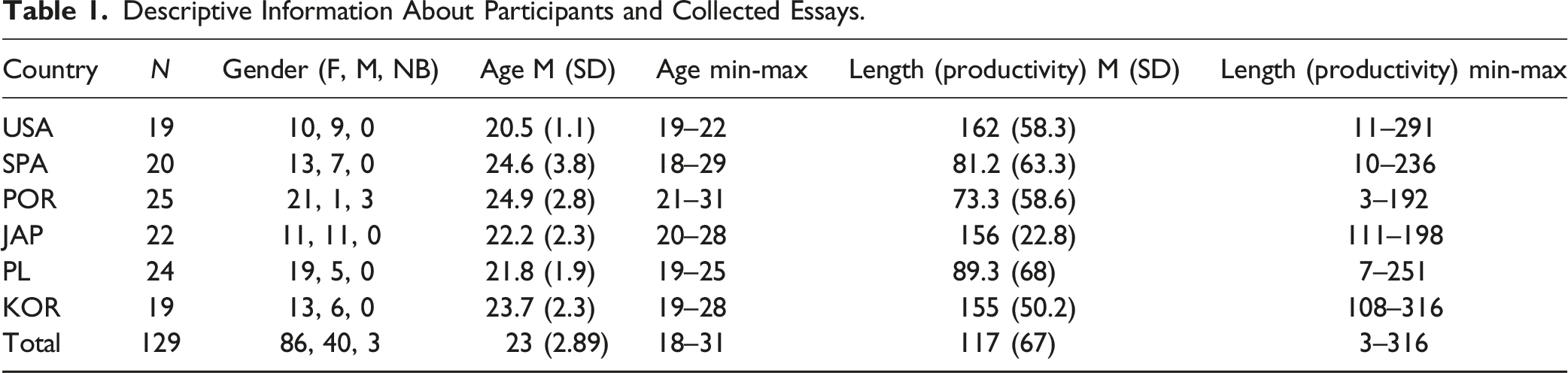
Countries differed in age and productivity of the essays. Based on one-way analysis of variance (F(5, 54) = 15.9, p < .001; eta2 = 0.363), the US, Japan, and Korea had the highest average word counts (not significantly different from each other), while Spain, Poland, and Portugal had similar, lower productivity. All significance was checked using Games-Towell post hoc tests. Based on one-way analysis of variance, the countries also differed in age (F(5, 54.4) = 14.8, p < .001; eta2 = 0.287). Essays from the US were written by the youngest individuals (differing significantly in age with all countries except Poland). Those from Portugal and Spain were written by the oldest and not significantly different from each other, but Portugal was significantly different from the US, Japan, and Poland. All significance was checked using Games-Towell post hoc tests.
Ethical Considerations
Data were collected by project partners based at universities in various countries, and all the information gathered by the project partners and beneficiaries was confidential. Each partner was required to obtain the permission of their own ethics committees. The project protocol was approved by the ethical committee of the University of Alicante (Spain), the University Institute of Maia (Portugal), Ryutsu Keizai University (Japan), Ajou University (South Korea), and Adam Mickiewicz University (Poland). Waivers were obtained from Whittier College (the USA).
An online survey was conducted. The purpose of the survey was described at the beginning of the survey, as was the duration. The adult-only questionnaire included information about the rights of participants: “Participation in the study is anonymous, voluntary and you can withdraw at any time without giving any reason (…). We will only use the results obtained for scientific purposes”. Participants gave their informed consent to take part in the study by accepting the stated conditions of the study. Students were provided with an email address where they could address their concerns about the study or withdraw their consent to participate.
The survey data is stored on the server of the Faculty of Educational Studies, Adam Mickiewicz University in Poznań, Poland, fulfilling the requirements of Regulation (EU) 2016/679 of the European Parliament and of the Council of 27 April 2016 on the protection of natural persons with regard to the processing of personal data and on the free movement of such data, and repealing Directive 95/46/EC (General Data Protection Regulation). Prof. Barbara Jankowiak is the person responsible for archiving the data (without personal data, as we do not ask for such information in the survey).
Analytic Strategy
Data analysis was performed using the qualitative content analysis method, matching the appropriate analysis technique to the research questions (Hsieh & Shannon, 2005; Mayring, 2000; Schreier, 2014). To answer the first research question about developmental tasks (based on Havighurst’s theory, 1972), a directed (theory-driven, deductive) content analysis was used. Next, in order to answer the exploratory question about the new developmental tasks (not listed by Havighurst), the analysis was enhanced by the inductive (data-driven) generation of developmental tasks indices. The details of the analytic strategies were as follows.
First, indicators of developmental tasks for two periods - early adulthood and adolescence - were extracted based on Havighurst’s (1972) theory. A code-book was then created for these indicators with instructions for competent judges (coders) on how to recognize each developmental task in the essays. The coders’ task was to mark in the text the occurrence of each indicator in a given utterance (essay) and then to mark if the particular category (task) is present („1″) or absent („0″) in the analyzed essay. The coders were two academics proficient in psychological and pedagogical theories of human development over the life cycle. The coders participated in a training session that consisted of jointly coding 5 cases from different countries and with different word lengths and discussing difficulties that arose. Each coder was then given 10 randomly drawn from all the cases to evaluate them independently. Based on the independent ratings, the reliability coefficient (Krippendorff’s alpha, α) was calculated to measure the agreement among coders. The independent coding was performed twice before the final text sample. Finally, after two rounds of coding and Krippendorff’s α calculations, in the majority of categories, the agreement was complete (α = 1); in two cases, it was high (adolescent tasks A4 and A5 - α > 0.8), and in one case it was low (for adulthood task D6, α = 0.59). We deemed the coders’ agreement sufficient, and the remaining material was divided into two judges, and further analysis was performed.
It is worth adding that supplementary to the list of theory-generated categories that were included in the codebook and then used in coders’ training; coders were encouraged to mark those sentences in the essays that transmitted information on additional development tasks that had not been conceptualized before. Newly identified fragments were assigned to one distinct category named ”other tasks and life goals,” which included tasks that study participants set for themselves that were not included in Havighurst’s theory. The „other” category was introduced to make the classification more data-driven, aligned with a contemporary perspective, and more sensitive for further analysis. The obtained results (the presence or absence of a particular category in a given essay) were aggregated. Then a mean was calculated to form developmental tasks for adolescence (A) and adulthood (D). This calculation produced two generalized variables that described each text (variable A „adolescence tasks” and variable D „adulthood tasks”).
Second, in order to respond to the research question about new developmental tasks, the inductive content analysis was based on the previously identified category of ”other tasks and life goals”. This category gathered all goals and objectives important to the young person that could have not been previously considered to represent the individual indicators belonging to categories A and D. Thus, based on the coder’s suggestions from the previous stage of analysis and on a preliminary analysis of a random text sample of 30 essays (which allowed us to check the informative potential of such analyses), one investigator proposed a set of additional developmental tasks and proposed a code-book for them. Category suggestions were sent to the researchers from each country, along with a request to identify these categories in the text and feedback on their usefulness. Finally, after receiving feedback from the researchers, the principal investigator held a meeting to jointly decide on the content of the code-book for the new tasks. Another two researchers then used the final list of categories to analyze the essays regarding three newly established developmental tasks: lifelong learning, social solidarity, and resilience building. This made it possible to obtain information about the occurrence or absence of newly established developmental tasks in all the essays. As a result of the content analysis, we described each essay by the occurrence or absence of each of the developmental tasks of adolescence (A), adulthood (D), and additional tasks for emerging adulthood (EA), as well as the mean frequency of occurrence of these three groups of tasks.
Results
Developmental Tasks According to the Havighurst’s Theory and New Emerging Adulthood Tasks
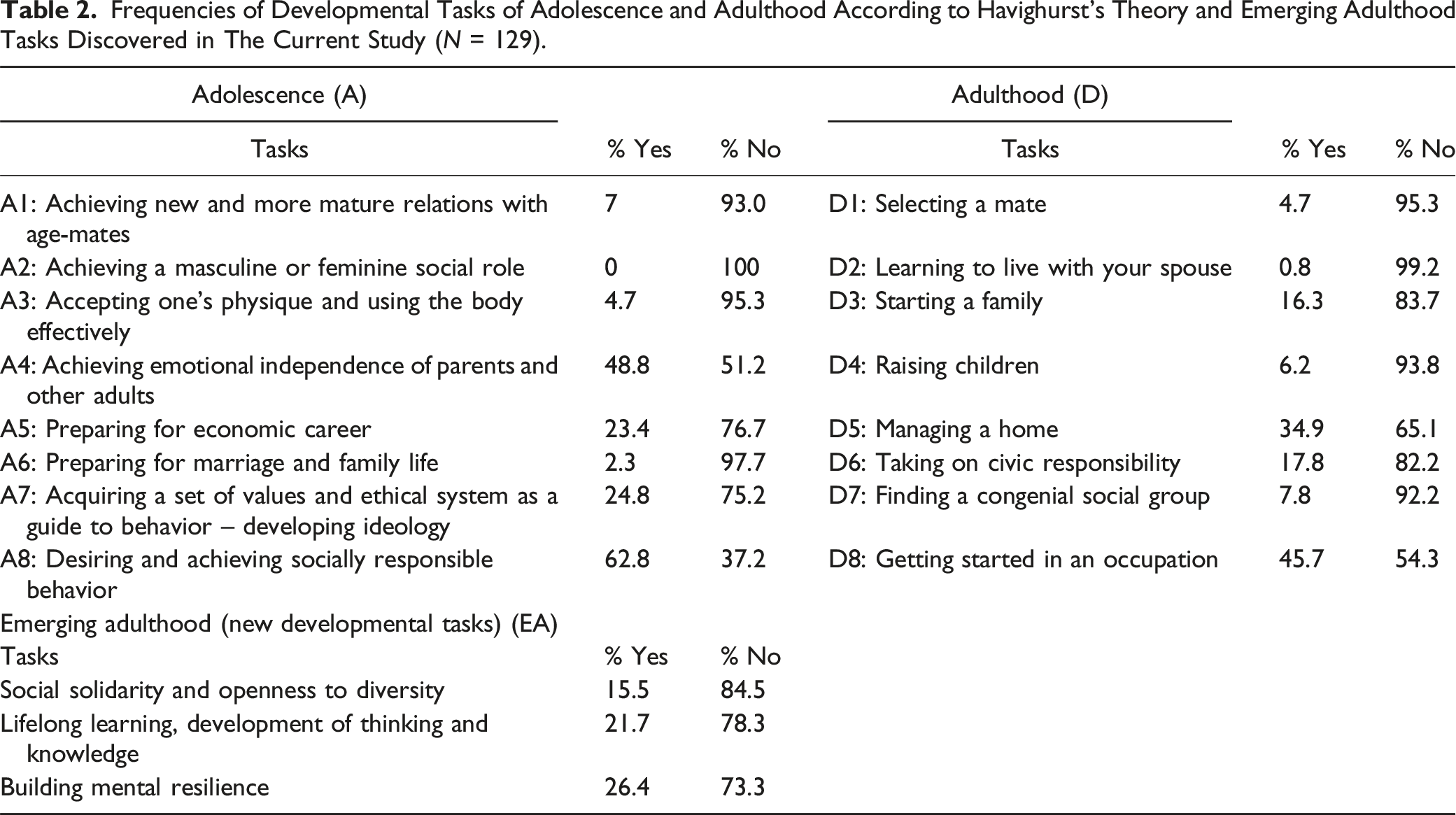
In the students’ essays, there were more mentions of the developmental tasks of adolescence than of adulthood (and new emerging adulthood tasks). A non-parametric repeated measures ANOVA was used. Friedman’s chi2 test showed that raising in the statements of the task groups differed significantly (chi2(2) = 8.65; p = .013). Pairwise comparisons made with the Durbin-Conover test showed that the mean appearance of developmental tasks in essays from adolescence is higher than those from adulthood (Durbin-Conover test = 2.881, p = .004) and emerging adulthood (Durbin-Conover test = 2.101, p = .037). No differences were noted between tasks from adulthood and emerging adulthood (Durbin-Conover test = 0.780, p = .436).
Frequencies of Developmental Tasks of Adolescence and Adulthood According to Havighurst’s Theory and Emerging Adulthood Tasks Discovered in The Current Study (N = 129).
Descriptive Information About Aggregated Developmental Tasks for Adolescence, Adulthood, and Emerging Adulthood Tasks Discovered in the Current Study (N = 129).

Developmental Tasks of Adolescence and Adulthood according to Havighurst’s Theory
According to the results of the content analysis, the beliefs that resonated most strongly were those related to the developmental tasks of adolescence according to Havighurst’s theory, such as: desiring and achieving socially responsible behavior (62.8%) and achieving emotional independence of parents and other adults (48.8%). The students highlighted that they are now in charge of their own well-being and their own lives: “The biggest thing about becoming an adult is that comes with responsibility. Independence brings responsibility, to take care of ourselves without any help. It comes with accountability, with handling our own problems. Becoming an adult means that you are on your own and have to be able to make something for yourself and for your life, and possibly for those around you” (POR 16). Participants attributed great importance to their own responsibility for the choices they make and their behavior toward others. A crucial issue for the students in their adulthood was gaining independence from their parents. “I think that becoming an adult refers to the stage when you become aware that you are now responsible for all your actions. This includes being able to stand on your own two feet without being dependent on your parents and being mentally and financially independent.” (JAP 4).
Such developmental tasks attributed, according to Havighurst, to adolescence as acquiring a set of values and ethical system as a guide to behavior (24.8%) and preparing for economic career (23.4%). According to these participants, moral values are the basis for making decisions in harmony with one’s self. “Being an adult more valuable, it gives people the freedom to make their own decisions throughout life. Decision making is also a HUGE part of being an adult; being able to use one’s own sense of morals, ethics and logic to base their decisions off of.” (USA14) Decision-making related to career direction also proved to be noteworthy. Becoming an adult is the transition from school life into a stage characterized by the struggle to survive in the world. It is characterized by making decisions about work, earning money, […] and deciding what direction our lives will take. (PL3) In students’ essays, such developmental tasks of the adolescent period almost did not appear: achieving new and more mature relations with age-mates, achieving a masculine or feminine social role, and accepting one’s physique.
Regarding the developmental tasks of adulthood according to Havighurst’s theory, the students’ strongest statements resonated: getting started in an occupation (45.7%) and managing a home (34.9%). “The first thing I think about is work and financial responsibility. On the one hand, I think that when you enter the labor market, whether part-time or full-time, this implies a series of responsibilities that I relate to adulthood, despite the fact that the age of entry to the labor market is different. for each person and working conditions. On the other hand, and closely related to the above, I consider that a person begins to become an adult when they begin to manage economic responsibilities such as having a payroll, paying bills and household expenses (water, electricity, internet, food …), buy and maintain your own vehicle” (SPA4).
The essays also raised issues related to taking on civic responsibility (17.8%): ”Becoming an adult means more personal but also civic, community responsibility.” (POR 1) Some of the essays also featured issues related to family life (16.3%) “It is important to be able to take care of ourselves and the people we will be living with, and actually starting a family” (PL 12). Such developmental tasks mentioned as belonging to the period of adulthood, as the following, hardly appeared in the students’ essays: selecting a mate, learning to live with your spouse, raising children, and finding a congenial social group.
New Developmental Tasks of Emerging Adulthood
Based on inductive content analysis, new developmental tasks of the period of emerging adulthood were distinguished, which did not appear in the Havighurst’s theory while they emerged from the essays of the students. New development tasks include: - Social solidarity and openness to diversity (15.5%); - Lifelong learning, development of thinking and knowledge (21.7%); - Building mental resilience (26.4%).
Social Solidarity and Openness to Diversity
The study participants understood their adulthood as a growing responsibility for the world and future generations. Their statements reflect a desire to contribute to the development of humanity and to care for the world around them, not just themselves and their family members. In my opinion, becoming an adult means that there is an increased level of responsibility. During this transitional period, we must look for ways that we can contribute to a cause and make a positive impact within our world and society. We have to start thinking about future generations and making sure the children of this world are being taught things that are relevant and essential for their future success. At a more personal level, we must start thinking about death, and the things we want to get done before our time is done. (USA 3). According to the young adults, being an adult is associated with intergenerational solidarity and the search for solutions that guarantee benefits for everyone and concern for the environment. I believe becoming an adult means acknowledging you now have responsibilities to complete. It means using past experiences and learning from them to create a better place for you and those around. It means having the discipline to get what needs to be done, done. It is no longer about running around and just not caring about the world around you, since now you are in a place where you can create change either for you, your family or the world as a whole. Becoming an adult is not about hitting a certain age but is about hitting a certain level of maturation that lets you know life is about more than just you. (USA 13)
The students’ statements clearly show concern for all social groups and the desire to include all people in development processes without discrimination against anyone. I believe that being an adult means having social skills and always living for something more. […] I believe that a mature society is formed when people can live together, help each other, have compassion for others, and be able to do things without discrimination. Moreover, it is not that people with disabilities are not adults, nor are they adults because their bodies have matured. I think it is important to support each other so that we can live a stable life, always aspiring to live better, making efforts to come back even if we take a wrong path, and encouraging others to make the same efforts together (JAP18) The participants' essays included themes related to social activism and the willingness to take action to introduce changes in the social perception of minority and disfavored groups. Becoming an adult means more personal but also civic, community responsibility. Being an adult is to contribute in a more active way to a better world, to help others, to receive and pass knowledge about inequalities that surround us. (POR2)
Lifelong Learning, Development of Thinking and Knowledge
Another developmental task of emerging adulthood has been conceptualized because study participants are aware of the importance of developing their own knowledge, expanding competencies and qualifications, as well as the need to cultivate thinking—and this is how they define their maturity. According to students, investing in knowledge is an important task in adult life. It means learning more and learning better. (POR19) I do not believe being an adult means you have to stop making mistakes and stop learning. (POR5). Students believe that, due to changing conditions in the job market, a lifelong learning approach to education is necessary. The part of the job has become very limited, as specialized jobs have become even more competitive than ever, leading to eventually having to either invest really high on education and training or go to another area that offers more jobs (POR25).
Young adults believe that the essence of their maturity is cognitive improvement and reaching a higher level of thinking. Also being an adult means being able to make your own decisions and take responsibility for the consequences that arise from them. It is to be able to have a critical thought before the events that occur, and the opinions of other people. It is to be able to question things that you did not question before and that you had normalized. (SPA6)
The development of knowledge and learning plays a role that is oriented toward pursuing individual passions and aligns with the idea of individual, conscious development. Finding out what your passion is and who you want to be in life. Learning, adapting and growing to every situation. (POR8) I think becoming a grown-up means having a sense of responsibility and always growing.[…] Therefore, an individual must endeavor to become more mature than oneself in the past, and I consider grown-up as one who restrains from neglecting learning and always grows with the ability to learn from others and teach others as well (regardless of age). (KOR5)
Building Mental Resilience
According to the data obtained, young adults set themselves the task of understanding their own selves, taking care of their mental health to cope with both past traumas and current challenges and to be able to grow. Finally, it is growing as a person, understanding yourself and being willing to work and change life patterns (which are not necessarily the best) in order to be the best version of yourself. Always open to learning with empathy and passion. (SPA9) Being able to manage and juggle not only your work and social life but all the stepping stones you run into. Everybody deals with personal problems, some worse than others but being an adult means finding a way to come out on top and keep pushing. (USA13) Dealing with problems requires emotional resilience which, according to the participants, testifies to their adulthood. I also think that being an adult carries a lot of emotional load, because you go from depending on someone to someone depending on you (be it the children you have, the parents themselves) … And in the end, everything that you do or stop doing is going to affect you, and you are going to have to deal with the problems that arise. (SPA6) Taking care of one’s health, according to surveys conducted, is a high value for participants. When you become an adult, it is important to get a job and earn money so that you can survive and secure a place to live on your own while striving to maintain your own mental and physical health. (JAP 12)
Many young people realize that as adults, they must confront stressful and challenging childhood experiences to take responsibility for their lives. To do this, some of them choose to undergo therapy. I want to say that becoming an adult, to me, should mean the ability to gain stability, financial responsibility and independence - to be able to afford my own place and a stable job, as well as time to indulge in hobbies and meet other people in a similar situation, but the truth is that, to me specifically, it has become a struggle to wake up each day and choose to live, to continue going to therapy, (POR11) It means realizing you need more therapy than you thought. (POR12) Being mature is about transcending difficult conditions from the past over which one had no control at the time. First of all, my parents divorced when I was a child, and I was raised by my mother and maternal grandparents, which has become the basis of the way I think about everything. For me, “becoming an adult means leaving this experience. What I mean by that is that a family without a father has always been incomplete and uncertain for me, and I have come to think that the only way to let go of this uncertainty is to become an adult. (JAP 15)
Differences Between Countries in the Intensity of Groups of Developmental Tasks
Countries do not differ in the intensity of any developmental task groups (A, D, EA). A covariance (MANCOVA) analysis was performed to test whether the country differentiates between the extracted groups of development tasks (A, D, EA). Normality was checked using the Shapiro-Wilk multivariate test, yielding W =−.938, p < .001, confirming skewed distributions of the study variables. The essays of each country did not differ in the mean incidence of tasks from Group A (F(5, 122) = 0.529, p = .754), Group D (F(5, 122) = 0.917, p = .473), or Group EA (F(5, 122) = 0.616, p = .688). Thus, differences in the average occurrence of development tasks between countries were not found at the generalized level. The only development task in which countries differed was the D5 task, “Managing a home.” The frequency distribution significantly differed across countries (chi2(5) = 16.4, p = .006). The task appeared in 68.4% of essays from the US, 41.7% of Poland, and 40% of Spain. In other countries, the task appeared in essays less frequently: Portugal 28%, Japan 18.2% and Korea 15.8%.
Discussion
The results of our study allowed us to initiate a discussion on the developmental tasks of the emerging adulthood period. We were able to identify new developmental tasks that contemporary emerging adults set for themselves as they confront socio-cultural challenges, using their emotional and cognitive resources (derived from mental development) to address these challenges. In our study, the young adults emphasize tasks that are important to them, such as lifelong learning, social solidarity, or taking responsibility for their psychological development by building resilience. These are new developmental tasks that were not present in Havighurst’s historical theory but, according to our analysis, may be characteristic of the new developmental stage of emerging adulthood. Study participants are not currently trying to fulfill many of the developmental tasks that were characteristic of adulthood, such as marriage, family life, and raising children (Havighurst, 1972). At the same time they are still fulfilling developmental tasks of adolescence. The results show that emerging adulthood is not only caught between the challenges of adolescence and those specific to older individuals, but it also has its own distinct characteristics deeply rooted in contemporary contexts.
In relation to Havighurst’s classical concept, young adults believe that their adulthood involves building independence from parents and engaging in responsible behaviors, which is considered an important task of adolescence (Havighurst, 1972), as well as managing a household and starting a job, which according to Havighurst, is a task of adulthood (Havighurst, 1972). It is also worth noting that in research on the criteria of adulthood used by contemporary emerging adults, ‘accept responsibility for the consequences of your actions,' ‘decide on beliefs and values independently of parents or other influences,' and ‘establish a relationship with parents as an equal adult' are among the most frequently chosen (Arnett, 2007; Mayseless and Scharf, 2003; Kuang et al., 2024).
References to some of Havighurst’s developmental tasks for adolescence and adulthood were absent or nearly absent in students’ essays, possibly because they dealt with developmental dilemmas they had resolved earlier, such as accepting their body image and effectively using their body or forming new, more mature relationships with peers (Havighurst, 1972). On the other hand, the significance of other tasks has changed due to sociocultural changes. For example, the way women’s and men’s roles are perceived is drastically different from the traditional view in contemporary societies (Giddens, 2013; Lefkowitz & Gillen, 2006).
Additionally, according to Arnett’s observations, in societies with a highly technological and information-based economy, members of the community are required to have increasingly higher levels of education. Therefore, young people are preparing for the best jobs by staying in school longer. By extending their education for many years, they delay transitioning into adult roles, such as waiting to make decisions about marriage and parenthood (Arnett, 2000). Unsurprisingly, the results of our project indicate that such developmental tasks in adulthood as learning to live with a spouse and raising children appeared extremely rarely (Havighurst, 1972). Furthermore, young adults do not even address the issue of preparing for marriage and family life, which is a task of adolescence (Havighurst, 1972), since they are not yet ready to do so.
Importantly, in the students’ essays on what their adulthood is to them, three themes emerged that allow us to formulate new developmental tasks that may be unique to the period of emerging adulthood in contemporary society. These include: - lifelong learning, development of thinking and knowledge, - building mental resilience, - social sodality and openness to diversity.
All three new developmental tasks related to emerging adulthood meet Havighurst’s proposed need to remain in continuous development and possess a strong biopsychosocial imperative (Havighurst, 1972), involving biological, psychological, and social bases. Successfully navigating the social and psychological environment depends on several biological processes, such as brain development (both cortical and subcortical structures), which continues into early adulthood (Andrews et al., 2021). This ongoing development enables not only the full utilization of abstract thinking but also the construction of knowledge at the post-formal level and the capacity for moral judgment (Narvaez & Vaydich, 2008). New developmental tasks highlight young adults’ willingness to continuously develop competencies in various areas of life, deepen their personal narratives, and take responsibility for their well-being. Thus, we observe an individual psychological imperative for personalized development. The autonomy of the self and the enhancement of personality development (Obuchowski, 2006), along with subjectivity, enable individuals to gain self-knowledge, set tasks based on this understanding, choose appropriate methods, design their own paths, and construct a personal model of the world (Obuchowski, 2006; Blachnio, 2006). Through the development of thinking and the formation of personal attitudes and beliefs, young adults can integrate their experiences with new social challenges and find innovative solutions to individual and societal problems (Alheit & Dausien, 1996, 2000a, 2000b).
Lifelong Learning, Development of Thinking and Knowledge
In the catalog of developmental tasks assigned to early adulthood, Havighurst does not indicate tasks related to cognitive development; however, we know that the way we reason, make moral judgments, draw conclusions, and engage in decision-making processes changes throughout life. These changes are necessary and expected. Adult thinking should differ from the thinking of children and adolescents, and progress in this differentiation should be a developmental task of early adulthood. This is mainly justified since well-known developmental concepts have already described significant changes in thinking in adulthood since the 1960s. Notable post-Piagetian proposals include the concepts of metasystematic and paradigmatic thinking (Commons et al., 1982), the concept of epistemic engagement (Perry, 1968); the notion of dialectical operations (Riegel, 1973), and the postformal stage of problem finding (Arlin, 1975). One of the more popular approaches is the “fifth stage” theory proposed by Labouvie-Vief (1990), which suggests that adult thinking is relativistic, contextual, and/or dialectical, allowing individuals to perceive contradictions, accept alternative views, and understand many everyday situations and problems for which a simple, straightforward scheme is not enough for resolution. Therefore, adult thinking should also be creative (Basseches, 1984; Labouvie-Vief, 1990, 2003).
A new developmental task not described by Havighurst, lifelong learning, is likely a result of the modern (postmodern) perception of reality by people in the phase of emerging adulthood. Young adults point to the need to develop their own way of thinking and knowledge (about themselves and the world), which may indicate their high level of developed biographical competence — that is, the ability to learn based on their own biography (Alheit, 1993, 1999). Peter Alheit introduces the term “biographicality” and understands it as the ability of people in contemporary societies to reflect on their own biography (Alheit & Dausien, 1996, 2000a, 2000b) Lifelong learning and development of thinking and knowledge ensures reflective selection and assimilation of new information. Havighurst wrote: “Living is learning, and growing is learning …. To understand human development, one must understand learning. The human individual learns his way throughout life” (Havighurst et al., 1975, p.1) This task is also extremely important in the context of civilization changes and unlimited access to knowledge. This is because it equips a person with the ability to reflectively view reality, apply non-formal moral judgments and, unusually, contributes to cognitive and affective openness to new experiences. Thus, it becomes a valuable cultural resource.
Lifelong learning and thinking and knowledge development are undoubtedly Havighurst’s new overlooked developmental task of emerging adulthood, and the acquisition of the resulting competencies from successfully solving it contributes to further development toward achieving life wisdom in adulthood.
Improving one’s own thinking leading to the attainment of life wisdom in later (subsequent) developmental stages-is also an opportunity for young adults to realize the second developmental task indicated by themselves, that of building mental resilience.
Building Mental Resilience
Reflecting on one’s own biography (Alheit & Dausien, 1996, 2000a, 2000b) provides an opportunity to reflect on one’s own life (biographical project), that is, it prepares one to build their own resilience. Building one’s own resilience, on the other hand, enables an individual to self-develop even when earlier developmental stages were resource-poor and filled with risk factors. Resilience is defined as successful adaptation to adversity, including successful recovery from adverse life events and sustainability in relation to life challenges, individually and on group- and community-levels (Zautra et al., 2010). Cross-cultural research indicates heterogeneity of adult resilience networks in different national contexts, indicating that building resilience may vary across cultures (Jefferies et al., 2023). Resilience is the process of overcoming stressors. The level of awareness of a subject’s emotional states is an important determinant of the level of resilience (Hosgoren Alıcı et al., 2023). The current generation of emerging adults in industrialized countries face a developmental task of finding life that is meaningful for them (Mayseless & Keren, 2014). According to our research, young people are becoming increasingly aware of the feelings they experience and the events that trigger them (including those from the past), as well as of their own beliefs and their impact on behavior. For them, self-awareness and responsibility for their well-being is a sign of adulthood.
Expanding one’s awareness and monitoring of one’s mental states and developing ego functions fosters the development of cognitive abilities that mediate effective emotional regulation and more adequate social functioning. This is because mentalization involves recognizing and understanding feelings and intentions, one’s own and those of others. It is the basis for reflecting on the relationship between one’s own expectations and those of others and is related to emotion regulation processes. It is crucial for mutual understanding of relationships, self-control, motivation, and flexible understanding of what is happening in the world around us (Fonagy et al., 2011; Fonagy et al., 2002) and is an important factor in dealing with difficult and traumatic situations (Luyten & Fonagy, 2019). The most common way of operationalizing and measuring the ability to mentalize is exactly reflexive functioning (Katznelson, 2014).
Building one’s own resilience is based on self-awareness and enables the activation of protective factors of individual development to compensate for difficult and stressful events of the past and, at the same time, prepares to face the next developmental tasks of adulthood.
Social Solidarity and Openness to Diversity
It should be noted that this new developmental task is different from the two distinguished by Havighurst falling in early adulthood: “taking on civic responsibility” and “finding a congenial social group” (Havighurst, 1972), which Havighurst relates mainly to the realization of family roles related to the performance of parental duties and the strengthening of family relations with closer and distant relatives, and to the professional activity (understood as building a professional position, career development) of young adults. However, our research indicates that contemporary young adults at the stage of emerging adulthood perceive their own developmental tasks rather than the strictly defined (given, imposed) patterns of family life (marriage, parenthood).
Today’s emerging adults—especially college students—live in a highly diverse society. Global migration in recent decades has led to more schools enrolling students from diverse cultural backgrounds than ever before (Kim & Cooc, 2022). Additionally, academic mobility (Jankowiak et al., 2024; Pedro & Franco, 2015) and societal openness toward gender and sexual identity are increasing (Savin-Williams, 2005; Savin-Williams et al., 2012). These social processes co-occur with the tendency of emerging adults to explore their identity in various areas (Arnett, 2024), further amplifying their experience of diversity at both societal and individual levels. Diversity also encompasses choices about how to engage in intimate relationships, sexual orientation, and gender identity. With greater acceptance of premarital sex and cohabitation today, along with delayed marriage patterns (Arnett, 2024), emerging adults have more opportunities for sexual and romantic exploration. They actively engage in sexual identity exploration, making this developmental period a particularly rich setting for understanding how sexual identities are formed and maintained (Arnett, 2024). Savin-Williams (2005) argues that, in response to constraints imposed by traditional sexual orientation labels, emerging adults often reject these traditional categories, opting instead for nontraditional labels or choosing to forgo labels entirely. Growing evidence suggests that offering alternative sexual orientation labels reveals unique groups of people with distinct sexual profiles (Morgan, 2013). Additionally, findings indicate that campus climate significantly influences the integration of sexual minority students. Perceptions of whether lesbian, gay, and bisexual (LGB) individuals can be open about their sexual identity are positively associated with feelings of acceptance on campus (Woodford & Kulick, 2015). The literature highlights the critical role of higher education in advancing diversity and inclusion in broader society (Riedel et al., 2023; Smith & Schonfeld, 2000). The integration of diversity within higher education is a crucial first step toward broader social inclusion (Tienda, 2013). Moreover, social tolerance is a key indicator of well-functioning societies, particularly those that are highly diverse (Chua et al., 2024).
Therefore, the emerging new development task we call “social solidarity and openness to diversity” refers to personal, personalized development paths, but does not exclude social involvement, and even more, the fulfillment of this task by young adults is a manifestation of their concern for social development, and perhaps even the survival and development of humanity. According to Smykowski, in the process of identity formation, the ability to reasonably stand in solidarity with other people appears as an achievement of early adulthood. It is associated with progress in the ability to form one’s own abstract conceptual systems that provide the context in which one’s own experiences are generalized and sensationalized. In early adulthood, the skeleton for formulating one’s own generalized views of the states of the world is a hierarchically organized, realized value structure. Solidarity is an alternative to indifference and isolation. It makes it possible, even though one has never been in a situation experienced by another person, to have a sense of connection with them and to engage in actions on their behalf. (Smykowski, 2002, p. 223)
In E.H. Erikson’s conception, the sense of solidarity and intimacy are closely related, being different manifestations of the same achievement. The author synthesizes some juxtapositions (Erikson, 1980, pp. 178–179), calling the problem of the early adulthood phase intimacy/solidarity versus isolation. Intimacy versus isolation concerns the relationships of two sexually different people. Solidarity versus social isolation plays out in the area of social relationships between people in communities.” (Smykowski, 2002, p. 222).
“Social solidarity and openness to diversity” is therefore a modern alternative to the “old” development tasks, which were inadequate in the face of socio-cultural-civilizational changes, and which referred to the fulfillment of family and professional roles. Social solidarity can be realized in an attitude of social commitment, expressed in activities such as volunteering, giving blood donations, working at a food bank or animal shelter or other charity work. Supporting issues that affect society, such as advocating political or social issues that can help others-for example, advocating for child labor laws, purchasing fair trade products, recycling. Social solidarity can also take the more radical form of social activism, f.ex. strikes, boycotts about racial equality, gender equality, immigration reform, human rights, LGBTQ + rights, and religious freedom.
In contemporary models of public health (Campbell, 2006) as a resource of postmodern societies, social solidarity is derived from personal, private actions, attitudes, and beliefs: trust, altruism, reciprocity, and leads to collective action from which collective health results (Douwes et al., 2018). Solidarity is an element of human association that emphasizes the cohesive social bond that holds a group together, which is valued and understood by all group members (Rehg, 2007). There are different motives for solidarity. For some, affection and shared norms and beliefs are motives, while for others, rational choice and self-interest are drivers (Woolcock & Narayan, 2000).
In summary, our project revises the development tasks formulated by Havighurst through their initial update with three new areas characteristic of the emerging adulthood stage: lifelong learning, development of thinking and knowledge; building mental resilience; and social solidarity and openness to diversity It is noteworthy that the highlighted new developmental tasks suggest a mobilization of young people for growth rather than a desire to fit into the existing world. Respondents take responsibility for their own and others’ well-being by making changes in their biographies and caring for society and future generations. Young adults continue to pursue the tasks emphasized by Havighurst as important for their adulthood: desire and achievement of socially responsible behaviors, attaining emotional independence from parents and other adults, acquiring a set of values and an ethical system as a guide for behavior—developing an ideology, preparing for an economic career, starting a job in a profession, managing a household, assuming civic responsibility, and starting a family. These specific tasks formulated by Havighurst and the three supplementary tasks highlighted in our project can, therefore, be considered as the developmental tasks of emerging adulthood.
It is also worth noting that this research was international in scope, and while we believe the way developmental tasks are carried out will vary across different cultures, the results of our research indicate that the analyzed countries did not differ in whether specific tasks appeared in students’ essays or not. This may suggest the universality of the obtained results.
Limitations and Future Directions
Our project marks the first step in determining the developmental tasks of emerging adulthood and the extent to which Havighurst’s theory describes the developmental tasks of this period. We used qualitative exploration, so it is not possible to generalize the results to the population of young adults. The study participants were students, so it is likely that other individuals in the emerging adulthood period perceive the tasks differently. Therefore, a future direction for scientific research should involve the construction of a questionnaire tool to investigate the developmental tasks of emerging adulthood, taking into account the new task areas. Studies assessing the usefulness of the revised task list should be cross-cultural and include other social groups beyond students. Furthermore, the study was conducted during the pandemic, which may have heightened the significance of values such as health and social solidarity among the participants. This aligns with the findings of scientific analyses conducted during that period (Bojanowska et al., 2021). Accordingly, further research on developmental tasks is warranted.
Conclusions
According to Arnett (2007), emerging adulthood is a new developmental stage identified in the human life cycle. At this stage, as at all previously identified stages, individuals confront successive developmental tasks (Havighurst, 1972). The results of our project indicate that new tasks characteristic of the emerging adulthood stage include: social solidarity and openness to diversity; lifelong learning, development of thinking, and knowledge; and building mental resilience. Students define adulthood as a time of intense learning and development of thinking, taking care of both their own well-being and that of the broader society, especially for minorities. Despite limitations, the results of the project point to important areas of new developmental tasks for contemporary youth from different cultures.
Supplemental Material
Supplemental Material - Building Bridges Between Arnett’s and Havighurst’s Theories: New Developmental Tasks in Emerging Adulthood Across Six Countries
Supplemental Material for Building Bridges Between Arnett’s and Havighurst’s Theories: New Developmental Tasks in Emerging Adulthood Across Six Countries by Barbara Jankowiak, Emilia Soroko, Karolina Kuryś-Szyncel, Sylwia Jaskulska, Charles T. Hill, Takafumi Sawaumi, Belén Sanz-Barbero, Carmen Vives-Cases, Sofia Neves, Tsutomu Inagaki Joo Lee and Yayoi Watanabe in Emerging Adulthood.
Footnotes
Declaration of Conflicting Interests
The author(s) declared no potential conflicts of interest with respect to the research, authorship, and/or publication of this article.
Funding
The author(s) received no financial support for the research, authorship, and/or publication of this article.
Transparency and Openness Statement
The raw data contained in this manuscript are not openly available due to privacy restrictions set forth by the institutional ethics board, but can be obtained from the corresponding author following the completion of a privacy and fair use agreement. The coding system used in this manuscript is available upon request. No aspects of the study were pre-registered.

Supplemental Material
Supplemental material for this article is available online.
Author Biographies
References
Supplementary Material
Please find the following supplemental material available below.
For Open Access articles published under a Creative Commons License, all supplemental material carries the same license as the article it is associated with.
For non-Open Access articles published, all supplemental material carries a non-exclusive license, and permission requests for re-use of supplemental material or any part of supplemental material shall be sent directly to the copyright owner as specified in the copyright notice associated with the article.
